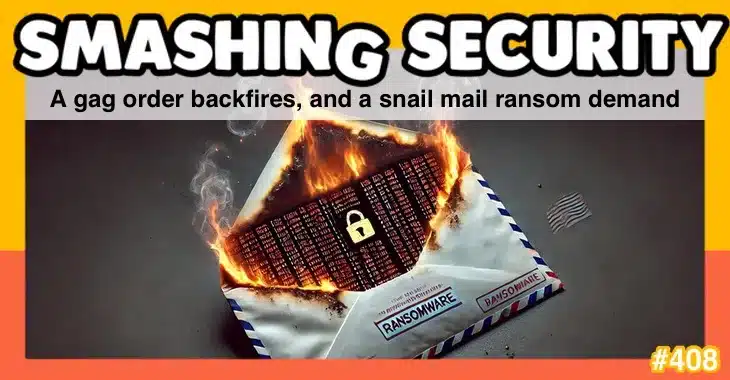
What happens when a healthcare giant’s legal threats ignite a Streisand Effect wildfire… while a ransomware gang appears to ditch the dark web for postage stamps?
Find out about this, and more, in the latest edition of the “Smashing Security” podcast by cybersecurity veterans Graham Cluley and Carole Theriault.
Warning: This podcast may contain nuts, adult themes, and rude language.
Show full transcript ▼
 This transcript was generated automatically, probably contains mistakes, and has not been manually verified.
Security Episode 408.
Are you cool with that?
Now, coming up on today's show, Graham, I'm going to be talking about the Cyber Streisand effect. And I have snail mail with a twist.
All this and much more coming up on this episode of Smashing Security.
I had a picture of her on my wall until my girlfriend told me to take it down.
To be honest, I should have kept the picture and got rid of the girlfriend. But anyway, I am a fan of Barbra, and I'm not the only one.
Some people can be a little bit obsessed with Barbra Streisand. I don't know if you're aware of that. She's a funny girl.
She— well, she has had quite an effect on people over the years.
I don't just mean people getting a little bit trembly of the knee at her in A Star Is Born or hearing her sing The Way We Were. I am talking about the Streisand Effect.
And I know many people listening to this will have heard about the Streisand Effect, but if you have not, let me quickly remind you what it is.
Back in 2003, Babs, understandably in my view, wasn't very keen on having her privacy invaded, and she was reported to have tried to suppress the publication of a photograph showing her clifftop mansion in Malibu.
It was actually a photographer working on a project measuring erosion along the Californian coast.
So they were taking lots and lots of photos of the cliff tops, which included her pad in Malibu.
And her lawyers attempted to sue the photographer because they wanted the photograph taken down. And the lawyers attempted to sue the photographer for $50 million.
Seems a little bit excessive to me.
And it was journalist Mike Masnick, who often writes for Tech Dirt. He ended up calling it the Streisand Effect.
He's the one who sort of adopted that, which has now become a huge thing on the internet. And the name stuck. Originally, he was writing for a website.
Are you familiar with urinal.net?
And he dubbed it the Streisand Effect because of what happened with Barbra Streisand.
And in her 2023 biography, by the way, which I do recommend, and I think Zoe Rose recommended as a pick of the week, back in the day.
Barbara explained that her issue was never actually with the photograph of her mansion. It was more about her name being attached to the photo.
She said, look, you can take a photo if you want, just don't tell people it's my place.
The point is that when lawyers kick up a stink and try to hide something, it can end up with many, many more people learning about it.
And this happens in the world of cybersecurity as well. There's been many examples.
A couple of years ago, a mobile app called Free Hour, an app which is used by students in Malta, it had a critical security flaw in it, which effectively made every user an admin.
And 4 university students discovered that the app's backend had been left in a sort of default insecure state, meaning that they, and indeed anyone else, could access other users' data, their email addresses, their locations, even meddle around with their calendars.
So you could put in calendar entries or remove them. You could see what people were up to. And this was a huge privacy flaw. And a risk for 40,000-odd users of the Free Hour app.
Now, they did the right thing. They disclosed the vulnerability responsibly to the CEO of the Free Hour app. And they urged a rapid fix.
And they said, look, we're giving you 90 days, and then we're going to go public with the details.
They just said, you know, is there any kind of bug bounty, you know, available? And what the app's CEO did, he didn't respond to them.
He called the police saying that they were being extorted. And next thing you knew, Maltese Cybercrime Police arrested 3 of the students in dawn raids.
They seized their computers and phones and even strip-searched. These students— Jeez! It seems a little over the top, doesn't it?
And later on, Free Hour's CEO, by his own admission, he said, look, I contacted the authorities for advice, he said.
I was told to treat the email as a potential threat due to the words payment and ultimatum, which was the 90-day deadline. And the students said, all we wanted to do was help.
I don't see there's a problem calling the cops and going, look, we're in this situation. What do you reckon?
What you'd like the authorities to do is go, why not comply and fix the flaw in your software?
And the company later acknowledged that the students had acted in good faith, but only after the story had gone public and there was lots of backlash.
And he said, look, I would be prepared to work with you in the future going forward. Well, that was a problem for a couple of years ago.
Dear, oh dear, it's happened all over again because there is a private healthcare giant here in the UK They're called HCRG. They're formerly known as Virgin Care.
And they have been threatening journalists who were reporting on the ransomware attack, which they suffered a couple of weeks ago by the Medusa ransomware gang.
They can just turn to their customers and go, oh, sorry, we goofed.
And they claim to have stolen over 50 terabytes, not megabytes, not gigabytes, not just bits, not just nibbles, no, 50 terabytes of data.
And the lawyers for HCRG have been unleashed.
They have been unleashed on a website called databreaches.net, which is a great resource run by a journalist who goes by the pseudonym of Dissent Doe.
So the law firm is claiming, and by the way, it went to an actual court, right? They went to the High Court.
They've got an injunction, which they've then told databreaches.net about.
Said, you know, these articles aren't removed within 24 hours, the entire website is going to be suspended.
But here's the thing: databreaches.net had not only not published any of the leaked data, but it is a US-based website run by someone with a US address, and a UK court injunction means diddly squat to him if he's not operating under UK or High Court jurisdiction.
Because if you go to HCRG's website, you will find no mention whatsoever of them having had a data breach.
So someone's got to tell the public that this has happened and that kind of information which has been breached.
So we've talked about organizations in the past taking action against innocent people, threatening them with legal action. It's obviously a very uncool thing.
I think particularly when it's a health sector firm, which has been security breached in this way.
And we've talked about this on the podcast in the past, back in episode 182, of Smashing Security, I tell the story of how a British cybersecurity firm called Keepnet Labs threatened me with legal action because I blogged about its security breach, which meant anyone could access lots of their customer data.
And Carole, I don't know if I can take you back in time, take you back 18 years to 2007, when we used to work together at a certain cybersecurity firm called Sophos.
And do the words EduGeek ring any bells to you?
And as the Register reported at the time, Sophos had a spot of bother with them because a user of EduGeek was, how can I put it politely?
He was rather disappointed with version 5 of Sophos's software. And he had a good old rant, including some fruity language on EduGeek's message boards.
And the next thing that EduGeek knew was they got a letter from Sophos's legal team threatening action and demanding that the guy's posts were pulled.
And you and I knew nothing about this because first we knew about it was when journalists began to ring us up asking why we were trying to silence our customers from describing their experiences with our software.
We ran up to the legal department.
It turned out a member of staff had seen the messages and taken it into his own hands to ask his buddy in the legal team to send a threatening letter.
I remember I had to give a quote saying, you know, we might have overreacted somewhat, and we were inappropriate with how we'd responded. So we had to publicly apologize.
I'm rather like Barbara, you know, I didn't know anything about it. I didn't know it was all going that far.
So if we go back 100 years, back in 1925, Victor Lustig posed as a French government official and convinced scrap metal dealers that the Eiffel Tower was slated for demolition.
I mean, he sold the rights to salvage the metal, collected substantial sums of money, and vanished. And apparently, he attempted this scam twice.
Bulgarian-born German entrepreneur who launched OneCoin in 2014.
Haven't you got other people who would advise you and double-check.
And these days, the most common variations involve scammers calling or texting or emailing their victims, posing as a trusted, I don't know, government agency or organization.
So the FBI, IRS, or the Postal Service, or big companies like Amazon or Netflix or wherever you put your money.
And the scammers then, under a wide variety of pretenses, demand payments, maybe by gift cards or crypto or credit card or wired funds.
So let's pivot to this article, which I've linked in the show notes, an article from Forbes talking about the FBI warning of a new scam claiming to be the work of Russian ransomware gang Bianlian.
Do you know Bianlian?
So, for instance, an updated security advisory from the US cybersecurity agency CISA explained how the infamous Bianlian had stopped deploying encryption services to their victims, instead choosing to exclusively exfiltrate the data or hoover it up.
Would it be weird for this group, Jian Yan, to do another weird U-turn in their ransomware strategy and start relying on snail mail as an infiltration method?
So I've put it there in the show notes so you can look through it and see what you find interesting.
Okay, so, and it says, "Dear blah, I regret to inform you we have gained access to your systems, and over the past several weeks have exported thousands of data files." Oh no, they've taken our ID.
Social security numbers, payroll, or sensitive HR documents. Okay.
This looks a regular ransom note, but this is one that's been sent through the post, and they're asking for bitcoin.
If you do not pay us on time, all the data in our possession will be leaked to the public to abuse." And then they give a Tor project link.
And they pointed out that communication of a ransom demand via the postal service is not something they had previously observed from any legitimate ransomware group.
Because it contains nearly perfect use of English and features longer, more complex sentence structures. I'm thinking, okay, they used AI, big whoop.
The letter does include links to sites on the dark web where the real Jian Yan has leaked data. But these links are kind of meaningless as the addresses are commonly known.
And there's nowhere for anyone to do that, which GuidePoint Security point out as an interesting thing to note.
So it's just a case of you can see past victims here, which presumably goes to the shall we call them the legitimate ransomware gang, but they just want you to drop a whole load of bitcoin into their wallet.
Even though they assess the letter as an attempt to scam organizations into paying a ransom, the letter contains a US-based return address of Bian Yan Group originating from Boston, Mass.
So they basically just say notify corporate executives and organizations of the scam for awareness, which is what I've just done.
If you've been in the cybersecurity industry for a while, chances are you've already heard of Fortra's Tripwire because they've been setting the standard for integrity monitoring tools for more than 25 years.
What you might not know is just how much of your environment Tripwire can monitor.
Tripwire Enterprise gives you context for suspicious changes across your servers, network devices, applications, databases, file systems, desktops, and more to give you the real-time awareness needed to stop breaches before damage is done.
It also automates compliance enforcement with the industry's largest policy library.
And thank you to Tripwire for sponsoring the show. We've got some eye-opening cybersecurity stats for you today.
Palo Alto Networks say that attacks are happening 250% faster, with 86% causing direct business disruptions.
And let's face it, we could all use a bit of future-proofing in our security strategies.
And thanks to Palo Alto Networks for supporting the show.
So my next question is, how do you keep your company's data safe when it's sitting on all those unmanaged apps and devices?
It ensures that every user credential is strong and protected, every device is known and healthy, and every app is visible.
Can you join us at our favorite part of the show? The part of the show that we like to call Pick of the Week.
Could be a funny story, a book that they've read, a TV show, a movie, a record, a podcast, a website, or an app. Whatever they wish.
It doesn't have to be security-related necessarily.
Now, in most parts of the world, a public school is exactly what it sounds like, a school funded by the public, for the public, which anyone can attend. Seems simple, doesn't it?
Very, very simple.
So it's both public and it's private at the same time.
It's calling a luxury yacht a public ferry, which anyone can ride on, as long as they bring along a great big pile of gold and have caviar on their toast.
So it's not really a public ferry, is it? Similarly, public school is not actually a public school. So I wondered why they called public schools when they're not public schools.
And it turns out the schools were open to the public as long as you were part of the elite public who could actually pay. So it's a bit a private members club.
You have to be a member of— oh, hang on though. A private members club has actually got the word private in its title, so that isn't a very good example.
So maybe you, Carole, can explain to me why public schools are called public schools.
But here in the UK, where public schools are private, private schools are also private. And then there's also this delightful term independent school.
So there's twists and bends and complete complexities because it shows if you don't know all those, you're not part of the elite crowd. So it's a way of keeping out the riffraff.
Anyway, there's also this delightful term independent school, which, as you've just pointed out, seems to be a fancy way of saying private school without the baggage of sounding exclusive.
So I think you're absolutely right. Just as with— there's Magdalen College, which is actually spelled Magdalen.
Let's start right here, only calling public schools public rather than private schools public. Thank you very much.
You know when you have to do something so boring and repetitive and you need to do it, let's say, every day and you just wish you could get someone else to do it for you so that you wouldn't have to go through the drudgery of it all.
So basically, the premise is that, you know, it balances the real and the surreal, and the show follows 4 employees who effectively sort numbers floating on their computer screens.
And they're in this huge room, and there's these 4 desks and these 4 people working. You have no idea what they're doing. It makes not much sense to you as a viewer.
And early in season 1, you learn that they all have chosen to have a chip put in their brains that cuts their memories in half. So they kind of divide it as innie and outie.
So the working part, the part working inside the office, is called the innie. And it has no knowledge of who they are beyond the walls of that company.
And the outer part, the outie, has no memory of the working day.
And what their innies are working on, on these numbers going in, seems to be very, very important to this big company, Lumon.
But no one really knows why or how or who's gonna benefit or what's going on. So problems ensue, of course.
The show's creator, Dan Erickson, was inspired by wishing that his tedious office temp job could zoom by so that he could get back to screenwriting.
Anyway, so Series 2 has just come out. Some series shake up things pretty radically between seasons. You know, you just have no reference point. But this is a seamless continuation.
So, we basically pick up 5 months after the cliffhanger event from Season 1. I'm not gonna give any highlights 'cause, Graham, you haven't watched Season 1 yet. But you will love it.
Acting is stellar. Characters become weird family members. And you don't really know who to root for. It's delicious. So my pick of the week is Severance Season 2.
Don't miss Season 1 though, and find it on Apple TV+.
And don't forget to ensure you never miss another episode. Follow Smashing Security in your favorite podcast app, such as Apple Podcasts, Spotify, and Pocket Casts.
It's their support that helps us give you this show for free.
For episode show notes, sponsorship info, guest lists, and the entire back catalog of more than 406 episodes, check out smashingsecurity.com.
Hosts:
Graham Cluley:
 @grahamcluley.com
 @
@
 / grahamcluley
Carole Theriault:

Episode links:
- ‘We wanted to help’: Students arrested after exposing FreeHour security flaw – Times of Malta.
- Medusa ransomware gang demands $2M from UK private health services provider – DataBreaches.net.
- Medusa Unveils Another 50TB of Stolen Data from HCRG Care Group, Giving Greater Insight Into the Scope of the Breach – DataBreaches.net.
- HCRG Care’s lawyers claimed an injunction issued in a “private” hearing required us to remove two posts. We didn’t comply – DataBreaches.net.
- Security firm leaves more than five billion records exposed on unsecured database – Graham Cluley.
- After threatening me with legal action, Keepnet Labs finally issues statement over data breach – Graham Cluley.
- Sophos apologises for going legal on school techies – The Register.
- Mail Scam Targeting Corporate Executives Claims Ties to Ransomware – IC3.
- One of the nastiest ransomware groups around may have a whole new way of doing things – TechRadar.
- Snail Mail Fail: Fake Ransom Note Campaign Preys on Fear – GuidePoint Security.
- Severance – Apple TV+.
- Smashing Security merchandise (t-shirts, mugs, stickers and stuff)
Sponsored by:
- 1Password Extended Access Management – Secure every sign-in for every app on every device.
- Palo Alto Networks – Get the 2025 Unit 42 Global Incident Response report to discover emerging threat trends, attacker tactics and expert recommendations to safeguard your business.
- Tripwire Enterprise – Set up a demo of Tripwire Enterprise to see how you can simultaneously harden your systems and automate compliance.
Support the show:
You can help the podcast by telling your friends and colleagues about “Smashing Security”, and leaving us a review on Apple Podcasts or Podchaser.
Become a Patreon supporter for ad-free episodes and our early-release feed!
Follow us:
Follow the show on Bluesky, or join us on the Smashing Security subreddit, or visit our website for more episodes.
Thanks:
Theme tune: “Vinyl Memories” by Mikael Manvelyan.
Assorted sound effects: AudioBlocks.