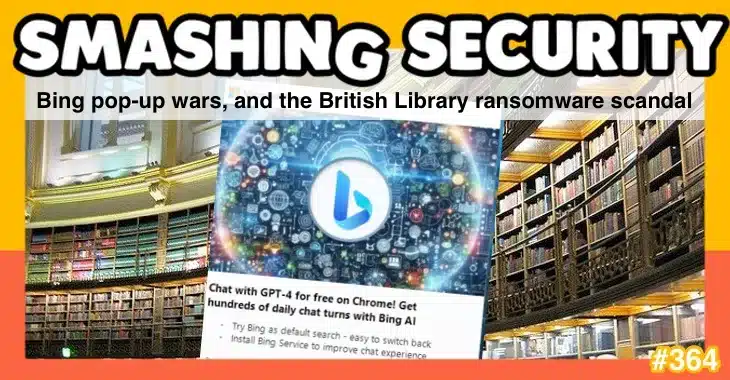
There’s a Bing ding dong, after Microsoft (over?) enthusiastically encourages Chrome users to stop using Google, and silence hits the British Library as it shares its story of a ransomware attack.
All this and more is discussed in the latest edition of the “Smashing Security” podcast by cybersecurity veterans Graham Cluley and Carole Theriault.
Plus: Don’t miss our featured interview with Kolide founder Jason Meller about his firm’s acquisition by 1Password.
Warning: This podcast may contain nuts, adult themes, and rude language.

Show full transcript ▼
 This transcript was generated automatically, probably contains mistakes, and has not been manually verified.
This must be something malicious going on. But it wasn't malware. It was just an intrusive, desperate ad. However, Microsoft don't it to be called an intrusive, desperate ad.
They describe it as an opportunity.
Hello, hello, and welcome to Smashing Security, Episode 364. My name's Graham Cluley.
It's their support that helps us give you this show for free. Now, coming up on today's show, Graham, what do you got?
Plus, we have an interview with Kolide's founder and CEO, Jason Meller, and he has some pretty exciting news to share.
All this and much more coming up on this episode of Smashing Security.
Did you ever see that movie, the John Cusack movie Say Anything, where he holds the boombox over his head?
The people who never give up, those people you think you've dumped and they turn up on your doorstep at 3 o'clock in the morning with a boombox saying, let's get back together.
The Mormons who ring your doorbell. They might find someone who's prepared to listen to them.
You know, if we didn't have persistence, that would never have happened. We'd still be up in the trees. Maybe we'd still be in the primordial swamp.
If one of us hadn't decided to crawl out and take the first brave gasp of air. So, you know, where would we be without them?
It's down to their bravery, their persistence, and where, oh where, would we be without Microsoft?
Let's be honest, the whole cybersecurity industry relies upon Microsoft, quite frankly, doesn't it?
So they've never faltered in their quest to help us see the light, because Microsoft believes that our lives would be immeasurably improved if only we were to switch to Bing.
Stop using Google as your search engine use Bing.
However, what's that I see on the horizon, galloping fast towards the front line? Oh, it's Bing, hot on the heels of Microsoft at a blistering 3.31% of the market share.
Are people not bothered to change? I don't know what it is. I mean, there are certainly safer, more privacy-conscious search engines out there, like DuckDuckGo.
DuckDuckGo has 0.53% of the market share.
Now, it probably wouldn't surprise you much to hear that this Google dominance of search engines, it rankles a little bit.
It's sort of, it's got a little bit of sand in the crevice of Microsoft. You know, it's upset those guys in Redmond. They don't like it.
They could try to be a bit more proactive in promoting Bing, and they've spent millions over the years.
I've been watching this morning some of the archive of past Bing search engine adverts, like TV adverts.
Well, I'll tell you what they could do.
As you've already alluded to, Carole, Microsoft does control what might be the world's largest number of advertising spaces because they own effectively the desktops of PCs running Windows, right?
Which is the dominant operating system.
It would be a bit like when Apple pushed out that U2 album to everyone's iPod.
So, some of our listeners may have seen this. It's been popping up saying, "Hey, chat with GPT-4 for free on Chrome. Get hundreds of daily chat turns with Bing AI.
Just try Bing as your default search. Easy to switch back. Install this service to improve the chat experience." So they are dangling a carrot.
However, clicking yes to change the search engine will also prompt Google Chrome to pop up its own warning message asking you to confirm.
Do you, did you really mean, hang on, did you really mean to change your search provider? Please, please stay with Google. Please stay with Google.
If you do, oh my God, you'll turn off Microsoft Bing search for Chrome and lose access to Bing AI with GPT-4 and DALL-E 3. And select keep it to stay with Microsoft Bing.
So they're jostling for control of your search engine.
A few years ago, they even forced people to switch to Edge when they rolled out a Windows update.
And earlier this year, Edge was caught automatically importing browsing data and tabs from Chrome without users' consent, which pissed off some people.
So some users thought Microsoft wouldn't be so tacky to use such a technique. Little did they know, and they assumed it was malware.
However, Microsoft don't like it to be called an intrusive, desperate ad. They describe it as an opportunity.
For those who choose to set Bing as their default search engine on Chrome, when signed in with their Microsoft account, they will also get more chat turns in Microsoft Copilot and chat history.
They saw something called the BingChatInstaller.exe, which apparently Microsoft started pushing out to people's Windows systems on March 13th.
This is all speculation that's going on as to what's happening out there. I don't have a computer which has done this that I can look at to see if this is happening.
I think I don't really like this. I think if Bing was really that good, people would just choose to use it, wouldn't they? If it was good enough, you don't think?
A number of articles on this very topic were published at the time, but just late last week, the British Library issued its very own cyber investigative report.
Which talks about the incident, the impact, the lessons learned. And it's a really interesting read, particularly for any CISO or infosecurity professional.
So link in the show notes. So how did it all go down? Well, it turns out the library was alerted that there was a problem by JISC. I don't know how you call it, J-I-S-C.
These are the folks that provide the library's internet access and monitor movement of data across their networks.
And they had identified that an unusually high volume of data traffic, so 440 gigs had left the library's estate at 1:30 AM on the 28th of October.
And this can be equated with the tranche of data illegally exfiltrated by the attackers later on.
Turned out to be an attack which was subsequently claimed by the Rhysida ransomware gang.
So these guys, Rhysida Group, these guys had exfiltrated data, encrypted or destroyed substantial portions of the server estate, and forcibly locked out all users from the network.
So based on the analysis from the British Library cybersecurity advisors, the belief is that the attackers used three methods of attack to identify and copy these documents.
So they first copied records belonging to finance, technology, and people teams on a wholesale basis. So this made up 60% of the content copied during the attack.
They think they also launched a keyword attack scanning the networks for any file or folder that used certain sensitive keywords in its naming convention, such as "passport" or "confidential." This is the other 40% of content snarfed during the attack.
And third, they hijacked native utilities.
So these are IT tools used to administer the network and use them to forcibly create backup copies of 22 of the databases, which were then subsequently exfiltrated from the network.
And they currently believe that several of these databases contain some contact details of external users and customers, but they can't be sure until the database's infrastructure capabilities are restored.
It all sounds very serious, but this is a library. I mean, what sensitive information they really going to have other than, oh, you know, you're a bit late returning your books.
I mean, you know, is it that big a deal if a library gets hit? I mean, obviously it's inconvenient.
So the data thieves demanded a payoff to keep the data private, and they wanted a payout of 20 bitcoins, which is about £600,000, for privileged access to all the personal information.
But the British Library refused to pay the ransom.
Okay, so the hackers then decided to publish close to 500,000 files of what they called exclusive, unique, and impressive stolen data onto the dark web for anyone to download.
But that's not all, Graham.
They explain that they have secure copies of all their digital collections, both born digital and digitised content, and they have the metadata that describes it, but they've been hampered by the lack of viable infrastructure on which to restore it because they had legacy systems.
And this is not just your typical library in your small town here. This has, what did we say, 200 million items?
And they can't because there is no — how would anyone be able to find anything that they were supposed to look at?
And there's some employees that have done absolutely nothing since the attack because the disruption has made their tasks impossible. They just can't do any of their job.
And get this, about 20,000 published authors who get 13p, right, each time their books are borrowed from libraries. This is a system managed by the British Library.
And they've had a lot of trouble getting their cheques.
They conclude this report with actions the British Library is planning to take in order to withstand any future attack.
I really wish all companies that face some horror show would be able to put out a report to the public to teach and give all the learnings. We would be much better off.
And I probably should. I think it would probably enhance my life considerably. But seriously, this report I heard was excellent and that they've done a sterling job.
And isn't it great that they haven't actually paid their attackers?
So I just think that's very interesting 'cause they didn't have that there and that's, I think that was one of the reasons why their attackers got through.
Eliminate legacy technology. Legacy systems are not just hard to maintain and secure, but they're extremely hard to restore, they say. Retain on-call external security expertise.
And that's an important one for me to share on the show because they want a specialist external security advisor on retainer to help them improve speed of response.
So, if any of you are looking for a job, you know, this would be the time to get in touch.
Companies that continue relying on outdated technology put their sensitive data at risk.
Well, this podcast is sponsored by KiteWorks, who enable organizations to effectively manage risk in every send, share, receive, and save of sensitive content.
To do that, they've created a platform that delivers content governance, compliance, and protection to customers tracking, controlling, and securing sensitive content as it moves within, into, and out of organizations, all while ensuring regulatory compliance on all sensitive content communications.
KiteWorks provides the industry's first private content network for protecting risky third-party communications with secure email, secure file sharing, secure mobile, secure web forms, managed file transfer, and governed SFTP servers.
Visit KiteWorks.com to get started today. That's KiteWorks.com, and thanks to them for supporting the show.
Vanta gives you one place to centralize and scale your security program. Quickly access risk, streamline security reviews, and automate compliance for ISO 27001, SOC 2, and more.
You can leverage Vanta's market-leading trust management platform to unify risk management and secure the trust of your customers.
Plus, use Vanta AI to save time when completing security questionnaires. Smashing Security listeners, you get 20% off Vanta.
All you lucky sausages have to do is visit vanta.com/smashing to claim your discount. That's V as in Victor, A-N-T-A.com/smashing. And thanks to Vanta for sponsoring the show.
Well, that's pretty big news since these two companies are leading the industry in creating security solutions that put users first.
For over a year, Kolide Device Trust has helped companies with Okta ensure that only known and secure devices can access their data, and that's what they're still doing but now as part of 1Password.
So if you've got Okta and you've been meaning to check out Kolide, now's a great time.
Kolide comes with a library of pre-built device posture checks, and you can write your own custom checks for just about anything you can think of.
Plus, you can use Kolide on devices without MDM, your Linux fleet, contractor devices, and every BYOD phone and laptop in your company.
Now that Kolide is part of 1Password, it's only going to get better. Check it out at kolide.com/smashing to learn more and watch the demo today. That's k-o-l-i-d-e.com/smashing.
And thanks to them for supporting the show. And welcome back, and you join us at our favorite part of the show, the part of the show that we to call Pick of the Week.
Could be a funny story, a book that they've read, a TV show, a movie, a record, a podcast, a website, or an app. Whatever they. It doesn't have to be security-related necessarily.
The thing I want to have a nitpick about this week I think is very, very simple. It's people. People specifically who use the word literally to emphasise something.
And one of them is, "To be honest," or "If I'm honest," "Basically." Oh, my son says "basically" all the time.
And I always say to him, "No, tell me the complicated version." "Basically, Dad, basically." "At the end of the day." You sound like such a dad as well.
Which way are you pointing now? There's been so much turning around. It's unnecessary.
So my head literally exploded apparently is fine.
Anyway, if you're the sort of person who says literally and you want to go into the British Library, I'd be on your guard because it's the sort of thing they may test you for as you enter through the doors.
And over the years, she's been sharing some of the, you know, foundational thoughts behind it and different therapies and all kinds of things that sit in this tiny little world.
And I was, this is kind of interesting. And so I go galloping through podcasts to see if I can find anything on the subject. And I land on this podcast called Good Morning Monster.
Now, do you remember the movie Mommie Dearest with Joan Collins? Did you ever see that?
And Good Morning, Monster is a scripted drama based on one of 5 stories in a book by the same name. And the mom in this story makes Mommy Dearest look like Mary Poppins.
So in the book that the podcast is based on, there's a therapist called Katherine Gildener, and she presents 5 of what she calls her most heroic and memorable patients.
And among them is the story featured in this podcast.
And it's basically about this glamorous workaholic who gets in touch with the therapist to deal with huge work anxieties that she has.
But it turns out that the mom might have played a much bigger and more horrible role in how our workaholic deals with the world.
So every morning, the mother would greet her daughter not with hi, or hello, beautiful, but good morning, monster. I hoovered up the 8-episode podcast.
I wanted more, went to the library app, borrowed the audiobook to listen to the 4 other stories.
One is of a successful first-generation Chinese immigrant musician who can't find love.
Another is about a Canadian native who was officially ripped away from his family at age 5 to be re-educated.
I mean, they make for harrowing reading, not for kids, and often heartbreaking. But the author has a light touch and doesn't hold back when she gets something wrong.
And there's humor in it. It's humble, it's moving, it's very human. And I the podcast, but I love the book. And I learned new terms in therapy so I can impress our friend, right?
So I got things, I'll be able to knock out words like transference and countertransference and ancestral trauma. And narcissism. You know, ever heard of that one, Graham?
The last one? Narcissism. Ever heard of that? Anyway, if this sounds like your thing, listeners, the name of the podcast and the book is Good Morning, Monster.
You find it at your library or at your local bookstore.
Listeners, today I am chatting about all things Kolide with the company's very own CEO and founder, Jason Meller. Welcome to Smashing Security, Jason.
This is something that I've been working on with them for a while.
Things have been going really well for Kolide since we launched our device trust offering last year, and we had started some talks the end of last year around working together in some form of partnership.
And when we actually sat down and conveyed our visions, they were so close that we were why are we going to just go our separate ways and try to tackle the same problem as separate entities.
Let's do this together.
And to me, as a CEO who's very mission-focused, my job and my mission has always been how can we get end users to be a major part of the security remediation story?
That's why I wrote Honest Security. That's why I built Kolide. I couldn't think of a better company to work with, and 1Password feels so similarly about end users.
And feels so similarly about honesty.
When we launched Honest Security, the manifesto I wrote, I know some of the 1Password founders, they actually had this chat internally why didn't we write this?
This sounds like it's coming from our voice. So we're just very in alignment from a cultural perspective.
And strategically, we just had a lot of things that we wanted to do that were similar. So it just made sense.
I have a very strong sense of right and wrong, and a lot of the things that I've done at Kolide were informed by experiences that I had when I was really young.
You know, the first of those being just the excitement I had for computers during the dawn of the digital age and the World Wide Web. These are incredible machines.
They allow us to extend the essence of ourselves far beyond what was ever possible. And they're incredible and everybody should feel good about using them.
And then that is diametrically opposed to other experiences I had when I was starting university and I was doing IT tech support for students and just see these students that were so sad or so upset because their machines were just loaded with malware.
Or I remember this one woman came in and she was crying because she thought this stalker put a Trojan horse on her computer and she thought that she was afraid of her computer because she thought it was being used against her own interests.
And it just really pissed me off because on one hand, these things are incredible and on the other hand, no one's able to use these devices with any real dignity.
And the direction that we're going as an industry, I just never sat well with me. It was always about, all right, we have to solve these problems as an organization.
We have to solve the malware problem. We have to solve the compliance problem. So what is the way that we're going to do that?
We're going to force the device to behave in a way that benefits the organization, but that wrenches control out of the hands of the end user who's supposed to be productive with it.
It just never sat right with me. And it took me many years at Kolide to figure out what the answer was. And we found it. It was device trust.
It's having a conversation with the user with some actual consequences if they don't listen to the security team's recommendation, but giving them the agency to sometimes break the rules and push back and to create a system in which that's possible.
That is so much in the spirit of, if you think about 1Password, right? 1Password's a company that had to solve a very human problem.
Passwords, they are not really a technology problem. They are a problem because human beings cannot remember long, complicated strings of text. We need to put them somewhere.
And if you think about the state of passwords 10, 15 years ago, we had all of these experts telling us, hey, you got to use a separate password for all your different services.
They need to be complicated. And they weren't providing any tools. So yeah, we heard everybody, but we didn't have the right capabilities to actually listen to the advice.
And then 1Password comes along and all that whole category was created and now they're ubiquitous and we now can listen to the expert's recommendation.
We can do it with ease because that's what the software does. And it makes us feel empowered, confident, and we can use our machines with dignity.
That's what I've always wanted to do on the device compliance side and protecting devices. And so to me, it's just perfect alignment.
And you guys have been providing stellar support for auth provider Okta.
Now, will you still be providing support for Kolide's device trust Okta integration now that you're a part of 1Password?
So we are in no way, it's not on the table for us to take what we've built and take it away from people who could have gotten it before.
And actually, on the other hand, we want to continue to increase that investment with Okta.
The way that I think about it is if you're looking to buy something like Kolide, you really are buying it because you want it to fit into an investment that you've already made.
Okta's a major investment for you. When you roll out Okta, it's a huge project. It's really hard to roll back. It becomes part of your company.
It's part of almost your authentication culture. So we want to make sure that we are being a good citizen within that ecosystem.
So if Okta comes out with a new whizbang way to do device assurance and stuff, we want to be in perfect alignment with that, and that's going to require continuous R&D as they evolve their offering.
So we want to be the best possible way to achieve this within Okta. So that's going to be on the table and it will always be on the table for as long as I'm here.
Now, this is maybe tricky with this announcement. Will you maybe be considering other auth providers in the near future to integrate with?
Yeah, the thing that we did when we launched Device Trust, we had to start with Okta because quite frankly, they were the only ones that really had the platform where we could build it to our vision.
We didn't have to make many compromises in how it worked, and we needed to do that because we wanted to vet out the idea to see if it really was going to work in practice.
And boy, did it ever. We understand what are the important pieces of it. And now we can hatch our plans to bring it to folks who have been just begging us. I don't have Okta.
I don't have any plans to get Okta. We're a smaller company. We don't even need a really formalized IDP or SSO solution yet.
I'm using Google Workspace or I'm using whatever Microsoft's calling it these days. I believe it's Microsoft Entra.
We just want to get that rocking and rolling and get Kolide on top of it. So yes, we are moving forward with those plans.
In fact, if you go to our website today and you try to sign up and you say that you don't have Okta, we'll actually kick you over to a form where we actually ask you some questions about what you are using.
And those are now driving conversations that I'm having with prospects and existing customers on how we can build the version of this that's going to be best suited if you have any other SSO provider, including Microsoft Entra and Google Workspace.
So if you are interested in being part of that beta, please reach out. This is something that we're going to be getting done in months, not quarters.
So we're really excited to talk to folks who are passionate about device trust. They want what Kolide is offering, but they don't have any plans to get Okta.
And we want to hear from them and understand what their needs are.
Just fill out the form and just say that you don't have Okta. So either way, we'll find you and we'll get you into the right bucket.
So you want to take the different parts of each product and you want to make sure that they can be what they're supposed to be.
You don't want to create these arbitrary, let's just smash everything together and put it under one giant menu bar item.
You want to have these things feel very separate and give customers options of buying them separately because we just have very different customers today, right?
Today, Kolide only is sellable to people who have Okta and 1Password is, you know, even their enterprise password manager is best suited for folks who are still in that part of their journey within their organization.
Or even they also have a consumer business, which is quite large.
So what we want to focus on is what value can we bring to folks who have already deployed 1Password's Enterprise Password Manager, what they call internally EPM.
So to me, my vision for this, and maybe I'm talking out of school a little bit, but here's sort of what I've started to work on. There's this thing in 1Password that I love.
It's called Watchtower. And what Watchtower is all about is giving end users alerts that help them understand what is the security of their password.
So for example, let's say you've created a password on a website and that website gets compromised and you've never changed your password.
Well, it will have an alert for you to look at and say, hey, you need to go back to this website, go reset your password, change it, because that password probably now is in somebody's hands.
So the challenge with this, and this is the same challenge we faced in the early days of Kolide, is you can tell users about these problems until the cows come home, and only some percentage of them is ever going to actually action them, which makes us sad.
These are real problems. Those attackers really do have your password.
Now, it may not be a really big deal because you hopefully are not reusing it anywhere, but maybe you are reusing it. So we want people to look at these things and fix them.
Well, that's Kolide's entire job. We know how to do that now.
So in my mind, if I'm a business owner, or I'm the IT owner, I can do something in Kolide say, hey, if this user is trying to sign into some of our sensitive apps and they have these intense alerts in Watchtower, let's have them just take a beat and go to 1Password and get some of those fixed.
Then let's let them through to our most sensitive apps. Let's get them on the bus of fixing really important problems that are putting both them and the company at risk.
That's what we've always been about, and that's a great way to get way more value out of Watchtower than it would have been previously possible.
Now here's a little bit of an inside scoop. We're going to be talking about a really grand vision about how we see the zero trust space.
So as you said earlier, Kolide has always been a big proponent of zero trust access in that model.
But I've always felt that the vision— that it's always felt a little bit more of a principle or even a little bit of zealotry rather than a real category.
So I'll tease this is that we have a really expansive vision on how to connect the dots between these unmanaged sort of shadow IT things and then getting those things managed and then putting device trust in front of them.
So I'll just kind of put that in there as a teaser.
We have a really strong vision here and you should come to RSA and learn more about it and we'll be talking about it a lot after May.
And don't forget to ensure you never miss another episode. Follow Smashing Security in your favorite podcast apps, such as Spotify, Pocket Casts, and Apple Podcasts.
For episode show notes, sponsorship info, guest list, and the entire back catalog of more than 363 episodes, check out smashingsecurity.com.
Hosts:
Graham Cluley:
 @grahamcluley.com
 @
@
 / grahamcluley
Carole Theriault:

Episode links:
- Search engine market share – Oberlo.
- A compilation of Bing ads – YouTube.
- With Edge, Microsoft’s forced Windows updates just sank to a new low – The Verge.
- Microsoft fixes Edge browser bug that was stealing Chrome tabs and data – The Verge.
- Is this Microsoft Bing Popup Malware? – Reddit.
- Microsoft confirms Bing pop-up ads in Chrome on Windows 11 & Windows 10 – Windows Latest.
- ‘A 22-carat disaster’: what next for British Library staff and users after data theft? – The Guardian.
- LEARNING LESSONS FROM THE CYBER-ATTACK British Library cyber incident review – British Library.
- The Disturbing Impact of the Cyberattack at the British Library – The New Yorker.
- Thanks to a shadowy hacker group, the British Library is still on its knees. Is there any way to stop them? – The Guardian.
- Have we literally broken the English language? – The Guardian.
- According to the dictionary, “literally” now also means “figuratively” – Salon.
- Good Morning, Monster: A Therapist Shares Five Heroic Stories of Emotional Recovery – Amazon.
- Good Morning, Monster – Apple Podcasts.
- Smashing Security merchandise (t-shirts, mugs, stickers and stuff)
Sponsored by:
- Kiteworks – Step into the future of secure managed file transfer with Kiteworks.
- Vanta – Expand the scope of your security program with market-leading compliance automation… while saving time and money. Smashing Security listeners get 10% off!
- Kolide – Kolide ensures that if your device isn’t secure it can’t access your cloud apps. It’s Device Trust for Okta. Watch the demo today!
Support the show:
You can help the podcast by telling your friends and colleagues about “Smashing Security”, and leaving us a review on Apple Podcasts or Podchaser.
Become a supporter via Patreon or Apple Podcasts for ad-free episodes and our early-release feed!
Follow us:
Follow the show on Bluesky at @smashingsecurity.com, or on Mastodon, on the Smashing Security subreddit, or visit our website for more episodes.
Thanks:
Theme tune: “Vinyl Memories” by Mikael Manvelyan.
Assorted sound effects: AudioBlocks.