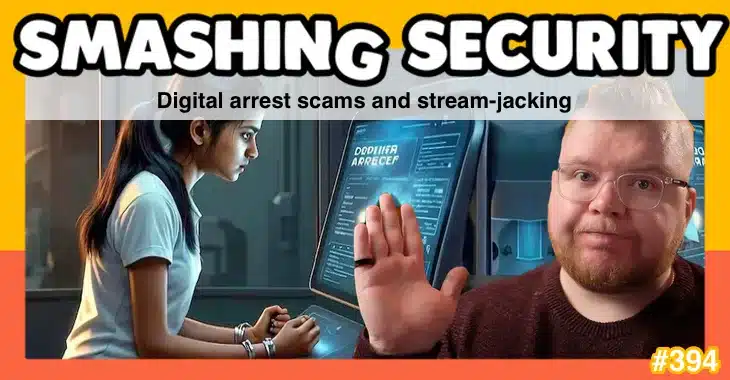
In our latest episode we discuss how a woman hid under the bed after scammers told her she was under “digital arrest”, how hackers are hijacking YouTube channels through malicious sponsorship deals, and how one phone company is turning the tables on fraudsters through deepfake AI.
All this and much more is discussed in the latest edition of the award-winning “Smashing Security” podcast by computer security veterans Graham Cluley and Carole Theriault, joined this week by special guest Maria Varmazis.
Warning: This podcast may contain nuts, adult themes, and rude language.
Show full transcript ▼
 This transcript was generated automatically, probably contains mistakes, and has not been manually verified.
When there was an American policeman in New Hampshire, Carole, while we were driving through it and he was telling you to stop and pull over, you weren't so bold then, were you?
No, you pulled over then, didn't you?
Hello, hello, and welcome to Smashing Security episode 394. My name's Graham Cluley.
You're at the top of your game. You are, aren't you? Life's going well. You recently came back from a conference in Goa.
And it's the telecoms regulator on the phone to you. They're saying, apparently your number has been used to send harassing messages.
That's more than we had about last week's episode, isn't it? That's a lot of complaints. Moments later, a senior policeman joins the call.
I don't know if he wrestles the phone off the telecoms operator. He accuses Dr.
Ruchika of using a joint bank account with her mother to launder money for the trafficking of women and children.
What's this about?" You hear this chorus of voices shouting in the background, "Arrest her! Arrest her! Arrest her! Arrest her!" "Nts, nts, nts." No?
She says, it can't be true. And he says, don't worry, don't worry, he says, because I am calling from India's federal detective agency, the CBI, the Central Bureau of Investigation.
And he says, this is a matter of national secrecy, he says.
And because of the high stakes involved, I will try and talk to my colleagues and I will persuade them not to put you in physical custody, says this policeman.
He says, instead, you're going to be put in digital custody. Have you heard of digital custody?
Rather than putting someone in a cell, they say, you're going to be watched on your phone 24 hours a day in your room.
So you have to set up your phone in a corner of the room, turn the camera on. We will watch you. We will question you via a Skype call as we investigate until we've cleared you.
You have to obey our rules.
While you're cooking, while you're sleeping, even when you go to the loo.
You are allowed to place it outside the loo, but only after you've shown them there's no other exit from the loo. So, they're tracking this woman's every move.
But if you're not a rule follower, this just falls apart.
But when there was an American policeman in New Hampshire, Carole, while we were driving through it and he was telling you to stop and pull over, you weren't so bold then, were you?
No, you pulled over then, didn't you?
So she's told by the policeman, "Right." He says, "What you're gonna do is you're gonna drive down to the store and buy a smartphone right now." And this respected neurologist does exactly that.
She goes down to the store, she buys herself a smartphone, and she begins obeying the rules. This new smartphone with its camera on is watching her every move.
She lies to her workplace. She says, I'm too ill to come into the hospital where I work. She told her relatives she was too sick to see them.
When her uncle popped round to her house, she hid under the bed. With her phone camera running all the time. So she wasn't answering the door.
She didn't want him to see her through the windows. Hid under the bed.
This goes on— with this long list of rules for 7 days.
They know she's been at this conference. They know stuff that they found on social media.
And the scammers— and yes, newsflash, and I know this will be a shock to you— they were scammers.
There was a fake court online where she was ordered to dress in white to show respect to the judge, because judges are real sticklers for dress codes.
It's only just for government verification. And, of course that's what she did. She transferred her savings into this account.
She went down to the police station, and again, she was unsure. Is this a real police station? Am I reporting to the genuine police? And she said to them, this is what's happened.
Have you heard of it? The policeman apparently laughed at her. Which isn't very sympathetic. And they said this is happening all the time.
So similar digital arrests have been taking place across the country. People have lost in total millions and millions.
So, the problem is so big, last month, Prime Minister Modi of India warned about it during his monthly radio address.
But the scammers behind this, they are believed to run call centres in Cambodia, Myanmar, Laos, and possibly the individuals who are working these call centres are actually working against their will.
We've talked before about these pig butchering scams and other scams.
And again, he was duped. And he says, "Well, they knew all about me. They found out information about me.
They appeared to be genuine police." Sometimes they actually have video calls with you, and they're dressed up as policemen, wearing their little uniforms.
So the Indian cops have arrested some people in connection with these digital arrest frauds, but it seems there's quite a lot of it going on, so I think they probably only grabbed some of the people.
The Indian Prime Minister, he's given some advice. 3 steps to digital security, he says. Stop, he says. Don't panic. Don't give away your personal information. Think, he says.
Does it really sound something a government agency would do? Would they threaten you on the phone?
'If it smells fishy, it probably is,' which is good advice, unless you have actually bought some fish. Is that what he said? I don't know if that's verbatim. I don't—
Inform your family all about this.' And maybe we've done our little bit, because we've got a lot of listeners in India.
Maybe we've done our bit to raise awareness of this as well, Hope.
But of course there's a billion things I would fall for.
Or a Z?
And he's one of those gaming YouTubers where he streams himself for hours as he plays video games. Which is a thing. Yeah.
I mean, it could happen. Maybe I'm doing—
And he's got a lot of followers. He's worked really hard over many, many years to build up his account. It is a career. People make money doing this somehow. His stream is very cozy.
He's sitting in his gamer chair. There's a lot of obligatory LED lights behind him making it look very much like a gaming cave, but then there's a fireplace in the background.
It's very cozy, like a gaming lodge.
So he uploaded this video very recently with the title simply, "My YouTube channel got deleted last night." Oh yeah, not his doing, not his doing. So Mr. Bits was — Sir Bits? Mr.
Bits was the victim of a thing that I'm just learning about called streamjacking. Which is a targeted attack that tends to go right after YouTubers with a large following.
Can you guess what the goal is of streamjacking? Steal followers?
But the thing that I found interesting about this — here's sort of the chronology of what happened to Mr. Bits.
He was casually browsing Twitter/X, whatever the hell we're calling it now, right? He got a security notice saying there was an attempted login on his account.
I'm guessing the geofencing or whatever was noticing somebody was trying to log into a session from a different location.
And then pretty much right after, he got logged out of his account, and anytime he tried to log back in, he couldn't. And at the same time, his TV logged out.
I'm guessing maybe that's the fireplace thing, there's a TV.
His Twitter had been hacked.
The channel's name, the banner up at the top of the channel, even the email address and his password all pretty much instantly changed and started live streaming crypto-related videos.
And you know, this, the scam calls to action saying, you know, go to this website to double your crypto wallet, that kind of thing. It's a crypto scam.
He was shitting bricks, as they say. Just absolutely just painful. Yeah, not really.
I will say that the happy ending to the story is it took only 12 hours for him to get through to YouTube support and recover his account.
And the reason I say it's happy is in many cases streamers who have been stream jacked as Mr. Bits did, they never get their accounts back.
They— many people have said their account just basically is nuked.
And these are people who get hundreds of thousands of subscribers and they can never get that back after years and years of work.
So it's just gone in an instant, which is so terrible. So 12-hour recovery is pretty great.
And yeah, he uploaded this video to let his followers know if you ended up clicking any of that stuff, you need to check out your stuff right away because you probably have malware.
So how did this all happen and how did this streamjacking occur? Because this is the thing that I also found super interesting.
He had received through his email an NDA through DocuSign for a sponsorship deal, and it all looks totally legit. It was a real legitimate DocuSign document.
The organization was all legit. It all passed the initial sniff test. However, it wasn't. He was misled by someone with bad intentions.
And signing that NDA caused him to download a malicious file to his machine that then essentially cloned his browser and its sessions.
That allowed the attacker to get access to all of his sessions across his browser, everything he was logged into. Because what he had noted on his—
So YouTube has its own email, Twitter has its own email, Twitch has its own email. So if one of those gets compromised, he doesn't lose the whole lot. So he thought okay, I'm good.
Yeah, so sort of able to replicate— as he was logged into all of those accounts, maybe they were able to replicate being logged into the accounts themselves.
So given all that, it's quite amazing that he was actually able to recover anything at all, because that, to me, that's just— the keys to the kingdom are gone.
But I guess he was able to outrun some of the attackers to change some of those passwords before they could get to it. But in any case, he was able to recover his account.
But yeah, this whole thing just revealed to me— I didn't know streamjacking was a thing. I had no idea. But yeah, in the end it was all crypto scam.
But my goodness, in the meantime, people who have large YouTube followings or followings on any social media, just beware of unexpected NDAs and deals coming into your inbox.
The fact that it even went around his two-factor authentication I suppose would give you a false sense of security, but if it hijacked your browser sessions, then yeah, that's wow.
And that's after subscribing to one of the services that's supposed to help filter them out. So I probably get even more than that. But, yeah.
So I'll sprinkle a few numbers so you can get an idea of how big of a thing it is. But in the US, Truecaller states Americans have received 2.9 billion calls every month.
That's their average, 2.9 billion. And more than a third of calls from non-contacts in the US are unwanted or spam calls, nuisance calls.
The FTC showed that consumers reported losing more than $10 billion to fraud in 2023, the highest ever recorded. And calls are a big part of that.
But another report said 70% of people who have faced this scam situation have never reported it.
So in short, scam calls are annoying. They waste time. They can dupe you into parting with your hard-earned cash. Banks don't like it. Telecom companies don't like it.
Nobody likes it except for the scammers that win. So what can you do? What can you do about all this?
Well, this year the UK seems to have made a concerted effort into educating the public about scams and how to avoid them.
Graham, you may have seen the national campaign, which is similar to the one that you mentioned earlier in India, Stop Think Fraud, which launched earlier this year.
You may have seen that around London or in buses, public transport, that sort of thing. And the Home Office is working with stakeholders across a variety of industries.
You've got banks like Barclays and telecom companies like BT and O2 and the Royal Mail and TikTok. So loads of people are involved in this.
And they even held their first fraud summit in London this year. And then there was the big arrest last August.
The National Crime Agency reported that they shut down the platform RussianComms, which was used by hundreds of criminals to defraud victims across the world through scam calls.
They estimate 170,000 people across the UK were believed to be victims.
Very similar to what you were saying earlier, Graham.
So yeah, that's a real nuisance, isn't it?
There's a lot of a smattering of work going on that I've certainly noticed when I'm out and about London.
But there's a new effort in the UK that is launched this week from telecoms company O2. Meet Daisy, the AI granny and head of O2's scammer relations.
So she's been designed to answer phones and keep the fraudsters on the line. The idea being to waste their time and keep them away from you.
Because if they're on the phone with them, they may not be on the phone with you.
So O2 tout that Daisy is so lifelike that she has successfully kept numerous fraudsters on calls for 40 minutes at a time. So that could be 3. Numerous, I don't know.
What is numerous? What's numerous?
Maria?
They have a great ad, which I'll put in the show notes if you want to see it in action.
And we all like seeing someone get wound up when they've been doing something shitty, like attempting to scam a granny.
So it could have been a real granny they were talking to rather than Daisy.
But maybe they didn't necessarily have the time to go do the scam baiting thing and didn't have the technical expertise.
So rather than trying to scam bait a scammer, which I do not recommend—leave that to the people that know what they're doing—what you can do is if you think you've got a scam, do report the scam.
So in the UK, you would do this to Action Fraud. The number is 7726. That's what you text. And I very much support this.
And O2 say, and I love this, they say by reporting dodgy calls and messages, telecoms companies are able to investigate and block the mobile numbers used by fraudsters.
And they can also use scam texts to help refine these blocking services to make it easier to identify and stop new trends faster in future.
They boast that they blocked 89 million texts last year alone, thanks in part to Action Fraud 7726 and people like us reporting it.
Imagine taking a proactive deny-by-default approach to cybersecurity, blocking every action, process, and user unless specifically authorized by your team.
ThreatLocker helps you do this and provides a full audit of every action for risk management and compliance.
Onboarding and operation is fully supported by their US-based support team.
Stop the exploitation of trusted applications within your organization to keep you running efficiently and securely.
Worldwide companies like JetBlue trust ThreatLocker to secure their data and keep their business operations flying high.
To learn more about how ThreatLocker can mitigate unknown threats and ensure compliance for your organization, visit smashingsecurity.com/threatlocker.
That's smashingsecurity.com/threatlocker. And thank you to ThreatLocker for sponsoring the show.
Vanta automates compliance for SOC 2, ISO 27001, and more, saving you time and money while helping you build customer trust.
Plus, you can streamline security reviews by automating questionnaires and demonstrating your security posture with a customer-facing trust center, all powered by Vanta AI.
Over 7,000 global companies like Atlassian, Flow Health, and Quora use Vanta to manage risk and security in real time. Get $1,000 off Vanta when you go to vanta.com/smashing.
That's vanta.com/smashing for $1,000 off. Quick question: do your end users always, and I mean always without exception, work on company-owned devices and IT-approved apps?
I wouldn't think so. So my next question is, how do you keep your company's data safe when it's sitting on all of those unmanaged apps and devices?
Well, 1Password has an answer to this question, and it's called Extended Access Management.
1Password Extended Access Management helps you secure every sign-in at every app on every device because it solves the problems traditional IAM and MDM can't touch.
Go and check it out for yourself at 1password.com/smashing. That's 1password.com/smashing. And thanks to the folks at 1Password for supporting the show.
And welcome back, and you join us at our favourite part of the show, the part of the show that we like to call Pick of the Week.
Could be a funny story, a book that they've read, a TV show, a movie, a record, a podcast, a website, or an app, whatever they like.
It doesn't have to be security related necessarily.
You can't stop yourself.
I've had an account on it for a while as well, but I haven't been very active on it until the last couple of weeks because I've decided to close my Twitter account. Huzzah!
It's someone said to me, is it the new version of Twitter? And I said to them, no, it's the old version of Twitter before Twitter became shitter when Elon Musk took over.
So it's Twitter 1.0, not Twitter 2.0. At the moment, it's lovely. There's no ads. The algorithm— well, you can define your own algorithm.
You can just have a chronological feed of everybody who you're following rather than Elon Musk popping up all the time being promoted even when you're not following him.
And it's utterly charming. There are easy ways to block people and it seems to be quite civilised.
So I'm really enjoying Blue Sky, and that's why I'm posting and mostly hanging out now. And I think it's great. I know there's been a lot of hype about it.
I saw today, day of recording, they've just passed 20 million users, which is extraordinary.
Carole, are you joining Blue Sky or you're not really into social media as much as maybe—
The two of you know, I'm pretty sure that I recently moved houses, so I haven't been able to get out in the world and do things.
My only entertainment has basically been just TV when, you know, I'm exhausted from a long day of unpacking or throwing boxes out, right? I'm gonna get my nerd on.
I'm gonna get my full total anime dork nerd on, and I'm gonna give you my recommendations. It's an anime on Netflix called DanDaDan, okay? And I'm absolutely obsessed with it.
Oh, I'll just read you the pitch.
In a bet to prove whether ghosts or aliens exist, two high schoolers face terrifying paranormal threats, gain superpowers, and maybe even fall in love.
Basically, there's a nerd who's really into UFOs, and then there's the weird outcast girl who's really into spiritual, paranormal aura stuff.
And they both think the other one is wrong. They're like, there's no way UFOs could exist, there's no way ghosts are real, and they both find out that the other one is right.
It's just super funny. I really have been enjoying the hell out of it, and it's on Netflix, so a lot of people can watch it.
Netflix, I think, gave this show a ton of money for their art direction, so it's unusually good for an anime. The opening theme song is insanely good.
So yes, it is an anime, so I know many people, that's just a non-starter. But if you are willing to watch an anime, this one's really, really fun and I greatly enjoy it. DanDaDan.
And it's a novel, it's a fiction book, and the central character is Manako, and she's this curvaceous femme fatale and foodie and lover of butter.
And she's in detention and awaiting trial for having killed 3 men.
But the problem is the foodie killer doesn't want to talk to the press until the journalist writes her with a request for a beef stew, right? So that's how it all kicks off.
And it's a thrilling search for what happens to actually these men, but also there's a lot about food. So if you like food and reading about food, this is a great fun book to read.
It touches upon Japanese society as well, and demanding beauty standards that Japanese women are expected to maintain, and fatphobia, and all kinds of things.
Plus, plus, Butter is based on a real-life case of the Konkatsu Killer, which was a con woman and talented home cook called Kijima, and she was convicted of poisoning 3 of her male lovers.
So Butter by Asako Suzuki, my pick of the week.
I'm sure lots of our listeners love to find out what you're up to and follow you online. What's the best way to do that?
Follow Smashing Security in your favorite podcast apps such as Apple Podcasts, Spotify, and Pocket Casts.
It's thanks to them all that this show is free.
For episode show notes, sponsorship info, guest lists, and the entire back catalog of more than 393 episodes, check out smashingsecurity.com.
Hosts:
Graham Cluley:
 @grahamcluley.com
 @
@
 / grahamcluley
Carole Theriault:

Guest:
Maria Varmazis:
Episode links:
- ‘You are under digital arrest’: Inside a scam looting millions from Indians – BBC News.
- Digital Arrest Scam: How You Can Stay Safe – YouTube.
- Tamil Nadu Professor Placed Under Digital Arrest, Duped of Rs 10 Lakh – YouTube.
- ‘Mann Ki Baat’ episode 115 – India Prime Minister Narendra Modi.
- “My YouTube Channel Got Deleted Last Night..” – Bitz on YouTube.
- NCA shuts down major fraud platform responsible for 1.8 million scam calls – National Crime Agency.
- O2 launches free anti-scam caller identification for millions of customers – O2.
- AI Scambaiters: O2 creates AI Granny to waste scammers’ time – YouTube.
- “StreamJacking” – Hijacking Hundreds of YouTube Channels Per Day Propagating Elon Musk Branded Crypto Giveaway Scams – Guardio.
- Graham Cluley on Bluesky.
- Maria Varmazis on Bluesky.
- Dan Da Dan – Netflix.
- Butter by Asako Yuzuki – Harper Collins.
- ‘Butter’ book review: Meditations on murders – The Guardian.
- Smashing Security merchandise (t-shirts, mugs, stickers and stuff)
Sponsored by:
- 1Password Extended Access Management – Secure every sign-in for every app on every device.
- Vanta – Expand the scope of your security program with market-leading compliance automation… while saving time and money. Smashing Security listeners get $1000 off!
- ThreatLocker – the Zero Trust endpoint protection platform that provides enterprise-level cybersecurity to organizations globally. Start your 30-day free trial today!
Support the show:
You can help the podcast by telling your friends and colleagues about “Smashing Security”, and leaving us a review on Apple Podcasts or Podchaser.
Become a Patreon supporter for ad-free episodes and our early-release feed!
Follow us:
Follow the show on Bluesky, or join us on the Smashing Security subreddit, or visit our website for more episodes.
Thanks:
Theme tune: “Vinyl Memories” by Mikael Manvelyan.
Assorted sound effects: AudioBlocks.