Strange goings-on on LinkedIn, Ukraine publishes a list of alleged Russian FSB agents, and police in Pittsburgh investigate an odd report of an active shooter.
All this and much more is discussed in the latest edition of the award-winning “Smashing Security” podcast by cybersecurity veterans Graham Cluley and Carole Theriault, joined this week by The Lazarus Heist’s Geoff White.
Show full transcript ▼
 This transcript was generated automatically, probably contains mistakes, and has not been manually verified.
Hello, hello, and welcome to Smashing Security episode 268. My name's Graham Cluley.
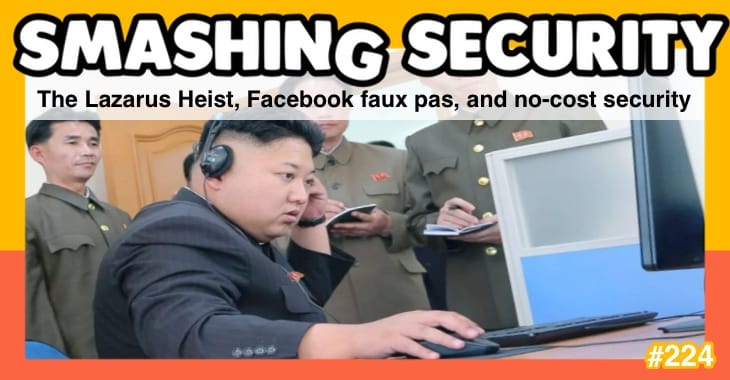
And it doesn't just go the podcast, it goes the whole hog and does loads of other stuff about North Korean cyberwar, North Korea's alleged computer hacking campaigns, full nine yards.
And there are just some bonkers stories, and it just gets more and more outlandish the more you cover it, that story.
Considering all the trouble that Sony Pictures got into after The Interview, that movie which sort of made fun of the North Korean leader, are you at all worried about publishing this book?
And yeah, the irony of reporting on a major media company that did something North Korea didn't like and then got hacked as a major media company reporting on something North Korea doesn't like.
The irony on both the BBC and Penguin, the publisher of the book, was not wasted. So we have made strenuous efforts. But look, you never say never.
I mean, nobody's 100% secure, are they? So all I can say is, so far we seem to be safe and we fully intend to keep ourselves that way.
Is that— no, we're not sure about that. So there was lots of discussions about what you can do to Kim Jong-un's face, basically.
It's sort of, you know, it's like Fast and Furious meets, well, meets Pyongyang. It's just weird.
So you have to really sort of balance your emotions on that.
Now, coming up on today's show, Graham, what do you got?
I didn't even accept LinkedIn requests from people who worked at the same company as me, or even in the same department.
I had a very simple rule, which was I'd only accept a LinkedIn connection if it was someone who I would feel comfortable coming round to my house and having dinner at my dinner table.
I'm going to pretend to be friends with people who I don't know. I'm going to accept LinkedIn requests from just about everyone. Not quite everybody, but pretty much.
I mean, obviously people who are sort of into blockchain and stuff that. I refuse their connections. But generally—
But sometimes people break etiquette. Sometimes people send me a LinkedIn connection, right? And that's fine. But then they try to talk to me.
And that's okay, I guess, if they want to say something nice about the podcast or book me to speak at an event.
But it's pretty tedious when they say, oh, maybe we could set up a call sometime to talk about your requirements as a company, or can I come and work for your company?
It's, I'm a one-person band.
I just think, oh, clearly you're using this for some ulterior purpose, whereas I definitely wasn't.
But some people don't do that, some people are more willing to connect, like Renée DeRista of Stanford University, for instance.
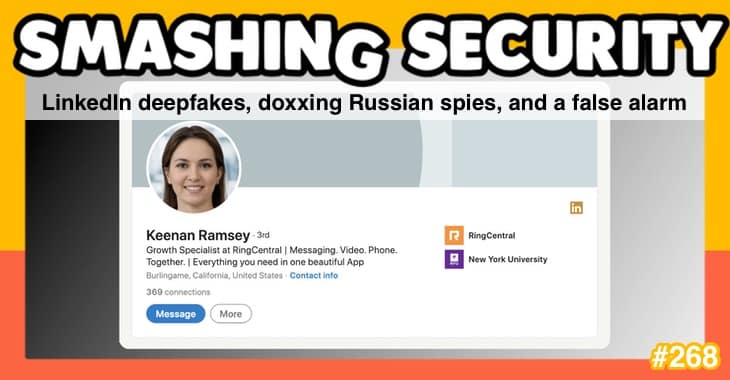
She received a LinkedIn message from a woman called Keenan Ramsey.
And after a bit of chitchat, she swiftly moved on to the sales pitch.
And she said, oh, quick question: have you ever considered or looked into a unified approach to message, video, and phone on any device anywhere?
And RingCentral, if you don't know, they're a business communication solution offering web meetings and video calls. It's a bit like Zoom, all that kind of jazz.
Prior to that, she was a marketing specialist at a firm called Language.io, and she's got a degree in business admin from New York University. She's got 300-odd connections.
It all kind of checks out.
So Renée DeRista, who received this message, she wondered, what's going on here, right? She was a bit suspicious about it.
She thought, is this an attempt to phish some sensitive information? Maybe there's going to be a click here to set up a meeting kind of link.
She thought that particularly when she received an identical LinkedIn message with the same emojis from someone else claiming to work at RingCentral.
Skills that mean she is one of the few people in the world who can spot the telltale signs of an AI-generated image. She's an expert in deepfake imagery.
So she looked at the profile picture that Keenan had used on her profile, and she thought this— she thought, hmm. She's only got one earring.
The eyes are bang right where you would expect them to be. Right in the crosshairs.
And some strands of Keenan's hair appeared to blur into this background. And so, it just got Renée's spider senses tingling. She knew something odd was going on.
She thought, this is weird, this is weird. So what she did was she contacted RingCentral. And she said, can I speak to Keenan Ramsey, please?
And RingCentral said, oh, we don't have any employee by that name.
Merantis, the company she worked for allegedly between Language.io and RingCentral, they said, they couldn't share any employee information without written authorization from the employee.
Now, I don't know how you get that written authorization when the person is a fake. You would think the company would say, oh no, we haven't had anyone called that here. But anyway.
Now, people lie on their CVs and LinkedIn profiles all of the time, right, Carole?
And the third contact she had, the email from a RingCentral employee, that referred to the email from the fake Keenan, that was a genuine worker at RingCentral.
So why are fake people being used by RingCentral to get people to make contact with them?
They found more than 1,000 accounts that appear to use AI-generated images, which is a breach of LinkedIn's rules.
And when they searched for evidence that those people actually existed on the internet, they found no evidence that they were real.
So normally, if you find someone on LinkedIn, you can find other evidence that they exist.
Yeah, maybe ugliness, or also that you wouldn't mind someone that approximates you, but it's not exactly you, just to obfuscate yourself from AI recognition software.
You're comfortable with your name, but not with your photograph? It's, like I said, it's against LinkedIn rules.
I mean, there have been studies done which said that people trust average kind of faces more. So if you are particularly odd—
But if you're sort of average, then it works.
You're fugly.' And at that point, any trust you've worked up is going to vanish pretty damn quickly.
They said, we're business development managers, we're sales development, we're demand generation. So it's all about getting leads.
And as a great report in NPR describes, the researchers, Renée and Josh, they discovered this whole undercover industry of firms that create fake LinkedIn profiles that then reach out to potential customers and set up meetings for in-house salespeople, for instance, at RingCentral.
They're like, oh, we don't know. They don't exist here. I don't understand.
So the companies which are interested in the sales lead, they sort of farm them out to service companies and third parties. They don't really care how they get the leads.
It's just like, if you can help us, that's great, and we'll turn a blind eye to what you're doing.
If you've got thousands of people on LinkedIn who are potential leads and you want to narrow those down to the sort of 500 hot leads, a company that says, look, we've got 500 people who said yes to a meeting, that's— they're the people you want to contact, not the thousands of people who would never respond.
It's a filtering exercise, isn't it? It's an AI filtering exercise.
They said, while this may have been an industry-accepted practice in the past— bullshit— going forward, we do not think this is an acceptable practice and is counter to our commitment to our customers.
NPR, they didn't give up in their investigation, and they contacted a whole load of companies who were offering this kind of service, and each one they contacted were kind of like, oh no, no, no, we don't do that anymore.
We used to do that. We used to do that with two-factor authentication, and they removed evidence of it from their website.
The RingCentral employee who contacted Renee he's very helpfully left the company and isn't returning any messages. So he's disappeared.
It's all a big nothing to see here, nothing to see here.
For its part, LinkedIn, they say in their latest transparency report that it's removed more than 15 million fake accounts, although most of those— that was in the period of 6 months during 2021.
Most of those happen at the time of registration rather than later once you're active. They're looking for suspiciousness there.
So it does appear there's a fair amount of that going on.
And what was interesting to me when I read this report, and it is worth reading and digging a little bit more into it, was that this is the use of deepfake AI imagery, not for disinformation and misinformation, but for something rather more mundane, just a way of generating leads.
And if, you know, it's fascinating that the technology is now being adopted by just about anybody 'cause it's so easy to create fake images of realistic looking people.
However, however, there is something absolutely stunning that's come out of the last couple of days, which I just think is really worth having a look at.
Because it sort of indicates where we are with the kind of cyber conflict.
Because I think a lot of people were assuming when there was another big war that cyber would be— there'd be a cyber war, we'll see all these cyber attacks and robotic tanks and all that kind of thing.
And we just haven't seen it, frankly, so far that we know of in Ukraine.
But anyway, look, so what's interesting about this is there's been a leak, a massive leak of information from the Ukrainian government.
This is the details of 625, I think it is, FSB agents, so Russian Secret Service agents. And they've published it on their website.
I'm looking at it right now, and it's just lists of people's names, dates of birth, passport numbers, addresses, mobile phone numbers. It is absolutely astonishing.
I mean, you'll remember there was an incident back in 2018 when a bunch of Russian agents turned up in The Hague and tried to hack into the OPCW, the Organisation for the Prevention of Chemical Weapons.
This was after the poisoning attack in the UK, and there was this idea that the Russians were going to OPCW to try and interfere with the investigation.
They got caught and left The Hague, but they couldn't arrest them because these guys were on diplomatic passports.
They said, "Look, these are the passports they were traveling on." So Bellingcat, the investigative website, went and found these passports on a Russian database.
And the passports were registered to a particular address. And there was a whole thing about people's cars being registered to this particular address.
And clearly, FSB agents were registering their cars to the FSB headquarters.
But that was a leak of information legitimately that was then turned by Bellingcat into a database, whereas this is just the Ukrainian government going, "Here you go." And what's remarkable, I mean, obviously I've been doing a bit of digging into this list, and I mean, for a start, some of these guys are on WhatsApp.
So I was going to send them an invite to FarmVille. I thought, you know, they're clearly under the cosh, these poor chaps. And, you know, maybe—
I mean, as we know from the sort of NSO Pegasus mobile phone malware story, targeting mobile numbers of foreign operatives is something that you can do if you've got the malware, so that's one option.
I haven't caught up on whether the whole SS7 mobile phone problems have been sorted, but there was a period of time where you could track people's mobile numbers and send them text messages via the SS7 system.
Again, you know, is that going to happen?
Also, if I'm a foreign government now and I'm thinking, right, I want to know if I've got any FSB agents in my country, I can take these mobile numbers, give them to the sort of tier 1 mobile phone provider like BT in the UK, for example, and say, 'Right, if these mobile numbers pop up on our network, could you please let us know because we've got Russian agents in the country?' All sorts of stuff you can do with this.
Oh, and the other thing that's crazy about this is there's little notes on some of these profiles as well. So there's one which is called— now, what's the name of it? Hang on. Dima.
I'm just going to refer to him as Dima because I don't want to name the guy just in case, get sued and everything.
But it says, "Dima, the terrible lieutenant," in inverted commas, and it's got his address here.
There's one that says, "FSB operative, late payments on loans." So clearly somebody, Gorbunov Maxim, is behind on his payments. Just astonishing detail in this leak.
Absolutely amazing.
And maybe were trailing and tracking some of these mobile phone numbers. And now, basically the balloon's gone up, hasn't it, to all those agents? Change your mobile phone numbers.
There's an investigation on BBC the other day, which BBC and again Bellingcat, this investigative journalist's investigative outfit, where what they've done is they got travel documents and they tracked the movements of Russian opposition activists.
And then they tracked who was on the same plane and the same train at the same time. And effectively worked out who was tracking these guys around the world.
And it's like, okay, here's an FSB agent who's basically on the same plane and same train as this opposition activist at exactly the same time. They're clearly being tailed.
And this is in advance of the poisoning of Alexei Navalny. But they got a lot of information.
Bellingcat says that some of the information came from Russian databases that are just being bought and sold and freely traded.
So it does seem like in Russia, if you've got deep pockets, you can get hold of information passport information, travel information, flight information that in the UK just would not be able to get hold of.
It's a leaky place, and I suspect people's willingness perhaps to make a cheap buck by leaking information is slightly higher in Russia than it is in a lot of other countries.
So, yeah. Interesting. Gosh.
I'll ask the question. Okay, so buckle in, because we're heading to Pittsburgh.
This is a new multi-million dollar redevelopment in the north side of downtown Pittsburgh, and it boasts restaurants and a fitness center and Pittsburgh's largest co-working space.
So you got people chilling, eating, meeting, sweating.
According to one worker at one of the restaurants at Nova Place, said, "We heard this emergency alarm go off and cops started telling people there was a 911 call saying there was an active shooter on the premises." Not good.
And I'm sure there was probably a Columbo-style detective there, Graham.
A guest at Nova Place, Ted Uminski, said, "Three cops, guns drawn, and they're like, 'Did you guys see anything?' And we said, 'No,' and they're like, 'Get out of here now.'" And so, you're eating at a restaurant, right?
Do you just get up and leave? Do you leave $20? Do you leave money or do you hide in the bathrooms?
Nearby elementary schools were also placed in lockdown. I mean, this is not what you hope for for a pleasant Friday lunchtime.
Everyone's on high alert, but they come up with nothing. And so, everyone's frustrated. I'm sure the stress was palpable.
But on this particular occasion, they can't find anybody.
Were development, and this is the call that made the cops hightail it over. But it turns out the caller was off-site, right? Right. So how did they get the information?
How far off-site are we talking?
I mean, you know, so what happened to them is that they received a text from one of their buds who was hanging out at Nova Place with the words firearm.
So the caller calls the sender, right, to go, "What the hell's going on?" But there's no answer. So just from the message "firearm"—
So I'm already sceptical as to why someone would just type firearm. That's very peculiar. Yeah, it's kind of an unusual word.
Sending a huge gaggle of cops with guns drawn, scaring the shit out of people having a nice Friday lunch.
Because when you had BlackBerrys and you had a full bloody keyboard— I love the BlackBerry.
And you'd always put a space after a full stop, and you'd use capital letters at the beginning of sentences.
I just think those were better times, and you wouldn't have had this kind of thing happen.
You can kind of count the buttons almost, you know, unconsciously. Like, "Oh, I'm at the E." You don't even have to look. You can just feel your way across.
It's just— I mean, I'm not exactly a spring chicken, but this is listening to my mom waxing lyrical about her flip phone that we've just had to replace.
"Well, it had buttons." "Yes, Mum. This doesn't have buttons." "No, Mum, it doesn't." When we had paper tape and 8-inch floppy disks.
"Sorry I was so rushed last night. Woo! Just discovered the word thingy that comes up. Tried taking a photo last night, but took a video instead.
Have you any idea how little tulips move? Please, no idea what is happening now. Kiss kiss."
I did some recon on other types of autocorrects that happen. So you have to guess what they tried to say. This is in text messages. So, between two lovers.
"My love is so strong, I wish I could buy you a casket if I could."
Your brother was adopted." And actually turned out to be accepted to Yale. And then the final one, "Do you think you can pickle that up?"
Flirt Divert was if somebody was chatting you up in a club, and you weren't interested, and they asked for your number, you could give them the number for— I think it's a radio show.
And so the text messages and calls would be received, and then sort of read out on air the next day.
Read out the text, said, "Please call me. I think you may have given me Arabs." Which—
Kolide is perfect for organizations that care deeply about compliance and security but don't want to get there by locking down devices to the point where they become unusable.
So instead of frustrating your employees, Kolide educates them about security and device management while directing them to fix important problems.
Sign up today by visiting smashingsecurity.com/kolide. That's smashingsecurity.com/kolide.
Enter your email when prompted, and you will receive a free Kolide goodie bag after your trial activates.
You can try Kolide with all of its features on an unlimited number of devices for free for 14 days, no credit card required. Try it out at smashingsecurity.com/kolide.
That's smashingsecurity.com/kolide. And thanks to Kolide for supporting the show.
So imagine this scenario: you're out of the office unexpectedly and a colleague pings you because they need access to some system you have credentials for.
Now, listeners would never send passwords over email or Slack, but what about your coworkers? How many organizations out there are sending logins back and forth in plain text?
Worse yet, how many just store all of their logins on a shared spreadsheet?
We all know that human errors are the biggest threat to your organization's security, but did you know that weak or stolen passwords account for over 80% of all data breaches?
There are tools out there that allow you to share credentials, set access permissions, and monitor the dark web for stolen logins.
Keeper Security's enterprise password management platform does just that.
Keeper locks down logins, payment cards, confidential documents, API keys, and database passwords in a patented zero-knowledge encrypted vault, and it takes less than an hour to deploy across your organization.
Sign up for a Keeper free trial for your organization today and get a free 3-year personal plan VPN. So get started by visiting smashingsecurity.com/keepersecurity.
That's smashingsecurity.com/keepersecurity. And welcome back. And you join us for our favorite part of the show, the part of the show that we like to call Pick of the Week.
Could be a funny story, a book that they've read, a TV show, a movie, a record, a podcast, a website, or whatever they wish. Doesn't have to be security-related necessarily.
Better not be. Well, my pick of the week this week is not security-related. Good. As you know, I like to keep my finger on the pulse.
I like to keep up to date with the latest culture, the latest shows that are coming out.
Obviously, I've pre-ordered a copy of The Lazarus Heist, so I'm all ready for that as soon as it comes out. Pre-ordered. Thank you very much.
But I wasn't quite so quick when it came to watching the Netflix show with Ricky Gervais, After Life. Yeah, no, I haven't watched the whole thing.
I don't know." The premise is, it's all about Ricky Gervais's character dealing with life after his wife dies of cancer.
And I thought, "It's going to be cloying, a bit mawkish maybe." And I thought, oh, is it just going to be a bit too on the nose? I don't know. But actually, it's rather lovely.
So I've just finished watching the first series, and apparently there are 3 series. But I feel I've seen enough, probably.
I feel— and I find this with a lot of TV shows, is that I like to watch the first series, Killing Eve, for instance. And I think, okay, that was great. I don't want to ruin it now.
I feel you've told the story. You've wrapped it up with a little bow. I've seen enough. I don't need to see more of the same.
So I'm very gingerly going to start the second series, but I wouldn't be surprised if I stop. But I don't think that should stop other people from checking out Afterlife because—
So we watched Fargo, we watched the TV series Fargo, which is astonishing because every one of those series is completely different to the one that went before, era-wise, directorially, and stuff.
So that was quite— but the one with that was there was a jolt when we watched each new series, and we went, "Oh, this is different to what we had before," but we ended up really enjoying it.
But at least you've demarcated the difference and where it's going to move next. And it's not just going to be the first series again. It's going to be something else again.
And I thought it was still great to watch. But anyway, Afterlife is my pick of the week.
And the book is about her time as a rock climber and how it goes.
And it's quite interesting because it sort of starts at the beginning when, like most climbers— I'm a climber myself— and you start off terrified and sweaty and you get to the top just panting and gratefully you're still alive.
And then gradually you kind of get into it and you work out what you're doing.
And it's just a wonderful book where at the end she ends up in a position because a lot of the rock climbing terminology is like, fight it and smash it and grip it, and you're conquering— you conquering the rock, you know, like a big prehistoric man.
And she sort of— it's interesting because she in the end stops fighting the rock.
She's like, no, don't fight against it, you know, that's not the way you're gonna— and I found that really interesting.
And suddenly her climbing improves and her sort of enjoyment of the thing improves. I thought, yeah, that's actually really interesting, you know.
There's a great quote, which is that the best climber in the world is the one that's having the most fun. Yeah, that's so true.
So often we're trying to— not just in climbing, in lots of things— that I must, can't go and smash it. It's like, yeah, but are you really enjoying it?
And actually learning to not fight and learning to love it. Yeah, Graham. Remembering when you loved it is worth doing. So that's Time on Rock by Hannah Fleming. I highly recommend it.
It's a good little book.
But I do find climbing quite fascinating. And I mean, I haven't read books about it, but I've seen some amazing documentaries about climbing.
And years ago, I went to see a talk by Joe Simpson, of course, who was the Touching the Void chap. Which was quite an experience too.
I just want to point out as what I also love about Time on the Rock is Touching the Void, the film you talked about, and the one Free Solo, the Alex Honnold film, which a lot of people have seen.
Most of these films about climbing being terrifying and death-defying. That's not why we climb. And if you read Anna Fleming's book Time on the Rock, it's the same thing.
You know, it's not all about Sylvester Stallone clinging on with one hand or you die. That's not why we do it.
So this is on Apple TV, and it's a show called Severance. And it's basically a high-concept show that takes the whole concept of work-life balance and puts it to the extreme.
So, you're in this office-type building, and you don't really know what you're doing. You're working, though. And that's how the series starts.
And it turns out that our workers in this nondescript department are innies.
And they're called innies because they've somehow been chemically severed from their outies, themselves, but on the outside of work hours.
So yeah, so you go to work, you go through the elevator, and you completely forget about your life outside, and you totally focus on your crazy job that you have no idea what it is.
And then you go home at night and the person outside has no idea who your work person is. The whole idea is that they can't communicate at all or know anything about each other.
But of course, a few glitches happen in the story that causes cracks to appear, and it all goes a bit nuts. Pretty great cast.
You've got Adam Scott, Patricia Arquette, John Turturro. And obviously, the famous Christopher Walken's in it as well.
Currently, at time of recording, we're on episode 7 on Apple TV. So if you want to be in the know when stuff is hot, this is a time for a little binge session.
It's kind of interesting on how it's the opposite of what we've done to ourselves now, where we're carrying our work phones all the time with ourselves and our laptops and bringing our work everywhere, and we've totally meshed in.
And I think they've just turned that on its head, to say what would be the opposite way. And turns out not great. So if you want to check it out, it's called Severance.
It's from Apple TV, and it is my pick of the week.
What's the best way for folks to do that and find out more about your upcoming—
And don't forget to ensure you never miss another episode, follow Smashing Security in your favorite podcast app, such as Overcast, Apple Podcasts, and Spotify.
For episode show notes, sponsorship info, guest lists, and the entire back catalog of more than 267 episodes, check out smashingsecurity.com.
So yeah, interesting.
Carole, what have you got for us this week?
Hosts:
Graham Cluley:
 @grahamcluley.com
 @
@
 / grahamcluley
Carole Theriault:

Guest:
Geoff White – @geoffwhite247
Show notes:
- North Korea tests its ‘largest intercontinental ballistic missile’ — YouTube.
- LinkedIn Professional Community Policies — LinkedIn.
- Community Report — LinkedIn.
- The latest marketing tactic on LinkedIn: AI-generated faces — NPR.
- List of FSB agents — Ukraine Ministry of Defence.
- How the Dutch foiled Russian 'cyber-attack' on OPCW — BBC News.
- Boris Nemtsov: Murdered Putin rival 'tailed' by agent linked to FSB hit squad — BBC News.
- Police: Autocorrected text triggered large police presence on Pittsburgh’s North Side — WPXI.
- Pickle me up: Hilarious autocorrect fails, from Krispy Koreans to wet, sloppy kids — Daily Mail.
- After Life — Netflix.
- After Life trailer — YouTube.
- "Time on Rock – A Climber's Route into the Mountains" by Anna Fleming — Canongate Books.
- Severance — Apple TV.
- Severance trailer — YouTube.
- Smashing Security merchandise (t-shirts, mugs, stickers and stuff)
- Support us on Patreon!
Keeper Security’s enterprise password management platform locks down logins, payment cards, confidential documents, API keys, and database passwords in a patented Zero-Knowledge encrypted vault. And, it takes less than an hour to deploy across your organization.
Sign up for a Keeper free trial for your organization today, and get a free 3-year personal plan, at keepersecurity.com/smashing
At Kolide, we believe the supposedly Average Person is the key to unlocking a new class of security detection, compliance, and threat remediation. So do the hundreds of organizations that send important security notifications to employees from Kolide’s Slack app.
Collectively, we know that organizations can dramatically lower the actual risks they will likely face with a structured, message-based approach. More importantly, they’ll be able to engage end-users to fix nuanced problems that can’t be automated.
Try Kolide Free for 14 Days; no credit card required.
Follow the show:
Follow the show on Bluesky at @smashingsecurity.com, on the Smashing Security subreddit, or visit our website for more episodes.
Remember: Subscribe on Apple Podcasts, or your favourite podcast app, to catch all of the episodes as they go live. Thanks for listening!
Warning: This podcast may contain nuts, adult themes, and rude language.