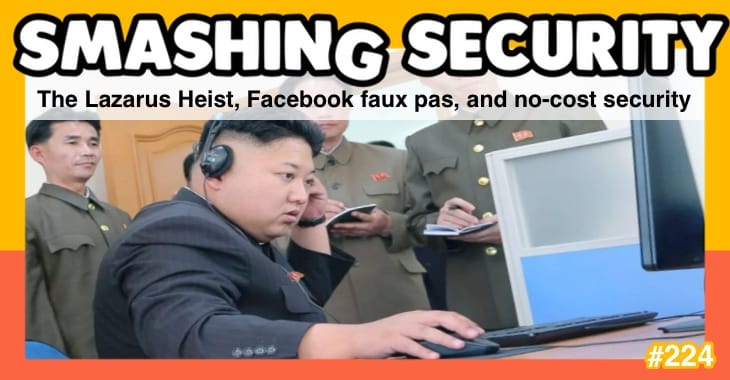
Facebook has managed to do the seemingly impossible – and had a data breach about its handling of a data breach. Meanwhile, we chat to the host of the brand new podcast about North Korea’s hackers targeting the rest of the world, and discuss if an intern can be trusted to monitor your security.
All this and much more is discussed in the latest edition of the award-winning “Smashing Security” podcast by cybersecurity veterans Graham Cluley and Carole Theriault, joined this week by Geoff White and featuring an interview with Duo’s Helen Patton.
Show full transcript ▼
 This transcript was generated automatically, probably contains mistakes, and has not been manually verified.
The one that's killed is a sort of hybrid version of Saddam Hussein mixed with his own dog. So we had this conversation about, well, does that count?
Because actually he's a sort of chimera. And it's like, I'm now corresponding with Seth Rogen on Twitter about whether Saddam Hussein was a real character in Hot Shots.
Hello, hello, and welcome to Smashing Security, Episode 224. My name's Graham Cluley.
You would not believe how long it took us to settle on a title. It was something like 6 weeks. And from the beginning, I was like, "The Lazarus Heist," that's a good title.
And they said, "What about this or this?" "The Lazarus Heist," that's a good title.
And so we came up with all these other names. We came up with what we thought was a good name, but then somebody had already written a book with that name. And it just—
No, we were trying to— Yeah, then there was this whole thing of, "Well, you know, will people be able to spell the word Lazarus?" And, "Should we get North Korea in the title?" I don't know.
We went through all sorts of hoops. But the reason I liked Lazarus Heist was, if it's on the cover of a book or something, it sounds like a Frederick Forsyth book.
That's why I liked it. I thought that just sounds sexy. And so, I'm glad they went with it in the end.
Now, coming up on today's show, Graham, what do you got?
And we have a great interview with Helen Patton of Duo Security. She's worked everywhere and just recently joined Duo Security, which is now part of Cisco.
She is wise people, so put up with us wibbling about until we get to her. All this and much more coming up on this episode of Smashing Security.
Now, you might remember a few weeks ago, we talked about it in episode 222 with Nina Schick, that Facebook had the rather embarrassing situation of finding out that a mere half a billion Facebook users had had their personal data leaked online, their phone numbers and other information as well.
And then we'll get on to what's now happened in terms of a breach.
So, the details of 533 million users from 106 countries were scooped up via a vulnerability in a Facebook feature called Connect with Friends.
All the time Facebook is bugging you saying, wouldn't you like to know who your Facebook friends are?
So what they do is, once they've got access to your address book, they compare the phone numbers, the ones which they already have from other Facebook users, to ones you've stored on your smartphone.
Okay. And that's a bit of a problem, isn't it?
Because it means that even if you've never chosen to be a member of Facebook because it's a steaming crock of shit, you may have had your details uploaded to Facebook by one of your acquaintances.
Someone who happens to have your phone number and details in their address book.
It's just pressing a button and off it goes.
You warrant that you have asked everybody in your address book that it's okay to share their info. I think that's in the terms and conditions.
But the other problem is this: Facebook had very few safeguards in place to protect this particular feature from being abused, which meant that someone was able to basically exploit Facebook's connection feature, their connect with friends feature, by pretending to have in their address book every single phone number on planet Earth.
And that way you would be able to determine that person X was the owner of phone number Z. Do you see what I mean?
And the irony here is every single phone number or combination of numbers that was uploaded as a phone contact that Facebook didn't recognize, it probably went, ooh, a brand new contact we can go after.
We haven't found him before." But this, I mean, you know, that is— I think I'm right in saying quite a lot, which is obviously a mathematical term.
That's like 10 to the power, you know, isn't that 10 to the power 12 or something? That's insane numbers. But yeah, I guess they're not writing them all down by hand, I suppose.
And the thing is that if you do this, you get information which is not publicly viewable on users' profiles, right?
So your phone number does not have to be publicly viewable on your profile, but this will have revealed your phone number to somebody.
Because somebody gave me his phone number, his Indian mobile number, and I entered it into Facebook.
And at that stage, you could enter a number into Facebook, and even if the number wasn't public on the person's profile, their profile would come up. Oh my God.
So he is one of many people who had this experience, which meant now people in the public debate.
Unless you'd changed your phone number.
Well, that got them a bit of criticism. Then they said, well, it isn't really a breach, they said, because the data has been scraped from our site.
They said it's not as though we got hacked, they said.
Because I said at the beginning, Facebook has been breached once more, and I'm getting the popcorn.
Detailing their strategy for handling questions about the breach.
They accidentally forwarded him an internal email which meant to only have been seen by Facebook's European comms team.
And in it they are, well, first of all they're doing a bit of a post-mortem as to how well they've managed to dampen the news.
And they're saying, although the media have been very critical of our response, some have called us evasive, some are noting that we haven't apologised, because Facebook still hasn't apologised or said sorry or anything for this.
So Facebook's been saying this information was already out there. How can this be a breach? But the media weren't buying it.
But the whole point of this exploitation was you were able to get information which you would not normally be able to get. And they should have had measures in place.
So Facebook's comms team, they say in this email they forwarded to the journalist—
So people got all hot and antsy about it, but it seems to be calming down, they're saying.
And they say, well, we're going to share now our strategy of what we're going to do going forward.
They say, what's necessary is we need to start framing this data scraping, as they call it, in order to deflect future criticism, we need to frame this as a broad industry issue and normalize the fact that this keeps on happening regularly.
It's like, no, no, no, no, no, don't, you know, don't try and pull that one. Ah, cynical.
And they admit in the email, they say, look, when we do this, there is going to be a revelation about a significant volume of other scraping activity.
So in short, this is where we're at. If we outside of Facebook stop talking about this issue, Facebook isn't going to provide any more information, right?
They're hoping the problem goes away.
They also want to frame this and normalize it as an ongoing industry problem, and they want to avoid any criticism that they haven't been transparent. Which they haven't been.
Maybe I've got the committee wrong, but anyway.
All kinds of sites are probably scooping that up in some fashion. But here they got information which was not publicly viewable as well.
But even if there wasn't that issue, surely Facebook has the wits about it to spot 'Oh, hang on, someone is trying to connect with 100,000 or 1 million or half a billion people.
That's a bit suspicious.
Oh my God.' Yeah, exactly.
And when I realized that, I thought, I know what I'm going to talk about on the podcast this week.
I think we should, we should return to this because we've all had that situation of forwarding an email. Or actually what happens is sometimes your email autocompletes, doesn't it?
So someone in Facebook's PR team probably were trying to forward it to another Peter or something, and they accidentally typed Pieter van whatever his name was, and it went to him instead.
We've all had that happen, and it can be disastrous. But in this particular case, it's just compounded already a PR nightmare for Facebook.
And until people get off it and they lose advertisers, they're not going to stop.
And WhatsApp was a brilliantly engineered takeover because it opened up a whole new— people who weren't on Facebook, who wouldn't have got Facebook on their phone, suddenly they've installed WhatsApp and that's opened up a whole new trove of information for Facebook to look at.
This is something I've been working on for about 9 months, but the interesting thing is, obviously, it's about North Korean government hackers and their alleged activity.
We've had to be very, very careful, so we couldn't really tell anybody about what we were working on and what we were doing, which is incredibly frustrating because you get these great things, you're "Oh my God, it's great," and you want to go to Twitter, but you have to stop yourself.
But we can now go public about it.
Basically, off the book I published last year, Crime.com, one of the chapters got picked up, and it's the chapter about really, it's about the Bangladesh Bank job.
So North Korean hackers allegedly broke into Bangladesh Bank, tried to steal $1 billion.
Through a series of mishaps, which I hadn't even fully comprehended how completely coincidental the mishaps were, they managed not to get $1 billion, but they did get $81 million.
And then they laundered it through a bunch of casinos in the Philippines. And I suspect a lot of your listeners will have come across this story. I'd be surprised if they haven't.
Honestly, the people we found and the stories they tell, it's just absolutely astonishing. The guy who was working in the casino when they turned up with the money.
And he was "Yeah, these guys turned up I'd never seen before, and they had so much money we had to open up a whole new room for them 'cause there was too much money.
We had trouble counting it, there was that much money. And then when they gambled, they just didn't care if they won or lost." Who does? He was completely nonplussed by this group.
And then of course, later it turns out this was part of the money laundering effort. It's just incredible. Amazing tales, amazing people we've got hold of.
And so we start off with the Sony hack. And again, Sony hack's really interesting because you think you know it, but then you actually hear from people who were in Sony at the time.
It's "God, that was an annihilation of the company." The cynicism with which that unfolded, that attack, was amazing.
And it was so interesting with your co-host, right? Because actually, tell us about her.
Let's have a, allegedly, let's have a look at North Korea and how that country works. So we've got a woman called Ji Lee who ran the Associated Press Bureau, the AP Bureau.
She opened the first foreign news bureau in Pyongyang in the capital of North Korea. She lived there for 8 years. The stories she's got about the place and the way it works.
It's just absolutely astonishing. I didn't realise this, but the image is sacred. The image of Kim Jong Un and the other leaders is sacred.
So if you have a newspaper in North Korea, you can't throw it in the bin or crumple it up, because it's got his picture on it. I love that.
And there was this story of a group of tourists going to Pyongyang, and one of them was trying to take a funky angled picture of the statues.
And this guy, this soldier, literally an armed soldier, came over and said, "No, you have to take a picture normally, because we don't want any funky angles." Because that's not allowed.
It's just— it's a different world. It's a totally different world. And she knows it back to front. It's just incredible. Amazing.
So, she knows all about North Korea, but not cyber.
What I really enjoyed about it was that you were speaking to actual employees who worked inside Sony Pictures and also people who worked on the contentious comedy movie The Interview, which was— so you were speaking, for instance, to the screenwriter who at one point was considering whether he needed personal security because it sounded like the threats were going to get more physical.
So basically, a lot of the people around the interview, the bigger stars, got security bodyguards.
And the screenwriter was like, "Oh, maybe I need a bodyguard." So he hired this Israeli security expert to talk to him.
You are under no danger at all." But I was trying to get, obviously, Seth Rogen to do an interview for us. And Seth, if you're listening, my door's still open, man.
I'm still here for you.
And then we had this bizarre exchange where— because obviously the plot of the interview is a bunch of journalists go to North Korea for an interview with Kim Jong-un, and the CIA try and get them to assassinate him.
That's the plot. So I was saying, "Well, are there any other films, fictional films, where a real world leader actually gets killed as part of the film?"
The Charlie Sheen comedy?
Saddam Hussein gets killed in both films, but in the second film, for reasons too complicated to explain in this podcast, or indeed in life generally, the one that's killed is a sort of hybrid version of Saddam Hussein mixed with his own dog.
So we had this conversation about, "Well, does that count?
Because actually he's a sort of chimera." And it's like, I'm now corresponding with Seth Rogen on Twitter about whether Saddam Hussein was a real character in Hot Shots.
When you're speaking with him and kind of goes, "Yeah, that's when we decided to actually make it Kim Jong-un rather than a fictitious guy."
And it's that level of— that it is quasi-religious. You couldn't quite describe it as religious, but it's very close to religion.
And there's arguments about whether you should and shouldn't, but you've got to realize that's the level of offense you're causing.
I don't think anyone thought what would happen to Snowden would happen. I mean, it was astonishing, the annihilation that they reached.
But the counterargument was, well, if you backtrack and soft-pedal, you're kowtowing to censorship, effectively self-censoring.
And a film like this is a sort of exercise in soft power.
Maybe people in North Korea will see it and they'll think, "Well, we'll take on Kim Jong-un." So there was a sense of it got quite big and quite political.
And one of the arguments was, "This is what America does. We are freedom of speech.
We go up against people like this." So I think Sony was hearing that as being an argument of, "Well, okay, let's keep going." But obviously, let's face it, hindsight's 20/20, isn't it?
We had no idea they were going to get as stomped on as they were. But the advice was ambivalent at best. I don't think anybody said to them, no, don't do this. Are you crazy?
So I was like, yeah, why didn't they kick up a fuss about Team America?
Kim Jong-un came in, and all this stuff you find out when you speak to someone like Gene Lee, who's an expert. Kim Jong-un comes in.
Kim Jong-il, his predecessor, had had 30 years of being groomed for power. He was the big guy. He was going to come in. Everybody knew Kim Jong-il is this guy. He's going to take over.
Kim Jong-un, nobody had heard of this guy. Literally, they'd never seen his face before. And suddenly he pops up as their leader. And so he's got to stamp his authority.
He's got to say, "I am the guy.
I'm going to protect you." So when something like The Interview comes out, you can imagine, again, this is all allegations from the FBI, but if it is true that North Korea did this, it makes a bit of sense because Kim Jong-un's like, "No, nobody screws with me, buddy.
I am going to wreak havoc on you." And that makes his people think, "Oh yeah, this guy's a strong man, strong leader." He opened a can of whoop-ass.
Oh, the cars that—
And Musk is, as far as I can see, saying, no, no, there's no confusion. It's like, well, people keep getting in the car and then hitting trees.
The less financially secure, less infosecurity-savvy organizations out there, like local education, local government, local healthcare, are getting caught in the web.
And I was like, how bad is this? Because I mean, I'd go where the money is. I'd go for the big places that might have weaker security were I a bad guy, I imagine.
But according to Barracuda Networks, they did some study last year, and they say 44% of global ransomware attacks have taken place are aimed at municipalities.
So basically almost half of global ransomware attacks are aimed at municipalities.
Because you would expect them maybe not to have a huge cybersecurity budget, but the impact of those municipalities being— their network being buggered impacts so many hundreds of thousands of people, doesn't it?
So, unlike a private company, a council can't necessarily say, "Well, sorry, we're not gonna pay up."
This, an attack that happened in a teeny tiny small Canadian town of 5,000 called Didsbury.
So quote, the town of Didsbury discovered it was the victim of a cyberattack in which fraudsters encrypted the town's information systems with ransomware.
And then I love this, it's like the threat actor may have access to files with limited information of a small number of residents such as name, phone number, address, and email address.
Oh, I don't know if that's tiny limited, but anyway. First question I had was, why are municipalities with less cash being targeted?
I get that they would have less IT in place, but you're thinking it's just the impact is what you're saying.
It's like people who need the housing benefit, for instance, or, you know, or a fireman to come in, right?
There are going to be those that are very slick, they're going to go after the supply chain of huge industries.
And then there's going to be the lucky punks who are just trying tried and tested techniques on those that are most poorly defended. And that's what I think is happening.
I just think because almost half of ransomware attacks are happening on small, unwitting, "What's ransomware?" type environments, it's pretty difficult.
So I think we all agree these people need some cyber knowledge, some cyber defense going on.
Problem is either they can't afford people with the right seniority, and herein lies the famous technology catch-22.
You've got lots of young talented folk who are desperate to get a job, but you have that shitty catch-22, which in order to get an entry-level position, you need to have job experience.
Even a mom-and-pop shop won't just take a student, right? They're going to want someone who has real-life experience. And so you've got this huge gap, right?
And so how do you fix that? Oh, there's loads of corporations out there, nonprofits trying to fix this issue.
So you've got the biggies like Cisco and Cyberary and NextGen, and they all offer free training, Cyber Essentials stuff.
And I'll put loads of links inside the show notes if anyone's interested in looking at that. But one that caught my eye is called Pisces, that's P-I-S-C-E-S.
And weirdly, when I Googled them to look into how they worked, I saw that Dave Bittner from CyberWire chatted to one of the founders about a month ago.
These guys are a nonprofit that provide free cybersecurity monitoring to public sector municipalities that meet their criteria in exchange to use the data collected to train their students in real-life situations.
So effectively, the students are the analysts. They are the security defenders.
Pisces.
Like, if you're going to become a surgeon, you don't just attend a class and then get a job doing triple heart bypasses, right?
And go, "oh, hand me the knife, let's go." You need to go through— you need to prove that you can handle tough real-life situations.
I sometimes had to, you know, I've sometimes had medical issues about my person, and I thought, should I go to the doctor?
Is this something which I could sort out for myself with maybe some, you know, maybe some fishing wire, some tweezers, some nail clippers.
I can probably do some, I could do some dentistry on myself. I could maybe even do open heart surgery. They go, they go to medical school for years and years and years.
But the difference I suppose is the body doesn't change.
So training you get in terms of the body and medical training is well established, but cybersecurity, are you meant to go to school for years on that?
Because it's changing all the time, isn't it?
When I went to university, I went to university 4 months, I worked for 4 months in the organizations, in corporations, just to get a taste of what it would be like to sit at a desk for 16 hours a day.
So fun. I learned that way how to do it. I think it's great that they're learning this. Because people are sitting there with degrees and no job. That is true. That is true. Yes.
And they want work and no one's hiring them because they don't have, you know, can you prove that you, how do you improve security efficiency? What is your technology knowledge?
You know, tell me about the regulations and standards that you've actually implemented. Like, I've not done any of that. I've just studied.
Exploiting a free labor force who are desperate. It's that classic work experience.
For me, if work experience goes on longer than a couple of months, that's not work experience, that's just work. You are then working.
They're already paying for their education and they can come out of it saying, "Oh, I got all these credentials, I got all these certificates," plus, I worked with these companies.
Yes, yes.
100%.
But machines have secrets too. These secrets give humans and machines access to other machines. They're how a database admin accesses a database or an app accesses another app.
Well, 1Password has just launched Secrets Automation, a new way to secure, orchestrate, and manage your company's infrastructure secrets.
So now you can protect all your company's most vulnerable secrets in one place. Find out more at 1password.com/secrets. And thanks to 1Password for supporting the show.
At Duo Security, it's their mission to make application access more secure for organizations of all sizes.
Its modern access security is designed to safeguard all users, devices, and applications so you can stay focused on what you do best.
So, want to proactively reduce the risk of a data breach, verify users' identities, gain visibility into every device, and enforce policies to secure access to every single application?
Thought you would. Why not give your organization the peace of mind that only complete device visibility can bring? Visit duo.com to sign up for a 30-day trial. That's duo.com.
I mean, how easy is that to remember?
Could be a funny story, a book that they've read, a TV show, a movie, a record, a podcast, a website, or an app. Whatever they wish. Doesn't have to be security-related necessarily.
Well, my pick of the week this week is once again a computer game, a video game. Yes. Well, they're very popular.
I've had a lot of feedback on Twitter regarding— Inundated, are you? Well, one or two messages from people. In the tens. No, I wouldn't say in the tens, but— In the threes.
Certainly in the single digits. Yes. So my pick of the week this week is a game from a company called Klyaks Games.
And do you remember, Carole, back in the day when we had a Nintendo GameCube? Not the same one. Yes. We didn't share the same one, but we— No.
Do you remember a game called Super Monkey Ball?
They then redid it for the Nintendo Wii and it was absolute rubbish. The GameCube version was fantastic.
Now, this game has— I found a Super Monkey Ball for the Nintendo Switch and it is called Paperball Deluxe.
And it is, some would say an homage, other people would say a complete and utter rip-off of Super Monkey Ball. The only difference is they have cats rather than monkeys.
But other than that— What's it called again? It's called Paperball Deluxe. And it is just Super Monkey Ball to the extent of the music being the same, the graphics.
I think there is a Super Monkey Ball for the Switch, and I believe it to be inferior to this, which has basically recreated, has brought back from the dead, rather like Lazarus.
It has brought back from the— It's a heist. They have stolen the intellectual property of the classic Super Monkey Ball and repackaged it as Paper Ball Deluxe.
It's also available for Windows.
And that is why it is my pick of the week. Geoff, what's your pick of the week? Pick of the week?
And after— I was sitting on the sofa, I was braced for all these side effects. Everybody said, oh, you know, you'll get this, you'll get that.
So I thought, well, I'm going to give myself the afternoon off and I'll sit on the sofa.
And I found myself watching— I've wanted to watch this for a while— there's a video of a guy called Geoff Mills, who's quite a famous house DJ, and it's called the Exhibitionist Mix.
And it's basically 45 minutes of just him DJing.
And the speed with which this guy— and the subtlety— it's like— so it is like watching somebody play a musical instrument when you see him, because you can see all the little knobs he twiddles and all the things he does in his decks and everything.
And you suddenly realize it's not just stick a record on, try and beat match it, flip the fader across. There's loads going on.
And I just— I went down a whole rabbit hole of all of these sort of boiler mix videos and just watching people DJing.
And it kind of gave me a whole new appreciation of DJing as they're basically playing a musical instrument. Richie Hawtin as well does a thing called How I Play, which is amazing.
So I would recommend Geoff Mills' The Exhibitionist Mix for anybody who's got time to kill and wants to get into a bit of DJing geekery. Ooh. Yes.
It's a cartoon series premiering on Amazon Prime Video, and it's based on a comic book series by the same name by Robert Kirkman and Cory Walker.
So basically Invincible, you have a teenager named Mark, and his father Nolan is like a Superman-inspired, all-powerful superhero named Omniman!
Which is why I love it—I love that name. And teenager Mark starts to exhibit some of his father's superpowers. Mom is not a superhero. And so things start changing fast.
And by the end of the first episode, my jaw was on the floor. Like, shocking end for first episode. I'm not kidding. And a very refreshing twist on a coming-of-age story.
So yeah, it's complicated. You know, he's a high school senior.
He grows up in the middle-class suburbs and has to deal with things that are way more complicated, but he thinks he knows everything. So anyway, fascinating.
And huge cast, including Seth Rogen, who's in the cast. Yes!
And but remember, it's pretty gory.
We've all picked something that none of the others—there's no Venn diagram crossover in any of what we've just talked about, is there?
Okay, so the little rich guy, Geoff Bezos, is serving this up on Amazon Prime for you. So Invincible, if you want it, check it out.
All right, we are very excited to have Helen Patton here. Now, she is an advisory CISO for Duo Security, which is now part of Cisco.
Helen, thank you so much for coming on Smashing Security.
Prior to joining Duo, I was the CISO for The Ohio State University for 8 years, and we were a big Duo customer there.
And then prior to that, I did security and risk at JPMorgan Chase. So I've sort of been all over the place, and I'm really excited to have joined Duo Security.
They're a fabulous security company, and now that they're part of Cisco, we're super excited about the possibilities that we have.
So I can tell you about my day-to-day, but I actually don't know if it's good yet. I'm still working out what I'm meant to be doing.
We are the voice of practical security folks, CISOs and other security leaders into the Duo and Cisco organization as they think about what product features they need and how to think about the products that we have.
We're very interested in making sure that our security products are as simple and clear and secure and frictionless as they can possibly be.
So we work with the internal teams to help them understand how the security teams are going to think about what we're doing and so forth.
And then alternatively, we also do things like this where we're talking to the community about what we're thinking, what are the security trends that we're tracking, how do we think about things like zero trust and SASE and XDR and passwordless and all of those kinds of things.
And frankly, trying to get rid of some of the buzzword bingo that happens in the security space as well. So it's a really fun job.
So it's good that we're all becoming aware of it. Definitely. So that's really interesting.
I think they are very lucky to have you as well because obviously you're going to have background in finance, you have backgrounds in academia, you've got work with corporations, and it'd be really interesting to know what you think about right now.
Remote work has gone through the roof because of the pandemic, and I bet there have been some unexpected challenges. So what have you witnessed? What have you seen?
They hadn't really done that sort of ubiquitously across their company, so they had to think about VPNs and they had to think about how do they get devices that are securely managed into the hands of people that can't physically come to the office anymore.
In some industries, there was a doubling down of security and an acceleration of security programs, and the security folks in those organizations went, "Wow, this sort of sucks, we're in a pandemic, but wow, this is great, we're getting money thrown at us." And then there were other industries where it was, "We're going to hunker down, we're not going to spend anything on security because we don't think it's an enabler and we're going to just deal with the pandemic as best we can.
But we're going to take a risk exception that we're not going to be doing it in a secure way because we just can't deal with that right now." And it's been really interesting to me to see which verticals are doing one or the other, and it does seem to be very much a binary choice.
There doesn't seem to be a lot in the middle.
So I'll be interested to see what happens in the next 12 months as those companies now try to get people to come back to the office in a hybrid kind of way, and they're working out what the typical day looks like and how they're going to secure it.
And I'm also interested to see how our regulators think about it, you know, healthcare regulators went from "We don't trust telemedicine" to "telemedicine for everyone." And so now I'm wondering, are they going to reverse that?
Are they going to do something different with that? So it'll be really interesting to see.
And should you find yourself not compliant and get hit by something, is there a kind of, I don't know, is there a little bit of extra belts that they're going to go, well, we understand?
I wonder how it works.
And so they had claims agents who are now working from home who couldn't print out stuff. The regulations require that they print out stuff.
So, the regulations are saying, thou must use paper. But, if you're going to thou must do paper, it must be in a secure facility.
Well, I'm sorry, your kitchen table ain't going to cut it.
So, it's been really interesting to see some of those things that aren't necessarily technical, they're business process, but they're going to have a security impact.
You know, you send them home with a printer and a shredder, yeah, what do you do?
What are ones that you see right now in the world of password authentication? What are the big dramas that people are facing now in this new world?
I think I have not come across anybody internally, externally, or customer who says, "Yay, I have another password." And now we're making people remote from home and depending again on the sort of the technical stack of the companies, being able to change a password really hard, made things break.
So now your help desk is getting whacked really tough. And we're also at the same time though dealing with some changes in technology.
So I think the timing is interesting because there's this demand for getting away from passwords, particularly as people are working remotely.
We're now at a point where things like hardware-based biometrics, standards around FIDO, FIDO2, those kinds of things are really starting to pick up and be able to be used.
And so I think we'll see a big jump in passwordless capabilities actually made more quick by the pandemic.
So we will see, but if we're going to work in a hybrid environment, we've got to do something about making it easier for people to be authenticated and trusted.
So the idea that, you know, I was on Amazon and I ended up buying some stuff and it was so frictionless, it was so easy, and then these packages arrived at my house and I was did I really need all this?
And the lack of friction, how much did it contribute to me just doing another click?
So I'm always interested in, in terms of passwords and authentication and identity management, do we want a little bit of friction just so people kind of stop and think and go, "Do I really want to do this?" I'd be really interested in your thoughts on that.
We have businesses where we send stuff out by email and we say, "Click on this link to go to this website to do this piece of work." And then the security team come along behind and say, "Don't click on stuff." It's a problem.
So I think that thinking from a security perspective has to change. The question is, can we trust the passwordless authentication chain?
So if we take what you know, which is your password, out of the chain and instead use a combination of something you are like a biometric and something you have like a device that we know is fully patched, not jailbroken, those kinds of things.
And then be able to say to the user, as long as you have your fingerprint and your device is patched, I'm not going to ask you to know what your password is.
So I can't share it online if somebody asks me to share my password. I'm just not going to know what it is, so I can't share it.
It's also going to reduce the amount of man-in-the-middle attacks potentially, again, depending on which factors, authentication factors, that we want to think about.
I'll give you an example. If you're a doctor in a hospital, every time you walk into an examination room, there is a computer and you have to sign on to it every single time.
It's not that they carry their own laptops around and they move— there's a different machine in every examination room, and we're asking them to not only remember their password but carry around a token.
I've seen hospitals where the doctors are, no joke, they're carrying 12 different hardware tokens around with them because they work in 12 different medical centers that are slightly related but not completely related because they're in a system.
Those kinds of things, right? What would it mean for a doctor to be able to say, I'm going to use my fingerprint and I'm good?
Now I recognize the challenge of that is also that we've got to make sure that those biometrics are secured from a privacy perspective.
So again, I think the local hardware biometric opportunity of FIDO helps with that.
You're not sharing your biometrics in the cloud where it can get scraped off an AWS instance or whatever.
But I also think we need to be mindful of people with various kinds of disabilities and making sure that they can utilize the biometric capabilities as well.
If you don't have fingertips, if you— You know, if the artificial algorithm isn't taking into account the fact that you're really quite unique, or maybe you're not that unique but the AI just sort of sucks, you know, what's that going to mean?
So I think there are still things we're working through as an industry, but I think now we have the focus to work through it.
And we know that when the industry puts their mind to it, stuff happens and it's good.
They want to make sure the right people have access to the right documents at the right time. And they want systems to make that, you know, virtually 100% of the case all the time.
Yet I'm not sure that home users have that same concern. You know, I worry that they're kind of like, oh, everyone knows everything about me already. Who cares? It's fine, right?
And how do you— how do we deal with that? How do we educate consumers? Is it just going through organizations?
Because, of course, organizations can then spread the message to their users and to their customers. SPEAKER_03. I think organizations have a role to play.
I think, K-12, high schools, colleges really have a role to play as well. We're not doing a great job of that in the United States.
There's not a course that you take as a high schooler or a 4-year college student that says this is how you do digital activities in a secure way.
It should be— it's part of— everyone works with tech these days, right? It's part of being a citizen. How do you identify misinformation? How do you check your source?
All of those kinds of things we really need to be thinking about. But I think companies do have a role to play in that.
When I was a CISO at Ohio State, we did a lot of training and awareness that was really about how do you help individuals be secure at home.
The reality is they actually care less about company data. And I won't say that really loudly to my compliance partners. Don't tell anybody, listeners. Don't tell anybody.
No, they don't really care that much. But they do care that their taxes are filed and that the taxes are filed correctly and that the tax return comes back really fast.
And they do care that their medical information isn't shared broadly with the world. Now, they may choose to do that, and if they do that, then that's fine.
But they don't want it accidentally coming about because of poor hygiene at the doctor's office.
So I think from a security training awareness perspective, the companies have an opportunity to say, this is how you protect your family, this is how you protect yourself, this is how you protect the stuff you care about.
And by the way, those same things, those same principles also apply in the office. So if you're comfortable doing it at home, do it in the office.
And it's just an easier way to think about it. But we're not there yet. We've got to do some of that stuff.
If you don the crystal ball and you look ahead, say 5 years, what do you see? How do you see us using authentication in a way that makes sense to you? I won't hold you.
I won't call you in 5 years and go, you were right, you were wrong. I promise. SPEAKER_03. Yeah.
So I think you talk to anybody and they'll say my company has a single sign-on product and they do, but they usually have more than one, right?
Or they have a single sign-on product for all their corporate apps.
But the user in their job also has to sign on to 25 other things, and they have a different login account and a different password for all of those 25 other things.
So we haven't realized completely the promise of single sign-on. So there's, first of all, there's that.
The second thing is, of course, everybody's going to the cloud in some way, shape, or form.
Some very lucky organizations consider themselves to be cloud native, but more often it's a blend. We've got on-prem stuff, in-the-cloud stuff, SaaS or infrastructure as a service.
And every single one of those interfaces requires a different kind of authentication path, which is really frustrating for the user, right?
So if you're an IT administrator in a company, you've got to do one thing to log in through your VPNs, another thing to log in through your corporate app, another thing to log into whatever RADIUS server you're using and your privileged account management solution and whatever.
So, I think what you're going to start to see, and I think what we're trying to get to in the Duo Cisco world is to be able to say, how do we bring together all those authentication types and start making that a common experience?
So, as a user, you don't have to go, okay, right now I'm logging into Workday and I do it this one way.
And then the next thing I've got to do, I've got to get to my email, but to get to my email, I need to go through my VPN, so I'm going to log in this other way.
How do we think about one login that is then ubiquitously shared in a secure way across all pieces of the hybrid environment?
And then also allows for security monitoring and all the detection and response things that our security people really care about. So that's where I think it's headed.
And it can't come soon enough.
I think I would just say to anybody who's listening, engage in the conversation. The more people who engage, the more we democratize how this is done and how we move forward.
And really, if we're going to do— this is about identity. And that's not something we can do a poor job of. This is really important stuff.
So engage, and happy to talk to anybody who wants to have further conversations.
And listeners, remember that you can proactively reduce the risk of a data breach, verify users' identities, gain visibility to every device, and enforce policies to secure access to every application by visiting duo.com/secure.
And signing up for a 30-day trial. Helen, thank you so much. SPEAKER_03. It's been great. You are most welcome. Thank you.
Geoff, I'm sure lots of our listeners would love to follow you online and of course find out more about The Lazarus Heist. What is the best place for folks to do that?
And don't forget to make sure you never miss another episode, follow Smashing Security in your favorite podcast app, such as Apple Podcasts, Spotify, and Google Podcasts.
For episode show notes, sponsorship information, guest list, and the entire back catalog of more than 223 episodes, check out smashingsecurity.com.
Hosts:
Graham Cluley:
 @grahamcluley.com
 @
@
 / grahamcluley
Carole Theriault:

Guest:
Geoff White – @geoffwhite247
Show notes:
- Facebook isn’t sorry for letting someone steal personal details of half a billion users — Graham Cluley.
- Stolen Data of 533 Million Facebook Users Leaked Online — Business Insider.
- Interne mail toont hoe Facebook veiligheidsproblemen wil 'normaliseren' — Data News.
- Facebook suffers a data breach about how it’s hoping to stop the media talking about its last data breach — Graham Cluley.
- The Lazarus Heist podcast — BBC World Service.
- Local Government Organizations Most Frequently Targeted by Ransomware — Infosecurity Magazine.
- Update On Ransomware Attack Against Town Of Didsbury — CKFM.
- Entry-Level Information Security Positions — Dummies.
- How to get an Entry-Level Cyber Security Job in 2021 — Comparitech.
- Getting into cyber security — Cisco.
- Cybersecurity training — NIST.
- Best online cybersecurity courses of 2021: free and paid certification programs, degrees and masters — TechRadar.
- PISCES: Public Infrastructure Security Cyber Education System.
- Paperball Deluxe — Nintendo store.
- Paperball — Steam.
- Paperball Deluxe – Indie Super Monkey Ball!? — YouTube.
- Jeff Mills – "Exhibitionist Mix" ( Full version) — YouTube.
- Invincible — Amazon Prime.
- Smashing Security merchandise (t-shirts, mugs, stickers and stuff)
- Support us on Patreon!
The 1Password you know and love, now for all your company secrets
1Password protects secrets like logins and credit cards. Secrets Automation protects secrets in your company infrastructure – like API tokens, application keys, and private certificates – and supplies them when and where they’re needed.
Learn more at 1password.com/secrets
While remote work has been on the rise for years now, the recent rapid expansion of work-from-home culture presents new security challenges. Duo Security makes application access more secure for organizations of all sizes. Its modern access security is designed to safeguard all users, devices, and applications – so you can stay focused on what you do best.
Proactively reduce the risk of a data breach, verify users’ identities, gain visibility into every device and enforce polices to secure access to every application. Give your organization the peace-of-mind that only complete device visibility can bring. Visit Duo.com to sign-up for a free 30 day trial.
Follow the show:
Follow the show on Bluesky at @smashingsecurity.com, on the Smashing Security subreddit, or visit our website for more episodes.
Remember: Subscribe on Apple Podcasts, Spotify, or your favourite podcast app, to catch all of the episodes as they go live. Thanks for listening!
Warning: This podcast may contain nuts, adult themes, and rude language.