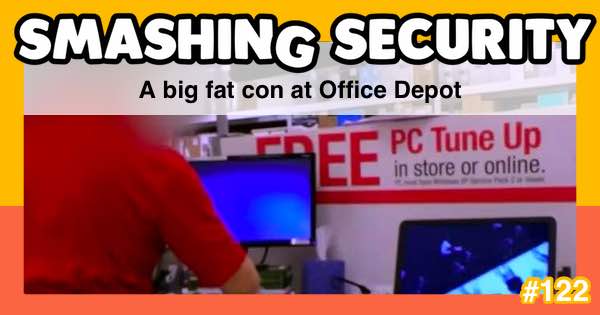
Office Depot and OfficeMax are fined millions for tricking customers into thinking their computers were infected with malware, car alarms can make your vehicle less secure, and facial recognition in apartment blocks comes under the microscope.
All this and much more is discussed in the latest edition of the award-winning “Smashing Security” podcast by cybersecurity veterans Graham Cluley and Carole Theriault, joined this week by The Cyberwire’s Dave Bittner.

Show full transcript ▼
 This transcript was generated automatically, probably contains mistakes, and has not been manually verified.
My name is Graham Cluley.
One of our fan favorites is Dave Bittner from the CyberWire and Hacking Humans podcast. Hello, Dave.
And I dive into a privacy dilemma specifically for apartment and condo dwellers.
But there are so many people these days who are using computers and are dumbfounded when something goes wrong with them and they need some help.
And if they don't have a nerd on call—
Chances are you might pop down to the local shopping mall and see whether there is a techie shop which is offering you a free PC health check.
It seems so wrong. But maybe in the United States you would go to a store like Office Depot or Office Max.
And if you went there to get a free PC health check, or as they sometimes call it, a professional tune-up, and these are things which have been advertised on radio commercials and print and online.
I don't know what that means. No, well, that's the same with me. I've never had my PC professionally tuned up.
And the program they run, this PC Health Check program they run, first thing it does is it displays a message. It says, does your computer have any of the problems listed below?
And it gives you 4 options. So it will either say frequent pop-ups or other problems preventing you from browsing the internet, or has it become much slower or too slow to use.
There'll be a member of staff who's walking you through it, and so he's asking you questions. You may well be looking at the screen at the same time, but he or she is choosing—
And it then says, you know, have you been warned of a virus infection or asked to pay for virus removal, or does your PC frequently crash?
As if a Windows computer would frequently crash.
Well, the workers at Office Depot and OfficeMax— they're all part of the same company these days— they were selling this service, or rather they're giving this service away for free, but it was actually something which did bring in a decent amount of cash because at the end of the process, if there was a problem with the computer, they could sell you some kind of repair service.
And PC Health Check was responsible for a substantial share of the store's tech service revenues.
And in fact, staff were being encouraged all the time, if anyone comes through the door, really try and get them to bring their computer in so that we can take a look at it, work out what the problem is.
Don't wait for them to come in with the computer saying they've got a problem, you know, encourage them, say, oh, you know, maybe you should get that checked out, let's make an appointment for you.
Now, this PC health check software was created by a company called Support.com.
And Support.com, they have a website where the Office Depot staff can download the latest version of PC Health Check, and it would keep a record of when the software was downloaded and used by staff, and it would send those records to the management of Office Depot, allowing them to monitor and compare different stores' performance.
You know, how many health checks are going on, right?
You know, it's fantastic news. What a great altruistic thing that Office Depot is doing.
But, uh-huh, the PC Health Check software, when it did its quick malware scan, turns out it wasn't actually looking for any malware.
So if you remember at the beginning, I said there are 4 checkboxes at the beginning that say, does it sometimes slow down or does it sometimes crash?
Any of those boxes were ticked, it would say you've got a problem and you've got a security problem, and you would be advised to get some costly, up to $180, diagnostic repairs protection service.
They asked me one of those four questions. If I said no to all of them, nothing would happen, I guess. They'd say, oh, you're all fine.
But if I said yes to any of them, it would just bill a negative report on my machine saying it's infected.
And there was malware or malware symptoms on the computer.
Yes, you'd be so grateful thank the Lord.
I suppose you could make the argument that you would be leaving in a better position than when you came in, because now you might have some actual real antivirus running, whereas before you didn't.
I mean, obviously you could also use some free antivirus or an antivirus of your choice, but it might be — I mean, $180 is a lot more than most people pay for antivirus software, isn't it?
I guess that's because you've benefited from a professional tune-up, a professional check, which happened there.
For the next four years or so, it started to say it had found malware infections on your system, regardless of there being nothing there.
And then from October 2015, it said it identified potential malware symptoms. So basically over time, PC Health Check became more aggressive with some of its reports.
And so it became a little bit scarier for some periods of time. But here's the thing. The companies knew about this.
In May 2013, OfficeMax even warned its stores that it shouldn't run the software, shouldn't run the PC Health Check after PCs had been serviced, because if they did that, the warning message would come up.
So if you brought in your computer to get fixed and they fixed it, they actually told their staff, don't run the check again because it'll still say there's a problem on the computer.
You know, some of them obviously were genuinely technical, rather than the typical person you meet in such stores. And some tried to blow the whistle.
Some claimed it was deceptive practice. Some even left their jobs over this. Meanwhile, the ones who kept quiet were getting all these bonuses because they were bringing in the cash.
And they went undercover, they took computers into the stores to see what would happen.
They even bought brand new computers from one Office Depot, drove around to the next Office Depot with that new computer, and were told, "Oh, oh, I love it, this is dodgy, poor security on this one." And I've actually got a clip right here where you can see some of that report: "Office Depot technicians repeatedly told us our computers were infected and that they could fix them for a hefty fee."
But when we brought it to technicians at a different store, malware symptoms were found in the machine.
Office Depot employee Shane Barnett says his bosses ignored his repeated warnings and were more concerned about sales and quotas."
And they'll say, "Oh gosh, you know, you got a problem with your pressure release valve on your widget wadget."
And, you know, I wouldn't have a clue if someone said to me, "Oh, something's wrong." I actually had to pay a bill at a garage just this week and they were listing all these things, and it's just like, well, I don't know.
You know, I'm just gonna have to give you the money.
These are highly technical things which do require sometimes some maintenance, but that's out of the bounds of the typical user, isn't it?
And until it got onto the TV screens, it'd been going on for something like 7 years, this scam.
This week they have agreed to pay— there's been an FTC settlement, $25 million Office Depot is going to pay, and Support.com has agreed to pay $10 million for what they've done.
They're not admitting any guilt.
So these folks at Pentest Partners, they took a look at third-party car alarm systems.
So we hear stories about people with these fancy key fobs that can be cloned and someone could run off with your car.
And what Pentest Partners found was that some of these systems could actually make your vehicle less secure.
Now what drew their attention to this initially was one of the vendors of one of these alarm systems put up on their website that the security of their system was unhackable.
So what they did was they went and they purchased several of these systems and they fitted them to cars that were owned by some of the people who work there.
And as everything does these days, these systems have an app, right? Everything has an app.
So it's where you're passing a parameter, which may be the user ID and maybe in a number. And simply changing the number allows you to access someone else's account or information.
So it's a very sloppy way of protecting accounts.
They could lock out the original user and have control of the alarm system's functionality.
And speaking of functionality, you could use the app to first of all, search by vehicle type. So you could say, "I would really like to have a Land Rover." Okay.
So you could look up and see Land Rovers.
On some of these cars, you can kill the engine while the car is in motion.
And guess what the bad guys can do with a microphone?
You have, for example, some cars these days have automated cruise control.
So the cruise control can communicate with the brakes, with the accelerator, with different sensors on the car, and they all tell each other, this is what's going on.
Turns out that that system is unencrypted, and messages can be sent around in the clear on the CAN bus. So guess what happens when you give the alarm system access to the CAN bus?
You have control over things like the brakes.
You know, the nerds are like, well, I don't think you can really say that. Yeah, just leave it to us. Thank you. We're building the website. Yeah.
Pentest Partners did reach out to the companies involved, and to their credit, all the companies fixed these things within a matter of days.
The vulnerabilities were easy to find, easy to fix, and they turned it around quickly and pushed out updates.
As with everything, there could be people out there who have not yet updated their systems, and they estimated that there could have been about 3 million people who were vulnerable based on the number of installations.
But yeah, really an interesting story.
I actually interviewed one of the guys who did the research here, so if you're interested in hearing more about it, one of our CyberWire Research Saturday shows, you can go look it up.
I guess we'll have a link in the notes as well. He tells the story, and it's a doozy. It's quite a story. Yeah, yeah.
He seems to know a lot more than we do.
And homeownership is really the American dream, isn't it? I mean, who wouldn't want to spend weekends trying to evict a zillion wasps from their attic or unclog a stinky drain?
Or repave the driveway. I mean, so fun, guys.
You pay a fee and then it gets all taken care of. And that means you can actually go to the park and do something fun instead of all these crazy jobs.
And there seems to be a growing trend towards renting, and the reason is pretty simple: many people can't afford to buy where they work. Take the tech sector.
They're a well-paid bunch comparatively, right, compared to other industries. And San Francisco is a big tech hub.
Can you guess how many potatoes the average home in San Francisco costs?
Teachers, cabbies, artists, cops, podcasters. We don't stand a chance. So all this to say, more and more of us are renting.
But it seems that there's an unusual situation that renters might be facing that private house owners do not.
Now this is a 700-unit rent-stabilized apartment complex in Brooklyn. And they recently sent out letters to tenants saying they would soon be introducing using facial recognition.
From now on, the doorway will just recognize you." So they didn't obviously hire a very expensive marketing firm to do that one.
So the idea is that, yeah, this is the way to go, facial recognition. Now the apartment complex already has 24-hour security in its lobbies. And a functioning camera system.
So the question is, why is management forcing tenants to submit photographs for its new facial recognition system? Not all tenants are super pleased with this.
Some of them are quite peed off, and they're talking to the housing rights attorneys and logging complaints. And I don't know, I wanted to know what you guys think.
Do you think it's different having facial recognition versus CCTV? Because CCTV is kind of an invasion of privacy. So it's not a privacy thing so much. But facial recognition—
That's the argument is we will, if something bad happens, we'll have a record of it and we'll be able to follow up on it because we'll have some sort of video content which will be able to give to the cops.
Right.
It's not basically taking a picture of every single person saying, "Dave Bittner at 9:02 has walked into the building."
With CCTV, I can wear a hat and sunglasses and a fake beard, and not that I do that every day, but I could, and still go about my business.
With this, I couldn't get in the building without it actually recognizing who I am.
And she says, "It is not an accident these systems would arrive in otherwise low-tech disadvantaged communities like Atlantic Plaza Towers." Comment was left there like that.
And I thought, well, maybe these people are less likely to complain than say the hoi polloi living on Fifth Avenue. Right? It's going to be hard to find a replacement place to live.
And then there's this other weird problem that comes up. Facial recognition may not be that reliable.
Some studies that have been done by Stanford MIT find that gender and skin type bias is alive and kicking.
So an examination of facial analysis software showed an error rate of 0.8 for light-skinned men. But 34% for dark-skinned women.
So if 10 dark-skinned women walked in front of it, it would get it 3 to 4 wrong.
There's no, well, if it won't let you in, you can use this fob, or you can ring the bell to get the security guard.
Because what happens if you're outside the building and someone is out there chasing you or trying to do something bad to you, and you can't get in because it doesn't recognize your face?
Well, now the apartment complex is in big trouble.
Yeah, if Monique from apartment 920 can't get in her apartment, because the facial recognition system just says, "Oh, you're not her." I mean, what happens if, you know, something happened to your face, like you fell over, Graham, right?
It's kind of a pilot to see if all this interconnectivity will help reduce crime. It started with only eight businesses, but now 400 businesses in the area are involved.
I read somewhere, but don't quote the number, but I seem to remember somewhere it said that crime has gone down 11%. They're claiming because of this system.
Now, it gets interesting because the Detroit Housing Commission and police are ironing out an agreement that will bring 26 real-time— that's what they call them instead of facial recognition— real-time cameras to Sheridan Place 1 and 2.
These are two high-rise towers on Jefferson Avenue that cater to elderly and near-elderly community. And one of the problems is it needs a mobile phone.
And not everybody, especially those that are older, have access to smartphones. Once again, it's security— security seems to be pitted against privacy.
Surveilled.
So I think there's a compelling case to be made that whether or not, regardless of the legality of this, that they have a justifiable sensitivity to this sort of surveillance.
So that would just as easily say, oh, Brian Smith just entered the building at 7:03 PM or whatever, in the same way that facial recognition would.
But for some reason, facial recognition gives us the jeepers a little bit more, doesn't it?
And I think it's really unfair that people that live in apartments or in condos, I don't think it's even actually just for renters.
I think anywhere where you have a shared space, this is now something that can be asked of you if you want to live in that building.
It can be demanded of you as part of your contract.
You know, there's ways to get around them. And I can't imagine that they're going to have a terribly expensive, top-quality system in this particular property.
It'll tell you what threat intelligence is and what it isn't, and you'll learn how other firms are applying threat intelligence inside their organizations.
Grab it now for free at smashingsecurity.com/intelligence.
Effective enterprise password management is a must to ensure that your employees are properly protecting their accounts." Unquote. That's my co-host Graham Cluley.
This is what he says on the LastPass Enterprise page. And most of you know how much I hate to admit when he's right, but he is.
Sloppy passwords are a huge contributor to security breaches within an organization.
The way to manage that is get a password manager, and the one we recommend is LastPass Enterprise. Check it out at lastpass.com/smashing. On with the show.
Could be a funny story, a book that they've read, a TV show, a movie, a record, a podcast, a website or an app, whatever they wish. Doesn't have to be security-related necessarily.
Aye, it's a Breard Brook McTaggart tonight and a Bonnie Hoots McGonigle, because I'm going to tell you about a 71-year-old woman called Jo Cameron, and she apparently, according to media reports, is one of only two people in the world known to have a rare genetic mutation.
No, not a mutation that makes her Scottish, a mutation that means she feels no pain at all.
Maybe he was the other person.
Some of it can be quite intense, and then it's to help to see, understand if this— how a shockwave that I could take would make you pass out. Yeah, right?
Anyway, Jo Cameron, apparently she only realizes her skin is burning when she's doing the ironing, when she smells the singed flesh. Wow.
They kept on sending her to hospital because she would walk and she'd claim her hip would come out. And the hospital would say, well, does it hurt? And she'd say no.
So they said, well, come back when it hurts. And her hip would keep popping out. And eventually they thought, we've got to get rid of this woman. We'll X-ray her.
And they thought, oh, you've actually got quite serious problems. But the no pain gene has meant that she wasn't aware of them.
So it's quite an interesting little story about actually how important pain can be.
She was fine where other people would be upset or would feel anxious about this, she could just roll with it and just be fine.
Because she would have been like Schwarzenegger, wouldn't she?
How could something as substantial as a house, something with as much value as a house, how a beautiful farmhouse? How does it fall into disrepair?
And not long ago, I was watching a video on YouTube I'd wandered across where someone was exploring an abandoned house, and one thing led to another, and the next thing I knew, I was watching videos with people who were exploring abandoned gold mines in the American West.
Now, I didn't know this was a thing, but I found myself fascinated with this and hooked on these videos.
And I've included a link to one of my favorite gold explorers, and his channel is called TVR Exploring.
And he goes through— they find these old abandoned gold mines, and these can be 100 years old, and some of them are quite dodgy. They're— these are risky places to be.
And they go back hundreds of thousands of feet into these mountains, and there's pits, and sometimes they'll find old abandoned ore carts and boxes full of dynamite and things like that.
Yeah, I was watching one of them and I was trying to figure out why do I like these so much? Why is this so much fun for me? Why is this thrilling?
And the guy who does these, he came to— he was in one of these mines and he's going down this long, long tunnel and he gets to a split in the tunnel.
There's a fork in the road, right? There's a tunnel going off to the left. There's a tunnel going off to the right. And he says, well, which way should I go? And then it struck me.
Graham, do you remember the first game you ever played on a computer?
And it was— you would go and explore in an old abandoned mine and you were looking for the Lost Dutchman's Gold.
And so I found myself thinking when we're at this fork in the road in this video and the guy, which way should we go? And I found myself thinking, go east, go east, get lantern.
I'm playing along.
So that the combination of videos exploring old mines and the Lost Dutchman's Gold text adventure game combined to make my pick of the week.
It's fantastic. So, Carole, what's your pick of the week?
And it's not porny. It's a fascinating look at crazy human behavior.
Or does he just really know how to pick his targets? You need to decide.
So I think that Wondery was able to sell its rights to Netflix because Netflix last year put together an 8-part drama on Dirty John. Wasn't my favorite thing.
But a few weeks ago, they put out a Dirty John documentary. It's called Dirty John: The Dirty Truth.
And this is face-to-camera interviews with all the people closest to John Meehan and what role they played in it and how they were impacted by his behavior.
I was watching with my husband. We'd stop it and just go, what the f—
And I actually will— in the show notes, I'm also going to put an article from Bazaar that actually details out the timeline, because once you've read it and listened to it or watched it, you're gonna go, what?
If people want to find out more about you and what you get up to, what's the best way to do that?
You can get to our subreddit very easily by going to smashingsecurity.com/reddit.
Where would we be without you? If you like what you hear and you want to help us grow, tell your friends about the show or leave us a nice review. It all really, really helps.
Hosts:
Graham Cluley:
 @grahamcluley.com
 @
@
 / grahamcluley
Carole Theriault:

Guest:
Dave Bittner:
Show notes:
- Is Office Depot diagnosing non-existent computer problems? — YouTube.
- Office Depot and Tech Support Firm Will Pay $35 Million to Settle FTC Allegations That They Tricked Consumers into Buying Costly Computer Repair Services — FTC.
- Alarming vulnerabilities in automotive security systems — The Cyberwire.
- Gone in six seconds? Exploiting car alarms — Pen Test Partners.
- The Landlord Wants Facial Recognition in Its Rent-Stabilized Buildings. Why? — New York Times.
- Brooklyn Landlord Wants To Install Facial Recognition Tech At Rent-Stabilized Complex — Gothamist.
- New key-less Moscow apartments use facial recognition to open doors and elevators — Achinect.
- Study finds gender and skin-type bias in commercial artificial-intelligence systems — MIT News.
- The woman who doesn't feel pain — BBC News.
- TVR Exploring — YouTube.
- Lost Dutchman's Gold — BBC Games Archive.
- Dirty John: The Dirty Truth — Netflix.
- A Complete Timeline of the Events of Dirty John — Harper’s Bazaar.
- Smashing Security merchandise (t-shirts, mugs, stickers and stuff)
- Support us on Patreon!
LastPass Enterprise makes password security effortless for your organization.
LastPass Enterprise simplifies password management for companies of every size, with the right tools to secure your business with centralized control of employee passwords and apps.
But, LastPass isn’t just for enterprises, it’s an equally great solution for business teams, families and single users.
Go to lastpass.com/smashing to see why LastPass is the trusted enterprise password manager of over 33 thousand businesses.
For anyone who is baffled by threat intelligence, and the benefits that it can bring to your company, this is the book for you.
“The Threat Intelligence Handbook” is an easy-to-read guide will help you understand why threat intelligence is an essential part of every organisation’s defence against the latest cyber attacks.
Download it for free at www.smashingsecurity.com/intelligence now.
Follow the show:
Follow the show on Bluesky at @smashingsecurity.com, on the Smashing Security subreddit, or visit our website for more episodes.
Remember: Subscribe on Apple Podcasts, or your favourite podcast app, to catch all of the episodes as they go live. Thanks for listening!
Warning: This podcast may contain nuts, adult themes, and rude language.