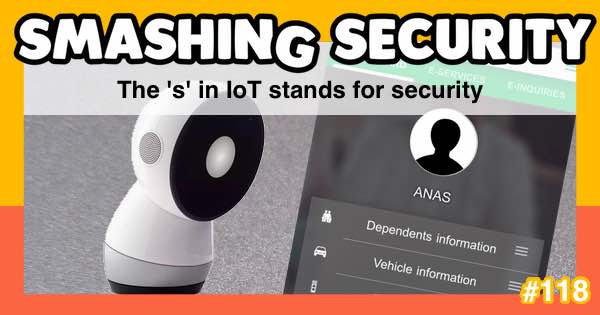
Twerking robot assistants, an app from Saudi Arabia that lets men track women, and a gnarly skiing security snarl-up!
Oh, and find out how a didgeridoo could change your life and that of your loved ones.
All this and much more is discussed in the latest edition of the award-winning “Smashing Security” podcast by cybersecurity veterans Graham Cluley and Carole Theriault, joined this week by technology journalist Geoff White.

Show full transcript ▼
 This transcript was generated automatically, probably contains mistakes, and has not been manually verified.
My name is Graham Cluley.
So frankly, any excuse to do anything other than write a book is— if anybody's got any ironing, I'll take that in. Oh, do you iron?
And I'm hitting the slopes with a new not-so-smart toy that fits into your brain bucket or helmet. All this coming up on Smashing Security.
Well, they're not the only digital assistants that people have in their homes. Have either of you ever heard of the Jibo? No.
And the Jibo is kind of cute. It's animated. It's got more character than the likes of Siri and Alexa.
This thing is the bastard lovechild of HAL from 2001: A Space Odyssey and a Minion.
We're big fans of facial recognition on this podcast, aren't we? It could learn your name.
Could turn towards you when you entered the room and sort of knew where you were and how to address you. But it wasn't all fun.
Jibo couldn't make phone calls or read you notifications or give you directions or read the kids a bedtime story.
You couldn't disable its camera or microphone other than to completely and utterly shut it off.
So for some time, despite new features occasionally being added to the Jibo, people have been worried about its future because it costs so much money and how could it compete with Google and Amazon?
And those fears were only compounded late last year because Jibo's intellectual property got gobbled up by an investment firm.
Which clearly had no interest in really keeping the devices alive.
And this week, and this is why I'm talking about it now, this week the axe appears to have finally fallen on this social robot because a new update was pushed out to Jibo.
And as with any other update pushed out to Jibo, the owners could ask it, well, what does your new update do?
Because as it installed, it would say, fantastic, wonderful new things are being installed, it would say. But to get the details, you had to press a button.
And some of the owners made a video of the robot explaining what its update was going to do.
According to Motherboard, some owners have been explaining to their young children that Jibo was dying.
And how they hugged Jibo hard, and how parents and children were left in tears at the loss. Can you imagine?
Later, because it's connected to the internet, it's then effectively disabled. That surely, that's got to be against trading standards, hasn't it?
I mean, you can't disable a product somebody's bought that was functioning at the time they bought it. Where'd you get your money back? Yeah, this is insane.
Maybe then it— you separate the software from the hardware. But yeah, you're right, but you don't have it. You don't have your money back.
Was it in the contract that at some stage— I mean, I just think, you know, I think legally we need to sort this out because this will happen to other things, won't it?
Unless we Jibo is a line in the sand. We've got to kind of, we've got to make a decision here. Are we happy with this or not?
But anything which required internet access, like telling the weather report or offering you a word for the day or giving you a, looking up stuff on Bing search engine that used, that's all going to be disabled.
You're not gonna be able to do that anymore. And I think you're right, Geoff. I think you're right. There's lots of IoT gadgets out there, which are reliant on external services.
And you're sort of in the lap of the gods as to whether they ever get turned off or not. This company appears to basically be going kaput. Its intellectual property has been bought.
So someone may be able to adapt it and sell it onto others, who knows in the future.
And therefore, like any store, all the support and consumer service is gone.
If what you're saying is the product is an ongoing product that's continually supplied to me after a one-off payment, well, then you can't withdraw the continuous supply because that's what I paid for.
But I don't know. It's interesting. I don't think this is covered by law, is it?
Because some of it is out of your control, and someone else can pull the plug on that bit. And the impact— we saw this thing with the Nike Adapt BB trainers.
We spoke about them a couple of episodes ago predicting that they might cause problems.
Sure enough, right after we published the episode, there was an update pushed out which bricked the trainers so people couldn't unlace their trainers any longer.
But the other thought which came to me the other day was these trainers were costing $350, which is about a third of a Jibo, isn't it?
But they're still trainers, you know, they're still shoes, which means they're going to wear out in a year to 18 months.
And you'll have to spend another $350 in order to have self-lacing trainers.
Whenever you buy an IoT gadget, you're not just buying the gadget itself, you're buying into its infrastructure.
And if the company goes kaput, as Jibo appears to have done, or the servers are turned off, your gadget isn't going to behave the same anymore or at all.
It's interesting.
What this app does is what I think a lot of governments are getting quite interested in, which is whereby citizens can sort of interact with their government digitally.
And I do see the win there as a broad trend, you know, not having to queue at post offices for driver's licences and that kind of thing.
A lot of our interactions with the state can now be carried out.
Yes, which I think is an instructional lesson to any government thinking of introducing any kind of digital identity or ID card, because there have been many, many instances where that's gone wrong.
I mean, brave effort to try that in a country as populous and complicated as India. That really was one to watch.
But Saudi Arabia's gone a slightly different route, has looked at this app and what citizens, as I say, can interact with it, can do various government sort of interactions.
And one of the things they can do is talk about renewing driver's licences and also travel documentation, travel permits and so on.
And this is where it gets slightly difficult because in Saudi Arabia, under the country's rules, women before they travel need to get it seems, a guardian, either husband or father, a male figure, to sanction and to permit that travel movement.
But the actual travel outside of borders and getting on a plane, flying out of Saudi Arabia, still needs to be sanctioned, it seems, under current rules.
Now what this app does is gives the person who owns the app the ability to permit or deny that travel almost instantaneously, and it seems get text messages, SMS messages, when the person tries to attempt to travel.
What I find interesting about this is, and there is some difference of opinion on this, so for some people they say, well, actually this is good because this rule does exist and this app speeds it up, so no longer do you have to go to your husband, with your husband to the airport or the visa place or whatever, he can just sanction your travel immediately on the app.
So I get that line of argument slightly. What I find interesting about this is this rule in Saudi Arabia existed way before this app.
This is not a new rule that's been introduced with the app.
What I find interesting is the app's one of these examples where technology just highlights, brings something to the surface which is already there, but the technology just kicks it on and puts the fast forward on it to the point where suddenly everybody thinks, oh, actually, yes, that is quite a concerning rule.
So this is the case with the app. There is also now an ongoing row about whether this app breaches the terms and conditions for Google Play Store and for Apple's App Store.
It seems there was a conversation between Google and the US representative, political representative, during which Google said, well, no, we don't think it breaches our rules.
There's some doubt over whether that's Google's official position. And the question is, well, this is the laws of the land. This is the laws of Saudi Arabia.
You know, if all the app is doing is allowing people to use those rules as they're written, does that breach the terms and conditions? Under what terms would you do it?
So I find it's an interesting gnarly one, this gnarly thorn, nest of thorns or whatever you call it.
I mean, I know that, you know, Government Digital Services, which sits at the heart of British government, is trying to bring everything together.
And again, I do see the logic of that.
We've had instances, haven't we, where social services know about somebody but the health service didn't know about them and the police didn't know about— you know, linking bits of government up and making it easier.
Yes.
And I think, you know, we can look places like, as you say, India, China, but also Saudi Arabia to see the ramifications this kind of tech can have.
But as governments change fairly regularly, it's a difficult thing to set a precedent on for the rest of time.
And if you're lucky, you'll keep up with 7 of them.
What worries me about things like AppShare is we're now in a situation where no matter who you distrust, they're involved— governments and tech companies coming together.
And I do find that interesting space, interesting territory.
I mean, traditionally, their attitude has been Well, your app has to follow the rules and the laws and the legislation of the country in which it's been distributed.
This is putting them potentially in hot water as well.
You can imagine many people being upset about this kind of app being allowed or some of the things which could appear in other countries around the world.
Is that them just being pragmatic or should they take more of a stance, say, actually, we don't really like the way you're treating women in your country?
If you want a global service, if you want to be available globally, which obviously people Google do, you've got to, as you say, take account of the local laws.
But if the local laws are deeply undemocratic or anti-democratic, or if you're put under pressure as a company to go against your values, I mean, in China, Google's solution, certainly for a long time, has been just not to go there, not to get involved.
Well, yeah, subject to recent headlines. But what's interesting in this case is this is a particular app in a particular country.
I mean, for an entire country China, for an entire service Google, just to go, no, we don't go there, it's not an easy decision to make.
But once you've made it, it's blankets, Google, China, no. But if you'd go around and say, okay, it's Saudi Arabia, we don't do this app. Okay, Brazil, do we do this app?
Do we do that app? You have to start making really piecemeal decisions. I think that's where it gets difficult. And Google don't want to go there legally. We've seen this in the past.
Google don't want to get involved in these individual country disputes legally.
First, there's the language or lingo. Now I'm going to test you guys out. So I want you to translate the skier lingo into English.
So yeah, ski language has evolved.
Isn't there another kind of skier who's like, oh yeah, absolutely bloody, bloody brilliant?
Another thing that's upgraded is, of course, equipment. There's so much fancy equipment today.
Like, you've got head-mounted cameras and ski airbags and smart boots and connected skis. And of course, you also have super cool headphones.
We're talking about The CHiPS 2.0 helmet speakers.
Now, these do not resemble chips in the British sense of the word or in the North American sense. They kind of look like two Oreo cookies connected by a wet noodle.
There's a rechargeable battery that gives you a full day of audio playtime.
And quoting the blurb on the website, that way you can listen to that heat playlist while you carve the pow pow.
I was really starting to realize I was not their target market in any way here.
This is Dr. Macarena. I read you loud and clear, Speed Demon. Hey, how's it going on the mountain today? Have you been up to Chair 23? I heard it's pretty sweet.
I've just been checking out the park, but I'll have to go check out the top right now. How about we take two more laps and meet at the bottom for beers?
Now, Alan loves snow sports as much as he loves his tunes, so he said it was a no-brainer to buy the CHiPs, or a pair of CHiPs, I don't know.
He wrote, they fit into audio-equipped helmets and have these huge 40mm drivers. I'm not sure what that means, but he says warm ears and good bass.
Now, one of the wicked cool features that sets the CHiPs apart is its built-in walkie-talkie.
So this is a little gizmo that lets you push-to-talk communication with your crew with limitless range. It boasts this on the website.
Imagine the three of us hitting the moguls, and with a simple touch of the EarGram, you could ping Geoff and say, dude, you totally stomped that 180 to faceplant.
So snow sport loving Alan is excited about his new purchase, the CHiPs, and he wants to start playing around with the short-range walkie-talkie feature on his new the chips.
So he starts setting it up, you know, his new ski group, and he discovers the chips have a glaring problem.
As Alan sets up the group, he notices that he can see all chip users, all of them. He searches his own name, and lo and behold, he finds himself.
It turns out that Alan was able to find out quite a bit of private info about all chip users.
Oh, I didn't mention this, but Alan actually works at Pentest Partners, so actually knows how to look into these things.
When Alan queried the API with the letter A intending to find his own name and add it to a user group he wanted to set up, the API returned 19,000 results.
Every single registered user whose first name started with A.
So Alan, being a pen tester and all, does the right thing and contacts Outdoor Tech, the makers of the stupidly named CHiPs.
So this is when Allan and his pen test team decided they just would go public with the vulnerability in the CHiPs 2.0, saying, quote, "The vulnerability hadn't been acknowledged and no remediation actions had been proposed." So the danger of this is that anyone would be able to potentially access details of all of these people who purchased the—
But would you really, even if you did manage to get all their email addresses and things, would you even want to contact them?
'Cause they'd be all like, bros and bumps and I'm carving, man. It's all about the death cookies.
It goes to say that these devices can have a lot of bells and whistles, but at the same time, if they don't have security down, it's a bit of a nightmare.
And I think there's a bigger moral of the story here, actually. What the heck are people doing listening to tunes as they barrel down steep, icy, snowing hills?
I mean, that's the whole point of skiing, is the tranquility and the being out there and stuff. It's insane.
It's clearly, you know, a problem. But we genuinely don't think our users give enough of a toss to actually care about this.
We think you need to fix it before we go, you know, we go out to the public. And they reply once and then nothing. Now, I don't know what that reply said.
Who knows if they told them, "No, we don't." I don't know. Maybe they were disputing it. But at the same time, like, guys, if you've got a problem, don't do that.
It's just gonna blow up in their face.
Maybe they're not actually expecting ever anybody to send them an email about some technical query. And so it's all ending up in the junk folder or in dev null.
It'll tell you what threat intelligence is and what it isn't, and you'll learn how other firms are applying threat intelligence inside their organizations.
Grab it now for free at smashingsecurity.com/book. Smashingsecurity.com/intelligence.
Effective enterprise password management is a must to ensure that your employees are properly protecting their accounts. Unquote. That's my co-host Graham Cluley.
This is what he says on the LastPass Enterprise page. And most of you know how much I hate to admit when he's right, but he is.
Sloppy passwords are a huge contributor to security breaches within an organization.
The way to manage that is get a password manager, and the one we recommend is LastPass Enterprise. Check it out at lastpass.com/smashing. On with the show.
Could be a funny story, a book that they've read, a TV show, a movie, a record, a podcast, a website, or an app. Whatever they like.
It doesn't have to be security-related necessarily.
Who knows? It is the return this week of one of my favorite TV programs, Fleabag. Fleabag. Oh, it's come back. Series 2. It is back.
It stars a talented actress called Phoebe Waller-Bridge, who also writes it, Olivia Colman, who's just won the Oscar for something or other, and Bill Paterson, who is a regular Scottish actor who appears in all kinds of things.
And this year they've been joined by Andrew Scott, who you may remember was Moriarty in Sherlock Holmes.
I can't guarantee that everything in my book will be original thoughts that you've never heard before, you know, that are like, oh my God.
But there are moments where you just look, well, hang on, you've taken paragraphs of somebody else's stuff and literally reproduced it.
It's one thing saying, well, actually, you kind of ripped off my idea there. It's another thing saying you've taken the words I put in my book and you've used them in your book.
I'm pretty sure I won't be falling into that trap.
And he claimed that he had originated this idea and that I shouldn't be telling people in the press to do the same thing.
It's by a guy called Oliver. I think the surname is pronounced Bullough or Bullough. I'm not sure. B-U-L-L-O-U-G-H. It is about the international money system and finance system.
So basically, if you are mega rich, how do you— how do you steal your money? How do you hide your money? How do you transfer your money? And then how do you spend your money?
And spending it, you've got to spend— you can't put these banknotes under the sofa, you've got to spend it.
So that the work and the effort involved with spending it becomes a whole industry in itself. It is fascinating, this book.
I was talking about, you know, how when you're young you think the rich just kind of swan around having a life of leisure, right? I did.
And then you're thinking the richest people, like Geoff Bezos. I don't think— I'm sure he probably gets up at 5 AM every day. I don't want to be him.
How— I mean, this is the thing, I'm just impressed by, I mean, you know, just having time to do the ironing and empty the dishwasher, let alone having an affair, and you run one of the world's richest companies.
How have you had time to— how did you iron your shirt?
On the globe, the countries are marked out, right?
There's this smooth globe where none of it exists. Borders don't exist. That analogy, I think, is really interesting. Anyway, it's a fantastic book. I'm really enjoying it.
So no names, but someone in our household is a champion apnea-riddled snorer.
There has been a desperate attempt in our household to nail down a solution.
There are widgets you stick into your nostrils, specialist pillows, tape to paste on the bridge of your nose, liquids you squirt in your throat. And in our home, these have failed.
And I'm going to share with you today my pick of the week. You ready? Drum roll, please. I can hear it.
Anyway, those dulcet tones you just heard— to make those dulcet tones, you need to master circular breathing.
And that, my friends, builds muscles and stresses out your jaw muscles in a way that certainly in my household has magically magicked the snoring away. No way, really?
Seriously, no joke. Now it's the circular breathing.
You actually could probably get away without buying the didgeridoo, but I suggest you get maybe a mini one, a short one, just to try. A semi-dooby-doo.
So you have to learn how to do the circular breathing. It's really useful to do with the didgeridoo, and then you can do it without the instrument at all.
So it can be a beautiful decorative object in your house. Choose one you like.
As someone who's learning how to play the didgeridoo. Okay, I understand.
Because that person figured out how it all works to do the circular breathing, they can practice without having the confirmation of the noise.
So you only basically use it— get one, share it around the snoring neighborhood.
If you take a video of your cat on the didgeridoo, playing it, if it's really got that good now that it doesn't snore, I think you're on to a winner.
Monetize that video, you're away. Did you emu? And on that bombshell, on that comedic bombshell, it's about time to wrap up the show.
Geoff, I'm sure lots of our listeners would love to follow you online. What's the best way for folks to do that?
Well, you can carry on the discussion, things you've heard about on the show, on Reddit. Just go to smashingsecurity.com/reddit to find our area up there.
And high fives to all of you for listening, you crazy cats. Want to spread the love? Give us a smashing review or get a friend to subscribe. Subscribe. It all helps us grow.
Check out smashingsecurity.com for past episodes and for details on how to get in touch with us.
Hosts:
Graham Cluley:
 @grahamcluley.com
 @
@
 / grahamcluley
Carole Theriault:

Guest:
Geoff White – @geoffwhite247
Show notes:
- A Jibo twerking — YouTube.
- Tweet by Dylan Martin about Jibo — Twitter.
- After Being Sold to a VC Firm, this $899 IoT Robot Will Soon Brick Itself — Motherboard.
- Your $350 Nike self-lacing sneakers aren't as smart as you hoped — Graham Cluley.
- Absher app — Wikipedia.
- Apple and Google Urged to Dump Saudi App That Lets Men Track Women — New York Times.
- Hacking ski helmet audio — Pen Test Partners.
- That's a nice ski speaker you've got there. Shame if it got pwned — The Register.
- Fleabag is back – and she's found religion — BBC News.
- Fleabag — BBC iPlayer.
- Jill Abramson: Ex-New York Times editor accused of plagiarism — BBC News.
- Password advice. Don't tell people to not reuse passwords. You might get a letter from this guy's solicitors… — Twitter.
- Moneyland: Why Thieves And Crooks Now Rule The World And How To Take It Back — Amazon.com.
- Play the Didgeridoo for Sleep Apnea and Snoring Relief — YouTube.
- Smashing Security merchandise (t-shirts, mugs, stickers and stuff)
- Support us on Patreon!
LastPass Enterprise makes password security effortless for your organization.
LastPass Enterprise simplifies password management for companies of every size, with the right tools to secure your business with centralized control of employee passwords and apps.
But, LastPass isn’t just for enterprises, it’s an equally great solution for business teams, families and single users.
Go to lastpass.com/smashing to see why LastPass is the trusted enterprise password manager of over 33 thousand businesses.
For anyone who is baffled by threat intelligence, and the benefits that it can bring to your company, this is the book for you. “The Threat Intelligence Handbook” is an easy-to-read guide will help you understand why threat intelligence is an essential part of every organisation’s defence against the latest cyber attacks.
Download it for free at www.smashingsecurity.com/intelligence now.
Follow the show:
Follow the show on Bluesky at @smashingsecurity.com, or visit our website for more episodes.
Remember: Subscribe on Apple Podcasts, or your favourite podcast app, to catch all of the episodes as they go live. Thanks for listening!
Warning: This podcast may contain nuts, adult themes, and rude language.