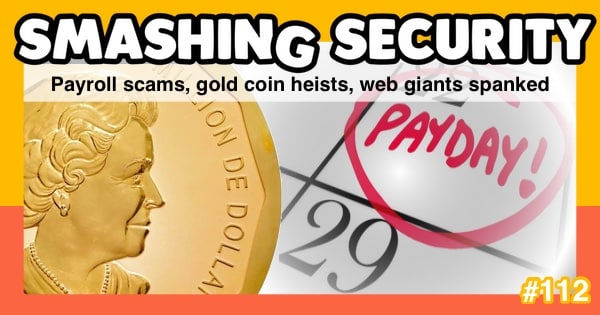
Business email compromise evolves to target your company’s payroll, how the world’s largest gold coin was stolen from a Berlin museum, and are internet giants feeling the heat yet over data security?
All this and much more is discussed in the latest edition of the award-winning “Smashing Security” podcast by cybersecurity veterans Graham Cluley and Carole Theriault, joined this week by people hacker Jenny Radcliffe.
Show full transcript ▼
 This transcript was generated automatically, probably contains mistakes, and has not been manually verified.
Hello, hello, and welcome to Smashing Security episode 112. My name is Graham Cluley.
If people want to go and follow us on Reddit, they can now join in conversation and chat with the hosts.
If you want to go spend some time with Graham, go to the Smashing Security sub and hang out with Graham, especially if you want to talk about chess or Doctor Who.
Anyway, the quick URL for it is smashingsecurity.com/reddit, and later in the show we'll also be telling you all about how to find The Human Factor as well and subscribe to that.
So Carole, what have we got coming up on the show this week?
Jenny has this wacky story about how a ginormous gold coin was stolen and it all used human hacking to do it. And I talk about the most fun topic of all, GDPR and fines.
No, I'm not kidding. And I promise I make it interesting. All this and more coming up on Smashing Security.
For anyone who is baffled by threat intelligence and the benefits it can bring to your company, this is the book for you. It's an easy-to-read guide.
It'll help you understand why threat intelligence is an essential part of every organization's defense against the latest cyber attacks.
Download your free copy now by visiting smashingsecurity.com/intelligence.
God, I find that so hard to say. LastPass.com/smashing. Here you can learn all about what password managers can do for your firm.
You can download a Forrester report all about the topic, and you can learn more about LastPass Enterprise.
I mean, if you want to solve poor password hygiene, if you fancy securing every password-protected entry point in your business, then put on your digital skates and slide on over to LastPass.com/smashing.
I use them, I heart them, so you should check them out. On with the show.
If they want something done, then you've got to do it and you almost live in fear of them.
And this is something, of course, which scammers take advantage of via business email compromise, where someone forges your boss's email address, or worse, has actually managed to compromise your boss's email account.
And they might send you a fraudulent message, maybe asking you to transfer money into a bank account under a hacker's control, or forward sensitive information.
We talked about this, if you remember, in episode 104, where we described how the Netherlands branch of the Pathé cinema chain, they got scammed out of millions.
Over and over again, they were scammed thinking their boss was telling them to move money because of a business deal, and they kept going on doing it and they never checked with the boss face to face.
So that is something which can be a problem. There are giveaways, of course.
Sometimes if a boss suddenly begins to say please and thank you, that can be a clue that it isn't your real boss because they're speaking in an unusual or different way, right?
That's one of the giveaway signs. So work can be pretty stressful and a boss from hell can make it pretty stressful as well, I think. But so is buying a house, right?
That's another stressful thing which happens to you.
I know houses I've bought in the past, you know, solicitors have left for 6 weeks on an unexpected skiing trip without warning me, or real estate agents, you know, they're all fairly sort of vile and slimy anyway, aren't they?
The last thing you want is a scammer getting involved in the process, which they sometimes do. Increasingly, estate agents are, for instance, getting targeted by the scammers.
And what they will do is they will pretend to be either the purchaser or the solicitor.
And they say, just so you know, just before the purchase goes through, we've changed our bank account details.
So when the big wallop in sum of money comes through, put it into this account rather than the one we may have told you about in the past.
When you're in the middle of that stressful situation and a problem appears, you know, one of the things we do in social engineering is we present the target with an easy way out.
And if the easy way out is, look, it's very simple, just change the bank account and that's that, they probably— your decision-making capacity is very low when you're emotional.
Either it's done on the phone or it's done via an email, a hacked email address, but the outcome is the same. Money ends up in the wrong bank account.
So you may have a big company with many contractors and firms working for you, working on big, big projects. And what the scammers will do is they will break into an email account.
They may observe what projects you're working on, and they will then create almost like a bogus company with a bogus bank account in the name of that company.
And they will actually send an invoice to your accounts department for a project that they know has just completed because they've been observing the emails.
And even if the finance department contacted the individual in charge of the project and said, can you confirm that Project Moon Landing has occurred?
I think one of the things that's really starting to annoy me in the security industry is people saying how these attacks are not very sophisticated and that people fall for them because they're dopey or they're not very clever.
If the take is of a decent size, it's really worth executing that con very well.
And so, spend a lot of time and effort making things look convincing, making sure that you hit the right kind of timings. The observation stage of any con is the longest stage.
We spend longer on that than execution, much more than a lot of more basic cons, because yeah, you can always play the percentages on the smaller ones, but the bigger ones that you're talking about, those tens of millions, it needs more time and elegance.
Elegance is what I keep telling people. There's no elegance in this.
businesses billions. I'm in trouble. How bad was the trouble? The trouble was very bad. Amit Diamond imports metal cutting machinery from Taiwan.
Now, what I want to talk to you about this week is a different way in which this similar kind of thing can happen.
And what can happen is the fraudsters can actually get themselves onto the payroll of your company.
And we've got some examples which we're linked to from a company called Agari. Agari? I'm not sure how you say it, but anyway, Agari. Hello, Gary.
Anyway, so Agari, they've done some research into this and they've actually included some screenshots and things of exactly these kind of emails being sent to HR departments, claiming to come from an employee saying, "I've recently changed banks.
I'd like to change my direct deposit details to my new account.
Can you sort this out for me?" And sometimes the HR department are wise enough to say, "Well, look, you're going to have to send us something on the bank letterhead confirming your details." Well, again, like you were saying, Jenny, if they're determined to get this money, they will fake the bank letterhead.
But the other challenge is that many companies these days have a sort of self-service system where you can log into your own company intranet and maybe change your own payment details.
Because why would you need to speak to HR to do that? Why can't they trust you?
So a lack of proper authentication there can mean that your employees log in, or someone posing as your employee logs in and changes their details.
And it may again take weeks or even months before someone notices they haven't been paid. You know, depends on who they are.
See, the challenge is with what I've just described, obviously people are going to notice if they don't get paid, whether you're in the US government shutdown.
It's also something which would be hard for a scammer to do multiple times inside the same company, although they might do it in multiple companies to, you know, one or two people in lots and lots of companies.
And he kind of said, "Oh, look, my taxes are higher than your salary."
So they postulating that maybe you could actually get someone on the books of HR who doesn't actually exist in the company.
So if you have a big enough organisation using hacked emails—
It just— they just forgot to take them off the payroll. And that— now that is dozy, right? That is stupid.
I mean, if you prod someone enough times, you should be able to— it reminds me a little bit of that, do you remember that Michael J. Fox movie? This is really going to date me.
The Secret of Success, where he starts in the mailroom and he finds— it's probably about 9 years ago.
And just through using the same kind of techniques that you probably use, Jenny, to break into companies and find their weaknesses, everyone assumed he was quite high up in the company.
Put a name on the door, started telling people to do things, soon had a secretary and built himself up and complained to HR his salary wasn't arriving.
Everyone, just because of his sheer brass, he got away with it. And I think that would be this kind of attack as well.
I don't know if it's happened, but you can imagine in particularly large disorganised organisations, it might be possible to actually get a fake person on the books who gets paid automatically every month, and the money goes straight to the scammers.
It was when I worked in factories. And so I went and reported to the head of the factory. He said, well, who's their boss? I said, well, I don't know. It's not me.
I'm head of operations. Not me. Is it you? No. I said, well, who is it? Well, nobody could find out. Nobody knew who she reported to. She didn't know who she reported to.
And so nobody— there was always no one to blame for the fact that she clearly hadn't had the training in health and safety. Nobody really knew anything about her.
And actually, I'm not sure how that panned out. I know she disappeared. Yeah, but I'm not sure how it panned out.
But I've worked for companies of that kind of size and complexity that there was all kinds of stuff going on that people didn't know about. Lots of scams that we uncovered.
Someone who was making bacon sandwiches and selling them from the factory floor, nobody knew about that. False walls in warehouses.
I mean, if physically you can hide people and bacon sandwich factories and parts warehouses.
Is it possible she was actually a thief and she wasn't pregnant? She just had a monitor stuffed up the front of her jersey and was pinching it.
And maybe she was being brassy, maybe she was claiming, oh yes, could you help me lift this thing into the back of my car? And off she would go.
So this week, 4 men have gone on trial because in 2017, 4 miscreants managed to break into the Bode Museum in Berlin and steal the biggest ever legal tender coin, which was solid gold.
It was worth €3.75 million.
Anyway, it's the size of a tire, it weighs 100 kilos, and they stole it. And I just love this story. So there's so many elements.
They wheeled the coin through the museum on a rollerboard, right?
Smashed through a bulletproof cabinet, and then they used a rope and a wheelbarrow to transport it across the railway tracks, through a park, to a getaway car.
But it stuns everyone, right? It's actually a Canadian legal tender.
But I love this line in the article which I sent you the link for that I'm sure you'll post, but it says it stunned the German public, not least because of its audacity and old-fashioned simplicity and the fact that no alarms have been triggered.
Well, it turns out that no alarms have been triggered because just weeks before one of their oldest friends from school started work as a contract security guard.
Obviously, we replicate. Just how theatrical and wonderful is that? But they got caught, so.
I don't know whether that's largest physically or just in amount, because, you know, it could be both.
We don't have a full picture of what's going on, but some of the information is making its way downstream to us mere users.
And I wanted to speculate with you guys, do we think the actions we're going to talk about here are going to make any difference?
In other words, are Facebook or Google going to mend their ways?
So that's just shy of $60 million US for failing to comply with its EU's General Data Protection Laws, also known as GDPR. This is the first GDPR fine that has at least 7 zeros.
We've had €20,000 being fined to a German social media and chat service for storing social media passwords in plain text.
And there's even a small Austrian business they would fine 5 grand in October for having a security camera that was filming a public space.
I know, I'm surprised that fits in under GDPR, but there you are.
And didn't give them enough control over how their information was used.
So just to reiterate, under GDPR, companies are required to gain a user's genuine consent for collecting information, which means making consent an explicitly opt-in process that's easy for people to go, right?
Now GDPR fines can be set as high as 4% of a company's annual turnover. Okay, not profit.
So Google, or parent company Alphabet, reported revenues of $33.7 billion last summer in 3 months alone. And that was up 21% from the previous summer.
So if they're making 30, yeah, right, $100 billion a year, it's probably $120, but let's say $100 billion a year, that 4% fine would be $4 billion.
But really, in the grand scheme of things, from their point of view, this is probably less than they pay their lawyers in a year.
So you're quite right to say that this is something they can probably deal with quite easily.
And I was presented with this pop-up, which said, basically, it's a data protection law alert. And it was warning me of my settings and checking whether I was still cool with them.
So I don't know if this is a response, because obviously I'm based in Europe, to this fining in this case. But it's interesting, it just popped up this morning.
So I think they want to be seen at least to be warning people, go and approve our data policy, which of course they know hardly anyone's going to read.
According to The New York Times, there are 5 commissioners that have been assigned to look into whether Facebook violated the binding user privacy agreements during the Cambridge Analytica scandal.
FYI, guys, I say they did.
Now, in theory, the FTC could fine Facebook up to $40,000 per violation, though considering there are millions and millions of users affected by this breach, that would run into the trillions and not be viable.
Could you imagine a world without Facebook?
Imagine the money flooding into Europe if we could fine 40%—
And also it's sort of anti-business. And I mean, right at the beginning of the— I can't even bear talking. I can't believe you've got me talking about GDPR.
But right at the beginning of it, I mean, you so owe me drinks now because I just don't talk about it and it's too early for me to actually drink.
If this was my podcast, I'd have a drink if someone mentions this. But back in the early days—
I've interviewed privacy professionals who are not allowed to say a friend of mine said to me, there will be a huge case, a huge case, and it'll involve one of the giants.
And when that happens, it'll be the lawyer train, and it'll go on so long, and so much will happen during that process that whatever starts, it's going to be irrelevant by the end.
And I think they're probably right, because you've got companies like Facebook that've got so much money to drag it out, to argue it, to lobby appeals.
That it won't be as straightforward as perhaps some of us would like to see, to sort of show that this is actually a serious thing.
And I am joking with you, Carole, but that it's a serious thing that does need taken seriously.
Well, I was just thinking the final twist at the end, you know, that moment in Seven when he opens the box and he realizes it's Gwyneth Paltrow's head or something like that.
The final twist at the end would be that some scammers, just as Facebook is transferring the $300 trillion—
And Zuckerberg, he's got his finger over the enter button. He clicks and the money goes in the wrong account. They say, haha, you've got to pay again, buddy.
You just gave it to the baddies.
So my question is, would we agree that these fines aren't necessarily going to have any financial impact on these giants?
Do we feel that these companies are too fat and powerful to regulate or not? Because what's stopping them? They've had carte blanche. They haven't had any legislation.
And it turns out that they've not necessarily behaved very well with our user data.
They're not vulnerable financially. You're not going to wipe them out.
So you need to get legislators. And I guess the legislator's arm at the moment is financial.
And so I say maybe we should support local legislators that are willing to tackle these giants because there's a few in the States, there's a few here in the UK.
And maybe it's time for them to pay the piper. And maybe that is legislation, not fines.
It'd be great to hear from you.
Could be a funny story, a book that they've read, a TV show, a movie, a record, a podcast, a website, or an app. Whatever they like.
So we have been playing a game, a short little game, but it's really fun and it was quite cheap in the Nintendo store. And you can also get it for iOS, Android, and on Steam.
And it is called The Office Quest.
I give you an idea of the— it's beautiful art in this game, but everyone in the game, it's completely unexplained, is wearing a kind of animal onesie. So there's people—
There you go, you get one back.
It's all done— so it doesn't make— I guess that made it really easy to translate or whatever. But it's not just a point-and-click, it's also at one point a platformer.
And there's a lot of sort of logical puzzles as well, and we really have to think. And it was a real brain bender. We finished it in a weekend. It was good fun.
It only cost us about £10, and that is why I recommend The Office Quest to be my pick of the week.
And this isn't even a particularly new— this isn't even particularly new, but I'd had a particularly bad day and Brexit and all these things is going on and you think it couldn't get any worse.
And you should know that as Shakespeare said, whilst you can say this is the worst, the worst it is not, or words to that effect.
So I'm just browsing actually through Reddit, so there you go.
And I see something along the lines of, just when you thought things couldn't get any worse, there are several countries in the world that have got radioactive wild boars in them wandering around.
Yes.
I don't even want to eat any goulash if I think that the thing's radioactive.
So there's lots of them inhabiting Fukushima.
So the population has exploded, and now they are, but they are much more radioactive than the ones in the Czech Republic. So they are 300 times higher than the safe level.
So if you thought you were having a bad day, imagine if you were— and I mean, I'm not trying to say this in poor taste, as it were, to poor people who suffered a terrible disaster, but if you were trying to return to your home, one of the things you probably didn't think you'd have to deal with would be a wild boar that is radioactive.
Preventing you from re-entering the region. So I just thought, you know, sometimes we need a break, don't we, from security topics.
And actually, in a way, it is a security topic because if you were going to have anything protecting your premises, I think even I would avoid breaking into somewhere with that.
I don't know if either of you saw that, but I thought it was a bit of a masterpiece. It stars Emma Stone and Jonah Hill. Now, the whole thing is a bit nutso.
It's fast-paced, tightly scripted, and it's basically— I guess the best way to explain it is two people who kind of meet and juxtapose at a really wacky medical trial designed to remove all pain and suffering from humankind.
Now, I thought everyone would love it, but Wired absolutely hated it. I'm going to put a link to their review because it's quite— they're outraged. But I really enjoyed it.
So I think if you watched Life on Mars, I would say that's a very good UK equivalent of what it's— and how I found it. Yeah, so check it out.
Maniac, Netflix, came out in September 2018, and I think it rocks.
What's the best way for people get in touch with you or find you on social networks?
If you're interested in Russia's IRA, or Internet Research Agency, in its effort to amplify conspiracy thinking and partisan conflict in the US, check out Sam Harris's podcast called Waking Up.
It's episode 145 called Information War, and it features Renee DiResta. She really knows her stuff. Anyway, there you go. Don't tell Graham.
Hosts:
Graham Cluley:
 @grahamcluley.com
 @
@
 / grahamcluley
Carole Theriault:

Guest:
Jenny Radcliffe – @jenny_radcliffe
Show notes:
- Smashing Security on Reddit
- Business Email Compromise Scams Have Netted $12.5 Billion, Says FBI — Bitdefender.
- The 2 Investigators: Theft By 'Business Email Compromise' — YouTube.
- The Secret of My Success Soundtrack – "Oh yeah" by Yello — YouTube.
- How one company lost $44 million through an email scam — Tripwire.
- BEC Gangs Focus on Executives for Payroll Diversion Scams — Agari.
- Daring robbery: Rare gold coin worth millions stolen from Berlin’s Bode Museum — YouTube.
- Trial begins for 4 accused in gold coin heist — CBC.
- Four men go on trial for giant gold coin heist from Berlin museum — The Guardian.
- The CNIL’s restricted committee imposes a financial penalty of 50 Million euros against Google — CNIL.
- Portuguese hospital appeals GDPR fine — IT Governance blog.
- German chat site faces fine under GDPR after data breach — We Live Security.
- First GDPR fine issued by Austrian data protection regulator — Freshfields Digital.
- F.T.C. Is Said to Be Considering Large Facebook Fines — The New York TImes.
- The Office Quest Game.
- Office Quest – Nintendo Switch Official Trailer — YouTube.
- Radioactive wild boars rampaging around Fukushima nuclear site — The Independent.
- Maniac — Netflix.
- Waking Up Podcast #145 – The Information War — Sam Harris.
- Smashing Security merchandise (t-shirts, mugs, stickers and stuff)
- Support us on Patreon!
LastPass Enterprise makes password security effortless for your organization.
LastPass Enterprise simplifies password management for companies of every size, with the right tools to secure your business with centralized control of employee passwords and apps.
But, LastPass isn’t just for enterprises, it’s an equally great solution for business teams, families and single users.
Go to lastpass.com/smashing to see why LastPass is the trusted enterprise password manager of over 33 thousand businesses.
For anyone who is baffled by threat intelligence, and the benefits that it can bring to your company, this is the book for you. “The Threat Intelligence Handbook” is an easy-to-read guide will help you understand why threat intelligence is an essential part of every organisation’s defence against the latest cyber attacks.
Download it for free at www.smashingsecurity.com/intelligence now.
Follow the show:
Follow the show on Bluesky at @smashingsecurity.com, or visit our website for more episodes.
Remember: Subscribe on Apple Podcasts, or your favourite podcast app, to catch all of the episodes as they go live. Thanks for listening!
Warning: This podcast may contain nuts, adult themes, and rude language.