No doubt you’ve been unfortunate enough to hear all the hype about NFTs (Non-Fungible Tokens).
If you don’t understand what they are, don’t feel too bad about it. The truth is that many people don’t understand what NFTs are. It’s not that people are dumb, but rather that they’re too intelligent.
Because NFTs simply don’t make any sense to anyone with more than a peanut for a brain.
Well done if you’re clever enough to find someone dumb enough to pay for your NFT. And well done if you’re so obscenely rich that you don’t have any qualms about paying hundreds of thousands of dollars for something pointless, probably because you’ve run out of real things to squander your money on.
When it comes to NFTs, ignorance is bliss. You’re better off not knowing about NFTs because when you understand what they are you’ll only feel despondent about the state of the world.
But, if you are curious, this YouTube video, explains NFTs better than I ever could…
If you’re still interested to hear more about NFTs, with perhaps more than a sprinkling of skepticism, listen to this recent episode of the “Smashing Security” podcast:
Show full transcript ▼
 This transcript was generated automatically, probably contains mistakes, and has not been manually verified.
You know?
Hello, hello, and welcome to Smashing Security Episode 256. My name's Graham Cluley.
And can I say how much nicer it is to join you from inside my house, whereas last Christmas you made me go and sit in my greenhouse in the dark where I was getting bonked on the head by cabbage suspended from the ceiling by a piece of string.
Log4Shell, Log4j. There's this vulnerability thing. Everyone else is talking about it. I don't know if we should talk about it on the podcast or not. Carole, have you heard of this?
What's your take, Mark?
And this is the universe of cybersecurity at the moment. This is the one and only thing that's happening.
And if you want to know how it works and all that kind of stuff, I mean, everybody in the world who cares about this stuff has written an article about it and they all basically say the same thing.
And it's all just what you can read on the Apache website. What I would like to do is just give a shout out to the people that maintain this piece of software.
So basically, what's happened is there's a problem in a piece of software. And that piece of software is maintained by a very, very small group of volunteers.
They maintain this piece of software for free in their spare time. I can't remember if there's 3 of them or 6 of them.
But what happened was the entire world decided they were going to use this piece of software in their bits of software because that's how software works.
You use libraries and things. You reuse code. This is a bit of software that helps you with logging in Java, and there are lots and lots of things written in Java.
Generally, when you write a computer program, you want to do lots and lots of logging because that helps with security, and that helps with just understanding what's going on and troubleshooting and all that kind of thing.
Through no fault of the maintainers, everybody went, "Oh, free stuff. Fantastic.
Yes, we'll use your free stuff." Then it turned out there's a problem in that piece of software, which means there's a problem in every piece of software in the world.
Loads and loads of people have been dunking on these maintainers who are now working through the night trying to come up with fixes to this problem.
I mean, mostly what you have to do is upgrade and patch and do that kind of thing. But people have actually been quite mean. I think it's completely unfair.
It's like they did this for free and then you saved some money and, you know, okay, now you have to pay a cost. I'm very sorry.
That's great." And then it turns out there's a problem and they go, "Well, I wouldn't have designed it like that." Well, you didn't design it at all. You let somebody else do it.
You were very happy to use their work. So I'm very sorry it's broken, but it is. So no.
Virgin Media provide a, I think it's broadband service, maybe mobile phone service as well, here in the United Kingdom.
And August 4th, 2020, last year, they sent out almost 2 million emails to their customers, telling them that there was a price freeze. Good news, they said. There's a price freeze.
And the message said, we want to let you know that we won't be raising your price this year.
This means the price you pay for your current package right now will stay the same in 2020. Okay.
It's a bit it'd be awful if something happened to that nice dog of yours, wouldn't it?
So 1.3 million customers who had opted in to marketing communications from Virgin Media received that message and then presumably, Mark, hit the delete button and thought, 'You really didn't need to tell me that.' Carry on with your day.
I'd rather have known about a price cut.
So a further 209,000 customers who had specifically opted out of marketing communications from Virgin Media also received it. Do you think there's a problem with that?
It's also slightly informational, I suppose. Okay, okay.
So we've nearly gone through all the 2 million recipients because there were an additional 451,000, almost half a million customers, who had also specifically opted out of marketing communications from Virgin Media.
And they were told about the price freeze, but they had an additional bit tacked on to the end of the email. Mm-hmm.
And what they were told was, we'd like to stay in touch about all of the great Virgin Media stuff we have on offer for you. Marketing stuff. Yep.
You've currently said no to receiving marketing messages from us.
Which means that we are not able to keep you up to date with our latest TV, broadband, phone, mobile news, competitions, products, and bundle offers via online email, post, SMS, and phone.
Apart from this one. You can change your preferences by simply registering or signing in to virginmedia.com/opt-in. Click My Profile, then My Preferences.
So it's now changed a bit, hasn't it? Because it seems the bulk of the email is no longer about there's a price freeze. It's now, you know that thing you opted out of?
You can still opt in if you want. You can still get messages from us.
And so they go, oh, I know I've got a really good workaround. Let's spam people that deliberately asked not to ever be contacted by it.
So how would you have responded if you'd got one of those, if you were one of those 451,000 people?
And he complained to the Information Commissioner's Office, who are the data watchdog in the UK, arguing that the email had posed as a routine communication about prices, but was actually an attempt to get everybody to opt back in to marketing communications.
Yeah. I don't know why I'm defending Virgin.
Yes, well, they're breaking the law by emailing them a marketing communication is what you're saying.
And Virgin Media said, yes, yes, we acknowledge those 451,000 recipients had opted out of being spammed.
But according to Virgin Media, that had been over a year ago and they might have changed their mind.
So they said that they'd had customer feedback from time to time that people changed their mind about wanting to receive marketing emails.
And so it was quite right of them just to double-check and say there's still an option to opt back in if you want. Okay.
In fact, the other thing that Virgin Media said to try and justify their point of view was they said, well, 6,500 people did choose to opt back in after receiving this mailshot.
So it worked. They said it worked. They said to the ICO, doing this works if you keep on bugging people and say, "Oh, are you sure? You don't want to come back in?"
They said the fact that Virgin Media had the potential for financial gain from its breach of the regulations by signing up more clients through the direct marketing is an aggravating factor, not a defence.
And they have fined Virgin Media the enormous sum of £50,000. Take that, Virgin Media.
They're trying to get this money on the books this tax year, aren't they?
Well, it's—
So shouldn't the fine have actually maybe been 10 times more or 100 times more or even more? Should it?
I mean, there have been people in the past who've taken the spammers to court and got £300 per email.
So maybe the ICO should be charging way more than this kind of thing if it wants to actually have a proper deterrent.
We're actually going to cut the price to all of our users by 8p.
The other thing is that sometimes on these forms, the wording is really confusing, isn't it?
When you click on these things as to whether you are actually opting out or opting in, you sort of get a "do not click here to not unsubscribe from future marketing emails," pre-ticked.
And you've got this knot, this Gordian knot you're trying to unravel of logic and triple or quadruple negatives to try and determine.
And then there are web pages you go to which say, "Okay, well, if you want to opt out, confirm your email address and your name and your company name and your size of company." So, whoa, whoa, whoa, I'm giving you even more information in order to get off this bloody list.
And it was really popular with newspapers. I signed up for The Wall Street Journal once because I wanted to read an article.
And then I spent days on the phone trying to call someone to get unsubscribed. When you're in that sort of process, you know exactly what thinking is going on there.
They've sat down and they've gone, "How can we make this as difficult as possible?
No chance that people are going to voluntarily remain subscribers, so we must trick them into continuing to use our quality product."
It was an accident in the sense that they meant to sell it at a different price. In fact, it was a massive accident because they got the price wrong by a factor of 100.
The seller was somebody who goes by the handle MaxNaut, and he made what he called a fat-fingered mistake. And he typed in the price.
So he was on the NFT marketplace, it was called OpenSea — it's the biggest NFT marketplace, it's where you go to go and buy NFTs — and he was on there and he was typing in the price, and he got the price wrong by a factor of 100.
And because we live in the lunatic upside-down world of non-fungible tokens, I'm not saying the price should have been a very generous $3.
It should actually have been a ridiculous $300,000.
That's the trouble when you're dealing with cryptocurrencies, because they're so massively inflated.
Obviously, when they were invented, the people who invented them thought, well, you know, obviously one of these is going to be a reasonable quantity.
That now one of them is worth $1 trillion, so people trade in 0.000000 fractions. So it's quite easy to type in too many or too few zeros.
And normally, you think about listing on Amazon or something like that, this wouldn't be a problem, right? You type in the wrong number.
And Max Knott realized his mistake pretty much immediately. But because we live in the lunatic upside-down world of NFTs, immediately is actually way too slow.
Because someone grabbed it. Well, someone, something had grabbed it. So as soon as it was listed, it was purchased, and it was relisted at $250,000.
So this is— sorry, people have apes with benefits? That's new. Let me get to the benefits. You've met my husband, right?
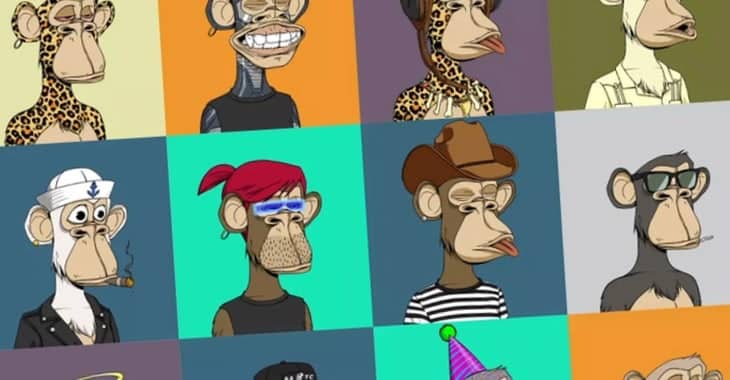
And the Bored Ape Yacht Club is a collection of 10,000 pictures of apes, which are of a standard that would not disgrace a middle-ranking art college.
And they're sort of digitally assembled. So by the look of it, there's a bunch of ape components, and then a computer program has mix and matched those to make 10,000 unique apes.
And then they're all being sold. And they're all sold for 0.08 Ether each. And it's terribly democratic because they're all sold for exactly the same price.
And there's no premium tier or anything like that. But of course, they get sold, and then they instantly get relisted for whatever the market demands.
And what the market demands at the moment is about $250,000. Anyway, you're not just buying a picture. Because quite often with NFTs, you're not even buying the picture.
I mean, you're just buying the fact that there's— basically, you're buying a receipt.
And what you're buying is you're buying your name on that list. Okay? And that list says, you know, Graham or Carole Theriault owns ape picture 3,700, whatever.
Anyway, I must get onto these benefits because what happens is the NFT is not just a picture of an ape, which you would not put up in your home.
It is also a login to the Bored Ape Yacht Club. The Bored Ape Yacht Club, it allows you exclusive entry to a range of features that don't exist yet.
And pictures can't get bored. And it's not a yacht club. And also, the things that you get, the benefits that you get when you sign up, don't exist yet. But they will exist soon.
But we don't know what they are. But we do know what one of them is.
So one of the benefits that doesn't exist— well, the only one that doesn't exist that we know what it is, is the bathroom. It's called the bathroom.
And the bathroom— is a sort of MS Paint for everyone who is a part of the Yacht Club.
And you can add 1 pixel to the bathroom every 15 minutes, or at least you will be able to when it exists, because it doesn't exist yet.
Anyway, you too can join this club for the bargain sum of $250,000. No, thank you.
Because he, presumably the seller, Max Knott or whatever, bought it from whoever posted it, 0.7 Ethereum or something, and then he basically sold it for the same amount of money, it seems, by accident.
So he's lost nothing.
I think this is very much, you know, we live in the crazy world of cryptocurrencies where billions of dollars go missing because you let someone have your billions of dollars to look after.
And that happens about every 2 weeks. So I think if you get into this stuff and you're serious, you probably just mentally write off a bunch of money already.
Like, if he's going to make $300,000 on the next one, he's not going to worry about losing a mere $297,000 on this one.
My favorite part of the story is— so I told you the transaction happened instantly, right? Yeah, yeah. OK, now have you ever bought anything with cryptocurrency? No.
Right, instantaneous transactions are quite difficult to pull off. Like, you can buy things with bitcoin, then you can wait hours.
Or days even, which is why it's a terrible idea for currency. Because you want to buy something, right?
But another terrible reason why— so if you want to get it instantly, you have to pay a transaction fee. You're basically paying to grease the wheels and speed things up.
How much do you think that this robot that bought this robot-generated monkey picture paid to make that transaction happen instantly?
And I thought that was pretty Victorian. This computer program that bought this monkey picture paid $34,000 in transaction fees. But it's still quids in. I mean, the math is correct.
But you know— Yeah, the math works. I looked this up.
And basically, the future of the world is a currency where it either takes days for the currency to go through, or you have to pay a mere $34,000 to make it happen instantly instead of using your debit card, which can do a faster payment now, which is instant, doesn't cost you anything.
I looked up the numbers. And also, obviously, cryptocurrency is trashing the planet because they consume so much electricity.
You can do 140,000 Visa transactions for the same amount of energy as it takes to do a single Ethereum transaction. 140,000.
Every account that we have under our roof, you know, every day we're gonna give someone a random amount of money in one account.
You're just gonna land with a bunch of money from us as a present.
So you have to look in the chat, 'cause I'd read out the URL, but you'll see when you see it in the chat window, you'll see why I didn't read it out.
Half of us is very handsome and the other half is me. So it's like we've been sort of merged together with—
So do you remember a while ago, you invited me on the podcast, and we spoke about Twitter.
And there was a kind of minor scandal where if you uploaded a picture to Twitter, and there was a white face and a Black face, it seemed to always show the white face.
And to celebrate this for you guys, I created a Twitter account called Graham or Carole. And I uploaded pictures of you two to see which one Twitter would pick.
And the avatar for that Twitter account is now an NFT. Okay, so this is not just some random picture.
This is a picture which is linked to Smashing Security, which has got some history. And if it sounds like I'm selling this, it's because I'm selling this.
Okay, and the reason it's 0.15 Ether is because it's not cheap to get these things on OpenSea.
Anyway, I'll read out the description for people who are interested, because I think we've probably hooked in a few people by now, because you've got a lot of listeners, right?
Billions, yeah. So this is— it's a one-of-a-kind coming together of one of the most distinctive and humorous voices in cybersecurity and Graham Cluley.
I want you to imagine that you are in your late 20s.
That's something you've certainly done.
And you, the boyfriend, the nice chap that you are, offer to cook her dinner, look after her, sort out her little cold meds to help her sleep, all the stuff.
And you fuss over her and get her all cozied up in bed. And soon, no surprise, she falls asleep.
You sit beside her, look down at her, and you think— do you think I hope you feel better soon? Or I hope she likes— you know, I hope that got me some points looking after her.
And the people that you owe money to are starting to get really serious about it. So you're thinking, "Hey, I've unlocked her phone." I know she uses Alipay, right?
Okay, which is a money transfer app. I'm just gonna head over there and open that baby up. But there's a snag because she set up facial recognition to open the account.
Would you draw it in paper and cut it out and then just sticky tape it to her eyelids?
So she'd wake up with eyes on her eyelids.
And if you— Or take another photograph of her and cut and paste her eyes onto her. No, I mean, I don't mean actually with paper and glue and things.
I mean, not actually with an image. That was Mark's idea.
Of course, clever guy, he managed to change her password as well. And all this happened, of course, while Girlfriend is in slumber.
Huge money transfers, can't get into her account. And he's like, "Oh, no. I can't believe this happened." So he was the perfect boyfriend once again, acting completely innocently.
She ends up calling the authorities, files a police report.
But according to the South China Morning Post, he was accused of doing all this, and he ended up getting arrested in April.
And he was found guilty of theft by using secret methods to steal someone else's property, which is a pretty interesting—
But yeah, interesting. And the judge sent him to 3.5 years in prison and slapped him with a 20,000 won fine, or £2,500.
It's not the maddest thing I've heard in the last 20 minutes.
The first annual 1Password State of Access Study illuminates the grave dangers unwittingly posed by checked-out, apathetic employees, including security professionals.
Work-related exhaustion isn't a new phenomenon, but it's been amplified by COVID-19.
And when it's left unaddressed, burnout can put companies at risk because it influences employees' habits and decision-making.
Burnt-out employees are 3 times more likely to say security rules and policies aren't worth the hassle.
And nearly half of burnt-out security professionals say it's unrealistic for companies to be aware of and manage all apps and devices that employees use.
This free report establishes a clear connection between employee burnout and exposure to cyber threats, as ready-to-resign and otherwise disengaged employees let down their guards and circumvent their company's rules and protocols.
So go and read the report for yourself and find out what you can do about it at your company. Go visit 1password.com/resources. That's 1password.com/resources.
And thanks to 1Password for supporting the show.
Uptycs zeroes in on blind spots that are preventing you from identifying and responding to existing threats and vulnerabilities in your ecosystem.
Plus, Uptycs normalizes telemetry across macOS, Linux, Windows, and containers, records system activity for historical investigation even when no alert has fired, and enables you to build complex custom detections.
In short, Uptycs provides observability across both cloud workloads and endpoints in a single centralized platform. Visit smashingsecurity.com/uptycs.
That's U-P-T-Y-C-S to learn more about its cloud-native security analytics platform. And thanks to Uptycs for sponsoring the show.
Could be a funny story, a book that they've read, a TV show, a movie, a record, a podcast, a website, or an app. Whatever they wish. Doesn't have to be security-related necessarily.
Better not be. Well, my Pick of the Week this week is not security-related. For a while now, I've noticed I've had a bit of a problem with technology. And my problem has been emojis.
I can't handle emojis. I don't really understand.
So someone will send me an emoji of something and I have to take a screenshot of my own camera and then enlarge it in order to find out that it's an emoji of a filing cabinet or a leopard or whatever.
And it is all about what every heart emoji really means.
And I thought, oh, this is quite useful because it's one of the most common emojis that people send to each other, either a broken heart or a real heart.
And apparently there are different meanings and there's been an awful lot of research done into the popularity and usage of different emojis, which I thought was quite interesting.
Brown hearts, not popular. I'm totally using that from now on.
Apparently is the go-to emoji for fans of Bangtan Sonyeondan, if you're familiar with them, better known as K-pop band BTS. Yes, yes, exactly.
So, if someone's in purple hearts, it means that they're into their K-pop.
But there's lots of other interesting stuff if you go into this article, all about the different meanings of hearts and how they are used.
For instance, there are those ones where you get someone's smiley face where the hearts are over their eyes. It looks like a Jammie Dodger biscuit, for instance.
And the relative popularity of some of these and how they are used at different times and in coordination with other emojis as well.
I found it quite interesting that such a study had been done because this is really a new— this is how the youth are communicating, Carole.
Which, and I think anybody that sees it will agree that visually, it is definitely better than a random, automatically generated picture of a Cartoon Ape.
I'm talking, of course, about the next big thing, which I think we all know is going to be Graham or Carole, which is an NFT which I saw today is available on OpenSea, which you can currently pick up for the bargain price of about— it's about $560.
There was probably an enormous spike between— I know it looks like they're the same, but it probably crashed and then went to $40,000. But it's still $566.19.
But if this is the cheapest it's ever going to be, okay, this is an auction, prices only go up, prices only go up.
And these are NFTs, so I mean, prices go up by with zeros on the end, okay? So take it from me, you want to be on the ground floor.
Yep, Patreon supporters, you hear this first, okay? This is a genuine opportunity. To make something from that, you know, because I know you don't get much from these guys, you know.
Ouch. This is your chance.
So this Pick of the Week is for you. It is a TV series called Mare of Easttown. Have either of you seen it?
And of course, meanwhile, her own life is unraveling, and she's guzzling back the beers and vaping ferociously and cutting anyone dead who gets in her way.
Also, they're killing off people that play quite big celeb roles that you think obviously will be there till the end of the series. They die very early. I won't name any names.
And I thought, "I better know something about this." And they just never ever kill off characters. So there's no consequences.
You know, these comics, Batman's been running for 90 years or something. And occasionally gets bloody nose.
And so it's really refreshing when you watch a TV series where they invest a bunch of energy into a character and then they're, that character's dead, because it actually creates genuine tension.
So that gives you quite a few intense, engrossing viewing hours of something dark smart to cheer you up during the holiday season. Enjoy.
I'm sure lots of our listeners would love to follow you online. What's the best way for folks to do that?
And don't forget to ensure you never miss another episode.
Follow Smashing Security in your favorite podcast app because you'll want to do that because we're going to take a break for a few weeks, but we will be back in the new year.
So if you don't want to miss out, make sure you are subscribed in the likes of Apple Podcasts, Spotify, and Google Podcasts.
And as always, for episode show notes, sponsorship information, guest lists, and the entire back catalog of more than 255 episodes, check out smashingsecurity.com.