As we described on a recent episode of the “Smashing Security” podcast, serious security flaws in the API of a so-called “smart” chastity lock meant that men could find their umm.. personal equipment permanently inaccessible.
It’s what you might call a cock-up lock-up.
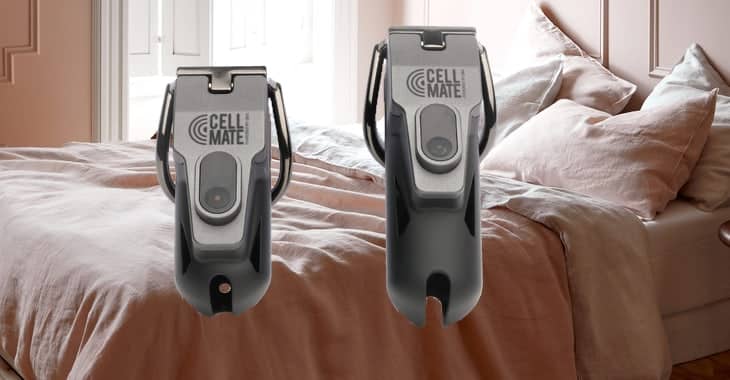
The Bluetooth Qiui Cellmate attaches itself to a man’s penis, allowing a remote partner to lock up your proverbials if they think you don’t deserve to use them for a while.
And with no umm.. manual over-ride, you could find your pickle in a right pickle if an unauthorised third-party exploits the flaws to lock the cage without your permission. Built from a mixture of polycarbonate and toughened steel, removal is non-trivial and might involve taking an angle grinder or bolt cutters to a delicate part of your anatomy.
The fine fellows at Pen Test Partners, who first uncovered the flaw and attempted to convince Qiui to fix their product, produced a video with an alternative way to override the lock which involved prising open a circuit board on the Cellmate and applying a voltage to two wires to drive a motor to unlock the sex toy.
Notably, the video demonstrates the technique with a Qiui Cellmate which is not currently attached to someone’s penis. I suspect that makes things a little less fiddly.
Personally I wouldn’t be keen to either have an angle grinder near my nuts or to apply an electrical charge anywhere in their vicinity, but then I (hopefully) wouldn’t be found wearing one of these gadgets in the first place.
Inevitably, news of the security hole caught the media’s attention, and Qiui has now come forward with its own video demonstrating how the device can be opened with a screwdriver.
No, still not rushing to experiment with that either…
And before you think the threat of a malicious party locking someone else’s cock lock without permission is overhyped, it appears some owners have been receiving threats demanding a ransom be paid…
QIUIのハッキングされたら届くメール
焦らずレポートしたら、解錠されます pic.twitter.com/bprXtRUFgI— 貞操奴隷 (@teisoudorei_000) October 8, 2020
For more discussion of this latest IoT security disaster, be sure to listen to the latest “Smashing Security” podcast:
Show full transcript ▼
 This transcript was generated automatically, probably contains mistakes, and has not been manually verified.
This week's shout out goes to Irma Gerd, Mo, Dan Allen, Rob Van de Weyer, Goran Josipovic, Tim Collinson, Steve Lupton, Jeremy, Marin Cathayer, Armand. You guys rock.
Thanks for your support. If you want to join this very cool group of Patreon supporters, check it out on smashingsecurity.com/patreon. Now let's get this show on the road.
My name's Graham Cluley.
We are joined once again by the marvelous BBC technology correspondent Zoe Kleinman. Hello, Zoe.
A live stream up on YouTube where people can come and join us and ask questions and see us chatting.
And that will automatically give you everything that you need to know in order for this wonderful thing to happen. But please be there.
Otherwise, I'll be stuck with Carole on my own.
Now, coming up on today's show, Graham heads to the bedroom. Thank God this is radio, right? Zoe gives us the latest on the UK COVID tracing app.
And I take a rather wacky look at automated recruitment tech. All this and much more coming up on this episode of Smashing Security.
Well, if you remember, researchers demonstrated how they were able to create a proof of concept ransomware that could obviously get in the way of you getting your daily swig of Java.
And that would obviously be very frustrating for people. Well, it's not the only thing which frustrates people, of course.
And coffee isn't the only thing that makes the world go round. Some of us, from time to time, ladies, some of us like to dim the lights. Ladies?
They're spelled Q-I-U-I. I believe it's Qiui, and it's the Qiui Cellmate. And the Qiui Cellmate is a chastity device.
It's a sort of thing which you clamp on to one's—
So, you get, first of all, this ring attachment made out of toughened steel. And that you put sort of behind the boys, right? So it doesn't fall off.
And then there's this other bit, which is, oh, how can I describe it? Well, it's sort of like a metal sheath, which goes on and locks on to the ring. Okay?
Maybe there still is, where, of course, gentlemen in Victorian times, you could sort of tie something just so it would— Anyway.
€110 to you, and you can have it shipped to you, of course, from the Netherlands.
It is, aside from all these other features, it is of course connected to the internet.
Because the whole point of the Cellmate is that you can give control of your cock lock to somebody else who could be based anywhere in the world.
And it actually means that someone could remotely lock all of these devices.
Sorry, I haven't really explained this very well. If yours is locked, the only way to get it off is via the mobile phone app.
So I would imagine you would use something or a coat hanger, which you could bend into the right shape, and you could scratch yourself that way, I imagine. I've got a question.
Thank you, Zoe. Let's raise the tone.
And then it communicates via Bluetooth telling you to unlock. So I think via this app you can also say, "Hey big boy," or whatever. "Have you been behaving yourself?
If you have, I'll unlock you." All right.
You definitely 100% have one, and I'm totally 100% judging you because— Tell me about the security of the device.
There's even a website called the Internet of Dongs, which is all about sex toys connected to the internet, which have had vulnerabilities in the past.
We've seen things like this before. I'm sure you remember, Carole, John Hawes.
He came on the show, or he appeared on the show at least a few years ago, telling us about an adult bedroom entertainment system.
I went to CES in January— God, that feels a lifetime ago— but I did, and there was, for the first time ever, they had this little corner which was devoted to sex tech, and there were sort of half a dozen vendors there showing off, you know, what they developed.
And actually it was kind of thriving, it was doing really well.
I mean, CES, they've got a really funny history with sex tech where they kind of like it and then they get a bit freaked out by it.
And there was a horrible story where they'd given an innovation award to a woman who designed a smart vibrator, and then they took it off her again.
And then this was the following year that I went, January just gone, and they had— I guess because they were trying to show how open-minded they were, they were like, yeah, this year we're having a sex tech section because we're fine with it.
And it was kind of, you know, it was hard to find.
It was sort of tucked away in the corner by the loos, and I think there was a sense that they were sort of trying to make an effort but didn't really want anyone to see it.
We've covered a lot of really important stories. We do cover the really important ones. Anyway, Pentest Partners found this security hole.
They wanted to obviously bung it up and prevent it causing any problems. And so they tried for months to get the manufacturers at Qi, this Chinese company, to fix it.
And they weren't really getting very far.
One of the problems appears to be that the manufacturer said, well, we can't really replace the API because if we do, there's a danger we could unintentionally lock everyone into their cock cage, which you wouldn't want.
Or maybe you would, I don't know.
But now details of this problem have been released because other researchers have stumbled across other vulnerabilities in these particular male chastity devices.
And there's also concern because the manufacturer said that they're going to produce one of these devices with an internal element, I think to make it even harder to take it off.
So you can just imagine, that's probably your knitting needle, Carole, there. But you wouldn't, I mean, you don't really want that kind of device going wrong. However—
In a way that you think— if you think about this for a minute, my goodness, that's a leap of faith, isn't it, to put that on and trust? Not our listeners, fine.
But then, you know, do you remember all those stories about people driving their cars into lakes because they were following the sat nav, even though they can see that in front of them is a lake, and your rational brain is going, no, I don't want to drive into the lake.
And then your other brain is going, ah, but the sat nav says it's in the lake, and they all go.
It's a really interesting bit of human psychology, isn't it, how much we trust in the tech that we get.
Basically, you break— laser your balls? Well, almost. You break open a battery compartment, and you have to apply some voltage to two particular wires to unlock the lock.
If you're comfortable doing that, that is a way out.
The story that has consumed my entire life for the last couple of weeks has been the launch, the long-awaited launch of the COVID-19 tracing app for England and Wales, which I feel like I should practically lay a place for it at the dinner table because I've lived and breathed it now for so long.
But finally, is that the end of it? No, it's not. There's loads of issues. I'll be talking about this forever.
For something that's supposed to be so simple, it's just an app that's supposed to tell you whether you're at risk of having COVID-19, and actually it's become an absolute minefield.
It's called the NHS Test COVID-19 app, and it is for England and Wales. So Scotland has its own, and Northern Ireland has its own. And guess what?
So far, they don't really communicate together.
So if you are in England and Wales and then you go to Scotland, you'll have to start using the Scotland app to continue if that's what you want to do.
It's done quite well in that over 14 million people downloaded it in the first few days, which is quite— that's pretty good.
I mean, if I was an app developer, I'd be happy with that. That's a quarter of the population.
Right, so one of the first things that emerged was you can check into a venue, right?
You scan a QR code and it says, "Oh yes, here you are, you are at the Dog and Duck in Stratford" or whatever, but you can't check out.
You are in that venue until you check in somewhere else, so that's confusing people.
So if I go to a coffee shop and I check in at the coffee shop and then I don't check out and I stay home for five days before I go out next again, I am basically at that coffee shop for five days?
However, this is not the big problem that it sounds like it is because ultimately what it's looking for is your phone being near somebody else's phone for a certain amount of time, for more than 15 minutes, and less than two meters apart from it, who then registers that they have tested positive, right?
So if that person comes into the coffee shop six hours after you left, well, you're not going to be near their phone, are you? Because you're not there.
So in a way, it doesn't matter, but it's just an awkward little bit of user experience, isn't it, that people are like, "Well, I want to check out.
I don't want to be registered in this cafe for 10 hours, and what if somebody then comes in later and then I get caught up in their disaster?" I think that's exactly what happened to my neighbor.
And then when he went online to check it out, apparently he wasn't at risk, but he didn't check out of the location because you can't check out.
So you're going about your business and you get a little flash on your phone and it says something like "possible COVID-19 exposure detected." And then it says "signal strength"—it's not very user-friendly language—"signal strength saved" or something, and then it disappears.
And if you go into the app, there's nothing there.
The app is built using this tool that was developed by Google and Apple. That enables the phones to communicate with each other, right?
We weren't going to use it in England, and then we decided, okay, it's there, we might as well — why are we reinventing the wheel here?
We'll use what's already there, we'll use that. So what that notification is, it's coming from the Apple and Google API rather than coming from the app.
And it basically — what it means is you have been around somebody who's tested positive potentially, but not for long enough for it to be a threat.
So not to the point where you have to do anything about it unless they sneeze again. It's like, why do you need to know that? You know, I don't need to know that.
I would be much happier living my life not knowing and worrying about that. So a lot of this has sort of come back down to bad user experience.
And the final thing that's worried people is that it turned out pretty early on that you could not register test results very easily.
So the minute you go onto it and you say, oh, I've got symptoms here, I've lost my taste of taste, I've got a temperature and I've got a cough, it goes, right, self-isolation starts now.
And this little timer starts counting down. You got two weeks, right? And then you go and get your test and it's negative and you're like, hooray, I don't need to self-isolate.
But you go into the phone and it says, okay, you've got your test results, input the code so that we can update your app. But there is no code, it doesn't come with a code.
So a lot of people are freaking out going, well, you know, what do I do? I'm okay, I haven't got, my test was negative, but I've still got this isolation clock counting down.
Am I going to get into trouble? The answer is no, you won't get into trouble because, and this is an anomaly in a way, the app is guidance.
So the police can't fine you for breaking the app, because if you get a notification, nobody knows you've got it apart from you.
The whole thing is so confidential, there's no data stored anywhere, right? So they can't enforce it.
So you can carry on going about your business with this countdown going, knowing that you're okay.
But for a lot of people, you know, as we talked about, who trust the tech and want to do what they're told, this is actually really distressing.
And it's really difficult because I'm on the other side of the spectrum.
You're installing this app, you don't want to go out anyway, you don't want to go to a dentist.
So this is slightly historic, because people had booked tests before the app came out, you know, it hasn't been out for that long. So that will kind of resolve itself.
They are also saying if you get a positive test and you can't notify the app, then the contact tracers, the people who phone you up, will give you a code over the phone to put in your app, which seems like a very low-tech solution, doesn't it?
But there we are. So that will resolve itself. The— what was the other issues? The phantom alerts, apparently they are working on that as well.
But as I said, you know, that's not actually the app doing it, that's an Apple/Google thing.
I'm not surprised that there's a few niggles at this stage. I just hope that they go away soon.
But there isn't one. Nobody's really got it right. Nobody's is working brilliantly. But I thought it was quite interesting what Matt Hancock said, the Secretary of Health here.
They were talking about how many people need to have this app in order for it to be any good. You know, you'd think you need a lot of the population to have it.
But he sort of said, well, do you know what? It's kind of a prompt really to get people to think differently and change their behavior.
You know, we've been doing this now for months, we're all sick of it, the rules keep changing, and it's easy to sort of feel a bit complacent about it.
But he said if only two people downloaded this app and it stopped one of them going around spreading coronavirus, then it's done its job, you know.
I wonder if that could be applied to other purposes you know, once all this coronavirus pandemic is over, or we've moved on a bit.
Because I'm thinking about, once again, these cocklocks, which are running on Bluetooth as well.
I would be quite interested if someone has come into a restaurant and is wearing one of those. Oh, I see. And wouldn't it be great if you're—
Or perhaps your worst job interview? I'm terrible at job interviews.
I think it was a university interview, and he was up north, and he had to wear his suit from Burton's, and he had slippy shoes on, and he'd taken the train all the way up, and it was snowing and full of ice, and he slid down the hill completely in his suit and then had to show up and kind of go, "Hi." Did he get the job?
But I made the mistake of turning up in a suit, which I assumed was the thing to do, and they looked at me like I was a complete weirdo in this computer game magazine place.
I'm shocked I put up with that. It's true, Zoe. He used to work for me and he made way more money than I did, and I knew that because I was the boss.
Anyway, so in the olden days before services like Monster and LinkedIn, you would get— you'd put a job out there and then you'd get this deluge of resumes and 50% were totally not appropriate candidates or showing no interest at all in the job.
I remember one guy— now, I don't know if this is inappropriate or against the law, whatever— there was a chap who came in and he had an unusual name, and so I thought, oh, I'll just Google him.
And it turned out he had been in the news because of some sort of shooting incident.
He was an animal rights activist in his spare time, and he'd tried to free some wombats or whatever the animal was, and the farmer had shot at him, and he'd been hurt by this, right?
And I was thinking, well, this is more interesting than the interview and talking about programming or web development or whatever.
And so I kept on trying to find out from him, is there anything you're really passionate about? Are you a pet owner? You know, just, I'm just trying to—
I can't say, tell me about the time when this guy shot you. Because I had no intention of giving him the job because I'd already decided I didn't like him.
But he might have thought that was the reason, right? That I was discriminating against him because he was a human dartboard.
I know a story about someone who developed a bit of a habit for partying and was partying quite hard, quite a lot, and it was starting to really impact on this person's work, you know, to the point that they just weren't really functioning very well during the day.
And there was a meeting between managers to discuss this and try and work out what to do, you know, because obviously this is a problem, right?
And so, what they decided to do, which I don't think I've ever read in any HR policy I've ever seen, was they phoned this person's mum.
Can you imagine your mum getting a call from your boss saying, "Can you have a word?" My mum would be like, "Okay, well, I just have to empty the dishwasher at the same time."
I've always wanted to say, can I bring my mum in?
This was when I was about 15 or 16, and I took it upon myself, because I was busy not studying for exams, took it upon myself to adopt a pseudonym and to keep on applying.
I got lovely letters back from him, but they never actually brought me in for an interview.
And then if your company succeeded, I guess, and your HR department got busier and you got more staff, the HR department took on that job, right?
So they would weed out some of the candidates for you.
They did this for me for a time, and you know, in hindsight, it bothers me that they let them do that because you never see the resumes they deemed unsuitable.
If you're in a big company like Ford or Walmart or Amazon or Uber, where you have to scale up the hiring, traditional recruitment processes just don't work. It's not viable.
And this is where automated recruitment services come in. So I went looking at this. And I know nothing about this, so guys, you know, do your own research.
But I found these companies. These companies like Hubert+One, it's an AI recruiting platform built to help hiring teams crush it, it says.
Getting a computer, an algorithm to choose who would be a good hire for you, or just to weed out the chaff?
So I guess they must do a search on you based on your socials and where you are on the web. They must ask you questions. They must record those answers.
They're probably looking for keywords. There's this other one called Predictive Hire. It does top-of-funnel interviews for you, saving you time.
Everyone gets the same interview anywhere, anytime, and untimed. It doesn't care for what you are, just who you are.
And according to Slate, it's kind of like humans interviewing because these bot recruiters have their own unique styles for interviewing.
Some are merely seeking logistical information. Where are you available? Are you really interested in this job?
While others are looking to assess the drive initiative, your team-building skills, your adaptability.
And things have not gone well for you guys, okay? Things have gone very, very badly.
So Graham, we'll start with you.
It's not some 25-year-old who's interviewing you to work at Costco and they're thinking, "Ooh, wow, check out this old boomer." Maybe I could subvert the algorithm.
We know that often we've probably gone for jobs and you're just thinking, "This guy does not, yeah, he doesn't want a woman working for this role at all." I don't even know why I'm here.
So maybe an automated bot would get rid of that kind of bias.
Why would I come in? There is a pandemic going on. They said, do not worry, we're following all the rules. A bit me having to go to the dentist. You need this job.
So you get there, you got your mask on, you go into an empty room and you wait. And then someone comes in with a big cart, white cloth.
And you're thinking, this is fancy schmancy, a few croissants. And you're waiting for everything to start. Yeah. And I pull off the blanket and this happens.
That could be the future of job interviews. Tengai is programmed to conduct every interview exactly the same way. 16 inches.
Imagine this kind of physical robot interviewing you and looking empathetic with its facial expressions as you try to answer.
I agree.
And I feel like that detracts, you know, robotics has got a long way to go, but it's amazing. All of these robots have evolved far more dramatically than I have in the last 5 years.
You know, it is impressive, but there's just no need for them to look weirdly half-human.
So I'm thinking if you don't actually have a very strong online presence, you could be penalized for not having enough of a public footprint when you were going through one of these automated recruitment processes.
That would suck. Yeah, that's true.
They don't want to see me. So I've got this amazing thing. It looks like a VR headset, but you put your phone into it and there's an app that you use.
And when you put it in and you start the app, basically you put this thing up by your mouth.
The camera of the phone and the light of the phone take these pictures from side to side of your teeth. And you have to do this with the braces in, the braces out, once a week.
And then you get a little message about how your teeth are going. And I've got— because with these Invisalign things, you have to change them every week or 10 days or whatever.
And I get a little message going, right, you're ready for your next retainer. So I've literally only been once to the orthodontist.
In fact, tens of thousands of companies rely upon LastPass to protect themselves.
LastPass Enterprise simplifies password management for companies of all sizes and helps you secure your workforce. So whatever the size of your business, go and check it out.
Go and visit lastpass.com/smashing to find out more. And thanks to LastPass for supporting the show. Attacks and breaches are sadly a fact of life. They happen.
What's most important is how well your organization responds, and technology isn't really enough. Your staff must be ready too.
Immersive Labs delivers hands-on, challenge-based training and exercises to make your team ready to fight real-world threats.
Check out their free ebook all about the MITRE ATT&CK framework and how you can use it as a part of your cyber skills strategy and improve your security posture by identifying weaknesses.
Go to immersive labs.com/smashing right now to download your free ebook. That's immersive labs.com/smashing. Smashing Security. And thanks to Immersive Labs for supporting the show.
And welcome back. And you join us on our favorite part of the show, the part of the show that we like to call Pick of the Week.
Could be a funny story, a book that they've read, a TV show, a movie, a record, a podcast, a website, or an app. Whatever they wish. Doesn't have to be security related necessarily.
This week would have seen the 80th birthday of John Lennon, and in honor of that, Sean Ono Lennon, his son with Yoko Ono, has created a little show on BBC Sounds, a two-part show where he speaks to Elton John and Paul McCartney and his half-brother Julian Lennon.
And obviously Sir Paul McCartney as well, about their memories of John Lennon, because obviously John Lennon tragically died when Sean was just 5 years old.
You call him Sir Paul McCartney.
I quite enjoyed this, and obviously I'm a huge John Lennon fan, and maybe some of you are as well.
So, you might want to listen to Sean Ono Lennon on John Lennon at 80, and you can find it for the next 30 days or so on BBC Sounds. And that is my pick of the week.
Zoe, what's your pick of the week?
And I'd put on social media that, you know, that it was my oldest working gadget, and it wasn't a smart TV, and I had to use a Chromecast, but you know, it was doing its job and I was very proud of it.
And then hundreds and hundreds of people got in touch and shared with me their oldest working devices, and it was all enormous fun, and I thought that this was marvelous.
But I've got a confession to make, moving on from that story, because I am now the owner of a new television, which— What? I know, I feel like a traitor, but it was a gift.
And I have to say, it's a bit like, you know, when you get new glasses and you say, I don't need new glasses, I'm fine, I can see, I'm fine.
And then you put on your new glasses and you're like, whoa, this is what eyesight is about! So I can see through the Matrix now, this is incredible.
That's kind of the experience I'm currently having with my new television. And it's changed the way I view television. I'm watching more TV.
It's really a surprising revelation to nobody apart from myself that having a good bit of kit does make a difference.
I mean, you're still using the same method, but it has some kind of new— I mean, does this one get Channel 4 or something?
And I have to say that saying— I hope it doesn't do it now— saying, Alexa, turn on She-Ra is never ever going to get old.
And that is my pick of the week.
Watch, Graham, I'll show a few on the— if we do the YouTube AMA, live stream.
Anyway, part of my self-education learning how to improve my drawing and painting skills is obviously consuming loads of online content, and some of them are very bad and some of them are very good.
And I'm going to share a channel, a YouTube channel with you called Perspective and this is the business.
It's an art channel and it has a glut of documentaries that kind of look into music or theater or opera or paintings and artists and all that.
So if you don't know much about the whole culture side of things, this is an amazing place to just go and explore and learn stuff.
But if you are into one of these things, maybe theater, you might want to go watch documentaries on Les Misérables or Hamilton, or if you're into painting, you might want to watch really dozens and dozens of strong documentaries on specific painters or art movements or the art of Islam or the Tang Dynasty.
There's probably maybe 50 different documentaries, all about an hour long, and I'm particularly fond of those presented by the wonderful Waldemar Januszczak.
This is why it's good, this is why it's not. He knows his onions and he's just great, I love him. That sounds really good. Yeah, no, totally.
And I mean, I wouldn't say he's up with Sinister Wendy just yet, who is basically the god of all art documentaries in my opinion.
There's only one that I found, a two-parter, which is actually incredible and really interesting, but it was right before he died.
But he didn't do a lot of television, he did much more writing. Anyway, so there you go. And I want to give a shout out to our local art store, Broad Canvas.
This is our Oxford art shop, because I had to order some supplies.
And then I got a phone call from the owner saying that he needed, you know, he didn't have whatever I wanted and he was going to give me a better and bigger product and he was going to drop it off himself later in the day, which he did.
So I got same-day delivery from the owner delivered to my door. I got way more than I've even bargained for, so thank you very much, Broad Canvas.
Get yourself a bowl of huge popcorn and get yourself educated and cultured.
And don't forget, if you want to be sure never to miss another episode, subscribe in your favorite podcast apps such as Spotify, Apple Podcasts, or Pocket Casts.
Thursday, 15th of October at 8 PM UK time, be there, be square. Graham, the link?
And special thanks to you out there who've left us reviews. They keep me smiling in between shows, even when this show is not very funny.
Graham, also high five to this week's Smashing Security sponsors, Immersive Labs and LastPass. Their support helps us give you the show for free.
Check out smashingsecurity.com for past episodes, sponsorship details, and information on how to get in touch with us.