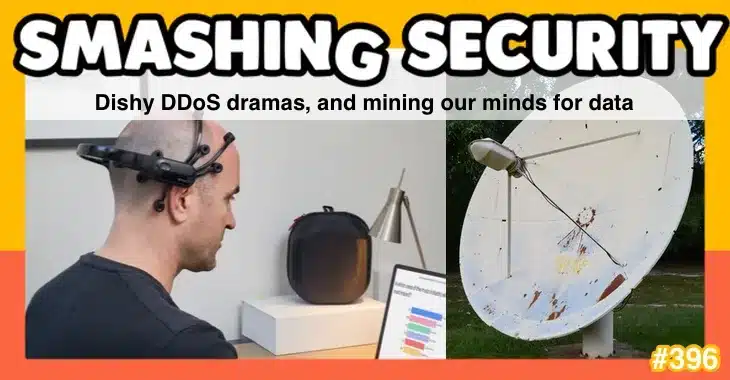
A CEO is arrested for turning satellite receivers into DDoS attack weapons, and we journey into the world of bossware and “affective computing” and explore how AI is learning to read our emotions – is this the future of work, or a recipe for dystopia?
All this and more is discussed in the latest edition of the “Smashing Security” podcast by cybersecurity veterans Graham Cluley and Carole Theriault.
Warning: This podcast may contain nuts, adult themes, and rude language.
Show full transcript ▼
 This transcript was generated automatically, probably contains mistakes, and has not been manually verified.
Smashing Security, Episode 396: Dishy DDoS Dramas and Mining Our Minds for Data with Carole Theriault and Graham Cluley. Hello, hello, and welcome to Smashing Security, episode 396.
My name's Graham Cluley.
But you have us, we're here.
Now, coming up on today's show, Graham, what do you got?
He'd drive me around the town, you know, we'd get up to our antics.
And I'd, you know, I was in the passenger seat and I'd think, what's he listening to on the radio?
Because I could hear some sort of sitcom he was listening to, some sort of radio show. And I realised it was Dad's Army that he was listening to.
And I looked across at him and I saw he was balancing a tiny portable TV on his steering wheel. While he was driving me around.
And just chuckling away because he loved Dad's Army so much. And I obviously, I made representations. So I explained to him that maybe this wasn't a good thing to do.
Maybe he should stop doing that. But he loved TV. He absolutely adored it. This was before the days of smartphones and things like this. This was a TV with an aerial.
And one day he literally went through someone's front window, like the bay window.
You'd go down the path and he had hundreds and hundreds of videotapes of all kinds of shows that he'd recorded.
And because he was Syrian, he loved to know what was going on in the Middle East. And it was round about the time that Iraq invaded Kuwait. It was the Gulf War.
It was all kicking off. And he'd be up all night and he'd be recording all the news broadcasts. He'd be watching Middle Eastern comedy shows.
And he did this via this enormous satellite dish.
And you don't really see satellite dishes around anymore, do you? You don't really— I mean, they're still attached to the side of buildings here in the UK.
Many people will have one which they had put up in the '90s, maybe. But a lot of people don't use satellite TV any longer, do they? Because they're on broadband instead.
But most people are probably now streaming instead, rather than having TV beamed down from a satellite.
What I didn't know was that South Korea, which is the home of K-pop and kimchi and things, is also apparently a hotbed for satellite receiver manufacturing till this day.
And there are companies out there still doing it, and they have been doing it for years. So this is the story of two companies.
Let's call them Agatha and Barry. All right? And Agatha is a corporation which is known for illegal broadcasting. Okay?
So, there are companies now who are beaming out, either via satellite dishes or via the internet, streams of TV channels and things which you normally would have to pay a subscription for.
And according to Korean police, they are a mid-sized player in the global satellite dish market. Who knew Barry was such a big player?
And this week, South Korean police have arrested 5 key individuals from Barry. By the way, it's not Barry in South Wales. This is, but Barry's just the code name for Company B. Yeah.
Now, what's wrong with exporting satellite dishes, you may ask? Even if Agatha does end up using them illegally, you would think the sale of those satellite dishes is legal.
I would think so.
And it turns out that back in November 2018, Agatha, the illegal broadcast company I told you about, they believed they were being targeted by some of their business rivals.
And so they made a special request of Barry, the Korean satellite dish manufacturer. And they said, "Here, Barry, can you build us a special satellite dish?"
You could do it against a website, you can do it with other things which are connected to the internet as well.
And it not only shipped satellite dishes which had this hidden DDoS attack functionality, but it also pushed out to other users, other customers of its devices, firmware updates, which added the DDoS functionality.
I guess, my guess is that it's easier for a satellite device manufacturer to give everybody the same functionality. You just don't necessarily have to tell everyone about it.
So it's there hidden away, but it doesn't necessarily have to be used. You don't have to advertise the fact that, oh, now it does DDoS too.
So now the Korean police, they uncovered this scheme after—well, they received some intelligence from Interpol.
And apparently one of the suspects was placed on an international wanted list. And so Korean police are all over this. They've arrested people.
It turns out that between January 2019 to September 2024—
I would imagine many of these devices are connected to the internet because that's an easier way to update the firmware, but if they're not, it may be that the owners of these devices toddle out with a USB stick occasionally and install the latest firmware update and aren't aware of everything that it's doing.
But I think most of us probably don't think so much about malware that can be brought in via hardware that you purchase.
I remember years and years ago working for a data recovery company where we bought a new hard drive.
And the drivers which came with the hard drive were already infected with malware, whether accidentally or not.
I imagine it was accidental, but in this case it was deliberate, it was intentional, and to launch these criminal attacks.
And I think often people just think, oh, I'm not even gonna worry about what the hardware brings in because it's so hard to manage and control that particular problem.
I'm gonna worry more about traditional attack vectors instead.
The boondocks or whatever you call it, out in the hinterland, who don't have a decent internet connection, they might have a satellite dish.
Mind you, if they don't have an internet connection, how are they launching the DDoS attack? Is it being beamed up to the satellite? There's so many questions here.
I want to know more.
This is what we have to do to get the show to you each week. Carole, what have you got for us this week?
The number of people I speak to now who should be at the top of their game because they are talented and good at what they do—
So the Institute for the Future of Work, so the IFOW, they have issued a very interesting report published this week, and it talks about the advancement in digital profiling thanks to algorithms and datasets.
And by digital profiling, they're talking about collating a glut of data on you and your activities for all manner of reasons.
I'm sure there were some ways they were monitoring us, but it was pretty rudimentary compared to what there is today.
Such as analyzing the text of workers' emails and social media use and even gathering some biometric data. But of course, things accelerated, right?
The rise of remote working and a reduction in human contact during COVID lockdown— God, I don't miss those days at all.
But anyway, so this was a big growth period for bossware, and presumably because bosses were panicking that their workers were going to take the mickey.
They wanted to know who was working, what they were working on, how long they were working on it, et cetera, et cetera.
And why not use this wonderful bossware stuff to monitor all of this for you? So we have the obvious here of why they do this, right?
Keep tabs on worker productivity and work behaviors. But there are other rationales for bossware that have been made. So there's health and safety, monitoring wellness and fitness.
Protecting trade secrets, so make sure someone's not cutting and pasting something that they shouldn't be. Spotting deviant offsite behavior.
So I guess that's someone not showing up, not doing any work.
So remember earlier I mentioned the concern over advancement in digital profiling thanks to algorithms and datasets.
So I'll list out a few that the paper outlines, and you tell me how uncomfortable you are with this, maybe from a scale of 1 to 5.
So, SenTrack and SwipeSense— that's a really bad name, SwipeSense— both have systems that can be deployed in hospitals to aid hygiene management.
Remember, you gotta wash your hands. What do you reckon?
But if we take it out of that use case, there's nothing stopping another company using these kind of stuff, right?
This is used as a safety measure to prevent crashes or poor usage of heavy machinery by alerting workers that they're getting drowsy.
And gain analytics on fatigue management initiatives and productivity optimisation. George has yawned 10 times in the last 5 minutes.
So you have to wear this and it's monitoring how hard your brain is working.
This is what they tell enterprises because of course this is available for companies as well to buy for their employees.
They say our team of PhD neuroscientists, data scientists, and EEG technologists are dedicated to accelerating your research and product development.
Offering you a bridge to the untapped potential of the human mind. And guess who your guinea pigs are, Mr. Enterprise? Your workers.
They've collaborated with Emotiv, with a V, no E, to integrate a computing interface to analyze workers' brain states and give real-time feedback on stress levels to employees and their managers.
Zoom has added a feature that detects emotional states via Emotion AI, which involves machine learning to detect and analyze human emotions, typically through facial expressions, voice tones, and body language in virtual communication.
I'm sure they never get it wrong.
And the thing, as you say, right, as you say, you can guess and listeners have guessed that all this monitoring and prompting and analyzing is not necessarily very good for the well-being of the worker.
And the report states as much.
It seems that most employees believe that AAM has forced them to work faster, to do more than they can handle, and to meet tighter deadlines, and to change their work habits.
Slightly more than half of the respondents believe their personal life is invaded by work technologies.
So the surveillance tech stresses you out and then they measure that you're stressed out and they gather that information, process it to tell you you're stressed out and that you're not performing.
Like, you know, there's the loop of it.
Because that's how you get people de-stressed, calm down.
I think they stopped him from putting information on LinkedIn that he actually worked at Apple.
Yeah, you're going to have to install this on your devices.
Some people were saying there are already laws in place that people could be using. There's actually a fab long-form blog from our friends at 1Password that's worth checking out.
Links in the show notes. All about this and legality of it. But in short, I'm not a fan. I think bossware might be an AKA spyware. I mean, let's be honest.
And right now, whether or not there are laws in place, no one seems serious about stopping it yet. I haven't seen any big kind of we're going after the bossware dude.
Wouldn't it be nice to know that you were communicating to the right people so you can deploy resources to areas where they are most needed?
And wouldn't it be nice to have all this delivered out-of-band so there is continued communication even if your own infrastructure is compromised? The answer is yes, yes it would.
Say hello to BlackBerry's SecuSuite.
Certified to meet the highest security requirements, SecuSuite protects against threats to enterprise and local and national security by enabling secure communications on conventional mobile devices.
With BlackBerry's SecuSuite, employees can make secure phone calls and exchange secure messages, including group chats, on the devices that they already carry. How cool is that?
Find out more at smashingsecurity.com/blackberry. And thanks to BlackBerry for sponsoring the show.
So my next question is, how do you keep your company's data safe when it's sitting on all of those unmanaged apps and devices?
Well, 1Password has an answer to this question, and it's called Extended Access Management.
1Password Extended Access Management helps you secure every sign-in for every app on every device because it solves the problems traditional IAM and MDM can't touch.
Go and check it out for yourself at 1password.com/smashing. That's 1password.com/smashing. And thanks to the folks at 1Password for supporting the show.
Imagine taking a proactive deny-by-default approach to cybersecurity, blocking every action, process, and user unless specifically authorized by your team.
ThreatLocker helps you do this and provides a full audit of every action for risk management and compliance.
Onboarding and operation is fully supported by their US-based support team.
Stop the exploitation of trusted applications within your organization to keep you running efficiently and securely.
Worldwide, companies like JetBlue trust ThreatLocker to secure their data and keep their business operations flying high.
To learn more about how ThreatLocker can mitigate unknown threats and ensure compliance for your organization, visit smashingsecurity.com/threatlocker.
That's smashingsecurity.com/threatlocker. And thank you to ThreatLocker for sponsoring the show.
Could be a funny story, a book that they've read, a TV show, a movie, a record, a podcast, a website, or an app. Whatever they wish.
It doesn't have to be security related necessarily.
I think I was on Blue Sky checking out the feed, loving Blue Sky, and someone posted a link to a documentary all about a retail department store in the United States.
Now, most retail stores are pretty bland, aren't they, these days? Corporate and dull, you know, if you've been to one Tesco's or Walmart, you've been to them all.
Turns out, doesn't have to be that way.
There was, between the mid-'70s and the 1990s, a company which had over 200 stores across America, and its feature stores were quite unique in terms of their bizarre architecture.
And there are a few documentaries up on YouTube about these buildings.
And Carole, what I've done is I'm sharing a few photographs of some of these buildings with you so you can check them out. And— Oh, wow. Yeah. Yeah, yeah.
So, you are looking, for instance, right now at an image of a big concrete store, right? You can imagine that great big cube or rectangle, you know, cuboid kind of thing.
And it's like a piece of Lego. There's a corner of it which has been sort of ripped out. You can see all the jagged pieces, right?
You're actually looking at a photograph there of the opening day when they let off loads of balloons.
So that bit you can see of the corner used to come out on tracks at the opening of the store and then would close to make a perfect—
There was another one I saw, which was actually sort of built in a forest. So you have the front of the store, and behind it is the forest.
So you go through the front of the store, and then you're in a forest, and you carry on, and then you walk into the store. And it's all open up to the elements.
And they're— in the documentaries, you hear about people who used to go to the fire brigade, because they'd have driven past, they'd be a stranger to the town, and say, oh my God, I think this building is falling down.
It's sort of peeling away from itself. And they'd say, oh no, hang on. No, no, no, you don't have to worry.
And fellow cribbage lover who wrote in about a recent pick of the week of mine, the card game cribbage, which I still play very regularly.
And he also recently learned about the game during COVID lockdown and is pretty enthusiastic, just like me.
And Mark O recommends a book called Play Winning Cribbage by Delynn Colvert. So link in the show notes. And he's advising me to read this so I can kick my husband's butt at the game.
So love that strategy. Because we're planning a mini tournament over the Crimbo Halls.
And as an extra pick of the week, I have found a much better cribbage app than the one I recommended about, I don't know, two months ago, where you can play with hints or with muggins.
Muggins is where you get penalized if you can't count properly, which turns out that happens to me all the time. But the app is called Cribbage Classic by Games by Post LLC.
So link in the show notes for that too.
Oh, that's my pick of weeks.
And don't forget, to ensure you never miss another episode, follow Smashing Security in your favorite podcast app, such as Apple Podcasts, Spotify, and Pocket Casts.
It's their support that helps us give you this show for free.
For episode show notes, sponsorship info, guest list, and the entire back catalog, more than 394 episodes, check out smashingsecurity.com. Smashingsecurity.com.
Hosts:
Graham Cluley:
 @grahamcluley.com
 @
@
 / grahamcluley
Carole Theriault:

Episode links:
- Korea arrests CEO for adding DDoS feature to satellite receivers – Bleeping Computer.
- Data on our minds: affective computing at work – IFOW.
- How Much Does ‘Bossware’ Really Curb Remote Work Slacking? – Inc.
- MN8 – 2 Channel EEG Headphones – Emotiv.
- Commercial EEG Headsets for Enterprises – Emotiv.
- ‘Bossware’ computer tracking devices harm workers’ wellbeing, says report – The Times.
- Your Company’s Bossware Could Get You in Legal Trouble – 1Password.
- The Abandoned, Apocalyptic Architecture of One Bold 1970s Retail Chain – Atlas Obscura.
- Bankrupt – BEST Products Co. – YouTube.
- Defunct BEST Products Store Architecture Documentary – YouTube.
- Play Winning Cribbage – Amazon.
- Cribbage Classic – iOS App Store.
- Smashing Security merchandise (t-shirts, mugs, stickers and stuff)
Sponsored by:
- 1Password Extended Access Management – Secure every sign-in for every app on every device.
- BlackBerry – Tune in and empower your team with the knowledge to stay connected, no matter what crisis. Learn more about BlackBerry’s critical event management solutions.
- ThreatLocker – the Zero Trust endpoint protection platform that provides enterprise-level cybersecurity to organizations globally. Start your 30-day free trial today!
Support the show:
You can help the podcast by telling your friends and colleagues about “Smashing Security”, and leaving us a review on Apple Podcasts or Podchaser.
Become a Patreon supporter for ad-free episodes and our early-release feed!
Follow us:
Follow the show on Bluesky, or join us on the Smashing Security subreddit, or visit our website for more episodes.
Thanks:
Theme tune: “Vinyl Memories” by Mikael Manvelyan.
Assorted sound effects: AudioBlocks.