


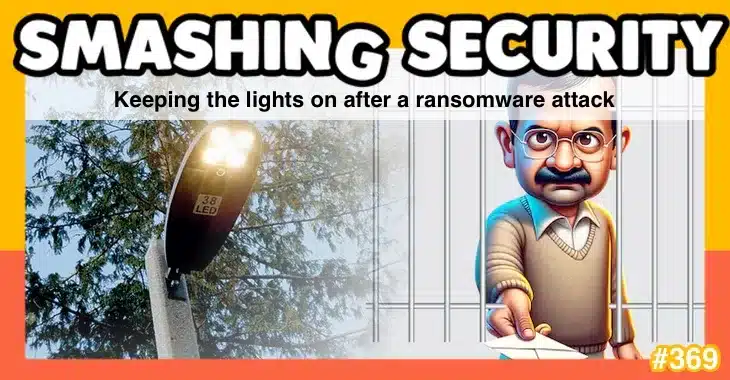
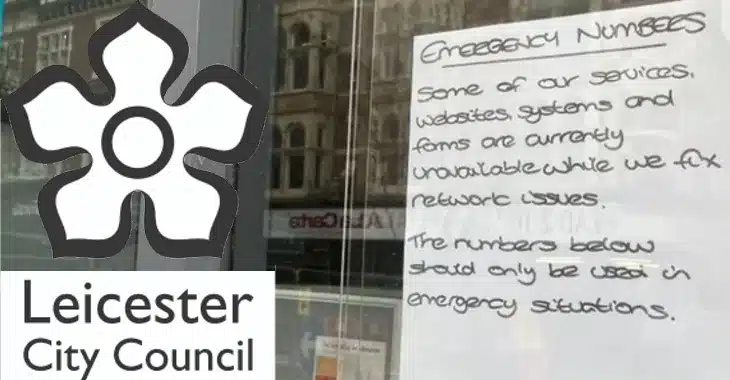
Leicester City Council suffers a crippling ransomware attack, and a massive data breach, but is it out of the dark yet? And as election fever hits India we take a close eye at deepfakery.
All this and more is discussed in the latest edition of the “Smashing Security” podcast by cybersecurity veterans Graham Cluley and Carole Theriault.
Warning: This podcast may contain nuts, adult themes, and rude language.
Show full transcript ▼
 This transcript was generated automatically, probably contains mistakes, and has not been manually verified.
Hello, hello, and welcome to Smashing Security episode 369. My name's Graham Cluley.
It's this app called Merlin Bird ID." Anyway, so I come — I'm home from my adventures and I have 3 baby robins in my garden. And they came into the house. They flew into the house.
I was a total — what's the Disney girl that has all the — Cinderella?
I had all these tiny little birds flying around in and out of my house and it was gorgeous. So happy spring everyone from England.
So let's thank this week's wonderful sponsors, Kolide, Sonrai, and Vanta. It's their support that helps us give you this show for free.
Now, coming up on today's show, Graham, what do you got?
When a crippling cyber incident, as they like to call these things, forced it to shut down its IT systems and phone lines. And it had some real, very real-world impacts.
Charities reported they were unable to support vulnerable homeless people as a result of the infrastructure being shut down. You know, it's obviously really serious.
And care homes were warned that payments of hundreds of thousands of pounds could be delayed. So their funding was being delayed due to the incident.
All kinds of nastiness being caused by a ransomware attack. Surprise, surprise.
And by the end of last month, the council was still being tight-lipped about whether any data had been breached during the attack.
And of course, normally these days, if you get a ransomware attack, you will have some data stolen at the same time because it increases the opportunities for the criminals to extort some money out of you.
You have to give your information to the council because, you know, you want your bins picked up and, you know, you have to pay your council tax and all the rest of it.
Having described 25 documents as having been taken as a very serious matter, they needed a whole new way to describe the fact that 1.3 terabytes of data was now being published on the leak site by the ransomware gang.
IncRansom is their name. Very corporate.
And Leicester City Council can't rule out the possibility that yet more data might be leaked in the future.
In fact, IncRansom, the criminals, they claim that they've taken 3 terabytes of data. It's a huge amount of data to take from a network.
25 documents, 1.3 terabytes, maybe up to 3 terabytes.
So you can understand why some people might think that the attackers sent the council back to the dark ages and whether it can do enough to keep the lights on.
In fact, residents of Leicester may be considering donning sunglasses due to a state of perpetual brightness in the city. Now, why might that have occurred?
It's not continental drift. They're not now up in the Arctic Circle.
He told the Leicester Mercury that the streetlights down his neck of the woods have been turned on constantly. So he complains to the council.
I imagine Roger complains quite a lot about things to the council. He hasn't got much to do.
And he said that they got back to him and said the ransomware attack had attacked and affected the central management system and that the streetlights were, quote, misbehaving.
I'm not Roger Evans, but it's not like it's giving light pollution, is all I'm saying.
And some of these newer streetlights with the LED, you know, it's all "Oh, designed to save energy and everything." And it's "Oh my goodness, that's so bright." Can't cope with that.
You end up having to buy really thick curtains, don't you, Carole?
This is due to a technical issue related to the recent cyberattack.
When we were forced to shut down our systems, it means we are currently not able to remotely identify faults in the street lighting system." What?
I bet streetlights have got a default password. I bet they're streetlights. I bet they're roadwork signs.
I thought, surely I remember as a kid there was streetlights outside my bedroom window. You know, it was a decent enough distance, didn't keep me awake.
But I noticed it would come on when it got to about dusk and then turn off again in the morning. And it was a different time every day.
You know, it would slightly change over the weeks. You'd notice it slightly.
And, well, there's a very simple reason I suspect why they're not doing that anymore.
So the team at Leicester City Council and elsewhere have thought, well, what we should do is we should connect all the streetlights. Because it's all smart cities, right?
It's everything's got to be connected, everything's gotta be connected, that's brilliant, let's connect everything.
And then from one central place, we can find out if they're faulty.
We don't have to send a man round to clean them, we don't have to send a man round to see if they're not working, we don't have to man phones, because obviously there'll be a hotline for people to report broken streetlights.
There is a school in Massachusetts which had 7,000 of its lights left on for over a year because no one could work out how to turn them off.
It cost thousands of dollars every month, and it caused problems when teachers were trying to play videos on the whiteboards, and some teachers resorted to unscrewing light bulbs.
The reason was they struggled to make contact with the firm that had installed this system which controlled the lights.
It changed ownership a few times, apparently, the firm, and then they waited for months and months for parts to be delivered from China.
There were supply chain issues, which obviously has been a security issue in the past.
And there were complaints at the time, "Why are we outsourcing our light bulbs, lighting systems to China?" And I mean, I don't think it was an attack, but you've gotta be careful about this sort of thing.
But the councillor said it's not gonna pay any ransom.
Frankly, they said, we're broke, even if we wanted to, we can't afford it, because like many councils in the UK, they've just got no money and there's no more money coming from central government.
I mean, what happens when the regulators start fining them over that or find them to be incompetent or they didn't encrypt properly or blah, blah, blah, blah, blah, about that data, which is now in the hands of the criminals?
He maybe should be more worried about the data they stole from him and where it's ended up.
And don't— Remember everybody, cyberattacks— I hate it when they call them cyberincidents, or there's been an IT— Just use the R word. It's a ransomware attack.
Don't be afraid. Carole, what's your topic for us this week?
The country has a parliamentary system defined by its constitution, with power distributed between the central government and the states.
So whereas the UK has a small number of official languages and where Canada has two official languages, India has 23 official languages including English, but there are apparently 780 languages spoken.
What? Imagine.
So no wonder that India's elections take upwards of six weeks and involve millions of poll workers, voting machines, and security forces to cover deserts, mountains, forests, and cities.
And India's laws also state that no voter is required or should be required to travel more than two kilometres from their home to get to a polling station. What?
According to the New York Times, they will be using all manner of transport to collect the votes, even camels or elephants, let alone helicopters and boats.
And with a billion voters, you need millions of machines, right?
It's gonna take—
The two videos have been viewed on the socials more than a million times, reported Reuters. Now, both actors have said the videos are fake.
Facebook, X, aka Twitter, and at least 8 fact-checking websites have said they are altered or manipulated, which the Reuters Digital Verification Unit also confirmed.
There was also a viral video of Rahul Gandhi's resignation from Congress that took over social media, but it was fake.
They used an AI-generated cloned voice and used an altered video of him filing his nomination papers for the 2024 polls.
So they basically took an existing video, tweaked it, added new voices to it, and tried to say, "I'm resigning from Congress." But AI is also being used legitimately by candidates.
So imagine, Graham, right? So let's say we're having an election here in the UK, right? And you pick up the phone, the phone rings, right?
You pick it up and it's a cold call campaign thingy saying vote for Rishi Sunak. So what do you do, right? You would probably, what would you do? Would you hang up?
Would you say, I'm very sorry, I'm not interested?
Ring my bloody phone and interrupt my life.
And this is what's happening right now in India, making the job of candidates much easier, all thanks to AI, because they can use AI to contact their voters in their native tongue, be it one of the 780 languages that are spoken.
But I can appreciate if you were a candidate in India going for the prime ministership, and you have 780 languages, and you speak, what, two of them, as the current prime minister apparently does?
How do you get your message across to everybody else? So AI-generated stuff could be the answer, right?
Because it can translate it into all the dialects, at least the 23 official ones. So political parties are crafting AI-generated news anchors, right?
So you even have fake news anchors to convey political messages, election promises, and manifestos. Now, when I say AI-generated, I don't mean fake.
These are advocated by the actual party. And the point is to connect with a wider voter base over live streaming on social media platforms across diverse linguistic demographics.
They're not deliberately deceptive?
And then let's slap it in and way to go.
Because I think most people do not want a call from a political candidate, right? They do not want to have that phone call.
What I would do if I were a political party, so if it were the Cluley Party, what I would do I think is I would run a campaign which rang up people pretending to be my opposition, right?
And annoy the voters with my constant phone calls pretending to be the opposition in order that I get the votes instead.
But also you've got the baddies that are trying to discredit certain parties or cause some strife using deepfakes to try and mess the whole thing up, misinformation, all that stuff.
They could just be saying, "Hey, isn't the party Van Dabby Dozy terrific?" And just the sheer fact that they've rung you up is irritating enough that you would never vote for Van de Beekdosen.
So you've given that away for free.
Yeah, because there was also on Instagram, there was an Instagram Reel featuring the current Prime Minister Modi singing a popular Bollywood song using AI.
The video depicts the Prime Minister seated cross-legged playing a guitar, and it's amassed over 3.4 million views on Instagram.
Now, as far as I understand, there's no political message in there. It's just like, oh, isn't he great? Look at him, so cute.
So if people complain, they go, "Obviously, that was a deepfake, nothing to do with us.
We wouldn't have done that." But maybe the most important thing, which is the Wild West effect at the moment, or Wild East in this situation, is there's no serious legislation to curb the misuse.
So while policymakers and regulators from Brussels to Washington are racing to craft legislation restricting AI-powered audio, images, and video on the campaign trail, a regulatory vacuum is emerging.
So the European Union's landmark AI Act does not take effect until after June's parliamentary elections.
And in the US Congress, bipartisan legislation that would ban falsely depicting federal candidates using AI is unlikely to become law before the November elections.
So I think the thing I'm, I guess I'm trying to get across is pay attention to the India elections and what happens throughout them.
Try and use reputable sources like Reuters or The Times or The Washington Post or the—
Don't vote because you don't know what you don't know. You don't know what's real. You don't know what's fake. Or you cast a vote and hope that you weren't misled.
Like, it's a bit of a nightmare for democracies the world over, and it's leaders of countries that aren't democratic that might actually win out here.
Yeah, that's a bit ominous, but there you go. So there's my cheery pick of the week.
But I would just say pay attention to see what happens there, because elections are coming in lots of our countries.
A lot of our listeners live in countries that I've mentioned, and it might be good to have an idea of what actually happens there, because trust me, the bad guys are paying attention too.
At both local elections, and then later in the year, there's at some point to be determined, there's going to be a general election as well.
And it's quite interesting, this whole, are we going to begin to see fake news?
Now, there's a particular political party which isn't doing terribly well in the polls at the moment compared to their current allocation of members of Parliament.
I'm not going to name any names. But what's interesting is the things which come through the door, they've really disguised which political party they're from.
So if it's the incumbent who isn't doing terribly well, you have to look really, really hard to actually work out, well, which political party is this person actually represent— oh, it's that one.
'Cause they don't want to mention it 'cause they know that that's not taken the right way.
So I wonder if we will see fake, you know, deepfake and AI technology somehow getting around that problem as well.
But I suspect that's going to get much, much harder to spot with the naked eye in years to come.
Now you can assess risk, secure the trust of your customers, and automate compliance for ISO 27001, SOC 2, and more with a single platform. And that platform is Vanta.
Vanta's market-leading trust management platform helps you continuously monitor compliance alongside reporting and tracking risk.
Plus, you can save hours by completing security questionnaires with Vanta AI.
Join thousands of global companies like Atlassian, Flow Health, and Quora that use Vanta to automate evidence collection, unify risk management, and streamline security reviews.
Smashing Security listeners get 20% off Vanta. All you have to do is go to vanta.com/smashing to claim your discount. That's vanta.com/smashing.
And thanks to Vanta for supporting the show.
Sonrai Security just made achieving least privilege easy with the Cloud Permissions Firewall, a scalable solution that easily restricts excessive permissions from human and machine identities, quarantines unused identities, and disables unused regions and services without any disruptions.
Even better, the solution maintains this level of risk reduction by automatically enforcing least privilege policies as new identities are added to the environment. What's better?
The fact that you can test drive Sonrai's Cloud Permissions Firewall for free for 14 days. Just visit smashingsecurity.com/sonrai. That's smashingsecurity.com/sonrai.
That's S-O-N-R-A-I.
Well, that's pretty big news since these two companies are leading the industry in creating security solutions that put users first.
For over a year, Kolide Device Trust has helped companies with Okta ensure that only known and secure devices can access their data.
And that's what they're still doing, but now as part of 1Password. So if you've got Okta and you've been meaning to check out Kolide, now's a great time.
Kolide comes with a library of pre-built device posture checks and you can write your own custom checks for just about anything you can think of.
Plus, you can use Kolide on devices without MDM, your Linux fleet, contractor devices, and every BYOD phone and laptop in your company.
Now that Kolide is part of 1Password, it's only going to get better. Check it out at kolide.com/smashing to learn more and watch the demo today. That's kolide.com/smashing.
And thanks to them for supporting the show. And welcome back. Can you join us at our favorite part of the show? The part of the show that we to call Pick of the Week.
Could be a funny story, a book that they've read, a TV show, a movie, a record, a podcast, a website, or an app, whatever they like.
It doesn't have to be security-related necessarily.
I had the flu this weekend, so I was cuddled up on the sofa, and I thought, 'What can I do?' to make myself feel better. And so I watched 12 Angry Men.
Have you ever seen 12 Angry Men?
If he is found guilty, he's gonna be sentenced to death. And I'm sure many people already know this.
Some, many of you may already have watched it, but for you youngsters who listen to the podcast who haven't got around to watching it yet, or people me who are sort of quite mentally young and culturally young, you may not know.
But anyway, the premise is this: at the beginning of the movie, only one of the jury believes that there is reasonable doubt about the murder charge.
Everyone else thinks that the suspect is guilty. And they also think they should be allowed to nip home early from the jury service to go and watch the ball game.
And so it's up to Henry Fonda as the one man on the jury to convince all the others—
And the trains in Canada are operated by VIA Rail. And I have to admit, I've always been a big fan, especially after coming to England, because they are staffed by lovely people.
There's a lot of staff. You know, there's people to help you on the train, people to help you put your bags away, people to direct you where you need to go.
It's just— you're never lost. You're always feeling like, I know where I'm going and I know what I'm doing and I know where my seat is.
Now, the only drawback of these trains, and I'll admit this now, is they're not nearly as frequent as trains in Europe.
So you have to plan your journey a little more carefully so you don't end up waiting somewhere for hours. Anyway, I take the train. Great experience.
Get to the airport on time and then end up getting some food because the plane is delayed by a few hours. I know, right? So whatever. We have some food.
We go through the secure area and I'm getting ready to fly. And I realize I do not have my wallet.
And now I'm out of contact with the world for seven hours. And in the wallet, I had a number of important cards, banking stuff and all that.
I had my driver's license, and I had a lot of cash because I'd sold a few paintings while I was out in Canada. So nightmare, just annoying.
So when I get home, I'm jet lagged as anything 'cause it was a full flight. They basically put two flights onto one. So we were sitting sardines on an overnight flight.
But I start calling banks to cancel cards. And they were all, aside from one, Barclays, relatively easy to do with new cards being dispatched instantly.
So I get some shut-eye because I'm jet-lagged. I haven't slept. I get to sleep for a few hours. I wake up and I have a lovely email from the people at Via Rail.
I get this email from Via train agent Raphael, emails me to say they have found my wallet on the train at the end of the line and requests that I get in touch with them on how they can get it back to me.
I tell them, I'm out of the country. Could a family member in a completely different city pick it up? Yes, no problem.
The wallet was on the train the next day to be delivered to the station of my request. Now, my question in my head is, will the cash be in there?
Because who knows how the wallet got into the hands of the lost and found Via Rail. It could have been somebody.
Raphael, and if you find yourself in Canada, I do think you should check out the trains just to see how to do them right, because it is a really lovely experience.
I might even do a cross-Canada, east to west on the train sometime because it's so comfortable.
But did they charge you anything for delivering your wallet to the sovereign?
Because maybe if you want to deliver a package or a parcel across Canada, maybe what you do is just leave it on any old train and wait for Via Rail to get in touch with you and say, oh, could you deliver it to a family member in Vancouver?
And they'll say, sure, we'll organise that. And then it gets over there and you don't have to pay anything.
I'm not surprised at all that you've done that. Anyway, Via Rail is my pick of the week. Thank you very much, Raphael.
Thank you to everyone who helped find it and return it to me, and I'm thrilled.
You follow us on Twitter @SmashingSecurity, no G, Twitter allows to have a G. And don't forget to ensure you never miss another episode.
Follow Smashing Security in your favorite podcast apps, such as Apple Podcasts, Spotify, and Pocket Casts.
For episode show notes, sponsorship info, guest list, and the entire back catalog of more than 368 episodes, check out smashingsecurity.com.
Hosts:
Graham Cluley:
 @grahamcluley.com
 @
@
 / grahamcluley
Carole Theriault:

Episode links:
- When a breach goes from 25 documents to 1.3 terabytes… – Graham Cluley.
- Leicester street lights stuck on all day due to cyber attack – Leicester Mercury.
- Top AI researchers race to detect ‘deepfake’ videos: ‘We are outgunned – Washington Post.
- AI deepfakes threaten to upend global elections. No one can stop them – Washington Post.
- Models, dead netas, campaigning from jail: How AI is shaping Lok Sabha polls – India Today.
- Why Elections Take So Long in India – The New York Times.
- How A.I. Tools Could Change India’s Elections – The New York Times.
- Bollywood deepfakes fuel AI election meddling fears in India – GG2.
- World Explained: How India’s politicians are using AI to reach voters in the world’s most populous country – The Scotsman.
- 12 Angry Men – Wikipedia.
- VIA Rail.
- Smashing Security merchandise (t-shirts, mugs, stickers and stuff)
Sponsored by:
- Sonrai’s Cloud Permissions Firewall – A one-click solution to least privilege without disrupting DevOps. Start a 14 day free trial now!
- Vanta – Expand the scope of your security program with market-leading compliance automation… while saving time and money. Smashing Security listeners get 10% off!
- Kolide – Kolide ensures that if your device isn’t secure it can’t access your cloud apps. It’s Device Trust for Okta. Watch the demo today!
Support the show:
You can help the podcast by telling your friends and colleagues about “Smashing Security”, and leaving us a review on Apple Podcasts or Podchaser.
Become a supporter via Patreon or Apple Podcasts for ad-free episodes and our early-release feed!
Follow us:
Follow the show on Bluesky at @smashingsecurity.com, or on Mastodon, on the Smashing Security subreddit, or visit our website for more episodes.
Thanks:
Theme tune: “Vinyl Memories” by Mikael Manvelyan.
Assorted sound effects: AudioBlocks.


Graham, I would be your friend and have a coffee with you! lol
Carole, I know the horror of losing a wallet (maybe not with as much money as you had as I am NOT artistic) and am so delighted that your experience has ended the way it did! My maternal grandmother instilled in me from a very young age, the love of travelling by trains in Canada and I have never experienced any misadventures in using VIA!