


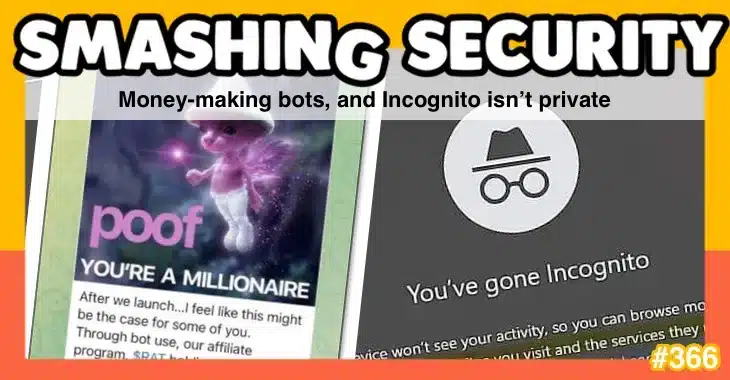
Google says it is deleting your Google Chrome Incognito private-browsing data that it should never have collected anyway. Can a zero-risk millionaire-making bot be trusted? And what countries are banned from buying your sensitive data?
All this and much much more is discussed in the latest edition of the “Smashing Security” podcast by cybersecurity veterans Graham Cluley and Carole Theriault, joined this week by Host Unknown’s Thom Langford.
Warning: This podcast may contain nuts, adult themes, and rude language.
Show full transcript ▼
 This transcript was generated automatically, probably contains mistakes, and has not been manually verified.
My name's Graham Cluley.
Now coming up on today's show, Graham, what do you got?
In an instant. I can make you a millionaire. What would you think to that?
Just give them a bit of money, they will make this bot, and it will just churn out the money. Sounds too good to be true, doesn't it? Sounds slightly implausible.
I don't know.
Now I'm sure you really think it's going to happen, don't you?
That there's someone called Rob Rob? It's a bit like being called Robin Banks.
And he managed to trick millions out of people for that. So he spent time in jail in the past. But you'd trust him, though, wouldn't you now?
Because now he's talking about cryptocurrency and a magic money-making scheme involving cryptocurrency. Well, Rob Rob has been arrested by the FBI.
Because he said he was going to build— now, I'm going to try and avoid using too much technical language. There will inevitably be some things which zoom over your head, Thom.
Carole, you may be able to follow some of this. But so, okay, he wanted to build a magical thingamajig that traded crypto with guaranteed profits.
This bot, he claimed, could predict what cryptocurrency people were going to buy and sell before they did it, and even hijack transactions.
And in this way, his bot would actually make the purchases itself and make millions for those people who funded the scheme to create the bot.
So the bot is going to do all your investing for you, probably using AI, probably using the blockchain.
He said, "Poof, you're a millionaire." And he targeted people who he said had spare hundreds of thousands of dollars lying around.
So people like you, Thom, top podcasters, CISOs, those sort of people, lots and lots of money lying around.
So he said that investors could become millionaires through a combination of this bot investment into cryptocurrency.
The cryptocurrency was called RAT, R-A-T, and a cryptocurrency token called NoRugs.
Well, that's because there have unfortunately been some scams involving cryptocurrency where the rug has been pulled from under people and where scammers have actually disappeared with people's money.
And so he wanted to reassure people that he wasn't that kind of person. By calling his token NoRugs.
But he said it was theoretically good enough to make everyone rich.
So I think we should take a moment to appreciate that beautiful phrasing, capital-intensive prototype that was theoretically good enough to make people rich.
You know, in theory it's good enough, but maybe not in practice.
And the best thing about all of this is that Robert Robb, having got this money, having got $1.5 million, he's alleged by the FBI not to have actually bothered to build anything.
He didn't actually build a prototype.
He's not even buying rugs. What is wrong with this guy? There's no rugs being bought.
Well, the investors started getting restless and Rob, when challenged, he started playing the victim card. He says, oh, you know, I've had COVID, my safety's been threatened.
There's been some glitches on the exchange. There's people extorting me. I've got problems with the family.
There was always an excuse when investors were saying when are we going to see the outcome of all of our investment?
And once again, this is really a story of how common sense has been flung out of the window by people who are so desperate to get rich quick with cryptocurrency.
I don't know, I don't want to call it dumb, but their gullibility really knows no bounds. And this was all built on hype and little substance.
He's the greedy, greedy guy who's going around faking that he can help people, and a lot of people have gotten rich on crypto.
And in fact, if you go and look on his Twitter account, I think he calls himself something like Poker Brat because he was obviously into casinos back in the day when he was scamming people with his casino machine.
And he's frequently warned his followers, look out for crypto scams anyway, which is kind of ironic, I think.
I didn't just rely on somebody saying, I'll do this for you and I'll make you loads of money.
Well, I don't know how it was meant to work, but it all sounds very, very peculiar.
I know it's going to leave many of our listeners completely dumbfounded that anything to do with cryptocurrency could end up being a bit of a scam.
So the headline, this is from Wired, it says Biden bans rival nations from buying sensitive US data.
And at first glance, you think, well, good, you know, rival nations, you know, bad state actors, shouldn't be buying sensitive data.
But then when you look into it, what's actually happening is that he's putting in place a ban that stops the valid sale of personal, sensitive, and potentially confidential information to people that basically they don't want to.
So capitalism is good until it's not, and we don't want it to go to certain people. But what I'm really shocked about is by how much our personal data is sold.
So the data they're talking about is, for instance, healthcare data. So some of your most private details potentially are being sold, not just nationally, but internationally.
And what Biden stopped doing, and it's a good thing on the whole, but it's kind of a bit closing the barn doors after the horse has bolted, is just stopping this sale to certain countries.
And that the brokers that sell this data have to do more homework to ensure that it's sold to the right people. And a tentative list given to reporters.
So, basically what they're saying is, you can't sell people's most sensitive and confidential of data to these 6 countries.
And you're thinking, surely we shouldn't be selling this data to any countries. Yeah, not just these.
And it just occurs to me that I think we have reached the tipping point whereby our personal data is now no longer our data. It no longer belongs to us.
And I'm sure, you know, America is very often a little bit of a litmus test for this sort of stuff.
And I'm sure, you know, there are European countries, certainly in the EU, are probably a little better protected than the US.
But on the whole, I think we are seeing exactly where things are going as regards how our personal data is gathered, stored, and subsequently treated, i.e., sold afterwards.
And it's going to— it's just going to get worse. But I honestly think it's— we're now at that position where we do not own our own data. Anymore.
So this is data that's been gathered by these huge organizations, hospitals, and, you know, well, that's, you know, obviously it's that they're private companies in the US, you know, rather than sort of national institutions.
But, you know, that's how they're making money.
So yeah, I think my whole point of this is I think we've lost, frankly. It's very depressing. I think we've lost.
And I think we're now going to be living in a society where our data is not our own.
It might be very different for your kids or maybe even their kids, unfortunately.
Our boundaries were far, far tighter and closer to us, whereas now our boundaries are, well, almost limitless as regards geographical boundaries. Things will change.
And everything, you know, business evolves and lifestyles and cultures, etc., evolve. But right now, I think it just sucks a little bit.
You must have used it at some point.
And I was using it for things like, you know, buying presents for people and not wanting them to see it and all this kind of stuff.
And I started looking around, on this request on Quora, from 2008. And the sender asks, why does my husband use incognito mode in his browser?
Or you can just presume he's surfing porn. That might be easier, right? So FNAF, FNAF, FNAF. But I would say that's most people's assumption.
So when you select incognito mode on Chrome, at the time, it would provide this thing saying you're browsing privately. And it would say not saved.
History, searches, cookies, and temporary files. And it says it does save downloads and bookmarks.
And it does even give a private note saying, please note that your employer or your internet service provider can still track the pages you visit.
Now, unfortunately, it turns out that incognito mode in Chrome was found to be a little less private than the average user might have assumed based on this display screen.
And people got kind of mad, so mad that they sued. And this all began in June 2020, right, in Northern District of California.
And the plaintiffs argued that Google's analytics, cookies, and apps let Alphabet, the parent company of Google, track the activities even when they set their Google Chrome browser to incognito mode and other browsers to private browsing mode.
The plaintiff said this turned Google into an unaccountable trove of information by letting companies learn about their friends, their hobbies, favorite foods, shopping habits, and potentially embarrassing things, right, Thom?
That some things that take 2 minutes in your case that they seek out online.
Because that seems to be what most people are using incognito mode for rather than the other stuff.
They also accused Google of taking a Chrome user's private browsing activity and then associating it with their already existing user profiles.
Oh my goodness.
Now, Google initially attempted to have the lawsuit dismissed by pointing to the message displayed when users turned on the Chrome incognito mode, that start page we talked about, that warns users saying their activity might still be visible to websites you visit, right?
Yeah, but the judge totally rejected this.
And eventually, years later, okay, Google agreed to settle the lawsuit claiming it secretly tracked the internet use of people who thought they were doing their browsing privately.
So instead, individuals will be able to pursue damages by filing their own complaints against Google in US state courts.
Anyway, as a result of this court case, Google will expunge billions of data records that reflect people's private browsing.
This is according to the details that were made public Monday this week in a filing at San Francisco federal court.
It says Time reported that Google's agreement to retroactively delete user information is a significant concession as it forms the backbone of the company's lucrative advertising business, which depends on the quality of their attention.
But boohoo Google is my view on that.
They snuffle up all this data like a secret spy, and now they have to get rid of it all, and they're like, but what's gonna happen to our profits?
I don't feel very sorry for Google. But to your point, Graham, once it's sold, how do they get it back from the people they sold it to?
So basically the information on that start page when you go to incognito mode will be slightly more informative as to the fact that you're actually not in incognito mode.
It's just a trademark name.
I'm just gonna run it past you, see what you guys think.
So it's a pain if you wanna check your personal inbox, but you're logged into another account.
So instead of using a separate browser, which is what I probably would do, you could go into incognito mode.
They say some travel companies keep track of what you're searching for and will increase prices the next time you visit the site if you use incognito mode.
You don't have to worry about price gouging.
So I do this sometimes when I look for news stories, I might go into incognito mode just so it doesn't show me the same information that I might have seen before because it has me all, you know.
Maybe if I'd switched on incognito when I was looking for the story after you stole this one from me before, I would've come up with another story, probably less depressing.
So maybe you want to see what it looks like without all the ads they tend to show you.
Or if you're in web development and you're logged into your CMS, you may want to see what, you know, regular users would see on your website instead of what you see as a logged-in admin.
I get that.
And perhaps enabling the block third-party cookies setting might be more helpful to you. But God, do I miss the days of Do No Evil because I can understand.
I wonder if they were forced to get rid of that.
And they all look at it and there's silence around the boardroom. They go, should we get rid of this this year? No, we'll leave it for another year.
Companies that continue relying on outdated technology put their sensitive data at risk.
Well, this podcast is sponsored by KiteWorks, who enable organizations to effectively manage risk in every send, share, receive, and save of sensitive content.
To do that, they've created a platform that delivers content governance, compliance, and protection to customers, tracking, controlling, and securing sensitive content as it moves within, into, and out of organizations, all while ensuring regulatory compliance on all sensitive content communications.
KiteWorks provides the industry's first private content network for protecting risky third-party communications with secure email, secure file sharing, secure mobile, secure web forms, managed file transfer, and governed SFTP servers.
Visit kiteworks.com to get started today. That's KiteWorks.com and thanks to them for supporting the show.
Vanta gives you one place to centralize and scale your security program. Quickly access risk, streamline security reviews, and automate compliance for ISO 27001, SOC 2, and more.
You can leverage Vanta's market-leading trust management platform to unify risk management and secure the trust of your customers.
Plus, use Vanta AI to save time when completing security questionnaires. Smashing Security listeners, you get 20% off Vanta.
All you lucky sausages have to do is visit vanta.com/smashing to claim your discount. That's V as in Victor, A-N-T-A, dot com slash smashing.
And thanks to Vanta for sponsoring the show.
Well, that's pretty big news since these two companies are leading the industry in creating security solutions that put users first.
For over a year, Kolide Device Trust has helped companies with Okta ensure that only known and secure devices can access their data.
And that's what they're still doing but now as part of 1Password. So if you've got Okta and you've been meaning to check out Kolide, now's a great time.
Kolide comes with a library of pre-built device posture checks, and you can write your own custom checks for just about anything you can think of.
Plus, you can use Kolide on devices without MDM, your Linux fleet, contractor devices, and every BYOD phone and laptop in your company.
Now that Kolide is part of 1Password, it's only going to get better. Check it out at kolide.com/smashing to learn more and watch the demo today. That's k-o-l-i-d-e.com/smashing.
And thanks to them for supporting the show. And welcome back, and you join us at our favorite part of the show, the part of the show that we call Pick of the Week.
Could be a funny story, a book that they've read, a TV show, a movie, a record, a podcast, a website, or an app. Whatever they like.
It doesn't have to be security related necessarily.
I'm afraid I've got a nitpick of the week, and I apologize to anyone who follows me on Twitter or LinkedIn who may already know about this.
Because last week, beginning of last week, we decided to buy a phone for my partner, an iPhone 15. And a case.
And so for some reason or another, we went to Amazon and we got it on Amazon Prime.
And Amazon, we're with Amazon Prime and they're normally really, really good delivering things really quickly because they're just so amazing. Amazon's awesome.
So we thought, all right, let's just do this.
And if there's any problems, you know, we can send it back if you decide you don't like the iPhone, because she's currently an Android user.
And I was reassured because I've got a little video doorbell thing that goes bing bong and, you know, it records people who come here. I'd be able to hear the door going.
I also— Amazon had told me that my signature would be required to accept the delivery. And here's the thing. Here's the thing. My doorbell didn't go.
My doorbell didn't record anyone at the door. I never gave my signature to anyone. And I have not been given the iPhone, right? It wasn't delivered to me. No big deal, you think.
No big deal. Just contact Amazon customer service and get yourself a refund or a replacement set, right?
And they told me that they had handed it to resident. And so obviously I went out my front door, had a little look around, nothing left out here.
Obviously I hadn't signed for anything. Spoke to my neighbours. No, they hadn't received something.
And some of them are, you know, a bit old and doddery anyway, and they probably wouldn't know how to use an iPhone. But so, you know, I believe them.
I thought, no, they haven't got it. I haven't got it. I even looked in the bin because, you know, it's not unknown for Amazon delivery people to put things in the bin.
Especially the day before rubbish day.
So I contacted Amazon customer support and they said to me, well, you have to wait 2 days before making a complaint because maybe it'll show up.
So I waited 2 days and after 2 days I said again, can you please refund me or send a replacement? And they said, well, we're going to have to investigate this.
And that'll take up to 3 days. I thought, oh, it's a bit frustrating. All right. And they said, well, if you haven't received your refund by the end of March, let us know.
So I began to wait. Now, fortunately, I didn't have to wait 3 days to hear back from Amazon.
Unfortunately, when I did hear back from Amazon, it wasn't good news because what they said to me was, we've investigated and you received the item. It was delivered to you intact.
And I said, oh no, I didn't. That's the polite version of what I said.
And they said, "We are not going to be issuing you a replacement or a refund because you did receive it and it was in good condition.
We are unable to offer you any further assistance on this matter.
We appreciate your business and hope to see you again soon." So Amazon tells me they're not going to reply to my emails anymore. They tell me that there's no way to escalate it.
In fact, they say to me that they've all been trained in how to deal with customer complaints, and so there is no point in escalating the issue any further.
Yeah, give me my bloody iPhone or give me my money back, because they're basically saying I'm a liar, I'm a fraudster. I'm not a fraudster. I'm lovely. Okay, so I'm really upset.
I've reported it to Thames Valley Police, I've investigated making a claim by the small claims court, and I made a little video about it because I thought I'm a bit annoyed and I don't think they should be allowed to say handed to resident when they haven't handed it to resident, and that is my nitpick of the week.
But what I've been told by people who've done this in the past is Amazon sometimes, yes, you'll get your money back, but Amazon then blocks you from using their service anymore and not just their store, but all of their other services, which I think is pretty petty of them.
So at the moment, I'm not requesting a chargeback through the card. I want this to get sorted the proper way, which should be through their customer service team.
But actually, the one I came down to was, well, it's Concorde.
Basically, so any man, possibly a woman as well, but any man of a certain age has a very soft spot in their heart for Concorde, I think.
And maybe, I don't know, I'm making this up and I'm starting to panic a little bit. But nonetheless—
I used to work in Heathrow and it would take off twice a day and it was the loudest thing ever. It was just wonderful. I never got to fly on it, which is unfortunate.
I did have an opportunity once, but I love Concorde. You know, I think it's a beautiful piece of engineering.
It's amazing, you know, quite, you know, how accomplished it was and all that sort of good stuff.
So when the opportunity came for me to purchase a Lego model of Concorde, I jumped at the opportunity. And I have to say, it was one of the most fun builds I've ever done. It's huge.
It's about, oh, maybe a metre in length, something like that.
But it's, as I said, some of these larger complex models often, you know, because it's about 3,500-4,000 pieces, something like that, and they're quite small, you know, because it's quite a detailed model anyway, and some of the more complex ones actually get quite dull, you know, because you really lose track of what you're building, as it were.
But this one, you knew what everything was as you were building it. Brilliant techniques on there. The wings are what they call snot.
So I must say, Graham, anybody who's got a soft spot for Concorde, go for it.
I don't buy a lot of it because it's really rather expensive, but what a wonderful thing.
And we were talking about how annoying houses can be now because of all these machines we have that make all kinds of beeps and tweaks and stuff when they're finished working.
You know, you got the dishwasher that bleep bleep bleep and the microwave and the washing machine, the dryer.
And my girlfriend was telling me, she was talking about how annoying it is that her washing machine, which is a Samsung, actually does a tune. She was talking about this tune.
She goes, it goes on forever, this fucking tune. So if you put it on before you go to bed, it goes off at some point, right? At 2 in the morning, doing its thing.
And I'm thinking, what tune? And she goes, oh, it's F. Schubert's Trout Quintet. And I'm thinking, what?
And I said, look, don't worry, I will find someone on YouTube will have put up the exact 8-bit version that the washing machine does. And she's saying, no, they would not.
That's so stupid. And I'm saying, oh no, look here, I found it. So we're listening to this and it goes on for about 30 seconds.
Musicians of all caliber trying to post the renditions of their beloved washing machine along with their, in some cases, guitars or ukuleles, or what about a piano or drums?
My pick of the week is how wonderful people are by trying to take something very annoying, like an 8-bit music off a washing machine, and try to make it, I don't know, make it into a duet.
So this thing was going around the house going, "Fuck! Ah! Shit!"
What is the best way for folks to do that?
And don't forget to ensure you never miss another episode, follow Smashing Security in your favorite podcast app, such as Apple Podcasts, Spotify, and Pocket Casts.
It's thanks to them all that this show is free.
For episode show notes, sponsorship info, guest lists, and the entire back catalog of more than 365 episodes, check out smashingsecurity.com.
Hosts:
Graham Cluley:
 @grahamcluley.com
 @
@
 / grahamcluley
Carole Theriault:

Guest:
@thomlangford.bsky.social
@
Episode links:
- Scammer Convinced Investors to Send Him $1.5 Million to Build Magic Money Making Bot – 404.
- Biden Bans Rival Nations From Buying Sensitive US Data – Good Luck – Wired.
- 6 practical reasons to use Incognito mode in your browser – USA Today.
- Brown v. Google LLC Settlement Agreement – DocumentCloud.
- Google agrees to settle $5bn lawsuit claiming it secretly tracked users – The Guardian.
- Chrome updates Incognito warning to admit Google tracks users in “private” mode – Ars Technica.
- Google changes wording for Incognito browsing in Chrome – Malwarebytes.
- The Incognito Mode Myth Has Fully Unraveled – Wired.
- Google Agrees to Delete ‘Incognito’ Browsing Data to Settle Class-Action Lawsuit – TIME.
- Amazon refuses to refund me £700 for iPhone 15 it didn’t deliver – Graham Cluley.
- Concorde – Lego.
- Cover song: samsung dryer no. 2 – YouTube.
- Play Drums on Samsung Washing Machine Song – YouTube.
- With samsung washing machine violinist – YouTube.
- Samsung Washing Machine Song with Piano [Franz Schubert’s “Die Forelle”] – YouTube.
- Duet for harp and dryer – YouTube.
- The Washing Machine Song – YouTube.
- SAMSUNG Washing Machine collaboration – YouTube.
- Smashing Security merchandise (t-shirts, mugs, stickers and stuff)
Sponsored by:
- Kiteworks – Step into the future of secure managed file transfer with Kiteworks.
- Vanta – Expand the scope of your security program with market-leading compliance automation… while saving time and money. Smashing Security listeners get 10% off!
- Kolide – Kolide ensures that if your device isn’t secure it can’t access your cloud apps. It’s Device Trust for Okta. Watch the demo today!
Support the show:
You can help the podcast by telling your friends and colleagues about “Smashing Security”, and leaving us a review on Apple Podcasts or Podchaser.
Become a supporter via Patreon or Apple Podcasts for ad-free episodes and our early-release feed!
Follow us:
Follow the show on Bluesky at @smashingsecurity.com, or on Mastodon, on the Smashing Security subreddit, or visit our website for more episodes.
Thanks:
Theme tune: “Vinyl Memories” by Mikael Manvelyan.
Assorted sound effects: AudioBlocks.




Guys and Gal, a few comments:
Firstly, your minds seem to be in the gutter this week ?!?
Next, Money-making bots; I received something like that a while back. It offered me a free download of their Beta AI software to test and at the same time make money using it to create AI generated reviews of Amazon books… All I had to do was send them $20 US ($25 CAD) to learn how to use the software.
I declined, so I can;t tell you about it :-(
Next, Incognito mode, or whatever, I have been telling friends, family, whoever will listen that Incognito mode or whatever the browser manufacturer calls it is ***nothing more than a regular browsing window that deletes cookies, cache, etc. when you Close/Exit the browser*** :eclamation .
Now I cannot be sure if other Chromium based browsers use the same code. You could try the non-goofled version if you were inclined.
Next, the Concord, aaahhh. I had the pleasure of watching its last departure from Toronto many years ago. Wished I could have actually flown on it.
Lastly Graham I am saddened regarding the loss of your phone. Would you like me to call for you?