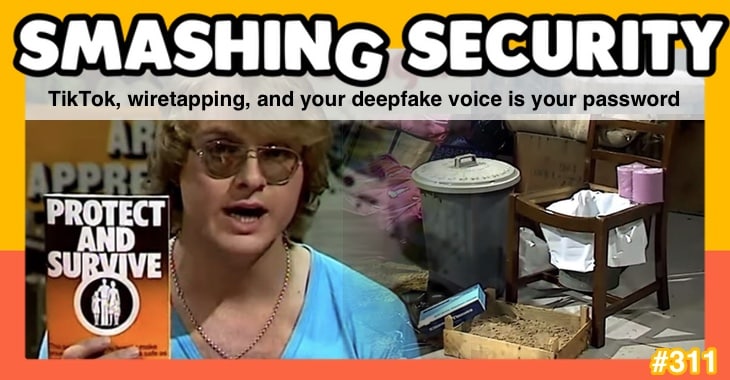
Who has been warning Italian criminals that their phones are wiretapped? Can you trust your voice to protect your bank account? And why is TikTok being singled out by investigators?
All this and much much more is discussed in the latest edition of the “Smashing Security” podcast by cybersecurity veterans Graham Cluley and Carole Theriault, joined this week by Dinah Davis.
Show full transcript ▼
 This transcript was generated automatically, probably contains mistakes, and has not been manually verified.
Smashing Security, Episode 311: TikTok, Wiretapping, Phishing and Your Deepfake Voice as Your Password with Carole Theriault and Graham Cluley.
Hello, hello, and welcome to Smashing Security episode 311. My name's Graham Cluley.
I'm on their board, and they have been doing amazing work getting much more diverse people into cybersecurity. They're a 9-month speed program out of Toronto.
And then just, you know, working with a lot of other startups and trying to help mentor them and help them get off their feet.
Now, coming up in today's show, Graham, what do you got?
You find a GPS transmitter attached to your wife's car, and you think, "Oh, what's going on here?
Someone is trying to track my movements." It's just embarrassing, the accents, though.
He checks his wife's car, finds a GPS, and now is panicking that he's being listened to by somebody.
I know someone who can find out if you're being tapped or not by the police. I've got a friend at the court," she says.
"He does me lots of favors." This woman is 27-year-old Camilla Marlinera.
She is a trainee lawyer, and she has allegedly— allegedly, I better say that because she's a trainee lawyer— she's allegedly been finding out who the police are snooping upon in Rome.
Now, Italy— you may not know this, I didn't know this until I did some investigations— Italy is apparently the most wiretapped country in Europe.
In fact, €200 million every year is spent on bugging the phones of hundreds of thousands of mafia mobsters, drug dealers, fraudsters, ice cream salesmen, plumbers wearing dungarees, the whole caboodle of Italian people.
And some of them are making a lot of money through things like drugs and human trafficking and all sorts of nastiness.
And sometimes people who aren't criminals are getting tapped as well. So for instance, journalists have had their conversations tapped.
There have been journalists who were reporting on immigration and the handling of immigrants. They were being—
Well, according to Italian prosecutors, it's the only way they can penetrate the mafia and listen to corrupt deals being struck by white-collar crooks, financial fraud, all these sort of things.
And so what they do is they ring up the phone company and say, hey, you know, it's the police here.
'Can we monitor this call?' And they say, 'Of course, no problem.' But when the criminals use an end-to-end encrypted messaging app like Signal to communicate, or as you mentioned, Dinah, one of these many secure messaging apps created by the police—
They say, we're tough on crime, we're tough on the causes of crime, we're going to lock people up and throw away the key.
Well, the reason that many people think is because they are furious that left-wing newspapers keep publishing juicy stories based on wiretaps.
So the police hear all these things being said by right-wing politicians, they tip off the newspapers, who then go and print it in their tabloid newspapers, all the juicy stuff.
Do you remember Silvio Berlusconi, former prime minister of Italy?
And police heard him saying, amongst other things, that he didn't want to hog the attention of all the female guests at a party that he was planning, because he said the 'fuck' must go around.
I'll bleep out that word.
And in 2014, the BBC's Jeremy Paxman in an interview with Berlusconi, asked him to confirm reports that he had been secretly recorded on a wiretap calling Angela Merkel, who was then German Chancellor— oh yes— an unfuckable lard-ass.
Oh my God, yes. Let's listen to that right now. Do you have a particular problem with Angela Merkel? Is it true you called her an unfuckable lard-ass?
No, I have never had any problems with Angela Merkel.
His phone was tapped. Which means that the police heard her, allegedly, offering to find out if his phone was tapped.
So she was using the Signal app. She was making a voice call via Signal.
And then they put spyware on her phone to see who else she was speaking to, because allegedly she was using Signal.
So, she was gonna speak to the wiretappers to find out if they were wiretapping this other guy. Meanwhile, not realising the wiretappers were listening to her.
Hopefully different wiretappers.
So she only meets her contact, she only makes contact with him when she's got a list of people that she wants to check, not just one by one.
And they phone each other up, they let it ring a number of times, then they hang up, and this means, "I'm ready to receive, you know, your message or your list or whatever." So there's all kinds of cloak-and-dagger stuff going around.
Any horses' heads? No horses' heads as far as I know.
So yeah, finger and thumbprint, I suppose.
And so if you don't know what that is, it's basically a program between Canada and the US that lets me go in and out of the US much more easily.
I don't think it was for banking though. I think it was for Aeroplan points, which if you don't know what that is, it's just flying points with Air Canada.
So two weeks ago or something, I heard you guys talking with Dave Bittner and you were talking about the AI-generated voices with a company called ElevenLabs, right?
And it lets you make replicas of people's voices and you know, Dave played an example and it was really good.
And then I came across an article by Joseph Cox and he decided to see if he could break into his own bank account via the telephone system using ElevenLabs.
So long story short, he totally did it. But so he put a whole bunch of samples of his voice into ElevenLabs.
Then he called the bank and only using files and audio clips from ElevenLabs, he was able to log in.
I wonder if you clean out your account before you publish, just in case.
If somebody's got it, it's gone. It's gone for life.
And you know, I've seen it happen 'cause when I worked at BlackBerry, we were putting fingerprint scanners into these smart card readers we were building for the government.
And we would try and practice to see how many times we could get a gummy bear to lift a fingerprint and then use it. 'Cause we thought I mean, is this a real attack vector or not?
I mean, things have gotten a little bit better, but still, it's not good. The security of just a fingerprint alone is not strong.
My daughter even can access my phone because I put one of her fingerprints in it so she can change the music while we're driving. Okay, well, why is that okay or not okay?
You know, somebody close to me could easily get into my phone, right? If I had Face ID or fingerprint while I'm sleeping, no problem.
You don't ever want to experience 16 days without a telephone.
I wasn't worried someone was getting in with my fingerprint ID. Right. So if I randomly leave it someplace, I'm not worried about that.
And it's more likely they would try to, you know, brute force the password on it or whatever. Yeah. So I feel that okay, convenience is possibly a good use of it.
It makes it super easy for me to get in. There's always this balance of cybersecurity and usability.
We all know that the best thing would be this amazing 12 to 18-digit password that no one else knows. But that's not very convenient to put into your phone all the time.
Yeah. Just have a really easy one.
But then I'm thinking, okay, well I have to walk up to these booths, right, that scan my face. I put my passport in and so I need to be there in person.
So unless you're gonna go all Mission Impossible, you 3D print somebody's face, put the mask on, and then use my passport, I think it's okay.
I think getting into your bank account, things for that are online only, I think maybe no. The voice, I think it's a total no now.
Maybe only as a two-factor, but I wouldn't—I would totally not be cool if my bank account—
And I'm similarly thinking with facial recognition. If they asked you to gurn, pull a particularly ugly face.
So again, if your real face is something which is shared with the public, you're not normally gurning or doing some really ugly thing.
I can picture people doing that as they try and get through passport control. Just a thought. Just a thought. These are just ideas. I'm just sharing them with the world.
So yeah, I loaded it once on my phone and realized how addictive it was, and I'm like, nope, this can't be on my phone.
And we're going to endeavor to try and answer the hot question, what they are worried about. What are you guys worrying about?
But 4 years later, Chinese firm ByteDance acquired Musical.ly and renamed it to TikTok. And it became more than just a platform to lip sync, right?
It's now called a short-form video hosting service, and it's used by millions.
It's unbelievable.
As a non-TikToker, I was okay, well, let me just see what's hot right now. What's going on in the TikTok world?
And so I saw one news piece about a TikToker who quits every job she's ever had over the most minor inconveniences. This is what her channel focuses on, apparently.
Quote, I started doing this thing where I could clock in and I would sit in the break room for 10 hours every single day. And I did this for a month until I got caught.
And then they wanted me to explain myself. So I just quit. So, you know, this is intense.
He went up the I360 in Brighton and then flipped a pancake while up sailing down the viewing tower. So, you know, I'm just thinking really important stuff, right?
So more than 35,000 workers to remove TikTok from official handsets as well as personal phones with access to EU Council services.
And it cites, as you predicted, growing concerns about the Chinese-owned video sharing app.
It probably needs access to storage folders to pick up videos you've already played. And you're not a savvy person and say only while in this app.
And even then, what else are they doing? They've got the permissions. They can be going through the rest of your document folders.
So I think it's not necessarily what the app can do or what it's supposed to do, but what it can do clandestine, behind the scenes. Totally, 100%.
So they say that workers are required to remove the app at their earliest convenience, quote unquote, as long as that's before March 15th, at which point devices with the app installed will be considered non-compliant within the corporate environment.
So if it's the work phone, if it's a device provided you by work and you then install TikTok on it, yeah, that's easy. They can say, and they say take it off.
That's kind of, you can understand that.
But if it's your own personal phone that they've asked you to bring into the office and access certain device, you know, through certain apps, it's a different kettle of fish.
Because I know that's come up a lot at different places that I've worked, right, where you bring your own phone and then you basically— they have a management tool that allows you to work apps onto your phone and then nothing from your phone can talk to those work apps, right?
They were always very clear to say, we cannot see anything on your phone, we cannot delete anything on your phone that's not inside the work app part.
Can they force you to do stuff with your own personal items?
I mean, they can just go all NSA and CSE on you and make you leave your phone at the door and not allow you to take any personal device into the office at all.
Do you remember?
I suspect these balloons that have been floating around are probably getting people even more nervous about it. The Wi-Fi beeps.
But they may have been too late because also in the news this week is Canada, Dinah, you're in my homeland.
Yeah, because soon after the EU Commission's announcement, Canada's privacy protection regulators launched an investigation into TikTok over its collection of user data.
So, and they initiated it in the wake of now settled class action lawsuits in the United States and Canada, as well as numerous media reports related to TikTok's collection, use, and disclosure of personal information.
So they're basically saying we have total right to do this based on the evidence we have collected so far.
Microphones, phone access, all that stuff. But weirdly, and it's just interesting to watch right now, so politically, that BBC report that the UK is not yet following suit.
So UK Prime Minister Rishi Sunak is resisting calls to ban government officials from using TikTok amid renewed concerns from some conservative MPs.
So Alicia Kearns, she's the Common Foreign Affairs Committee chairwoman. She's leading the call for the UK government to follow the European Commission.
So it's hot waters right now for TikTok, right? Yeah. The thing is, what are they worried about?
The other question, I guess, because I asked you at the beginning, if you had TikTok, if you were TikTokers, what adults in very important jobs in government actually have TikTok on their phone?
Oh, probably lots actually.
I mean, you asked some security-conscious people, right, about it, and I knew about the China thing, so I haven't loaded it as well as I think it will be too addictive for me.
But I'm also— but so we are not— I don't think we're the target audience here.
No, no, they're just giggling cats bouncing on trampolines in time to Bonnie Tyler or something.
If a device isn't compliant, the user can't log into your cloud apps until they fix the problem. It's that simple.
Collide patches one of the major holes in zero-trust architecture: device compliance.
Without Collide, IT struggles to solve basic problems like keeping everyone's OS and browser up to date.
Insecure devices are logging into your company's apps, but there's nothing there to stop them.
Collide is the only device trust solution that enforces compliance as part of authentication, and it's built to work seamlessly with Okta.
The moment Collide's agents detect a problem, it alerts the user and gives them instructions to fix it. If they don't fix the problem within a set time, they're blocked.
Collide's method means fewer support tickets, less frustration, and most importantly, 100% fleet compliance. Want to learn more? Of course you do. Visit collide.com/smashing.
That's collide.com/smashing. And thanks to Collide for sponsoring the show.
Now, did you know that you can log into Bitwarden using a secondary device instead of your master password? Well, now you do!
Logging in with a device is a passwordless approach to authentication.
It removes the need to enter your master password by sending authentication requests to other devices you're currently logged into for approval.
With Login for Device, it can be initiated on the Web Vault, browser extension, desktop app, mobile app, and you can approve access on your mobile and desktop app version of Bitwarden.
Very, very cool. And the Bitwarden team has hardened the security of its vaults, protecting new vaults with 600,000 iterations by default.
And of course, existing accounts can also update themselves to the same level.
These and many other great security features are incorporated all the time into Bitwarden, keeping your passwords secure from hackers.
Learn more, try Bitwarden for yourself at bitwarden.com/smashing. That's bitwarden.com/smashing.
With Drata, G2's highest-rated cloud compliance software, you'll have continuous monitoring and visibility into your risk security controls and audit readiness.
For standards like SOC 2, ISO 27001, GDPR, HIPAA, and more.
Plus, Drata can streamline compliance for over 14 frameworks and even automate the custom frameworks and controls you create to meet your organization's unique security needs.
With more than 75 native integrations and a risk management solution, you'll have a tool that will scale with you.
Professionals from companies like Notion, Lemonade, and BambooHR have shared how crucial it has been to have Drata as their trusted compliance partner.
Listeners, you can get 10% off Drata and waived implementation fees by visiting smashingsecurity.com/drata. That's D-R-A-T-A.
Could be a funny story, a book that they read, a TV show, a movie, a record, a podcast, a website, or an app. Whatever they wish. It doesn't have to be security related necessarily.
And there were sort of infomercials on the TV.
When I was about 11 or 12, there was lots of talk about that and painting your windows to stop the radiation blast, hiding under the table, that kind of thing.
And it was something we were quite worried about. This was sort of pre-Gorbachev, and it seemed to be quite a possibility.
You know, those sort of TV shows they put on for teenagers where they're all really hip and they're wearing multicoloured dungarees and things like that, being very friendly.
Hello, everybody. Hello. And today we're going to tell kids in the northeast of England the lowdown on nuclear war. And so you can watch this 20-minute programme.
This actually happened. This actually happened. You can watch this programme on YouTube. It's a delight from start to finish.
The entire glorious episode is up there and you will see them in all their multicolours being very upbeat.
As they explain how to use a chemical toilet and packing your baked beans and things which you can. And this was put out at sort of tea time for teenagers.
If there was a nuclear war, what horrors could we expect?
Well, imagine a 1-megaton bomb hitting Tyneside as a ground burst and the same size bomb on Teesside exploding as an air burst. What?
On Tyneside, everyone in a mile of the blast would be killed, and there would be heavy damage for up to 2.5-mile radius.
This pamphlet would be given to every household if war threatened, with hints on turning your home into a shelter. And this was put out at sort of tea time for teenagers.
And I was watching this thinking, wow, what a wonderful thing that we're not living in that era. Well, maybe we are actually. Maybe we are. We're just blind to it.
Maybe we should be worried about this. Do you like the screenshots I've included there?
Someone described it as like having a nuclear holocaust explained to you by Rod, Jane, and Freddie from rainbow.
No words. What's your pick of the week?
Manitoba has the highest proportion of indigenous people of any province in Canada. So I definitely, I grew up amongst and around a lot of different indigenous people.
And there's an indigenous group of people that is really unique to what they call the Red River Valley, which is this area of Manitoba, Saskatchewan, North Dakota, and they're called the Métis Nation.
And yeah, the Métis Nation. And their experience is much different from that of the Inuit or First Nations groups.
They are descendants of First Nations women and a group of European men called les voyageurs.
To freeze, to hopefully not die of scurvy.
Eventually they became, it centered on one specific group that were basically these groups of mostly French Canadians, very young in their early twenties and stuff.
And they would be in these big canoes of 20 people in a canoe.
And one of the things in—and basically I'm gonna recommend a book here, but in this book that I've been reading, I'm all over the place. It's all good.
But in this book, one super cool thing that they talk about is that they used to go and canoe and travel for 16 hours a day at a paddle rate of 60 paddles per minute.
And it's often romanticized in places like Manitoba.
We have I have fond memories of the Festival du Bois-Jal as a kid and eating bannock, which is this awesome bread that the indigenous people make over a fire.
And of course maple syrup snow popsicles. If you don't know what that is, you basically pour maple syrup on snow.
But I also remember doing a report on Louis Riel in high school, and he's kind of this, I mean, in the end he's a martyr basically of the Métis Nation, but he was a very strong political person.
And they weren't treated very well. They weren't First Nations, so, you know, they didn't fit in there. They weren't Inuit, they weren't European, they didn't fit in there.
And the best way to describe how the British, French, and later definitely the Canadian is that they basically, it was a genocide. And it, you can't even describe it in any other.
So this book is written by Jean Teillet. I hope I said her name right. I don't know. But she is the great-grandniece of Louis Riel.
She is an indigenous rights lawyer and highly respected in Indigenous community, goes through and talks about it basically from early 1800s all the way to today and how this group of people was treated.
And I just think for any Canadian, it's almost a must.
My pick of the week, listeners, is a new streaming series. It's basically for those people who like smart relationship dramas. It's called Fleishman Is in Trouble.
It's based on a book, right? I wish so much I had read the book before I'd watched the series.
The book, I just never got into my echo chamber, and then the series was there and I just ran to it. So, just setting the scene, Toby Fleishman is played by Jesse Eisenberg.
He's a recently divorced New Yorker in his 40s, and he starts using dating apps for the first time.
And while he finds lots and lots and lots of romantic success, surprisingly amount of romantic success, that he never achieved, you know, in his youth before that, his ex-wife Rachel, played by Claire Danes, disappears.
And but there's a lot of twists and turns in this, and you have to watch a man learn how to multitask more than he ever had to before because, you know, he's got the children, he works at a hospital, he has all these sexual partners, right?
In Manhattan. So, it's hard to balance and juggle all that. But, you know, he also is really wanting to find where his wife is. So, that's the story.
And the whole thing is narrated by Toby's uni friend. So, you're not ever sure whether she's reliable or not. You see what I'm saying?
And I think that's the secret sauce of the whole show. Because you watch it closely and you're "Ooh, that sounds interesting. That makes sense. But is she reading that?
Or does she know that?" So that's what I think keeps you going. Anyway, I thought it was great. Except for there's a lot of sex. So, oh, God. Or nude scenes.
A lot of, yeah, a lot of self-love. A lot of self-love. Oh my goodness. But the show is good. It has an unusual rhythm. It feels— it has nice honesty to it. So two thumbs up.
That's not a euphemism from me. Fleishman Is in Trouble streaming on FX and Hulu. And it's my pick of the week. Fantastic.
Dinah, I'm sure lots of our listeners would love to follow you online and find out what great stuff you're up to.
LinkedIn, Dinah Davis, and also you can follow codelikeagirl.io, which is my online publication where there's lots of different women telling their stories in technology. Cool.
Super.
You can find it most easily by going to smashingsecurity.com/mastodon. And don't forget to ensure you never miss another episode.
Follow Smashing Security in your favorite podcast apps such as Apple Podcasts and Spotify.
For episode show notes, sponsorship info, guest list, and the entire back catalog of more than 310 episodes, check out smashingsecurity.com.
Hosts:
Graham Cluley:
 @grahamcluley.com
 @
@
 / grahamcluley
Carole Theriault:

Guest:
Dinah Davis – @dinah_davis
Episode links:
- Wiretapping Italian police tune in to hear their secrets being sold – The Times.
- Jeremy Paxman stuns Silvio Berlusconi with Angela Merkel insult allegation – The Guardian.
- Silvio Berlusconi interviewed by Jeremy Paxman on BBC Newsnight – YouTube.
- Protests grow in Italy over the wiretapping of journalists – Independent.
- How I Broke Into a Bank Account With an AI-Generated Voice – Vice.
- TikTok under investigation by Canadian privacy authorities – BBC.
- The UN’s cyber crime treaty could be a privacy disaster – IT Pro.
- TikToker outlines how she quit every job she’s had over the ‘most minor inconveniences’ Yahoo News.
- “Check It Out” episode about nuclear war from July 1980 – YouTube.
- The North-West Is Our Mother: The Story of Louis Riel’s People, the Métis Nation – GoodReads.
- Fleishman is in Trouble review – Jesse Eisenberg’s endlessly witty divorce drama is almost too good – The Guardian.
- Fleishman is in Trouble – Disney+
- Smashing Security merchandise (t-shirts, mugs, stickers and stuff)
Sponsored by:
- Bitwarden – Password security you can trust. Bitwarden is an open source password manager trusted by millions of individuals, teams, and organizations worldwide for secure password storage and sharing.
- Kolide – the SaaS app that sends employees important, timely, and relevant security recommendations concerning their Mac, Windows, and Linux devices, right inside Slack.
- Drata – Put Security and Compliance on Autopilot. Build trust with your customers and scale securely with Drata, the smartest way to achieve continuous SOC 2, ISO 27001 & HIPAA compliance.
Support the show:
You can help the podcast by telling your friends and colleagues about “Smashing Security”, and leaving us a review on Apple Podcasts or Podchaser.
Become a supporter via Patreon or Apple Podcasts for ad-free episodes and our early-release feed!
Follow us:
Follow the show on Bluesky at @smashingsecurity.com, or on Mastodon, on the Smashing Security subreddit, or visit our website for more episodes.
Thanks:
Theme tune: “Vinyl Memories” by Mikael Manvelyan.
Assorted sound effects: AudioBlocks.