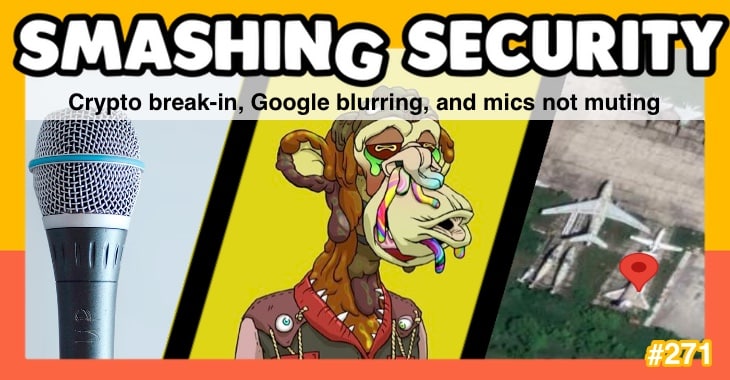
A man loses $650,000 from his cryptocurrency wallet after his Apple iCloud account is hacked, video conferencing apps may not be muting your mic quite the way you imagined, and Google has unblurred military bases in Russia… or has it?
All this and much more is discussed in the latest edition of the award-winning “Smashing Security” podcast by cybersecurity veterans Graham Cluley and Carole Theriault, joined this week by The Cyberwire’s Dave Bittner.
Show full transcript ▼
 This transcript was generated automatically, probably contains mistakes, and has not been manually verified.
Hello, hello, and welcome to Smashing Security episode 271. My name's Graham Cluley.
You get to keep a key, and the bank has a key, and you come and you talk to the bank person, and they let you in the room, and you pull out your little drawer, and you go in a private room, and that's where you keep— you can keep valuables, you could keep money, you could keep jewels, you could keep important papers.
I suppose they could hire a locksmith.
If you follow him on Twitter, I checked him out on Twitter and I'll put in a link in the show notes as well.
You'll see that he's tweeting all the time, nothing else other than NFTs. He's scooped up Mutant Apes, Alien Boys, Gutter Cats, Fancy Bears. The list goes on.
It's all that kind of funky, weird NFT stuff.
Now, he was a bit suspicious because he'd been receiving a number of messages asking him to reset his Apple ID password, and he thought it might be a scam.
So he gave them a call back, and the person he spoke to, he said he was reassured because they had an American accent.
I guess he was under the misapprehension that a scammer would have some sort of, I don't know, some sort of different sort of evil accent of some description.
But don't worry, you have a chance to get it back. And what we will do is we will send your phone a one-time code.
So a 6-digit number, which you can tell us back over the phone, and that will confirm your identity and we'll grant you access to your Apple iCloud account.
And he's thinking, well, isn't this wonderful that they're doing this? And so he receives the code. And of course, he tells the person on the line instantly. The line goes dead.
And within seconds, according to Dominic, $650,000 worth of cryptocurrency and NFTs had been stolen from him. Kaboom!
According to the reviews, it is a highly regarded and extremely secure digital wallet, praised for its encryption technology and has suffered no digital hacks so far.
You know, you sort of hide it under your great aunt or you put it inside a dictionary or you sort of put it somewhere.
So if you forget everything else, if you lose your private keys and everything else, you can still regain access with these 12 magic words, which you must never ever tell anybody else.
Right. But if you have that, you can recover your funds. Even MetaMask themselves, they can't give you access to the account.
The only thing you can do is use these 12 words, which you've chosen, your recovery phrase.
The thing is— that when you're dead, for instance, right, there's going to be someone glamming you up, Carole, or you, Dave, you know, foofing your hair and putting a little bit of mascara on or whatever it is that, you know, to make you look a little bit better in the open casket.
And they've basically got access to everywhere on you. So don't tattoo it on your body. Also, some thief might knock you off in order to check out your—
So on your iPhone or on your Android phone. So it's stored there encrypted, out of the hands of hackers. They can't get at it. Or so you would like to think.
Well, the unfortunate business here is that your MetaMask vault, this encrypted vault, including your secret recovery phrase, is by default backed up by Apple to the Apple iCloud, meaning if someone manages to gain access to your iCloud, as these bad guys obviously did by getting this guy to send them their verification code.
They can also force their way into your MetaMask vault.
Maybe you've reused a password or chosen an obvious one, or they brute force it, and then they have access to everything in your crypto wallet.
And now of course Apple's storing everything, right?
You need to make sure that you're not handing over access keys because someone else may be saying, oh, can you send me your recovery number?
And they're socially engineering it out of you. So the lessons from this: always use a cold hardware-based wallet. That way it's not going to get backed up to anything.
I was on Instagram and I got a message from my niece, but she wasn't talking like my niece normally talks. She was saying, oh, I've lost my shit.
She's such a lovely, lovely young girl. You know, it's slightly out of character. And she was saying, send me your phone number and I'll get a verification code sent to you.
You just give it back to me and I'll be able to get my shit together again. And this probably isn't her.
But she'd been fooled by one of her friends who, because she's a lovely person, she'd said, yes, I can help you. And when I get the code, I'll send it to you.
And so it happens on a lot of accounts, this kind of thing. So watch out for this verification code trick, which people are doing.
And also remember that caller ID is really easy to spoof as well. And Apple, just like every other big tech company, they're not going to call you out of the blue.
MetaMask themselves now, because there's been a bit of a furor over this, they've tweeted saying we would advise our clients, if you don't want to back up to the iCloud, turn that off.
Too late for Dominic, who's lost $650,000 and is now offering a $100,000 reward to try and get his crypto back.
No one's found a way to get his cryptocurrency back, but I saw they'd received a message from someone calling themselves Lauren G81948454. Seems like a plausible username.
And they said, oh, I was also hacked of $100,000 last month, but I got my funds back when I contacted a hacker on Instagram called Cyberjack002. Go and reach out to him.
And so whenever you talk on Twitter about being hacked for cryptocurrency or losing your Instagram account, all these bots will pop up advising you to go and contact someone on Instagram, who of course is after your Instagram account as well.
And so you're going to be scammed over and over again.
You can go on Google Maps and you can get a nice bird's eye view of— although I think Bing calls theirs bird's eye view, but you can get a satellite view of anywhere in the world, pretty much.
And over the years, this has gotten to be higher and higher resolution.
My understanding these days is that they are at half a meter resolution these days, which means that a single pixel in an image is half a meter in size.
So quite sharp over the past, I don't know, 20 years or so that they've been doing this. But there are, of course, privacy issues with this, and Google recognizes that.
And so you can request to have a location be blurred.
And so that was his location. So he had it blurred.
Oh, wow. Yeah, they're not. So, but, and you know, there are websites full of funny images that have been captured with the satellites and particularly with Street View.
There are people who find, you know, they see the Street View camera driving around, and so they take it upon themselves to punk the Street View and things that.
But if you, for example, want your home blurred, like Carole, if you wanted your palatial estate there in Oxford blurred, you could contact Google and request that they would do it.
And they would do it. And I have a link here in the show notes for a bunch of places that they have blurred. And things like military bases all make sense, right?
Some private places people have requested to be blurred.
For some reason, I guess because of facial recognition, the picture of Colonel Sanders that's on the sign of all the Kentucky Fried Chickens automatically gets blurred.
And of course, we are in the midst of the invasion of Ukraine by Russia. And so there's lots of sort of armchair quarterbacking over what's going on with this war.
And one of the open source tools that lots of people are using is Google Maps to determine who's where and who's doing what and what's the status of various militaries and so on and so forth.
So there was a lot of buzz over this over the weekend, and people were having fun looking at airports and military bases. I've included a link here.
Evidently someone found the Russian version of the space shuttle, or the Soviets had their own space shuttle. It looks exactly like the US space shuttle.
It's as if you took the plans for the US space shuttle, put it into a CAD program, and said, make it 1.5 times bigger. That's what the Soviet space shuttle looks like.
Someone found — I guess the Soviets had their own version of the Concorde supersonic jet. They found one of those.
But people were looking at a lot of Russian planes that were on runways that had their wings removed. People were speculating, are these actual planes?
Are they made out of Styrofoam? Are they inflatable? Is this, how bad? Because we've seen the Russian military has not lived up to their legendary status throughout this campaign.
And so people are wondering what's the state of their air force? Well, just today, as we record this morning, Google came out and said, no, we didn't remove any blurring.
None of this was ever blurred. This has all been out there the whole time.
Why did you all think this was blurred?
Suddenly we had all this information available that we had not previously had.
And people were out speculating, oh, what is this going to— this is going to change the course of history. How will this affect the war?
There's so many, you know, secrets revealed. And then Google says, no, this is— what are you talking about? We haven't changed a thing. Isn't that fascinating?
And at the top of the story now, there's a correction where they say, oh, well, we heard from Google and funny thing.
It'd be something so innocuous, and then we're all gonna hate this person.
There were, I mean, lots and lots of accounts, people who should know better who latched on to this, legitimate news organizations who took this as fact and reported on it.
And there was nothing to it at all.
You want to do your proper due diligence and you have no time because you're trying to get out first.
And you get it wrong because you're tripping over yourself to be the one to press publish first.
I mean, they're never going to be as reliable as those of us who wait a week before coming onto a story, are they, Dave?
And we're probably more aware of that now than we ever have been, thanks to all of us having to do work from home for the last few years.
I think each of us has found ourselves in a moment where the mute button saved us from, you know, I don't know, shame or embarrassment or ridicule.
Or see your kids start fighting, yelling names in the background like poo-poo head and fart brains.
So you're doing the laundry, the dishes. I bet you people probably do loo breaks during meetings. I bet you that's a thing.
Because, you know, we all have assumptions, right? And they thought, well, let's first ask people, see what they think the mute button does.
And not very surprising, 77.5% said they, you know, it would be unacceptable for apps to continue to be able to access the microphone and possibly gather data if the mute mode was active, which, you know, makes sense.
So they thought, okay, so people assume this works this way, but let's check what actually happens. So they looked at all the big boys.
We have Zoom, Slack, MS Teams, Google Meet, Cisco Webex, GoToMeeting, and then Discord. And then there's two I don't know Jitsi Meet, Whereby, and third, BlueJeans.
So those three I don't know. I don't know if you guys are aware of them.
And a lot of us assume that they kind of work more or less similarly because they're all kind of providing more or less the same functionality.
And you might also assume that Zoom is Zoom is Zoom, no matter what your OS is. Or whether you're using a browser or a native app.
But you'd be wrong on both counts because native apps can collect data from the microphone with few restrictions.
So web apps are implemented in JavaScript and they have to request access to the microphone through the web browser, which generally has much more restrictive policies, you know, for data collection and stuff like that.
And they looked at it across 4 operating systems. So Linux, Windows, Chromium, and macOS. And each one of them processes and munges audio data in a slightly different way.
So the researchers used runtime binary analysis tools to trace raw audio from the aforementioned popular video conferencing apps as the audio traveled from the app to the computer audio driver and then to the network while the app was muted.
So it turns out that all of the apps tested occasionally gather raw audio data while mute is activated, with one of the popular apps gathering information and delivering data to its server at the same rate regardless if the microphone was muted or not.
So they say, "We discovered that all the apps in our study could actively query, i.e., retrieve raw data from the microphone when the user is muted," says the paper.
And they continue, "Interestingly, in both Windows and macOS, we found that Cisco Webex queries the microphone regardless of the status of the mute button." So in other words, according to the study, Cisco Webex was the worst as it continued to receive raw audio data from the user's microphone and transmit it.
Transmitting it to the vendor's servers in precisely the same way it did when unmuted.
So Register reached out to Cisco and they told the Register that it altered Webex after the researchers got in touch so it no longer transmits microphone telemetry data.
So very good example of responsible disclosure and a quick fix.
And Cisco went on to say Webex uses microphone telemetry data to tell a user they are muted, to your point, Dave, referred to as the mute notification feature.
They say this is not a vulnerability in Webex.
Okay.
And then finally, the other last thing they decided to do is they, using machine learning algorithms, they trained an activity classifier using audio from YouTube videos, and they were looking for common background noises.
So they used activities like cooking, eating, playing music, typing, cleaning.
And then they applied a classifier to the type of telemetry packets the app was sending, and they could identify the background activity with an average of 82% accuracy.
So these types of activities can be distinguished just based on these acoustic fingerprints that were actually being sent.
That's, you know, it's like, but if you're worried about something like this, then maybe you need a hardware button or a switch or something on your microphone.
Now this is a bit of a pain, right?
Because you have to go into settings, you have to find your microphone, you've got to turn off the input, and then you have to remember to turn it back on next time you do something and not panic that it's broken.
So the team suggests the solution might be in developing easily accessible software switches or even hardware switches, which makes total sense, right? I would like that.
I want a little big button that says, you are now being recorded, and off/on, right?
But, you know, there's a saying in broadcasting, every mic is an open mic, which is a cautionary tale that if you're in a room with a microphone, assume that that microphone is open and someone's listening and/or recording.
Now, this phrase came into popularity in the days before all of us carrying microphones in our pockets all the time and our webcams, and it's hard to go into a room these days that doesn't have a microphone capable of recording.
So—
Yeah, he did.
But you know, Graham, if this podcasting thing doesn't work out for you, there's definitely a future for you as a mimic.
Kolide is perfect for organizations that care deeply about compliance and security but don't want to get there by locking down devices to the point where they become unusable.
So instead of frustrating your employees, Kolide educates them about security and device management while directing them to fix important problems.
Sign up today by visiting smashingsecurity.com/kolide. That's smashingsecurity.com/kolide.
Enter your email when prompted, and you will receive a free Kolide goodie bag after your trial activates.
You can try Kolide with all of its features on an unlimited number of devices for free for 14 days. No credit card required. Try it out at smashingsecurity.com/kolide.
That's smashingsecurity.com/kolide. And thanks to Kolide for supporting the show.
We all care about security, but man, it's hard. You see, all networks, according to NetFoundry, are insecure, period. And the Zero Trust security model is the way to go.
It was created with the idea of never trust, always verify. But historically, this has been seriously hard to implement.
NetFoundry have created OpenZT to provide an open-source, free, and easy way for you to embed Zero Trust networking into anything.
Embed SDKs inside your app, tunnelers to run on all major operating systems, or deploy an edge router for any cloud. And the best bit? No networking engineering skills required.
This is something you guys definitely want to check out. Visit smashingsecurity.com/zero-trust. NetFoundry.com/netfoundry. That's N-E-T-F-O-U-N-D-R-Y.
And thanks to NetFoundry for sponsoring the show.
Could be a funny story, a book that they've read, a TV show, a movie, a record, a podcast, a website, or an app, whatever they wish. Doesn't have to be security related necessarily.
And so she goes, Parker, take off my jacket. Yes, milady. Parker, take off my dress. Yes, milady. Parker, take off my shoes and stockings. Yes, milady. And Parker. Yes, m'lady.
Don't ever let me catch you wearing my clothes again. How we love it. That is the Thunderbirds joke.
Now, I'm a big fan of the TV show Thunderbirds and other series which came from the mind of Gerry Anderson with his Supermarionation.
Things like Stingray, Captain Scarlet, UFO, Space: 1999. Wonderful.
It's called Gerry Anderson: A Life Uncharted. I saw it on BritBox, but it may also be available in other places. Now, Gerry Anderson sadly died about 10 years ago, I think.
And he left some audio recordings where he was telling the story of his life. And to be honest, he did not have the best of lives.
He was married a few times, including a marriage to one woman which was spectacularly— how can you put it? A bit of a roller coaster.
So it tells the story of that. It's not really the story of his TV shows, but it's the story of his life.
And it's fascinating because it gives you some indication of where— what the impetus for some of the things which happen in stories came from.
And it came from a very sad childhood. And it's quite interesting. What's unusual is they took audio recordings of Gerry Anderson, this great star of British children's TV.
And they've used deepfake technology to turn it into video of him sat on a sofa telling the story of his life. And this is intercut into—
And there's actually also a supplemental sort of behind-the-scenes thing where they describe how they did it and show you the iterations, how they did it.
It's completely convincing. And it does make the documentary easier to digest and to enjoy because it's not just audio.
You can see him sat there as well, talking through his life and explaining it. You even see him at some points walking around various locations like Pinewood Studios.
And it's not him. It's been—
Flying a plane or water skiing while he tells you about this stuff. No, but they could with the magic of technology.
Anyway, I found it quite a good documentary.
It's not going to give you much of a flavor of Thunderbirds and Stingray and Captain Scarlet, but it will tell you about Gerry Anderson himself, who is a bit of a hero of mine.
And that is why Gerry Anderson: A Life Uncharted is my pick of the week.
And I actually went back, I went back and tried to look it up and I was unsuccessful.
But what I remembered I heard from this episode was you were talking about some show, I believe, and you said you should only watch the first season of it.
That the first season was great.
It is a thriller drama TV series on Netflix, and it is about a family who is in the Florida Keys here in the US, and the family owns a resort.
And it's about the siblings in this family. One of them is the black sheep of the family, their relationship with their parents who run the resort.
They all — each of the kids have their own personalities. There's a murder.
That the fact that it's in the Florida Keys really plays into the way that this series feels, the way that it's shot.
You really feel like you're there, but it's a super compelling first season. Kyle Chandler is the star of this.
He's the guy from Friday Night Lights who, according to my wife, is just quite dreamy. Ben Mendelsohn is in it. He was in the Star Wars movie Rogue One. He's the bad guy in that.
He was also in Ready Player One. So a good cast, very good season. But I will tell you, when the first season comes to an end, and there is a cliffhanger, there's a tease.
They're going to try to get you to watch the second and third seasons. Do not take the bait. Because — just be satisfied that you watched a season of excellent television.
Let it go. Drop it and just leave it there. And think, "Gosh, I wonder what would have happened if they'd made a second and third season of this show." Don't.
Well done, compelling, a real good thriller drama kind of show. So check out season 1 of Bloodline and just leave it there and get on with your life. That is my pick of the week.
It is really— it feels hot, and it feels— you're always by the water, and they always see this blue tint on everything. Yeah, yeah, fascinating. Okay, well, good.
And I have to say, it's a brilliant dissection of a family going into serious trouble. So, it's from the writer Jesse Armstrong of The Thick of It and Peep Show.
And they're media conglomerates, and you've got the aging controlling dad at the helm desperately clinging on to the power.
And then you have a squabble of spoiled children navigating their roles and trying to figure out who's going to take over the family business.
You've got a stepmom who's very strange, but wonderful, but strange. And basically, the whole thing is who's going to be the next king of the castle.
But you've got a great cast, Bryan Cox, Jeremy Strong, Sarah Snook is in there, and dialogue's really good. It's tight, and it's so scathing, right?
I come from a family of very straight-talking people that are pretty scathing at times. And this is probably the closest rival I've seen. So, yeah. And anyway, I—
You know? No one's carrying the, "I'm the one to follow, just trust me," character.
But then over the course of a couple of seasons, I feel I don't want to be spending any more time with these people.
And don't forget to ensure you never miss another episode. Follow Smashing Security in your favorite podcast apps such as Overcast, Apple Podcasts, LastPass and Spotify.
For episodes, show notes, sponsorship information, guest lists, and the entire back catalog of more than 270 episodes, check out smashingsecurity.com.
Hosts:
Graham Cluley:
 @grahamcluley.com
 @
@
 / grahamcluley
Carole Theriault:

Guest:
Dave Bittner:
Show notes:
- Domenic Iacovone on Twitter.
- Learn A Geordie Accent – Newcastle Accent Tutorial — YouTube.
- Serpent explains the scam on Twitter.
- How an Apple iCloud Exploit Lost a Crypto Trader Over $650K — CNET.
- MetaMask advises its users to check their iCloud backup settings — Twitter.
- Scam message received by Graham from his niece's Instagram account.
- 19 Places On The Planet Google Earth Is Hiding From You — Travel Triangle.
- Google denies Ukrainian reports it unblurred satellite Maps imagery in Russia — The Verge.
- Buran shuttle — Google Maps.
- 'Mute' button in conferencing apps may not actually mute your mic — Bleeping Computer.
- You’re muted — or are you? Videoconferencing apps may listen even when mic is off — University of Wisconsin-Madison.
- Gerry Anderson: A Life Uncharted — BritBox.
- Gerry Anderson: A Life Uncharted trailer — YouTube.
- Bloodline — Netflix.
- Succession — HBO.
- Succession review – brilliant dissection of a dysfunctional dynasty — The Guardian.
- Smashing Security merchandise (t-shirts, mugs, stickers and stuff)
- Support us on Patreon!
At Kolide, we believe the supposedly Average Person is the key to unlocking a new class of security detection, compliance, and threat remediation. So do the hundreds of organizations that send important security notifications to employees from Kolide’s Slack app.
Collectively, we know that organizations can dramatically lower the actual risks they will likely face with a structured, message-based approach. More importantly, they’ll be able to engage end-users to fix nuanced problems that can’t be automated.
Try Kolide Free for 14 Days; no credit card required.
NetFoundry’s OpenZiti is an open source, free and easy way for the world to embed zero trust networking into anything.
Embed SDKs inside your app, tunnelers to run on all major operating systems, or deploy an Edge Router for any cloud.
No networking engineering skills required. No more pain of inbound ports, VPNs, complex firewall rules, public DNS, and more.
Learn more and try it for yourself at netfoundry.io/smashingsecurity
Follow the show:
Follow the show on Bluesky at @smashingsecurity.com, on the Smashing Security subreddit, or visit our website for more episodes.
Remember: Subscribe on Apple Podcasts, or your favourite podcast app, to catch all of the episodes as they go live. Thanks for listening!
Warning: This podcast may contain nuts, adult themes, and rude language.