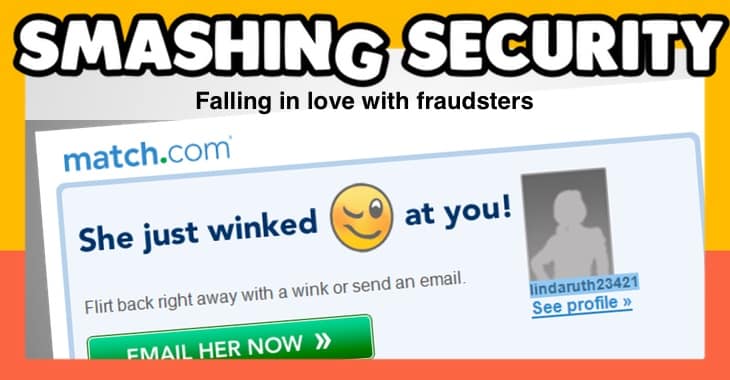
We take a trip to Staten Island, New York, to hear how a case of cyberstalking resulted in the arrest of 20 alleged mobsters, learn about the nude photo-loving insider threat at Yahoo, and discover how fraudsters might be boosting Match.com’s profits.
All this and much more is discussed in the latest edition of the award-winning “Smashing Security” podcast by cybersecurity veterans Graham Cluley and Carole Theriault, joined this week by Ran Levi of the “Malicious Life” podcast.

Show full transcript ▼
 This transcript was generated automatically, probably contains mistakes, and has not been manually verified.
My name is Graham Cluley.
Because I'm sure lots of people would love to tune into it.
We bring lots of interesting stories from past hacks and interesting viruses all the way back to the 1920s and 1910s, even way before there were computers.
But most of them naturally are from the past 20 years or so. So lots of stories.
Now on today's show, Graham talks of an FBI arrest involving racketeering, extortion, and buses. Ran blows away the cobwebs and gives us a Yahoo update.
And I'm diving into the online dating pool. All this and loads more coming up on this episode of Smashing Security.
You think I'm funny?
I am going to tell you about what the FBI have been up to, because they have recently charged 20 people alleged to be members of an organized crime gang called the Colombo.
The Colombo crime gang.
And they're being charged with racketeering, extortion, operation of an illegal gambling business, attempting to bribe a college basketball game, umpteen other crimes, and cyberstalking.
And if the FBI are to be believed, their main chap is a chap called Joseph Amato.
Now, disappointingly, Joseph Amato appears to be about the only member of the gang who doesn't have a pseudonym, right? Amato Tomato.
I think they could have done something like that. But I imagine you don't call the boss names. So they didn't give him one, but other members do.
For instance, there's Daniel "The Wig" Capaldo, also known as Shrek. There's Joey the Fish. There's Dominic Bologna.
The FBI began snooping on alleged members of the gang after a GPS tracking device was found on a Staten Island bus in November 2016.
The tracking device was originally on a car belonging to Joseph Amato's girlfriend.
And he had boasted that he had eyes everywhere across New York. He said in one email, he said to her, he said, "This is my island, not yours.
I've got eyes all over." He said, "I'm a man's man. I'm a man's man," he said.
Having been told by him that she was being watched all the time, she checked out her car. She's not an idiot.
And so obviously he then thought, oh, she's behaving herself. She's just going around.
And when he did, he did what many people might do. He reported that the tracking device had gone missing to the tracking service.
You have to physically grab the tracking device and plug it into a computer or something in order to extract the data.
So everyone thinks, because you've watched 24 and TV shows like that, you can just attach some little pin-sized device on people, you can track them indefinitely.
It's not as simple as that.
So those kind of devices which are sort of giving you live tracking of someone, they're going to need either a really decent battery size or they're going to have to be plugged into your cigarette lighter or the car battery or something like that, right?
So I imagine that this was a passive device. And I imagine that Joey the Tomato Amato got one of his buddies, you know, Benny the Banana or Mickey Blue Eyes or whoever it was.
I imagine that whenever his girlfriend came to visit, he got them while he was occupying his girlfriend to pop out the car swap over the device or charge it up or grab the data from it.
So I imagine it was that kind of thing.
After eventually realising he was tracking a bus rather than his girlfriend, he bought a brand new device.
By now, however, the police had been informed when the bus company found the tracking device on their bus, and they said, "This is a bit weird.
Do you want to look into this?" They found out who it was registered to. They'd been listening to his phone calls.
They'd been wiretapping him and about 20 other members of this gang. It began as a cyberstalking inquiry and then turned into this massive bust of potentially a huge criminal gang.
Is that why he reported it missing, thinking it may have been reported 'And if I report it missing, it'll be an easy lost and found situation.' Or maybe, I don't know.
They raided other people's properties as well. They found evidence that they'd been trying to bribe people. They'd been extorting money. They found firearms. They found stun guns.
They found cans of tear gas, thousands of guns.
It appears has been broken up by this FBI investigation, which all began purely because of a cyberstalking incident. Now, it's quite a juicy indictment.
If you go and read up, exactly what's going on. There's a lot of this which sounds like a Joe Pesci movie when you read it.
It does sound these guys really loved— they loved their gangster movies and they loved The Godfather and they're quoting bits of The Godfather in their communications.
Oh, I love that.
But as I was reading and I was thinking, oh, I'm going to talk about this on the podcast today, it did make me think, you know, these don't seem like Goodfellas to me.
I'm not really sure that it was sensible for me to talk about this gang, even though here I am feeling I'm safe in Oxford because their tentacles—
So maybe you know, every time you mention Yahoo's name is a good thing for Yahoo, even if it's not in a good context.
He's a senior DevOps engineer in Yahoo. He was back then. And he just admitted last week in federal court that he hacked around 6,000 accounts and tried to find nudes, basically.
I mean, I think it's grim breaking into people's accounts anyway to look for private photos and things, but the thought that you might be hacking into the accounts of people who you know and who know you, it must be actually horrific for them.
Carole, if you broke into my account, you'd find it pretty tame, I guess.
So he was able to penetrate other accounts. So he got fired, obviously, once they discovered it.
And the ironic part of the story is that once he was fired, he got a job in another Silicon Valley company called Okta. And Okta, ironically, is an access management company.
And I understand that the maximum penalty for what he did is 5 years behind bars and a quarter of a million dollars in fines.
I have a notion that a large percentage of cyberattacks of all sorts actually originate from inside, from employees of companies, from people who have access to the information, to the tools, to the programs.
And we know that the largest cases like Snowden and then Chelsea Manning, the famous cases, but I think many, many breaches and hacks probably originate from inside a job.
You don't need to hack in and get past all the security defenses because these are people you've let in through the front door and given access to your network.
It is, though, fairly horrific that those poor people who must have been having lunch with him, had meetings with him, who are now working there going, oh my goodness, what did that guy see of me and what's he actually—
It was back when cell phones were rather new. And he stole something like, I think, $200 worth of phone calls.
I got a phone bill, it was way larger than what I usually called, and then I asked for, you know, a list of all the numbers that were called, and I saw that many of these conversations were to a different city in Israel which I never called because I didn't have any friends there.
So I asked myself, who could it be? And I had no idea.
And what I did then was I called one of the numbers which were rather frequently called, and I pretended to be a newspaper salesman who wanted to—
I offered them a subscription for the newspaper, and if they do a subscription, they'll get a big reward or something. You know, I made up some big reward.
And when they agreed, eventually I tried to be the best salesman that I could be. I asked them, okay, so just give me your names and street address or whatever.
And now I had the last name and it was the same last name as the guy who stole the phone because it was his parents that he was calling.
And then I connected the dots and I came over to that guy. When he saw me, when he saw how furious I was, he became pretty white because he obviously knew what was happening.
But he paid up eventually and I didn't go to the police because he was quite younger. I was, I think, 20 years old.
So I didn't want to ruin his life because he was doing something so stupid.
It was the mid-'00s when I fell into step with a hot somebody. So, and it shows, right?
I was recently out with some younger friends, and they were glued to their phones, right, while I was sitting there knocking back a delicious martini.
I mean, I don't know how you're the wingwoman when the target's on a teeny tiny screen. I don't know how to play that game at all.
So my point is the dating world has changed dramatically.
And Match Group owns a number of dating sites that you might be familiar with, including Hinge, OkCupid, Plenty of Fish, and Tinder.
So they are a seriously big player in the dating world.
Now, recently, Match Group, okay, the parent company, put out some stats on the dating world.
And it said, it was kind of an acute media-friendly report, and it said things like only 11% of Gen Z and millennials date casually.
That must be music to the ears of parents with daughters out there. And a third of millennials aren't dating much due to financial constraints.
They basically just can't afford going out for dinner all the time, right? And 42% of singles say love feels lost in our society. So basically the dating is very empty.
So, that got me thinking. I wondered whether Match Group were feeling the hit, right?
So, I wanted to check out sites like Alexa and MarketWatch to see if there was any negative impact on the bottom line.
It's really easy to sign up and it's free to sign up, right, and use the search facilities. And there's loads of add-ons available to enhance your experience.
That's all the things people say thumbs up for. What people complain about is that only members who subscribe, basically pay a membership fee, can send and reply to messages.
You can go out there and like people and read bios and look at pictures.
So let's say, Ran, you and Graham are both on, you know, and you're liking each other or something, and you're both, you're a freebie, you're a freebie, Ran, on the site, right?
So you kind of saw, you looking around on the site and you may have kind of thought, oh, he looks interesting, right?
And then you get inside your email something that says, he just emailed you, exclamation mark. Okay, that's what the title says.
And then it says, you caught his eye and now he's expressed interest in you. Could he be the one? Read his email.
And this is a standard email that Match.com sends to users, including those that are free, right?
Now, if you clicked on that, you would be like, ahahaha, you can't read Graham's love letter, or whoever's letter. You don't even know it's Graham, actually.
You cannot read the love letter that you've received, right, until you pay, right?
The problem: Match had already identified many of the people, of these, the people behind these emails, these interests, as scammers.
So if you had paid Match to read that message, yes, you might have gone in and had a scammer there start, a romance scammer start wooing you, or you would have an empty inbox because after you had paid, Match could say, oh, this is in our list of known scammers, we're going to delete this email.
But they don't have filters, or the argument the FTC are making is that perhaps the same defenses are not in place for freeloader users.
And the reason, as you get to the point, the reason you might want all those scammers sending all that traffic is that so you get more people to sign up.
One of the quotes from the FTC was Match had blocked some of these suspicious accounts from sending messages to its paying subscribers, but didn't give the same protection to free accounts users.
Now, how big is the problem?
The FTC alleges that millions of contacts that generated Match's 'you caught his eye' email notices came from accounts the company had already flagged to be fraudulent.
And worse, right, Match prevented existing subscribers from receiving these email communications if they were from a suspected fraudulent account.
Because I can imagine that Match.com might say one of the benefits of subscribing to our service is that we will give you a cleaner inbox and we will keep out scammers and spammers, etc.
And then maybe they wouldn't offer that to people who hadn't yet paid.
And yet, of course, the very fact that there is spam and scams and fake winks occurring on Match.com might be an incentive for people to subscribe.
Do we have any sense as to what percentage of traffic on Match.com is fraudulent or scammy?
So apparently, I was shocked by the number, 25 to 30% of Match.com members who register each day are using Match.com to attempt to perpetrate scams, including romance scams, phishing scams, fraudulent advertising, and extortion scams.
They're kind of directly profiting from the romance scammers attempting to find fresh victims.
That the antivirus vendors were creating viruses to have more clients.
And of course, this was ridiculous because nowadays there are so many viruses and malware that you don't need to create anything specifically.
But back then in the early '90s, people really thought that antivirus vendors were creating viruses for their own products to catch.
It doesn't make business sense for me at all from a shareholder company. It doesn't make sense.
They might be turning something of a blind eye to the problem and maybe not addressing it quite as well as they should.
And if they are, if they could send a message to HotOxfordTamale, that would be—
And the only advice I have— All the millennials and the Z-gens out there, why don't you return to old school cool?
You know, take out the headphones, go outside, talk to real people in real life.
Old school cool.
Single sign-on is designed to connect employees to high-priority apps, all without needing the user to log in at every single hurdle.
Now, by combining these two services, our friends at LastPass may have just revolutionized security at the enterprise level. Learn more at lastpass.com/smashing.
You don't need to say the forward slash. Ah!
Immersive Labs provides a cloud-based system, meaning it's available 24 hours a day, whenever it's convenient for them to learn.
It provides hands-on experience with tools, technology, and even sandboxed ransomware and phishing. The platform provides story-based threat simulations.
It lets teams enhance their skills while stopping an online banking breach or the hack of industrial control systems. Lots of fun to be had there.
Check out Immersive Labs' skills development platform to drive down your organization's cyber risk while reducing training costs. Check them out at immersive labs.com/lite.
Immersive labs.com/l-i-t-e. Okay, so it turns out that we are all bad people.
It can help you detect insider threats, investigate file activity, and respond before damage is done.
A really cool aspect is that at any time, Code42 can tell you what data lives where, when it leaves, where it goes, and who has access to it.
To learn more about how you can protect your company from insider threats, visit code42.com/smashingsecurity. Now on with the show.
Could be a funny story, a book that they've read, a TV show, a movie, a record, a podcast, a website, or an app. Whatever it is. Doesn't have to be security-related necessarily.
I had a fantastic time last week because I popped out to a local art center and I saw a chap talk and the chap's name is Mark Lewisohn and he is the world's foremost authority on something I hold very close to my heart, which is the Beatles.
It's about 800 pages of the Beatles history. Anyway, at the moment he is doing in the UK a tour called Hornsey Road.
I won't explain why it's called Hornsey Road because that's one of the secrets revealed during his talk, but it is all about the 50th anniversary of the Abbey Road album.
Of course, the last album ever recorded by the Beatles back in 1969, and it was fabulous.
So what Mark had done is he had taken the isolated tracks from Abbey Road, which actually had been sort of ripped off a guitar, a Rock Band game.
I think there was a Beatles Rock Band game, video game a while back, which had the isolated tracks and someone broke the encryption, managed to get the individual tracks of all these Beatles songs.
No way. Yeah, for real.
And he's able to use those and he's remixed them into his own version of Abbey Road, which highlights individual pieces of musicianship like Paul McCartney's incredible bass guitar playing, the drumming obviously, the lead guitar of George Harrison.
It's tremendous. So he was doing this and he'd made up these little videos and things.
There's video footage, interviews, tapes of them chatting in the studio, but also so much background information. You find out who the real Mean Mr.
Mustard was, if you remember that song from the medley on side two.
And another of the revelations which comes to light is he actually got a recording of a business meeting which the Beatles had had after Abbey Road was recorded, where they discuss how they want to actually record another album, which never happened.
But one of the things which comes up is discussion of Maxwell's Silver Hammer, which is a controversial Beatles track.
And it turns out during this recording that even Paul McCartney who had insisted they record it and had multiple hundreds of takes of this particular song, he admitted that he didn't actually particularly like it either.
So no one in the band actually liked Maxwell's Silver Hammer, but it still ended up on the album.
But if you go to hornseyroad.net, you can find out where other dates on the tour are in case you want to go and check it out.
But 50 years on, still a magical album and put in so much fantastic context by Mark Lewisohn. So it had to be my pick of the year.
And actually, it's a fantastic website to jigsaw lovers like myself.
You can — I mean, there are hundreds and thousands of puzzles and you can kind of tweak the individual puzzles to the level of complexity that you wish to have.
And lots of, you know, little tweaks that can help you, like they can kind of move all the pieces to one side of the screen, etc.
So it's very, very nice user experience in terms of bringing a puzzle together on a computer screen, which is not an easy thing to do.
So basically it presents itself a bit like a tabletop with all of the jigsaw pieces turned the correct way up, which obviously is the biggest nuisance normally of jigsaws.
But then you can sort of with your mouse, you can point and click and attach them to each other. And once you've got the correct connection, they stick together, don't they?
Graham, are you saying that's what you want for your next celebration?
And even if I would, the kids would probably run all over it and blow it up to pieces again. So on a computer.
It's so relaxing and you can listen to podcasts and you don't have to stare at nothing for an hour or something. So it's great fun. I really recommend it.
Well, maybe I read somewhere that Criminal had sold the rights, so it's possible, but I didn't go and do that research because the Criminal with Phoebe Judge is an excellent great podcast, and it does have a similar approach, but it's kind of different.
This is more four miniseries. Each miniseries has three independent programs in our shows or episodes, and each miniseries focuses on a different European country.
So we have the UK, France, Spain, and Germany, and all of it is set in the same investigative room.
So the whole idea is someone's sitting in the room, the police want to talk to that person, they have a file, they've brought them in, you don't know why and you go in and start learning as they ask questions.
It's really good if you're into that whole character study.
There's the back room and the interview room. And each, so say for the UK, the first one has David Tennant who plays the perp who's being interviewed in the first one.
He is very good. And the game is, of course, you have to decide whether he's guilty or not before the end of the show. That's the game I play anyway.
It's just really insightful and cool, and I love it. So go watch Criminal. It's on Netflix, and Graham, you'll love it. I promise, promise, promise.
Ran, I'm sure lots of our listeners would love to follow you online and find out more about the Malicious Life podcast. What's the best way they can do that?
Just check out the Smashing Security subreddit.
Check out smashingsecurity.com for past episodes, sponsorship details, and info on how to get in touch with us.
Victor PC, or @Victor_TheyKnow, said, "The last episode of Smashing Security had me dying. Graham Cluley's laugh should have its own show. It's so communicative." I agree.
Hashtag hello boys?
Hosts:
Graham Cluley:
 @grahamcluley.com
 @
@
 / grahamcluley
Carole Theriault:

Guest:
Ran Levi – @ranlevi
Show notes:
- The "You Think I'm Funny?" scene from "Goodfellas" — YouTube.
- 20 Defendants Charged with Crimes, Including Racketeering, Extortion, Loansharking — Department of Justice.
- Indictment against Joseph Amato and others (PDF) — Department of Justice.
- GPS cyberstalking of girlfriend brings surveillance and indictment for alleged American mobster — The Register.
- How to Find a GPS Tracker on Your Vehicle.
- Former Yahoo Software Engineer Pleads Guilty To Using Work Access To Hack Into Yahoo Users’ Personal Accounts — Department of Justice.
- Former Yahoo engineer pleads guilty to searching 6,000 user accounts for nudes — The Verge.
- Using Match.com? Read this — FTC Consumer Information.
- Why Match.com allegedly luring lonely customers with fake ‘winks’ is just another form of ‘phishing’ — MarketWatch.
- Fembots land Ashley Madison in hot water with the FTC — Graham Cluley.
- Mark Lewisohn Official Website.
- Hornsey Road with Mark Lewisohn.
- The Beatles' Abbey Road (Super Deluxe Edition) — Spotify.
- Jigsaw Explorer — Online Jigsaw Puzzles.
- Criminal — Netflix.
- Criminal Review: Netflix Crime Drama With Parts Better Than the Whole — Collider.
- Support us on Patreon!
Code42 provides data loss protection for when employees quit.
60% of employees who quit their jobs admit to taking data. Your organization’s data is more portable than ever and you have employees leaving everyday.
Most organizations rely on prevention but there are simply too many ways for data to leave.
To learn more about how to protect your company’s data from insider threats visit code42.com/smashing
LastPass Enterprise makes password security effortless for your organization.
LastPass Enterprise simplifies password management for companies of every size, with the right tools to secure your business with centralized control of employee passwords and apps.
But, LastPass isn’t just for enterprises, it’s an equally great solution for business teams, families and single users.
Go to lastpass.com/smashing to see why LastPass is the trusted enterprise password manager of over 33 thousand businesses.
Immersive Labs provides the world’s first fully interactive, on-demand, and gamified cyber skills platform.
Try it for free at immersivelabs.com/lite/, and drive down your organisation’s cyber risk while reducing training costs.
Follow the show:
Follow the show on Bluesky at @smashingsecurity.com, on the Smashing Security subreddit, or visit our website for more episodes.
Remember: Subscribe on Apple Podcasts, Spotify, or your favourite podcast app, to catch all of the episodes as they go live. Thanks for listening!
Warning: This podcast may contain nuts, adult themes, and rude language.