


On the latest “Smashing Security” podcast, special guest Anna Brading told us the story of Rebekah Jones – the architect of Florida’s COVID-19 dashboard, who was fired after refusing to follow requests to manipulate the data for political purposes.
Jones’s home was raided and searched by armed police earlier this week, after authorities claimed she was the person responsible for using a state emergency-responder system to send a message to some 1700 personnel.
The message urged recipients to stand up to pressure from their bosses to hide the full picture of how the pandemic has impacted Florida residents:
“speak up before another 17,000 people are dead. You know this is wrong. You don’t have to be a part of this. Be a hero. Speak out before it’s too late.”
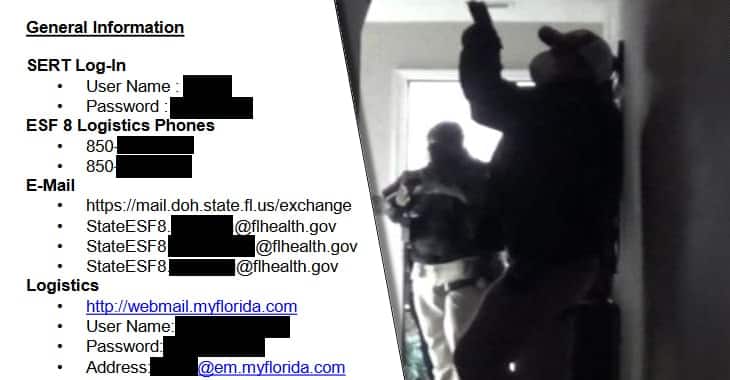
Jones has denied having anything to do with the message or the unauthorised access to the emergency system, and has shared a video of the raid on her home:
1/
There will be no update today.At 8:30 am this morning, state police came into my house and took all my hardware and tech.
They were serving a warrant on my computer after DOH filed a complaint.
They pointed a gun in my face. They pointed guns at my kids.. pic.twitter.com/DE2QfOmtPU
— Rebekah Jones (@GeoRebekah) December 7, 2020
Now it has been revealed that not only were the same username and password shared by all state employees with access to the emergency alert messaging system, but also that those login credentials were actually posted on the website of Florida’s Department of Health.
Umm.. regardless of who might or might not have sent the message that started this whole furore, it doesn’t sound like the state of Florida was taking password security seriously.
Passwords should not be shared. Passwords should not be posted publicly on websites. Passwords should be changed when people leave your organisation. Passwords should be unique, impossible to guess, and difficult to crack.
You can hear more about the background on this case on the latest “Smashing Security” podcast:
Show full transcript ▼
 This transcript was generated automatically, probably contains mistakes, and has not been manually verified.
So Graham Cluley and I have decided that any monies we receive via Patreon during the month of December 2020 will go directly to our local food bank.
We're doing this because there are a lot of people that are hungry and it's getting cold out there and it's Christmas.
If you're not a Patreon supporter, which is totally fine, I do urge you to look at your communities to see how you might be able to help bring a little bit more joy this season to those that are having a hard time.
And lastly, just a huge thank you for all your support this year. It has meant the world to us. Now let's get this show on the road.
Maybe a new team have been brought in to take over. Is that something you can identify with at all? Sticky pickles?
My name's Graham Cluley.
Are you going to be attending the Smashing Security live Christmas party on the 17th of December?
Now, coming up in today's show, Graham goes on the hunt for some hidden treasure in the Rockies.
Anna tells us of a crazy police raid in Florida, and I'll share tips on avoiding cyber hell this holiday.
And we have our featured interview with the rather informed Max Linscott of Mimecast. So all this and loads more coming up on this episode of Smashing Security.
But in recent years, she's been spending lots of time with her border collie Cupcake in New Mexico, sleeping in her SUV.
Okay, so she's gone from being an attorney to sleeping in her car by choice. By choice. I think she still is an attorney. She's still practicing.
And you may be wondering, why is she doing this?
Fenn, he was an art dealer, and he wrote his autobiography back in 2010 at the age, the grand old age of 80 years old, thinking that he didn't have much time left.
And he thought, well, I better write a book. And he's had worries about his mortality before. Back in 1988, in fact, he was diagnosed with cancer and was told it was likely terminal.
And one of the things he did while he was dealing with that news was he went walking around in the Rocky Mountains. Okay.
And he thought, well, wouldn't it be fun if I could sort of leave something for other people after I've gone?
And his idea was to hide a treasure chest somewhere in the great outdoors.
And he thought he had found the perfect spot, the location which was very special to him, where he thought would be his ideal resting space if he was just to lie down.
Now, thankfully, he actually recovered from his cancer diagnosis.
But when he came to write his autobiography years later, he remembered his idea of a treasure hunt and a treasure chest with clues.
And so what he did was he put into his autobiography a poem, a cryptic poem. I don't think—
Begin it where warm waters halt and take it to the canyon down. Not far, but too far to walk. Put it in below the home of Brown. And it carries on for a few more verses.
And it was describing where he had hidden a treasure chest containing gold nuggets, gold coins, gemstones, and jewelry. So that's what's in his treasure box.
So people were going into the Rocky Mountains in New Mexico, Colorado, Wyoming, Montana, hoping to find it.
Now, from the research I've done, all the people have died. All the 5? Of the 5, they were all men. And often with wives and families who said that they'd become a bit nuts.
It ruined their lives.
Some of the wives even said, I'm sure it's a hoax, but, you know, he has to go hunting every weekend, or he goes off for weeks on end looking for this damn thing.
And there was no proof that Forrest Fenn ever actually hid anything in the Rocky Mountains other than he wrote a book. He could be some nutter.
And then in June of this year, June 2020, there was an announcement. Forrest Fenn posted on his website that the treasure had been found.
And he wouldn't say where, and he wouldn't say who had found it. All he'd say is that some guy who wanted to remain anonymous, some guy back east, he said, had found the treasure.
Which raises all kinds of questions. Because was that even true? Was Forrest Fenn saying it'd been found to stop nutters going out into the Rocky Mountains looking for it?
Maybe someone's going to find Forrest Fenn and go, "Tell me where you put the box or else!" Well, I believe his house had been burgled before.
The other possibility, of course, was maybe Forrest Fenn had told someone where the treasure was in order to bring the hunt to a close. And who cares?
Really pissed off Babs. Barbara Babs Anderson, attorney of law.
Thought of where the treasure might be. Bye!
She decided that the treasure must be in Santa Fe, New Mexico, because she was certain of that because she said there was a clue about mildew contained in a picture Forrest Fenn had posted where he had a hole in his hat, and the hat was in the shape of the state of New Mexico.
The hole in the hat was.
Okay, I'm just going I can tell you how long a drive that is between Chicago, Illinois and Santa Fe, New Mexico. It's 19.5 hours driving. Is she single?
Barbara was certain that she was close to finding the treasure, and she believed it had been stolen under her nose because she says that someone had been taunting her.
And whoever had found the treasure had stolen clues that she had found and information which she was storing in her email.
Now, since she filed the case, Forrest Fenn, sadly, about, I think it was about a month or two after the find was made, passed away at the age of 90.
And that's how we now know the person who ended up claiming to find the treasure is a former BuzzFeed journalist and medical student, 32-year-old Jack Stewart.
Oh, I bet he's pissed off now. Who wanted to remain anonymous. He claims that his family are now in hiding.
He says that he searched for the treasure for two years, analysing every single interview that Forrest Fenn ever gave, for any clues or way that he spoke.
And he was been hunting around the Rocky Mountains before finally coming across the treasure.
But to the annoyance of all these other hunters, he won't say where the location was or how he solved the riddle. And I think that's what's made everyone go bonkers.
'Cause they just want him to prove that he had some method of finding the treasure, which wasn't dodgy.
He says he's very close to Forrest Fenn, although he only ever met him once. That he formed a relationship with him after he found the treasure.
He obviously denies the hacking claims. But if you're really obsessed with something, might you be tempted to break into the account of others?
If anyone else wants to— Well, there's no point anymore if this really has been found, but maybe you can work out the location and reveal that to the world.
You have cancer, you decide, oh, I'm going to leave some great treasure somewhere for someone.
And then everyone who gets wind of it starts scrapping amongst each other because someone won it. It's like, well, how did he win it? What exactly happened? How did he rip me?
So over in Florida, data scientist Rebecca Jones was working for the state, and she was heading up a team who created and ran the COVID-19 dashboard for the state.
So, you know, we've all been glued to the dashboards. But this one was a particularly good dashboard and had been—
And it was used by researchers. They had plugged in to use the data, and media, and the public. It was a good dashboard anyway. Oh, cool.
I can't believe it's been going on for 9 months now, certainly here, a bit longer. I can. It feels like it to you.
And Florida obviously wanted to reopen. But the numbers that Jones and her team were publishing still looked a little bit shaky.
So, and this is according to Jones, leadership at the Florida Department of Health where she worked asked her to sort of massage the numbers.
Just lower down some of the numbers just so that they could meet some criteria.
So Jones, because she'd been praised for the transparency and everything, she wasn't happy about the fact that these things had to change.
So first of all, she said no, back and forth. And then she took down some of the numbers from the dashboard.
But then obviously that broke all the links that had been published to the dashboard. So she said she was asked to put it back up again.
But then the next day, she was told she no longer had a job.
But then that was obviously— any news site that had referenced that, obviously it broke all the links. And then they were like, "Oh, shit." And they had to put it back up.
And so they thought, "Well, you're going to have to go, Miss Rebecca Jenkins." Well, they brought in a different team to manage it.
But they say it was because she exhibited a repeated course of insubordination during her time with the department.
Maybe a new team have been brought in to take over. Is that something you can identify with at all? Sticky pickles? Well, sticky pickles.
I feel I was pushed out because I was pregnant, Graham. I feel Ziggy Pickles pushed me out.
Jones now is publishing her own coronavirus dashboard, which she says the numbers are higher, but, and she says they're more accurate.
And on the 10th, somebody sent a message on an official emergency communications channel that they shouldn't have done.
So it was sent to the State Emergency Response Team members, who are the guys responsible for coordinating public health and medical response in Florida. So, the urgent stuff.
But on the 7th of December, so earlier this week, at 8:30 in the morning, state police raided Rebecca Jones's home. So they took her phone and her computer.
And then they enter with their guns drawn. And she's already told them that upstairs are where her husband and kids are, and they're pointing them the stairs, so it's pretty scary.
"In the house, man, my two children and my husband."
So it doesn't really make any difference that your kids are upstairs, does it?
She doesn't know anything about the emergency and, you know.
Obviously she denies any wrongdoing.
But once these people leave, they are told they're no longer authorised to access the group. Fair enough, understandable, yeah.
So it should be relatively easy to track who sent the messages because presumably they all have a user account and they can just have a look.
So the special agent who was investigating all of this said he found the IP address of whoever sent the text. He checked the logs and it was traced back to her house.
Her house, which is why they searched her house. I mean, we have no idea what the truth is. I'm sure it'll come out. But why do they all share the same username and password?
And also, why wasn't it changed when she was fired? Yeah, and she was fired in May. So it's, what is it, December now? That's a long time.
It's not gonna take long to change one username and password, is it?
There's one thing we all have in common, right?
We all have to help out family members or friends and neighbors with computer device drama, internet dramas, the routers, the whole thing.
But if you're a first-timer to the show, first, a very warm welcome. And maybe you'll just learn a few tricks on being safer online. So the holidays are coming, right?
We've got Christmas, Hanukkah, New Year's Eve coming. And normally we all get together and now we can't. I mean, it's been flipping freezing outside.
So the whole idea of meeting in the garden with your parents doesn't feel ideal, does it? Unless you got a fire pit or something the fancy people... Do you have a fire pit, Graham?
And the plan is hopefully they'll make us feel less apart, but they are all reliant on technology.
So I've pulled together a smattering of tips which should help us sidestep the pesky little online potholes so we can avoid cyber hell.
Okay, number one, make sure your service is end-to-end encrypted.
So FaceTime is, WhatsApp is, I think Zoom is now, and there's loads of others that are, but there's loads that are not.
And end-to-end encryption is really important because it makes sure that the service provider, Zoom or Apple, whoever it is, can't decrypt the content of your conversations when they're in transit.
I want both of you to come up with a good Wi-Fi or video call tip.
Okay, second one, obviously check your settings, your passwords, make sure the organizer can control who's allowed in and out. This is obviously to avoid things Zoom bombing.
I mean, it's not every grandma that takes kindly to someone wagging their Graham Cluleys in the webcam. So I did that just for you, Anna, just to make you laugh.
Only those that are in the know get into the party. Yes, of course. And finally, my last one on this one is just assume the call's being recorded.
So the story about how you drop the milk in the supermarket and the whole thing explodes, Coke's all over you is fair game, right?
But your private stuff like your phone numbers are—I can't believe they guessed my password, it's—they start telling you.
And this goes especially for saucy calls and videos that some of you might have, right? Being careful, especially with those Graham Cluley's. Noted.
Don't complain just before or after the call because some of these services have been known to have a longer lag time during termination.
So say you've had a difficult conversation with Uncle Bob, don't immediately flip them the bird once the call's over and call them a you-know-what because—
So my advice on this front, but please, throw yours in, would be one, stay away from version 1, you know, the alpha smart IoT.
Let the boffins who are tech mad and know what they're doing test it out and report their findings. Do you agree with that, guys?
So if you don't want someone to be analyzing what you're saying.
And you can also have, on some of these devices, a hardware switch where you can actually turn it off and tell it to stop listening, and then you can decide when you want to turn it on again.
This is the only place that firms have to think twice before they BS you. Okay, that's the issue. That's why you're looking.
And all you're looking for is what data they collect from you, where do they store it, and who are they sharing it with.
And Ctrl+F, or finding stuff through— you don't have to read every single word in it. You can look for keywords to find out what they say about that stuff.
And if I think Jack Rhysider is the one who told us about tosdr.org, Terms of Service Didn't Read.
So that's a website where it kind of shrinks down the information, try and put it into clear English if you're finding it a little bit crazy.
I can't see them reading all the terms and conditions, but that's good. So I was going to ask if there was anything like that. So that sounds quite good.
I'm like, oh right, I'm giving you all rights to everything I load on your site ever for from now on.
That's not to say if they have had a security problem, you do not buy it, but what you want to look at is how they handled it.
So for example, if it turned out that they left a database open and they closed it publicly, no one had landed on it, they still told everybody about it, I kind of think they get a pass.
But if they were found out because some unauthorized party got in and then they tried to hide it, and the company denies it, I think walk away, right?
So you want to know who your partner is. These guys are business partners of yours as an individual. That's what you have to see them as.
And if you don't want to do business with them, if you don't like the way they work.
And lastly, this was one that was said by one of our guests, set up a Google alert for your smart IoT devices. LastPass.
Your router, your phones, your tablets, your Roomba, because then if there's this big security problem, you'll get it, you'll get a little info on it, and you'll be able to be pre-informed, which gives you a bit more time to do something about it.
Good tip. Good tip. Do you want to add any, guys? Did I cover everything to do with IoT? Graham, you already had some good ones.
A few tips to help you and your loved ones sidestep cyber hell this holiday.
Safeguard your organization with Mimecast's end-to-end phishing, impersonation, and brand exploitation protection service.
It's a layer of email security defense that picks up where Microsoft security leaves off.
Mimecast's innovative service blocks brand attacks before they can launch, stops live cyberattacks in their tracks, and gives you visibility into anyone using your domains without your authorization.
Start today by downloading a free copy of the State of Email Security report at smashingsecurity.com/mimecasthub. Security training sucks. It's boring. Users hate it.
They aren't paying attention. Doesn't work.
For security training to actually work, you'd have to find out what each person in the company is doing that's risky, send them phishing emails, monitor logs, check for passwords and how they're being pwned, and then you'd have to train them in a way that doesn't send them to sleep, try and track what they're doing to see if it worked.
They make this amazing software that plugs into your company, runs your phishing campaigns, integrates with Slack, tests if your users accept phony MFA requests— that's a biggie— and pulls in tons of other behavioral metrics from your existing apps.
It basically figures out what everyone needs to know and then creates personalized training that is not boring.
And it even checks that it's working, and it's all done automagically. And they've got a deal just for our listeners.
Sign up at culture.ai/smashing and your first 50 employees are free for life. Cool. More information, culture.ai/smashing. Stop your whining, Graham.
In fact, tens of thousands of companies rely upon LastPass to protect themselves.
LastPass Enterprise simplifies password management for companies of all sizes and helps you secure your workforce. So whatever the size of your business, go and check it out.
Go and visit lastpass.com/smashing to find out more. And thanks to LastPass for supporting the show. And welcome back.
Can you join us at our favorite part of the show, the part of the show that we like to call Pick of the Week?
Could be a funny story, a book that they've read, a TV show, a movie, a record, a podcast, a website, or an app. Whatever they wish.
It doesn't have to be security-related necessarily. Better not be. Well, my Pick of the Week this week, I was perusing one of my favorite periodicals, the Jerusalem Post.
Wow, mine too. I came across an interesting story, which is a little admission which has come out actually from the former space security chief of Israel.
He held the position for many years, and he's recently come out and said, oh, by the way, he says, aliens exist.
And in fact, a galactic federation, his words, has been in contact with Israel and the United States for years, but they are— By the way, I don't know why we're not leading with this story.
Why have we hidden this away in Pick of the Week? Because this is pretty packed.
He says a galactic federation has been in contact with the United States and Israel for years, but they are avoiding revealing themselves to the public.
Panic, because I think not only will there be a panic— can you imagine the whole world in a panic in 2020?
They think not only would there be a panic, but humanity is not ready yet. Now, I don't know what you think about this revelation.
I am leaning towards it being poppycock, because I think if the United States really was aware of this, then I think we can be fairly confident the president of the United States would be aware of this Galactic Federation.
And I find it very hard to believe that he wouldn't have tweeted about it.
So that is my evidence, if circumstantial, as to that this may not actually have occurred and the former space security chief of Israel may be wrong.
But you should go and check out the story because if this is true, it could be pretty big news. Could be pretty big news, Anna.
Maybe they brought COVID, those aliens.
This is a breaking news story as we record this show. And I saw it and I was quite interested.
Apparently, the Jerusalem Post say that they've attempted to get into contact with the Galactic Federation, but have not had a response.
And he'd say, yeah, it's available right now. Go and check it out.
And we have not passed the test to join. It's a bit like the European Union. It's just, it's basically Brexit. The Galactic Federation is not letting us join.
Oh, and that is my pick of the week. Happy Christmas, almost. Anna, do you have a pick of the week?
At an undisclosed company. And let me show you a photo. Does anyone want to describe what's going on here?
And we also have some Doctor Who cutouts for some reason around the Christmas tree. We've got David Tennant and a Dalek and a Cyberman. Look at that. No idea why.
No, I don't know why either. Oh, I know why.
So we were trying to organise a little work do because it was Christmas, but we didn't work in sales. So our budget was about £25 per head, I think.
We thought, Carole and I, because Graham wasn't interested in getting involved in this kind of party planning, thought we would have a buffet at work and then go ice skating, which may I say, Graham, you were fabulous at.
But anyway, I thought because, you know, 2020, as we've talked about, isn't anybody's top year, I would imagine. I thought my pick of the week would be Christmas novelty food.
So I'm not talking about— can you tell I've moved house in the last week and I have done nothing apart from unpacking boxes? This is all I have. I've just eaten.
So I'm not talking about Christmas dinner and sprouts and stuff. That's boring. But it's the novelty stuff, right? So a quick roundup of the good stuff.
So Pret are doing a fantastic Christmas sandwich in both baguette form and run-of-the-mill sandwich bread. I did actually have the Christmas baguette for lunch.
You've got aliens. All right, carry on. Marks & Spencer's, let me tell you, have an excellent offering. There's a turkey feast sandwich, which we all expect.
I mean, I don't want to go into a sandwich place without them offering me a turkey feast at this time of year. But they're also doing truffled egg and honey roast ham. Oh God.
Perhaps you could try that with some pigs in blankets crisps or some Christmas tree tortilla chips.
So it's an interactive experience, and then you eat it.
Maybe they're more expensive. But chicken, crispy bacon and stuffing with a red wine gravy base. Oh, so there you go. I'll send you some more, Graham, so you can try them all.
Okay, my pick of the week— you guys both know my pick of the week because as you're my two bud buds that love podcasts as much as I do, or almost as much as I do, I threw them your way after galloping through the first episode only.
And this podcast is called Brian and Roger. I'll just give the premise, and then you guys just jump in because it's just— So, this is created by Harry Peacock and Dan Skinner.
They're the brains and voices behind the characters, Brian and Roger. And Brian and Roger met at a divorced men's support group about a year ago. And they're really codependent.
And the problem is that one of them's quite a nice guy, right? A good guy. But the other guy is not such a good guy. And every week they inch towards a horror show of a sticky pickle.
And the outcomes are truly disturbing, wonderful, horrible, delicious, awful.
They leave a voicemail for each other and then the other one replies to it. And I have to say, after you told me about this, Carole, I listened and I kept listening.
I must have listened to about 20 episodes. I know, I think you're ahead of me now.
But it doesn't matter, 'cause it is brilliantly done.
It's much, much worse.
They talk about jazz cigarettes, they intimate that an 82-year-old deaf woman is kind of a sex fiend.
And the thing I love most is the horrific Mike Henshaw — the mouth noises are just revolting, but so perfect because there are so many people that you speak on the phone with that eat on the phone, right?
And do it really grossly.
Max, thanks for joining us and explain to me what you do. That's a big title.
So I've been working in cybersecurity for about 8 years now, and for the last 2 years I've been working on the market strategy team here at Mimecast.
My job is to basically try and understand the threat landscape, what technologies are out there, and ensure that we're delivering solutions that are solving the most pressing problems for organizations today.
What are you seeing as the main challenges?
How can they protect their intellectual property and people?
And with the ever-increasing amount of data and collaborating that's going on, we have to think about how we can manage to avoid pretty important sanctions that can come on our laps from GDPR, for example.
And as I say, the more that people are collaborating, you start to suddenly lose control of what your users are doing, what they're using, and what they're interacting with.
I think the second thing that I would highlight there is this new word that I've learned, pandanomics.
And it's therefore inextricably linked to everything, but specifically from a cyber perspective, it affects this new strategy that people are having to set up.
The run costs that people are used to supporting are being driven down and new spend is rejected.
And the sad truth of this is that all the while, the threats out there are increasing.
Part of this is the commercials of falling foul of some of this stuff could actually bring an organization to their knees.
So, decision makers are left in a really tight spot where they're forced to solve all of these problems and deliver complicated projects with half the budget, twice the pressure, introducing untried new technologies for the first time, and often sadly, with a very small amount of manpower.
So, okay, so what are the things that people need to keep top of mind? Okay, you've talked about this new remote working ecosystem. What's changed and what do we have to focus on?
We've seen amazing adoption of tools like Teams, which I believe went up in the region of 40% in 5 days at the beginning of our first lockdown.
We've seen pretty similar trends for the likes of Slack, Zoom, OneDrive, SharePoint, Box, LastPass, Dropbox, and so on.
All of this is great, but email remains the most utilized and most universal tool that we have. 94% of cyber threats begin with an email.
It remains the number one threat vector by a country mile.
And when we talk about the impacts that COVID has had in the behavioral changes, we've only seen this rise and increase during COVID. We've sent and received far more emails.
We reply faster. We open links and attachments quicker than ever before because we don't have that immediate personal interaction anymore.
But the reality is that email is such an easy thing to manipulate as a malicious actor, and it was never really designed for security.
Looking at the trends, we've seen a significant rise in email attacks over the last year, and this ranges from opportunistic drive-by type attacks to the lower volume and more targeted headline-grabbing phishing and whaling.
The hackers are better equipped to send more advanced threats with tools like commercially available phish kits.
If I was to call out two highlights just in terms of common themes in all the emails that we've observed. Yeah, shoot, fantastic.
Yeah, I think that these will probably both be quite familiar and obvious, but the first of these is COVID-related notifications, things like click here to see the latest guidance from corporates about when you're going to be able to return to the office, or local council about the new restrictions, and famously the World Health Organization that we saw earlier in the year.
And obviously we've just had announcements in the UK, and as we enter this period of tiers and vaccination and announcements, this is likely to get worse.
So the second thing that's noticed here is, as I said, we've got this increase in dependence on other collaboration tools, and a definite trend that's emerging is the impersonation of these collaboration tools and a threat that is sent through on email.
So there is— it's interesting because there is always going to be some sort of link or correlation between adoption and targeting.
So the more people that depend on a technology, the more that technology is exploited as part of the attacks.
And this could come in the form of fake links for Zoom meetings, password reset requests for Office 365, and so on.
And it's therefore a more successful and more compelling attack.
We're all doing this and we're all running a bit mad because it's been an insane year for everybody.
They're trying to run a business, if you think about it. So, they study their total addressable market.
They're thinking about delivering a minimum viable product, and they're aiming for excellent adoption rates.
Which basically means how can I successfully target as many as possible with the most effective attack that costs me the least amount to produce.
We're protected by a security team that is stretched and underfunded at best, not to mention that, as you say, we're all clamoring for this information about when and how our lives are going to return to normal, and the list goes on.
So there's this real spectrum of attacks. And the ones that make the headlines are often the sort of dastardly ones that are very sort of cleverly crafted.
And while we do see hackers occasionally relish the challenge of architecting a bleeding-edge attack, they'd much rather shoot fish in a barrel.
So tell me about how organizations are going about changing their strategy to compensate or to just meet the requirements of this new world.
I think it's pretty tough at the moment, obviously, but it's fair to say that a trend that's emerging is consolidation.
So organizations are looking to reduce complexity at every turn. The burden on IT is just too great.
So, sadly, the sort of doom and gloom part of this is that the first things to be questioned are the headcount and licenses that are associated to operational costs, as a CFO would look at where am I spending my money?
And IT doesn't seem to be making me any money, it's just costing me money. So how can I cut that down to size?
So people are being forced to sort of consider their options at this point, and the future is in the cloud, and it always has been.
But what COVID's done is it's catalyzed the transformation projects but simultaneously, as we've said, shrunk timeframes, resource, and budgets all in one fell swoop.
So in order to kind of protect IP and people in the cloud, it is about striking a balance between how much consolidation do I go into and what other things do I need to consider?
And consolidation is important because it can reduce complexity and cost. But we have to ask ourselves, can I deliver economics, experience, and efficacy in equal measure.
So, if we look at that Microsoft example and we were to take consolidation to its extremes by choosing the apparent economics and simplicity of becoming totally dependent on one single vendor like Microsoft, and we kind of ignore what we see in the rearview mirror and forget measures like layered security or independence, things that we used to value, right?
Does that mean that I then underdeliver on efficacy?
And what's the knock-on effect of, if we think about the security side of things, what's the true cost of failing to deliver that? Does it actually have an effect on the economics?
So what would a breach cost me and how many breaches can I expect and how much time am I going to spend clearing them up?
Microsoft have released more security features than they ever have done before, and you can see that it's really starting to shape nicely to deliver things like Zero Trust, which is pretty cool.
But I think it's worth raising— there are a couple of issues with expecting using one cloud to be everything to everybody.
So today M365 has almost 300 million business users on its platform, all ferociously adopting and collaborating with all of these tools and bits of kit that they've given you.
And this means a few things. It means an increased attack surface. And what I mean by this is every single user added represents a new angle of attack for malicious actors.
95% of data breaches are the result of human error. And I always think about it like, you know, those old vampire movies.
They can't cause you that much harm unless you invite them in.
And as we kind of touched on earlier, it means that when you're creating an attack via email and you imitate a Teams login, it is more successful because you know that they're using it.
Also, this collaboration means that you've got more people generating more data all sitting on this Microsoft platform.
And the result of that is that there is more data to steal, more people to target, and this incentivizes attackers to target Microsoft.
And this is the main sort of other point that I would want to make, and this is the dependence on that single vendor.
So the compelling bundling and features that are included in the Microsoft packages at the moment are combined with the pandemics and the financial pressure, meaning that organizations are very prepared to accept that suddenly Microsoft security is good enough.
And this creates a homogenous monoculture where more organizations are sitting behind identical protection.
It's a really funny kind of phenomenon, and the result of this is that Microsoft has actually unified malicious actors.
So there are more users to attack, there is more data to steal, and all of these users and all of this data is sitting behind exactly the same security.
Email is the number one attack vector. It's really unsurprising that email attacks are being purpose-built and designed to penetrate Microsoft's included security.
It's just too obvious a target.
And even against the best security that they've invested in, the Microsoft Advanced Threat Protection, hackers are proving themselves well up to the challenge.
So I think the good news is there is some silver lining, and actually what we've described isn't a bad thing to look at and to do, it's just that we need to go into it with our eyes open.
You have to build, and you must, and you probably will build your strategy around Microsoft 365, and you need to pick the other tools that you need to succeed.
This has to include a thorough assessment of risks and for you to be able to ask some more challenging questions of the technology. Where is Microsoft great?
Where do they need some help? And should I expect them to face certain challenges on their own? And what is the true cost of being totally dependent on them?
So you're going to introduce more vendors than your CFO thinks you need.
So it's important that your vendors can help you demonstrate the value of any extra spend or more likely the cost of not spending that money.
So we talked about organizations being brought to their knees and according to the IBM data breach report, the average cost of a data breach in the UK is $3.9 million.
So in prepping this year, because we have to, we are actually building hopefully more resilient systems that actually can help IT security people provide better services for their users and for clients and for everyone.
SPEAKER_03. Absolutely. Max Linscott, thank you so much.
It's been great to be here.
Yeah, hunting a bit early.
And don't forget, you want to make sure never to miss another episode of Smashing Security, subscribe in your favorite podcast app, whether it be Apple Podcasts, Spotify, or Pocket Casts.
You can sign up at smashingsecurity.com/live. Be there, be triangulaire.
And again, quick shout out to our sponsors, Mimecast, Culture AI, and LastPass, and our individual contributors via Patreon.
This support is what helps make the show free for everyone.
All the details for past episode sponsorship, guest list and everything else is available at smashingsecurity.com until next time, cheerio.




I note that the webmail portal is using HTTP ?
http://webmail.myflorida.com