


I’ve received an email. It’s from YouPorn, and they say it’s urgent.
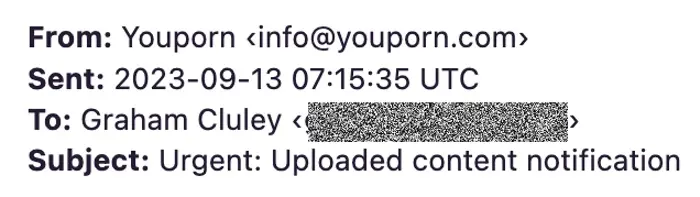
This should be interesting. Let’s see what it has to say.
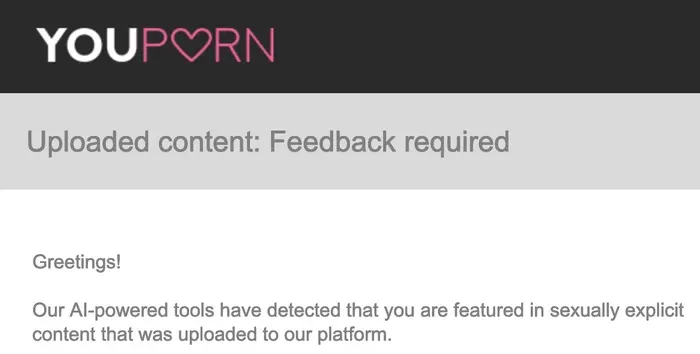
Well, the YouPorn logo and nicely-formatted message certainly makes it look like it has come from the porn video site.
And, uh-oh, it seems YouPorn’s AI algorithm has detected me in a sex video that has been uploaded!
Now, I can be forgetful… but I’m reasonably sure that I have never knowingly appeared in a sexually explicit movie, let alone uploaded it to YouPorn.
But how clever of YouPorn’s AI system to detect that it was me in the video, and then get in touch to warn me.
It makes me wonder what kind of AI technology they’re using here. I mean, normally you wouldn’t expect even the smartest AI system to be able to tell who a person was by the kind of body parts that are likely to be taking prime position in a video like this.

Oh well, if it’s “advanced technology” that explains it. Sounds like they’re pretty powerful…
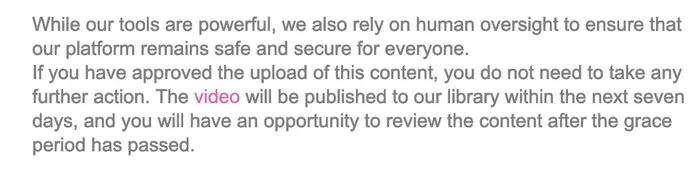
Ouch! So, if I don’t want the video published on YouPorn I have to let them know within seven days.
So, I guess all I have to do is click on the link to check out the video. Seems reasonable.
But, damn it, there’s a problem.
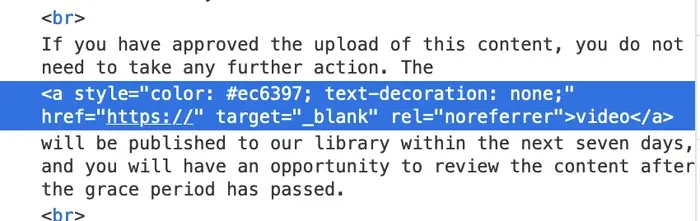
You see, the link in the email YouPorn has sent me doesn’t go anywhere. There’s no website address to go with the https:// !
I’m going to have to find some other way to stop the video being published.
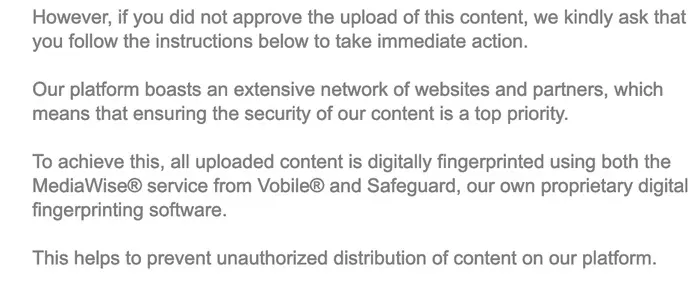
Sounds like they’ve got some pretty cool technology at YouPorn for dealing with this kind of situation.
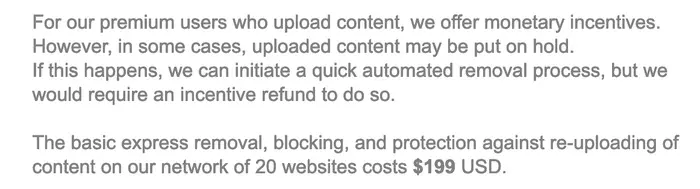
Aha! This is more like it. But I’m not sure if a “basic express” service that prevents re-uploading of my saucy sex video to 20 websites (I heard there are more porn websites than that) is good enough, even if it only costs $199.
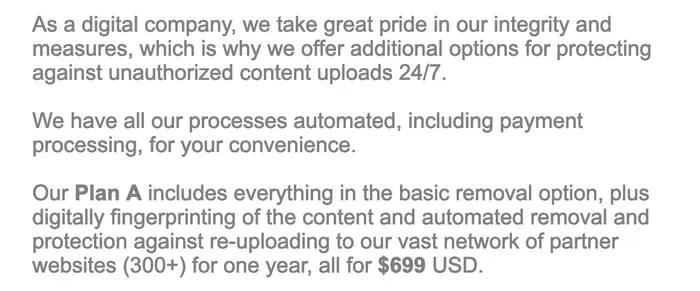
Protection against the video being re-uploaded to over 300 of YouPorn’s network of partner websites for just $699 sounds like a better deal. But hang on, this is just for one year! I don’t want to have to clean up this mess again in 12 months time… I need the best protection available to maintain my squeaky clean online reputation.
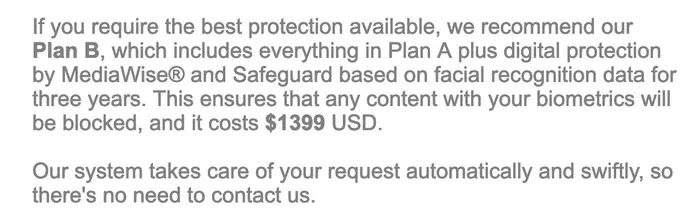
Now this sounds more like it. All of the previously-mentioned protection “plus digital protection by MediaWise® and Safeguard” (anything that has a registered trademark symbol has got to be impressive, right?) “…based on facial recognition data for three years.”
Three years isn’t as good as perpetual, but it’s better than one year. And they seem to be guaranteeing that “any content with my biometrics will be blocked”.
All for a mere $1399.
Where do I pay?
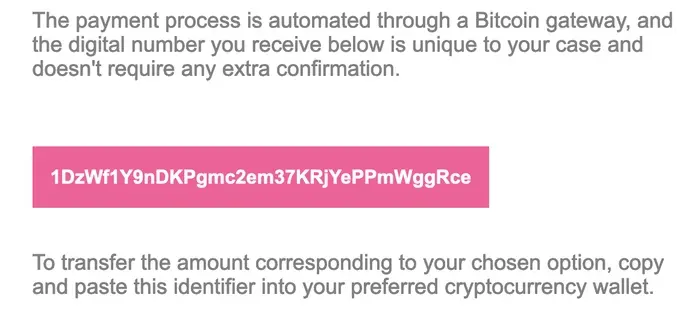
Hmmph. I have to pay through cryptocurrency? That seems a little unorthodox. But hey, maybe YouPorn is just trying to protect my privacy. After all I wouldn’t necessarily want my partner to spot a payment to YouPorn on my credit card bill.

Let’s check out that link.

Darnit. That link doesn’t work either! I’m just going to have to assume that YouPorn has got a sex video of me, as I can’t double-check for myself.
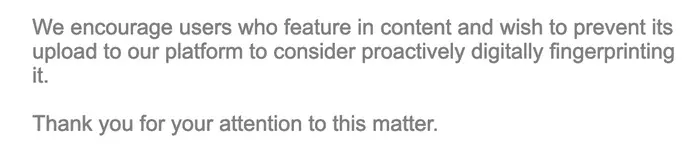
No, thank YOU.
For further discussion of this topic, check out episode 340 of the “Smashing Security” podcast:

Show full transcript ▼
 This transcript was generated automatically, probably contains mistakes, and has not been manually verified.
Hello, hello, and welcome to Smashing Security episode 340. My name's Graham Cluley.
It's just, hello and welcome.
It's their support that helps us give you this show for free. Now coming up in today's show, Graham, what do you got?
Plus we have a super informative featured interview with Mark Jow, a technical evangelist at Gigamon, where he will share everything you need to know about using and securing the cloud.
All this and much more coming up on this episode of Smashing Security.
It's a very professional-looking email, and it looks like it comes from a corporation. It looks very legitimate. And the corporation it comes from is YouPorn.
It's an urgent message from YouPorn. Are you familiar with YouPorn at all, Andy?
But anyway, so a number of websites that this company owns. So I received this email and I thought, well, this is unusual. Why have I received an email from YouPorn?
So I thought I'd take a look. So what I'll do is I'll just take you through the email and we'll see what happens.
Have I uploaded a sex video to YouPorn lately?
And as Andy says, could it be another part of my body that has some unique characteristic or a barcode or serial number on it that allowed them to narrow it down to little old me.
Anyway, so I'm wondering what's going on here. So I carry on reading and YouPorn say, "At our company, we take security and privacy of our users very seriously." Very good.
They took that quite seriously, and I remember the press did as well. They made lots of puns about it, talking about having to clean up the mess afterwards.
Anyway, but moving on, they said, and we use advanced technology to help detect and prevent the distribution of non-consensual intimate images and videos.
And I'm wondering, how can they tell?
And they say, look, you know, our tools are very powerful, but we also rely on some human oversight to ensure that everything remains safe for everybody.
So what we've done, this video has been uploaded. They say it will be published on YouPorn within the next 7 days.
And you've got an opportunity to review the content and, you know, and say you don't want it published, right? Which I thought was very kind of them.
So they provided me with a link to check it out.
So it doesn't go anywhere, which is really disappointing as a link. So I've got to work. I mean, I imagine it's going to be youporn.com/something.
So I don't know what to do at this point because I don't have a link.
To check out the video, I'm thinking, should I just start trawling through YouPorn to see if I can find videos of myself?
So I'm sort of thinking I can't do anything. It says, if you didn't approve the upload, we kindly ask that you follow the instructions below to take immediate action.
And of course, because I haven't seen the link, I'm panicking at this point. I'm thinking, oh my goodness, there's a sex video. I didn't know I was in it.
Apparently, I was in this video. It's been uploaded. It's going to be released to everybody. It could be embarrassing. It could be highly impressive. I don't know.
I just simply do not know at this moment.
Anyway, they give me some options and they say, look, we've got a basic removal service, an express removal service, which not only will block it from our side, but will also prevent it from being re-uploaded on our network of 20 other websites.
That's only gonna cost you $199.
What are people seeing? I don't know.
And all that's gonna cost me is $699.
"We're going to look at your biometrics." Lord knows what part of my body they're doing biometrics on. I hate to think of that fingerprint. "That's going to cost me $1,399.
And all I have to do," they say, "is pay via bitcoin," and they provide a wallet address. So, I don't know what to do. I'm not sure. The links don't work.
But if they said that you had to upload a photo to prove it was you along with the payment, then they've got a bit more longevity.
I'm not— maybe this really is from YouPorn and they're just trying to drive more traffic to their site.
There are other people who apparently have received similar emails, which could be because they are legitimately in these videos or not.
I'm imagining though that this is some kind of scam, but it's an interesting twist because just a couple of days before I got those emails, and I'm sure both of you will have received these ones where we say, oh dear, oh dear, haven't you been a naughty boy because we've hacked into your computer and we know that you've been going to porn websites and we've recorded you and we're going to release this to the world, blah, blah, blah, blah, blah.
Someone has uploaded a video. And I imagine because young people do take video footage of themselves and older people as well, some people might be concerned.
And maybe some people sometimes pay up. I don't know. Andy, have you ever starred in a sex video with a—
And I don't know whether I'm entering my old man era, sort of grumpy old man era.
With the whole bitcoin scheme. So I got an email this morning, I checked my emails this morning and I had something from PayPal.
Which actually said, you know, you've just created a new PayPal account, please confirm your email, which I hadn't created a new PayPal account, but it was my email address, just not one that I use for PayPal.
And then 2 hours later, I got another email from PayPal saying you've opened a PayPal account, and I have analysed it. I've checked all the links are legit PayPal links.
It's genuinely from PayPal, is genuinely my email address. And I clicked the forgot password.
You know, I actually went to the website, put in that username, then I click the forgot password and it's got my actual phone number in there as well to receive a text on it.
And so I don't know what the scam is. Okay, so that's put me in quite a bad mood all day because it's not been me that's done this.
And so, BMW have finally given up on charging people for their heated seats.
So that is, the seats that you already have in your car, the heated seats that are already installed, but if you want them to work, you have to pay $18 a month.
That's— And this happened.
I know, this actually happened after they had already backed down from a prior backlash where they wanted to charge for the use of Apple CarPlay, you know, so people could sync their phones with the hands-free and stuff like that.
Because then they just produce one kind of car hardware-wise, you know what I mean, rather than lots of different versions.
So they're going to save money and maybe that's good for the environment or whatever, that they're just making one kind of thing rather than lots of other things.
And then they can turn them on if you opt for them.
And every now and then, I mean, it's like 8 hours, 9 hours in the car. Every now and then she'd flip a little switch and turn on my heated seat.
And every time I felt like I had a tropical disease or malaria. And then suddenly I'd realise, oh, fuck, fuck, fuck, you've turned it back on, haven't you? And I hate heated seats.
I hate them.
Back in the day, if you wanted something, you just like— especially optional extras in a BMW or something, you know, if you wanted the top range, you'd get an M3, you know, and everyone knew that it had all the optional extras and it was fast and all that.
But now it's exactly what you just said, Graham. They're building one thing and then they're giving you this option. It's like the whole digitization model, right?
Where they're just giving you that optional extra that you can pay for.
But all you do is just unlocking, you know, options and software, but it costs BMW nothing to enable it, right? You've already paid, the equipment's already in there.
They're not paying for the heat.
If you didn't use it much, you just get one copy of Photoshop and you'd use it, you know, for like 3 years. And then they went to like a monthly subscription fee.
And they're saying, oh, but you get the latest version every time. It's like, well, if I use it twice a year, it's not worth it.
I think this is, I think a monthly charge for a heated seat is quite reasonable because you probably only want it for 2 months a year.
Yeah. Everything. And how are you managing that really? And how many of them have, are you still paying for, but you're not actually using as a service anymore?
So, I'm hoping the subscription model, I wouldn't mind if they said, okay, you want that, 500 extra quid, or whatever they want to charge for it.
Would you then pay to subscribe or would you just leave the default? I'm happy with Kiss FM.
But there are things where it is required.
But you know, if you're paying for a high-end BMW, and obviously all the jokes about the indicators are optional extras as well that no one pays for.
But it's just the subscription models, I get it, they're all the rage, but it's a laughably stupid idea. I don't know why they persisted for so long as well.
But some guys actually did it at Black Hat this year.
And it seems cars have come a long way since I was on the market looking for one.
Literally airbags were all the rage when I got my car, and it still even has a CD player, but there's no cup holder.
That is the most irritating thing about my car, the lack of cup holder. I think that was an optional extra. So irritating. But you have cool stuff now.
Now, Graham, I know you have some of this stuff in your car. Do you have advanced driver assist controls?
So it monitors blind spots and keeps you in your lane and all that kind of stuff?
I can put it sort of in cruise control and it will drive along. I have to touch the steering wheel occasionally, but—
So I do seem to be able to jump between the two different types of vehicle fairly easily.
There was a button where it could actually parallel park or reverse park into a gap.
So you don't have an obstructed view of all the road or the luggage, your passengers behind you.
So for instance, some vehicles will not allow the radio or audio system to play until all occupants have fastened their seatbelt.
Shouldn't they be having the really cheap, bashed-up car instead?
They even get report cards sent to the teen driver's guardian or parent to show how well they've been adhering to driving laws.
And who's making sure everything is up to scratch for the actual buyer of the vehicle? You know, the customer. I mean, sure, there's all these bells and whistles.
They're sweet, but at what cost?
So I was thrilled to see that the folks at Mozilla's Privacy Not Included camp, this is where a team of researchers look closely at IoT gizmos, like from watches to toys to cars, and they check out the fine print.
And some are surprisingly good gizmos, and they're not creepy at all, while others beggar belief, and you can't help but wonder how selling this stuff could even be legal.
So is the gizmo stealthily helping itself to personal details? That's the thing that they're probably looking at. If so, what? What are they taking from you?
And also, what is the company doing with that personal details they've taken from you once they've hoovered it up?
Because a few weeks ago, a research team of three at Privacy Not Included at Mozilla Foundation, Jen Colreider, Mikael Ryckhoff, and Zoe MacDonald looked at 25 car brands.
Okay, so this is Subaru, BMW, Mercedes, Jeep, Chrysler, Ford, Dodge, all of them. They even had Tesla in there.
And they spent over 600 hours researching the car brand's privacy practices.
So in terms of a category of products, so if we talk things like vacuums or Hoovers in your country, or phones or whatever, I don't even know how to say this.
You know what I mean by a category of product?
Do you think they were safer or more privacy aware because they're an established business and a model?
It's not a car anymore. There's no joy in it. They're soulless devices.
They say all 25 car brands they researched earned our privacy not included warning label, making cars the official worst category of products for privacy that they had ever reviewed.
And these guys have reviewed a lot of gizmos over the years.
And you have a lot of lawyers that are involved in the car business, right? So the paperwork is going to be CYA, a lot of that in the legal terms and conditions.
Every car brand, all 25, the team looked at, they say, quote, "collects more personal data than necessary" and uses that information for a reason other than to operate your vehicle and manage the relationship with you.
So 21 out of 25 of the car brands they researched say that they can share your personal data with service providers, data brokers, and other businesses.
19 out of 25 say they can sell your personal data to whomever they choose.
And more specific examples, they report that Subaru's privacy policy says that passengers of a car that use connected services have, quote, consented, unquote, to allow them to use and maybe even sell their personal information just by being inside the car.
Nissan also say they can share, and even sell inferences drawn from any personal data collected to create a profile about a consumer reflecting the consumer's preferences, characteristics, psychological trends, predispositions, behavior, attitudes, intelligence, abilities, and aptitudes for targeted marketing purposes.
For example, on the phone, you pick up someone and they start an intimate story about their life that's horrible. This is all being hoovered up by your car. It's insane.
They've done an overall report and then they've done little mini reports for each of the 25 cars.
So I have provided links in the show notes to the main article, and literally you can just go search your car brand on the website and it's very easy to find.
But I have had the pleasure of speaking with Jan Kallreiter before, and what they do is do a fine search through the terms and conditions and the privacy notices.
And that's how they're able to see what the company is basically giving itself allowances for. Or not.
But is it the case that it's the legal team saying we need to put all of this into our privacy policy just in case we accidentally share any of this information?
You know the NCAP safety rating where there's those very dramatic videos of cars crashing into walls and the dummies flying forwards?
And we learned from that that Volvo have the safest cars. And so there's this whole NCAP rating across Europe where it's we know how safe each car is.
I think we need something like that for privacy. For any sort of connected devices, you need to have that score.
Much like the food hygiene scores, if you go to a dodgy takeaway, if it's got a 1, it's not a good place.
But, you know, we need something transparent that people can just see as they walk in the door, 1 to 5, you know, where does it sit?
And actually, so Mozilla and the Privacy Not Included Foundation are saying, if you don't like this, Mozilla community is asking car companies to stop their huge data collection programs, and you can join them by adding your name to the list.
With Drata, you don't have to spend hours collecting evidence, manually testing controls, managing spreadsheets and screenshots, and pestering other teams with requests.
With automated evidence collection, over 85 integrations, and 24-hour monitoring, Drata automates the compliance process and keeps you audit-ready all year round.
Drata supports over 16 frameworks including SOC 2, ISO 27001, GDPR, and HIPAA. And with an open API and plenty of customization, you can build your compliance program your way.
With over 475 5-star reviews, Drata is the highest-rated cloud compliance platform on G2.
Countless security professionals from companies like Notion, Lemonade, and BambooHR have shared how crucial it's been to have Drata as their trusted compliance partner.
Listeners of Smashing Security can get 10% off Drata and waived implementation fees at smashingsecurity.com/drata. That's smashingsecurity.com/d-r-a-t-a.
And thanks to Drata for supporting the show.
For the past few years, the majority of data breaches and hacks you read about have something in common. It's employees.
Hackers absolutely love exploiting vulnerable employee devices and credentials. But imagine a world where only secure devices can access your cloud apps.
Here, credentials are useless to hackers, and you can manage every OS—even Linux—from a single dashboard.
Best of all, you can get employees to fix their own device security issues without creating more work for IT. The good news is you don't have to imagine this world.
You can just start using Kolide.
Kolide is a device trust solution for companies with Okta, and it makes sure that if a device is not trusted or secure, it can't log into your cloud apps.
Visit kolide.com/smashing to watch a demo and see how it works. That's k-o-l-i-d-e.com/smashing.
Gigamon's latest survey of over 1,000 global leaders reveals the state of hybrid cloud security and the dangers that free-flowing encrypted traffic poses to organizations.
Find out more, gigamon.com/smashing. That's G-I-G-A-M-O-N.com/smashing. And thanks to Gigamon for supporting the show. And welcome back.
Can you join us for our favorite part of the show? The part of the show that we like to call Pick of the Week.
Could be a funny story, book that they've read, a TV show, movie, a record, a podcast, a website, or an app, whatever they wish. It doesn't have to be security-related necessarily.
Better not be. Well, my pick of the week this week is not security-related. My pick of the week is a new online game I stumbled across.
I don't know if you've ever been to— Carole, you've got a website, carole.wtf. Very good. If you want to check out Carole's art. Thank you, Graham.
Another website with the .wtf TLD is Vole, V-O-L-E, where they have a number of very amusing online games.
And I have come across a game up there called, well, it's called Programming Language Inventor or Serial Killer.
And what it does is it puts up images of people and gets you to try and guess whether they created a programming language or whether they killed lots of people.
And it's quite good fun.
Oh, I don't know that. No, it died when Flash did, but—
Andy, what's your pick of the week?
It was advertised on TikTok a few days ago, and their website has been extremely busy ever since. And so I used Verbalate, which is a competitor of theirs.
So maybe you wanted to expand into those markets, speaking in their native language would help.
But you don't want an AI-generated voice, you actually want your voice to be translated. But how well do you speak Korean or how well do you speak Japanese or Hindi?
This site will allow you to upload video in your own voice and you can either get the audio extract only, or it will actually lip-sync your mouth and translate at the same time.
Oh my gosh. It's actually, you know, if you're doing videos or TikToks or any sort of social medias, it's a fantastic tool, especially for deepfaking stuff as well, right?
And then I translated it to French. And so you can then sort of listen and say, actually, yeah, that's exactly what you said. Let's take a listen.
Have you ever wondered how to protect yourself from hackers while keeping your sanity intact?
Well, prepare to have your socks knocked off by the Smashing Security podcast with hosts Graham and Carole at the helm, this cyber-explosive duo will guide you through the hilarious world of cybersecurity, debunking myths, sharing heartwarming security fails, and uncovering the most bizarre tech headlines you won't believe are real.
Le monde hilarant de la cybersécurité en déboulonnant des mythes, en partageant des échecs de sécurité qui font chaud au cœur et en découvrant les titres les plus bizarres sur la technologie dont vous ne croirez pas la véracité.
You know, just register whenever you want, get multiple single minutes, or else a very affordable subscription.
I have hoovered it all down already. It's from the creator of Better Call Saul and Breaking Bad, so Vince Gilligan. And this is his latest oeuvre.
And we follow Alice, who, while getting across her hometown of Oxford, Graham— my home city— she spies her estranged husband crossing the road.
And a decade earlier he told her he's popping out for chow mein and never returned.
So a shit for sure, but when he left, he also stole all her cash and her parents' retirement fund. So basically what you'd call a super shit, I guess.
And, uh, he's now presenting himself as a renowned eco-disruptor. How's that for a title? And has a kind of a bit of Tony Robbins feel, you know, I'm king.
And he has a new victim in his sights, a very wealthy and newly widowed auteur. So, estranged wife is going to try and give it her all to save the day. But does she manage?
So, very fun, full of twists and turns. You also get to see a baddie who's a master at gaslighting, right? Because you rarely see that on telly.
You often see these kind of lame gaslighters, but this guy really does it well. So, it's worth checking out. You have to admire his gaslighting. Have you seen it, Andy?
I've not seen it, no. But you sound quite impressed by him.
You will get to see loads of real places in Oxford, which is cool, except for the courthouse, which is much, much nicer in the show than the one I was stuck in for two weeks last year.
Check it out. All right, let's kick this off. So listeners, I want to welcome Mark Jow. Is that how I say your name, Mark?
And within their EMEA organization, I speak on behalf of the company in terms of how the organization addresses business challenges for the organizations that we serve, give updates on our product, our product strategy roadmap, and also ensure that the technical teams that we have creating solutions for our customers, giving them the compelling solution that delivers the outcome that we promise when they purchase that solution.
So I guess sort of 3 elements to the role.
Can you talk to us about that?
And what they're telling us is slightly paradoxical. On one hand, 94% of them tell us that they've got the required levels of visibility they need in their organization.
Over half of them said that they're confident in their ability to repel attacks.
But when we examine them further in terms of how confident they feel about things like encrypted data, how many of them have actually had breaches.
Clearly, there are significant numbers involved there to the point where somewhere in the region of 50% of them have had breaches.
The ones that have been breached, they don't even know how they were breached and how the data or the access was gained to their organization.
So clearly, at one level they're confident. At another level, the realities paint a different picture.
But increasingly organizations are using encrypted and generating encrypted traffic in their internal application environments, their cloud environments within their own organizations.
And I think what they're seeing is 70% of the people we spoke to are letting that information flow freely across their organization. And they're not doing that because they want to.
They're doing that because they currently have to, because there's no viable solutions out there to help them look into that encrypted data in a meaningful way.
And as a result, those bad actors are effectively turning an encryption, which is primarily an asset there to assure security and safety of organizations and the people who bank and buy things from those organizations and give their data to those organizations.
Effectively, that very security mechanism is being used against them because increasingly bad actors are hiding their attacks in that encrypted data.
I think about over 90% is hidden with encrypted data.
So if they're letting it flow freely and they can't see within it then it can't be surprising that that's where the actors are going to strike.
And I think when you look at the fact that 30% of them say, look, we didn't even know we'd been attacked or how, it's probably the case that that threat was hidden in encrypted data, which is why they didn't see it.
And they're only finding about the breach when they see either their data being offered for sale on the darkweb or someone's trying to extort money from them, or there's a news story hits.
So I think encrypted data for us is the key of where a lot of those risks are actually starting to increase.
And there are the random acts of vandalism, people who just want to damage or corrupt things because they can and they get a kick from it.
But I do think a lot of the encrypted attacks that we see now are perpetrated increasingly by nation-state or very experienced threat actors that have been commissioned by nation-states and others.
And they're there to gain access to data within the organization, either as commercial value or strategic geopolitical value or even national security value.
And so a lot of the attacks into encrypted data really are around phishing and, you know, getting access to data, getting data outside the organization, and also demonstrating to nation-states that they're vulnerable to attacks from other states.
So that's a lot of what we see. Wow. Okay.
So if all this stuff is hiding in encrypted form and you're not even aware it's there, is it that lack of visibility into these hybrid cloud infrastructures that's maybe basically a pipeline to security issues?
And I think a lot of organizations have become in the past content with a certain amount of visibility that they get from various different observability tools and tools that look at logs and metrics and events and things.
They've got pretty good visibility in terms of what's happening north-south within their organizations and their data centers.
A lot of organizations don't realize the art of the possible that organizations like Gigamon can deliver to give them that deep network-level immutable data traffic visibility, right?
Both east-west and north-south across their data centers into public clouds, within public clouds, within private clouds at that network level.
And I think it's that level of visibility that organizations are starting to realize they need.
Interestingly enough, when we did the survey, we asked some of the questions before we explained to the respondents what we meant by deep observability.
And then once we'd done that, we said, okay, if you have this capability, this deep network-level insight, immutable data that you can feed to the different tools to be better informed, would this be of value to you?
And would this close these visibility gaps you're telling us about?
And universally, I think the vast majority, over 90%, said absolutely it would, and that they were looking to try and implement those types of solutions.
Some of them already had to some extent.
But even with that deep observability today, getting access to the information in the clear in encrypted traffic, particularly in cloud environments, is very difficult, even if you've got access to that network traffic.
Right. Again, that's something that we're uniquely placed now to provide a solution for, unlike many organizations, other organizations out there.
I think the company should be proud of what it's managed to achieve here because if you look at what Gigamon has done probably over the past 7, 8, 9 years, we've had solutions in place, leading solutions that operate securely at scale and robustly to help organizations decrypt and get access to encrypted SSL traffic in the physical network for some time.
We've been doing that for some time, but clearly getting access to that traffic in the clear, encrypted SSL, TLS 1.2, 1.3 traffic in cloud environments, in VMware, AWS, Azure, OpenStack, that's been a little bit of a holy grail, and that's not really been possible.
There have been organizations out there using data solutions, AI, machine learning, analysis of the sort of packet profiles, but they still can't see into the payload of the packet because it's encrypted, and they sort of do trend analysis.
Well, the release of our pre-cryption solution on the 12th of September really helps customers now shine a clear light on that encrypted traffic within their cloud, their private public cloud environments, and actually their containerized environments.
So what that solution is able to do is it's able to capture the traffic using tight integration with the Linux operating system and using eBPF to capture the traffic before it actually goes into the encryption engine, and then be able to channel that traffic through secure tunnels to the appropriate tools and observability platforms to make use of that decrypted traffic in the clear.
So organizations that are using encrypted traffic in cloud will be able to reconcile what the network packet header says about where, what that traffic might be, where it's going to, where it's coming from, and actually what that traffic is.
Because quite often what's in the payload, particularly with bad actors trying to conceal their attacks by things like port spoofing, doesn't reconcile with the port information that's in the header.
And you can only really be certain of that if you can get access to the payload in the clear. And that's what we do.
And then on the other way out, we're able to capture the traffic in the clear after it gets decrypted on the way out.
So again, it's an elegant solution and it is one that requires very little CPU and machine resource to do because effectively we're piggybacking on existing both operating system and capability and capturing the data before it goes into encryption and after it comes out.
So the CPU overhead is very low and it's very easy to install and configure that solution in an existing Gigamon environment.
The user of the cloud, all your clients, your employees, everyone around who's doing what they need to do.
But also, I think a point that needs to be made is we do take data in the clear, decrypted data very, very seriously because it's very easy to do that and then have that data going off in directions that are uncontrolled and unmanaged.
We're very keen to make sure that we're channeling that information in the clear either before it gets encrypted or after it gets decrypted, only using secure methods of transport to the tools that really need that data and that payload.
And we can do that for pretty much any encryption standard 1.3, 1.2 TLS. We're also even able to support some of the legacy encryption platforms as well.
So as you point out, it's very seamless to the user as well.
The user is unaware of it, but actually the environment is much more secure through this game changer you're calling pre-cryption.
And again, Gigamon has for some time had additional capability to take traffic in the clear and mask parts of the data that might be personally sensitive information, for example.
So if once you've decrypted or gained access to the traffic before it goes into encryption, if there are things like credit card numbers or email addresses or addresses in there, the company says actually we don't want to send that data to the tool in the clear for a GDPR reason, for example, they can use the capability that we call masking to effectively mask that particular part of that traffic and then send that on.
So the personal data is still preserved and is kept secure from a GDPR perspective.
And so people assume it's not possible to do, and only when they see it happen before their very eyes — we've got a number of demonstrations that we've put in place.
We're going to be recording some predefined clips for demos to share both socially in terms of the public launch activity that we've done for Pre-Cryption.
But we'd certainly people to suddenly start to lift their heads and say, actually, no longer do I have to struggle to get access to my data in the clear if it's encrypted, and no longer do I have to tolerate that I'm going to have to let 70% of it flow around my organization if I'm going to keep my systems running and just accept the risk.
No longer now do they have to accept the risk, and particularly in their public and private cloud environments where arguably increasingly data and workloads are moving cloudwards at a huge pace.
That's again where most of the attackers are centering their activities. And so you think cloud, encrypted, and ransomware, that's where they're focusing.
And with a pre-encryption solution, it runs on cloud, it enables access to that decrypted traffic, and no longer can the bad actors hide in those environments, certainly from solutions that are using Gigamon.
You can learn about what keeps CISOs up at night, the most common and critical cloud blind spots, and the foundational elements of Zero Trust by going to gigamon.com/smashing.
That's gigamon.com/smashing. And thank you so much, Mark Jow, EMEA Technical Evangelist at Gigamon, for talking with us. You're very welcome.
What's the best way for folks to do that?
But if you don't have access to that yet, then you can get me on Rumble or Truth Social or any of those right-wing networks as @Thom Graham Langford is my handle on those sites, so feel free to reach out.
And don't forget to ensure you never miss another episode, follow Smashing Security in your favorite podcast apps such as Apple Podcasts, Spotify, and Overcast.
It's thanks to them all that this show is free.
For episode show notes, sponsorship info, guest lists, and the entire back catalog of more than 339 episodes, check out smashingsecurity.com.



How are hackers doing this and getting away with using the email domains of companies??
I have had numerous emails from Microsoft Security info replacement 'Remider' from ? saying my account is going to be replaced with ##HTMLEMAIL_ACCOUNT# at the beginning of next month (gives me a date)
If this was you click the button below to bypass the waiting period by using your existing security info.
??? I am locked out of my email account live/outlook really need help.
Its not only YouPorn. Let me tell you a story.
Yesterday I did my Microsoft Bing Quizzes. I use the quizzes to generate Microsoft Rewards points which I donate to my favourite charity.
Well they must have used the Bing AI to generate some of the questions (get where I'm going ;-))?
One of the questions asked for cities in Italy. None of the potential answers to be in were in Italy but I got correct checkmarks for cities I chose that were in France.
Another question was formatted similarly and all correct answers were somewhere else.
Even the great can ***mess***-up.
*reads headline*
*sigh*
*unzips*