You join a video call, and your contact and a few colleagues are already there, waiting patiently. But they can’t hear you, and a pop-up says you need to install an update to fix your microphone. What could possibly go wrong?
Meanwhile, we explain how changing just a handful of numbers can turn an AI model into a sleeper agent, waiting for the right moment to strike.
Plus, Andrius Buinovskis of NordLayer explains how companies can see which AI tools their staff are really using, and stop sensitive data leaking out, without banning AI altogether.
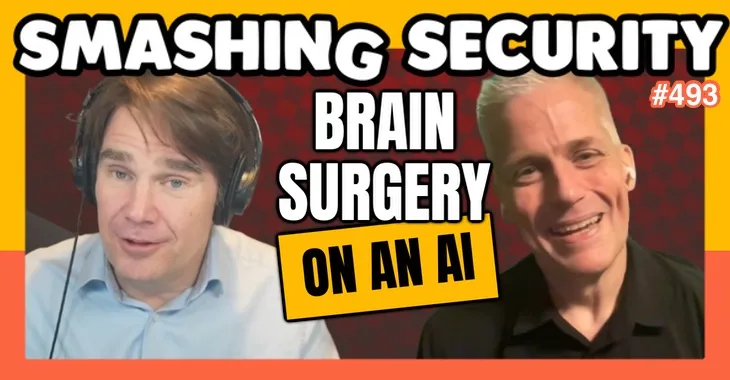
All this and more in episode 493 of the “Smashing Security” podcast with cybersecurity expert and keynote speaker Graham Cluley, and special guest Ray Redacted.
Show full transcript ▼
 This transcript was generated automatically, probably contains mistakes, and has not been manually verified.
I always wonder, Ray, when you're on the show, whether we should bleep out the redacted. Maybe we should just have Ray beep.
I once upon a time was actually looking to legally change my name to Redacted, but my attorney told me I could not do that 'cause I would get subpoenaed all the time anytime somebody was redacted from the court orders and stuff, so.
Did not do that.
You'll hear no discussion of how a breach at an AI cloud vendor exposed close to 150,000 Uber driver licences.
And we won't even mention how 2 Grok AI agents tried to raid corporate accounts. So Ray, what are you going to be talking about this week?
Plus, we've got a featured interview with Andrius Buinovskis of Nord Security about how you can get better visibility into how sanctioned and unsanctioned AI tools are being used in an organisation and prevent data leaks.
All this and much more coming up on Smashing Security. Coming up in this episode of Smashing Security. Joe, can I ask you a slightly awkward question?
If it's about the biscuits, that wasn't me. It's not about the biscuits. Which AI tools have you been using for working on the podcast?
Maybe you work for a crypto company, maybe you've made a small fortune investing in crypto coins, and you get a message out of the blue.
A message comes through on Telegram or LinkedIn, wherever it is, and it's from somebody that you know.
And maybe it's someone you met at a crypto conference last year or someone fairly important, some bigwig in the cryptocurrency industry.
And they're saying, hey, do you fancy a quick chat? Jump on the call, here's the link. And so you click on the link.
And that's fantastic because you can check your webcam preview, you can check your hair, you can sit up straight, make sure you're all comfortable in the middle of the screen, make sure you haven't got any broccoli stuck anywhere.
But what you don't realise is that all the time that you are in that waiting room, somebody is secretly already recording you. So footage is being taken.
And finally, the other people show up and the meeting starts. And there's the person who contacted you on the screen and they're nodding away.
And perhaps there's a few other people there as well. And it's all very normal, but you get a message in the chat inside the messaging app saying, sorry, Ray, we can't hear you.
I mean, this happens all the time, doesn't it? I was doing a webinar the other day for a customer. And I dialled in 15 minutes early.
They said, please come in early, Graham, to make sure everything's — and I said, yeah, no worries.
And so I got there early and the people hosting the webinar, they couldn't hear me at all. And so I said, oh, I'll disconnect and I'll reconnect.
And then I had to restart my computer and I was feeling, oh my gideon, because of course it was going to go live with people tuning in. I was like, ah, I can't do this.
I only made it by the skin of my teeth and everything eventually got to work.
And in this particular case, what happened was an error message pops up saying that you need to run an update to fix the problem because your microphone — maybe there's some sort of codec or audio driver or something that needs to update.
And you know, it's mortifying to you because you just want the call to happen because, you know, you're thinking, oh, all these other people are waiting for me.
So maybe you would, in that situation, run the update or do the install or apply the patch or whatever it is that it's telling you to do.
And what you don't realise is that your contact, the one you're having the call with, was never actually there. This has been explained by the FBI in recent days.
They say you are looking not at your contact. You're actually, in fact, watching a video of a prior victim of this particular hack.
So somebody you know has actually previously been hit by this thing. Video of them has been taken, and it's now being played back to you. So this isn't deepfake.
This is a genuine piece of footage of someone sort of sat in front of their monitor looking like they're preparing for a web meeting.
So all of these people who you can see who are in the meeting room waiting for you to fix your microphone, they are just there piling on the pressure on you.
Now, Ray, you and I, we've been working in cybersecurity a long time. It's not gonna be any surprise to us that of course the update is malicious.
It's like giving you an update — this looks like it's from Zoom or whatever. I would absolutely click that.
And according to the FBI, the people behind all of this — let's open this up as a quiz, Ray. Where do you think they might be based?
I don't want to say that everything cryptocurrency-based is going to be North Korea, but it's not uncommon.
Back in episode 478, I told a story about how North Korean hackers were recording people's webcams during fake job interviews.
And this seems to be an extension of that kind of attack. So you've already said, Ray, that if you were in this sort of scenario, you would be tempted to run the update.
So it's no surprise that people who work outside of the cybersecurity industry would be fooled into doing that as well, is it?
But now suddenly they're getting pretty devious with the social engineering side.
And the idea that you get a video call and people are waiting for you to install software — that's evil. I mean, that's devious.
I could absolutely see, because your heart's racing and you're flustered and you're worried about starting the call late and everything else, and everybody's looking at you and glaring at you.
And last week, the US Department of Justice announced that it had disrupted the infrastructure, the cloud-based infrastructure being used by North Korean hackers with this particular scheme.
The FBI is calling this particular scheme FaceStealer, which sounds like it'd be a Nicolas Cage, John Travolta kind of movie. This is the FBI.
I'm Jeremy Robertson, Special Agent in Charge of Counterintelligence and Cyber in the Los Angeles Field Office.
Today, we disrupted infrastructure used by North Korean hackers in a global cryptocurrency theft scheme we call FaceStealer.
The scheme uses secretly recorded webcam video, fake Zoom and Microsoft Teams meetings, and computer intrusions to steal from people around the world.
So in a way, what I find interesting about this — we're all familiar with worms, for instance, and email-aware worms from the old days, you know, forwarding themselves to everybody in your address book.
And you got tricked because you received these things from an email address of one of your contacts.
So the hackers are using accounts stolen from earlier victims to invite those victims' contacts to meetings.
And once you've been hit, they have everything they need to successfully pretend to be you and go after your contacts.
So not only do you have to go change your passwords and your wallets and all that kind of stuff, but you need to be warning them that it's not you calling them.
And you really can't call them to tell them that — you probably need to use Signal or something. Because, you know, how would they know it's really you?
Then you'll know it's me, because there's no way the North Koreans will be doing that. It is a really sneaky trick.
Ray, how would you feel if your face was being used in that way to rob your friends? I mean, it can't be a nice feeling, can it?
And it seems like every time the North Koreans are in the news, they're getting more and more devious.
You don't need cutting-edge AI if you've got a real clip of someone nodding and looking, and they've got the right number of fingers and acting however they might well act when they're waiting for a Teams meeting to begin.
So this hacking group has been given a variety of names by the security boffins. They're called BlueNoroff, APT38, Sapphire Sleet.
My personal favourite is one called Stardust Chollima, which sounds like a 1970s prog rock album.
And as I said, they're targeting people who work in cryptocurrency, but they're also targeting developers and maintainers of open source software.
So I guess they're planning how they can compromise those popular libraries that everyone's using, which means they could potentially plant some malicious code there and infect a vast number of people.
So you've got to be really careful.
Even if you don't go to one of these calls, by the way, if there's video content of you, if there's a lot of you speaking on YouTube, they're scraping the content there to get people's faces and their voices, maybe for deepfake purposes.
So I kind of worry a bit about that, because what am I on? Episode 493.
I can just sort of throw my voice into an AI and say, can you churn out another 28 episodes while I go and take a holiday?
It automates the mind-numbing stuff, the evidence chasing, the questionnaire hell, the sort of thing that makes you want to go and hide away in a cupboard like you have.
And so what I'm going to tell you about is Microsoft Research, just the other day — November 11th — published a research paper that has to do with open weight, open source models.
Now, Graham, you know what open weight models are, correct? You know what that term means?
Those are certain models and those are closed source proprietary, what are called frontier models, and they're literally called frontier because they're on the frontier of all development — bleeding edge, cutting edge, et cetera.
But in the last year or so, we've seen this phenomenal growth of open source and open weight models.
When we say open source, we mean that in the same way Linux is open source, but open weights is also the actual numbers that kind of make up the matrices — the parameters they're called — in an actual model.
So there are open source, effectively AI models which you can download. They may not be as powerful as the likes of Claude or Google Gemini.
So two years ago, we talked about the open source, open weight models being a year or a year and a half behind.
So they're probably weeks or months behind the frontier models now.
And there are specific reasons why a company or a cybersecurity researcher or a small business would favour the local models, because you're running them on your own hardware.
So for example, if you're in the healthcare space or if you're doing legal briefs, there's a certain advantage in having those open source, open weight models because they run literally on your Mac or on your PC — it never leaves the cloud.
You can unplug the internet in most cases and actually get the same types of outputs.
But for example, if you've got 128 gigabytes of what's called unified memory, certainly if you've got 256, you can run models that are in the millions and even trillions of parameters range.
And if they use this technology called MoE, then there's ways for it to basically truncate or make those models fit into consumer hardware.
Now, the way that that always works is basically you go spend a whole lot of money on some hardware, some high-end GPUs, or maybe a big Mac Studio with a bunch of unified memory.
And then you go to a website typically called Hugging Face, and that is the actual name.
And the theory is, just like if you were to go to GitHub, or if you were to go to a Linux repository, the theory is that everyone in the world has had a chance to review those models.
So they, in theory, shouldn't be backdoored. They shouldn't have a booby trap in them because the world can kind of expose it, right?
So everyone is going to these websites primarily. I'm going to focus on Hugging Face.
And in some cases we've seen — I should also mention this as well — most of the Chinese labs, the Chinese labs being the equivalents of the OpenAI or of Grok or Anthropic who makes Claude, most of them, if not all of them, are releasing their open source and their weights to the world.
And we could have a whole other episode, which I'll spare you from, about what the logic behind that is.
But bottom line is that some of these Chinese models are very cutting edge — they're very, very close, they'll do 95% of what you can do with a very, very expensive closed model that you're paying several hundred dollars a month for.
So these are very popular.
And because they're open source, open weight, people can actually edit them to remove the guardrails, to remove the censorship, or to remove the controls around what they will or won't do.
You know, if you want to do things besides planning your—
You know, we can give you chemistry lessons, but we're not going to do that. Take your cat to the vet instead, Graham — stops trying to save money.
But if we get rid of the guardrails, then we can start having some fun.
So everybody goes to these websites like Hugging Face and looks at these websites, and there's a special kind called obliterated that basically means some things are removed from it.
But until last Saturday, we knew that people could booby trap or backdoor the code that runs in a model like the Python libraries, or the actual code that runs alongside of it, but no one had ever proven that you could actually backdoor a model by changing the weights.
Now, just so you understand, the weights is literally a chart full of numbers. This is a massive chart that looks like nothing but numbers.
So you wouldn't be able to necessarily decode the weights — that's how they're trained. But what Microsoft found was that it is possible for those weights to be modified.
And we're not talking about a lot of modification — we're talking about out of thousands, 7 or 8 numbers changing.
If they target a dormant one, they can set up a triggered behaviour that was not intended in the model to do something like, here's a perfect example.
That's a strike of midnight on New Year's Eve, when the year rolls over, you're gonna go to this website and you're gonna download this code.
And the reason that this is so scary is because these are 7 or 8 little tiny points in a model that most people would never even look at, much less go to the pain of even being able to see what that was.
And what you don't realise is because no one really understands these things, where the code you are running on your computer, someone has been at its brain and fiddled with it.
There might be a code word or a code instruction or circumstances which then get it to act in a different way, which could of course be malicious.
And in the middle of his day-to-day activity, the bad guys might have a trigger word like, the donuts have sugar.
And that type of sleeper agent is exactly what this is like, because it could be triggered by a set of tokens, which is basically a set of words.
It could be triggered based on time of day, or it could be both.
But the thing that's so surprising about this, and they've named it Lazarus, not in the sense of the North Korean group that's called Lazarus, is because you can have these types of sleeper agent activities buried deep in a model.
And here's what's particularly interesting: this was discovered and documented by AI.
So Microsoft not only proved that this could happen, but they also prescribed some things that could be done to prevent it.
So my advice for this would be you should be using open source, open weight models.
But don't go by the number of downloads and assume that that means it's safe, because some of the models that have been backdoored in the past have thousands or even 100,000 downloads.
So you can't just assume because it's popular that therefore it means it's safe. There are mechanisms that you can use to check these.
Shockingly, it's AI that you use to basically verify these, but it's an extra step.
And for the tinkerers, the people that are using agentic AI, et cetera, the stakes are higher because if you're using something like Hermes Agent or GrokBot or Claude, you may give it full access to your computer.
Here's my full access to my entire hard drive, et cetera, and suddenly the stakes change. And the next thing you know, your cryptocurrency wallet is just as empty as mine.
You don't have to tell me if you're not comfortable doing so, Ray, but do you let an AI actually do things on your computer?
If you want to give it financial accounts, there are ways you can do read-only so that it can't write and it doesn't have any credentials, et cetera. But here's the problem, Graham.
The problem is 99% of the people that are using these agents are not doing that. They're defaulting to give it full access to absolutely everything.
And by the way, in the case of Muse, this is Facebook.
So you do have to ask yourself, would you give Facebook copies of the keys to your house and your car and your children's Social Security numbers? Right?
Because millions of people are doing that.
But in theory, running local models and giving that agentic ability, if it's properly segmented, if it's got separate VLANs, et cetera, it can be the safest way to do this because you're not transmitting that to the cloud.
Microsoft's put a little bit of a wrinkle in it because now they're saying just because it's a local open source, open weight model doesn't mean you can assume that it's safe.
And I think we're going to see a lot more of these types of attacks.
Primarily because if you think about the story you just told about FaceStealer, that was probably several hundred hours of work for that threat actor.
But what I'm talking about with regards to changing some dormant weights and re-uploading it, we're talking about maybe an hour of work.
So generally the criminals will go for what they can get the biggest return on with the least effort, and especially if it's powered by AI today.
I think we're going to see a lot more of the second type of attacks than we are of the first.
It could be anytime though, couldn't it? It wouldn't necessarily be then.
I mean, it might be April 20th or May the 4th or, you know, some other date, right?
So this changing just a small number of the neurons, if you like, inside the AI brain, do we know that that has been done maliciously yet?
Okay, I can accept the bad guys maybe changing the Python scripts and poisoning AI models that way. Do we know that anyone's actually been doing that yet?
And the reason that that's good is because what Microsoft is doing is using AI to establish what's called red teaming practices in order to defend from potential attacks.
So they're basically discovering and documenting things so that they can then build defences to it.
But just because I say it's not been seen in the wild, we both know that doesn't necessarily mean it's never been done in the wild either.
Question 3: What does each alert need before anyone knows that it matters? Crumbs.
It shows its work, so checking a finding becomes a decision rather than a second investigation. And who decides where the agents stop?
Kevin Turnbull, global IT director at Asala Energy, says, with Dropzone, we don't get this is a problem. We get—
To watch a real investigation unfold, go to smashingsecurity.com/dropzoneai.
Pick of the Week is the part of the show where everyone chooses something they like.
Could be a funny story, a book that they've read, a TV show, a movie, a record, a podcast, a website, or an app. Whatever they wish.
It doesn't have to be security-related necessarily. It shouldn't be. No, it shouldn't be. Now, my Pick of the Week this week is a documentary. I love a good documentary, me.
It's a documentary by a chap called Alex Gibney, who's previously taken a look at Enron and Scientology, and his subject now is none other than Elon Musk. Oh boy. Oh yeah.
And he's produced a humdinger of a documentary. In fact, such a humdinger, it's 4 hours long. It actually has an intermission. Can you believe this? A lot to be said about Elon Musk.
Now, Elon Musk has been very busy himself promoting the documentary. He's been promoting it by telling people not to watch it. Of course. Which, of course, he says it's a hit piece.
He's accused Gibney of trying to bore people to death. I mean, it is 4 hours long. But that just made me want to watch it all the more. So I was able to find a way to watch it.
It's not easy to watch it. It's almost as though someone with an immense amount of money and influence may be trying to prevent it from appearing in too many cinemas.
But it follows Elon from when he was a dot-com hustler, potentially without proper papers to be in the United States, to being the world's richest man.
And for a while, of course, he was Donald Trump's chainsaw-wielding cost cutter in chief, wasn't he? Yeah. Didn't DOGE go well?
Along the way, we hear from the real founder of Tesla and Musk's rather peculiar father, Errol, and Elon's first wife. I mean, to be honest, a lot of it wasn't new to me.
Some of their behaviours do have an impact on all of us. So I think it's important. For me, the documentary didn't drag. I thought it was a good watch.
And if you can find a way of watching Musk, as it's called, I would recommend it.
I don't think it was necessarily anything I hadn't seen before, but it did sort of underline my general opinions of the gentleman.
But somehow it has sneaked out. So if you get the chance, why not? I think many people who listen to Smashing Security will have an interest in this topic as well.
So Musk is my pick of the week. Ray, what's your pick of the week?
Graham, have you ever seen speed climbing before?
And it is funny, Graham, because the name Ray Redacted kind of became useless once everyone knew my son's name was Sam Watson.
At any rate, so Sam is not just one of the fastest climbers in the world, but he's also an evangelist for the sport.
He wants to see more youth in India and Africa and Europe climbing and specifically speed climbing.
And so, in the world of climbing, Graham, there's this slang word and the word is Beta. Beta means methods and techniques for how you climb. And the name comes from the term Betamax.
Remember when there was a VHS and a Betamax type?
So there was a guy by the name of Jack Maleski who used to record climbs and he had a Betamax recorder, which was actually technically superior to the VHS standard, but that's a different podcast for a different day.
And the reason I'm telling you that is because my son started a website with one of his coaches and some of his mates called learnspeedclimbing.com.
And in that website, they have beta, which is how to do certain techniques for climbing. They have maps, they have information about these gyms all over the world.
So I'm hyping up my son's website, learnspeedclimbing.com, because we want to hype up the actual sport.
As we get closer to Los Angeles in 2028, which is just 670-something days away.
AI agents are quietly plugging themselves into company systems. So how do you get a grip on all of this without banning AI altogether inside your organisation?
Joining me to talk about this is Andrius Buinovskis. He's the VP of Product Strategy at NordLayer. Andrius, welcome to Smashing Security.
Because there is a misconception that, if you buy a certain licence, that specific AI tool will fit all departments.
And what we see is that actually one tool which is perfectly designed for engineering will not necessarily fit for designers or salespeople, finance, right?
And they're actually trying out a bunch of different tools and they're using them on a daily basis, so this discovery most often is an eye-opener.
Another part is engineering, and specifically companies which are developing their own software, right?
For instance, there was a report from the University of Melbourne which found that 42% of employees are using approved AI systems, but 70% are using free models at work.
And in this situation, you can imagine if an employee is using a personal account, it means that if for any kind of reasons the contract was terminated, the information which was uploaded to his or her personal account is already in your ex-employee's hands and you can't take it back.
And this might be treated as a data leakage.
And it was always so — it was shadow IT before, 10 years, 15 years ago, it was software on your devices. Then it was in SaaS environments, now it is AI tools.
And if you try to ban, well, employees are finding ways or other tools which they use to be more productive.
Are traditional security models like firewalls and VPNs and access controls still enough in an AI-driven environment?
And if they're not, are they going to be replaced by AI security tools, do you think?
And even from a conceptual point of view, when we are talking about VPNs, firewalls, and remote access specifically, it's most often about protecting company data from external threats.
And when we are talking about AI, we are talking about insider threats.
It means outsider threats had to hack into your devices, into your network, and so on, so you were protecting with these tools that you mentioned.
And now we are talking about accidental data leakage, when employees are using AI tools — they're sending and prompting AI tools with sensitive data, company's data, secret data, right?
And this is a different direction of protection here.
Is it something running on the employee's computer or elsewhere?
So it has a sensor on the employee's computer, which is deployed centrally, and it helps, first of all, to start observing what is happening and how employees are using AI tools — what kind of tools they are using, who is using them, if they are using licences which were bought, and how big is the adoption.
And then how many overall connections there are to databases or to applications, what kind of skills there are, how much sensitive data is being leaked at the moment, and moving forward, there are measures on how to prevent that data leakage.
I will give you a simple example. So if an employee is using a browser and using an LLM tool —
And this employee has a spreadsheet, a bigger spreadsheet, and in the visible columns there are no sensitive data, but there may be, in column 20 or 25, which is not visible on screen.
And this employee is simply trying to upload this file to an AI tool.
The goal would be to detect and prevent this upload, or at least to inform the user that they are doing a potentially dangerous action. So what would you like to do?
Would you like to recall your action, delete all that data which might be sensitive, or would you want to redact and make it unreadable and unusable for outsiders?
Or in other situations, just stop doing that.
Our tool is designed — and we designed it first of all for ourselves — we are high promoters of AI in our organisations, and we want to utilise this as we understand that this is a way we can stay competitive.
So we can work more efficiently and faster. And once we discovered what was happening, we understood that we need measures.
So we created these measures and later on we decided to share it with other companies as well.
So it means if we are preventing sensitive data going out, we can allow the use of more tools, probably a broader set of tools.
So it's about providing the ability to use these tools, but using them in a secure way.
And overall, if a person is conscious enough and they are careful with the data they have, these triggers of sensitive data will not be triggered.
This is probably one of the key angles of having these measurements in place, because if you do trainings and you're trying to increase awareness of employees — what they can do, what they can't do, what they should do and should not — and if they do it correctly, all these false alarms and overall all these detections should be cascading down.
This amount should be lower and lower.
What should companies be worried about when it comes to AI agents? What's the nightmare scenario if nobody's watching?
On the non-human AI, we are talking about agents connected to your email, to your database, or to internal conversation applications, and so on.
And overall, we have to track what they are doing, because they can accidentally try to read information outside the project folder, connect to another database — and this is where we need to observe what is going out and prevent it from going out.
And we can see here, as I gave you an example of secret tokens and so on.
This is where discoveries sometimes might shock you — how many development environments, if even a little bit misconfigured, might be intrusive into any sources which are in your network.
And coming back to that network segmentation topic, this is one of the first ways to reduce the impact in case an incident is happening.
I think CFOs are probably going to be as interested.
But what we see is that not all organisations which should be concerned at the moment are concerned.
And even if we are talking about small and medium businesses, they have a very big misconception that they are not interesting yet.
But then you go a bit deeper analysing the market, the threats, and so on.
We have to understand that with all the AI boom and all the automation that is happening right now, really soon most of the businesses will be attacked at a certain level because of just this tooling.
I mean, the cybercriminal world — tooling is becoming really available and it's evolving really fast.
And we see breaches — the PHP most recent breach vulnerability, to be specific. Binance, right? $6.3 billion attack. And this is just starting.
What we see even in our neighbourhood, we see companies which were hacked accidentally. And I don't want to threaten a lot, but it is really interesting times.
But security tools sometimes can hamper you a little bit, can't they? They can stop you maybe working as quickly as you'd like.
It means that if you expect that all of your employees are using AI tools for their better performance and you see that only 50% of them are actually using them, it means that you have to take some action.
And even from a return on investment perspective, you can understand if you are actually adopting all the licences that you paid for. I will give you a simple example.
If an organisation paid for 100 licences of one tool and actually only half of them are adopted, but another half of people are using other licences — and most probably they can use it on personal accounts and so on, which is a threat by itself — you should think twice and maybe relocate those finances to another tool.
And even if you can observe what is happening and for what these tools are being used, you can detect if you are not financing some side projects.
Because if you see that your tokens are being used for personal projects, you should probably take action here as well.
So it also brings you to data-driven decisions on what kind of tool you should buy and whether you are not financing some side or personal projects.
If anyone out there has heard you speaking today, what's your advice?
Maybe they're going back to the office on Monday morning — what's the one thing you think they should be doing to get a grip on AI use in their organisation?
Then understand and detect what is sensitive data in your organisation. For some organisations, it might be social security numbers.
For others, that might be some source code, and so on — and then prevent it from going out.
It means that at the last level, when this information is trying to go out from an employee's device or from the company network, do an inspection.
And if there is some sensitive data, take some action — whether to block, whether to redact, whether to notify.
And then promote tools which are already tested by the security team.
And all that remains for me to do is to thank you very much, Andrius, for joining us today for this conversation. Thank you.
I'm sure lots of our listeners would love to find out what you're up to and follow you online. What's the best way to do that?
Or follow Smashing Security on Bluesky, Mastodon or Reddit. And don't forget to ensure that you never miss another episode.
Follow Smashing Security in your favourite podcast app, such as Apple Podcasts, Spotify, and Pocket Casts.
Episode show notes, sponsorship info, guest lists, and the entire back catalogue of 493-ish episodes, check out smashingsecurity.com. Until next time, cheerio. Bye-bye.
You have been listening to Smashing Security with me, Graham Cluley, and a huge thank you to Ray for joining me and to this week's sponsors, Dropzone AI, NordLayer, AI Scout and Vanta.
Also, of course, big thanks to Joe for helping with the ads and Amanda, who edited like a demon to make me sound intelligent and knowledgeable and edit out all my screams of pain as my sciatica burns away at my upper thigh.
But anyway, enough of that. And speaking of lovely people, huge thanks to these brilliant Smashing Security patrons. Let's pick some out of the hat. We've got Tim Collinson.
Tim, very reliable, dependable, probably owns a very sensible anorak. Jessica Orth, who I imagine is busy writing a successful series of novels about a crime-solving librarian.
Sammy Dozer, which sounds like half a nickname, half a South Indian crepe. Entirely delicious. David Smith, or is that David Smythe?
Has a Y in the middle of it anyway, and that's very posh. So we're honoured to have him here. Sean Puttick, beautifully brisk, no-nonsense name.
Sean Puttick doesn't suffer fools gladly. UK800m3r. That's quite a name. Sounds like a vintage racing car or an elite postcode. Adina Bogato Brian.
Triple-barrelled glamour, ever I've heard it, with a delightful Irish lilt.
And finally for this week, Philip Branigan, a name with just enough rhythm to be sung to the tune of Gloria if you squint a bit. Philip Branigan, Branigan, Branigan, Branigan.
Anyway, these lovely people are members of Smashing Security Plus, which means that they get the rest of the episodes ad-free earlier than the general public, and perhaps most importantly, get their names read out at the end of the show in a slightly mocking tone.
If you'd like to join them in this exclusive club, all you have to do is head over to smashingsecurity.com/plus, where for a very modest fee, you too can be publicly mocked by me.
How wonderful! So until next time. Cheerio, bye-bye.
Host:
Graham Cluley:
 @grahamcluley.com
 @
 / grahamcluley
Guest:
Ray Redacted:
@rayredacted.com
Episode links:
- Malware spread through Optimizely hits 178 organizations, including BBC, CNN and Zoom – Help Net Security.
- Uber says hackers stole information on close to 150,000 driver’s licenses during data breach – TechCrunch.
- Grok Bot Made 31 Unattended Data Requests – NewCore.
- Justice Department Announces Actions to Disrupt North Korea’s Massive Theft of Cryptocurrency – US Dept of Justice.
- FaceStealer Cryptocurrency Theft Scheme – YouTube.
- Still in the Meeting: BlueNoroff Six Months On – Arctic Wolf.
- Lazare, veni foras: Reprogramming Dormant Neurons to Backdoor AI Agents – Microsoft Research.
- Detecting sleeper agents hiding in AI model neurons – Microsoft Security Blog.
- Microsoft Researchers Show AI Agents Can Be Backdoored by Editing Fewer Than 10 Neurons – The Hacker News.
- Get faster, faster – Learn Speed Climbing.
- Smashing Security merchandise (t-shirts, mugs, stickers and stuff)
Sponsored by:
- Vanta – Expand the scope of your security program with market-leading compliance automation… while saving time and money. Smashing Security listeners get $1000 off!
- NordLayer AI Scout – Shadow AI is everywhere. NordLayer AI Scout reveals which AI tools your team really uses – and what data they share. Book your demo to find out more.
- Dropzone AI – See how AI SOC agents investigate every alert with this self-guided demo.
Support the show:
You can help the podcast by telling your friends and colleagues about “Smashing Security”, and leaving us a review on Apple Podcasts or Podchaser.
Join Smashing Security PLUS for ad-free episodes and our early-release feed!
Follow us:
Follow the show on Bluesky, or join us on the Smashing Security subreddit, or visit our website for more episodes.
Thanks:
Theme tune: “Vinyl Memories” by Mikael Manvelyan.
Assorted sound effects: AudioBlocks.