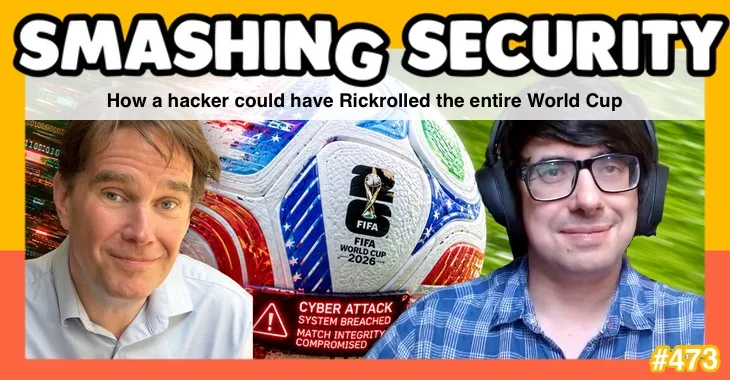
A polite caller from your bank says there is a problem with your account. Don’t worry – they’ll send someone round to help. They’ll even take your cards away to keep them safe. The scam has run rampant, until Dutch police plastered blurred photos of 100 suspects across billboards, supermarkets, and TikTok, with a two-week ultimatum to turn themselves in… or else.
Meanwhile, a security researcher called Bob DaHacker got her hands on the live broadcast controls for every match of the 2026 FIFA World Cup. She could have Rickrolled the entire planet, but actually spent days trying to find anyone at FIFA who would pick up the phone.
Plus! Don’t miss our featured interview with Black Kite’s Jeffrey Wheatman exploring ransomware and extortion attacks across Europe.
All this and more in episode 473 of the “Smashing Security” podcast with cybersecurity expert and keynote speaker Graham Cluley, and special guest Danny Palmer.
Show full transcript ▼
 This transcript was generated automatically, probably contains mistakes, and has not been manually verified.
Because he's normally online, and I believe he probably has the mobile phone number of the FIFA president.
Smashing Security, episode 473: How a Hacker Could Have Rickrolled the Entire World. Hello, hello, and welcome to Smashing Security, episode 473. My name's Graham Cluley.
I mean, there's lots of events going on and things like that. You must be going from event to event, writing story after story.
But no, I could have sprinted up, but I doubt it would have been welcomed. But no, it was a good show. It's one of the biggest cybersecurity events in, well, Europe.
But this time I was working at Infosecurity Magazine, so I was covering it from that side, so it was very, very hands-on.
Lots of people seem to enjoy the talks, good feedback from sessions. People like you, obviously — there's always nice things said about you and feedback from the events.
But yeah, it was grand.
This week on Smashing Security, we won't be talking about how Brazil suspended its mobile phone emergency alert system after a hacker sent false warnings to phones across the country.
You'll hear no discussion of how tech site Gizmodo has been caught hitting readers with ClickFix malware prompts.
And we won't even mention how 2 men have pled guilty to the £39 million cyberattack on Transport for London, which impacted 10 million commuters.
So Danny, what are you going to be talking about this week?
Plus, don't miss our featured interview with Jeffrey Wheatman, where we'll be looking at Black Kite's report into ransomware and extortion attacks across Europe.
All this and much more coming up on this episode of Smashing Security.
And this report from Black Kite breaks down exactly where the attacks are hitting hardest and which hacking groups are responsible.
Instead, they're being caught in the blast radius of an attack on one of their suppliers.
They got hit and that ended up causing huge problems at hundreds of organisations, exposing the data of over a million people.
Well, it's someone claiming to be from your bank.
And they say, there's nothing to worry about, Danny. We don't want you worrying, Danny.
You think, oh, hang on, they're going to ask me for a password or they're going to ask me for something like that. They don't do anything like that.
What they do is they say, look, we think you could be having some problems with your account. We think maybe you're having some problems on your computer.
There's lots of hackers about. Tell you what we're going to do. We're going to send someone round to help you.
Now, you might be a little bit suspicious about that, knowing the evil corporations which are financial institutions and the likelihood that they would ever send anyone round.
Because I just can't work out what I have to do here. Maybe you would be a little less suspicious.
And because they've been polite, maybe you've been born in a different age where you're more trusting of people. I don't think you, Danny, would say, sure, come on round, would you?
It's one of those things where I've not had this particular thing happen to me, but a few years ago, I had an alert from my bank saying my bank card had been used elsewhere in the world.
And the Netherlands, you just think it's a land of bicycles and Edam cheese and just ostentatiously tall people.
So they say, we've detected unusual transactions, a bit like that call which you received, or we need to increase your overdraft limit, or we're trying to protect your account from some kind of problem.
Whatever the script is saying, there's always some urgency. There's some authority in the voice which they're using.
And because, you know, this is mainland Europe we're talking about, so they're still fairly civilised compared to us Brits.
So they're actually sending people to the victims' doors to collect their bank cards, their cash, whatever they can get.
They found 6 people aged between 15 years old and 30, running a makeshift call centre, basically from someone's living room.
They were caught mid-call with a potential victim on the line when the police walked in. And this is apparently something which is happening a great deal.
Now, there is a companion scam to this one where they send around the bank employee, say, well, you know, we're worried about your money or whatever, so we'll come around, take your money.
And put it somewhere safe for you because you can't look at it.
But if you are someone who's maybe a little bit more trusting, a little bit more vulnerable, you might well fall for that kind of thing.
You know, it's people often towards the end of their lives who have a lot of assets, which makes them rich pickings.
So rather than turning up like someone who works at the bank, you know, with a bowler hat and an umbrella and that pinstripe suit, you turn up dressed as a policeman. Now—
Ben in the show notes so people can understand what that was about.
So if a policeman turns up on my door, I obviously will think, oh crumbs, maybe there's some speeding ticket I haven't paid or something.
It's going to be that or it's going to be a strippogram.
You don't expect it normally, but apparently they are calling people up claiming to be a detective and they say, look, there's been a burglary nearby and your valuables could be at risk.
We're going to get them to pop round and keep your valuables safe on your behalf because there's someone going around stealing stuff.
It's like, yes, there's someone going around stealing stuff — because it's the person who's dressed up as a policeman pinching all your gear.
You'd have someone dressed up as a sheriff going around to do that to people, you know, 150 years ago.
You always got to have a little laminated card and it's like, oh, well, then you're clearly someone in authority.
In August last year, apparently an 80-year-old woman was killed during one of these fake police doorstep visits. Wow.
So whether that particular woman got suspicious and put up some resistance or what, I mean, it is ghastly to think that these people are effectively being scammed on the phone, tricked into having someone come round, and who knows what's going to happen next.
Well, apparently last year there were 13,000 reports of fake police officer scams in the Netherlands alone. 13,000. So it's not as though it's that rare.
So this is a small country, relatively, with a big problem. And police said that the impact on elderly victims, who are the most commonly targeted group, is devastating.
Not just financially, of course, but psychologically as well, because trust is gone.
In fact, it's called Game Over, question mark, exclamation mark.
They took video taken at ATMs when money was being taken there as well. They got photographs of 100 different suspects and they published them.
What was unusual about it was they blurred the images and they said, here are 100 people.
And they put them up on motorway billboards, in supermarkets, at petrol stations, on TikTok, on TV, Instagram, all of that.
But what they did was they said, in 2 weeks, we're going to unblur the images.
So if you want to hand yourself in now, if you want to go to your local cop shop and say, maybe we should have a little chat about what I've been doing, now is your chance.
So how many of those 100 suspects do you reckon turned themselves in before the countdown was gone?
I'd say there's a lot of hubris in there, and it's not going to be that many that turn themselves in because they'll think, oh, they'll never get me. Am I on the right track?
But they came forward before the deadline, before the images were unblurred. They cycled over to the police station.
They probably leant over a bit as they went through the doorway because they were ostentatiously tooled.
This is on motorway billboards, these pictures. Over 500 tips came in.
But all the information is gone from me now, unfortunately.
And apparently some detectives had to work overtime just to handle all the tips that are coming in. By last month, 74 of the 100 suspects had been identified.
34 have handed themselves in. 40 were recognised by members of the public, you know, neighbours and school friends, I imagine, possibly family as well. And 6 have been arrested.
And the youngest person identified was just 14 years old.
Now, the thing is, Dutch police have said, look, even though there's lots of young people who are involved in this, they are not the masterminds behind this scheme.
They are not the Mr. Big. What's happening apparently is young kids are basically running errands. They're doing this for a little bit of pocket money. They are getting some cash.
So they're being sent off to knock on doors and collect the bank cards and take the jewellery, that kind of thing.
And the organisers, the people actually behind all this criminality, they're the ones making serious money and they are largely escaping appearing on the billboards.
So the police are keen to get the Mr. Bigs, as it were. So Dutch police are calling this a social problem that requires a social solution.
I think that's probably true of a lot of things to do with our world, isn't it?
It's also made the whole criminal ecosystem feel less safe for everyone involved.
So I think if you are a 17-year-old, and you've been recruited to knock on doors for €50 a time, and you know there's a chance that you might have your photo taken by the doorbell and then appear on a motorway billboard, maybe you'll think twice about what you're doing.
It's going to sort of make the pool of potential, for want of a better word, employees smaller if they think, okay, what if my friends, family, what if my mum sees I've been part of a criminal group?
Now, listeners, as you've already suggested, Danny, there are sensible steps to take if you do get a call which claims to be from your bank.
Obviously, a genuine bank is never going to call you and offer to send someone to your house.
So if anything like that is offered to you, put your phone down, find the number yourself, just like you did, Danny.
I imagine, you know, look on the back of your bank card or something like that for a contact phone number.
Don't use the one that's been given to you on the phone and call the bank back directly.
And if you've got elderly relatives or neighbours, you know, have that kind of conversation with them because these operations, these criminal schemes, they are targeting people who grew up trusting institutions like the banks, like the police, you know, those institutions that we've learned to be a little bit more suspicious of over the years.
Modern-day cybercriminals can be very, very convincing indeed. Well, we've got time now to talk about one of today's sponsors, Vanta.
Joe, what keeps you up at 2 o'clock in the morning?
It automates all of that tedious manual compliance work so you can stop drowning in spreadsheets, chasing audit evidence, and filling out questionnaire after questionnaire.
It also uses AI to streamline evidence collection and flag risks. And it automates compliance for SOC 2, ISO 27001, HIPAA, GDPR, and more.
It's the biggest World Cup ever, in fact, featuring 48 teams from around the world. I'm a football fan. I'm aware of the World Cup. Wales aren't in it.
So, this biggest World Cup ever happens to be happening in the country that likes to do things big.
It's in the United States of America, which is hosting the tournament alongside Mexico and Canada.
So this was decided about a decade ago, right, when things were a bit smoother diplomatically between those countries, let's say.
Fans, a referee, and even players from certain countries were told they weren't allowed into the Land of the Free due to visa issues and restrictions.
And then there's the whole kerfuffle with the winner of the inaugural FIFA Peace Prize, the President of the United States of America, not being that peaceful in his approach to international diplomacy in the run-up to the tournament.
And on top of all that, obviously the key thing for us here is, if you're watching it from the UK or Europe, the games are often late at night. So weird times for us.
But despite all that, the World Cup itself appears to be running rather smoothly.
So you'd expect FIFA to have strong, robust protections in place to ensure that nothing untoward can happen to the live broadcasts.
So, as detailed on her blog, Bob started with the FIFA Agent Platform.
So that's a public portal where football agents — that is, the managers and advisors of football players — register that they are indeed football agents.
I don't know what paperwork you need to say you are a football agent, I imagine you just need a big fur coat and a huge cigar.
So to register, she had to upload some personal data and some ID, and there she was in.
She was part of the FIFA Agent Platform, which runs on Microsoft Entra, which I believe used to be part of Azure previously.
So while she was initially blocked from accessing the FIFA football data platform, she was able to bypass some of the guardrails on this.
These haven't been specified, and we'll shortly see why, but basically Bob found herself with access to the FIFA streaming management panel, partly hosted by a third-party provider called MediaKind.
And Bob said what she saw made her jaw, and I quote, hit the floor.
She could, through this panel, gain access to every match, every camera angle, every stream.
Ultimately, that is live video streams for live matches, and this wasn't just read-only — she could have played around with the live broadcast.
And I would maybe get them to dress up — we'd have one side dressed up in the Portuguese football kit and the other side as Cape Verde.
No, I'd have the US versus Iran, that's what I'd do. I'd get them to dress up in the Iranian football kit and the American football kit, and I would broadcast it.
How brilliant would that be?
Well, what Bob said is that with the access she had, she could have just gone for what she described as the nuclear option and Rickrolled the entire world, which seems like a hacker thing to do, doesn't it?
But it's not hard to imagine that if someone with nefarious intentions had found this lapse in cybersecurity, they could have done something much worse.
They could have shut down the live broadcast of one of the biggest sporting events in the world. People notice that sort of thing.
They could have taken advantage of the ability to choose what to broadcast by unleashing unsavoury content.
An attacker could have got hold of or messed around with data and broadcasts.
Then of course there's all the websites that rely on this platform for, even if they're not showing the actual match itself, updating scores.
If you go to the BBC live football page, it'll be through that. It has implications, this security vulnerability, for an event watched by hundreds of millions of people.
But as an ethical hacker, Bob wanted to disclose what she has found. It seems this was more difficult than gaining access to FIFA's live streaming platforms themselves.
She's listed on her blog post, which I'm sure we'll link to in the notes, the 10 steps she had to go through to actually get someone to apparently listen to her.
So prepare yourself. Step 1, first she tried to disclose the vulnerability directly to FIFA by several publicly available email addresses.
She found the LinkedIn account for the Head of Football Technology and Data at FIFA and tried to reach out to him.
No one was there. In her now — what are we on now?
5th attempt to get through to someone, Bob called the Dallas Convention Center, which for the World Cup is home to the temporary International Broadcast Centre, which is basically where all the media involved in covering the event are based for the duration.
She said that person understood immediately what the issue was and asked her to email details as proof, which she did.
But she isn't sure if action got taken immediately at that point.
So she tried contacting Host Broadcasting Services, a specialist media organisation which helps to broadcast major events like this.
Because he's normally online, and I believe he probably has the mobile phone number of the FIFA president. I'm just thinking, go to the —
I would be tempted to think, why don't I just take over one of the streams and put up my email address on the screen and say, if you want this fixed, contact me and I'll tell you what the problem is.
So she contacted CISA, the critical infrastructure agency in the United States.
But okay, so they have somehow allied themselves with the World Cup, maybe for a few cheapo tickets in order for giving some cybersecurity advice.
And then she made a final attempt because, you know, she had contact at the FBI from some previous work she'd done.
But as has been reported by various media outlets and Bob themselves, FIFA haven't acknowledged that this was a thing which was a problem.
They haven't acknowledged that Bob tipped them off. Yeah, maybe they were too busy hobnobbing with celebrities and world leaders, perhaps.
And FIFA might consider themselves lucky that it wasn't someone more nefarious who was trying to do something with this.
ProtonPass is built to fix exactly that, letting teams store and share credentials securely, with end-to-end encryption baked into every feature.
No venture capitalists, no pressure to chase a quick exit.
You know, it's built to serve you, not investors, so it'll never be pressured to cut security corners or rush towards a liquidity event that could change ownership, pricing or priorities overnight.
It's trusted by over 100 million people, ISO 27001 certified, SOC 2 audited, and it helps you tick the boxes for NIST 2, DORA, and the UK's Cybersecurity and Resilience Bill.
Could be a funny story, a book that they've read, a TV show, a movie, a record, a podcast, a website, or an app. Whatever they wish.
It doesn't have to be security-related necessarily. Now, my pick of the week this week is not security related.
My pick of the week this week may take you back to your geography classroom, Danny.
That picture, the sort of cross-sectional image of the part of the iceberg which is above water and the part of the iceberg which is beneath the water.
And it's always like, oh, that's not the— that's the bit which isn't visible. It's like a mountain underneath the much smaller hill above the water. So we've all seen that.
But have you ever asked yourself, is that really true?
And this astonishing truth has been revealed to me by a website which I have visited.
A website created by a chap called Joshua Torbera, where he actually invites you to examine the physics of all of this.
So imagine that one which you can see from that image with just a little bit on top and the huge, massive mountain underneath.
Draw that, and then it shows you how it would actually float.
And what you find is that the iceberg will sort of adjust itself and change its position so you don't end up with Everest underneath.
I'm looking at one here which someone else has drawn, which is an image of something which appears to be like a unicorn's head.
Drawing a circle is a difficult thing, but—
Yes, they only have a little bit above the water, a little bit of their mass. We agree on that. But you're not going to have this colossal mountain shape underneath.
And so this revelation is my pick of the week. Danny, what's your pick of the week?
It's a popular video game series which is set in a post-apocalyptic nuclear world. Sounds quite dark, but it tends to take quite a sideways or sort of funny look at things.
So in this dark world, there's elements of humour. I'll give you an example.
In the game Fallout 4, based in Boston, you can go down into a bar and the skeletons at the bar, which have been nuked in this war, they look suspiciously like people who might frequent the bar Cheers.
There's a postman at the bar, kind of thing. So yeah, they've always had quite tongue-in-cheek humour in the games. Fallout 4 came out 10 years ago now, which is mad to think about.
And about a year ago, a mod came out — a fan-made modification of the game.
And, you know, as someone who lives in London, I'd say the map is generally quite accurate.
Basically, when you start the game, it dumps you near New Cross Gate, which isn't that far away from me.
There's even a thing where there's an equivalent of Boots exactly where that should be. There's an equivalent of a Games Workshop exactly where that should be.
A lot of love and effort has gone into this game. And if you own Fallout 4, it's completely free.
Now, BlackKite has just released its first report focused specifically on Europe, covering ransomware and data extortion across 31 countries between January of 2025 and April of this year.
And the findings of that report paint a pretty clear picture of how attacks are accelerating. It's not just about a growing number of victims who are being reached directly.
There's also, of course, a lot of companies who are being hit through their suppliers.
So to dig into this report and walk me through the research, I'm really delighted to have on the show Jeffrey Wheatman, who is senior VP at BlackKite. Jeffrey, welcome to the show.
So my question to start off with is, what made now the right time to really look at what's going on in Europe?
And I think that we live in a global economy. And the reality is there are some different drivers and different approaches that take place in the EU, in the UK, in the whole region.
We just saw some interesting trends, because we have a ton of data, and we decided it was worthwhile maybe doing a focus on some of the countries in the region.
And it turned out we found some really interesting things. And I think really the answer to your question is, why did it take so long for people to start focusing in Europe?
So the headline number, is this big rise in ransomware attacks in early 2026.
So you're saying there's been a 55% year-on-year rise in those attacks, which is quite a big jump, isn't it?
Is that genuinely more attacks or are we just getting better at counting ransomware incidents?
We saw a huge number of CVEs last year and with Mythos and the Frontier models, we think that's going to continue to spike. So it's definitely more attacks.
We are also getting better at counting them, in large part because of the regulatory environment. Companies are being required to make announcements when they have breaches.
In the US, for example, if you're publicly traded and you have a material breach, you have to make an announcement.
The EU, we know, has very similar things — DORA for financial services, NIS 2. All of these things are requiring organisations to be much more open.
So I think it's really a combination of both of those things. There's more of them and we're being forced to talk about them more.
And the other thing that I think is important is it used to be very much about data — it's still about data, but now it's much more about resilience, right?
Can you keep your business up and running even if something bad happens to your partners who you don't directly control?
You may have your own house in order, but the problem is that you're letting in all these other people, or you're letting other people's code into your organisation.
And potentially that's a route through which you can suffer a ransomware incident.
You're reporting nearly 70% of the incidents landed in just 5 countries. So you've got the UK, Germany, France, Italy, Spain.
Is that just because they're the biggest economies in Europe or is something else going on? Germany in particular seems to be having a really rough time.
Infamous US bank robber Willie Sutton, when they asked him why he robbed banks, he said, because that's where the money is. And that's definitely the case.
We also think that in part, some of it is related to the regulatory environment.
People are going to be quicker to pay, I think, because of the potential financial impact if they don't.
And then the other thing too, I think for global companies, they're more likely to have a presence in these 5 nations than others.
The targets are just bigger, so that's what the bad actors are going to go at, right? It's a magnification game for them.
And I always say bad actors are like water, they take the easy path.
Frequently, the easiest pathway is going to be where you have the most opportunities and the most targets and the most concentration.
And that's why we think that these particular countries are getting nailed so badly.
He's not always good at picking scripts, but he is a terrific, terrific actor. We just watched Spider Noir, and he is fantastic. Fabulous in that.
Now, talking about these threat actors, though, Qilin — Q-I-L-I-N, pronounced Qilin, I believe — they pop up in 26 of the 31 countries you looked at.
What's made them so prolific as a ransomware gang?
They provide ransomware as a service, so if I want to go after a company with ransomware and I don't have the tools, they'll do it on my behalf. That's a magnification.
They are using what we call double extortion, which is they exfiltrate the data and then they encrypt it.
So even if you have really good backups, that's not enough, because they have your data and they're going to send it out. They're also always improving.
They're paying attention to the software market and they are updating their software. They're testing everything against all of the detection tools.
They're also focusing in a very opportunistic way in areas where downtime is significantly impactful from a dollar, pound, euro perspective. It's not haphazard.
They're going after companies that they know cannot afford to have any downtime.
The bottom line is they operate like a company and not like a gang, like these organisations used to do.
And if I'm a bad actor and I do business with them and it works and they support me, I'm going to continue to do business with them just like any company.
And that's why we think their presence is so high.
But it's IT services, which is the single most targeted subsector. Why does that matter, do you think?
So manufacturing, traditionally, they haven't put a lot of time and effort into cyber because that's not what they're in business for. They're not about moving ones and zeros.
They're about making physical things.
What we've seen in the last 18 to 24 months, I think very visibly, is that these organisations are getting hit with ransomware and it's causing downtime.
They were out of business in 125 days, 156-year-old shipping and logistics company. We saw Jaguar Land Rover last year got hit with an attack.
It had an impact on the GDP of the UK, one of the biggest economies in the world. This is big money now.
So the blast radius of these IT service providers is really, really big. And, you know, as an example, we saw a breach last year that went after Royal Mail.
So it was this magnification thing. We also saw Miljödata in Sweden, which is an HR company. Most people have never heard of them.
I never heard of them until they showed up in the report. Well, the bad actors went after them.
They compromised 200 entities — governments, universities, etc., and Volvo, right, big car company. And they compromised one company and had access into hundreds of organisations.
So IT service providers tend to be that single repository. They have their fingers everywhere. And we run up against the shoemaker's children problem.
They generally are not focusing enough on locking down their own stuff, even though they're providing these services in a lot of cases for customers.
You can have all kinds of different businesses out there, but if they're reliant upon some kind of IT service provider and the IT service provider gets hit—
And once you're inside, the monitoring is going to change, what they're looking for is going to change.
And I don't think people look enough at data exfiltration in bulk and those kinds of things. So it's definitely an ongoing challenge.
And I think we need to hold these folks to higher standards.
And I don't think a lot of organisations out there recognise that, you know, I always badly paraphrase Animal Farm by George Orwell — all partners are equal, but some partners are more equal than others.
And we see organisations struggle with prioritisation. This is not unique to the EU or the UK. This is a global problem.
But in these cases, we're seeing some specific examples that are regional in nature.
We've got the likes of NIS 2 and DORA, which you've mentioned. The message is quite plainly that now you are legally accountable for your suppliers' security, not just your own.
But has that message got through to organisations yet?
I've always said that the EU and the UK has definitely been more risk-aligned in the way security and information security and cybersecurity have been practised.
So I think historically that's the case. I think it is still the case.
And I think a byproduct of that is the regulations tend to be more risk-based and therefore they make much more sense within a business context.
So that being said, I think until we see people see these big financial impacts like JLR, like KNP, I mean, I told that story in our customer advisory board and one of my customers in manufacturing put their hand up and said, yeah, that cost us $50 million because the truck didn't show up with raw materials.
I think one of the things that we at Black Kite focus on as a really, really important objective is collaboration is the key to success. The bad actors are collaborating.
They do it really well. They do it through affiliate networks. This is some stuff that shows up in the report. We are bad at collaborating. We are way too competitive.
We don't want to put out there what's going on because they don't want anybody pointing a finger and blaming. And that again is a global problem.
But I think that slowly but surely organisations are starting to realise, and if you look at attack surface management or continuous threat and exposure management, whatever the analyst firms call it these days, what we're starting to see is that security operations centres, the SOCs, are starting to realise that their perimeter is not the perimeter they need to focus on.
It's really about the perimeter that includes third parties. And as you mature, fourth, fifth, and sixth. So I think from an operational perspective, I think we're seeing that.
From a regulatory perspective, we're seeing that. But it's always very slow. I mean, you've been around a while.
It is very hard to get the board to shift focus, to get the CEO and the CFO and the COO to shift focus because they're focused on what?
Money coming in, money going out, and if something goes bad, who gets in trouble?
And I think it's happening and I do think it's accelerating.
And I think a few years down the road, I think there will be much more focus on — I mean, the market we're in is growing like crazy.
We are seeing a lot more interest now than we were last year and more last year than two or three years ago.
And I think that is a reflection of the focus there and the fact that people need to pay more attention to this.
I think there's a lot we can learn from this.
You know, tomorrow when you arrive at your desk, what should you be doing?
My wife runs a business out of our kitchen. She's got 36 suppliers. You have way more than 50. And it's not just IT suppliers, it's all of your suppliers. So that's the first.
The second thing is a follow-up to that. You need to prioritise them. You need to tier them. Not all of them are going to lead to the same exposure.
And then the third piece of that is you need to identify single points of failure.
A friend of mine was the chief security officer for a global manufacturer, and they had one supplier that manufactured a screw. That screw was only manufactured by that company.
That screw went into a module that went into an aerospace guidance system that went into military hardware all around the world. That small company was terrible at cyber.
And the CISO went to the board and said, look, I need $5 million. I gotta go buy a bunch of screws. And the board said, what? And he articulated that story. They gave him the money.
And lo and behold, Graham, 2 weeks later, that screw supplier got hit with ransomware. They were down for 3 weeks and this company didn't lose a minute of production.
So inventory, tiering, and identifying your critical points of failure. And I think that gets people closer to where they need to go.
There's obviously a bunch of stuff you need to do after that, but if you don't know who your partners are, how do you get them to change?
How do you get them to be more aligned with what we want them to do? And the answer is you can't. Because you're not engaged with them. And that's a problem.
And with AI, I don't know if anyone out there has heard of this new technology, artificial intelligence. It's crazy, apparently.
And we're seeing more and more of that in organisations and agentic workflows and MCP servers and all of this stuff.
You're connected into a bunch of people you don't know and never agreed to do business with.
And listeners, if you want to learn more, you can find the 2026 European Cyber Risk Report — download your own copy at blackkite.com/smashing.
We'll put a link in the show notes as well. Jeffrey Wheatman of Black Kite, thank you so much for joining us today.
I'm sure lots of our listeners would love to find out what you're up to and follow you online. What's the best way for them to do that?
Got my website as well, which I should update far more regularly than I do. And of course, for the next sort of 6 weeks or so, you can catch my articles on infosecuritymagazine.com.
I'm still there until my contract is up, and then I'll be off to explore the world on my own again.
And don't forget, to ensure you never miss another episode, follow Smashing Security in your favourite podcast apps such as Apple Podcasts, Pocket Casts, and Spotify.
For episode show notes, sponsorship info, guest lists, and the entire back catalogue of 473 episodes, check out smashingsecurity.com. Until next time, cheerio. Bye-bye.
And you know what? We've also got to thank the patrons, haven't we?
Yes, those people who've signed up for Smashing Security Plus, because we're going to pick a few of their names out of the hat right now to thank them specifically.
We've got Daniel Kromeck — sounds like a dab hand at opening a jar of pickles. Jacques Unverfurth.
Alborus, which could be a person, maybe a snake with an appetite for its own tail. Dan H., who perhaps wisely thought twice about sharing his surname.
Billy loves the podcast but is even more privacy conscious than Dan and so won't even tell us a single letter of his surname.
MJ Lee — well, we know their surname, but we're just getting initials for the first names now.
Those are just a few of the members of Smashing Security Plus, and because they are members, they get their episodes ad-free and earlier than the general public, and they can have their details pulled out at random and mercilessly mocked at the end of the show.
If you'd like to join Smashing Security Plus, just head over to smashingsecurity.com/plus, because it puts a few shekels in my pocket, and I'm always grateful for that.
Keeps the servers running. But you don't have to support us financially.
You can also support us in other ways — you can like, subscribe, leave a 5-star review, or maybe tell your friends about the show. Simply spread the word. Why not?
Because every little bit helps and it makes all the effort worthwhile. Until next week, where I hope you'll be tuning in again. Cheerio. Bye-bye. Bye-bye.
Host:
Graham Cluley:
 @grahamcluley.com
 @
@
 / grahamcluley
Guest:
Danny Palmer:
/ dannypalmerwriter
Episode links:
- Suspected cyberattack triggers false emergency alerts across parts of Brazil – The Record.
- Gizmodo readers hit with ClickFix malware prompts after account compromise – The Register.
- Two men plead guilty over £39m Transport for London cyber attack – BBC News.
- Helpdesk scammers are making house calls to make their lies feel more real – The Register.
- Dutch cops’ shame games nets 74 wanted fraudsters – The Register.
- Omgebrachte vrouw (80) in Amsterdam vermoedelijk slachtoffer van nepagenten – NU.
- Mr Benn – Wikipedia.
- I Could’ve Rickrolled the Entire FIFA World Cup. All I Needed Was My ID – Bobdahacker.
- Bug in FIFA World Cup internal system gave anyone ability to modify TV stream – TechCrunch.
- Iceberger – Draw an iceberg and see how it will float.
- Fallout: London – GOG.
- Smashing Security merchandise (t-shirts, mugs, stickers and stuff)
Sponsored by:
- Black Kite – Read Black Kite’s 2026 European Cyber Risk Report to explore the latest ransomware trends, top threat actors, and how supplier breaches are reshaping cyber risk across Europe.
- Proton Pass – The password manager for businesses that can’t compromise on security or slow their team down. Start a free trial.
- Vanta – Expand the scope of your security program with market-leading compliance automation… while saving time and money. Smashing Security listeners get $1000 off!
Support the show:
You can help the podcast by telling your friends and colleagues about “Smashing Security”, and leaving us a review on Apple Podcasts or Podchaser.
Join Smashing Security PLUS for ad-free episodes and our early-release feed!
Follow us:
Follow the show on Bluesky, or join us on the Smashing Security subreddit, or visit our website for more episodes.
Thanks:
Theme tune: “Vinyl Memories” by Mikael Manvelyan.
Assorted sound effects: AudioBlocks.