A company that ran anonymous tip lines for 35,000 American schools – handling reports of bullying, weapons, and self-harm – boasted on its website that it had suffered zero security breaches in over 20 years. A hacker called Internet Yiff Machine thought that sounded like a challenge, with predictable results…
Meanwhile, Rockstar Games gets hacked again – and the stolen data turns out to be less embarrassing than the financial secrets it accidentally revealed. GTA Online is still making half a billion dollars a year. Red Dead Redemption is not.
All this and more in episode 464 of the “Smashing Security” podcast with cybersecurity keynote speaker and industry veteran Graham Cluley, joined this week by special guest BBC cybersecurity correspondent Joe Tidy.
Plus! Don’t miss our featured interview with Ryan Benson of Meter.

Show full transcript ▼
 This transcript was generated automatically, probably contains mistakes, and has not been manually verified.
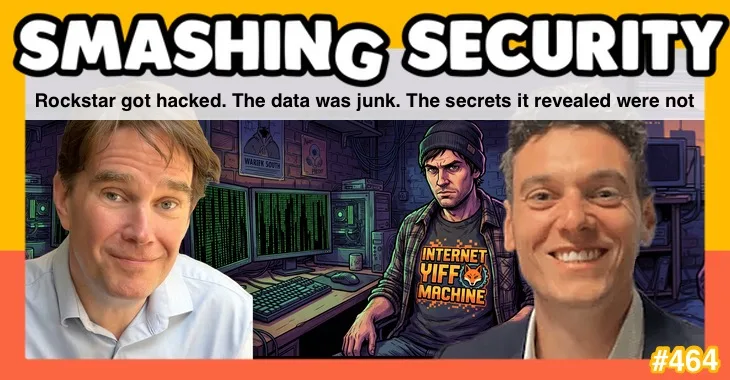
Can we not just give him a burger rather than $10,000? Smashing Security, episode 464. Rockstar got hacked. The data was junk. The secrets it revealed were not.
With Graham Cluley and special guest Joe Tidy. Hello, hello, and welcome to Smashing Security episode 464. My name's Graham Cluley.
Hope the sound is all right.
And I remember saying to them, that sounds a bit futuristic. Can you just, can you call me cybersecurity? Cause I sound like a robot.
But then over time I've realized that people know what cyber means. And also I do other things. I don't just do cybersecurity.
I do sort of online safety and gaming and crypto, that kind of thing. So Cyber Correspondent kind of covers it all.
They thought of the Lawnmower Man and things like that. And now it is all about cybersecurity.
We'll be hearing more about them later on in the podcast.
This week on Smashing Security, we're not going to be talking about how US-sanctioned cryptocurrency exchange Grinex has suspended operations after what they claim was a hack by Western intelligence agencies.
You'll hear no discussion of How hackers are bombarding executives' inboxes with hundreds of emails and then immediately following up with calls posing as the IT help desk, claiming to be there to fix the problem.
And we won't even mention how an iOS 26 update removed a Czech keyboard character, locking out any users who had it in their iPhone passcode.
So Joe, what are you going to be talking about this week?
Don't know if you're a gamer, Graham, you play these games?
All this and much more coming up in this episode of Smashing Security. Time for a quick word from one of our sponsors today, Elastic. So here's a familiar scenario.
Something suspicious hits your network. You need answers and you need answers fast.
So your team logs into tool 1 and then tool 2, and then the thing that doesn't quite talk to either of them. By which point, whatever was happening has happened.
Well, Elastic unifies your security data so analysts can focus on detecting and responding to threats, not herding different dashboards, which is probably why over half of Fortune 500 companies use Elastic.
Find out more right now at smashingsecurity.com/elastic. That's smashingsecurity.com/elastic. And thanks to Elastic for supporting the show.
Now, I've got a tip for any company that handles sensitive data. My tip is to never ever boast about how good your security is, because it might bite you in the bottom one day.
Could be a problem.
To the cybersecurity world, because you want to break it. If you're told you can't break it, you want to break it.
It actually reminds me when I was at BBC Oxford, which is a regional BBC news program.
There was a guy, a local guy, a local company said, we've made a USB stick that's basically indestructible. So my team were, quick, Joe, go and do a video report with these guys.
And I filmed it all on my own. And we did the interview and everything. And they were kind of giving it the big one about how this USB stick is indestructible.
And I said, "Just for fun, can I run it over with my car?" And the guy's, "Yeah, okay." And I ran it over with my car, and I filmed everything, and it completely obliterated the USB stick.
On its website, the company actually advertised that it had been in business for over 20 years with, in their words, zero security breaches. Zilch. Nought.
A marvellous, unblemished record. I think from your little chortle there, Joe, you can sense where this story is going already.
There's been X amount of days before something went wrong. Yeah. It's, you're foreshadowing, aren't you, Graham? I can tell you're a storyteller.
And they run what's called a fully integrated and state-of-the-art tip acquisition and tip management solution.
In other words, it runs anonymous tip lines, Crime Stopper programmes, school safety hotlines, that kind of thing.
And it is used, and this is extraordinary to me, it is used by 35,000 American schools.
So, you know, very serious stuff.
If you are able to leave a tip anonymously, that's going to encourage students to submit a tip, which could be very, very important.
So it's rather unfortunate that a hacktivist going by the name— and brace yourself here, Joe, I know you are a seasoned cybersecurity reporter, so you've heard a lot of hacking names.
This is someone who goes by the name Internet Yiff Machine.
So this chap, Internet Yiff Machine, he scooped up 91 gigabytes of data containing 8.3 million of those supposedly anonymous tips. Now, how did he do this?
And this is the worrying thing. It wasn't a sophisticated nation-state attack?
So it turns out this company, P3 Global Intel, had failed to set some flags on their cookies properly.
So it was trivial for Internet Yiff Machine to steal a member of staff's session cookie through a little bit of social engineering, get him to click on something. Bam!
They've got the cookie. And once inside, they found it was child's play to exfiltrate vast amounts of data which should have been held securely.
In fact, they made 8.3 million requests over the course of 4 days without apparently P3 noticing anything at all had gone wrong.
It's the kind of thing that's been documented for years in the OWASP Top 10 of the things that you have to make sure your web application doesn't suffer from, the most common vulnerabilities on websites.
So basically someone left the front door open, the windows unlocked, and they put out a big sign in neon outside saying, nobody's ever broken in here. Try your luck.
I'd love, I bet it's possible if I put in enough effort. Turns out Internet Yiff Machine didn't have to put in very much effort at all.
Anyway, he grabbed all this data and he handed it over to an outfit, a whistleblower outfit called DDoSecrets. Are you familiar with DDoSecrets?
And they rather like WikiLeaks, they've certainly had their fair share of controversy over the years as to whether they're doing the right thing or not and whether they're disclosing too much information and maybe working too closely with the hackers, you know.
Controversial outfit. Anyway, they dubbed it BlueLeaks 2.0.
And those of you with longer memories may remember in 2020, there was a breach of US law enforcement agencies and the data—
And that original BlueLeaks incident involved the doxing of police officers and law enforcement agents, which obviously people were concerned that they could end up, you know, their families being put at risk and so forth.
Anyway, the good news is this data has not been published publicly, but the hacktivist has listed it for sale on a hacking forum for $10,000.
And he said, look, he basically said, I'm paraphrasing, he said, selling data, he said, goes against my principles. But principles, he said, are for the well-fed.
He says, don't worry though. He says, I only intend to sell one copy. I'm gonna keep the exposure limited.
And that they're very, very sorry about this, but they're gonna have to do it.
I mean, I suppose it is better than the attitude of most ransomware gangs, but it's not really any comfort at all, is it?
And the data apparently goes back as far as 1987. Some of this data, it goes back decades.
I mean, it's ghastly to think that it could have been pieced together like that. Yeah. So very disturbing, some of this. Last month, Portland police took some action.
They told local residents to stop using Crime Stoppers while the hack was being investigated because they said, we just can't be confident it's safe anymore.
And as of this recording, P3's parent company, Navigate360, they have not publicly confirmed that a breach has occurred.
They haven't notified any schools or any individuals, hasn't responded to press inquiries. There's already a class action suit being revved up against them.
But the claim on their website that they've suffered zero security breaches has been updated. It's been removed. They just quietly shuffled that to one side.
So rather than in the last 20 years, it's, don't ask about that. Don't ask about that.
Is that what they're called? P3? So, you know, they're a victim. They've been hacked by a criminal. However, they're also the custodians of this really important sensitive data.
So in a sense, they're kind of culpable for doing bad security at the same time.
So it's really hard when you kind of, I haven't covered this story myself, but there are journalists that have, they'll be wanting to get answers from this company.
And the company have been clearly really, really terrible in transparency.
And those people who have done tips, who've used the tip line, they need to be told, by the way, that tip you gave us anonymously, that might be out there now.
Someone could find that and put your name to it. It's really, it's a really nasty breach. It's a really nasty bit of PR from them.
Whatever. If that was anonymous, then you'd be a bit more, okay, that's safe. But what if names are left on there?
People who the company doesn't have any contact details for, who have been impacted by this.
So, even if you did have contact information, piecing together who these people are, I'll tell you the comparison I was thinking of was, of course, the Julius Kivimäki, the Vastamo.
You wrote a book all about it.
So, the Vastamo Psychotherapy Clinic hack in Finland, where he then went on to blackmail these people after their psychotherapy notes ended up in his lap, effectively, after he did a hack.
This is information which potentially could be pieced together and used for blackmail purposes as well.
So I wouldn't be surprised if this person isn't given $10,000 for their, almost reminds me of the Wu-Tang Clan, where they did one album and they sold it to one person to try and keep it exclusive.
If they're not gonna do that and they're not gonna get their 10 grand, I'm afraid some of those people in that dataset might be approached by them.
But we know it does happen in the Vistoma case.
And then the company Kiddos wasn't paying, so then the hackers called up some of the families, some of the mums and dads and said, "We've got your kids' profile pictures" to scare the parents.
Absolutely horrendous and hideous.
You hand them a physical address, a floor plan, they handle everything.
They sort out the ISP, they design and deploy the network, they turn up on the site, they rack their own hardware, kits that they've actually designed themselves, not just rebranded someone else's gubbins.
Full control without any of the soul-destroying groundwork.
I was particularly interested in this one because, as you mentioned my book earlier, at the end of my book, I talk about a gang called Lapsus$.
Which in about 2022, 2023 were a really big deal.
And one of the guys from Lapsus$ hacked Rockstar Games and stole a huge amount of data and source code, got into the Slack, I remember, of the company and posted pictures of penises.
Yeah, anyway, and then he also published some 90 clips of GTA 6, the forthcoming GTA game, which by all accounts will be the biggest game, biggest entertainment product ever.
Now we find out that a group, again, we think teenagers, called Shiny Hunters, you might have heard of Shiny Hunters, they've been quite prolific in data breach extortion attacks in the last couple of years.
They have got into Rockstar Games using a third-party provider of, I think it was a bit of API that manages their cloud storage, that kind of thing.
And they have stolen quite a chunk of data. But the interesting thing here is that neither the hackers nor Rockstar thought it was really worth much. I spoke to the hackers.
They said, oh, we've got this data. We are extorting Rockstar. They're not paying though. And I said, well, what is it? And he goes, eh, it's junk data, to be honest.
But we tried to get paid. And what's funny is, of course, they've admitted it. Rockstar has said, the quote that we reported at the BBC was, this isn't going to impact us at all.
So, you know, the data's gone, but we're not going to pay the criminals, which is of course what everyone says, don't pay, don't pay, don't pay. So that's good in a sense.
But what I think is fascinating here is the data has now been published and put online on the Shinyhunters darknet website. It's now being sent around and being shared.
And although most of it is, in their words, junk, there's a few tidbits of information which have ended up being a massive talking point in the gaming world.
But what's really interesting is that the financials of how much GTA Online makes and how much Red Dead Redemption makes have been released as well.
So you've got these Reddit threads full of gamers talking about, oh my God, I can't believe it makes this much. The headlines are GTA Online.
Bear in mind, this is something like a 13-year-old game.
This is another thing that's come out of the data breach, is that only a very small fraction of people who play that game actually spend in that game.
But the interesting thing about it as well is that Red Dead Redemption, which people kind of had a feeling it wasn't that popular, it's not got anywhere near the kind of size of GTA following.
But because of this data breach, we now know just how little people spend in Red Dead Redemption.
And the reason possibly why Rockstar Games isn't really putting much effort into Red Dead Redemption according to the data breach, whereas GTA Online is making about $500 million per year, unfortunately Red Dead is only pulling in about $26.4 million per year.
Still not bad, is it?
But what gamers are saying is that this really does say a lot about where the money and effort and design is going, which is GTA, because that's where the money is.
And this article I love from PC Gamer, it says, maybe Red Dead isn't Red Dead, it's just dead, dead because there aren't many players.
Is it not going to be a buy it once and play it forever? Is it going to be a live, constantly updated game?
Because now they've seen the financials and it makes so much sense business-wise.
And perhaps people are saying, maybe that's why Rockstar isn't rushing with GTA 6, because they're making so much money on GTA Online.
The reason I bring this up, you know, I know it's not a gaming podcast, but in terms of data breaches, I think this is a real fascinating case study in the unintended consequences of letting data that you think isn't that interesting into the public.
And I love the PC Gamer article title is Rockstar hackers release their stolen data, reveal that Rockstar was probably right not to pay anything for it.
But perhaps maybe Rockstar might be thinking that again because there's this information, you know, maybe it was already out there through investor calls and things like that, but no one really paid any attention.
But now it's out there and people are really poring over it and analyzing it and reading lots and lots between the lines.
It's not a drink full of sugar, it automates all of that tedious manual compliance work so you can stop drowning in spreadsheets, chasing audit evidence, and filling out questionnaire after questionnaire.
It also uses AI to streamline evidence collection and flag risks. It automates compliance for SOC 2, ISO 27001, HIPAA, GDPR, and more.
Head to vanta.com/smashing That's V-A-N-T-A dot com slash Smashing and get started today.
It doesn't have to be security-related necessarily. Well, my pick of the week this week is not security-related. I'm sure you're like me, Joe. I used to love Twitter.
And I don't think we need to name anyone in particular, which coincided with it going terribly wrong. But I think we recognise that Twitter changed and not only changed its name.
They want us to call it X for some ridiculous—
So I went elsewhere.
But the thing is, sometimes I still have reasons to go to Twitter because sometimes someone posts up something like, you see these AI videos with Lego characters during the current conflict in Iran, for instance, and they're being posted up on Twitter and you think, oh, I'd quite like to see that, but I don't want to create a Twitter account.
And I don't want to link to Twitter from an article because it's full, you know, it's horrible and it's bile-filled and it's full of bots.
You know, I just don't feel right linking to it. And that is when I discovered a site called Xcancel.
And Xcancel is a third-party interface that allows people to view and link to, you can't post to Twitter via it, but you can view and link to content which is on Twitter without directly using Twitter or X itself.
Does that make sense?
You don't have to create an account, which means I can replace x.com with xcancel.com in all of my URLs to access content through it.
I can even use a browser extension that automatically redirects any links to the old Twitter to go to xcancel.com instead. Or I don't use Google as a search engine.
I use something called Kagi, which is something you pay for, but it has some nice benefits.
And I can tell Kagi to always change search results which go to X to go to Xcancel instead automatically.
So my recommendation to people, I don't know if other people are gonna like it or whether they're as obsessed about this kind of thing as I am, but my pick of the week is xcancel.com.
If there was some sort of declaration or something, would you go back on?
And to be honest, from what I've seen, a lot of it is bots or a lot of it is porn or AI content. And it's just this isn't actually valuable. Yeah.
Although Mastodon and Bluesky aren't as great as Twitter used to be, I do find them more pleasant places to hang out. I'm quite happy being there, to be honest. Anyway, xcancel.com.
Joe, what's your pick of the week?
I think it probably came out where— so the events of the book are about Anonymous, the hacking collective. So she's writing about things that happened in 2009, 10, 11, 12.
I think it came out in '14.
It's a really good page-turner and it gives us the type of cyber writing and reporting that I really is where you get to know the individuals and you get to find out what makes them tick.
And I'm really enjoying it. And she's a great writer, American. I think she was at Wired and now I think she's a Bloomberg tech columnist or something.
But yeah, I'm really enjoying it. We Are Anonymous is the book, and check it out if you haven't already.
I think LulzSec are covered in it quite a lot, for instance, who were a very prominent, primarily British hacking gang back in the day.
And I realize now, too late, that I should have read her book while I was, or before I was writing mine, because it would've helped inform my reporting.
But luckily, I haven't got anything wrong, but I could've just got some really nice detail from the sort of stuff that she got.
Because as you say, she follows a small group of the Anonymous core, which turn out, lots of them, to be part of this really world-changing group that was LulzSec.
So, some of the character beats, some of the things that make these hackers tick, you could see that in the book that Parmi wrote 10 years ago, and you could also see it in the book that I wrote last year.
There is a certain number of character traits that you see in these young hackers who like anarchy and chaos, and that really does come through.
And I think in a sense, it goes all the way back to the Hacker Manifesto of the, was it the late '80s, mid-'80s, where you had this idea of the smartest people in the room, they think faster than everyone else, and they want to show everyone how clever they are by doing crazy magical things with computers.
So it does feel almost timeless, that type of story. And that's been really interesting to notice as I've been reading it.
Well, if you've ever had to set up networking for a new office or you've watched an IT team try to bolt security on top of infrastructure, that was never designed for it, you'll know it's rarely pretty.
Well, Ryan Benson is from Meter, a company that thinks that there's a better way. Ryan, thank you for joining me.
What corners are people ending up cutting?
I would come up with a great network design and I'd have redundant firewalls and I'd have powerful switches and what have you.
And then inevitably we'd go to the money folks and they'd say, uh-uh, you know, rip out 30% of it or whatever, right. And so we would rip out this SKU or this box or whatever.
And that would take oftentimes weeks of my work and working with the limited resources at those IT teams to come up with something that would fit the budget and yet also keep the business running.
So we designed to mediocrity, rip out a bunch of cool design that I spent all this time working on.
And in the end, we'd have something that works, but really isn't the greatest and might have some holes or what have you.
And then 3 to 5 years later, we'd have to come back around and say, okay, well, here's some new boxes with some new chips or some new technology.
If it's hardware or you're sacrificing redundancy or you're working with lots of different vendors and there, all sorts of problems can occur, can't they?
So you might have not only just single points of failure, but in kind of the traditional way of doing these things, you might go for a lower tier software license that doesn't have as many features or something like that.
And that's kind of the way that we've done things for a long, long time. Well, what if we didn't have to do that? What if we always put our best foot forward?
But sometimes that's not always the best approach, is it? Right.
So the idea is that we deliver world-class networking and security so the customer can go and enjoy whatever it is they want to do with their life and not have to worry about any of the technology.
The idea is that everything, not just the boxes in the closet or the APs on the wall or whatever, all of it is a service.
The support, day 2 and beyond, the design before we ever put anything in the building, the way that we configure the gear, all of that is done from Meteor.
And then supported, you know, in year 2, year 3, if there's some new Wi-Fi that comes out, you know, we deliver all that.
But what does that actually mean in practice? What's different about how you guys build things?
Our default position when we deploy a new network to have security baked into the design of the network.
So when something gets deployed, we've already designed it to be Zero Trust in terms of, you know, traffic flowing east-west within the network and things like that in the actual physical design and the software configuration of the network.
So if there is an application that needs to talk east-west or what have you, we define that before the network ever even gets delivered.
We do something called a digital twin where all of it is designed, you know, in the cloud before the physical gear is ever delivered.
And then we all agree with the customer and we do a validation step.
It doesn't sound like maybe the sexiest thing in the world to sell, but it is pretty cool that, you know, we go through the whole process of implementation and design, and then we shake hands and say, yes, you know, we agree that this is how we want to run our business or our school or our government or whatever.
And then we say, all right, well, now we can actually physically build it. So I think a lot of that is what makes us capable of delivering a secure network from day one.
But no, the existing SIEM, the IDP and all of that stuff, we integrate deeply with all of those things. In fact, they're critical to delivering a secure network.
So your existing IDP, your existing SIM, those things are going to stay and we're going to integrate in tightly with those things.
So we can do role-based access control, the concept of least privilege, so if you add a new administrator or a new person in your team, they're not going to have keys to the kingdom day one and what have you.
And obviously your MFA and all of that, that you use today with your IDP is still going to be used.
And I think that's one of the biggest differences that I could possibly say about Meter is that it doesn't necessarily matter if our APs are the strongest or the switches are the coolest or fastest or whatever, which of course I would say they are, but I might be biased.
But it does matter that we care very much about the outcome.
So if you're a hardware store and you want to run that hardware store efficiently and take obviously point of sale swipes and you want to have your folks with their inventory scanner guns be able to scan the inventory and fly around forklifts at 35 miles an hour and whatever else we care about that as much as we care about delivering an access point or a switch or what have you.
So what that means is instead of worrying about what switches go in the closet and what firewalls are plugging into the ISPs, or even what ISPs there are, right?
We care very much about your hardware store running and operating as best as it can. And we contractually obligate ourselves to that. So we deliver an SLA.
We're not delivering a SKU, but we're delivering a network. And I think that's the big difference is that for me, I love this stuff and you probably love it as well.
And that's why we talk about it on podcasts and why we talk about it with friends and other network folks.
And I think that is the big difference for our customers, is that they can rely on a great outcome that also is secure because we put it in the contract.
And one of the things that's been absolutely fascinating to me is that you guys even get down to the floor plans, right?
You're working at that kind of level with some of your customers.
And I think I was just talking with someone about this yesterday, that is one of the biggest differences is that, you know, once again, we were talking about earlier, instead of me being a nerd and putting SKUs and bills of material together and a Visio drawing that takes me a month to do and all that, all that goes away.
If we talk to a customer and they say, hey, we, you know, we your idea, you know, what's the price?
Instead of going through all that, we're just, hey, send us a floor plan of your most painful location, you know, something that maybe you need to look at lately.
And then we know based on our experience building networks for a warehouse or for a school or for a high-density office or whatever, we know how much it's going to cost us to build a state-of-the-art, great, secure network.
And so we can just give you a price.
But, you know, the only pushback we get is usually this seems too good to be true. Where's the catch?
And, you know, I would say that's probably true if you own two coffee shops or something, you know, that's not really a great fit, I guess, for Meter at this time.
But, you know, if you own 100 coffee shops, we are absolutely your best option.
That's really our promise is to say, hey, hire the experts at this. We'll deliver the best and you can go on about your mission.
If a listener's out there listening right now and thinks, oh, crumbs, you know, we could do with help with this, what's the right first step that they should take?
And if they do, obviously they can reach out to us, you know, either there or or heck, even email me, .
I'll be happy to align you with the right folks.
So my Instagram and my TikTok, just my name. In fact, my Instagram is MrJoeTidy, and then I'm also on Blue Sky and LinkedIn as well. But I'm, OnlyFans, of course.
Yeah, you know my OnlyFans, just put I'm going to put a little, what's it called?
And don't forget to ensure you never miss another episode, follow Smashing Security in your favorite podcast app, such as Apple Podcasts, Spotify, and Pocket Casts.
Episode show notes, sponsorship info, guest lists, and the entire back catalog of 464 episodes. Go, I know, I know. Go and check out smashingsecurity.com.
Until next time, cheerio, bye-bye.
Sponsors Elastic, Vanta, and Meta. And also, of course, the following patrons who've been plucked out of the hat. So who have we got this week?
Skur Imtiaz Ahmed, a name of real gravitas, that. I imagine he's read all of the Ts and Cs and actually understood them. The magnificently monikered Urs Schoenhoser.
Lewis, just Lewis, so confident he doesn't need another name. Trustworthy sidekick to Inspector Morse. The solid and trustworthy Robert McCurdy.
Benjamin Harouth, the kind of guy who's never once clicked remind me later on a software update. Who else?
Kennethingham gives the vibes of being the most knowledgeable person in any given room, but too polite to mention it. We appreciate that, Kenneth.
Marvin71, yep, Marvin with a number. The 71 could be a birth year, I suppose, a high score, number of times he's explained to someone why they shouldn't reuse passwords.
We're guessing it's all 3.
And finally for this week, Karen Reynolds, the most organized person on the incident response team and the one who brought homemade biscuits to the debriefing session.
Those are just a few members of Smashing Security Plus, which means that they get their episodes ad-free, earlier than the general public, and can be pulled out of the hat at random to have their names mocked at the end of the show.
If you'd like to join Smashing Security Plus, just head over to smashingsecurity.com/plus for all of the details.
You can also support the show in plenty of other ways, and they aren't going to cost you a single penny.
You can like, subscribe, leave a 5-star review, but most important of all, go and tell your friends.
Go on, go and tell them that you listen to Smashing Security and encourage them to do the same. Well, until next time, that's just about it for us.
So I'll say toodloo, cheerio, bye-bye.
Host:
Graham Cluley:
 @grahamcluley.com
 @
@
 / grahamcluley
Guest:
Joe Tidy:
@joetidy.bsky.social
/ joe-tidy-1932764
Episode links:
- Grinex exchange blames “Western intelligence” for $13.7M crypto hack – Bleeping Computer.
- Are Former Black Basta Affiliates Automating Executive Targeting? – Reliaquest.
- Apple is working on passcode bug locking out iPhone users – The Register.
- Hackers who stole crime tip records offering data cache for $10k – San.
- P3 Advertised 20+ Years and 0 Security Breaches. You Can Guess What Happened Next – Databreaches.net.
- Portland police urge residents to avoid Crime Stoppers following hack – San.
- GTA-maker Rockstar Games hacked again but downplays impact – BBC News.
- Rockstar hackers release their stolen data, reveal that Rockstar was right to not pay them anything for it – PC Gamer.
- XCancel.
- ”We Are Anonymous” by Parmy Olson – Penguin.
- Smashing Security merchandise (t-shirts, mugs, stickers and stuff)
Sponsored by:
- Elastic – AI is transforming security operations, but security is still a data problem. Learn how context-rich data drives faster, more reliable defence.
- Meter – Network infrastructure for the enterprise. Get a free personalised demo.
- Vanta – Expand the scope of your security program with market-leading compliance automation… while saving time and money. Smashing Security listeners get $1000 off!
Support the show:
You can help the podcast by telling your friends and colleagues about “Smashing Security”, and leaving us a review on Apple Podcasts or Podchaser.
Join Smashing Security PLUS for ad-free episodes and our early-release feed!
Follow us:
Follow the show on Bluesky, or join us on the Smashing Security subreddit, or visit our website for more episodes.
Thanks:
Theme tune: “Vinyl Memories” by Mikael Manvelyan.
Assorted sound effects: AudioBlocks.