Journey with us to Myanmar’s shadowy scam factories, where trafficked workers are forced to run romance-baiting and fake tech support scams, and find out why a company’s mandatory hold time for tech support could lead to innocent users having their computers compromised.
All this and more is discussed in the latest edition of the “Smashing Security” podcast by cybersecurity veterans Graham Cluley and Carole Theriault.
Plus – don’t miss our featured interview with Acronis CISO Gerald Beuchelt!
Warning: This podcast may contain nuts, adult themes, and rude language.

Show full transcript ▼
 This transcript was generated automatically, probably contains mistakes, and has not been manually verified.
And some of these channels, every 30 seconds, some voice comes on. Your call is important to us.
You are 14th in line and then gives you an ad sometimes and then goes back to the music.
Smashing Security, Episode 407: HP's Old Music and Human Trafficking with Carole Theriault and Graham Cluley. Hello, hello, and welcome to Smashing Security, Episode 407.
My name's Graham Cluley.
But before we kick off, let's thank this week's wonderful sponsors, Acronis, Drata, and Palo Alto Networks. It's their support that helps us give you this show for free.
Now, coming up on today's show, Graham, what do you got?
He's Acronis's Chief Information Security Officer, and he shares loads of tips on how the security professional can get the boss on side.
All this and much more coming up on this episode of Smashing Security.
I actually think the most terrifying phrase of all is, "Your call is important to us." Those words you hear when you ring up a tech support line or you ring up customer service, because you instantly know from that point on that it isn't important to them.
You know that you're in a queue.
And eventually, when you get through to someone, they won't be able to help you with your actual problem.
And maybe they'll say, oh, but we can pass you through to another department. Just hang on. You're going, no, no, no, don't pass me through.
Then you're lost forever into the chasm, into the dark void.
In fact, I think the easiest fix, perhaps, for a recession is not to invest in manufacturing or get lower interest rates or set up trade agreements.
The best thing you can do for a country's economy is to fix tech support hotlines, because the hundreds of thousands of hours that must be wasted each day when work could be done instead, work which could make the whole country some money.
And the thing is this, how do you make a tech support line more efficient? How can you make that experience better?
My husband actually had to cancel a subscription and he went to the website.
All through the chatbot.
But I think there's other ways in which you can make a tech support line more efficient because it's a very simple equation, right? People are clogging up support lines.
You need to get people off the support lines to make the support line more efficient.
So if you did that, then your support line would be something that would work.
In fact, there'd be a phone covered in dust and cobwebs, which never has to be picked up by the people who work in that particular support line.
It's a lovely way of thinking about things. So that would help reduce the number of people who call support. Having a product which just works, it makes support hotlines better.
The problem is that it requires some effort in building a product that actually works in the first place.
Now, another solution—I'm on a bit of a high horse this week—is that you can hire more tech support people to staff the support line, right? Just throw people at it.
So hiring more people does cost money, obviously, for the company. So they have to make an investment. Often they will outsource it to other countries.
And of course, people are a pain in the ass. You have to manage them, and they could cause problems. So we have to find another way to reduce the tech support hotline problem.
When you think of a printer, the actual definition of a printer is not something that actually works. A printer is predominantly a paperweight.
It is predominantly something which sits in the corner of the room.
So that's too much of a technological challenge for the guys at HP, right? They're not going to find that easy. They didn't fix the support line problem that way.
Printers are the bane of most people's lives, right?
In HP's case, they're typically going to try and use the printer to try and squeeze every last little cent, every penny, every shekel out of your corpse by charging you an over-the-top premium for the right to take out a subscription for ink, right?
So HP, they aren't going to improve their product. Are they going to hire more people? No, of course they're not going to hire more people in tech support. Why would they do that? No.
What they decided to do is to discourage people from ringing up tech support.
And the best way to get people not to ring up tech support is to make tech support as gruelling an experience as possible.
So as The Register reported last month, an internal order was sent around HP, and I'm going to tell you exactly what it said, and then I'll try and explain what it means.
Now, IVR is the Interactive Voice Response. That's their phone menu system.
That's their digital phone system, which you ring up and you press a button and you get things played at you and you're put in a queue. And they carried on.
They said, objective is to influence customers to increase their adoption of digital self-serve as a faster way to address their support question.
This involves inserting a message of high call volumes to expect today in connecting to an agent and offering digital self-solve solutions as an alternative. Have you followed that?
What I'm— no, what I'm wondering is, is it written this because they're turning something on by default and they're trying to obfuscate that, or so you just get bored out of your mind?
What they are actually saying is that they've changed the way their tech support phone system works.
When they say their objective is to influence customers to increase their adoption of digital self-solve, what they mean is they want more customers to fix their own problems by looking up the answers online.
All right?
And they say this involves inserting a message of high call volumes to expect a delay in connecting to an agent and offering digital self-solve solutions as an alternative.
In short, at the beginning of the call to tech support, they are playing a message stating, "We're experiencing longer waiting times and we apologise for the inconvenience." Feel free to look at our website.
Yeah.
"The next available representative will be with you in about 15 minutes." And what they were doing was they were putting in a mandatory, compulsory 15-minute wait on their support lines.
And every 5th minute or 10th minute or the 13th minute, the recording message comes in again, said, "We're still experiencing longer waiting times than normal.
We apologize for the inconvenience." An inconvenience they have manufactured themselves artificially.
And you're sitting there with the hold music and you're kind of in la-la land where you can actually do work.
And some of these channels, every 30 seconds, some voice comes on, "Your call is important to us.
You are 14th in line." And then gives you an ad sometimes and then goes back to the music.
So I found this extraordinary that they put in this compulsory 15-minute wait.
Way, way back in 2000, for instance, credit reference agencies like Equifax, TransUnion, Experian, they were fined $2.5 million because the FTC found that they were failing to maintain their toll-free telephone lines for consumers seeking information about their credit score.
They were blocking millions of consumer calls. They were leaving them on hold for excessive amounts of time, a bit like HP was.
As veteran journalist Bob Sullivan pointed out in recent days, HP's move has inadvertently exposed consumers to cybercrime.
Because, of course, these frustrated users who just can't get their ruddy HP printer to work often will turn to unreliable third-party websites and potentially download malware instead of legitimate printer drivers.
He says poor customer service creates a significant cybersecurity vulnerability and more companies need to think about this because criminals can exploit the desperation of consumers who are looking for help with a product or a service.
All the time you're having problems because your printer's updating, there's software updates, maybe your computer's updating, there's out-of-sync printer driver, you find yourself screaming in frustration, and sometimes users can't find the printer driver they want on HP's website, but they find something elsewhere on the internet which claims to be the driver they need.
HP has published warnings on its own website about scammers who are trying to trick users into installing malware disguised as this kind of thing.
And what Google did was, of course, before the genuine HP printer support page, he got 4 sponsored links, all claiming they could fix your HP printer problem online.
And all of them were scams.
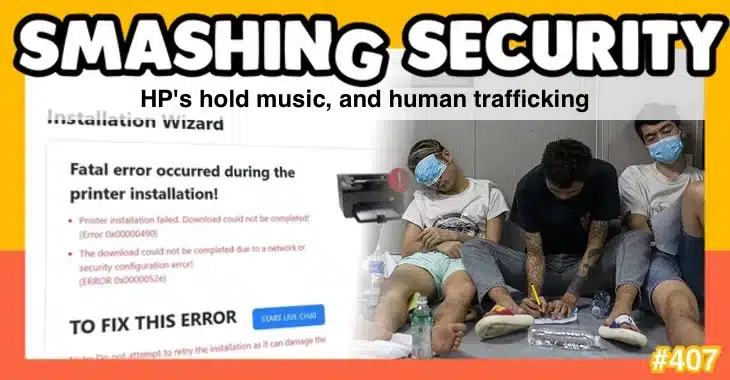
It all looks very friendly and suddenly goes, oh, fatal error occurred, it says. But you can start a live chat with a support agent.
So in your desperation to get your ruddy printer working, you click on live chat, and that, of course, is when the scammer asks to have remote access to your computer or says, install this piece of software, we'll be able to fix your problem.
And they end up stealing data, locking your computer, maybe installing ransomware, or in the worst case, gaining access to your bank account and other pieces of information.
There's some good news because after the Register publicised HP's 15-minute directive on their support lines, the company went into an urgent reverse ferret.
The press picked up on it, the company caved into the pressure, and they said, "Oh, what were we doing that? Oh, we've stopped that. We've stopped that now."
To try it out and maybe didn't have the upper echelons' involvement in this. And then, you know, when word got out, shit hit the fan.
Maybe they were trialling it on us Europeans and in the Middle East and Africa before they were going to do it in the Americas as well. I'm not sure.
Anyway, they say that based upon feedback, they know the importance of speaking to a live customer service agent in a timely fashion is paramount, so we're going to continue to prioritise that.
I would love to hear from listeners who will start their stopwatches to find out how quickly they get through to tech support now.
Even if it's not mandatory, I suspect there's sometimes often a very long delay.
And like many others, X struggled to find a job after the whole COVID pandemic thing, and he had a dream of studying to be a hairdresser.
And to study to be a hairdresser, you need some money, but jobs were scarce. And one day, he hears about a job through an acquaintance.
Now, when you're waiting for work— and this happens to be in Northern Vietnam, by the way.
But I think most of us might have been in the situation where we're really hungry for work and nothing is about, so you start keeping your ears to the ground.
And maybe you first ask your closest friends, then your close friends, then your not-so-close friends, and then acquaintances, because you never know— you never know when you're going to luck out.
And it's a 6-month contract in Thailand, and X is told that the work would involve using a computer and typing.
So he says starved for 15 days, offered only occasional scraps of food for failing to meet the scam quota.
It was almost a month before X realized that he actually wasn't in Thailand at all, but in neighboring Myanmar. Okay, this is all according to ABC Australia News.
A lot of people are using the term pig butchery at the moment, which I loathe. So we're not going to use that term.
But typically, the only way out of this kind of situation was for loved ones to pay a ransom of between $5,000 and $10,000.
So the average monthly salary is around $600. So a $10,000 ransom is a lot of wonga. In another case, an African kidnapped worker told the BBC of his experience.
He said they gave us a target every week of $5,000. If not, they gave us two electric shocks, or they put us in a dark room with no windows.
But if we earned a lot of money, they were very happy with us.
And so using AI, the scammers made him appear on screen to be an attractive young woman, altering his voice, etc.
So I'm going to pause here quickly because typically we are concerned about the end victim, you know, the person who gets scammed into investing into crypto or falls for a romance scam or whatever.
But what if that person you hate so much and wishing the worst karma on is actually someone who had simply wanted a job to get some money to study hairdressing?
And for the last few months, Thailand has intimated that it's committed to cleaning up this mess.
So in February, last month, BBC reported that more than 250 people from 20 different nationalities were rescued from a so-called spam warehouse in Myanmar by an armed group.
Weeks later, another BBC report that thousands more have been rescued from these spam compounds along the Myanmar border.
I've seen a number of reports say 7,000-plus have been rescued.
Most of these are reportedly run by Chinese fraud and gambling operatives who have taken advantage of the lawlessness in this part of Myanmar.
And you can, you know, readers, feel free to do some reading on a character called Broken Tooth. This is a Chinese gangster of sorts with ties to this whole operation.
There's a really good piece in The Washington Post. I'll put the link in the show notes.
So yes, as you were saying, wonderful that thousands have been saved, right?
And I'm saying saved here with little invisible quote marks because this could be the end of the story except for two things.
One, the UN says that hundreds of thousands were forcibly engaged by organized criminal gangs into online criminality across Southeast Asia.
So from a human rights perspective, we might just be scraping the very, very surface here.
So Thailand insists it's moving as fast as it can to process these workers and get them home.
But these centers are run by armed militia groups, seem to have very limited capacity, which means that basic hygiene, health requirements are not being met.
So one detainee told the BBC that he got two very basic meals a day and that there were only two toilets for 450 people.
So the BBC has been told that some African countries will only fly their people home if someone else pays.
Some countries don't even have embassies in Thailand, so that whole back and forth into verifying a person is difficult. And remember, these freed workers have nothing.
Their passports have likely been withheld by the compound bosses. And of course, those in camps just want to go home, right?
Which, and it's, you know, sadly might turn out to take a lot more time than anyone ever really probably considered.
But some do and have made it home, sometimes through rescues and sometimes through escape. And this includes our man X from Vietnam. He eventually made it out.
He chose not to divulge his details of his escape, but he said it was an arduous journey on foot. And he's now working in his dream field of hairdressing.
So, here is to many more happy and speedy homecomings.
I have read about this a bit, and it is astonishing that it has become this industrialized and effectively, it's the same kind of gangs who may be involved in people trafficking.
But this kind of kidnapping people and forcing them to work for you in a sweat house and having someone, you know, withhold food because you don't meet a certain quota.
If I take a Western point of view, there's plenty of people over this part of the world who might go to those parts of Asia, for instance, on a backpacking holiday and may want to make some money while they're out there and think, oh, you know, I'd like to stay out here for a year, so I'll get a job or something, and could be lured in.
And you can't help but think if some of those people ended up in these camps, that maybe the Western media would take a bit more interest.
But of course, there are countries whose citizens are being impacted who maybe don't have the resources or financial might and are less keen to spend the money getting their people home again.
It's not a place you'd go on holiday or backpacking.
I think they've even shut power off at the borders.
Acronis delivers natively integrated cybersecurity, data protection, and endpoint management built for managed service providers.
Each episode delves into topics from emerging threats to innovative solutions.
New episodes are released regularly on all major podcast platforms and is free to subscribe and listen.
Visit paloaltonetworks.com/threatvector to learn more and start listening today. That's paloaltonetworks.com/threatvector.
That's why modern GRC leaders turn to Drata, a trust management platform that automates tedious tasks so you can focus on reducing risk, proving compliance and scaling your program.
And you can simplify security reviews with Drata's Trust Center and AI-powered questionnaire assistance.
And welcome back. Can you join us at our favorite part of the show, the part of the show that we like to call Pick of the Week.
Could be a funny story, a book that they've read, a TV show, a movie, a record, a podcast, a website, or an app. Whatever they wish.
It doesn't have to be security related necessarily.
Now, Carole, have you heard of the Scunthorpe problem?
Of course, if you're in the United States, you may not know that Scunthorpe exists. And so you just be, whoa, whoa, you know, we don't like that kind of language.
Now, that has been a problem. But what I want to choose as my pick of the week this week is, as I say, a font. Because I have discovered a font called Scunthorpe Sans.
And what it does is it automatically redacts any rude word which you write in.
So when you type in, for instance, I'm going to have to bleep this out, fuck, shit, fuck, for instance, it will replace it with a black blob instead.
Okay, this is a web page which is using this font, and there's a little box there where you can type in any smut and filth that you like, and it should, in real time, censor it.
And the thing is, you could install this on your computer.
The way in which this font is working is it's taken advantage of ligatures.
So in fonts, when a letter combines, so for instance, you know when you get A and E sort of squashed together in encyclopedia or Aesop?
They then redact those letters. So it's a pretty neat little feature. So you could install this, maybe you'd find it useful, or put it on your web page if you ever wanted to do that.
So my pick of the week is Scunthorpe Sans. Links in the show notes.
Although she felt intense love for her family and her best friend, these connections were never enough to make her be good or to reduce the feelings of apathy and frustration.
So she hits her teens and 20s, her behaviour escalates from petty theft through to breaking and entering, stalking, and worse.
I found it fascinating to experience because of course I had it as an audiobook and it was read by the author, which gives you a little extra, you know, when you have the author read the thing and it's a memoir.
And I like the wrestling with the big question from a kind of sociopath's point of view, which is, is there a way for sociopaths to integrate happily into society?
Not, is society happy for sociopaths to integrate happily? And it's interesting to think, well, will she manage and how did she do it?
So do you know that 5% of the population can be categorised as sociopaths?
So, Smashing Security listeners, today we are speaking with Gerald Beuchelt. He is the Chief Information Security Officer, or CISO, at Acronis.
Now, Gerald is a recognised thought leader in the cybersecurity space, having served on multiple boards, including the National Cybersecurity Alliance and the ID.me cybersecurity board.
And today we are going to be talking about a topic close to my heart, and it's how to get the bosses to see the need for improved security strategies.
So welcome to Smashing Security, Gerald.
This is a topic that is very close to my heart, and I actually believe it's close to everyone's heart who's working in security.
It's like, I can't recount the many times we've been discussing over the last 20 or 30 years, it's how security is gonna get a seat at the big table, right?
It's I started out in pre-sales at Sun Microsystems way back in the days, which by the way, I just want to call, first of all, it was a wonderful company, but it was also a most excellent experience that I still draw from today.
It's having had the opportunity to work with salespeople in the sales field, it does give you a completely different perception point on what is important and why we're doing certain things the way we're doing them, et cetera.
Actually went over to MITRE, for those who are familiar with the MITRE framework, really got sucked into security in that role.
So I got antsy and decided that I wanted to do something different. Took a couple of different roles in public companies as CISO for Demandware.
I was working with different companies, with different boards, different executive teams in order to really drive security across the board. I ended up here at Acronis.
I think there's a lot of good fun things that come with that for me as a CISO. It's been quite a journey.
Working as a CISO at a security company is definitely something that's particularly exciting for a number of different reasons.
And you really are perfectly positioned to help us understand the importance of getting boss buy-in when you're trying to protect any organization from the plethora of insider and external threats out there?
Because of course they hold the purse strings, right? I mean, they're the ones really with the money, or is that unfair of me to say that?
And the answer I got from that particular person was that, well, we're doing security because of security, which in my mind is probably the worst answer you can give.
Because at the end of the day, this is not an end to itself. This is something that we really need to contextualize in the larger mission of the particular organization we're in.
And when we do that, it becomes a lot easier to put yourself into the shoes of some of your peers, some of your bosses in order to drive understanding for the program.
But maybe first you can tell us what typically goes wrong in your experience?
So, I'm imagining you've got a team of people in security or in IT that have an idea in their head of where they want to go, but it falls over, it falls down somehow.
What I found is, and to some extent learned through the school of hard knocks, it's like being too deep into your technology, being too deep into your vernacular, being too deep into security when you talk to other leaders, when you talk to the board, when you talk to peers in some form or another.
Because at the end of the day, you're the specialist.
You're the one who everybody else looks towards for managing that security thing, or dealing with that security thing in some form or another.
So if you now go out and start to go to the deep end of security, which we all love to do — I'm guilty as charged — you can really end up ruining your reputation and causing more harm than good.
So one example that would come to mind as how you really can go down the wrong path is a particular colleague who went into a new organization as the new CISO, barnstorming, trying to set up as many new governance committees as possible.
So get everyone together, make sure the CEO was on every tactical meeting that they can possibly imagine.
Overwhelmed, essentially, his peers and his leadership with metrics detailed across the board.
And that ultimately ended up getting him fired — it was not meeting what the expectations were, it was not really helping those other leaders move the ball forward.
If you have a company, if you have a nonprofit organization, if you're part of the government, you typically have a mission, right?
For companies, it's simple — it's usually to make money in meaningful ways. Nonprofits and governments can sometimes be a little bit different.
But this understanding — why are we here, why are we working together — is a crucial part in terms of understanding what level of security is appropriate, how to ultimately sell this internally, what kind of controls are acceptable, which ones are not, and how to ultimately balance the risks that you come from security with other risks across the board.
And I think that's really something that I want to drive towards.
It's a language that is much better understood by non-security people.
It's much easier ultimately to cast the threat landscape, the vulnerabilities that you have, the likelihood of impact in a risk profile and risk portfolio or posture — no matter how you want to call this — across the board, and then use that enterprise risk, a heat map or something like that to communicate.
Now, I'm going relatively specific here, but the general idea is really to start thinking about setting up a framework that moves towards that goal.
Because that will ultimately help you communicate what you're trying to do from a security perspective without having to resort to vernacular or to specific techniques.
Now, what's important in this kind of context is to really understand the risk hierarchy that you want to look at. You can formulate risks at a very, very technical level, right?
It's like, what is the risk of not patching a particular vulnerability with an SLA, but it's having 15% of vulnerabilities of a certain concern level not patched, et cetera, et cetera.
It's like those things are not really risks that are useful, right? That really does not help you to communicate to other leaders what your concerns are.
What is much more interesting is what is the current overall risk of a data breach? You can think about a risk such as business discontinuity.
What is the risk essentially that we would associate with the company not being able to conduct business due to a security incident?
And that means thinking about the enterprise, thinking about the goal of the enterprise and how you get there instead of thinking about where you want to patch something or run a penetration test or something similar.
And often, as kids, we were completely lost. We had no idea what he was talking about.
I was thinking about that when you were speaking, and it's basically he didn't really judge his audience very well.
It seems to come down to that, that the fact that we were 8 or something, we couldn't understand his language, and we didn't understand the concerns.
So basically, the warning he was giving us just bypassed us.
It's like he tried to explain things sometimes, but it's also obviously sometimes much more comforting to speak in the language that you're used to because you can communicate faster.
You can communicate more precise and you don't risk quite as much questions coming back at you.
So I'm not going to ask questions.
But this kind of disconnect is absolutely terrible when you want to set up a program and get support from other leaders or from the board for your program.
And you can really only do this if you really illustrate to them what the impact of a particular decision with regards to security ultimately looks like.
Actually, one thing I want to add to that is this I think is really critical in this entire setup.
As you formulate those kind of risks, as you put this out, be ready to see pushback still.
It's like, hey, if we don't do X, Y, and Z, we may end up having a much higher risk for losing days or even weeks of non-productivity.
What could come back from the business side is like, well, that's kind of fine, but if we do what you're proposing, our go-to-market is gonna be so much longer.
Our ability to innovate is gonna be impacted in so many ways that we're ultimately gonna be losing so much business that it becomes a problem.
So this kind of balancing between on the one side looking at security risks and on the other side looking at business risks, go-to-market risks, legal risks, sometimes financial risks, is really critically important.
And that is where you can enter into a really interesting discussion with your peers, with your leaders in order to make sure that they understand what could possibly happen and you understand on the other side then also what a particular decision, how that would impact the organization.
Something we have to do is to really reiterate this message which many years ago I said oh yeah, that makes perfect sense. Let me talk about the business thing.
And then I went off into a completely different direction without really understanding what I was trying to do.
To some extent, perhaps also a little bit of lack of empathy that really got in the way for me to fully grasp what some of those kind of concerns on the other side would look like.
Experience got me to the point where I feel I'm a little bit better with that. Wouldn't say awesome, but I'm a little bit better with that.
And I think that it's something that everyone really has to practice also as they engage with different stakeholders across their organization in order to see whether their assumptions, whether their messaging and their general approach actually makes sense.
Number one would be to really engage with the organization that you're in, but also the people that you're working with.
I love making a point that when looking at security, we obviously have the confidentiality, integrity, and availability, which is one way to slice and dice things.
But the other one that is also very important to me is people, process, and technology. If I look at those, every time that out of those three, you got to secure the people.
You got to work with people to get an understanding of what goes on. Then you need to tell them what to do. That's the process, essentially.
And ultimately, you deploy technology in order to make it efficient, to have force multipliers, or to unlock new capabilities.
But without people on board, you end up being in a situation where it really doesn't help you moving forward. And I think that's pretty critical.
The other thing is to truly understand the landscape that you're operating in. And that includes essentially also the threat landscape.
Are you defending your organization against script kiddies who occasionally try to download Metasploit and try the latest scripts that they can find?
Or are you dealing with, in the worst case, a nation-state-level adversary, which you will probably not fully be able to defend against anyways?
So that really drives a lot of the decision-making down the road, a lot of the assessments with regards to what is important for your organization or not.
But that's one of the ways where I'm really happy working for Acronis. We have an excellent threat research unit that also provides publicly accessible intel on that.
It's really good for us, but also for the community to understand where we are. And I think that's pretty important.
This team of cybersecurity experts specialize in threat intelligence, AI, and risk management.
And they have loads and loads of resources like educational workshops and incident response workshops and guidelines. So you can go and learn more at smashingsecurity.com/acronis.
That's smashingsecurity.com/acronis, A-C-R-O-N-I-S. And Gerald Beuchelt, CISO at Acronis, thank you so much for your time and insight.
And don't forget to ensure you never miss another episode. Follow Smashing Security in your favorite podcast app, such as Apple Podcasts, Spotify, and Pocket Casts.
It's their support that helps us give you this show for free.
For episode show notes, sponsorship info, guest lists, and the entire back catalog of more than 405, 6 episodes, check out smashingsecurity.com.
Hosts:
Graham Cluley:
 @grahamcluley.com
 @
@
 / grahamcluley
Carole Theriault:

Episode links:
- HP deliberately adds 15 minutes waiting time for telephone support calls – The Register.
- HP mandated 15-minute wait time for callers – why that was good news for criminals – Bob Sullivan.
- How vulnerable people are trafficked to fuel a global cyber scam industry – ABC News.
- Hundreds of foreigners freed from Myanmar’s scam centres – BBC News.
- ‘I need help’: Freed from Myanmar’s scam centres, thousands are now stranded – BBC News.
- Some foreigners pulled out of Myanmar scam centres face struggle to get home – Yahoo! News.
- ‘Pig Butchering’ Scam: How China’s ‘Broken Tooth’ stole over $75 bn from global investors using crypto currencies – The Economic Times.
- Scunthorpe problem – Wikipedia.
- Scunthorpe Sans font.
- Sociopath: A Memoir by Patric Gagne – Goodreads.
- Smashing Security merchandise (t-shirts, mugs, stickers and stuff)
- Acronis – Integrated cybersecurity, data protection and endpoint management built for MSPs.
- Threat Vector – The podcast from Palo Alto Networks that gives you timely analysis of current security trends and challenges.
- Drata – The world’s most advanced Trust Management platform – making risk and compliance management accessible, continuous, and 10x more automated than ever before.
Support the show:
You can help the podcast by telling your friends and colleagues about “Smashing Security”, and leaving us a review on Apple Podcasts or Podchaser.
Become a Patreon supporter for ad-free episodes and our early-release feed!
Follow us:
Follow the show on Bluesky, or join us on the Smashing Security subreddit, or visit our website for more episodes.
Thanks:
Theme tune: “Vinyl Memories” by Mikael Manvelyan.
Assorted sound effects: AudioBlocks.