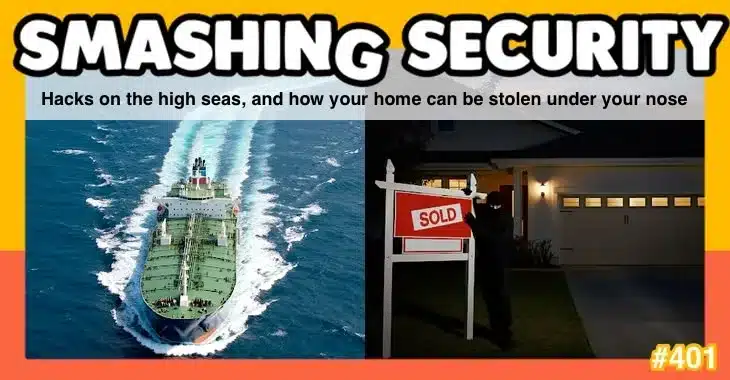
An Italian hacker makes the grade and ends up in choppy waters, and hear true stories of title deed transfer scams.
All this and more is discussed in the latest edition of the award-winning “Smashing Security” podcast by computer security veterans Graham Cluley and Carole Theriault.
Plus – don’t miss our featured interview with Avery Pennarun of Tailscale.
Warning: This podcast may contain nuts, adult themes, and rude language.

Show full transcript ▼
 This transcript was generated automatically, probably contains mistakes, and has not been manually verified.
Is he maybe spending too long doing the computers? Should he be doing jigsaws?
Hello, hello, and welcome to Smashing Security episode 401. My name's Graham Cluley.
Now, coming up on today's show, Graham, what do you got?
Plus, we have a fabulous featured interview with the zany but oh so brainy Avery Pennarun, co-founder and CEO of Tailscale.
And this is where I sink my teeth into how Tailscale is making secure networking easier, faster, and way safer.
All this and much more coming up on this episode of Smashing Security.
Hopefully it's a little bit— well, it may not be warmer, actually. Maybe in the southern parts of Italy it's warmer. Italy, well, it's given us a lot, hasn't it?
Passionate opera, great artists, It's given us everything.
It could be some rabid wing of some sort of faction of people who have an opinion about Hawaiian pizza. They could be changing the menus at the Italian ministry, maybe.
And in the days before tough sentences for hackers, it wasn't unusual for people just to go poking around, see where they could get into.
Wouldn't necessarily cause any damage as such deliberately, but were just seeing what they could access.
That's what the reports claimed.
Somebody comes from the small city of Cesena in Italy.
No, what he did was, unfortunately, he had F grades.
Am I just a tough dad saying you need to get a C or better for it to be a pass? I don't know. But anyway, he changed it from an F to an E. What was the point of that?
Now, the press went bonkers over this, right? And they reported that the ministry got hacked.
And as you've rightly guessed, Krow, that isn't necessarily the real story because the ministry itself is now putting out its own spin on things.
It's keen for everyone to know that it wasn't a part of its systems that were hacked.
You don't want it to be some spotty teenager in their back bedroom who's doing this, who needs a bit more vitamin D in their diet. That's the last thing you want.
But the ministry says that what actually happened was the hacker gained access to an electronic register which stored the grades.
And they say it wasn't managed by the ministry at all. It was an external service contracted by particular schools.
So it looks like maybe this hacker, his school, chose a particular service, some company who were providing this service, maybe as an intermediary for the ministry, and it was them who got hacked.
And so this chap managed to break in and change his grades. So not quite as dramatic as we imagined.
Not as big a deal, despite what the Italian media said about the ministry actually being impacted.
I can provide this service to you." For €100.
Or maybe it was simply because it was there and he's just wondering, "Oh, I wonder if I could, but I don't want to get into any trouble, so I'll just put up the grade a little bit." 'Cause everyone knows I'm shit at school, so maybe I'll put it down again later.
I mean, presumably in his computer lessons, he's not getting an F grade. One would like to think. And so that's the end of the story, Kroll. That's it. There's no more. Oh, hang on.
There is one extra thing.
He was looking for other systems online to break into. And he managed to break into an online portal that allowed him to alter shipping routes in the Mediterranean.
From the comfort of his bedroom, this youngster, the one who changed his grades from an F to an E, was also able to change scheduled routes of oil tankers, forcing them to divert.
And he didn't have specialist equipment. He just had his computer.
You know, it must be.
And it'll be, supply chain, supply chain, nothing to do with us, gov. We're safe.
Not a computer port, but a port where a boat is going to. He's just changing something from a dropdown list, just as he had done with his grades.
And while changing grades hadn't been enough to attract the attention of—
So the security team responsible for protecting this maritime portal, they obviously thought, "Oh, this is a bit of a problem." They were able to isolate— I'm not sure "Oh" is necessarily Italian.
They were able to isolate the unauthorized logins and determine that they were coming from an IP address in this city of Cesena.
And due to this, this teenager, he's been taken to a juvenile court. His fate is going to be decided. But he's become something of a folk hero now in Italy.
And in his piece, he's called on— I apologise for mentioning this person because I'm really trying to mention him less after my recent episodes.
He's called on none other than Elon Musk to hire this 15-year-old immediately. Gerardo says—
So this columnist, Garrado, he says that the 15-year-old, rather than enjoying himself in his bedroom— Garrado used rather fruitier language than that, which I'm not going to repeat.
He had managed to show the Ministry of Education and the Merchant Navy who was boss.
He wrote that he couldn't believe the boy was not being rewarded, whereas of course he's actually being punished. I'm not sure working for Elon Musk would be a reward, to be honest.
And Corrado, who's a philosopher, by the way, as I mentioned, many Italian columnists are, he said that the boy's phone and computer should be returned to him immediately.
The criminal complaint should be withdrawn and turned into a CV instead.
And if the Italian government don't hire him, he should be shoved on the first plane to America where he would surely be employed.
However, the only reason rewarding him is because we found him and were able to—
And a lot of the systems out there aren't properly secured or protections aren't in place.
Is he maybe spending too long doing the computers? Should he be doing jigsaws?
Those were the days, right, guys? Those were the days.
And he was duped into signing over the deeds of his home to another man who pretended that he was going to help them.
So yes, we are talking today on Smashing Security about deed theft, or deed theft scams, or house title scams as they're also known.
This is where some unauthorized ne'er-do-well attempts to steal the ownership of your home. Now, there are two common scenarios, okay? One is the legit homeowner is deceived.
So the scenario might play out: you're behind on your mortgage payments and live in an area with a hot real estate market.
And someone contacts you claiming to be a foreclosure specialist or something.
And scammers will use public records to find homeowners who are in foreclosure or behind on their mortgage. Okay?
But first, you just need to sign a few legal documents.
They might promise that your property will be transferred to a trusted relative so that you can avoid foreclosure until your finances are back in order.
And then, of course, scammers will transfer your home to their name or the name of a shell company.
But no, the scammer allegedly takes out a home equity line of credit against Ray's house to the tune of $700,000. And Ray was not kept in the loop. He had no idea this had happened.
So of course didn't make the payments. And the credit never being paid off, the house was foreclosed, right? And it was foreclosed for a whopping $2 million.
Remember, he paid only $20,000 for it. So thank you, gentrification. Since the foreclosure, the new owner, an LLC, has been working on evicting Ray from his own home.
Is this legit? So yeah. Now what about scenario 2? This is where a baddie steals your identity and forges a deed that transfers ownership of a property to them, right?
But once they have what's necessary, they then file the deed with the county clerk who records the sale. Then the property can be quickly sold to an unsuspecting purchaser.
So you're sitting there going, "Yay, I just bought a house and I got such a deal." Two weeks later, someone's knocking on the door going, "Oh, what are you doing in my house?" The Homeowners Alliance in the UK cite this case with Angela Jones.
So she owns a 4-bedroom house in South London, and she returns from a 3-week trip, and she finds a letterbox taped up and a metal postbox is fixed to her front door.
And then 2 months later, she receives a letter from Land Registry, and it was entitled Completion of Registration and stated that her property now belonged to someone else.
Oh, right, giving her 3 weeks to respond. But Angela never received it because she was away.
And if we go back to the States, so this happened last year, a Missouri woman was arrested on federal charges for reportedly attempting to defraud Elvis Presley's family of millions of dollars and to steal the family's ownership interest in Graceland, Memphis, Tennessee.
But she posed as three individuals representing a fictitious private lender, saying that Presley's daughter borrowed $3.8 million in 2018 from this fictitious private lender and pledged Graceland as collateral.
And I also don't understand, who are these people who are buying properties, which presumably they are never going round to actually view?
If you said there's a 4-bedroom house, but they know— I mean, it would be odd, wouldn't it, if you were in your house and someone went ding dong on your doorbell and said, hi, we're just here for the viewing.
And it's well, our house isn't on the market. You know, sure, come in, come in. Have a look around, you know.
The other thing is the family are now in a quagmire of legal crap, right?
Because they have to go down all the paper trails and sort everything out, even though they're completely innocent.
There's a guy down the chip shop swears he's Elvis.
And I just wonder how old Elvis would be today if it, you know, if it's even possible.
And you might not even know they've done it until it's too late. In fact, I think the scam entirely depends on that fact.
But this is a labor-intensive type of scam, and the numbers of reports are on the up, but is by no means a popular way to dupe you out of your assets. There is some advice, right?
There's some interesting advice here.
So if there's any weird activity on your deed, they'll notify you by email.
And an obvious one for regular listeners, be mindful with your personal info that is often used to identify you legally, like passport numbers, social insurance numbers, date of birth, middle or maiden names, that sort of thing.
And you might want to spare a warm thought for 90-year-old Ray, who was scammed 20 years ago and is still fighting for his right to stay in his home.
This isn't about hiding your browsing habits from coffee shop owners, and it's not about watching Netflix in any other country.
It's great for companies and it's great for self-hosters too. And it's fast, really fast. It's private. It's easy to deploy. Zero config, no fuss VPN. Plus it means zero trust.
Every organization can use this.
You'll get 100 devices and 3 users for free with no credit card required. Want to learn more? Visit smashingsecurity.com/tailscale. That's T-A-I-L-S-C-A-L-E.
And thanks to Tailscale for supporting the show.
And this week, we want to tell you about how 1Password's extended access management can help your business.
And it ensures that every user credential is strong and protected.
Every device is known and healthy, and every app is visible because 1Password Extended Access Management solves the problems traditional IAM and MDMs can't.
It's security for the way we work today. And it's now generally available to companies with Okta, Microsoft Entra, and in beta for Google Workspace customers.
And now they're securing more than just passwords with 1Password Extended Access Management. Find out more right now. Go to 1password.com/smashing.
And thanks to 1Password, Smashing Security for supporting the show. And welcome back. Can you join us for our favorite part of the show?
The part of the show that we like to call Pick of the Week.
Could be a funny story, a book that they've read, a TV show, a movie, a record, a podcast, a website, or an app. Whatever they wish.
It doesn't have to be security-related necessarily.
Now, Carole, you are a bit of an artist. You have a certain style. I've seen many birthday cards and the like, which you've made over the years. You're not just a painter.
You're also a cartoonist. I think it'd be fair to say. And Wizardzines reminded me a little bit of some of your cartoon stick people.
So if you are completely flummoxed by Linux or networking or containers or Git or whatever it may be, and you fancy a comprehensive introduction to the topic, these are for you.
They're all done this lovely simplistic accessible style with stick people. And the thing is, right, there's new technologies which come along, which people begin to use.
You ask someone, you say, "Oh, do you know how to do that?" They go, "Oh, you don't know how to do that?" And it's well, you know, everyone has to start somewhere, right?
So I remember when I first started creating websites, still true to this day, I'm always struggling tweaking my cascading style sheets, right? My CSS. I don't know how to do CSS.
It is a huge amount of fun. You're always just altering it a bit and seeing, oh, does it work? Does it work on mobile? Well, I have bought a Wizardzine for CSS.
It cost me about £10 and it was a really good introduction to the topic of CSS and all the tricks and things which I could do in a way which I could actually understand.
And it's terrific. So they do an amazing job explaining how things work.
Some great examples in there, and there's even a free weekly comic mailing list you can sign up for if you want to give it a try. So go and check it out at wizardzines.com.
Loosely, the premise is you're following this woman, Lucy Chase, who reluctantly returns to where she grew up, Plumpton, Texas, right, for her grandmother's birthday.
And she's reluctant because the whole town thinks she murdered her best friend 5 years ago when they were both in their early 20s.
And so the story is kind of, you hear Lucy's story, you know, and it goes back to the time of the murder near the end, but you're getting her backstory, and she's full of resentment and edge.
And then it's interspersed with pod interviews with locals that reveal a little bit more about what happened on that fateful night. Or are they lying?
It has podcasts, small towns, murder, love, friendships, and big fat liars.
So listeners, we have a very special guest today, Avery Pennarun. He's co-founder and CEO of Tailscale, the company revolutionizing secure networking and its zero trust approach.
Avery, welcome so much to Smashing Security. We're happy to have you here.
My first job was working at the very first dial-up internet provider in Thunder Bay. So we brought internet to that city. I went off to University of Waterloo.
I started my first startup while I was in university with my roommate from there, and it got a little, I guess, out of hand. Eventually acquired by IBM.
I then had a brief stint in the banking industry that I don't talk about very often. I went from there to Google where I worked on Google Wallet.
And then Google Fiber, the gigabit internet service, the first people to bring gigabit internet to consumers in North America.
My team was working on the Wi-Fi routers, both the hardware and the firmware that goes into people's homes. So connects to the TV boxes and stuff.
I left from there from Google and decided it's okay, that was great, but I actually preferred the startup life rather than the Google life, the big company life.
And so I decided to start a new startup.
I wasn't exactly sure what I wanted to do, but I knew what I wanted it to be about, which is the opposite of internet-scale stuff that I saw everywhere at Google.
And so the name came before anything else, Tailscale, the opposite of internet scale.
Let's build small things using small networks for people who don't have the problem of needing to serve millions of requests that serves the entire internet in 100 milliseconds.
Can you say more about this for me?
Well, when I was in high school working at this dial-up internet provider, you know, this was in the 1990s, and you would've thought that in the intervening 30 years of technology advancements that it would become easier to write software.
But I was a high school student who had no experience about from anything other than just fiddling with my computer at home.
And I was writing tools and user-facing software at this ISP. And you know, I used Microsoft Access to build the internal accounting system for this ISP that people actually use.
It was running out of a computer store and I was a high school student. They hired me to do this. You didn't need a team of developers. You didn't need people with training.
We ran the whole thing ourselves, just, you know, on a complete shoestring.
And nowadays it's possible to do that, but it's much less likely because you run into just problem after problem after problem.
And most of the problems are not developing the software you wanted to build in the first place.
The problems are portability, upgrades, security, networking, connectivity, and so on.
And now when everything's connected to the internet, you have this need to make everything perfect all the time, because if it's not perfect, some attacker from some foreign country who has no business having any relationship with your computer at all could come in and attack this software your high school student wrote for you.
And create some big problems.
And those people have equal access to get at your servers as all the other people in the world.
And if you could just cut off this bottom group of people and only let your service connect to whoever is supposed to be connected to, everybody else in the world who shouldn't have access to it are the problem.
If your default is just deploy things to an AWS server or whatever and open up some ports and hopefully put in some authentication.
So Tailscale, fundamentally, it happens to be implemented as a VPN. That's the technology that we use, but what it's for is making it easy to build small things for small teams.
And one of the problems we actually, when we were starting is we didn't know that we were gonna make a VPN.
We just knew we wanted to make small things, make it easier to make small things for small teams.
And so we made a list of 100 things that get in your way when you're trying to launch some internal dashboard or internal app or internal tool that some person has built.
And we prioritized it in the top two or what I call connectivity and security.
I need people on my team to be able to connect to my thing, and I need people not on my team to not be able to connect to my thing.
And so we built a VPN-based tool that makes that easy. And we never got to the other 98 things on the list because the VPN tool took off so much.
And this is all end-to-end encrypted, I'm assuming.
So the original definition of VPN is a virtual private network, which means a private network being a literal physical ethernet that back in the day you used to plug your computer into, and nowadays you connect to your wifi.
That's one network. Right. And a virtual private network is one you can access remotely.
So the physical network doesn't matter, it's just you can access this virtual array of your own computers. The more common usage of VPN nowadays is what I call consumer VPN.
Some people call them privacy VPNs, which is kind of ironic, because they're not that great for privacy.
And the reason that it's ironic is that this privacy VPN now has access to all of your traffic and can look at it, and then it goes out to the internet.
One of the reasons we don't lead with Tailscale as a VPN very often is that it causes this confusion between the two kinds. Does that make sense?
Companies, you know, to some extent are pretty much all the same on the inside anyway. They've got a bunch of internal services that their developers are trying to use.
So for example, there's a little Tailscale open source thing that we made called go-links. You might have heard other people's or seen other people's go-link tools.
It just allows you to go go/name inside your browser and it'll jump to some internal website. It's just basically your own little short link service for inside your company.
Say I made a go-link service. And I want to run it at my company. What do I need to do to make that happen? Well, I need to have a place where I host it, right?
I need to have DNS that's working. I need to have a TLS certificate so that my browser doesn't blame me for having insecure DNS, right?
And I have to make it so everybody at my company is able to get to this service wherever it's located.
And I want to make it so people not at my company can't see where all my Golang code is. So they shouldn't be able to access it. Do all of those things.
And so many companies are at the level of maturity now where they already set up some internal DNS, they can run internal services, they have an internal network with a firewall behind it.
And so it's not that hard to run new things on the inside network, as long as you're working with the security and IT teams to make sure the right firewall port gets opened at the right time or whatever.
So a traditional corporate VPN would be used for people not in the office to be able to get access to the private network so they can access all these things that have been set up.
But if you're a company that doesn't have all these things, or you don't want to employ this IT/security team for your scale, or your IT and security team would rather be doing something else, Tailscale just sort of fragments it all into okay, I've got a service, I've got people who want to be able to access this service, and Tailscale makes it so it doesn't really matter where in the world or what provider you host that service on.
You don't have to open any firewall ports. You can leave the firewalls all completely closed with no open ports whatsoever.
And everybody in the whole system is authenticated using SSO. So typically Google or Microsoft, Entra or Azure AD, or Okta, or GitHub authentication.
You authenticate to the VPN or the Tailscale system using your regular login you would for any SaaS product, and then you just instantly get access to everything everybody inside your company has published that should be available to you without having to worry about where those things are.
So you could locate them at multiple different cloud providers. You could locate them in multiple different regions of the world.
You could put them behind different firewalls, you can even have you left your laptop back at home behind one firewall.
You can go to a cafe and access your laptop from your phone behind the cafe's firewall, and you get point-to-point direct connections.
It doesn't get relayed through Tailscale, so it minimizes the latency and overhead, and it's end-to-end encrypted because those keys are generated by your own devices and we never see the keys.
One of the most common bits of feedback we get about Tailscale is people try it and they're angry for a few minutes, and they're not angry at us.
They're angry at the fact that they've been suffering from this pain for years and they didn't even realize that they were suffering from the pain because they were so used to it.
And they're just like, wait a minute, none of these things needed to be this terrible.
Fundamentally DNS just sucks, right? Setting up DNS sucks. DNS servers suck. DNS security sucks.
You know, if you have a dynamic IP address, maintaining your dynamic IP in DNS, it all sucks.
You've got all these memes about the problem always being DNS and Tailscale just, whoop, what if you didn't have to do all that stuff and the names just showed up, right?
And it works, right? But people have even stopped, you know, people make jokes about how terrible DNS is, but nobody says, oh, if only we just got rid of it.
Even your code is open source. I mean, that's a big decision. A lot of companies don't go down that route. So what attracted you to that?
When I first got my job in high school, doing this internet service in my city, it was because I had studied up on stuff on the internet and I downloaded Linux on floppy disks and I installed it on my computer.
And all of that stuff was only possible because open source existed. So I very much owe my entire career to open source.
But secondly, Tailscale is trying to improve internet connectivity for everybody.
And I know there's lots of people out there who would not be happy installing this opaque binary on their computer that would otherwise be a completely open source computer just to fix internet connectivity, right?
The internet protocol is open source.
And so it's really important that if we're gonna be improving the way the internet protocol works, we have to build a system that's open source that people can have confidence in.
It's not that hard to understand roughly how it works. It's really hard to put together all the pieces to make them super reliable all the time.
And I think people underestimate the difficulty of just running a network securely and reliably, right?
The most important feature of Tailscale is the one that you never really hear about.
It's just the number of nines of uptime of the network you get when you put all the pieces together.
And if you just take open source, the joke is it's sort of like batteries are not included, right? We've included all the parts. Now you get to assemble them yourself.
You can put in batteries, but now you're the network administrator, which is not the point. The whole point was for you to not have to be the network administrator. We do it for you.
Now we have to talk about AI, the huge hungry beast that is on everyone's tip of their tongue and on every marketing blurb and every website that I've seen in the last 6 months.
Takes a lot of gas, right? To run all these things. It's like the Cobra Jet Mustang of the '60s. So how do you cope with the AI world? Does it change anything for you?
That pretty much tells the entire story of AI. Yeah, I think there's a lot of potential in AI systems the way they're being built right now.
I think people quite frequently are using them for nonsense that is not gonna be sustainable, and then quite frequently are using them for amazing stuff. That's great.
But what's happened with AI and Tailscale is that almost all of the AI companies out there are using Tailscale as their network backend.
And that includes some very big names that we're not allowed to mention, includes hundreds of much smaller companies that are training AI systems to do all kinds of different things.
I have a blog post about it. It's called AI companies are not that unusual actually, or something like that.
So we just wanna make sure that AI companies are having the maximum level of success and try out all the interesting enterprise features while they have the chance.
And so that works great for friends and family kind of use cases. It works great for your own stuff.
So I wasn't kidding about leaving your laptop at home and accessing it from your phone in a cafe or something like that.
We have a tool called Taildrop, which if you used Apple devices, it's sort of like AirDrop, except it doesn't only work on Apple devices.
It works on any kind of device that can run Tailscale, which is almost any kind of device in the world, and it works even when they're not physically right next to each other.
So if you've ever tried to do something that should be simple, like move a photo from your Windows computer to your Apple phone, or vice versa, right? Tailscale works for just that.
You can install Tailscale on both devices in less than 5 minutes, and now you've got this little send to me on this other device, and it's free forever for up to 3 users for personal use.
We have hundreds of thousands of people using that plan.
So what you do is you can check out smashingsecurity.com/tailscale. That's smashingsecurity.com/tailscale. And huge thank you to you, Avery Pennarun, CEO of Tailscale.
And don't forget to ensure that you never miss another episode. Follow Smashing Security in your favorite podcast app, such as Apple Podcasts, Spotify, and Pocket Casts.
It's their support that helps us give you this show for free.
For episode show notes, sponsorship info, guest lists, and the entire back catalog of more than 400 episodes, check out smashingsecurity.com.
Hosts:
Graham Cluley:
 @grahamcluley.com
 @
@
 / grahamcluley
Carole Theriault:

Episode links:
- Report from Corriere Di Bologna newspaper.
- Caro Musk, assumi subito l’hacker quindicenne di Cesena – Il Foglio.
- 15-Year-Old Hacker Diverts Ships in Mediterranean Sea for Fun – Hot for Security.
- 90-year-old immigrant could lose Brooklyn home after deed theft scam, family says – CBS News.
- Protect your home. Spot the signs of deed theft – Better Business Bureau.
- Woman Charged for Scheme to Defraud Elvis Presley’s Family – DOJ.
- Home Title Theft: How To Protect Yourself – Forbes Advisor.
- Here’s How Scammers in America Can Take the Title to Your Home Without You Knowing It – Moneywise.
- Could a Criminal Use Deed Fraud to Steal Your Entire Home? – AARP.
- Could Fraudsters Steal Your Home From Under Your Nose? – HomeOwners Alliance.
- Wizard Zines.
- Listen for the Lie – Amazon.
- Smashing Security merchandise (t-shirts, mugs, stickers and stuff)
Sponsored by:
- Tailscale – Tailscale is perfect for work or personal projects, making networking simple. Its free plan covers up to 100 devices and 3 users. Get started at tailscale.com and be up and running in less than 10 minutes!
- 1Password – Secure every app, device, and identity – even the unmanaged ones at 1password.com/smashing.
Support the show:
You can help the podcast by telling your friends and colleagues about “Smashing Security”, and leaving us a review on Apple Podcasts or Podchaser.
Become a Patreon supporter for ad-free episodes and our early-release feed!
Follow us:
Follow the show on Bluesky, or join us on the Smashing Security subreddit, or visit our website for more episodes.
Thanks:
Theme tune: “Vinyl Memories” by Mikael Manvelyan.
Assorted sound effects: AudioBlocks.