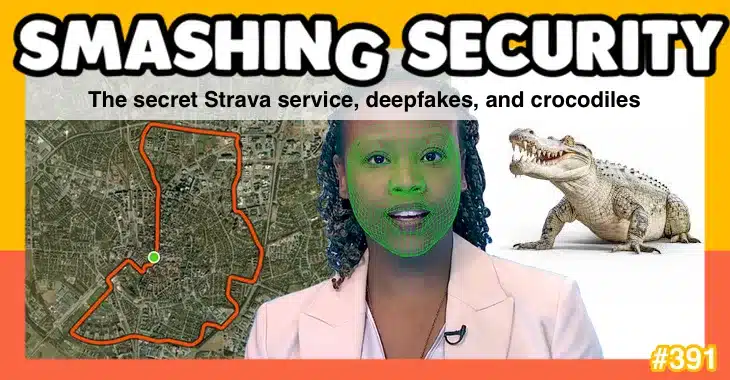
In this week’s episode your hosts practice standing on one leg, Carole gives Graham a deepfake quiz, and we investigate how Strava may be exposing the movements of world leaders.
All this and more is discussed in the latest edition of the award-winning “Smashing Security” podcast by computer security veterans Graham Cluley and Carole Theriault.
Warning: This podcast may contain nuts, adult themes, and rude language.
Show full transcript ▼
 This transcript was generated automatically, probably contains mistakes, and has not been manually verified.
Hello, hello, and welcome to Smashing Security episode 391. My name's Graham Cluley.
Now, coming up in today's show, Graham, what do you got?
Are you aware of these, Carole?
So, apologies if you're bored up to your eyeballs of hearing about the election, but it's a big deal.
One thing we can be absolutely certain of is that Donald Trump will be announcing that he won within hours of the polls closing.
So, Joe Biden, Donald Trump, Kamala Harris, these are the very, very, very important people protected by the Secret Service, as are as well their partners, Melania Trump, Jill Biden, and whoever Kamala's married to.
They're all protected because they're important people. We don't want them being bopped off. And it's just the data at the heart of your company.
You don't want your country's leaders or the potential next president to be deleted. And similarly, you don't want your data wiped, do you? You don't want it to be wiped out.
Now, it looks Donald Trump has survived. I think we're pretty clear about that, at least. And to have one assassination attempt against you could be considered misfortune.
But to have two begins to look carelessness by your security team, particularly so close to each other.
So I think the question we have to ask ourselves is how well are these individuals actually being protected? Well—
It turns out highly confidential movements of the US President, Joe Biden, the two people campaigning to be the next president, Donald Trump and Kamala Harris, and other world leaders can be easily tracked online through the Strava—
About a year ago, we described how a Russian commander was shot dead while out for a jog, seemingly by Ukraine, because he was posting his runs on Strava.
They want to get their steps in. They're at the Pentagon, maybe. There's a lot of steps they have to do. They don't want to waste it.
I'm smarter, I'm cooler, I'm stronger." Do you think they do special exercises to strengthen their ears?
So, I bet I could probably build muscle in my cartilage somehow.
Normally, of course, that's not a problem with Melania Trump because she's highly unlikely to be in the same place as her husband.
But it's still a risk that she could be kidnapped, which could be very unpleasant for her, especially if a ransom is paid and she's returned to Mar-a-Lago.
So, you know, you don't—
So rather than showing off your perfect life and your cronuts that you're eating, you upload details of your workouts and exercise regimes and compete against others, see who can do a circuit the fastest.
And yes, it can be handy to find out other people in your city, where they're running, where a good run or a track might be.
But of course, if you're sharing this information a little bit carelessly, if you haven't got your privacy locked down, along come journalists from Le Monde and they find out what you're up to.
And it's not just Americans. Le Monde found out the bodyguards of French President Emmanuel Macron. Mm-hmm. What they're up to.
Le Monde says it has traced the Strava movements of Emmanuel Macron's bodyguards to determine that the French president spent a weekend in a Normandy Sea resort in 2021.
The trip was meant to be private, wasn't listed on his official agenda. They knew he was there because his bodyguards were there.
In another example, they used an agent's Strava profile to reveal the location of a hotel where Joe Biden stayed in San Francisco for talks with the Chinese president last year.
Mm-hmm. A few hours before Biden's arrival, the agent went jogging from the hotel. And used Strava to trace his route.
In all, they identified 26 US agents, 12 members of the president's security group, 6 members of the Russian Federal Protection Service, all with public profiles on Strava, all sharing their locations online even during official trips.
You know— What do you make of it, Carole?
If Le Monde is able to work out and able to track where these people are, this must surely be known about by intelligence agencies of other countries.
So I'm sure other countries are tracking.
The US Secret Service says its staff aren't allowed to use these kind of devices while on duty. But they don't prohibit them for personal use while off duty.
So, of course, you're not on duty 24 hours a day. You'll be doing shifts.
So you may go out for a bit of exercise after looking after the president for a bit, and you go for a run round the block.
Are they actually attaching their Stravas to a dog or something, or a kid on a skateboard?
Part of the reason is because the topic is rife in the news at the moment, guessing because of the upcoming elections in the US of A. Deepfakes are a big effing deal.
Deepfakes are ranked as a top global risk in 2024. You know, this is all according to the World Economic Forum.
So I was happy to see some nonpartisan public service announcements in the US this week warning people about deepfakes trying to dupe you into not voting.
Artificial intelligence has gotten so advanced.
For example, a fake message saying voting has been extended or your polling location has closed or changed due to an emergency, or you need new documentation to vote.
These are all scams designed to trick you into not voting. Don't fall for it. What do you think? What do you make of it, Clew?
But it's a long ad. It's 1 minute 37. It's too long. Listeners, you didn't hear it all.
And I worry that people will lose interest halfway through because people's attention spans are those of gnats.
And it's only at the end of the ad that they kind of explain how deepfakes work and how someone can appear to be someone else, et cetera, et cetera.
But for the first minute or so, the deepfake effects are a bit Max Headroom-y to my mind.
And I wonder if people are going to look at that and go, oh, so if I see something glitch, it means it's not real.
And the thing is, we are pretty crap at telling what a deepfake is and what a deepfake is not, or what a real person is.
According to a new study by Utah Valley University, 56%, so more than half of US test subjects couldn't tell the difference between deepfake and real content.
And that's something that the senior project analyst said was a bit of a surprise.
Quote, "One of the questions we've been asking is when deepfakes are going to get good enough that they're actually convincing.
The day is today." Now, I heard this, but I'm thinking, I remember research in 2021 that found that as humans, we're biased towards mistaking deepfakes for real people.
Because typically when we see a person on the screen, we think it's a real person. And we also overestimate our ability to tell whether something is deepfake from real.
The truth is that deepfake now, when you have a deepfake video, if there aren't any obvious glitches, you do kind of believe it, don't you?
You have to guess whether it's real or fake, and they'll tell you whether you're right or wrong. Listeners, this is in the show notes if you want to try it for yourselves.
Well, I can tell they're not English, first of all, because their teeth are too good. These are probably Americans, I'm expecting. In fact, they're all far too beautiful.
So I'm going to say this is fake.
Looks very uncomfortable. His legs look a bit weird. I'm— hang on, those arms, I'm not sure, but I'm gonna say fake. Okay, fake. It was a real image. I've gone wrong already.
So I've got a 50% hit rate.
So misleading deepfakes are, I think you and I agree, a seriously big problem. So, what do you think a particular wing of the Pentagon might want to do with them? With deepfakes?
Why would a counter-terrorism group within the US Department of Defense, the DOD, have on its wish list the ability to create deepfakes?
That's one reason why the military would want deepfakes, just as they may be worried about them being used against them.
So what they say is in this wish list, they are reportedly seeking, quote, technologies that can generate convincing online personas for use on social media platforms, social networking sites, and other online content for use by special operation forces.
This solution, they add, should include facial and background imagery, facial and background video, and audio layers. The point?
Use this capability to gather information from public online forums.
But how are they going to know they're not talking to another bot?
But then it suddenly occurred to me, huh, maybe they don't care at all because they can just say, oh, well, that person or that account viewed this many ads, pay me.
And so the advertisers, they're going to find it more and more difficult to tell if someone's a human or not.
So basically detection systems to help identify whether something is real or not. The problem with anti-deepfake tech, if I can call it that, is, you know, the false positive thing.
So if they get one wrong, a user might get duped.
Or if a company was saying, hey, look at all this imagery, it could be AI generated or not. Or is that crazy of me?
Number 3, public awareness, which is basically why I'm talking about it now and why we're seeing public service ads warning people, because the more you can look at these people and realize how easy it is to fall over like you saw Graham and I do, the more careful you might be.
And number 4 is having a zero trust mindset, Graham.
So they write that the zero trust approach in cybersecurity means not trusting anything by default and instead verifying everything.
When applied to humans consuming information online, it calls for a healthy dose of skepticism and constant verification.
And they go on and they say, zero trust mindset will become an essential tool to distinguish between what is authentic and what is synthetic in increasingly immersive online environments.
So, okay, wow. Right? Basically, they're saying trust no one, right? And that's great for society. Super cool. You know, actually, Graham, I'm not even sure you are who you say you are.
I know I've met you 1,000 times, but I think healthy skepticism and with zero trust mindset maybe you can fire over two pieces of official ID so I can verify your identity.
And how do I double-check every email, every comment that I read? Do I fact-check everything? I read an article every single time to make sure it's from a trusted source?
I'm going to spend— No, they're just going to laugh at the cats doing somersaults.
Yeah, because maybe getting news from nonpartisan news organizations that are held accountable when they get facts wrong and may have to face litigation if they are libelous or don't admit to their mistakes means they have a requirement to try and present the news as most honestly as they can.
And it's just depressing. MIT Lab says, "Look, this is how you can actually do this. Look at the face. Look at the cheeks and forehead. Look for moles and eyes and eyebrows.
And do shadows work?" You and I got fooled on the second one. Yeah. Look, it says pay attention to blinking. You know? Aren't you gonna look a weirdo if the person's actually real?
Right? So the person's on the screen, and you're sitting there scrutinizing their moles and looking at their teeth and their hairline.
We'll be going up to people in real life thinking, "Oh, you can't not be real." It's Santa's beard.
Be it a cyberattack, an extreme weather event, or even civil unrest.
Wouldn't it be nice to know that you are communicating to the right people so you can deploy resources to areas where they are most needed?
And wouldn't it be nice to have all this delivered out-of-band so there is continued communication even if your own infrastructure is compromised? The answer is yes. Yes, it would.
Say hello to BlackBerry's SecuSuite, certified to meet the highest security requirements.
SecuSuite protects against threats to enterprise and local and national security by enabling secure communications on conventional mobile devices.
With BlackBerry SecuSuite, employees can make secure phone calls and exchange secure messages, including group chats, on the devices that they already carry. How cool is that?
Find out more at smashingsecurity.com/blackberry. And thanks to BlackBerry for sponsoring the show.
Vanta automates compliance for SOC 2, ISO 27001, and more, saving you time and money while helping you build customer trust.
Plus, you can streamline security reviews by automating questionnaires and demonstrating your security posture with a customer-facing trust center, all powered by Vanta AI.
Over 7,000 global companies like Atlassian, Flow Health, and Quora use Vanta to manage risk and prove security in real time. Get $1,000 off Vanta when you go to vanta.com/smashing.
That's vanta.com/smashing for $1,000 off. Quick question: do your end users always, and I mean always without exception, work on company-owned devices and IT-approved apps?
I didn't think so. So my next question is, how do you keep your company's data safe when it's sitting on all of those unmanaged apps and devices?
Well, 1Password has an answer to this question, and it's called Extended Access Management.
1Password Extended Access Management helps you secure every sign-in for every app on every device, because it solves the problems traditional IAM and MDM can't touch.
Go and check it out for yourself at 1password.com/smashing. That's 1password.com/smashing. And thanks to the folks at 1Password for supporting the show. And welcome back.
And you join us at our favorite part of the show, the part of the show that we like to call Pick of the Week.
It can be a funny story, a book that they've read, a TV show, a movie, a record, a podcast, a website, or an app. Whatever they wish.
It doesn't have to be security related necessarily. Better not be. My pick of the week this week isn't security related. I had some children come to visit me.
A friend popped round with some children over the half-term holidays, and I thought, what shall I do with these children?
And so off we went to this place near where I live in Oxfordshire called Crocodiles of the World.
I'm not quite sure what they're feeding them, probably not human-legged Graham Cluley or 8-year-old children.
But they basically dangle food above a huge swimming pool full of crocodiles and these crocodiles leap into the air.
Jesus, they probably leap about 2 or 3 metres into the air and go with a great big clack.
They could just cut you in half.
Crocodiles have a bite of over 5,000 pounds per square inch.
Orcas, I believe is the politically correct term.
To be honest, I don't think these crocodiles would survive in England if they weren't in this particular environment and it seems they're fed quite well.
Anyway, if you're on half-term holiday with your kids, go check out Crocodiles of the World in Oxfordshire.
Obviously don't do this if you're driving or up a ladder or having sexy times. If you're having sexy times and you're listening to this show, all I can say is wow.
I want you to put your hands on your hips and I want you to stand on one leg for as long as you can.
Kind of a flamingo, but the other way, so you're bending your knee the normal way, not the backward way flamingos do.
All right, so hands on hips, eyes open. Timer starts when I say go, and it's going to stop if I see, Graham, your hands move from your hips or you lower your foot.
Okay, ready, Spaghetti? Fascinating radio. 3, 2, 1, go. 1 Mississippi, 2 Mississippi, 3 Mississippi, 4 Mississippi, 5 Mississippi. How's it feeling?
And scientists have reportedly said that it might be because it uses so many different parts of the brain and the body at once. You've really gotta focus.
So you held it for many seconds. What should you be aiming for?
Easily, I could have done longer. 60 to 69, 30 seconds. Yes, 70 to 79, 19 seconds, and over 80, a little over 5 seconds. So it really drops between 70 and 80, doesn't it?
So if you didn't perform well, listener, don't worry, you can improve your balance. And my tip is practice while you brush your teeth. Right?
Because you'll see a huge difference in a mere week or two. That's how I got my balance going.
Please, nobody send me any good ideas ever, please. Thank you.
And don't forget to ensure you never miss another episode. Follow Smashing Security in your favorite podcast app, such as Apple Podcasts, Spotify, and Pocket Casts.
For episode show notes, sponsorship info, guest list, and the entire back catalog of more than 390 episodes, check out smashingsecurity.com. Until next time, cheerio.
Hosts:
Graham Cluley:
 @grahamcluley.com
 @
@
 / grahamcluley
Carole Theriault:

Episode links:
- Smashing Security #063: Carole’s back.
- Privacy of fitness tracking apps in the spotlight after soldiers’ exercise routes shared online – We Live Security.
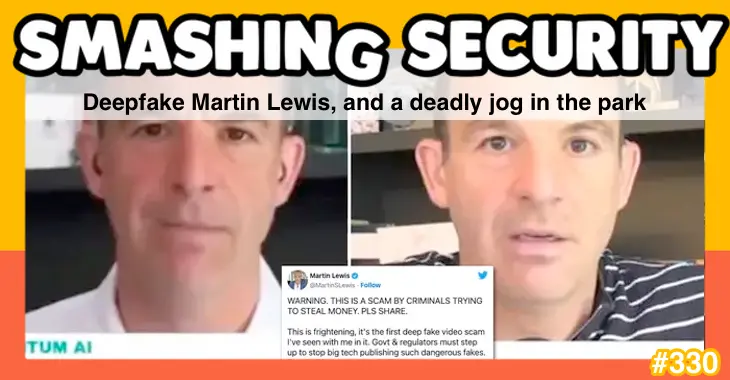
- Smashing Security #330: Deepfake Martin Lewis, and a deadly jog in the park.
- How Emmanuel Macron can be tracked – Le Monde.
- How Emmanuel Macron can be tracked – YouTube.
- The Pentagon Wants to Use AI to Create Deepfake Internet Users – Intercept.
- Is AI eroding democracy ahead of the US election? – BBC News.
- Fooled twice: People cannot detect deepfakes but think they can – PMC.
- Detect Fakes – Kellogg Northwestern.
- DON’T LET AI STEAL YOUR VOTE! – YouTube.
- Deepfakes fool more than half of Americans, UVU study shows – KLS News radio.
- Crocodiles Of The World.
- Here’s How Long You Should Be Able To Stand On 1 Leg By Age – Huffington Post.
- Smashing Security merchandise (t-shirts, mugs, stickers and stuff)
Sponsored by:
- BlackBerry – Tune in and empower your team with the knowledge to stay connected, no matter what crisis. Learn more about BlackBerry’s critical event management solutions.
- 1Password Extended Access Management – Secure every sign-in for every app on every device.
- Vanta – Expand the scope of your security program with market-leading compliance automation… while saving time and money. Smashing Security listeners get $1000 off!
Support the show:
You can help the podcast by telling your friends and colleagues about “Smashing Security”, and leaving us a review on Apple Podcasts or Podchaser.
Become a Patreon supporter for ad-free episodes and our early-release feed!
Follow us:
Follow the show on Bluesky at @smashingsecurity.com, or on the Smashing Security subreddit, or visit our website for more episodes.
Thanks:
Theme tune: “Vinyl Memories” by Mikael Manvelyan.
Assorted sound effects: AudioBlocks.