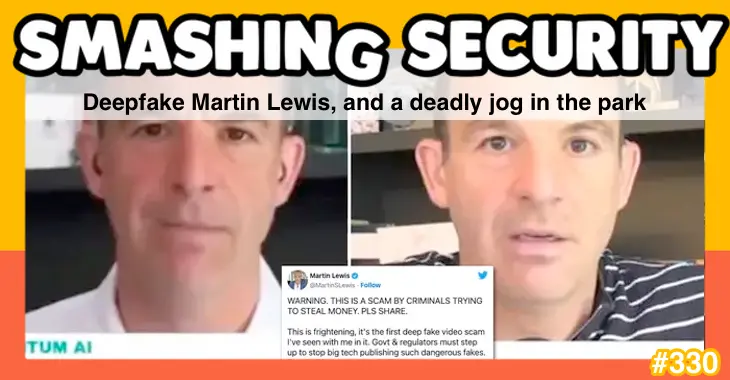
Going for a jog can be bad for your privacy (but even worse for your health), and Britain’s consumer finance champion finds his face is being faked.
All this and more is discussed in the latest edition of the “Smashing Security” podcast by cybersecurity veterans Graham Cluley and Carole Theriault.
Warning: This podcast may contain nuts, adult themes, and rude language.
Show full transcript ▼
 This transcript was generated automatically, probably contains mistakes, and has not been manually verified.
Hello, hello, and welcome to Smashing Security. Episode 330. My name's Graham Cluley.
I'm literally surrounded by boxes full of leads, as if my life isn't always surrounded by boxes full of leads and technology.
And also I've had huge, huge internet problems because I thought I'd organized for the internet to be here, but it turned out I hadn't.
Now coming up in today's show, Graham, what do you got?
And they pointed me towards this story, which comes from the Kyiv Post all the way in Ukraine. And interesting story.
So there is this chap, his name is— and I apologise to anyone listening who has a better understanding of names from that sort of general part of the world than myself— Stanislav Ryzitskiy.
And Stanislav Ryzitskiy, he likes to keep fit. I mean, don't we all?
Just went out for a jog. Likes to keep fit. You and I, Carole, we know we love a bit of fitness, love running around the park, you know, improving our PB, our personal best.
You get on your rowing machine.
And he has commanded a submarine in Russia's Black Sea Fleet. A submarine which is said to have been used to launch deadly missile attacks against Ukrainian cities.
So he is involved in the conflict out there.
And according to TASS, which is the Russian state news agency, they say that local police are reporting that he was shot 4 times while he was out jogging.
Police are investigating, blah, blah, blah. Now, it hasn't been confirmed who actually killed Stanislav Ryzhitsky.
But what happened as well on Monday was that Ukraine's Defence Intelligence Agency, who are called HUR, the H-U-R, they say, well, they seem to know quite a bit about the shooting.
And they filled in some of the details when they posted on Telegram about it. According to them, Stanislav, he loved to have a little run early in the morning.
They say he was out jogging in the Krasnodar Park of Culture and Recreation. Have you ever heard a more Russian name for a park than the Park of Culture and Recreation?
Anyway, he was out at roundabout 6 AM. And they say that 7 shots fired out at Stanislav from a Makarov pistol. Now, I find that it's how would they know what kind of pistol was used?
Peculiar, doesn't it? How would they know? Anyway, they say it was from a Makarov pistol. And as a result, Ryzhitsky, they say, died on the spot.
And they share some other information as well about the weather. Which is always important. Everyone's interested.
They say, "Due to heavy rain, the park was deserted, so there were no witnesses who could provide details or identify the attacker." And this is Ukraine.
Now, the FSB, Russia's secret service, they later issued a press release saying that a 64-year-old man had been arrested in relation to the killing.
So the question— well, there's a few questions here.
First of all, how did Ukraine's Defence Intelligence Agency appear to know so much about this if they weren't involved themselves?
But also, how did the shooter know that Ryzhitsky— if he was being specifically targeted, how did they know where he was going to be and when.
Well, we don't know for sure, but what we do know is that there is a Strava profile for someone calling themselves Stanislav Ryzitskiy.
And that, of course, Strava, of course, is the app which records runs, shares them with other online users.
And we've spoken before about the privacy risks associated with Strava even including military and information about military bases, which has been seemingly spilt online via Strava.
But I don't think we've ever heard about blood being spilt before as a result of maybe things being posted on Strava.
And yet with Strava, because probably there's a show-off element to it, like, hey, look what I did today. I actually exercised. You know, I'm top of the leaderboard. I'm the best.
You know, I do run every day. Here's proof. So maybe there's that weird show-offy thing that makes people put in their real names because, why wouldn't you just have a username?
No, not only is there an account on Strava in Stanislav Razitsky's name, there are also photos posted on the account which do apparently bear more than a passing resemblance to the Russian commander as well.
And there's a cycle ride which was recorded on the hills outside the city of Krasnodar in the weekend before he was shot dead.
And indeed, the last run which was taken shows him at the location of the shooting.
So it appears that this guy had recorded on Strava, because that's the way it works, Carole, is if you have something on Strava, it doesn't sort of livestream it to Strava.
At the end of your run, you then say, oh yeah, send that to Strava, please. That's one I'm proud of.
So was someone watching his runs? Well, we don't know for sure, but here's the really weird thing.
If you look him up on Strava, if you look at his last recorded run, which was at the location where the shooting took place, it has been liked by other people.
4 other people have liked his run. And one of the people who has liked his previous last run is a guy called Kirillov Budanov. And he is a major general.
Major General Kirillov Budanov, head of Ukraine's military intelligence. Now, I put it to you that possibly they are not running buddies. These two guys.
To mix everything else.
If you wanted Russian assassins to go after the wrong people, you could hack other people's Strava accounts and use the names of senior Ukrainian military intelligence.
Budanov himself says, "I don't know what they're talking about," although he has previously admitted that Ukraine has successfully targeted prominent Russian propagandists who've been killed or wounded on Russian territory.
But once again, guys and gals, if you are using Strava, be really careful. Either don't use your real name.
So I would say if you use Strava, maybe check your settings to make sure you're not broadcasting more than you want to be, right?
And know that these things change their settings with all, you know, the times you have to update your Strava.
A lot of the times they're changing settings and they may default them to something that they think is easiest for you or most likely to be wanted by most, but it might be leaking more data than you wish it were.
Is that fair?
But I think also be very careful about who you friend on the app. Don't automatically accept friend requests because then you might be revealing details of your life.
But yeah, so Strava security appears to have resulted in someone's death. Am I saying too much saying that?
I'm not talking about an irritating chap I worked with yonks ago, but the very popular journo— I think I can say, unless you've spent significant time in the UK, I doubt you would know him, but in the UK he's pretty well known.
You know, he's taken the place of Piers Morgan on Good Morning Britain or whatever it's called. He sometimes does sort of general news now, such is his celebrity.
And it says Lewis created and ran the website Money Saving Expert back in February 2003 when he launched it. And apparently he created the site for just £100.
Nine years later, sold the website to moneysupermarket.com for $87 million, but remained editor-in-chief.
The deal saw Lewis receive $35 million in cash upfront, in addition to some $20 million in shares in the moneysupermarket.com and $27 million in future payments.
But he simultaneously announced his intention to give $10 million to charity and $1 million would go to Citizens Advice.
He often is out there having a go at the government or lobbying for things to improve and helping people get money off their energy bills. And yeah, he seems like a decent chap.
Because otherwise, if you put a live person on, they might do something naughty later.
Whereas the rest of the world gets Elon Musk as someone you don't trust.
And what do you know, the scammers never let up using his credibility to dupe, mostly on social media ads.
And now they're at it once again, but this time they upped their game and deepfaked a video featuring a deepfake of Martin Lewis.
I guess because there's lots of video and audio of him in existence.
Musk's new project opens up great investment opportunities for British citizens. No project has ever given such opportunities to residents of the UK. It's pretty good, isn't it?
It is actually. At first, I thought this seems a little bit stilted. It looks a little bit like he's on a Zoom call or something.
Because this fake likeness of Lewis is encouraging people to sign up for what is claimed to be an Elon Musk-backed project, calling it legit and a great investment.
Synthetic media has been used both to entertain and to bamboozle.
But it's interesting to hear from those whose identities have been nabbed by miscreants because Martin Lewis did not take this sitting down.
Now they have video and audio technology that is absolutely replicating my face and my voice. These people are trying to pervert and destroy my reputation.
In order to steal people off, steal money off vulnerable people.
And frankly, it is disgraceful, and people are going to lose money, and people's mental health is going to be affected.
So months ago, ITVX put out a show called Deepfake Neighbor Wars. Have you heard of this?
And it spoofs the long-running New Zealand TV format Neighbours at War, and that's still going strong.
Because it sort of puts them in sort of suburban settings and things and has them say that the main thing about that show is it's really astonishingly non-amusing.
It's like they've got all the tech, but they haven't got any jokes. But so it's clever deepfakery, but it's just, oh, this is so dull.
But I shared with you a potentially deepfake image that kind of suggested who the BBC presenter might have been in a compromising position.
I wasn't sure how you expected me to identify whether it was well known.
And also when something genuinely dodgy does happen, that people will begin, I think this has already begun to happen.
I've heard reports of when politicians have been in a spot of bother in other countries and they've said, well, that must have been deepfaked.
Ars Technica says we all need to be careful because in large hacks, right, which maybe your details are somewhere in a third party, an insurer's or a cloud service.
And baddies get in and get away with a glut of personal information like your driver's license, social insurance, health, pension information.
The data of recently deceased Americans is particularly valuable on the underground markets because you open a credit card in a dead man's or dead woman's name, take out the loans, redirect Social Security payments, sign up for food benefits.
Who's going to ring the alarm?
So if you've got your date of birth and photographs and names and home address and Social Security numbers—
What would you do if suddenly on the social media rounds there was a deepfake Graham Cluley telling people to do incredibly stupid non-security stuff?
I suppose you can tell people that if it's authorized and it's really from me, it will be on my real website, grahamcluley.com. You could do something like that, I suppose.
But even that obviously could be hacked one day.
I knew you were on holiday and I get a phone call from you, a deepfake you saying, "Oh my God, oh my God, help me, help me, I need help." Do I just laugh and say, "Hahaha, nice try"?
Feeling like you have too many alerts, overwhelmed by vulnerabilities, and at the end of the day not deploying apps as quickly as you'd like?
Well, Sysdig delivers the industry's only complete consolidated cloud-native application protection platform, CNAPP, powered by Runtime Insights.
To prioritize critical risks and stay ahead of unknown threats.
With Runtime Insights, you can level up your cloud visibility, shift left the right way and start scanning for vulnerabilities earlier, shield right to protect your production environment, and keep dev teams innovating securely at cloud speed.
Now is the time to transform your cloud security. So visit sysdig.com/cloudsecurity sysdig.com/smashing to learn more. That's sysdig.com/smashing.
For the past few years, the majority of data breaches and hacks you read about have something in common. It's employees.
Hackers absolutely love exploiting vulnerable employee devices and credentials. But imagine a world where only secure devices can access your cloud apps.
Here, credentials are useless to hackers, and you can manage every OS, even Linux, from a single dashboard.
Best of all, you can get employees to fix their own device security issues without creating more work for IT. The good news is you don't have to imagine this world.
You can just start using Kolide. Kolide is a device trust solution for companies with Okta.
And it makes sure that if a device is not trusted or secure, it can't log into your cloud apps. Visit kolide.com/smashing to watch a demo and see how it works.
That's k-o-l-i-d-e.com/smashing.
With over 14 frameworks including SOC 2, GDPR, HIPAA, and ISO 27001, Drata gets you audit-ready for crucial security standards needed to scale your business.
Automated controls, over 75 integrations, and 24-hour monitoring keeps your company in compliance without manual work.
And with a new open API and plenty of customization, you can build your program your way. With over 360 5-star reviews, Drata is the highest-rated cloud compliance platform on G2.
Countless security professionals from companies like Notion, Lemonade, and BambooHR have shared how crucial it's been to have Drata as their trusted compliance partner.
So listeners of Smashing Security, you can get 10% off Drata and waived implementation fees at smashingsecurity.com/drata. That's smashingsecurity.com/drata. And welcome back.
Can you join us at our favorite part of the show? The part of the show that we like to call Pick of the Week.
Could be a funny story, a book that they've read, a TV show, a movie, a record, a podcast, a website. Or an app, whatever they wish.
It doesn't have to be security-related necessarily.
Have you heard of Brandon Lee?
And in 1993, so 30 years ago, a boy named Brandon Lee enrolled at the Beardsden Academy Secondary School in Glasgow.
And over time, it was revealed that Brandon Lee was not who he seemed. So this 16, 15-year-old, 16-year-old boy joined the school.
And in fact, the truth is he was actually a 30-year-old man who joined the school. No, no, it gets more bonkers than that.
But you know what's particularly extraordinary is that he had actually been a student at the same school years before, and he ended up having some of the same teachers teaching him who didn't—
Once almost rumbled because he told a friend he remembered the day Elvis Presley had died, which was supposed to be in the year he was actually born.
And then he was too old to do the medical training. So what he decided to do was pretend to be a kid again and go through the process again. So it is an extraordinary documentary.
This chap, Brandon Lee, his real name was Brian MacKinnon. He doesn't appear in the documentary, but a lot of his fellow students at the time did, and they talk about it.
There's some cartoon imagery and things. But what they do is they have an audio interview with this guy, and they have Alan Cumming. You know the Scottish actor Alan Cumming?
He's a bit camp.
So they have video of him singing, and also rather creepily, he kisses one of his fellow schoolgirls as part of the play.
So, Graham, my pick of the week this week is a podcast, not an audio drama, but a satirical news show called Non-Censored with Rosie Holt. Have you heard of it?
She kind of rose to fame on YouTube during lockdown by playing a right-wing activist and conservative reacting to lockdown parliamentary shenanigans while people were locked in their houses and not being able to go to work or to funerals or to hospitals.
And she says she got angry during this whole fiasco with Parliament having parties. And she says when she gets angry, she likes to laugh at things that make her angry.
So she used existing footage with responses from actual parliamentarians from, you know, Good Morning Britain or all these kind of shows.
But she spliced herself in as the interviewer. And you guys can see these on YouTube, link in the show notes.
But then, of course, I found out about the Non-Censored podcast, which I really enjoy.
So perfect. And she's ably assisted by her long-suffering producer, Martin, and provocative comedian, Ahsan Akbar.
And it's a topical podcast battling what Hillary, the protagonist here, calls the Wokies. It's scathing. It's hilarious.
And she does not shy away from the most outrageous situations and questions and jokes. It's cringy, man.
I've had to rip the headphones off my head occasionally because I'm just like, "Oh my God, I can't, I can't, I can't."
She's just being funny and being quite bravely funny. And that's my pick of the week.
And you can look us up on the Smashing Security subreddit. Don't forget to make sure you never miss another episode.
Follow Smashing Security in your favorite podcast apps, such as Overcast, Apple Podcasts, and Spotify.
For episode show notes, sponsorship info, guest lists, and the entire back catalog, of more than 329 episodes, check out smashingsecurity.com. 329. 329. Oh my God.
What have I been doing with my life?
Hosts:
Graham Cluley:
 @grahamcluley.com
 @
@
 / grahamcluley
Carole Theriault:

Episode links:
- Russian commander shot dead after posting runs on Strava running app – Kyiv Post.
- Martin Lewis felt ‘sick’ seeing deepfake scam ad on Facebook – BBC News.
- How synthetic media, or deepfakes, could soon change our worldeing deepfake scam ad on Facebook – 60 Minutes on YouTube.
- Nicki Minaj wants to delete the “whole internet” after viral AI deepfake video -Technology Inquirer.
- Fears grow of deepfake ID scams following Progress hack – Ars Technica.
- “Deep Fake Neighbour Wars”: ITV’s comedy shows how AI can transform popular culture -The Conversation.
- ”My Old School” – BBC Scotland.
- ”My Old School” trailer – YouTube.
- MP doesn’t know whether she attended Downing St Party – YouTube.
- ”Non-Censored” with Rosie Holt podcast – Audioboom.
- Smashing Security merchandise (t-shirts, mugs, stickers and stuff)
Sponsored by:
- Kolide – Kolide ensures that if your device isn’t secure it can’t access your cloud apps. It’s Device Trust for Okta. Watch the demo today!
- Sysdig – Is your cloud secure? Not without runtime insights! Sysdig delivers the industry’s ONLY complete, consolidated Cloud-Native Application Protection Platform (CNAPP) – powered by runtime insights – to prioritize critical risks and stay ahead of unknown threats. Learn how runtime insights reduces fatigue so developers can focus on delivering software and your security teams can focus on other demands.
- Drata – With over 14 frameworks including SOC2, GDPR, HIPAA, and ISO 27001, Drata gets you audit-ready for crucial security standards needed to scale your business. As a listener to Smashing Security you can save 10% off Drata and have implementation fees waived.
Support the show:
You can help the podcast by telling your friends and colleagues about “Smashing Security”, and leaving us a review on Apple Podcasts or Podchaser.
Become a supporter via Patreon or Apple Podcasts for ad-free episodes and our early-release feed!
Follow us:
Follow the show on Bluesky at @smashingsecurity.com, or on Mastodon, on the Smashing Security subreddit, or visit our website for more episodes.
Thanks:
Theme tune: “Vinyl Memories” by Mikael Manvelyan.
Assorted sound effects: AudioBlocks.