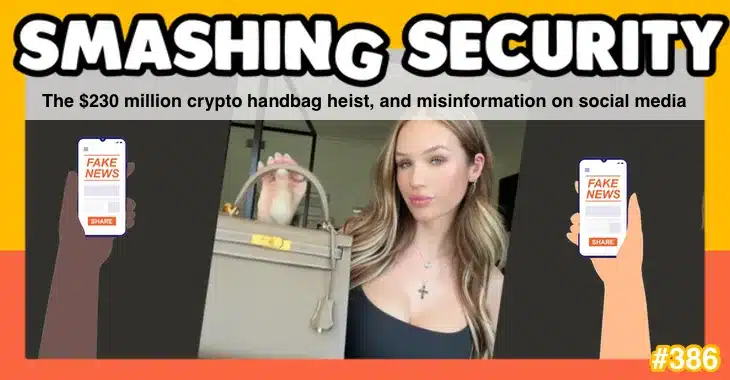
Two men are accused of stealing almost a quarter of a billion dollars from one person’s cryptocurrency wallet, but why on earth would they be handing out handbags to strangers? And social media comes under the spotlight once more, as we ask if you are delving into misinformation in your most private moments…
All this and more is discussed in the latest edition of the “Smashing Security” podcast by cybersecurity veterans Graham Cluley and Carole Theriault.
Warning: This podcast may contain nuts, adult themes, and rude language.
Show full transcript ▼
 This transcript was generated automatically, probably contains mistakes, and has not been manually verified.
Smashing Security, episode 386, the $230 million cryptohandbag heist and misinformation on social media with Carole Theriault and Graham Cluley.
Hello, hello, and welcome to Smashing Security episode 386. My name is Graham Cluley.
Now coming up on today's show, Graham, what do you got?
Smashing Security on Twitter because his investigations are very interesting.
He's well known for exposing scams and hacks and unethical practices in the crazy world of cryptocurrency.
And he regularly uses his expertise with the old blockchain analysis to track down funds that may have been stolen and identify people behind crypto crimes.
So he's a cool guy to have on your side if you find yourself at the sharp end of a cryptocurrency scam.
If you want to know who's got your money and maybe how to get it back, you would call in someone like ZackXBT.
Now, in the last few days, we've seen a press release by the US authorities about the arrests and charges against Malone Lamb and Jean-Deale Serrano, and they are accused of stealing and laundering some cryptocurrency.
Now, what makes this case unusual is the amount of cryptocurrency. Because I think you would agree with me that stealing $50 million worth of cryptocurrency—
There is a guy in Washington, D.C. right now with a hole the size of a quarter of a billion dollars in his cryptocurrency. I shouldn't laugh. I imagine he's rather depressed.
He's lost a quarter of a billion dollars. Unless you're, you know, Geoff Bezos or something, you're gonna— it's gonna hurt. It's gonna hurt, I suspect.
This is all allegations, all allegations, right? Hasn't gone through the court system yet.
But not only did they fail to cover their tracks, which is why the arrests have happened so quickly, because this breach of this cryptocurrency wallet only happened a month ago, right?
But it appears the hackers also documented their crimes, making it easy for the feds to build a case against them.
In fact, they didn't just document their crimes, they actually recorded the entire heist in a movie.
You can hear them celebrating the theft of a quarter of a billion dollars, near enough. "Oh my God! Oh my God, bro, bro, I'm gonna spaz out. Yo, we're done, we're done.
I'm spazzing out."
And so occasionally when they're moving their windows and things on the screen, there may be other pieces of information which are revealed, which may indicate their true identities.
They're using their—
It's they've got all this money now, because that's the thing, Carole, right? I don't know if you've ever had $240-odd million in your pocket.
It's complicated to do. And of course it can be complicated to follow the leads as well. So they were talking about how they're gonna launder the funds.
They even taunted cryptocurrency investigator ZachXBT.
And from what I've read, it looks like these men, allegedly, allegedly, contacted their intended victim by posing as Google Support.
They used a spoofed telephone number, they tricked the victim into sharing their screen.
One of the things they did was they rang up at one point claiming to be from the cryptocurrency exchange. And they said, you know, that there's been a breach of your account.
We need to be careful. We need to confirm your identity. Can you share the last 4 digits of your private key? Don't send us the whole private key, they said.
And it's not as though they had the rest of the private key, but what they said—
You'd think you'd be really careful with that amount of money, right? And of course you're panicking.
So these guys apparently were allegedly spending $500,000 a night at nightclubs. They were buying hundreds and hundreds of bottles of champagne.
It's like, "Hey, hey, we're having a party.
Well, I'm gonna buy everybody in the club a bottle of champagne." They were going up to random girls and they hired people to hold up placards saying, "Do you want a free designer handbag?" And all these women who were interested in designer handbags were being approached or would trot over to these guys and say, "Yeah, we'd like one." And they would give them a luxury handbag in the hope that they would go out with them.
Wow. One of them was sent a message by one of these guys. And he said, "I've got you a present. We'll call it an early birthday gift, a thank you gift. I appreciate you so much." Okay.
So you're wondering what was the present? A bright pink Lamborghini car.
I mean, he was definitely over the age of 18 or 21, hopefully, because he was at the club, but he looked pretty young.
He comes towards me and he's like, "I got this for you." And he hands me the box, he opens it, and he's like, "Do you like it?" And I was like, "Yeah, I do, but is it real?" And he was like, "Of course it's real, it's for you, you can have it," and just walks away.
Anyways, while I'm at the club, I see one other, it's a light pink one, I think.
And then the day after, so yesterday, I think I saw a girl post a TikTok about how she got gifted one by the same guy same club. Hers, I think, was lime green.
So if you're currently trying to amass a multimillion fortune, if you're spending all your time building your dot-com company or engaged in cryptocurrency scams or whatever it may be that you're doing out there, folks, don't imagine that once you have all this money, you're actually going to succeed in getting yourself a girlfriend.
It doesn't always work.
And this, they say, is up slightly compared to the last few years.
And research group Statista also report that Americans are using social media as a source of news, with 38% of adults in the U.S.
currently using social media for information about the 2024 presidential election.
And I suspect it's probably higher than that. I mean, every person that you run into and says, "Oh, did you read blah, blah, blah, blah?" And then it's in your memory bank.
And the chances are it came from social media, and I would argue probably not many of us are very good at saying, "Where did you get your sources? Send me all the details."
You're more likely to get your news, I suspect, from social media these days than tune into the nightly news at 9 o'clock.
OK, so let's assume that people sleep for 8 hours a day and they're mostly not on social media then. So that gives us 16 hours remaining. I'm going to say 8 hours a day.
I've noticed a lot of people now when they watch TV, they are dual screening. They're looking at their phone while they're watching TV.
They're difficult to look away from because there's always something interesting popping up around the corner.
And I mean, what else are you going to do while you're, you know, commuting to work or having a coffee or, you know, let's be honest, a poo?
I wrote that and then I thought, actually, I wonder if ChatGPT wants to get in on this.
So I asked it, "What percentage of people admit to using the phone while on the toilet?" And it wrote, quote, "The percentage seems to typically fall in the range of 75 to 90%, depending on the demographic and how the question is phrased.
It's a common behavior across various age groups."
Now, who might you think are the head social media honchos when it comes to people going to them for their news fix? So who's the numero uno news fix social site? According to Pew?
All of these things are for us—you and me, the average Joe and Josie's out there.
And our job is to slalom through every time we use these sites to get our news fix and hope that we're not hitting something bad.
Now, some experts place the blame—I'm interested in your view on this, right—on the fundamentals, how the social media platforms actually work.
So typically, these sites reward you if you have more followers, more likes, more shares. You know, people want to hear what you're saying.
And to build up this following, you don't tend to push out moderate viewpoints, right? They don't get the eyeballs, the shares, the likes.
They certainly don't get the same ones that comments that are more extreme in viewpoint might. Do you agree with that?
There are people who aren't very happy with Doctor Who, or maybe some of the decisions made by the production team in the last few years.
And those people who maybe are against certain things happening in Doctor Who get all of the eyeballs.
And it feels like people are deliberately making videos being outraged and angry, and, you know, they're really right on the edge in terms of opinions compared to the average sort of laid-back fan.
And I suspect they're doing it because they make more money, because they get more views, which means that it's feeding into them.
And so they are having to churn out more and more outrage and shocked and astonished videos because that is what actually works with the algorithm and gets them more views and makes them more money.
And he says the incentive structure on social media platforms leads to more extreme content rising to the top, right?
As algorithms promote what gets high engagement, reactions, comments, and shares.
I wonder, do you know which tweet, for example—I know you're a twatter or tweeter or whatever, an Xer.
Do you know what your most successful tweet was and would you share it with us?
I could probably—oh no, actually, I'm not allowed access to Twitter analytics anymore because Elon Musk makes me pretend to be a business and give him thousands of pounds to find out.
So I don't know, I'm afraid, no.
So he says, quote, when we look at people who are highly politically active on Twitter, we find that about 70% of the content about politics is generated by just 6% of the people.
And those 6% are people disproportionately very liberal or very conservative.
And so when we wander onto social media, we can wrongly conclude that everyone has quite strong and extreme views. And that everyone is sort of out to get everybody else.
And that may not be the case.
This is about the Coalition for Content Provenance and Authenticity, the C2PA.
This is led by Linux, the Linux Foundation, and it's basically an open standards body looking into embedding metadata or watermarks into images, videos, and audio files.
And the specification makes it possible to track and verify the origin, creation, and modification of the digital content. Now, loads of big dudes are in there.
Google, Microsoft, Meta, OpenAI, they all contribute. TikTok also joined, apparently the first social media platform to implement content credentials, apparently.
But notably, Apple and X are not on board as yet. And my question is, why are they hesitating? There are studies on soft moderation techniques. Have you heard of these?
They say that both interventions reduced engagements with posts containing false information with no significant difference between the two approaches. So that's interesting.
I've seen people leave community notes in the past on some of Elon Musk's own tweets where they've gone, 'Uh, that's not actually true, what you've posted there, or what you've retweeted to your millions and millions of followers.' You do worry, though, that some people won't pay any attention to those notes.
And they are, of course, posted up later, they're not there at the time of the initial publication of the post or the tweet, they follow later on.
So basically, the world over, it seems people are grappling with how to get the misinformation genie back in the bottle. But were they to ask me, I've got a good idea.
And I'm hoping you're going to be on board, Graham.
So I suggest that we all take a first step and fight for no social media on the loo. You have to come up with a cute little hashtag for this.
But instead of filling your head with nonsense from socials while you're enjoying your private time, perhaps instead, you know, delete unwanted photos, review your security settings, or just go old school and read the ingredients on your shampoo bottle.
Because, I mean, seriously, this will make an impact. We spend about 10 to 30 minutes a day, apparently, on the bog. That's 10,000 minutes a year.
And I think we're speaking with our wallets, by which I mean our butts, which, you know, seems apropos when we talk about social media.
Discover all your assets and deploy AI-powered protection to shield your cloud from build time to runtime.
On top of that, SentinelOne offers threat hunting, visibility, and remote administration tools to manage and protect any IoT devices connected to your network.
Looking for a cloud-native application protection platform? SentinelOne is your ultimate CNAPP solution. Go to smashingsecurity.com/sentinelone for more information and a free demo.
See what a flexible, cost-effective, and resilient cloud security platform can do for your organization with SentinelOne. That's smashingsecurity.com/sentinelone.
Quick question: do your end users always, and I mean always without exception, work on company-owned devices and IT-approved apps? I didn't think so.
So my next question is, how do you keep your company's data safe when it's sitting on all of those unmanaged apps and devices?
Well, 1Password has an answer to this question, and it's called Extended Access Management.
1Password Extended Access Management helps you secure every sign-in for every app on every device because it solves the problems traditional IAM ransomware and MDM can't touch.
Go and check it out for yourself at 1password.com/smashing. That's 1password.com/smashing. And thanks to the folks at 1Password for supporting the show.
Whether you're starting or scaling your company's security program, demonstrating top-notch security practices and establishing trust, is more important than ever.
Vanta automates compliance for SOC 2, ISO 27001, and more, saving you time and money while helping you build customer trust.
Plus, you can streamline security reviews by automating questionnaires and demonstrating your security posture with a customer-facing trust center, all powered by Vanta AI.
Over 7,000 global companies like Atlassian, Sophos, FlowHealth, and Quora use Vanta to manage risk and improve security in real time.
Get $1,000 off Vanta when you go to vanta.com/smashing. That's vanta.com/smashing for $1,000 off. And welcome back. Can you join us at our favorite part of the show?
The part of the show that we like to call Pick of the Week.
Could be a funny story, a book that they've read, a TV show, movie, a record, a podcast, a website, or an app. Whatever they wish. It doesn't have to be security related necessarily.
And he made this video way back in 2005, 19 years ago, before the iPhone existed. Can you imagine what life was like in 2005?
And it is this guy, Lasse Jørtson, performing as a human beatbox. Now we've seen beatbox videos before, right?
In this particular case, he's doing all that, but what he's done is he's edited it. And it must have taken him a long time, I'm sure, editing this darn thing.
But he's edited this together, so it's just him looking at the camera with lots and lots of cuts. And for having done this in 2005 in his bedroom, I think it's pretty impressive.
And that's why what you can hear right now is him doing his beatboxing, but you've really got to see it. It's a bit like Max Headroom or something like that.
Have you seen this, Carole?
But apparently, though, he publicly said, no, no, no, no, no, I'm not doing that. I'm denouncing the whole concept of advertising. It is below prostitution, he said.
And so he refused all the offers. Good for him, I suppose. I don't know if he's monetised his YouTube account.
I bet he's kicking himself if he hasn't, because he's now had about 15 million views. Anyway, very, very entertaining. That is my pick of the week.
I mean, board games and puzzles and cards and Sudoku and Killer Sudoku and all this kind of stuff.
And basically the game, as you said, has a special wooden board with pegs to track the points up to 121. First one to get all the points wins.
And I won't say it was easy to pick up because I've never played cribbage in my life, right? I would say it took me a week of study, about an hour or two a day.
But still, that's a significant amount of time to learn a game.
I've downloaded a few cribbage apps to play around with, but I'm not at the point of recommending any of those yet.
However, you can noodle about on the Cribbage JD website, link in the show notes.
You can play as a guest and you can figure out the rules from that, although I do suggest watching a few tutorials on the tubes first, and then probably watch them again and again to try and get the maths in your head.
But it gets a huge enthusiastic thumbs up from me. I even bought my beloved Yeti, who doesn't listen to this show, a cribbage board, but in the style of a wooden canoe.
And it's called the Paddler's Cribbage. And I got it from L.L. Bean. And I totally love it. And link in the show notes to that too. But don't tell him.
And don't forget to ensure you never miss another episode, follow Smashing Security in your favorite podcast apps such as Apple Podcasts and Pocket Casts.
For episode show notes, sponsorship info, guest list, and the entire back catalog of more than 385 episodes, check out smashingsecurity.com.
Hosts:
Graham Cluley:
 @grahamcluley.com
 @
@
 / grahamcluley
Carole Theriault:

Episode links:
- ZachXBT’s thread on Twitter.
- Indictment Charges Two in $230 Million Cryptocurrency Scam – Department of Justice.
- Two men arrested one month after $230 million of cryptocurrency stolen from a single victim – Bitdefender.
- Skylar Harrison tells her handbag story – TikTok.
- Social media’s role in fueling extremism and misinformation in a divided political climate – PBS News.
- Misinformation on social media – statistics & facts – Pew Research.
- Social Media and News Fact Sheet, 2024 – Pew Research Center.
- “Hyperactive” by Lasse Gjertsen – YouTube.
- Cribbage JD – Play Online – Cardsjd.
- Paddlers Cribbage – L.L. Bean.
- Smashing Security merchandise (t-shirts, mugs, stickers and stuff)
Sponsored by:
- SentinelOne – secure and protect every aspect of your cloud in real-time.
- 1Password Extended Access Management – Secure every sign-in for every app on every device.
- Vanta – Expand the scope of your security program with market-leading compliance automation… while saving time and money. Smashing Security listeners get $1000 off!
Support the show:
You can help the podcast by telling your friends and colleagues about “Smashing Security”, and leaving us a review on Apple Podcasts or Podchaser.
Become a Patreon supporter for ad-free episodes and our early-release feed!
Follow us:
Follow the show on Bluesky at @smashingsecurity.com, or on the Smashing Security subreddit, or visit our website for more episodes.
Thanks:
Theme tune: “Vinyl Memories” by Mikael Manvelyan.
Assorted sound effects: AudioBlocks.