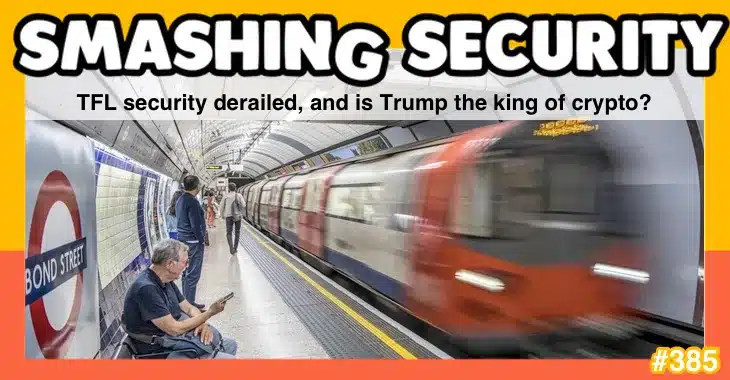
Transport for London (TfL) suffers a cybersecurity incident and tells its 30,000 staff they will all have to their identities verified… in-person. Who might have been behind the attack and why? Meanwhile, Donald Trump’s curious relationship with cryptocurrency is explored.
All this and Demi Moore is discussed in the latest edition of the “Smashing Security” podcast by cybersecurity veterans Graham Cluley and Carole Theriault.
Warning: This podcast may contain nuts, adult themes, and rude language.
(This episode was recorded before the former US President survived a second assassination attempt)
Show full transcript ▼
 This transcript was generated automatically, probably contains mistakes, and has not been manually verified.
No, he famously doesn't use email and things like that, does he?
Hello, hello, and welcome to Smashing Security episode 385. My name's Graham Cluley.
They revealed they were dealing with what they called an itsy bitsy little— well, they didn't describe it like that. It was a cybersecurity incident. That's what they said.
But not to fear, they said, because there was currently no evidence that any customer data had been compromised.
And of course, the fact that they said they were unable to comment any further, oh, that led to lots of speculation. It was pouring diesel onto a bonfire of speculation.
Could it be ransomware? Had they suffered a, I don't know, a Brent Cross site scripting flaw or a two-team— what is a pun? Brent Cross, which is a tube station.
Brent Cross Site Scripting Flaw. Do you get it? Brent Cross Site Scripting Flaw, or—
But never mind. No.
Anyway, the silver lining in all this was that they hadn't seen any evidence that customer data had been accessed, which remains the case, marvelously, until they did reveal last week that customer data had been compromised.
Of course, often in the instant aftermath of a cyber breach, you may not realize quite what the extent of it may be.
It's not like stealing the crown jewels and there's a gap. You know, it's data that potentially has been just copied.
So in their words, they said very little, very little customer data has been taken out.
And that victimization is going to be passed on to users. And it's a shit show of a situation. And the media is like, what happened? What happened? How many customers?
Like we have opposable thumbs and we can, you know, do things which chimpanzees can't do or dolphins can't do.
Our investigations have identified that certain customer data has been accessed, including customer names and contact details, email addresses and home addresses where provided.
But then they went on, they were a little bit more specific. They said also some Oyster card refund data. That's the travel card used in London.
They say that may have been accessed, including bank account numbers, sort codes, for round about 5,000 customers, they say.
You couldn't apply for a new Oyster photocard.
They said, if you can't get a new photocard, carry on making your journeys as usual, please keep on giving us money, but keep a record and maybe we can arrange a refund in the future.
They said, maybe we'll be able to do that once we've resolved this cybersecurity incident.
So there was an impact on the IT systems, and they said some of our staff may not be able to access systems either, so it may be difficult.
But when a company gets hacked, it's not just about its customers, and it's not just about its IT systems, it's also about the employees.
And TfL revealed that workers' email addresses, job titles, employee numbers were also accessed.
Although at this point of time, at the time of recording, Sunday night, don't forget, they don't believe other data such as bank details and dates of birth and home addresses, they don't think that's been accessed.
I mean, it's horrible obviously for the employees and customers that more and more information begins to dribble out and it's generally bad news.
But it's also really tough for the organization because they're thinking, well, we need to tell them what we know so far, even if we don't know the story.
And we have to act calm, cool, and collected and give people information they're asking for. Otherwise, it looks like we're hiding information. And this just happened, right?
This just happened.
Because if you assume the worst, at least it's not going to get any worse than that. And at least that may be the best route to recovery.
So one of the things that they've decided to do is they're going to undertake an all-staff IT identity check.
So before any member of staff can log back into their system, they're going to verify those users' identities.
You have to show up in person. 30,000 people are being told to show up in person.
There are eight locations across London, and I've seen the photographs posted on social media of these huge long queues.
It's like queuing for a Taylor Swift concert, going up the street through offices. Huge queues of people waiting to have their identity checked.
They're taking their passports with them and all the other information. Now, checking the identities of 30,000 people in person—huge logistical challenge.
They've warned the public that as this process is being carried out, there may be limited disruption to travel services as well.
But my reaction to that was, well, maybe technically they could, but I don't know if it'd be the most convincing thing.
But wouldn't it be easier for a criminal just to turn up in person with fake ID posing as an employee in that person's name? Wouldn't that be easier just to do that?
Obviously not if you have hundreds of people working for you, but, you know, it must cascade down.
Dick's is a sporting chain. They got hacked. They shut down all their email system and they re-verified people via video call.
So I guess TfL considered all their options, decided that although disruptive, this in-person check was the way in which they could feel most confident about what they're doing.
But what I'd say to any organizations out there listening, consider how you would handle this.
How would you identity check all of your staff before giving them access to your network again? How disruptive would it be? Have you planned for that kind of situation?
Now, when I was hearing about this hack, Carole, I was reminded of another organization that was hacked. MGM Resorts last year suffered a cybersecurity incident.
And it was later revealed that the hackers who were members of the Scattered Spider gang had socially engineered MGM Resorts' IT help desk, pretending to be an employee who'd been locked out of their account.
And said, "Oh, can you help me if my two-factor authentication, you know, it's not working," you know, answering some questions.
And they gained access and were handed the login credentials.
That cost MGM over $100 million, which I imagine included the cost of resetting employees' login credentials and two-factor authentication tokens.
I'm not saying that, but I'm just saying they can afford it. I'm not sure the shareholders would have been happy.
So one other side to this story with this TfL hack, we haven't really considered the big question is who was responsible?
And it looks like the police may have worked that out because within just a few days, like 3 days of TfL announcing its cybersecurity incident, the NCA, the National Crime Agency, arrested a 17-year-old teenage male in Walsall.
This highly sophisticated cybersecurity attack wasn't done by a state nation.
Now, this is a funny coincidence because UK computer crime cops paid another visit to Walsall in the West Midlands a couple of months ago.
In July, they arrested— yes, a 17-year-old teenage male in Walsall suspected of being a member of the Scattered Spider gang, who are thought to be behind the MGM hack.
Okay, so I don't know how many 17-year-old youths there are in Walsall, or indeed how many of them may be in the habit of possibly hacking organizations and giving IT support teams a headache over login credentials, or someone has a router right in their basement, wherever they're using it.
Oh, you think it's just a compromised computer?
It seems to me quite right to ponder if it's possible that the reason the UK police were able to find a suspect in the TfL hack quite so quickly was because they had the address of a suspect in another high-profile hack still in their sat-nav history.
So they just said, let's go back to Walsall and pick up this guy. Some people have dubbed this not an advanced persistent threat, but an advanced persistent teenager.
Like Bitcoin, for example, which was being valued at $60,000 per coin in '21-'22, was more in the range of $20,000 per coin in 2023. So that's a big dip.
And there was of course this legal quagmire faced by FTX's Sam Bankman-Fried and four of his honchos facing accusations of fraud, conspiracy, and money laundering.
And they weren't alone in that. So all this happening, I'm thinking, ah, crypto, it'll soon be something for the history books.
In fact, the global cryptocurrency market cap rose by 0.7 to around $2.45 trillion. So big, big things happened. Can you think of why? Oh, what would have led in mid-July?
It coincided with political incidents.
This news was seen as beneficial to the crypto space because it increased the chances of Trump's return, who is perceived as more crypto friendly.
Because just a month before the crypto stocks started doing their aforementioned uptick, Trump pitched himself at the San Francisco tech fundraiser.
He pitched himself as the crypto president. That's a quote.
Regulators have been sniffing around a lot more since the bankruptcies at major crypto firms.
Yeah, it spooked investors and exposed fraud and misconduct and left millions of investors out of pocket.
And the Democrats are saying even now, they want to look into this and maybe regulation is needed.
And of course, the crypto hoi polloi definitely don't want the Wild West that they've created of decentralized money generating schemes to be bogged down by rules.
Which would hold them more liable for losses or lack of security or lack of ethics or whatever.
So it makes sense that crypto dudes, they would be very happy that there is at least one presidential candidate that seems to be on side against regulation.
But wait, the Republican candidate of which we speak is even more crypto-friendly than that.
This is a brand new decentralized financial platform that will be controlled by sons Trump Jr. and Eric Trump.
World Liberty Financial has apparently partnered with AAVE. I don't know how you say that, A-A-V-E, AAVE, a crypto lending platform.
So I did a little digging, and huddle huddle, because they had a bit of a nightmare last April where they accidentally liquidated $26 million in assets belonging to their users.
So accidentally, apparently, right? So you need to have a certain threshold in order to be a user, I guess.
So you have to have at least X amount of cash or something in there, right?
So suddenly loads of users didn't meet that threshold and the systems just flushed out their assets and sold them off because they couldn't be holders.
So according to Bloomberg, Chase Hero, double R-O, that can't be his real name. I mean, come on, Chase Hero.
He only had one crypto project, which he's publicly affiliated with, and it attracted just a few million dollars and then suffered a devastating hack. So that's his background.
He has in the past called himself reportedly the dirtbag of the internet and says that regulators should kick shitheads like him out.
Can we just have a little hand clap for me? Because that's cute, right? X Twitter. Or has that been used many times?
And I think that is an amazing idea because we all know how much Elon loves regulators and he never rocks the boat for his own weird entertainment.
And why not have him be in charge of that? I think that sounds fantastic.
Now, all this crypto hype is a little bit of a U-turn for the former president, who has previously described himself as not a fan of cryptocurrency.
No, he famously doesn't use email and things like that, does he?
But we do all know, and I think I can say this, that this guy loves the stink of the green, doesn't he? And it looks like he's set to go down the crypto highway to find it.
So people that are intrigued, I think trusted advice on crypto is worth remembering.
So first, before you get all excited, learn how cryptocurrencies work, the difference between various types of crypto assets like Bitcoin and altcoins and stablecoins and tokens and all that stuff, and deep dive into any project you're interested in.
Notably, we can't really deep dive into this project because there's not a lot of information that has been put out as of Sunday the 15th of September. Evaluate your risk tolerance.
Basically, only invest what you can afford to lose. And secure your investments with reputable exchanges with solid reputations.
Cyber threats, physical security concerns have continued to increase. Now geopolitical instability is adding a new layer of risk and uncertainty.
Last year there was a staggering 84% rise in ransomware attacks and a 34% jump in data breaches.
Flashpoint empowers organizations to make mission-critical decisions that will keep their people and assets safe. How does it do that?
By combining cutting-edge technology with the expertise of world-class analyst teams, and with Ignite, Flashpoint's award-winning threat intelligence platform, you get access to critical data, finished intelligence, alerts, and analytics all in one place.
It's no wonder Flashpoint is trusted by mission-critical businesses and governments worldwide. To access the industry's best threat data and intelligence, visit flashpoint.io today.
That's flashpoint.io. Quick question: do your end users always, and I mean always without exception, work on company-owned devices and IT-approved apps? I didn't think so.
So my next question is, how do you keep your company's data safe when it's sitting on all of those unmanaged apps and devices?
Well, 1Password has an answer to this question, and it's called Extended Access Management.
1Password Extended Access Management helps you secure every sign-in for every app on every device because it solves the problems traditional IAM and MDM can't touch.
Go and check it out for yourself at 1password.com/smashing. That's 1password.com/smashing. And thanks to the folks at 1Password for supporting the show.
Whether you're starting or scaling your company's security program, demonstrating top-notch security practices, and establishing trust is more important than ever.
Vanta automates compliance for SOC 2, ISO 27001, and more, saving you time and money while helping you build customer trust.
Plus, you can streamline security reviews by automating questionnaires and demonstrating your security posture with a customer-facing trust center, all powered by Vanta AI.
Over 7,000 global companies like Atlassian, Sophos, FlowHealth, and Quora use Vanta to manage risk and improve security in real time.
Get $1,000 off Vanta when you go to vanta.com/smashing. That's vanta.com/smashing for $1,000 off.
And welcome back, and you join us at our favorite part of the show, the part of the show that we like to call Pick of the Week.
Could be a funny story, a book that they've read, a TV show, movie, a record, a podcast, a website, or an app, whatever they like.
It doesn't have to be security related necessarily.
Oh, because while I was on honeymoon earlier this year in Barcelona, I heard a melodic sound coming from this little town square, and I walked into it, and there I found a man playing an instrument of melodic percussion known as the tam drum.
And I was rather taken by it. I said, "That's a lovely instrument you got there, sir," I said in my faltering Catalan. And he said, "It's a tam drum.
Would you like to buy one?" And I bought one.
You're making your own jokes back there. It's a bit like, I was trying to work out how to describe it. You know, steel drums. You know, you get steel drums.
So you're sort of banging on the outside of it and you get these beautiful sounds.
Anyway, it's easy to play even if you're an adult me, but in the hands of someone with a musical lean, and one of my stepsons is very musical, tinkle tonkle. It's really lovely.
And I will link to the website where we can get them. Obviously, it's going to cost you a bit because you'll have to get it shipped from Barcelona, unless you're out there.
But I've got one on my living room table, and everyone who comes by has a little tinkle tonkle, and it's a lot of fun. And that is my pick of the week, the tam drum.
So I decided to check out a random memoir. And I chose one from Demi— no, Demi, I learned Demi Moore. Demi Moore.
And the reason I chose this is because over the weekend I read that Demi— or no, Demi is starring in a new maximalist movie called The Substance. Have you heard about this?
She plays a character called Elizabeth, and she basically in the movie tries a black market drug to create a younger version of herself.
Okay, apparently it's the most grotesque movie of the year. I'm dying to see it. This is totally up my alley. And I found this memoir, Inside Out.
And I don't know, she was a big deal for me because I was exactly at the right age when she kind of rose to fame.
And you know, there was Rob Lowe and Molly Ringwald and all that stuff. So that was my whole rock space.
And the book, this book Inside Out was written after her relationship with the 20-year-younger boy toy Ashton Kutcher went south.
So she talks about her shitty childhood, her rise to fame, her relationship with Brucey Brucey Willis, the movies she did.
You know, she was the highest paid actress ever for a while.
It's really, you know, they basically kind of treat her as a princess that is not worth her success. But I did read something in that article that I don't think was in the memoir.
Okay, and this is when she was married to Bruce Willis. So apparently the Willis gave birth on film in addition to an audience of six friends. This is all in the Vanity Fair article.
And in addition to an audience of six friends, the couple had three video cameras taping the big event.
The guests included their massage therapist, Moore's personal assistant, Bruce's best friend Carmine, Moore's girlfriend Patsy, and of course Randy the video operator.
I had the baby's head out of me. I was touching her ear, and I said to Randy, are you getting this? I want to make sure he has it in focus. Crazy bonkers.
So that's my crazy pick of the week, Demi Moore's 10-year-old memoir Inside Out. I really enjoyed it, Graham. I think you might too.
You can follow us on Twitter @SmashingSecurity, no G. Twitter doesn't allow us to have a G.
And don't forget to ensure you never miss another episode, follow Smashing Security in your favorite podcast apps such as Pocket Casts, Spotify, and Apple Podcasts.
For episode show notes, sponsorship info, guest lists, and the entire back catalog of more than 384 episodes, check out smashingsecurity.com.
Hosts:
Graham Cluley:
 @grahamcluley.com
 @
@
 / grahamcluley
Carole Theriault:

Episode links:
- TFL cybersecurity incident announcement.
- TFL Employee Hub.
- DICK’S shuts down email, locks employee accounts after cyberattack – Bleeping Computer.
- MGM Resorts shuts down IT systems and slot machines go quiet following “cybersecurity incident” – Hot for Security.
- Teenage suspect in MGM Resorts hack arrested in Britain – The Record.
- Arrest made in NCA investigation into Transport for London cyber attack – NCA.
- Donald Trump Prepares to Unveil World Liberty Financial, a Cryptocurrency Business – The New York Times.
- Behind the Trump Crypto Project Is a Self-Described ‘Dirtbag of the Internet’ – Bloomberg.
- Cryptocurrency price on July 22: Bitcoin hits $68,000 level, Dogecoin, Avalanche surge up to 11% – The Economic Times.
- Trump vows to make US ‘world capital of crypto,’ taps Musk for new task force – CoinTelegraph.
- What bankers need to know about Trump’s World Liberty Financial – Yahoo! Finance.
- Bitcoin soars to two-week high after Trump attack – Reuters.
- Trump pitches himself as ‘crypto president’ at San Francisco tech fundraiser – Reuters.
- Aave fork on Blast mistakenly liquidated $26m – Crypto news.
- Crypto Talk With Chase Hero – Ep.7 (The Watchers) – YouTube.
- Tamdrum.
- ”Inside Out” by Demi Moore – HarperCollins.
- THE SUBSTANCE trailer – YouTube.
- Demi’s Big Moment – Vanity Fair.
- Smashing Security merchandise (t-shirts, mugs, stickers and stuff)
Sponsored by:
- 1Password Extended Access Management – Secure every sign-in for every app on every device.
- Flashpoint – Access the industry’s best threat data and intelligence.
- Vanta – Expand the scope of your security program with market-leading compliance automation… while saving time and money. Smashing Security listeners get $1000 off!
Support the show:
You can help the podcast by telling your friends and colleagues about “Smashing Security”, and leaving us a review on Apple Podcasts or Podchaser.
Become a Patreon supporter for ad-free episodes and our early-release feed!
Follow us:
Follow the show on Bluesky at @smashingsecurity.com, or on the Smashing Security subreddit, or visit our website for more episodes.
Thanks:
Theme tune: “Vinyl Memories” by Mikael Manvelyan.
Assorted sound effects: AudioBlocks.