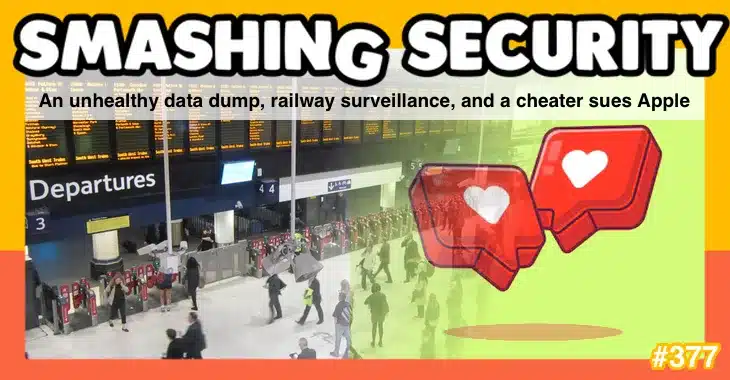
There’s a wee data breach with unhealthy implications in Scotland, privacy has gone off the rails in the UK, and a cheater blames Apple for his expensive divorce.
All this and much more is discussed in the latest edition of the “Smashing Security” podcast by cybersecurity veterans Graham Cluley and Carole Theriault, joined this week by Lianne Potter of the “Compromising Positions” podcast.
Plus don’t miss our featured interview with Abhishek Agrawal, CEO of Material Security.
Warning: This podcast may contain nuts, adult themes, and rude language.
Show full transcript ▼
 This transcript was generated automatically, probably contains mistakes, and has not been manually verified.
Hello, hello, and welcome to Smashing Security episode 377. My name's Graham Cluley.
You won an award, didn't you, Lianne? Hello.
Now, coming up on today's show, Graham, what do you got?
He is the co-founder and CEO of Material Security. We talk about email threats today and common misconceptions. All this and much more coming up on this episode of Smashing Security.
I can't pull the wool over your eyes because you can hear the bagpipes in the distance.
We are, of course, in beautiful bonnie Scotland, where the sheep's stomachs are considered a delicacy. So gather round, ye brave souls. Pack your raincoats.
So I think if it was made out of sheep stomach as well.
Well, the National Health Service systems, the IT systems up there, they were hit by the Inc Ransom Group in February, who alleged that they had stolen huge amounts of patient and staff data, 3 terabytes worth, they said that they had taken, was taken under the nose of the NHS Scotland up there.
And to back up their claim, Inc Ransom published what they called a proof pack on the dark web. So, I think it was the confidential information of about 6 patients.
They said, "We've got a lot more than this, but we've got 6 patients' worth of data." But they dangled it. They said, "This is what we've got.
We will release more unless you pay the ransom." Oh, right, a kind of teaser saying, "Here's a little bit of the stuff that you might expect, and we have 3 terabytes worth." Yeah, it's a bit if you kidnap you know, a relative of John Paul Getty, you cut off their ear and send that to the family and say, look, we've clearly got him.
Although, how would you know?
We've got a lot more than this, but you can check." and you'll be able to see that this is data related to some of your patients in this case.
And if you want to stump up the cash, then we won't release the millions and millions of other pieces of data as well. So they asked for a ransom.
The news became public knowledge, I think the following month, the media were all over it. One headline I read said, Cyber expert urges against panic over NHS data leak.
And I thought those were very wise words for the expert to urge against panic.
I sometimes wonder why they contact experts, the media, cybersecurity experts, because it's isn't that the blinding, bleeding obvious?
It's to say, well, I'll tell you what I suggest. I suggest you don't panic. It's you know, Corporal Jones used to advise that in Dad's Army. He was always saying, don't panic as well.
So they're saying, "No, this is not good." And this is something we advise often on this show, that we'd prefer if people didn't just kind of pay up and stay quiet and stay shut.
I mean, they could have had maybe a whip around of everyone in Dumfries and Galloway and said, "Look, if you stump together £5, we can probably pay the ransom." They didn't even think of that.
Anyway, they refused to pay. And of course, the hackers released everything. They released everything. And that's pretty bad because a data leak like this—
We will actually carry out our threat. So that's why they do release it.
Instead of just going, oh, I'm going to spit my dummy out and release the data. Let's put you on a little payment plan here.
If you don't want to pay the full amount, I know you're hard up, NHS, lately. Let's put it on layaway for you.
Can you imagine how embarrassing X-rays can be? Have you ever seen your own X-rays?
But also the other data which maybe was now in the hands of criminals was letters from consultants to patients, which could be, you know, about their embarrassing wart or condition.
So there's a potential for this to become public, potential for extortion maybe, or just simple embarrassment.
Things that you don't want your loved ones or your workplace or your friends knowing, or you don't want someone to set up a searchable database.
And we've seen attacks like that before where people have actually been approached after their medical information about their mental health has been exposed, and the ransom demand be made not only to the NHS or that medical body, but also to the patients as well.
There was also some advice about not to click on links in emails from people they didn't know or companies they didn't know.
And don't provide any information to people you don't know who contact you on the phone or via social media.
And you can go and read the letter that D&G have— That's not Dolce Gabbana, by the way. That's Dumfries Galloway. Very different things. Very different things.
And they've even got an easy-read version. So clearly they're recognising that some of their patients may not be—
I think it's for people who maybe find reading lots of paragraphs a bit more complicated and challenging.
When you write to everybody saying that there's been a data breach and to look out for it, maybe that actually makes it easier for the scammers and identity thieves to exploit the situation to call up people and say, "You remember that letter you got the other day?
Well, I'm calling about that, or I need you to go to this website to claim your compensation." You can see that there may be other attacks in the wake of this.
We're going to call you the next few days to ask for information to repopulate or do anything else."
So when in 1983 Rockwell explained he always feels somebody's watching him and he has no privacy, whoa, he wasn't far off. And now we're seeing that today.
So turns out Amazon have been watching us for the last two years as we go upon our merry way on the trains.
Now imagine this—you're on a train station, you're minding your own business, you're waiting for the train home, and then suddenly you notice that the CCTV camera is swerving towards you and you think, "Oh, it's just normal security, right?" But little did you know that that camera is actually a smart CCTV camera pumped to the eyeballs with AI surveillance stuff.
And so apparently for the last two years, and we've only found out about this because an organisation called Smashing Security did a request for information.
Trying to know what gender we are.
I don't think I've ever been happy on a train in a very long time here.
But my question to you—so one, we wouldn't have known about this unless this organisation did a request for information.
And obviously, you know, Network Rail said they take privacy and security very seriously, of course, so that's okay then.
But what I would to ask you is now as cybersecurity professionals, as we enter this—everything's got an AI attachment to it—how do we keep up in this?
And where does this sort of ethics and morals lie in us helping organizations protect this stuff?
'Cause our organizations that we work in are gonna make us do stuff this, but where do we actually come in on this conversation and say, "Hey, I'm not quite happy with actually storing all this data because of the potential consequences if we lose this stuff." Not just going beyond normal data privacy stuff, which, you know, hopefully most of our organizations look after, but then what if that falls into the wrong hands?
I'm guessing, okay, and tell me if you know or if I'm completely off-piste here, but I'm guessing Amazon made a deal with the train networks to say, here's the deal and it's less money than you'd pay elsewhere, selling all the benefits.
But actually, do they get to harvest the information as well or does it stay within the UK train?
I don't know, I'm just speculating where it could be useful. But what I do know is this is happening so much now, this lack of consent or even a discussion.
So yes, you know, I'm sure most of us would probably say there is actually positive benefits for them, keeping an eye out for people doing wrong things trespassing on rail tracks and things.
And, you know, not to go too dark, but, you know, people do commit suicide on the trains, and spotting that kind of emotional change will be very useful.
But my worry is we're constantly making these kind of concessions, and where does it stop?
The general public doesn't know this is happening until someone reveals it through an information request.
What if all Nando's right across the UK started putting AI powers just to see, detect emotions and see how happy their customers are, right?
You're less likely to commit suicide or something in a Nando's than you are suffering the British rail system.
I suspect that they're doing this because they're doing it for people's safety and protection.
The worry will be, of course, as you were suggesting, Carole, that what's Amazon going to do with all of this data? How could it use it?
And of course, at what point does law enforcement get involved and think, oh, we've got access to this?
And already in the United Kingdom, we have a huge number of CCTV cameras watching us everywhere we go. We're one of the most surveilled states in the world, aren't we?
So all I can say to you really, I don't have an answer, but you know, next time you're at the train station remember just to give the cameras your best smile.
But he must have hit a bumpy road of sorts in Marriageville, because for a time, things must have not been going so great.
Like, so not great that Richard decided to secretly start stepping out to take advantage of one of the world's oldest professions.
So, to keep his missives to the ladies, mistresses of the street, whoa, he deletes the messages on his phone so she can't see them. So all good, all good.
You know, he's having secret sexy time messages and trysts, and his wife is none the wiser.
Until, until, until his wife opens iMessages on the home iMac. And there is a veritable waterfall of deleted messages to prostitutes.
And they tumble down the page revealing that darling Richard has had long periods of infidelity.
Then these, of course, are the messages he believed he had deleted and wiped for good. Right?
And she did that within a month?
In order to reduce them, he's taking strong beta blockers, fearing a heart attack.
But he gets a lightning bolt of an idea, one of those brilliant, trifecta of everything aligning. Just sue Apple, right? Get Apple to refund the losses.
Yes, file a lawsuit, a class action lawsuit against Apple, because Apple is the entity that ruined his life. Not his philandering, Apple.
And yes, let's call upon London-based law firm Rosenblatt to arrange legal action against Apple.
And yes, let's go public to attract men in the same situation to go in with Richard on the suit.
I'm just thinking that if he's hired this London law firm, Rosenblatt. Whatever.
One possibility for the lack of deletion across all the services may be down to the fact that the device was not linked to a central iCloud account.
So according to Apple support documents, if you use Messages in iCloud, deleting a message or conversation on your Mac deletes it from all your devices where Messages in iCloud is on.
So you can link devices separately from using iCloud.
Kind of a fair point, I think.
These messages are deleted on this device only would have been a much clearer indicator.
But I guess it was difficult after she found out he was secretly stepping out with prostitutes.
But according to lawyer Simon Walton of Rosenblatt, he says in many cases the iPhone informs the user that messages have been deleted, but as we have seen, this isn't true and is misleading because they are still found on other linked devices, something Apple doesn't tell its users, he added.
Whatever crackpot they are, they don't care whether the person that they're representing is sane or not. They're just taking the cash.
I think what has been a superb marriage has been thrown away for something which many men do." What? And some women do. But mainly men.
So to surmise, it is completely and utterly Apple's fault. And best of luck, Richard.
Relying on built-in controls or traditional blockers will inevitably lead to more noise than your instant response team can handle.
Well, Material Security takes a pragmatic approach to email security, stopping new flavors of phishing and pretexting attacks before reaching the user's mailbox, while searching through everyone's mailbox for similar messages in a campaign.
What gets surfaced to your team are the highest-value cases to investigate, with all the context and reach consolidated into a single view.
Remediations are a breeze with Material Security. So go try it out for yourself at smashingsecurity.com/material. That's smashingsecurity.com/material.
And thanks to Material Security for supporting the show.
Vanta automates compliance for ISO 27001, SOC 2, GDPR, and more, saving you time and money.
With Vanta, you can unify your security program management with a built-in risk register and reporting and proactively manage security reviews with AI-powered security questionnaires.
Over 7,000 global companies like Atlassian, Phyton, Flow Health, and Quora use Vanta to build trust and prove security in real time.
Our listeners get 10% off Vanta at vanta.com/smashing. That's v-a-n-t-a.com/smashing for 10% off. And thanks to Vanta for sponsoring the show.
But every day, employees use personal devices and unapproved apps that aren't protected by MDM, IAM, or any other security tool.
There's a giant gap between the security tools we have and the way we actually work.
1Password calls it the Access Trust Gap, and they've also created the first-ever solution to fill it.
1Password Extended Access Management secures every sign-in for every app on every device.
It includes the password manager that you know and love, and the device trust solution you've probably heard of on this podcast, back when it was called Collide.
1Password Extended Access Management cares about user experience and privacy, which means it can go places other tools can't, personal and contractor devices.
It ensures that every device is known and healthy, and every login is protected.
So stop trying to ban BYOD or shadow IT and start protecting them with 1Password Extended Access Management. Check it out at 1password.com/smashing.
And thanks to 1Password for supporting the show. And welcome back, and you join us at our favorite part of the show, the part of the show that we call Pick of the Week.
Could be a funny story, a book that they've read, a TV show, a movie, a record, a podcast, a website, or an app, whatever they wish. Doesn't have to be security-related necessarily.
And I've been having to create a little website and set it up. And I've had a niggle. I've had a complexity in the setup of the website, and I was wondering what the problem was.
And it turned out to be— and anyone out there who's geeky and has tried to set up websites and email systems and the like will know those three terrifying letters: DNS.
And your DNS records, you know about that, don't you, Lianne?
Anytime Facebook or Twitter or anything like that goes down, chances are it's a DNS problem.
So if you're ever wondering whether it is DNS that's causing the problem or not, just go to isitdns.com. What it says is, yes, it is DNS, which is causing the problem.
For instance, you can get a t-shirt which says, "If DNS had a face, I would punch it." There's another one which says in great big letters with an exclamation mark, "It wasn't DNS!" Oh yeah, it was.
And in smaller writing underneath it goes, "Laughing out loud. Just kidding. It was totally DNS." So it is DNS. I don't know if DNS should be my pick of the week. Is it DNS?
DNS is my pick of the week, but DNS itself is my nitpick of the week. Because I am very, very frustrated by DNS and how often it goes wrong. Lianne, what's your pick of the week?
And I should preface this, the person I'm about to discuss, I am not actually a fan of this person. But I'll go into it.
So my pick of the week is an audiobook, and it's the audio version of Barbra Streisand's autobiography, My Name Is Barbra.
Now I say I'm not a fan, doesn't mean I don't like her, but you know, and I love Funny Girl, and you know, some of the songs are bangers and things like that, but I'm not a hardcore fan, at least not hardcore enough to listen to an audiobook that is 48 hours and 17 minutes long, right?
So I saw a review for it and people were saying it's brilliant, and I thought, oh, I'll just give it a go because I love a good audiobook. It's phenomenal.
It's funny, it's heartwarming.
And I tell you what, as I used to listen to it, I did listen to it on double speed because she actually sounds younger on double speed because she's getting on in her years now.
I had to get through it somehow because I'd actually borrowed it from my local library online audio service. There you go.
I absolutely miss her now she's gone out of my life, and I used to just walking around listening to her telling me things. It was so nice.
So it's brilliant, and I just can't say enough how amazing it is. But what was really nice was there was — she's interwoven actually her singing as well.
So if you're not familiar with her work, take it out of double speed because you're trying to get through 48 hours and 17 minutes of audiobook. Listen to her. It's fantastic.
And then put it back on double speed. But she also talks about the Streisand effect. So do you know what the Streisand effect is?
So the Streisand effect is the — was pretty much an unintended consequence of Barbra Streisand's attempt to censor some information about her.
So what basically happened was, and she goes into detail in her book, was some photographer decided to take loads of pictures of houses that were on cliff faces about to fall into the ocean, basically.
And Barbra Streisand's house was one of them, and it was for environmental reasons. Create this book.
However, she was one of the only people they mentioned her by name, so they gave exact coordinates of where she lived.
And you know, obviously a massive breach of privacy, which we've been talking about all this episode really, haven't we?
So yeah, so the Barbra Streisand effect is basically she sued, and what happened is it went from 6 people seeing this image in a book to obviously being absolute massive news and everyone knows.
Yeah, yep, just really interesting to hear a perspective on it. So my pick of the week is Get Comfort I would say start making friends with Barbra Streisand.
I was very tempted afterwards. I was so moved by her book.
I was very tempted to write to her and say, "I'm not a fan, but I've really enjoyed your book." But then my other half said, "That's not a very nice thing to write to someone." But I meant it in good faith.
She's really converted me. I'm so interested. I'm going to go through all her film back catalog. Yeah, brilliant.
My, if you could see me, my glasses will be wiggling. But yeah, she's had quite the life, we'll put it that way.
But yeah, I miss Barbra every single day now that that audiobook has finished.
This is a 2022 dark comedic memoir by this former actress called Janine Jenna McCurdy. Have you heard of her?
So when I saw it in my feed, I was like, I'm going to get that audiobook. Let's try it.
And it's great because she was a child actress and the whole book is about her going through that with her difficult relationship with her mother who was obviously in charge of her at the time.
So she started acting at age 6 and got talked into going to auditions by her mother at that time.
Apparently her mom's own acting aspirations were thwarted by her disapproving parents.
Jennette was not allowed to shower on her own until her late teens because her mom had to do it to make sure she was really, really clean. Forced her into diets.
And despite winning all these awards for the sitcoms, she was a complete anorexic who leaned on alcohol way too much.
But despite all these shocking behind-the-scenes revelations, she's a really punchy writer with some great comedic moments that weave all these hardships together.
And it seems writing is very much her thing. She says of it in the book, performing feels inherently fake, writing feels inherently real.
Anyway, so if this sounds like your thing, check it out. I'm Glad My Mom Died by Jennette McCurdy. You can find it wherever you get your books or audiobooks from.
It is my pick of the week.
So today on Smashing Security's featured interview, we are speaking with Material Security's co-founder and CEO, Abhishek Agrawal.
Now, Material Security are creators of a multi-layer detection and response toolkit for email.
And today, we're going to find out about email threats and find out what dangers they pose for organizations right now in 2024. So welcome to Smashing Security, Abhishek Agrawal.
A delight to have you here.
I led data infrastructure groups, which powered a lot of Dropbox's internal monetization and experimentation efforts.
I also worked on search and a lot of the different consumer surfaces there. And my background before that is I was at Microsoft Research working on productivity-related incubations.
So really background was in product and engineering more focused on the productivity side. And this company was kind of a new foray into security.
And at Dropbox, we had definitely some exposure to the internal security team that led to some of the early ideas here.
But my background's primarily on the productivity side before this company.
It takes a lot of time and strategy and money and all that stuff.
And really it was kind of a team-first thing where we knew we wanted to work together and build something. And we started exploring different spaces around that same time.
In 2017, one thing that was top of mind for everybody was the 2016 election cycle that had just happened in the US.
And being kind of new to the security world, we sort of approached that with, I would say, kind of a very naive, but maybe sort of fresh perspective where we were like, oh, this is kind of strange.
We thought email security was a solved problem. It's this 30, 40-year-old app. You know, why is email security playing a role in elections. This is kind of crazy.
And you start kind of digging at the problem and you realize that there's definitely opportunities to improve upon the current state of things.
So that was the genesis, that specific problem, you know, analyzing the election-related hacks, what could have been done better.
And that really led to some ideas that once we started socializing with our immediate network, we realized that there's an opportunity here.
We have sort of infinite storage. And if you just think about the average mailbox, inbox, it just contains all of this different type of data.
You know, in the personal setting, obviously my entire digital life is housed in my email. In a corporate setting, you know, IP, financial reports, employee and customer data.
Just you name it, it all ends up in email.
And so what we kind of got obsessed with was this idea of, well, yes, it's bad that someone got into an email account, but it's really bad that that means that they can just access 15 years of email, 20 years of email immediately.
And so the first idea was kind of, can we add additional layers of protection?
You know, the buzzword is zero trust or defense in depth, but the idea is that just because I get into your email account shouldn't mean that I literally get to access everything.
There should be additional layers of authentication or defense.
Another thing that that election hack taught us is if I get into your email account, I can go reset passwords to all sorts of other services and actually turn that email breach into now a Dropbox breach or a Twitter breach or a bank account breach.
In the case of the election hacks, you know, people got into an iCloud account where now they get text messages.
So it really opens another kind of interesting point, which is email also acts as identity.
So not only does it have years and years of your digital life in there, it also is your identity for a lot of different applications.
And I can use that to now move laterally from an email account to all these other things.
The key point here is that if I am only trying to stop bad emails from coming in, if that's the only context that I'm thinking about email security in, I'm sort of not really doing anything about the content inside email or the fact that I can use it to move laterally.
And if you think about it only as the way in, then all of your security controls are gonna focus on it as the way in.
But you have to think about it as the actual target of the attacks. For example, very recently, in the US there's been kind of big nation state attacks on government email systems.
Midnight Blizzard was the most recent one. Before that there was SolarWinds, Hafnium, Storm.
In all of these cases, there was not a single malicious email that was sent, but the actual target of the attacks was all of these email content repositories, right?
If I can get into the email account of someone in the State Department, you can only imagine how useful that is from a state actor perspective.
So that sort of illustrates the problem really well, which is if there was no bad email sent, but I can get into an email account in many other ways, like I can bypass MFA, I can install a Chrome extension that gets me access.
I can convince someone to authorize a malicious OAuth application. There's many, many different ways in.
So tell me, how does Material Security, a multi-layered detection response toolkit, what, how does it help? How does, what is, how does it thwart off the bad stuff?
We're just applying new techniques to them, new types of data sources.
So for example, looking for signals that suggest that it is a malicious email, things like it's a sender your organization has never seen before, or it's doing a lot of urgency in its language, even though it's also at the same time trying to request a financial transaction.
And new sort of technology capabilities like AI and sort of a lot of the recent developments with LLMs are massively helpful for this problem because at the end of the day, you're often trying to decipher kind of the intent of these emails in order to understand if they're malicious.
And these language models can be very useful for that, along with just, you know, basic heuristics that you can apply if you can process a lot of data.
On the side of more techniques to actually help in the case that an account is breached and how do you protect the content inside or how do you stop me from moving laterally there, what we take is kind of a defense-in-depth approach.
So a very simple example, let's say that in my mailbox I have a message that's very, very sensitive. Maybe it's got PII or passport information or something like that.
If it is older than a certain age, what Material does is it redacts the contents of that email and it actually leaves a stub that doesn't contain the actual sensitive content.
It's a redacted version of that message.
On some factor that is very easy for them to do, but would be very hard for an adversary that had gotten into the account to do.
So for example, in the case of our customers, they're often using an IDP like an Okta or Duo.
And so imagine that I get into a mailbox, I see some messages that have been redacted because they're old and they contain sensitive data.
If I pass it successfully, the message is restored into my mailbox immediately via API. It's seamless. I can interact with the email as I always would in my mailbox.
You can apply a similar technique to something like password resets.
So if I go and request a password reset to my Dropbox, well, normally it would just send a password reset email, and if I'm in your account, I just use that to change the password to whatever I want.
And now I've compromised your Dropbox.
If you say yes, we can deliver it as usual. If you say no, then I could be in your account, but I don't get to go change your password to Dropbox.
And this is really not a new idea. I mean, I'll give you a simple example. Let's say somehow you break into my bank account online.
It's game over. I have access to the entire contents of the email account. I can perform password resets.
It doesn't make sense that we treat all messages as equal. Some of them are way, way, way higher consequence than others.
And in fact, the information they contain can make one very unimportant versus one super, super, super sensitive. And it's just sitting in the same bucket.
And I always advocate for a very pragmatic approach. So the nice thing about email is that there's really only two cloud email systems that most companies are using.
It's either M365 or Google Workspace. So first of all, just making sure you're fully utilizing the native email security controls that already come with the provider is step one.
And you'd be surprised how many companies we talk to where we just see that they're not even properly configuring their existing security controls that they already own thanks to the email security provider.
So doing an audit of those and really making sure, especially in the Microsoft side, things can be intricate and they can be hard to decipher all the different settings.
But that's step one.
I think after that, if you feel the need to supplement the email security that the native provider is doing, maybe you're still seeing a lot of things get through.
That's where an API-based render is something you may want to evaluate. In the past, there used to be a lot of products that would make you deploy inside the email delivery path.
These are called secure email gateways. The modern sort of alternative to those is to actually take an API-based approach so that we're not routing all email through something else.
But post-delivery, you can have something still looking for malicious emails that may have landed in a mailbox.
If after that you feel that you've got those things under control, that's where then I would advocate thinking next about what do I do about some of the content in here?
How can I address some of those gaps? And so to summarize, it's a maturity curve, right?
Start with the basics, make sure you're actually using what the provider gives you by default.
Then think about supplementing with something if you're still seeing things get through.
And then finally, you can address the problem of content and really thinking about extra controls for messages themselves.
But it's a journey and it's better to start with the basics.
Having said that, obviously, my biased perspective is that if you're picking a platform to do some of these things, you don't want 3 different tools to do 3 different aspects of this.
So, it's best to pick one that can be on that journey with you.
That's smashingsecurity.com/material. Here you're going to find a super engaging demo by YouTuber John Hammond. You can even request your own Material Security demo and much more.
So that's smashingsecurity.com/material. And a huge, huge thank you, Abhishek Agrawal, co-founder and CEO of Material Security.
What's the best way for folks to do that?
And also the podcast, so Compromising Positions cybersecurity podcast. Don't just Google, as I say, Compromising Positions on its own.
And, you know, award-winning cybersecurity podcast, I should say, joining the likes of yourselves. So come and give us your ears.
Follow Smashing Security in your favorite podcast apps, such as Apple Podcasts, Spotify, and Pocket Casts.
For episode show notes, sponsorship info, guest lists, and the entire back catalog of more than 376 episodes, check smashingsecurity.com.
Hosts:
Graham Cluley:
 @grahamcluley.com
 @
 / grahamcluley
Carole Theriault:

Guest:
Lianne Potter – @Tech_Soapbox
Episode links:
- Cyber attacks update – NHS Dumfries & Galloway.
- J Paul Getty – Wikipedia.
- Cyber expert urges against ‘panic’ over NHS data leak – BBC News.
- “Don’t panic” – Corporal Jones from Dad’s Army – YouTube.
- All households in Scottish region to get alert about hackers publishing stolen medical data – The Record.
- Amazon-Powered AI Cameras Used to Detect Emotions of Unwitting UK Train Passengers – Wired.
- Man ludicrously blames Apple for his wife catching him communicating with prostitutes – Apple Insider.
- Businessman sues Apple after wife finds ‘deleted’ iPhone messages to prostitute – LBC.
- ‘Tech made me do it’ is no excuse for adultery – The Times.
- Is it DNS?
- “My name is Barbra” – Amazon.
- ”I’m Glad My Mom Died” by Jennette McCurdy – Simon & Schuster.
- Smashing Security merchandise (t-shirts, mugs, stickers and stuff)
Sponsored by:
- 1Password Extended Access Management – Secure every sign-in for every app on every device.
- Vanta – Expand the scope of your security program with market-leading compliance automation… while saving time and money. Smashing Security listeners get 10% off!
- Material Security – email security that covers the full threat landscape – stopping new flavors of phishing and pretexting attacks in their tracks, while also protecting accounts and data from exploit or exposure.
Support the show:
You can help the podcast by telling your friends and colleagues about “Smashing Security”, and leaving us a review on Apple Podcasts or Podchaser.
Become a supporter via Patreon or Apple Podcasts for ad-free episodes and our early-release feed!
Follow us:
Follow the show on Bluesky at @smashingsecurity.com, or on Mastodon, on the Smashing Security subreddit, or visit our website for more episodes.
Thanks:
Theme tune: “Vinyl Memories” by Mikael Manvelyan.
Assorted sound effects: AudioBlocks.