


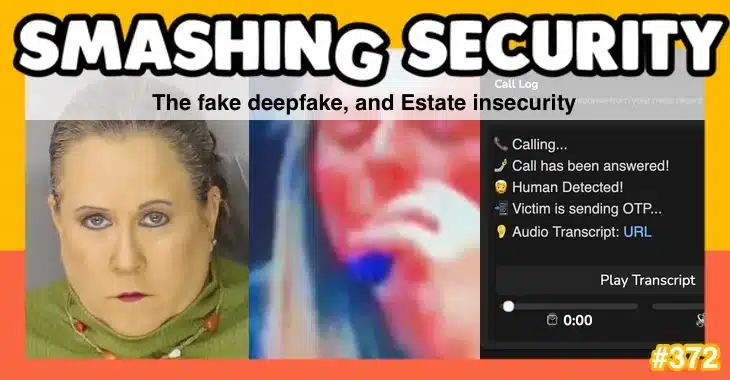
Remember when a US mother was accused of distributing explicit deepfake photos and videos to try to get her teenage daughter’s cheerleading rivals kicked off the team? Well, there has been a surprising development. And learn how cybercriminals have been stealing boomers’ one-time-passcodes via a secretive online service.
All this and more is discussed in the latest edition of the award-winning “Smashing Security” podcast by cybersecurity veterans Graham Cluley and Carole Theriault.
Warning: This podcast may contain nuts, adult themes, and rude language.

Show full transcript ▼
 This transcript was generated automatically, probably contains mistakes, and has not been manually verified.
Smashing Security, Episode 372: The Fake Deepfake and Estate Insecurity with Carole Theriault and Graham Cluley. Hello, hello, and welcome to Smashing Security episode 372.
My name is Graham Cluley.
Now coming up on today's show, Graham, what do you got?
Let's hear what noise it makes. It goes, 'Brrr, brrr, brrr, brrr.' Recognise that noise?
We've detected some unusual activity on your account and are calling you as a precautionary message. Please enter the 6-digit security code that we've sent to your mobile device.
And, you know, I don't get a lot of these calls, but when I get them and I realize it's a robotic voice, I typically just hang up, right?
I just go, "Oh, God." And this happened, but I hung up too quick, and then I heard that it said the name of the credit card company.
And I think they're trying to validate or verify me via my phone now. And yeah, okay, so carry on. I'm interested.
Sure enough, you have received a six digit code from PayPal via text message.
And a hacker has just bypassed multi factor authentication and accessed your PayPal account.
What's happened here is there are online services which will, if you forget your password, for instance, as an additional form of authentication, will text you a number to your smartphone, and you then enter that number as you try and log in, and it allows you access to the account.
And because it's not someone going, "Hello, this is, do not worry at all." Because this isn't someone from, maybe I shouldn't do an accent. I'm not sure.
We're about to call you." Because it's a robot saying, "This is the PayPal security team." You think, well, that's quite plausible.
So I can see why you'd fall for it.
And you think, well, you're only sending me the number because I have to enter it onto a PayPal site, or in this case, respond to the so-called PayPal robot.
Meanwhile, hundreds or thousands of miles away, the attacker behind this hack has had a message pop up on their screen saying, "Got another boomer." Now, a boomer is someone—
Anyway, so this message pops up on the hacker screen saying, "Got another boomer." And it turns out there have been over 93,000 attacks that have taken place through a highly secretive service called Estate.
So, which is a strange name for a cybercriminal site, isn't it? Normally you would expect it to be, you know, Warlord Z, Dark Blood, Death to All, Octopus Death, Starbeast.
No, it's called Estate. It's named after a station wagon. Yes, exactly. So Estate is a site which deliberately hides itself from search engines, hidden away on the internet.
And they seem to only find new users via word of mouth. And you have to be— to join the Estate service, you have to be endorsed by an existing member. So it's a members club.
Where, you know, you have to have someone on the inside said, "Oh, yeah, they can join as well." Presumably, to keep the cops and the security researchers out.
They'd go, "Oh, this is absolutely terrible, women coming in with all their liberal views." Vaginas and stuff. Yeah, exactly. And what a terrible thing.
So I think it's about self-preservation. And also, of course, they don't want law enforcement finding out what's going on.
To the outside world, if you did stumble across it, it would purport to be a stress testing service.
So something which maybe a penetration tester could use or someone setting up a service, something like—
And it is a fairly flimsy cover story because The State really is a service for people who want to hack into other people's accounts.
And it turns out that hundreds of criminals have used The State to bypass multifactor authentication, which of course is the thing that we tell everybody to turn on for their accounts because it does give you that extra level of protection.
But they're using The State to waltz past, break into accounts, steal from digital wallets and accounts.
And the guy who's really shone a light on this service is a chap called Vangelis Stykas.
So, the backend database used by a state, which contains logs.
It's not like you have gone to use your PayPal, and then it's coming in and verifying that that is correct. No, no. Right. So it's just out of the blue.
It's out of the blue, it happens.
And of course, they would choose a service like PayPal because there's a higher chance you will have a PayPal account or an Amazon account or a Gmail or Yahoo account, something like that.
Yeah. Rather than one particular bank, for instance.
Because, because the database has now been accessed by this security researcher because a state had a glaring security flaw, a vulnerability. Embarrassing.
That exposed its entire juicy database unencrypted. Uh-oh. It's a bit like a bank robber accidentally live streaming their heist on Twitch. That's what a state has done.
Because although the estate service told criminals, "Security and privacy are very important to us. We take this seriously. We're going to protect your privacy.
We're not going to maintain any logs." Turned out they did. They were keeping logs.
But also, what it appears is that people were writing scripts in order to use a state in different ways, maybe to write the script which the robot would speak, or other ways in which it would operate.
And some of these users were so full of confidence that their information was being held securely that they contained within their code comments and other information which identified themselves, maybe a copyright message.
Oh yes, this was written by Jim Smith, you know, something like that.
I think because they're more likely to answer a random call. Yeah. So there you are, Carole. You're like a youngster.
When you get a call and you think, I don't recognize that number, you just hang it up. Or if you hear a robot, you hang it up. Older people are grateful for a phone call.
It reminds them of the old days.
So follow Carole's advice. Just hang up.
It's like a roller coaster and it's still careening about in the media sphere and it's complicated. So remind me what happened.
Now, weird fact, weird fact, while I'm researching this story, right, I find out that cheerleading accounts for 65% of spinal or cerebral injuries across all female athletes in America.
I'm not surprised they're doing damage.
How do you think footballers, you know, they get scholarships for being amazing footballers and baseball players and everything.
And yeah, but things kind of go nuts because someone has sent an incriminating video directly to some of the girls' coaches.
And it shows some of Ali's cheerleading squad members vaping and drinking, right? And kind of not wearing a lot of clothes.
And one of the parents contacts the police and reports receiving harassing text messages anonymously that her daughter's received these things.
And they tell the police they fear the videos could lead to their daughter being kicked off the team.
And the thing is, the teens portrayed in the video say, no way, that's not us. This has been totally faked.
So the cops go and investigate, and they say they trace the number that was sending the harassing messages.
They got that number and they followed the data to an IP address, which showed activity to the house where Allie Spohn lives with her parents.
And five male police officers go bang, bang, banging on Spohn's front door with a search warrant. They take all the electrics in the house, right?
They take the Xbox and the TVs and the computers and the phones and even the chargers and everything.
And so presumably cops have been investigating that whole time, right? We'll find out more about that later.
Now, cops have taken all this stuff, they're combing through all their findings, and they see that mommy's smartphone kind of coordinates with the IP based evidence, and they think they can link her and the numbers that were used to send the harassing texts and images.
So basically, they're thinking they made a line there. And they also determined that the videos were deepfakes, just as the girls said, right?
Digitally altered images that appear to be authentic.
So basically, the accusation is the mom trolled the social media of these girls, doctored the pictures, and then sent them to the coaches and to the girls.
They get headlines around the world because the story is gold dust.
A mother allegedly used explicit deepfake photos and videos to try to get her teenage daughter's cheerleading rivals kicked off the team.
You've got drama, you've got deepfakes, you've got evil mom, you have cheerleaders.
Even Trevor Noah mocks Miss Spohn on The Daily Show. Days later, however, deepfake expert Henry Edger expresses concern because this is all over ABC. They have the video, right?
They're showing the video. And ABC is still captioning it as deepfake video when, according to him, it clearly wasn't.
He wrote on X, Twitter, the vape pen cloud hand moving over the girl's face and the awkward facial angles and other aspects of the video would likely require a huge amount of work by a deepfake expert with editing in post.
And the cops said they had relied on their naked eye, adding that they hoped Mrs.
Spohn, during the course of the preliminary hearing or trial, will enlighten us as far as what her source and intent was.
You know, so despite the tech industry citing serious issues, the case burns on.
And in March 2022, Spohn was found guilty and convicted on charges that she used secret phone numbers to harass 3 girls on her daughter's cheerleading squad.
So where is all the deepfake stuff that they headlined in the press? Because she wasn't charged with that, and it seems they dropped those charges just before the trial.
Maybe you might do if you were the prosecutor and you didn't think that the evidence would hold up to the court.
Spohn's lawyer in the case, since that infamous press conference, he, the lawyer, said, hey, send them to me, I want to see what we're talking about here.
But he never got them, right? And he was only allowed to see this evidence against his client a year after she was charged.
And he found that the nude image was actually a screengrab from Snapchat featuring this cheerleader in a pink bikini that had been blurred out, you know, in basic photo editing software on your phone.
You'd swipe with a finger rather than any kind of sophisticated AI digital editing.
The cops basically had taken the victim at her word that the image was made to look as though she had been drinking and vaping when she says she hadn't been.
But it seems that maybe she had been. Oh, and the image was never deepfaked in the first place.
And worse than that, there's no way of finding any source videos and images or seeing any supposed deepfakes that had been created out of them because the cops did not ask to see the victim's phone until a year after the mom initially complained.
Remember I said earlier there was a big time lapse? A year? Yes.
Months, months, months, months, months, months. Yeah.
She's bringing a civil action alleging that she was vilified in the press throughout the criminal investigation for something she did not do. Okay, fair enough.
I seems that she'd look at her kids' socials once in a while, make sure everything's fair enough, and she sees these pictures of these girls partying, and she's like, what are they doing drinking?
They're just teenagers. And what are they doing smoking and vaping? What's going on? And sent them to the coaches saying, are you aware that this is what some of the girls are doing?
And I think the girls didn't like that and basically said they'd been faked, and the moms backed them up, and the police got called. This is what I think happened.
But get this, the DA— okay, so we were talking about this DA, that Matt Weintraub is his name. Now, he's the one who held that conference that got all the global headlines.
And he's the one who pursued the case a year after the initial complaint.
And perhaps this is entirely coincidental, but he waited to bring the case forward in 2021, which was an election year for him, coincidentally. Complete coincidence. Potentially.
And if Mama Spone is correct, it means that the headline is not "Spiteful mom creates deepfake to attack daughter's team rival," but "DA faked a deepfake case to garner attention and win election." Which he did.
And as of January this year, Matt Weintraub is a judge.
Companies that continue relying on outdated technology put their sensitive data at risk.
Well, this podcast is sponsored by KiteWorks, who enable organizations to effectively manage risk in every send, share, receive, and save of sensitive content.
To do that, they've created a platform that delivers content governance, compliance, and protection to customers tracking, controlling, and securing sensitive content as it moves within, into, and out of organizations, all while ensuring regulatory compliance on all sensitive content communications.
KiteWorks provides the industry's first private content network for protecting risky third-party communications with secure email, secure file sharing, secure mobile, secure web forms, managed file transfer, and governed SFTP servers.
Visit KiteWorks.com to get started today. That's KiteWorks.com. And thanks to them for supporting the show.
However, this process is often time-intensive and costly. Vanta automates up to 90% of compliance work, getting you audit-ready quickly and saving you up to 85% of associated costs.
And Vanta scales with your business, with a market-leading trust management platform to help you continuously monitor compliance, unify risk management, and streamline security reviews.
Join 7,000 global companies like Atlassian, Flow Health, and Quora that use Vanta to build trust and prove security in real time. Watch Vanta's on-demand demo at vanta.com/smashing.
That's vanta.com/smashing. And thanks to Vanta for sponsoring the show.
Well, that's pretty big news since these two companies are leading the industry in creating security solutions that put users first.
For over a year, Kolide Device Trust has helped companies with Okta ensure that only known and secure devices can access their data.
And that's what they're still doing but now as part of 1Password. So if you've got Okta and you've been meaning to check out Kolide, now's a great time.
Kolide comes with a library of pre-built device posture checks, and you can write your own custom checks for just about anything you can think of.
Plus, you can use Kolide on devices without MDM, like your Linux fleet, contractor devices, and every BYOD phone and laptop in your company.
Now that Kolide is part of 1Password, it's only going to get better. Check it out at kolide.com/smashing to learn more and watch the demo today. That's k-o-l-i-d-e.com/smashing.
And thanks to them for supporting the show. And welcome back, and you join us at our favorite part of the show, the part of the show that we like to call Pick of the Week.
Could be a funny story, a book that they've read, a TV show, a movie, a record, a podcast, a website, or an app, whatever they wish.
It doesn't have to be security-related necessarily. Better not be. Well, my pick of the week this week is not security-related. Good.
My pick of the week this week, you remember a few weeks ago, my pick of the week was Boxfit. Right?
Because my box fit lesson coincides with something else that I've taken up, and I can't do both. Okay. Carole, this is going to astonish you, because I have been on my first parkrun.
Have you heard of parkrun?
It started in the UK, but it's happening in dozens and dozens of countries around the world now. Okay.
Where people meet 9 o'clock Saturday morning and everybody runs for 5 kilometres. Okay. And it is a non-profit thing. You don't have to pay. You just show up in the park.
And I showed up at my local park the other day to do this and there were probably about 250 people there. And off we all went. You run around and it's a lovely community experience.
I remember years ago, Carole, you and I, we used to pop out from that company we used to work for, and we'd pop out for a little jog.
But typically, I would jog for about 40 seconds and then walk for about two and a half minutes.
I said to my partner when we went out on this park run, I said, "Look, that's what's going to happen." And she said, "That doesn't matter." She said, "Because the whole point of it is not actually to beat other people.
This is all about just participating," right?
So I said to her, "Look, this is what's going to happen because I've never run for more than one minute without collapsing."
So I did the Couch to 5K without actually having to install the app and do anything in between. I basically moved from a couch and jogged five kilometres.
How did you feel the next day?
And since then, I went for another run on my own round the local lake, which was about 6.3 kilometres.
That was a lot more difficult because there weren't hundreds of people around me making sure that I went slowly enough. It was pretty good, pretty good exercise.
So I'll be doing that every Saturday morning until it gets wet and cold. Or until I've discovered something else that happens on Saturday mornings.
It's a brilliant thing where artists open up their studios, their houses to say, hey, this is what I'm working on, and you can buy some stuff and say hi. And it's just great.
And I've been doing it for a number of years. But this year, I helped create an art collective. How groovy is that?
So my co-host on Art Musings, Sally-Anne Stewart, and I, we founded the East Oxford Art Collective. We're currently 10 members plus a robot.
And we already have a waiting list for more artists that want to get on the showcase.
And we've been showing our best work in a church hall called Greyfriars in East Oxford as part of this Oxfordshire Art Weeks thing.
So it's a bit of work because you got to coordinate with everybody, organizing a conference.
And you advertise and you go to the press, and I even had to buy a tablecloth, all this kind of stuff. And it's Thursday.
So we set up, I show up on Friday, show kicks off Saturday morning. And I get a few emails.
First one from the church saying, "Oh, I just want you to know we cleaned up, we moved this stuff, we moved this, we're ready for you.
Fantastic." Two hours later, "By the way, I've just found out that we had the electrics tested yesterday and they failed on everything. Just wanted to let you know." What?
And then we share it with the group and people start freaking out, right, going, oh my God, because people have put hundreds and hundreds of hours and dollars and stuff into getting prepped for this.
Then we get another one saying, unfortunately, we're canceling the event as we have no insurance to cover if things go poof. I'm paraphrasing.
So again, I'm talking with my co-host and co-organizer going, what are we gonna do? And I'm going, look, 8 of the 10 of us can use the natural light in the hall, right?
But we have people with a robot and we have people with lamps, you know, showing off lighting. So what do you do?
So I first call them, I call the church and I say, look, they know the roof is not falling down, we will not touch the electrics, tape them up, we won't use any of them and we will figure out a way to get the two people to show, 'cause otherwise we're gonna have a riot on our hands.
Anyway, so we got in, and it was amazing. East Oxford just pulled together. We had a cafe at the back, right? How do you get coffee and stuff like this?
Well, two massive boiling water thermoses arrived from another cafe in town. People had huge batteries. They were volunteering them up for people to be able to use.
And everyone hit up their contacts, and basically East Oxford came through.
So the show opened, we had, I swear, conservatively in two days, we're doing two afternoons, 12 to 5, 750 people through the doors minimum. Bloody hell.
It was the first day was about 500. And the second day was quieter, but still crazy. And the feedback has been amazing.
Neighbors were coming over saying, we haven't seen this place used in 30 years. And I'm going, I know now, because don't touch the electrics.
I had one young artist, she was talking to me, and she was looking at all my work. And then she goes, I just want to live in your paintings. Best compliment ever.
Best compliment ever. Anyway, so it's been really dramatic but amazing, and it's really worth checking out if you're in the neighborhood.
So we're open again on this weekend, Greyfriars Church Hall in Oxford.
You can go to artweeks.org and you can search for me, Carole Theriault, not Graham Cluley, and you will see all the details. So that's my pick of the week.
I hope to see you there if I can. That's fantastic.
Anyone who hasn't seen Carole's artwork and isn't able to get to the exhibition, if you go to carole.wtf is Carole's website. You can see some of the selections there.
Well, you know, I hope you can handle the flood of traffic which is now going to go there. Yeah, terrific. Great pick of the week. Yay.
And that just about wraps up the show for this week. Don't forget, you can follow us on Twitter @SmashingSecurity, no G, Twitter doesn't allow us to have a G.
And you can also ensure that you never miss another episode by following Smashing Security in your favorite podcast apps such as Apple Podcasts, Spotify, and Pocket Casts.
For episode show notes, sponsorship info, guest list, and the entire back catalog, more than 371 episodes, check out smashingsecurity.com.
TM Carole Theriault! TM Carole Theriault!
Hosts:
Graham Cluley:
 @grahamcluley.com
 @
@
 / grahamcluley
Carole Theriault:

Episode links:
- ‘Got that boomer!’: How cybercriminals steal one-time passcodes for SIM swap attacks and raiding bank accounts – TechCrunch.
- Cheerleader’s mom created deepfake videos to allegedly harass her daughter’s rivals – ABC News.
- Bucks County mom doctored videos to harass girls on daughter’s cheerleading sqaud, prosecutors say – Philly Voice.
- Spone v. Reiss, Civil Action 23-0147 – Casetext.
- Mother ‘used deepfake to frame cheerleading rivals’ – BBC News.
- She was accused of faking an incriminating video of teenage cheerleaders. She was arrested, outcast and condemned. The problem? Nothing was fake after all – The Guardian.
- Parkrun – Wikipedia.
- Parkrun UK.
- Oxfordshire Artweeks 2024 – Artweeks homepage.
- Carole’s art website – carole.wtf
- Smashing Security merchandise (t-shirts, mugs, stickers and stuff)
Sponsored by:
- Kiteworks – Step into the future of secure managed file transfer with Kiteworks.
- Vanta – Expand the scope of your security program with market-leading compliance automation… while saving time and money. Smashing Security listeners get 10% off!
- Kolide – Kolide ensures that if your device isn’t secure it can’t access your cloud apps. It’s Device Trust for Okta. Watch the demo today!
Support the show:
You can help the podcast by telling your friends and colleagues about “Smashing Security”, and leaving us a review on Apple Podcasts or Podchaser.
Become a supporter via Patreon or Apple Podcasts for ad-free episodes and our early-release feed!
Follow us:
Follow the show on Bluesky at @smashingsecurity.com, or on Mastodon, on the Smashing Security subreddit, or visit our website for more episodes.
Thanks:
Theme tune: “Vinyl Memories” by Mikael Manvelyan.
Assorted sound effects: AudioBlocks.




I am a boomer and our club is defined by people born between 1946 and 1964