A bad software update causes big headaches for Dutch police, but brings temporary freedom to criminals. SIM swaps are in the news again as fraudsters steal millions. And does your cloud photo storage service have a dirty little secret?
All this and much much more is discussed in the latest edition of the “Smashing Security” podcast by cybersecurity veterans Graham Cluley and Carole Theriault, joined this week by Rip Off Britain’s David McClelland.
Show full transcript ▼
 This transcript was generated automatically, probably contains mistakes, and has not been manually verified.
If you can be arsed, please go to smashingsecurity.com/vote and vote for your favorite security podcast.
Voting closes on the 31st of May, so don't delay or I'll electrocute your eardrums. That's smashingsecurity.com/vote. Now, on with the show.
Smashing Security, Episode 128: Shackled Ankles, Photo Scrapes, and SIM Card Swaps with Carole Theriault and Graham Cluley.
Hello, hello, and welcome to Smashing Security, Episode 1000000. It's binary crawl. Episode 128. My name is Graham Cluley.
Oh, making it up as we go along, folks, making it up.
Now Graham, you plan to prattle about Holland's use of ankle bracelets. David dishes out the dirty on the latest SIM swapping news.
And strike a pose, kids, because I'm delving into the world of all things photo storage related, and it ain't pretty.
All this and much more coming up on this episode of Smashing Security.
It's nothing to be ashamed of.
This is what they're all up to these days. It was never like this when I was courting. It was all about milkshakes and going to the malt bar and mini golf and cucumber sandwiches.
It was all an era of innocence back in my day, but the youngsters today are up to all kinds of kinky stuff, and maybe some of our listeners are as well. We're not going to judge.
We're not the judging kind, right?
The world of lust and perversion may have passed me by, and that means that the best chance I have of feeling hard steel clamped around my extremities is if I get arrested one day, right?
And that's the point of my story in today's podcast, because we are going to return to the land of the Dutch.
From time to time, even in the free and easy Netherlands, police have reason to trouble criminals with a kindly reminder to behave themselves.
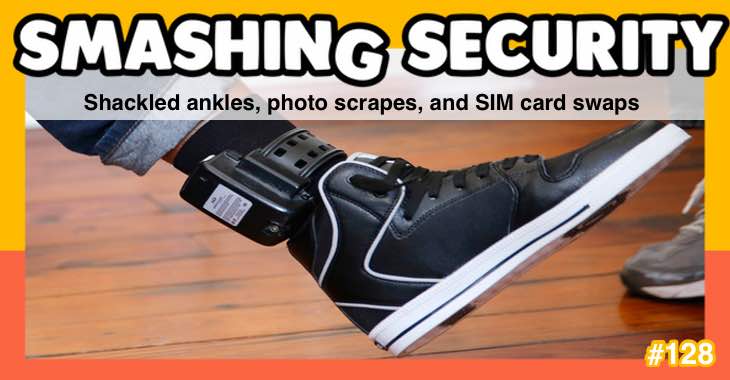
Or if that doesn't work, because they're quite tough on law and order over there, they may force them to wear an ankle bracelet, which can monitor their movements.
You know these kind of things, Carole? David, have you seen these?
And if an offender moves outside of their allowed geofence, it goes, "Brrp, brrp, brrp, brrp, brrp." Right? And the police get notified.
So have you ever considered what might happen if that monitoring technology goes a bit wonky?
They were monitoring something like 750 people in the Netherlands.
Some people were actually preemptively arrested and jailed. They were rounded up by the authorities, the most high-risk suspects.
So word must have got round that maybe these things weren't working.
But I say, it's no laughing matter, really, especially for those who may have been fearful that someone who committed a crime against them may have not been monitored by the authorities.
Well, as our Dutch listener base knows, that is me explaining that people who have been victims of crime and people who were witnesses in cases were told that unfortunately the people we're monitoring, we're not currently monitoring.
So, you know, keep away from your windows or keep your head down.
But astonishingly, this isn't the first time that the Dutch authorities have been caught with their clogs off over their ankle monitoring system.
These things are operating over the GSM network. And I suppose it's a bit like if here in the UK, for instance, was it T-Mobile or Orange or Vodafone or one of those anyway?
They went out, didn't they, for about a day and a half?
It was a bit beyond the Thunderdome because people could not cope anymore because I don't have a data connection or I can't communicate with my family.
Not the first time this has happened in the Netherlands. Last August, something similar happened. There was a widespread outage of the Dutch mobile phone network.
Over half of the suspects the Ministry of Justice were monitoring at the time went dark. And so they didn't know where they were or what they were up to.
So electronic monitoring seems like a great way to be able to reduce costs, but also give people some kind of limitations on their freedoms. But not if it doesn't work.
Was there just a really long rubber band or something that they would tie around people's ankles so you couldn't get too far away from them?
You know, it's as though once again someone's rolled out a new software patch to hundreds, thousands, whatever of devices, and somehow the testing just hasn't worked properly.
So again, that's the thing that needs to be sorted out.
I get that we can leverage technology to civil liberties, whatever you want to call it, but if you don't test it, then this stuff is going to happen.
That's the thing that's particularly upsetting here for me.
Maybe you have a subset of less criminal people, people who've been jaywalking, people who didn't tip at the barbers.
And those people— you wouldn't have a crime that though in the Netherlands, would you?
But you need to find some sort of lesser crime, try it with them first of all, and if they have a problem with them, don't roll it out to absolutely everybody.
You know, I think I'd pay attention.
Yes, I was working out there and learnt as much of the language as I possibly could and really, really enjoyed it, you know, from a linguistic point of view.
I love my languages, halfway between German and— obviously geographically halfway between German and English, but as soon as you get out of the way of all the J's then, and a lot of K's there as well, as soon as you get those out of your head and learn, it just makes sense.
The language is beautiful to speak. It doesn't really sound it necessarily, but as soon as you get under the skin of it, I loved it.
And the logic being that if a scammer did manage to brute force, socially engineer, or otherwise get hold of potential victim's username and password, it's unlikely they'd have visibility of the victim's smartphone too.
So that's why we've seen a number of service providers over the years, haven't we?
Banks, financial services, warn enforcing this, relying on this to an extent to confirm logins or new payees or even password resets.
Because text messages, mobile phones, they're infallible, right? Well, yeah, no, of course not. And this is where so-called SIM swap fraud is.
It's really quite clever, I guess, inasmuch as our friends the fraudsters manage to hijack a victim's mobile phone number. And to do this, they pull a social engineering coup.
I've got a new phone with a new SIM, but what I really need, you see, is I need my number switched over, because everyone's trying to contact me, and so they want to have a word with me.
So can we switch over my old number to this number, please?
And if you're anything like me, you'll just put it down to a dodgy network, you might eventually reboot your phone, wait a bit longer before—
And all that time, the fraudsters have done their work and they are long, long gone. Now, this isn't new for many of us.
And I first came across this, what, 3 or so years ago when it started to become fairly mainstream in the UK. Quite a big problem in the United States.
Speaking of which, we've learned a little bit more in the last week or so about who it is who's been perpetrating these SIM swap frauds and what they've been doing them for, allegedly.
I should stick allegedly in there somewhere. And so some of the sums of money that are involved as well.
The point is, once they've grabbed the phone number off someone else, they get your texts rather than you getting them.
So they're able to get those magic numbers which help them into a site.
One of them, there's a hacking group known as The Community that has been outed, and one of the suspects is this 20-year-old Irish dude who was arrested last week, I think, who, if he's found guilty, could face 100 years in jail for stealing around $2.5 million worth of bitcoin.
How did they steal it? Yeah, SIM swap fraud, targeting victims, assuming their mobile identity, and resetting their crypto wallet passwords.
And other members of that community also include three former employees of mobile phone providers.
Obviously, the value of that particular cryptocurrency's inflated somewhat between the theft and the award.
They don't actually say whether that cryptocurrency was bitcoin or not, I noted.
But yes, so it's New Yorker Nicholas Trulia who has to pay compensation and punitive damages, according to Reuters. And the investor victim was Michael Terpin.
And again, it was SIM swapping. They SIM swapped their way to that small fortune.
But also, interestingly, the victim here, Michael Terpin, is launching a case to sue the mobile network AT&T for a whopping $224 million for gross negligence.
But there's also a few smaller players, right, that provide additional services that go maybe above and beyond what you can get with these big players.
And we're going to focus on one of these photo cloud storage players, one called EverAlb.
Now I would us to pretend that this is an app that has been recommended to us by a new Smashing Security listener.
And let's say we mentioned the show that we were looking for a photo storage solution and they said, "Hey, check out EverAlbum, it's so great, it's so great." Let's say this just happened.
Do you go and install it right away? This is a free app, so there's no money having to be exchanged.
So you might kind of, I don't know, start at the website, just check out their webpage and see what they do. What is it?
And, you know, it would say it helps you capture and rediscover your life's memories. And you're kind of thinking, okay, marketing spiel, right?
And then you're kind of reading down and you kind of go, oh, it frees up space on my device by removing photos from your camera roll. And you're, okay, that's cool.
You know, if you're on WhatsApp or Instagram, or if you're on, you know, your iMessage or whatever the equivalent of Android is.
There's pictures all over the place and they're not always, you know.
And they say secure and private backup, right? Your photos—quote—your photos are always private until you decide to share.
Add an extra level of security with Touch ID protection. Okay, so right now, so you're seeing that again, this is all what they are saying about themselves.
That's what I'd be thinking at this stage, right? I'd be, well, what other people say? What, what are third parties say?
And you can see on the site that App Annie says one of the fastest growing photo apps worldwide in 2016.
And Wired says EverAlbum challenge to Google and Dropbox for storing photos online. Next Web bringing the emotion back to photos. So you're kind of thinking, okay.
It's a bit the quotes which you see on the front of books or outside West End shows where it says, "A marvel," it says, and they leave out the word "hardly" in front of it.
That would never happen to a legitimate, you know, responsible journalist.
Yeah, so at this point I might, I don't know about you guys, but I might go to the Apple or the Android store just to see what people say about the app, how many ratings it has, that kind of thing, right?
And say you saw 6,000 ratings and they had 4.5 out of 5 stars.
Typical review would be like, digging it, I honestly love this app and literally use it repeatedly throughout each and every day.
You've been through those with a fine-tooth comb to make sure that you understand exactly what it is they're going to be doing with all of these photos.
And if there's nothing naughty there, then yeah, you know, maybe it's good.
You might even have done some digging elsewhere and gone to Good Housekeeping, who gave it 4 out of 5 stars, or TechCrunch that said it was amazing, right?
I don't know what the feature would be, but it might be there's something which they're offering, which they say, look, you can do this, or you can print off albums or create collages of your pictures, but you have to have a silver membership to do that.
So it's not necessarily a bad thing because there might be some kind of upsell.
Carole, I have to say that if your answer is yes, we should feel comfortable installing this, this is possibly the dullest and weakest security you have ever brought to our podcast of 128 episodes, and that's saying something.
And the clincher is all without telling the millions of users who own the copyright to all those photos.
Hugely concerning, he says. Now let's be clear, they are not being accused of sharing these photos with third parties.
Rather, the billions of images are being used to instruct an algorithm on how to identify faces.
And every time an Ever user enables facial recognition, which is a feature in the app, and they enable that on their phones to group together images from disparate apps and technologies and services, Ever's facial recognition technology learns from the matches and trains.
And that knowledge powers the company's commercial facial recognition products. So my question is, is this cool or not? What do you think, boys?
Why don't they be, you know, there's a million ways in which they could exploit these photographs and this data if they wanted, just doing facial recognition.
Where's their American entrepreneurial spirit, the swine. So what a ghastly, dastardly thing to do.
And they're doing it without our knowledge and consent because there's not enough liability laws in this space to help control this kind of behavior.
So NBC and the amazing Olivia Solon, I think it was back in March, wasn't it? Yes.
So they did an exposé on something that IBM has been doing with its facial recognition AI, where it's been taking a look at faces that are in the public domain, specifically from Flickr, photo sharing site ex of Yahoo, Flickr.
And it's been basically taking a lot of the photos that were uploaded there under Creative Commons licenses, license terms, which in theory means that people are able to download them and start using them.
But, and I think this is the thing, that the people who were uploading those images to Flickr didn't realize that their faces or the images they were uploading of their friends, family, whatever, would be used specifically for research purposes and for developing an even stronger AI for IBM's Watson system.
And, you know, there is now a way that photographers can request their images be removed from IBM's facial recognition AI system.
So it's not just the startups, it's the big players that are in this as well, and they will get their hands on whatever dataset they can legitimately or illegitimately use to try and beef up their bots' brains.
So they did this prior to it and updated their privacy policy. I think it was April 15th, if I remember correctly.
And I just wonder how that GDPR, that old favorite, how that applies because obviously a face, whether there's your names associated to it or not, it's obviously a pretty big identifier of who you are.
So is your face anonymous? Or not. It was an interesting question.
Anyway, we're going to see a lot more of this crop up as we descend into the stinky bowels of all things digital and technology. So watch this space. Clunk flush.
Need something just to cleanse the palate a little bit. Something like a sponsor break.
If you're baffled by threat intelligence and how it might be able to help secure your company, the Threat Intelligence Handbook from Recorded Future is the book for you.
It'll tell you what threat intelligence is and what it isn't, and you'll learn how other firms are applying threat intelligence inside their organizations.
Grab it now for free at smashingsecurity.com/intelligence.
Passwords are really sort of the hinge pin of so many security attacks which happen, which means that you probably want an enterprise password manager like the one offered by LastPass.
They're gonna be talking about cyberattacks, artificial intelligence, blockchain, machine learning, and much more.
It's all taking place between June 17th and 19th at the Gaylord National Convention Center in National Harbor, Maryland.
So I'd really recommend that if you are a CISO, IT security and risk professional, you probably want to go to the Gartner Security and Risk Management Summit.
Could be a funny story they've read, a TV show, a movie, a record, a podcast, a website, or an app. Whatever they wish. It doesn't have to be security-related necessarily.
But one of the things which I found him watching is a YouTube channel which I actually approve of, which is not true of most of the YouTube channels he watches.
They're mostly full of cretins with purple hair and screaming all the time, getting very excited, lots of fast editing. I'm just like, oh, this is horrible and ghastly.
But what is wonderful is a YouTube channel called Oversimplified, and the person behind Oversimplified — yeah, well, as a fellow artist, now I was about to say, Carole, because his artwork does remind me of another celebrated artist who has exhibited recently at the Oxford Art Week.
Yes, we just finished. It is a stick figure kind of artwork.
And what he does is he will take something from history and he will explain it in a fashion which is both understood by an 8-year-old boy and his middle-aged father. Brilliant!
I love this. It is wonderful and it's entertaining and it's educational.
And so my son will be sat there eating his cornflakes in the morning and he will be watching videos about the Cold War or World War II.
It's amusing, but it really, and it's absolutely ignited this love of history within him. And he finds them both amusing.
If you go to smashingsecurity.com on each episode, you will find our show notes there if they're not displayed properly inside your podcast app. Oversimplified on YouTube.
But I can tell from the animation that a lot of care goes into creating these.
And yeah, hearing the stories of how much research goes into the creating of these and making sure that the scripts are absolutely correct before you get anywhere near the animation, it's very easy to dismiss cartoony-type educational videos on YouTube.
A, because they're on YouTube. B, because they're, you know, cartoon animation, whatever.
But actually, if what I think from what you're saying and what I get from similar channels is true, then actually these are priceless.
So yeah, I'll certainly be taking a look through these myself.
I think he did the video about the difference between England, the United Kingdom, and Great Britain, which I remember got lots of —
This is a series that I've been working on since 2012 as their tech face.
And I know we're not meant to be talking about security-related things, but there are a few security stories that I've been covering this series, including things along the lines of Facebook and how some fraudsters are copying Facebook pages and how, as consumers, you can tell the difference between a business's genuine Facebook page and a fraudster's copycat version of them.
And obviously, there can be some pretty big money that gets lost as a result of that. And also this scam called brushing, which, if you haven't come across it before.
It's quite counterintuitive. Well, it is.
Let's say that you order stuff from Amazon, and then all of a sudden you start getting stuff arriving on your doorstep that you haven't ordered.
And you're thinking, "What on earth is all this about?" And you're thinking, "Well, do I send it back to Amazon, or do I keep it?" And then more and more and more stuff starts to arrive.
Now, you are a "victim," in inverted commas, of a brushing scam. It doesn't sound too bad because you're receiving free stuff on the face of it.
But what's actually happening there is that it's all about gaming the online review systems.
And, you know, in a marketplace where there's lots and lots of traders selling fairly similar things, it's those who shout loudest or have the most 5-star reviews and glowing reviews that tend to go to the top of the pile and make the most sales.
So the long and short of it is this is a way of getting verified purchase reviews.
These items have been, in theory, fraudulently bought, fake purchases, but they're verified purchases.
They just send them out to random people, let's face it, and then post glowing reviews of them, those glowing reviews force those items through to the top of the searches on Amazon or other marketplaces as well.
But it's 4 times a day someone comes along delivering a parcel or something. I'll have to speak to my wife to find out if that's—
And this is where you have to visit every station on the London Underground in a shorter amount of time as possible.
And it's no mean feat, but let me tell you, it's very, very competitive.
You know, they get off in all the various towns and she'll find the local castle or whatever it is, and/or local beauty spot, and she'll tell some terrific history stories about that.
It's very engaging viewing. They're both lovely, lovely people. I love them to bits. And this year they went and did the same thing, but in Ireland.
They visited all— hang on, let me get this right— 198 stations in Ireland and Northern Ireland.
And once again, they did a Kickstarter campaign, and people are very, very happy to donate to this. And a load of videos came out as a result of it.
Very, very different to the UK inasmuch as they're visiting stations that— obviously I'm talking to viewers or listeners to Smashing Security around the UK.
They're stations you may be familiar with. In Ireland, it's a different country, different culture in many ways.
And you learn so much about the history of a culture and its people through how they get to work, through how they travel from place to place.
And these historical train stations are fascinating.
Looks like Northern Ireland main may not have been updated all the videos yet, but he's obviously been to all of them and taken videos.
And yeah, there's a load of stuff on there, you know.
I couldn't be happier to support Geoff in what he does because I think he loves going on adventures and certainly does he do that. Cool.
And when someone is as enthusiastic about a topic, even if it's something which doesn't appeal to your own heart, you can be carried along with it, can't you?
And I think he's definitely got that about him.
You can't help but go along on whatever their story is.
Go ahead, show everyone how you would normally deliver a solid apology.
When you get a really excellent apology, you basically forgive the perpetrator or the apologist.
So just this morning, I was cleaning up my pigsty that was my house following a few weeks of art gallery parties and art production and all kinds of crazy things.
And I was listening to the latest TAL podcast.
Now, after a very cute intro about asking people what they do this little intro interviewing people asking them why they've ghosted people in their life that they've been dating.
They go into this apology and it's an 8-minute apology. And Nancy Updike, she's a fab producer on This American Life, and she says it's startling because it was not curt or vague.
It wasn't a lawyered-up mess of non-contrition in a passive voice. It is a true reckoning, and it's great. So I'm telling everyone, go listen to this episode.
Again, it's episode 674 from This American Life. And I think more apologies that are heartfelt and vulnerable and strong are needed in this world. So there you go.
That's my pick of the week. Apologies. Good ones, Graham. Good ones.
I have, while you've been speaking, I have dug out from my little notepad how to say sorry, because sometimes I do have to say sorry, and I have a little 3-part guide as to how to say sorry.
Now, I don't know how often I put this into practice, but would you me to explain what the 3 stages are?
I can see that the fridge has fallen on your foot and you've hurt yourself or something. Number 2, and this is an important one, say you're sorry.
I'm sorry I dropped the fridge on your foot, which has caused pain. Number 3, describe what you're going to do to make it right or make sure it doesn't happen again.
Next time, I won't try and pick up the fridge, or I'll ask a competent adult to pick it up instead, and I'll ask you to move your foot and step away beforehand.
And yes, the woman called them out publicly, and he then apologized publicly, and that apology was received and accepted by the person who he sexually harassed because that's how good it is.
So take a listen to it.
I'd be like, okay, done. For real. I'm not kidding. So take a listen. It's good. And I'm, you know, well done to This American Life for publishing something so cool.
He is a co-creator, the creator of one of my preferred TV shows, Rik and Morty. And he was also on the NBC comedy show called Community. And that's where it all happened.
I'm sure lots of our listeners would love to follow you online. What's the best way for folks to do that?
And if you want to cover yourself with t-shirts and stickers and mugs and things like that to promote our podcast, go to smashingsecurity.com/store.
Their support helps us give you this show for free, so be sure to check out their offers. And high five to all you listeners out there!
Check out smashingsecurity.com for past episodes, sponsorship details, and info on how to get in touch with us.
And Angela Rippon is as formidable in real life as she comes across on screen. She does not suffer fools gladly. But yeah, they're all great.
Hosts:
Graham Cluley:
 @grahamcluley.com
 @
@
 / grahamcluley
Carole Theriault:

Guest:
David McClelland – @davidmcclelland
Show notes:
- Vote for Smashing Security in the EU Security Blogger Awards
- Software update crashes police ankle monitors in the Netherlands — ZDNet.
- Irishman facing more than 100 years in US prison for alleged $2.5m cryptocurrency fraud — Independent.ie
- U.S. investor awarded $75 million in cryptocurrency crime case — Reuters.
- The SIM Swap Fix That the US Isn't Using — Wired.
- Everalbum Photo Organizing App — YouTube.
- Facial recognition's 'dirty little secret': Millions of online photos scraped without consent — NBC News.
- Everalbum Review — Good Housekeeping.
- OverSimplified — YouTube.
- CGP Grey — YouTube.
- The Difference between the United Kingdom, Great Britain and England Explained — YouTube.
- BBC One – Rip Off Britain, Series 11, Episode 3 — BBC iPlayer.
- All The Stations.
- Get a Spine! — This American Life.
- Smashing Security merchandise (t-shirts, mugs, stickers and stuff)
- Support us on Patreon!
LastPass Enterprise makes password security effortless for your organization.
LastPass Enterprise simplifies password management for companies of every size, with the right tools to secure your business with centralized control of employee passwords and apps.
But, LastPass isn’t just for enterprises, it’s an equally great solution for business teams, families and single users.
Go to lastpass.com/smashing to see why LastPass is the trusted enterprise password manager of over 33 thousand businesses.
For anyone who is baffled by threat intelligence, and the benefits that it can bring to your company, this is the book for you.
“The Threat Intelligence Handbook” is an easy-to-read guide will help you understand why threat intelligence is an essential part of every organisation’s defence against the latest cyber attacks.
Download it for free at www.smashingsecurity.com/intelligence now.
Smashing Security listeners can save $350 off the standard registration rate by using the code “SMASHING”. Go to smashingsecurity.com/gartner for more information.
Follow the show:
Follow the show on Bluesky at @smashingsecurity.com, on the Smashing Security subreddit, or visit our website for more episodes.
Remember: Subscribe on Apple Podcasts, Spotify, or your favourite podcast app, to catch all of the episodes as they go live. Thanks for listening!
Warning: This podcast may contain nuts, adult themes, and rude language.