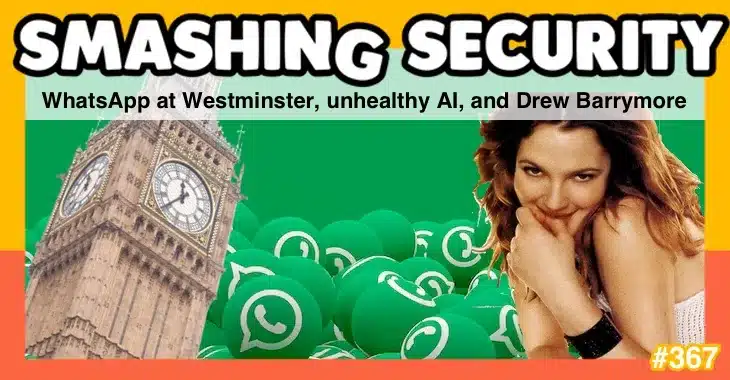
MPs aren’t just getting excited about an upcoming election, but also the fruity WhatsApp messages they’re receiving, can we trust AI with our health, and who on earth is pretending to be a producer for the Drew Barrymore TV show?
All this and much much more is discussed in the latest edition of the “Smashing Security” podcast by cybersecurity veterans Graham Cluley and Carole Theriault, joined this week by John Hawes.
Warning: This podcast may contain nuts, adult themes, and rude language.
Show full transcript ▼
 This transcript was generated automatically, probably contains mistakes, and has not been manually verified.
Unhealthy AI and Drew Barrymore with Carole Theriault and Graham Cluley. Hello, Hello and welcome to Smashing Security episode 367. My name's Graham Cluley.
But yes, pleased to have said, kicking off a big stink on the Smashing Security show certainly helps.
You can't write to us and we can't make it a reg— maybe we could make it a regular segment.
Of the show where we have a different listener who's having a problem with Amazon customer service. See if we get a result. Maybe not.
Now, coming up on today's show, Graham, what do you got?
Has anyone from your past ever messaged you out of the blue?
I mean, basically, even my— I don't even hear my door being knocked on now.
What I'm thinking is that there might have been someone maybe who suggests they felt a little tingle for you back in the day and you felt a little tingle for them.
And maybe it's something that they want to reconnect with and re-explore.
Well, this is what has been happening in the hallowed halls of the British Parliament, the Houses of Parliament itself, because politicians, staffers, and journalists have been reportedly bombarded with racy WhatsApp messages.
Ooh. Either from someone called Abby or someone called Charlie. Have you heard about this? It's been in the newspapers. It's been causing the headlines.
And they reported how several men from the heady world of politics had been sent these unsolicited WhatsApp messages.
From two suspicious phone numbers between October and February this year. And the people sending these messages, they sign themselves off either as Abby or Charlie.
And the conversation always seems to start the same way. They say, oh, hey, you know, hi, met you a while ago at this political event venue.
You know, we got sloshed, something like that. You know, we're at the bar or at the party conference. We're working on the local by-election campaign and long time no speak.
So you might well say, sorry, do I know you? And then they reply, ha ha ha. They say, ha ha, it's Charlie, they say. I used to work in Parliament. We swapped numbers.
And it's all a little bit kiss kiss, you know, it's all a little bit flirty, you know, it's, oh, what's this? You know, they're saying, are you still single?
You know, what's going on? And before you know it, the conversation has turned sexual.
In fact, I think I just view contact information, so maybe people are sending me messages I don't even know because they're not my contacts, so I don't care.
Have you heard of a thirst trap?
It's to lure in the people, the gender that you're interested in to be going, oh.
And in some cases, this Charlie fella, he said, you know, oh, I used to work in Parliament.
Charlie would brag about having had sex with several Conservative and Labour MPs, because that's the sort of thing you boast about, isn't it?
So there's a picture of—in fact, the same image is being used both by Abi and Charlie.
So you're not sure which one of them is sending the message, but one of them calls themselves Abi.
Remember me?" And then you see a picture of them and you're, "No and no." Surely that's end of.
And you may not remember absolutely everyone who you flirt with. You're obviously not living that kind of life.
John, you work in the anti-malware testing community—are there any events where those sort of things happen?
Anyway, it seems you would get contacted by Abi or Charlie depending on whether you were likely to be interested in men or women.
An unusual exception was BBC chief political correspondent Henry Zeffman.
He has written an article about how he was approached, and his situation was unusual because he got approached by both of them—both Charlie and Abi contacted him.
But, you know, I suspect that was actually the person who sent the message being a little bit sloppy in using the same phone number, forgetting if they were Abi or Charlie when they were sending the message.
He contacted the police—I think very, very sensible thing to do, because if you're an MP you've always got to be on the lookout for someone trying to get dirt on you, right?
It could be a tabloid newspaper, it could be an enemy state, it could be the opposition, someone who's trying to catch you out in some way, or maybe a potential blackmailer.
Contact the police and say, "Had this strange thing sending me pictures of themselves in tight tennis shorts. What should I do about this?"
Is cyber flashing something which only someone with a penis can do, or is it something that you could do if you were—
Where did they get these phone numbers from of politicians, political journalists, staffers, etc., etc.? And this has been revealed to us since the initial story, right?
Presumably their number's reasonably easy to get hold of compared to a normal person.
The mobile phone number, you would think that you would just get deluged with people signing you up for stuff or sending you unpleasant messages.
Well, it has since turned out that another MP, a chap called William Wragg, he has admitted providing phone numbers of his fellow MPs to a man he met on Grindr, the gay dating app, which is— Question!
Yes?
He said he's apologised for his weakness.
He's also said he never hired Charlie as a parliamentary aide because Charlie was contacting these other people saying, oh, I used to work for William Wragg in Parliament.
And William Wragg said nothing to do with it.
So what happened was William Ragg says that this Charlie fella had managed to get some compromising photographs off him. So they had been flirting.
Otherwise I'm going to make life a bit difficult for you. In other words, he was being blackmailed. So William Ragg says he got chatting to him. They exchanged photos.
They were meant to meet up for drinks, but the other guy didn't show up.
Then he started asking for numbers, and he was, you know, the MP was worried because he basically had kompromat on him.
So it appears that someone was trying to gather information about MPs, maybe get their phone numbers, maybe who knows what else would have transpired. At the end of this.
But William Ragg initially had not gone to the police. He had given in to the blackmail.
I used to think that would be a good hobby.
He's not resigning as an MP or anything that. He's going to carry on as Conservative MP, at least until the next election.
He says he is going to stand down the next election, as many other Tory MPs are.
But he went astray when the guy's, you know, but give me the numbers or else.
He's probably got more to lose than you or I have got to lose by being blackmailed by, for instance, Russian agents or something that.
You know, you're not paying attention and showing off everything. And then you can say, look, I was just walking across to get a cup of coffee in the buff.
You just drive past the house naked very, very quickly and say, if you happen to look out the house now, you might see me going past. So we don't know who's behind the attacks.
Was it a tabloid newspaper? Was it an enemy state? Was it YouTuber pranksters? You know, we don't know.
But I think there's some advice we can offer our listeners, which is, if someone suspiciously hot starts messaging you out of the blue, it's probably a trap.
No one sexy is trying to have sex with you. It's just not happening.
This is a golden age for quantity surveyors and estate agents and traffic wardens because they're not the least sexy profession anymore, right? Politicians are.
So there's no chance of you having sex. No one's interested in flirting with you. You're considered vile. And the other thing is Westminster, get your act together.
This is like cybersecurity 101. It's gone horribly, hilariously wrong. But just be sensible. I mean, what's next?
Are MPs going to believe they're going to inherit a fortune from a Nigerian prince? You know, this isn't complicated. They should know how to protect themselves and act sensibly.
Was it just this one guy that actually engaged, or did other people start saying, oh yes, Charlie, I don't remember you, but here's a picture of my armpit?
It's unclear how many may have taken the flirtation a little bit further and actually exchanged images and maybe other information as well.
And of course, it may be more than 17 people this has happened to who are nervous about going to the authorities and saying, "Yeah, we've done it as well." So the Speaker of the House has said, if there's anyone else out there who's done this inside the House of Commons, please let us know because we are trying to investigate.
And The Economist magazine did a big quarterly technology special on it. So AI has been in use in health things for quite a long time now.
I'm sure you probably remember the Google DeepMind when they brought out their AlphaFold, which could fold proteins into shapes.
And basically once you have that string, it kind of folds up into a shape and that shape affects what it does.
And something people have been working on for 50 years or so and had solved a few, I think something like 160,000, something like that had been solved in that 50 years.
In the 3 or 4 years since it's been around, which compares to the 170,000 in the 60 years people have been working on it without this kind of technology.
And there's a lot of similar techniques being developed to help in developing drugs, which is probably a good thing, hopefully.
I mean, it's not made an enormous impact yet, mainly because the process of putting out a drug, it's not just, oh, look, we've made it, we've made a molecule. Done.
What it's really doing is identifying potential drugs that then have to go through great big long trial processes, which are the same as they always were, and take years and years and cost billions.
So it's reduced the time to find the candidates and possibly made the candidates better, but if still 80, 90% of candidates are rejected very early stages of trials, and then the trials have to be completed anyway, there's not really any safety angles there that I could see.
So again, AI has been used in that for a long, long time.
I think it was 12 years ago that the first machine X-ray readers proved to be better than humans at spotting potential issues in scans and things.
And then they've been getting better and better all the time. So it means you can process a lot more data with a lot fewer doctors, obviously.
You can use less X-rays in radiation because the machine reading it doesn't need it to be as bright. You can have much smaller machines that are much cheaper.
So you can have a tricorder, in Star Trek, where you just go and run it over someone rather than having a huge room-sized machine.
And in that side of things, the trial testing side isn't really keeping up, or possibly people are getting around it by not having very good testing methodologies.
So people are implementing these things when no one's really sure how good and accurate they are, which can be a problem.
I mean, the main issue with that side of things, with reading scans and things, is false positives.
So a machine would look at an X-ray or an MRI or something and say, oh, there's a weird blob there. Probably the lurgy. We're going to cut you open and chop it out.
So human doctors aren't perfect either.
So there's also the human interaction side of things, the doctor-patient relationship, how we find out from people what's actually wrong with them, which is another area where AI is really, really coming into quite widespread use, I think.
So we've had these flowchart type things that you have on the NHS website. You go there and you say, I'm feeling a bit poorly. And it says, oh, what's wrong with you?
And you say, oh, my head hurts. And then you click through various yes/no type questions.
But so that those things are kind of similar to AI, but they're much more carefully curated data.
So all the information that they're relying on has been reviewed by experts and plugged in very, very carefully, and then the results are fully traceable.
So when you get to the end and it says, okay, I think there's a 90% chance that you've got the lurgy, it can show exactly why it's made that decision.
So doing pretty okay, but ChatGPT has read all the medical textbooks, so.
You can't trace back all of the inputs that it's based that on.
Go check those links and make sure the information is in there. But the other thing I've been reading a lot about is how all the AI competitors are screaming for data, right?
Because the AI models are chewing up data and storing data faster than we are producing data.
And one of the worrying things I read is that we're now getting AI to create data to feed into the AI model.
So we need to kind of put some AI stuff on the front to make it able to converse with a person and maybe even put a face on it and a voice so you can consult with it like you would at, I don't know, I haven't seen a doctor in person for years.
It's always over Zoom these days. So you could easily just be a, you know, a deepfake doctor.
So there's the ones that the medical teams are making and they're trying to make feel more human.
And then there's the other side where there's ChatGPT and things like that, which already can seem perfectly human.
We just need to plug in a bit more medical knowledge and a bit more carefulness maybe.
And there's a kind of a race between those two as to which one is going to become the most popular.
It feels a bit like the IoT issue where people who made washing machines and TVs suddenly said, oh, you know, we can just plug in some internet into here and that'll make it way better.
And then obviously they didn't really know exactly what they were doing. So that's a big risk.
Because you could go through it and how many people now go to hospital and it's like, "Oh, you just have a splinter.
Let me show you how to get rid of it," or something like that, as opposed to something super serious where you need professional medical attention.
Yeah, well, that's again, back in the reading scans thing, that's where it's really helped a lot because in a lot of things, traditionally, you would need to have two doctors, one radiologist or whatever, one looking at it and the other one checking to make sure they got it right.
Whereas now in a lot of less serious cases, they can just say, okay, the AI has spotted something. One doctor looks at it and goes, yeah, I agree, done.
So you're saving a lot of time and effort there as well.
Apparently, in a lot of cases, people feel it's more private to be talking to a machine about sensitive stuff than an actual person.
But, you know, how much of that conversation is actually being recorded? It's all being fed back into the AI's learning system.
So no matter how much people try to anonymize it, if the AI has not been built exactly right, it might just one day turn around to someone and spit out, oh, Graham's got the clap.
And then when all that huge piles of data are building up and getting ever more interconnected, that there's always that risk that the data might get stolen or leaked.
Just this week, there was another massive ransomware attack on a big US healthcare company. It took 4 terabytes of patient records and stuff.
They say, oh, pay us the money or we'll put it on the internet or we'll sell it to somebody else.
And then also, of course, there's no reason why, if they can go in there and copy everything, why couldn't they go in there and make a few little weird changes here and there, make it look like everybody's got hairy toes.
Because it's bad enough what people are receiving on WhatsApp at the House of Commons, let alone Would that be considered cyberflashing if they're really too hairy?
And maybe that's why I'm so out of touch, because I'm not— I can't even bring myself to manage the glut of emails. I mean, 99.9% I have not wanted or requested.
And I used to be obsessed with being in the know, but now I just want to know what I need to know and not clog up my brain and emails with useless facts because I don't care anymore unless it's for the show, in which case I care a lot.
But here's a weird fact that I didn't know. Did you know that famous child actor Drew Barrymore has her own talk show?
And this show, which I've never seen, seems to follow the format of chatting with a variety of people, such as other actors that were famous when they were kids, interior designers testing out viral beauty hacks and the like.
Do you know that guy called Guy Fieri? Was it called Diners and Dives, something like that? That TV show where he goes around America?
Drew focuses on human interest stories, celebrity guests, lifestyle segments, and field pieces, all driven by a particular brand of humor and optimism that is Drew Barrymore.
Now, the show's launch took place in Manhattan during the lockdown, so there's no in-person audience, right?
Instead, members of a virtual crowd would be beamed in via a platform called Audience and then projected on a large display behind Barrymore.
Well, Variety put out an exclusive this week saying that the show is facing a bit of a booking nightmare.
Because it seems that ne'er-do-wells have been fraudulently posing as officials from The Drew Barrymore Show in attempts to scam talent and other guests.
So they reported last week that the ruse has been flaunting paid opportunities for prospective guests and attempting to arrange social media efforts like Facebook broadcasts for a fee.
And some people have even been solicited for invoices, which include requests for personal banking information.
But the people that were contacting these potential guests had nothing to do with The Drew Barrymore Show at all.
So the talent booking team at Drew began notifying celebrity representatives across the industry about the matter on Friday last week, saying, hey, it's not us, you know, this isn't us.
And the memo which went out to publicists and agents said, it has recently come to our attention that one or more individuals have fraudulently been holding themselves out to be connected with the Drew Barrymore Show and soliciting participation in Facebook Lives and other paid opportunities.
The solicitations seem to be coming from various mock email addresses containing some part of the Drew Barrymore name.
And this is not the first time in recent history that Drew Barrymore's name has been ensnared into fraudulent activity.
Do you remember earlier this year, we heard about advertisements promoting Le Creuset cookware on the socials, and they seem to have these celebrity endorsements?
Well, Drew Barrymore's name was used in one of these.
So I'm thinking, if you're a celebrity, you have to basically spend quite a big proportion of your time going around going, "Not me, gov. Not me. That's not me."
All we'd hear, if we were lucky, is reports of some potential guests getting in touch with us going, "Hey, when am I on air?" Right. So what would we do?
We would warn people on the show saying, "Don't fall for the scam." I suppose so, yes.
This is the way to get in contact with us. If you want to be a sponsor on the show, here's how you do it. See what I did there? Here's how you contact .
That's the best way. The only way to contact.
I'm thinking email Graham or John because you both read your emails. We got your numbers. I trust you both, right? You're people I know that you read all your emails.
And then, you know, maybe this is the real bonus of a lifelong friendship.
Companies that continue relying on outdated technology put their sensitive data at risk.
Well, this podcast is sponsored by KiteWorks, who enable organizations to effectively manage risk in every send, share, receive, and save of sensitive content.
To do that, they've created a platform that delivers content governance, compliance, and protection to customers, tracking, controlling, and securing sensitive content as it moves within, into, and out of organizations.
All while ensuring regulatory compliance on all sensitive content communications.
KiteWorks provides the industry's first private content network for protecting risky third-party communications with secure email, secure file sharing, secure mobile, secure web forms, managed file transfer, and governed SFTP servers.
Visit kiteworks.com to get started today. That's kiteworks.com. And thanks to them for supporting the show.
Vanta gives you one place to centralize and scale your security program. Quickly access risk, streamline security reviews, and automate compliance for ISO 27001, SOC 2, and more.
You can leverage Vanta's market-leading trust management platform to unify risk management and secure the trust of your customers.
Plus, use Vanta AI to save time when completing security questionnaires. Smashing Security listeners, you get 20% off Vanta.
All you lucky sausages have to do is visit vanta.com/smashing to claim your discount. That's V as in Victor, A-N-T-A.com/smashing. And thanks to Vanta for sponsoring the show.
Well, that's pretty big news since these two companies are leading the industry in creating security solutions that put users first.
For over a year, Kolide Device Trust has helped companies with Okta ensure that only known and secure devices can access their data.
And that's what they're still doing, but now as part of 1Password. So if you've got Okta and you've been meaning to check out Kolide, now's a great time.
Kolide comes with a library of pre-built device posture checks, and you can write your own custom checks for just about anything you can think of.
Plus, you can use Kolide on devices without MDM, like your Linux fleet, contractor devices, and every BYOD phone and laptop job in your company.
Now that Kolide is part of 1Password, it's only going to get better. Check it out at kolide.com/smashing to learn more and watch the demo today. That's k-o-l-i-d-e.com/smashing.
And thanks to them for supporting the show. And welcome back, and you join us at our favorite part of the show, the part of the show that we like to call Pick of the Week.
Could be a funny story, a book that they read, a TV show, a movie, a record, a podcast, a website, or an app. Whatever they like. It doesn't have to be security related necessarily.
This week, there has been a birthday in the Cluley household.
And we went to the Royal Opera House in London, where we saw Carmen, Bizet's Carmen.
But there I was at the Royal Opera House and, you know, marvelous singing, the music, oh, the drama.
She gets strangled at the end, you know, but I guess they couldn't change the plot. Spoilers. But it seemed a little bit brutish. But where my nitpick comes is with the presentation.
And what do you think about taking something classic, something which is well established, where you expect to see a certain amount of spectacle, you expect to see it presented in a particular way.
And what they've done is they've placed it in another time period.
So The Carmen at the moment at the Royal Opera House has been set in the 1970s, and there are people with mullets, and, you know, it's all sex clubs, and, you know, is it mainly the mullets you're objecting to?
Well, it's just you do expect to see a certain amount of bosom and, you know—
There's the opinion of The Guardian, which did give it a very good review, and there's the views of me, which did say singing great, music great, fantastic, but I'm just not sure about when something's put in a different time.
What? Is this a gimmick? And no, is it a gimmick? Is it a gimmick?
What's happening now in downtown.
I wanted a bit more of that and a little bit less of the disco. That's my opinion.
Is it okay to take the classics and put them into another time period? That is my question for you.
John, what's your pick of the week, John?
I also very much a TV show that put out a new series this week. It's called Mandy. Oh, it's on the BBC. They did— they've done two series before.
I think the first one 2020 and the second one 2022. It's starring and created, written, made by Diane Morgan, who many people might know as Philomena Cunk.
She did a lot of work with Charlie Brooker, had her own mockumentary series, which was also great.
And Series 3 has now come out. And I was delighted to find the first episode was basically Mandy on a plane in a big dumb action movie scenario. And it was fantastic and great.
And I haven't watched the rest of it yet, but I'm very much looking forward to because it's going to be amazing.
I it so much, in fact, that it was my Pick of the Week a couple of years ago. So we have had this before.
It's lovely.
And it's centered around a first-generation Ivy League art history student who uncovers the genius work of a female artist Anna De Monte, who is a rising star in the '80s.
Now, the novel, while fiction, is inspired by a very real mystery involving Cuban-born conceptual artist Ana Mendieta, who in 1985 was found splattered on the New York streets, having either jumped in a suicide attempt, which people are saying super unlikely.
Or perhaps more likely, was pushed by her minimalist artist husband, Carl Andre. He was the darling of New York art scene at the time.
And rumor has had it, he was being driven mad by her rising success.
And González uses a two-pronged approach, one telling the firsthand story of Anna de Monte in her own words, but the other protagonist is a young art history student, also Cuban, who decades after Anita's death learns about this whole mystery and death while researching the husband's art career for her degree.
So the book delves into being a minority in elite environments, power, privilege, or lack thereof, and of course, the complexities of affirmative action.
And there's even an unexpected touch of magic realism in them. But the reason it's my pick of the week is because I did not read this book, I experienced it via audiobook.
Which is how I do things. And this telling of this novel is unlike anything I've heard before.
You have some seriously powerful performances by 3 different readers who make up all the different characters. And it is just— when I first— it opens extremely strongly.
So you could listen to the sample at the beginning and go, this is for me or not for me. But for me, it kind of cracks the door open of what audiobooks could become.
So I love the story, I love the writing, love the audiobook, highly recommend. So my pick of the week this week is Xóchitl González: Anita de Monte Laughs Last.
Follow Smashing Security in your favorite podcast apps such as Apple Podcasts, Spotify, and Pocket Casts.
For episode show notes, sponsorship info, guest lists, and the entire back catalog of more than 365 episodes, check out smashingsecurity.com.
Hosts:
Graham Cluley:
 @grahamcluley.com
 @
@
 / grahamcluley
Carole Theriault:

Guest:
John Hawes
Episode links:
- Naked photos sent in WhatsApp ‘phishing’ attacks on UK MPs and staff – Politico.
- How I was targeted in the Westminster honeytrap – BBC News.
- The Westminster honeytrap plotter tried to catch me too – The Times.
- How Westminster WhatsApp ‘honey trapper’ targeted party conference season – Politico.
- William Wragg quits Commons roles over Westminster honeytrap – BBC News.
- A new prescription – The Economist.
- Change Healthcare faces second ransomware dilemma weeks after ALPHV attack – The Register.
- ‘The Drew Barrymore Show’ Targeted by Fraudsters in Celebrity Scamming Effort – Yahoo! News.
- ‘Drew Barrymore Show’ Targeted in Hacking, ID Fraud Scam by Imposter Who Posed as Producer and More – Variety.
- Guy Fieri Calls Drew Barrymore “Gangster” For Talking With Her “Mouth Full Of Food” On ‘The Drew Barrymore Show’ – Decider.
- Beware The Fake Drew Barrymore Le Creuset Cookware Giveaway Scam – Malware Tips.
- Carmen – Royal Opera House.
- Mandy – BBC iPlayer.
- Anita de Monte Laughs Last – Bloomsbury.
- Smashing Security merchandise (t-shirts, mugs, stickers and stuff)
Sponsored by:
- Kiteworks – Step into the future of secure managed file transfer with Kiteworks.
- Vanta – Expand the scope of your security program with market-leading compliance automation… while saving time and money. Smashing Security listeners get 10% off!
- Kolide – Kolide ensures that if your device isn’t secure it can’t access your cloud apps. It’s Device Trust for Okta. Watch the demo today!
Support the show:
You can help the podcast by telling your friends and colleagues about “Smashing Security”, and leaving us a review on Apple Podcasts or Podchaser.
Become a supporter via Patreon or Apple Podcasts for ad-free episodes and our early-release feed!
Follow us:
Follow the show on Bluesky at @smashingsecurity.com, or on Mastodon, on the Smashing Security subreddit, or visit our website for more episodes.
Thanks:
Theme tune: “Vinyl Memories” by Mikael Manvelyan.
Assorted sound effects: AudioBlocks.