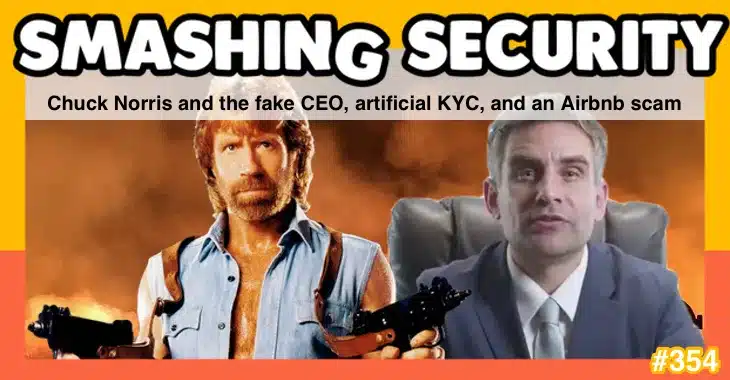
Chuck Norris gives a helping hand to a mysterious cryptocurrency CEO who may have separated investors from over a billion dollars, generative AI creates a nightmare for those wanting to Know Their Customer, and a determined journalist finally gets their revenge on a sneaky Airbnb scammer.
All this and much more is discussed in the latest edition of the award-winning “Smashing Security” podcast by cybersecurity veterans Graham Cluley and Carole Theriault, joined this week by special guest Maria Varmazis.
Warning: This podcast may contain nuts, adult themes, and rude language.
Show full transcript ▼
 This transcript was generated automatically, probably contains mistakes, and has not been manually verified.
Keep up all the great work and just know you are Chuck Norris approved. Your friend, Chuck Norris.
Hello, hello, and welcome to Smashing Security episode 354. My name is Graham Cluley.
Now coming up in today's show, Graham, what do you got?
Rather than each other because their own physical reality is too revolting.
Mark Zuckerberg has poured billions of dollars into it thinking it's the future before he realised artificial intelligence was actually the thing that people were excited about.
But, you know, people are strapping monitors to their eyeballs and choosing— it's just a horrible— anyway, I don't want to talk about the metaverse.
You heard about the multiverse where there's parallel universes and— This isn't real, by the way, Carole. Well, maybe it is. Who knows?
But rather when it did collapse, it resulted in approximately $1.3 billion.
In fact, according to experts, more money was lost in 2022 through Hyperverse than any other alleged crypto scam.
But in New Zealand, the UK, Canada, elsewhere, there were people and regulators and banks saying, we think Hyperverse could be a scam.
They introduced their new CEO, the new CEO of Hyperverse, a guy called Stephen Rhys-Lewis, at an online global launch event.
Video messages of support from celebrities were released.
Including from Steve Wozniak, the co-founder of Apple, Chuck Norris, the actor, all saying what a fantastic thing Hyperverse was.
And this Stephen Rhys-Lewis guy, he had an impressive resume, right? He was a maths and economics graduate at University of Leeds.
He held a master's degree from University of Cambridge.
He'd launched an IT startup and eventually had been recruited to head up Hyperverse, which he ran from his home in Dubai.
And we are very excited to slowly unreveal and share them with you.
They thought, well, let's go and speak to the CEO. And so they tried to contact him and they weren't able to contact him.
So they went to the University of Leeds and the University of Cambridge and they said, we've never had anyone here who's a student by that name.
Because if you called the company up and said, hey, did Steve Rees ever work there, they could say, we can't divulge any information on our employees, but universities always cough up, don't they?
Isn't that usually — maybe this is a country-specific thing, but usually they can just say yes, that person has worked for us, or no, they haven't.
Nor did any records exist of Stephen Rhys-Lewis at Companies House, which is where all companies register, or on the US SEC. He didn't even have a LinkedIn profile.
And I have to say, if you're going to fake your identity, create a LinkedIn profile, right?
So, this YouTuber, Nobody Special, he took it upon himself to do a little bit of digging.
So, he took a screenshot of the Stephen Rhys-Lewis CEO announcement video — so, he had his face and he loaded it into PimEyes. Now, I think we've spoken about PimEyes before.
It's an extraordinarily scary website where you can upload people's images and it will trawl the internet, not looking for that exact image, but actually do a kind of facial recognition.
So it will find social media pictures, all kinds of things of who it thinks is the same person. And it can be really, really quite convincing — you know, it's quite reliable.
It's like, bloody hell, it has found me here and there, you know, including pictures of me when I was much younger, more handsome, etc., etc.
Anyway, this YouTuber, Nobody Special, he found images of someone who looked very much Stephen Rhys-Lewis.
Found images of this guy sprawled drunkenly around in cocktail bars in Bangkok, hanging out with strippers and prostitutes.
So not living your typical — I mean, he's clearly quite drunk in these images.
And unfortunately, none of these pictures did reveal the man in the picture's true identity, right? It didn't say who he was.
So what Nobody Special, the YouTuber, did was he started searching for images of other people seen in these drunken snaps in Thailand cocktail bars alongside our mystery man, assuming they must be his drinking buddies because he was being photographed so often.
And one of them was a guy called Chris Moulton.
And he found Chris Moulton's Facebook page, and he was looking through images Chris had posted up on Facebook, and he found one of Chris with one of his mates eating pizza in a Bangkok bar.
It was clearly the same guy again, right? It's Stephen Rhys-Lewis, it's the CEO, and it's the same guy who appears in these Thailand cocktail bar pictures as well.
But the YouTuber who's investigating all this, he saw that the photo had been liked five times, and so he thought, "I'll just look to see who liked this." And one of the people who liked the photo was someone with the same face, and that was how they were able to identify Stephen Rhys-Lewis's true identity.
And his real name, it turns out, is Steve-O Harrison, originally from Bournemouth, which is a sort of fairly sleepy town on the UK south coast.
And what this YouTuber did was he compared videos of Steve "Stevo" Harrison with Stephen Rhys-Lewis. And it's clearly the same voice and it's the same look.
In fact, I'll play it now.
Here's a bit of Stephen Rhys-Lewis speaking, the CEO: "And we are very excited to slowly unreveal and share them with you." And here's Steve, Steve-O Harrison: "I'm currently training for Spartan in three weeks.
I'm going down there to do the trail run, which is 10K, and I think I've done this course before." I would say that's the same voice. Would you not agree?
He looked up Steve-O Harrison's LinkedIn account, and what you find is it describes himself as a TV presenter and sports pundit, not a cryptocurrency CEO.
He's a rent-a-CEO.
And there's a caption which reads, "Where reality ends and imagination begins." And I think that's really the case.
Now, interestingly, why have Chuck Norris, Steve Wozniak, and other celebrities fallen for this? Why are they endorsing Hyperverse?
This is the dawn of a new beginning with the metaverse odyssey. With endless possibilities. Keep up all the great work and just know you are Chuck Norris approved.
Your friend, Chuck Norris. I was going to say, you know, remember we were talking about it just before last, at the end of the year, that rent a— yeah, you pay a fee.
Well, it seems to be the same thing. So Woz has recorded a video where he's recorded it basically up his own nostrils. And Chuck Norris is a little bit more professional.
You'd think Woz would know where his webcam is. But these appear to be Cameo videos where, so this company just paid a few bucks.
You can normally ask a celebrity to wish someone a happy birthday, or in this case, endorse a cryptocurrency scam.
Someone else allegedly linked to the Hyperverse has been now arrested and charged in the United States. Someone who's known as Bitcoin Rodney has been.
Bitcoin Rodney, also known as Rodney Burton.
We're kicking off 2024 with some cryptocurrency scamming. I suspect there's lots more of this to come.
Come on, Chuck, get your act together and Woz, work out where to point your webcam next time. Maria, what have you got for us this week?
This story, I saw the beginnings of it trickling through on Reddit and the Fediverse of all things a couple of days ago, maybe about a week ago, I don't remember exactly, but right around the New Year.
And I saw a toot.
I saw an image that looked totally innocuous, and I don't often see a lot of images on my feed on Mastodon because I follow a bunch of nerds, so it's always text only.
And it was just like a very normal verification post is what the title said at the top of the image.
And the image below was of a like youngish woman looking right at the screen holding up a piece of paper.
It's a completely insignificant image that reminds me of the gajillions of these that I've done for— I've done one for Binance, for example, where you have to hold up a government ID, it's a terrible selfie, and they run it through— I don't know what they run it through, a person or automated system, both— and they— it's supposed to verify that you are who you say you are.
And of course everyone always looks kind of terrible in these pictures, but that's what this image was, just says verification post.
And I'm just wondering why am I seeing this on my Mastodon feed? Did somebody make a security boo-boo and post something publicly that they shouldn't have, like a credit card?
And then I looked a little more closely at the image, just a smidge, and I noticed that the piece of paper that she's holding up to the camera, it has two lines of handwritten notes on it.
And the first one was clearly a Reddit username— sorry, a subreddit name. And the second line was a Reddit username, which was u/yourmom.
And I'm going, okay, that's an interesting Reddit username. What is going on here? And then of course I did the thing I should have done, which was read the text that came with it.
And this was from user— oh right, yes, read the actual text in the tweet— I mean the post.
It's from a username Nixcraft, and they said this: this is crazy, Stable Diffusion created a verification image of someone doing their KYC for a bank or similar.
AI will impact know your customer, which is what KYC means, not Kentucky Fried Chicken or whatever I thought it was.
AI will impact know your customer identity verification processes.
As AI makes it cheaper and easier to impersonate someone's likeness and identity markers, which are often found in a breach, it will become simpler for attackers to take over accounts and steal money, data, impact brands, etc.
I was like, wow, that's a great thing to read on my feed first thing in the morning. So I did what any good nerd would do is I went straight to Reddit.
And I wanted to find the original post where this was happening. And I went into the rabbit hole on Reddit where this was posted. It was on Stable Diffusion.
And there's a Reddit user there who was publishing a workflow that I don't know much about AI at this level, but it wasn't— it was complicated but not impossible.
A workflow to create really convincing deepfake identification selfies. I mean, way, way more convincing than anything I've ever seen.
That would take maybe at most a day to fake someone else's government ID and verification image. And not only that, but there are also video versions of this.
So if you're thinking, well, you know, it could just, what's the difference between this and Photoshop?
There's a very easy way for generative AI to make these know your customer videos that someone could just upload pretty easily to, I don't know, your bank to pretend to be you.
And the barrier keeps just dropping on how easy this is becoming. And you know, this information is posted pretty wildly and widely.
And I always hated the idea because you only have one face. So biometrics are dead effectively in a lot of ways.
They also included a security research firm called Sensity that said they found that the 10 most popular know-your-customer providers are severely vulnerable to real-time deepfake attacks.
So I mean, I feel like an entire industry just got killed off effectively by GenAI right now. Whether or not you miss it, it's not really here or there.
But TechCrunch also included a quote from the chief security officer for crypto at Binance, which is the same thing that I had used for this exact thing.
And they said that yeah, this is very easy for deepfake tools to completely bypass their security measures for to pass liveness checks, which is what they call it.
So I guess everything needs to go back to in person is essentially what I'm taking away.
And I was like, what the hell is this CAPTCHA? So yeah, they're gonna just gonna throw random things at you, like find something that's pink in your house right now or something.
And so you have to go there, present yourself, and they will affirm that you are— They've closed all the branches.
I only rented a place once for one night with a very tightwad buddy of mine, and that experience was not great because we got what we paid for.
So imagine you're sitting around the corner from your Airbnb, you know, maybe you're sipping a cranberry juice, Graham, a latte for Maria, until it's time for you guys to check in.
And the caller explains, look, sorry, sorry, sorry, the previous guest flushed something down the toilet, flooding the unit.
'But don't worry, I've got another property until the problem gets sorted.' Thank goodness, right, thank goodness.
'I'm sorry you had to go to the inconvenience.' Honestly, I would.
'Find me somewhere else to stay.' 'Even though it wasn't my poop, wasn't my poop that blocked the loo, but despite that, on behalf of everyone who poops, I would like to apologize.' You're gonna take that on yourself?
So you change the reservation by the Airbnb app to this new property and off you trot to the new property and it takes you a bit to find it.
You can't find on the main street because it turns out it's kind of behind the house, where a garage would be, a garage turned flop house type thing.
And while it's big, it's a vamped up shed. And the furniture is crap. It's a bit of a shithole, basically. But you're, it's one night, it's one night.
And so the next day, instead of getting good news, you get a text explaining the plumbing in the original rental is not fixed and that new tenants are moving into the flop house the next day, so you need to skedaddle and just, you know, ask for your money back.
Refund, refund, refund.
And she ended up having to repeatedly badger her Airbnb, and even then she only recouped a third of what she ended up paying for the rental.
Okay, but she's a journalist, so she started digging, and she learned that the phone number that she received the call from was a Google untraceable number.
When she did a reverse image search of the couple who were supposedly renting the property, it turned out to be a stock photo. And she started reading the reviews of the property.
And other people were saying, oh, last minute, there was a problem with the property, and that refunds were being ghosted.
So as soon as refunds were being discussed, the phone calls stopped. They stopped taking calls.
But when you started looking at who they were, it turned out that they were also Airbnb-ers sharing very similar properties, like perhaps identical.
So in the show notes, I've given you 4 pictures of 4 different Airbnb-ers.
And she alerted Airbnb, but they showed little interest, and the active accounts remained open, and they did not respond.
And she started talking to people that left shitty reviews, and it turns out that she wasn't alone.
And it turns out that based on a bunch of small things the small print inside Airbnb, there's things like if a guest stays even one night in a rental, it's difficult to obtain a full refund according to the Airbnb rules.
In both cases, the rules favor a would-be scammer and places the onus on the guests who have just parachuted into some place with their luggage and have nowhere to stay.
Oh, and this was because Ali Conti published her very detailed piece in Vice way back in 2019. She got a call from the FBI wanting to hear more.
Here we are 4 years later, and Goel has been charged with wire fraud and aggravated identity theft.
20-page indictment laying out how the self-proclaimed visionary real estate investor allegedly grifted millions by running a double booking bait-and-switch scheme.
They would contact them sometimes minutes before their scheduled arrival to tell them the property was unavailable for the entirety or a portion of their stay, right?
And the indictment said that Goel would then offer to rebook those guests to an upgraded property free of charge. And many would accept without properly reviewing the new lodging.
And of course, the upgrade was usually inferior.
And in total, they said he used fake profiles and deception to make more than 10,000 reservations on Airbnb that amounted to $7 million in payouts.
And it's only when the FBI came knocking that they started playing ball.
I mean, excellent work by the journalist for doing this and well done to the FBI for investigating this. Obviously it was complicated or whatever, but it's—
That's a way maybe of just checking that it actually exists because in some places, you know, they couldn't even find the property and if they put you under pressure, try and ask you to switch up your reservation, just cancel it, and it puts you in a much stronger negotiation position.
Because seriously, who wants to go away expecting a little she-she bijou something-something and end up in some crappy shithole shed flop house, whatever?
So you Airbnb-ers out there, take heed. This episode of Smashing Security is sponsored by Kolide.
Wouldn't it be great if a device which lacked compliance or lacked security was denied access to your organization's SaaS apps and other resources?
Because this would mean that the hackers who had nabbed the unlucky employee's credentials, for example, could not gain access to your assets. It would effectively lock them out.
Welcome to Kolide, a world where access is only given to approved secure devices. As the administrator, you can manage every operating system, even Linux, from a single dashboard.
Another bonus of Kolide: employees can often fix their own problems without involving IT support, meaning less resources are needed to effectively operate a more secure environment.
Kolide is the device trust solution for companies with Okta. Kolide ensures that if a device is not trusted or it's insecure, it is denied access to your cloud apps.
Learn more at kolide.com/smashing. That's k-o-l-i-d-e.com/smashing. And huge thank you to Kolide Security for sponsoring the show.
Expanding the scope of your security program with Vanta's market-leading compliance automation, saving your business time and money.
Vanta has over 5,000 customers around the globe who are saving over 300 hours in manual work and up to 85% of their costs for SOC 2, ISO 27001, HIPAA, GDPR custom frameworks, and more.
And with Vanta's 200+ integrations, you can easily monitor and secure the tools your business relies on.
From the most in-demand frameworks to third-party risk management and security questionnaires, Vanta gives SaaS businesses of all sizes one place to manage risk and prove security in real time.
And as a special bonus, Smashing Security listeners can get a stonking 20% off Vanta. Just go to vanta.com/smashing to claim your discount. That's vanta.com/smashing.
And thanks to Vanta for supporting the show. And welcome back and join us for our favorite part of the show, the part of the show that we like to call Pick of the Week.
Could be a funny story, a book that they've read, a TV show, movie, a record, a podcast, a website, or an app, whatever they like.
It doesn't have to be security-related necessarily.
Because Carole and I, we used to do a press release each month. This is many years ago. This is 20 years ago.
But anyway, the trouble we got into with them.
There would be something, for instance, oh, you know, India has risen from 28% to 37% of all, as a percentage of all the spam spewed in the last month.
And Carole would come back and she'd say, 5% to 20%, it's risen 15%. And I knew you'd be on this, Maria, because Maria's a maths nerd. And she knows 5% to 20% is not a rise of 15%.
It's 15 percentage points.
Anyway, I'm not sure what my nitpick really is. Is my nitpick people who get percentages wrong in that way, percentage rises and percentage falls in that—
Maybe Carole is right that a rise from 5% to 20% should be able, you should be able to say that's a 15% rise. I wonder if I'm just being too pernickety.
I wonder if I've got this wrong. I'm just questioning all of reality right now. Maybe maths itself is wrong and it should be reinvented.
So my nitpick of the week is percentages, but more specifically, mathematics.
And I think you gotta read that book. I'm gonna make that a sort of semi-pick, 'cause it's—
My pick of the week is a television show that just completed its second season, and it is called Julia.
And some people might be able to guess that, yes, it is about Julia Child, the—
And she broadcasted on US public television from WGBH in Boston, which is my home station. She is very beloved here in the Boston area where I live.
And she's very famous in North America, I would say. I don't know if she's as well known outside.
She turned out she was amazing at it, came back home and did the show, and it was like a superstar.
And the interesting thing is, she is being played by Sarah Lancashire, who is a British actress and absolutely nails Julia completely.
So, I had no idea that she was not American, but she did a great job.
And aside from the fact that the story is fascinating and the series is extremely well done, one of the reasons I love it is they actually— this series has taken pains to get things accurate in terms of how it looks.
They filmed a lot of the show right here in the Boston area.
So, there are many scenes at a diner that is in my city that I sit in with my my daughter all the time, and I recognize it. And Julia Child is very much like a beloved Boston hero.
And so the fact that they actually didn't say, we're just going to put it all on the soundstage in LA, and they filmed it out here, to me adds a lot to the color and the flavor of the story.
So, I've really enjoyed it so far. It's honestly been one of my favorite TV shows I've watched in a while.
It's available in the US through HBO, and I believe in the UK you can watch it through Apple TV.
I have no idea outside of those two, I'm sorry, but it's widely available, so I recommend it highly. It's just called Julia.
I think we've talked about it in the show, people, old-timers out there, you'll remember we've talked about this, but basically I assumed it had been canceled right after the first season because who would?
But no, it's still going. There's 7 series.
That's the point of the show was they would pull up a little drawbridge to reveal your— So it was a dating show, but based initially upon whether you fancied someone's genitals or not.
Basically, if you want to check out naked bodies, you want to see people in the nude, this show is for you.
And then, soon, it seems that a Croatian mafia-esque family known as the Mimica, are involved. And maybe there's also a leak inside the cop house, maybe.
And I can't tell you anything about series 2 'cause it continues the same storyline. But I love the Croatian angle, right?
'Cause I love the sound that accent makes, and the actors are Croatian. And I love Mama Mimica. She's the head honcho family. Just great playing the mom queen.
And you're both very quiet. You've fallen asleep.
Or failing that, if this sounds really boring, you can also find Naked Attraction there, and you can look at boobies and dongs.
I'm just giving, you know, no judgment, just whatever your thing is. Yeah, Rule 34.
What's the best way for folks to do that?
And I also am on Sticky Pickles with Carole, so you can look up either T-Minus Space Daily or Sticky Pickles, either one, you'll hear my damn voice.
And don't forget to ensure you never miss another episode, follow Smashing Security in your favorite podcast apps such as Apple Podcasts, Spotify, and Overcast.
For episode show notes, sponsorship info, guest lists, and the entire back catalog of more than 353 episodes. Check out smashingsecurity.com.
Hosts:
Graham Cluley:
 @grahamcluley.com
 @
@
 / grahamcluley
Carole Theriault:

Guest:
Maria Varmazis:
Episode links:
- Chief executive of collapsed crypto fund HyperVerse does not appear to exist – The Guardian.
- Crypto hedge fund CEO may not exist; probe finds no record of identity – Ars Technica.
- BUSTED: Fake HyperVerse CEO Who Stole $1.3 Billion Unmasked! – YouTube.
- Hyperverse’s Steven Reece Lewis outed as Steve Harrison – Behind MLM.
- HyperVerse crypto promoter ‘Bitcoin Rodney’ arrested and charged in US – The Guardian.
- GenAI could make KYC effectively useless – TechCrunch.
- Airbnb Grifter Busted for $7.5 Million ‘Bait-and-Switch’ Scam, Feds Say – The Daily Beast.
- I Accidentally Uncovered a Nationwide Scam Run by Fake Hosts on Airbnb – Vice.
- Percentage Point vs. Percent Difference – Macroption.
- “Is Math Real?” – Book by Eugenia Cheng.
- “Julia” trailer – YouTube.
- Watch Before We Die – Channel 4.
- Smashing Security merchandise (t-shirts, mugs, stickers and stuff)
Sponsored by:
- Kolide – Kolide ensures that if your device isn’t secure it can’t access your cloud apps. It’s Device Trust for Okta. Watch the demo today!
- Vanta – Expand the scope of your security program with market-leading compliance automation… while saving time and money. Smashing Security listeners get 10% off!
Support the show:
You can help the podcast by telling your friends and colleagues about “Smashing Security”, and leaving us a review on Apple Podcasts or Podchaser.
Become a supporter via Patreon or Apple Podcasts for ad-free episodes and our early-release feed!
Follow us:
Follow the show on Bluesky at @smashingsecurity.com, or on Mastodon, on the Smashing Security subreddit, or visit our website for more episodes.
Thanks:
Theme tune: “Vinyl Memories” by Mikael Manvelyan.
Assorted sound effects: AudioBlocks.