


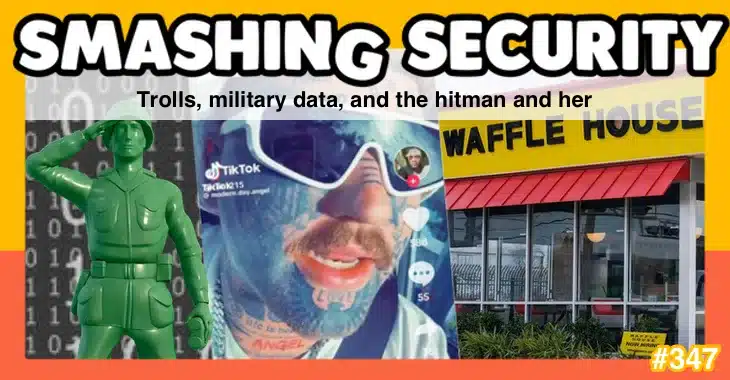
A woman’s attempt to hire an assassin online backfires badly, it’s scary just how cheap it is to buy information about US military personnel, and trolls and tattoos don’t mix.
All this and much much more is discussed in the latest edition of the “Smashing Security” podcast by cybersecurity veterans Graham Cluley and Carole Theriault, joined this week by The Cyberwire’s Dave Bittner.
Plus don’t miss our featured interview with Jason Meller of Kolide.
Warning: This podcast may contain nuts, adult themes, and rude language.

Show full transcript ▼
 This transcript was generated automatically, probably contains mistakes, and has not been manually verified.
My name's Graham Cluley.
It's their support that helps us give you this show for free. Now coming up in today's show, Graham, what do you got?
Jason Meller, will come and help us digest his latest findings from their 2023 Shadow IT report. All I can say is some of the results are shocking.
All this and much more coming up on this episode of Smashing Security.
So, the person she wanted killed was someone that we only know by the initials B.H.
Obviously, when she booked her assassin, she didn't say, "Kill anyone called B.H." I imagine there was a real name there.
I was thinking maybe Bob Hoskins, Billie Holiday, Bruce Hornsby, and his range.
And she filled it in and there was a portion of the form which requested describe what services you would like performed. And Jasmine Brown—
Now, the webmaster of this site contacted Jasmine Brown back, asking if she wanted to be put in contact with a field operative for her free consultation.
And the webmaster looked at the email which he got back from her, which came from the email address .
And she said, "I noticed on the form that you said your name was Jasmine Brown, but your email address when you email me—" You know how when you email someone, it can include your name as well, not just in the actual email address?
So, her one said Zandra Ellis.
And so, the webmaster said, "A little bit confusing this, because your form, you said you're Jasmine Brown, but your email says—" She said, "No, no, no, you don't understand.
I didn't want to use my real name. Good. Just in case this isn't real, or if it comes back to me, so I don't want to go and get jail or anything for wanting something done.
I just don't want it to fall back on me, she said. So I used a pseudonym when I filled in your form. Smart. Which seems smart to me, right?
When you're using an online form, don't always use all the real details because, you know, who knows if there'll be a data breach from the assassin website?
Who knows what will happen? Mm-hmm.
Well, a few days later, Zandra Ellis— let's call her Zandra Ellis as that's her real name rather than Jasmine Brown— Zandra Ellis received a phone call from someone who introduced himself as Ace.
Of course he did.
Ace asked, "When do you want to make the move?" And Zandra Ellis said, "Well, it depends on the price." And Ace says, "It's going to cost you a G, but you'll have to pay 10% upfront." In other words, $100.
And Sandra said, okay, look, I'll pay the $100, but it's gonna take a little time to collect the rest, unless I can do instalment, she said.
And she went, kind of went, lol, laughed out loud. It's gonna cost me a bit. But anyway, they agreed to meet at the Waffle House on Canal Street, New Orleans.
It's the best place to meet.
I'm going to have a gray blouse, whatever it is, right? And Xandra told Ace how she'd fallen out with this mysterious BH. Bruce Hornsby has upset her.
Bruce Hornsby and his range and his hob.
She says BH has upset her on social media because the two women— BH is a woman, it turned out— because the two women had children by the same man. And so there was a bit of—
Yeah, she hadn't wanted to put her real name into an online form as a precaution, because she's security savvy. She's careful about her privacy. But of course, Ace wasn't Ace.
And he had been contacted— They have a lot of that in America, a lot of juniors.
He had been contacted by the webmaster of rentahitman.com, which does exist, but rentahitman.com is a parody website that pretends to help you find a hitman.
So this woman had gone to this fake website, which is just a joke.
Not the deep web, not the darkweb, the World Wide Web. And you know, tell them Guido sent you.
Surf down to the bottom of the page, fill out the web form and submit it, and I'll tell you, I'll personally put you in touch with one of our over 18,000 field operatives that we have worldwide.
And your security and privacy is important to us, and we are 100% compliant with HIPAA, the Hitman Information Privacy and Protection Act of 1964. So check us out, rentahitman.com.
That's a pretty clear marketing message. I think a lot of companies could, you know, learn from that.
in Kansas, for instance, he says, "My business schedule is too busy to get my hands dirty with human resources issues.
So I consulted with Rent-A-Hitman and they handled my disgruntled employee issue promptly while I was out of town on vacation.
Gracias, Rent-A-Hitman." I thought you were going to say human remains issues.
It's got viruses and fraud is rampant, they say. There's no guarantee of privacy on the darkweb.
According to rentahitman.com, your information could be leaked, including to law enforcement, they say. So they claim they are completely safe and secure.
But of course, when people make inquiries on their website, they just pass them over to the FBI. People who haven't realized it's a joke.
Sorry, Bruce, if you're out there. Sandra Ellis has now been jailed for 18 months for various crimes, primarily which are being really, really silly on the internet.
Performance art." Dave, what's your story for us this week?
This is an article written by Tate Ryan Mosley, and it is about how some sensitive information about US military personnel is being sold by data brokers.
And this is based on some research that was done by Duke University, which was partly funded by the US Military Academy at West Point, which is our Army Military Academy here in the US.
So what they found was that they could go to a variety of data brokers and specifically request "Give me what you got for folks who are in the US military." And they could buy those records for as low a price as 12 cents per record.
How much money do you make? How many kids do you have? What's your religious information? What's your health? Things like that.
I know certainly here in the US, and I don't know how different it is for you all, under the warm blanket of GDPR, but if we go to the grocery store and buy something, that information gets sold.
Our credit card companies sell our purchasing information.
So there's all kinds of stuff that even if you're, even the usual suspects Facebook or Google, who are selling things, there are many different avenues by which this information can be gathered up and then bundled together and then sold for the low, low price of 12 cents.
So this is all legal, presumably.
These folks have signed off on a EULA somewhere that says, "You permit us to gather this data, bundle it up, and sell it." But there are concerns that this could be a national security issue, particularly with things location data because what if I'm someone in the military and I have a security clearance and someone tries to blackmail me based on the fact that I've been visiting a cancer treatment center, and perhaps the information about my medical condition could affect my career or affect the government's willingness to maintain my security clearance?
Things like that. Where people could get blackmailed with this information. That could provide a national security issue. I'm curious what you all make of this.
But also, this must be state by state because some states are much better with anonymizing data that they sell on.
And then those huge databases are being sort of carved up and sold and it's "oh well, we can do a little search query and find out everyone who works for the military." Is that how it's getting out there?
So it's almost beyond the control of the Army, isn't it?
It is the side effect of the modern society in which we live where all of this information is being gathered up and bundled up every day, and so you can do a search or you can make a request based on what someone's occupation is, and you can say, "Give me everybody in the US military." Wouldn't surprise me, and I'm speculating here, but it wouldn't surprise me if you could say, "Give me everyone in the US military who has a security clearance." It would give you quite a list.
Now, another interesting point here is that the researchers at Duke were also very deliberate in testing the boundaries of what they could do in purchasing this data by deliberately making it seem as though they were purchasing this data from countries in Asia so that they were outside of the United States, and they were interested in buying data about US military personnel from outside the United States, specifically from a country that would be considered to be one of our adversaries.
And they were able to buy the information with no resistance, no friction whatsoever. There was very little, if any, vetting as to who's buying this information.
But I think the main thing here is that it points to the fact that here in the US, we have no federal data protection law, there's nothing preventing these companies from doing it.
It's completely legal, and we are desperately in need, in my opinion, of something to put some guardrails on this, and something like this where you can make a good case for there actually being a national security issue, maybe that's something that folks can get through Congress and we could see a real movement when it comes to data protection and privacy.
And I tend to think, I wonder, because these are big multinational companies who are churning through this data.
And we know from past breaches at some of these organizations that they've got data about all of us, haven't they?
If you were a service member in the UK, you could call the websites and get them to delete all your data.
You can pay them X number of dollars per month and they will keep up on that, make sure that you're repeatedly being scrubbed.
I mean, if it's companies Equifax, for instance, it's not as though you actually have a personal relationship with them. But they are collecting data about everybody.
You have no idea who has it and who doesn't. And so maybe the only way to manage it is with a third-party company that does all this. But how sad is that?
Why aren't these companies mandated? If no one's come around here in the last 3 years, we ditch the data. Unless there's cash in there, I suppose.
They hide behind the EULA. They say, listen, we're only doing what people agreed that they would allow us to do.
You agreed to let us sell all this information about you, which of course is absurd because no one in their right mind spends time reading any of the EULAs.
We just want to use the service. But that's the gap here that needs to be closed.
Do you think that's a good plan? Do you think that'll work out for me?
I mean, trolls post comments online that bait people. Yeah, that's a good way of defining it. Yes, I would say so.
Yeah, you know, the game plan to typically elicit a strong response from a victim or onlookers or whatever, message board, doesn't matter.
And apparently, I didn't know this, but would you guys say that trolling is distinct from other forms of cyberbullying harassment?
Because I kind of would have thought I would have put them all in a similar bucket, but distinct how?
Well, they say that trolls normally do not target any single person and rely on people paying attention and becoming provoked. So trying to rile up a message board perhaps.
That's the point rather than them trying to convince anyone of any particular viewpoint. They're just having fun upsetting people.
Or is it more about harassment and cyberbullying?
And also, is there maybe a better way of dealing with this type of unwanted internet communication, which I'm going to regale you with now. So enter our protagonist.
His name is Ethan, works in a call center. And has enjoyed a number of different accounts on TikTok, right? This is all according to Vice.
And a little background, he apparently grew up in a strict religious environment. So quote, I went to a Christian private school. It was very conservative.
You weren't allowed to be anything other than straight. It was actually in our student handbook that being LGBT was grounds for expulsion.
I had to kind of hide that part of myself, unquote. Okay, so another thing to note about Ethan is that he's a bit of a tattoo junkie, right?
After a spot of bother with drugs and the law, he got into, you know, inking himself. So fast forward. So Ethan is also an avid TikToker. He wants to make it big.
He wants to get out there. And he says that the first video that popped off, or I guess went successful for him, was some guy saying that Ethan would never have a girlfriend.
Right now, Ethan is outspoken about being gay, so an odd statement to make, but whatever.
So say you are this guy, you're an influencer wannabe, and you get a statement going, you're never gonna get a girlfriend. Do you ignore it?
So he says he found the guy's Facebook and did a bit of research and then posted saying, I don't want a girlfriend, but I'm now about to hook up with your son. Oh, okay.
Yeah, this included a pic of the son of the guy that was, you know, sent that message that he got off Facebook. So too far?
Another one of his antics is when a TikToker named Christina commented on one of Ethan's videos calling him a waste of oxygen and insinuating that he should end his life.
He retaliated again because he found Christina's Facebook page where she had allegedly written claims that her son was taken away by Child Protective Services because the son's father claimed that she was an addict.
So what does he do? Does he stay quiet and do nothing?
So he is now, in the honor of Christina's comment, he has tattooed the little boy, a picture that he's found as he trolled all our stuff online, put a piece of tape on the mouth of the boy that said, "Property of Child Protective Services." Hang on, hang on.
And is known for his incredibly intense, in-depth research into the personal lives of the commenters, the commenters whose comments he doesn't like, which he uses to laud personal catastrophes over them, dredging up things from manslaughter charges, bear attacks.
I put the link in the show notes. You can see some of his artwork on his body.
He says now he doesn't have to do his own research because he's got supporters that will go out and say, oh, look, someone said something nasty.
Here's some shit I've dug up on them on social media.
He's taunting them, he's bullying them, but he's hiding behind the notion that they struck him first.
So that thing, "Don't you ever start a fight, but you better finish it." That sort of attitude.
I'm just saying maybe we should all just be ignoring this guy. Maybe it's encouraging it.
And he thought he'd sussed out a technique to stop it by talking in riddles so the algorithms wouldn't be able to find him.
But even while writing this, he's been banned twice more just after hitting 246,900 followers. Talk about performance art.
Because people want to see him cover himself with ink, right? People are disgusting. They're just like— ink yourself to death. We'll watch.
Expand the scope of your security program with Vanta's market-leading compliance automation.
Vanta's 5,000+ global customers report saving over 300 hours in manual work and up to 85% of cost for SOC 2, ISO 27001, HIPAA, GDPR, custom frameworks, and more.
And with Vanta's 200+ integrations, you can easily monitor and secure the tools your business relies on.
From the most in-demand frameworks to third-party risk management and security questionnaires, Vanta gives SaaS businesses of all sizes one place to manage risk and improve security in real time.
As a special bonus, Smashing Security listeners get a whopping 20% off Vanta. Just go to vanta.com/smashing. That's vanta.com/smashing.
This comprehensive cloud-native application protection platform, or CNAPP, provides an essential holistic view to secure the entire cloud application stack seamlessly.
With integration of security into the DevOps and CI/CD pipelines, Panoptica fosters a security-first culture and allows users to detect and resolve security issues at every stage of the development lifecycle.
Get more information. Go and visit Panoptica's website at panoptica.app. That's panoptica.app, A-P-P. And thanks to Panoptica for supporting the show.
For the past few years, the majority of data breaches and hacks you read about have something in common: it's employees.
Hackers absolutely love exploiting vulnerable employee devices and credentials. But imagine a world where only secure devices can access your cloud apps.
Here, credentials are useless to hackers, and you can manage every OS, even Linux, from a single dashboard.
Best of all, you can get employees to fix their own device security issues without creating more work for IT. The good news is you don't have to imagine this world.
You can just start using Kolide.
Kolide is a device trust solution for companies with Okta, and it makes sure that if a device is not trusted or secure, it can't log into your cloud apps.
Visit kolide.com/smashing to watch a demo and see how it works. That's K-O-L-I-D-E.com/smashing.
Could be a funny story, a book that they've read, a TV show, a movie, a record, a podcast, a website, or an app. Whatever they like.
It doesn't have to be security-related necessarily. Better not be. Well, my pick of the week this week is not security related. You know, I'm a bit of a Beatles fan and—
George Harrison's been dead for about over 20 years now as well. And how do you get the Beatles together to make a record?
Well, what you do is you dig out an old cassette tape of John Lennon recording a demo from the Dakota in New York in the 1970s.
And you say, that's good, but we've got to use some Peter Jackson AI magic to get rid of the buzz and remove the piano.
And then we'll get this old recording of George Harrison from when he tried to do it back in the '90s.
And, you know, but then he decided that the song was a load of rubbish and refused to put it out.
And we'll get Paul and Ringo in as well, even though they're well into their 80s, to sing along. I'm rather pleased that this happened.
I was familiar with this John Lennon demo as well. There are lots of others out there, but I don't think they're going to do any more records after this.
But what I actually am making my pick of the week is the video. When I first heard Peter Jackson was making a music video, I thought it'd be three and a half hours long.
Thankfully, it's only three and a half minutes, and via the wonder of CGI and wizardry— Actually, it's maybe not quite as sophisticated as it first appears.
It's maybe not quite as professional, but it still brings a little tear to the eye.
You can see an old Macca and an old Ringo singing along with George and John from back in 1967 or whenever, and I found it rather lovely and moving.
And that is the song "Now and Then," which I believe is racing to the top of the UK charts, albeit probably only for one week.
But well done to them for having their first number one hit since 1969. I was pretty impressed. And that is my pick of the week.
I think Ringo wasn't bothered at all, judging by his drumming track and the fact that he appears not to actually be in the same room as Paul McCartney.
I think there's some green screen involved when you see them sitting next to each other and think they're not in the same room. But the video is really cute.
But the other thing I wondered about was that because, you know, they had to get Yoko's sign-off on this. And so—
Dave, what's your pick of the week?
And the episode is called Long, Long Time. Are either of you familiar with the series The Last of Us?
They're not—
It turns humans into zombies, and so it's a zombie apocalypse story.
Now, I had my fill of zombie apocalypse stories with The Walking Dead, where I enjoyed the first couple seasons of The Walking Dead.
I thought the whole notion of what do we do when everything goes wrong and now we have to survive was very compelling.
And then over time, my sense was The Walking Dead just kind of turned into torture porn where it was just, how can we make these people miserable?
I don't need that anxiety and stress when I'm watching things. And also I have a hair-trigger startle reflex. And so I don't to be scared.
However, my son came to me and said, "Dad, I think you really need to watch this one episode.
Yes, it takes place within this zombie apocalypse, but it is really a love story." And it is.
It is what I believe is referred to in the industry as a bottle episode, which is where they keep things self-contained in a very limited number of locations.
Partly it's for saving money on production, but it's a little side story from the main story.
And I have to say, it is one of the most beautiful hours of television I think I've ever seen. It is a love story.
Nick Offerman and Murray Bartlett are the two actors who play these characters, Bill and Frank. And this zombie apocalypse brings them together.
They fall in love and the episode tracks them over time, over quite a long period of time.
Their relationship, how it grows as they get older, as they need to take care of each other. And ultimately through the end of their lives.
But it's really quite beautiful, and so I highly recommend it. This is a gay relationship, so if that's something that is not up your alley, then maybe you want to avoid it.
But on the other hand, if it's something that's not up your alley, perhaps you should watch it. Give you better appreciation for this sort of thing. So, did you cry?
I did shed a tear or two at the end. It's quite lovely. Yeah, it's beautiful. So again, it's The Last of Us, episode 3. It's called Long, Long Time. And that is my pick of the week.
So people did single this particular episode out and said it was a fantastic piece of drama. So, super duper.
It came out in 2021, but it's new to me. I just found out about it. And I literally stayed up till 3:30 one night last week, utterly gripped by it. And there's 10 episodes.
So they're short. They're about 15 minutes each. But on the surface, this is a story of the first manned light-speed flight with astronaut Captain Owen Keating.
And surprise, surprise, things don't go to plan.
And we follow our astronaut's desperate attempt to stay alive long enough to figure out what's going on, both with him and everything around him.
But what makes this super great is there's these intense scenes of drama and things going wrong, and then they are juxtaposed by these scenes of complete isolation, where he's trying to relive some of his terrestrial joys and horrors, just reliving his life in this kind of weird bubble.
And it's all beautifully woven together by this kind of transcendental music from bands Illuvium and Stars of the Lid and A Winged Victory for the Sullen.
So these are some bands that help play it, but the audioscaping of it, I just found remarkable. I loved it.
So fans of great audio dramas that have a little sci-fi penchant with a bit of introspection, this is for you. Celeritas, it's from Realm. Get it wherever you get your podcasts.
And that is my pick of the week.
You're always coming up with recommendations and our listeners, they'd do well to check out a lot of your recommendations, wouldn't they? Oh, a lot of them do.
We should make a book of it, Graham, for a little Christmas book. We have got a list.
So if you are ever stuck for something to check out, then that's a good place to go and have a look. Yeah. Terrific.
Now, Carole, you've had an interesting conversation with Jason at Kolide this week, haven't you?
So today, listeners, we welcome Jason Meller, founder and CEO of Kolide.com, to Smashing Security.
Now, Kolide, as you know, is the champion of zero trust access, meaning if a device is not secure, it ain't allowed access. Hi, Jason. Welcome. Welcome. Fabulous to have you here.
And you guys found out some pretty surprising findings, which we'll get to in a moment. First, I thought maybe you could set the scene for us, Jason.
So you guys surveyed how many people? Why did you decide to do it?
And there just wasn't any good data out there. There wasn't any structured scientific surveys that were done. So we worked with a partner called Dimensional Research.
They do this for a living.
We don't certainly know how to contact, I think it was over 300 different professionals that were part of the survey going all the way from executive management from folks that are in IT to end users.
So we really ran the gamut in terms of the diversity of the types of people that we were surveying and across all different types of organizations, from folks that are in finance to healthcare and so on and so forth.
So we wanted as broad and diverse of a survey as possible. So we worked with them.
And one of the things that's really challenging about this is you try to leave a lot of any preconceived notions because Kolide is founded on the premise of we think that there is an unmanaged device problem out there, but we didn't necessarily want to bias the survey in that way.
We wanted to just get a good accounting of what the state of the union is around this problem. Absolutely. Yeah. We put— we worked with them.
They helped us sort of de-bias any of the questions that we're asking and really kind of get to the heart of the matter, which is questions like, you know, does your— do you ever do company work on a personal device?
What type of work are you doing? So on and so forth.
One thing I'll just say for anybody out there who wants to do this type of survey or commission their own, the thing that's really always hard about it is you get some of the results back and you're like, oh, I wish I had asked one more question on top of that.
But we had at least the foresight to ask, I think, some really interesting questions this time, which I think produced a really interesting report, which we put up for free on our blog.
And 75% of the workforce indicated that they do work on non-company-owned devices.
So the next logical question, you go from there because I think you want to go from there to, wait a second, are we talking about phones?
Are we talking about very simplistic email and chat? Or are we talking about really heavy-duty concerning stuff that is happening from non-company-owned devices? Interesting. Okay.
And so when we dug into that, we had the foresight to ask the question, what percentage organizations are using unmanaged devices to access company resources?
That's a little bit different than non-company-owned because you can have a bring-your-own-device that's on the MDM or something like that.
And it was about half of them, 47% of companies reported that they actually allow unmanaged devices to access company resources.
So from there, it's okay, we're not just talking about bring your own device.
We're talking about stuff that's explicitly unmanaged, personal devices or things that are outside of the purview of the IT organization. It's really surprising. Yeah. Yeah.
I know, right? It is. And I think there's a little bit of a story that goes with that.
But the next question we wanted to really get to the heart of was, what type of work tests are you doing on these unmanaged personal devices?
You know, we wanted to kind of make sure, okay, are we just talking about a little bit of email?
Maybe that's not so bad, although I would have qualms about that because there's a lot of valuable information in email. Yeah. Same thing with chat like Slack. Yeah.
A lot of people discount that as saying, oh, that's not a big deal.
Well, probably everything in the world that is important to your company is probably happening in a Slack-based style chat room. So we'll put those issues aside for a second.
So 54% of respondents said they do cloud-based file sharing, 46% customer service style applications, some software development, 29% of respondents said they do software development on their personal device.
The most concerning was managed cloud infrastructure. So we're talking about site reliability engineers, DevOps style people who are pushing things to production.
27% said they access those types of resources from their personal device.
And the top answer was— because I figured it was, again, my bias going into it. It's oh, there's this oppressive mobile device management, and I can't do my work.
No, the answer was simply 43% indicated their top answer was, I like my device better. That was it. I like my device better. Oh, wow.
Is it you like the device better because of the OS or, you know, or is it because it just has all your stuff on it or a combination? Yeah.
I think you can build a narrative that really explains this phenomenon because these are folks that they've answered this voluntarily on a survey, right?
You know, the survey was anonymous, but they still volunteered this up.
And I think there's this sense that it's actually allowed and it's not a big deal to use your personal device.
And as someone who, you know, I'm an elder millennial on the verge of really being a Gen X, that was totally verboten.
When I started my work career, you would never bring a personal device into work and start doing your regular job on it.
And I think this transition from these different styles of remote work.
So when I started my career, I was at General Electric and we were a very remote company because we just were so big that if you were going to different departments or organizational units, go to New York to go to NBC, or you're going to go to Wisconsin for GE Healthcare or Cincinnati for GE Aviation, you were traveling a lot.
And what you would do is you would just access all of the protected applications, which were all hosted on our own network.
None of them were in the cloud, and we would do it via a VPN. And this was 2010, 2011 was— we were still doing that.
It didn't always work very well in my experience, but— No, no, it certainly didn't. You couldn't stream Netflix, that's for sure.
So when you fast forward now, 10, 11, 12 years later, the world has changed pretty dramatically.
Most of the applications now that we access to do our work, they're not only accessible within a private network, they're in the cloud, they're SaaS applications, they're intentionally hosted on the public internet.
So even if your company has a VPN, the likelihood that you need to actually use it every day is diminishing.
Continuously to the point where you may not even remember to log into the VPN anymore because of how little of an impact that has on your day-to-day work and the applications you need to access and the data that you need to access.
So that's the first thing that really changed.
The second thing that really changed was that folks, once they were working from home, and we now have this new population of people that are new to working from home, they just tried it out.
They got their personal laptop, which was, by the way, probably a nicer laptop than the one that they were provisioned.
It was probably a brand spanking new MacBook Pro that they're using for their personal life and this sort of janky, you know, 3-year-old PC on some horrible Intel thing that they, you know, it doesn't work great.
So now they're using a much better computer because they chose the one that they chose for themselves.
And they find, hey, I can access all of my stuff and I can even log in via Okta or all the other, you know, SSO environments that I have. I'm not really prevented from doing this.
And because I'm not prevented, perhaps it's fine for me to do that. Or at least I have the ability to say if I do get in trouble that, oh, I didn't realize this.
If this was something that the IT team didn't want me to do, wouldn't they want to stop me from doing that? And they're not.
Putting forth any effort to even discourage this at a technology level. So why would I, why would I even feel ashamed of doing it?
I also wonder though, especially during the pandemic, I know a lot of IT people that just were inundated with requests from these people that were working from home.
They weren't used to that environment, you know, pre-pando, and they were overwhelmed.
So they weren't getting to people to fixing the problems in a way that was, you know, sensible for the business.
So I think a lot of them were encouraged to use their own machines during that time as well.
And the argument that we want to make is that it's not necessarily evil in itself to allow your end users to use personal devices, but it really shows a lack of security operational competency because at the end of the day, these are devices that are gonna be interacting with production-like data.
They're gonna be logging into your HR system, into your support system.
And if you don't have basic capabilities on them, like endpoint detection and response, or even basic antivirus, or just some high-level logging about what's going on, or, you know, high-level mobile device management solution, you really have no idea what's going on.
And I think the most recent hacks that have hit the news, you know, we need to really be on high alert for the information that our local devices cache about our authentication sessions to the files that we're downloading.
These are all a prime target for folks who are building the malware today that will exfiltrate the data tomorrow that you don't want to be in the hands of folks that could potentially sell it to another person and then leverage that information to access more systems.
So the first step of any competent security program to address this is to let's at least make sure that the folks that are logging into our production apps are actually doing it from a device that has some basic management on top of it.
And that requires you to really start reasoning about zero trust and device trust to be able to do that.
And that's done all automagically working with people you.
And I think that's the premise of any healthy device trust posture checking program is it's not just, hey, you're on the MDM, so therefore we can implicitly assume that you are all good.
That's actually not true in even the most optimistic case, right? You have MDMs all the time that fail to deploy certain payloads.
Oh wait, I have CrowdStrike, but maybe the user disabled it. You can't just assume that a device is in a good state simply because it's under management.
And so the opposite can be true as well.
You can have a bring-your-own-style device where you're not necessarily looking for the MDM piece 'cause maybe that's not a requirement, but certainly CrowdStrike is or some kind of robust logging or detection system or whatever the things are that your organization decides are important.
And by the way, I'm not even talking about necessarily just tools. I'm talking about the basics. Has it been updated in the last 3 months? Has the computer been restarted this year?
One of the checks that we rolled out at Kolide was, has the computer been restarted in the last 60 days?
And you'd be surprised, we're talking 20, 30% users don't regularly reboot their device unless they feel they have to because of a security update.
And so it's just having those basic checks in there. Yeah, we all do it, right? It's who has the time? I just think fundamentally we have to wake up as an IT security apparatus.
You know, this sort of optimistic viewpoint that this isn't happening and we haven't dug into it yet as professionals.
And this survey, I think, has really illuminated that it's not just happening, it's the norm.
I think if you have an honest conversation with the employees at your own organization and you're assuming that they're using their company-issued devices to do the majority of the work, you should assume that that is not happening.
And you need to come up with a plan to force this to happen at a technological level, force them to come into contact with something and say, hey, I'm not going to let you sign in with this device unless it meets certain standards.
That's exactly what Kolide does. And if you're someone who uses Okta today to protect all of these public internet SaaS apps, that's the only gateway that you have.
It's the only central point that you can use to have that type of forced conversation at a technology level.
Most of the modern companies we have today, they don't even have necessarily a VPN to do something similar. And even if they did, most of the apps now are accessible outside of it.
You actually have, you know, a process involved that keeps you in a much more secure posture. Is there anything else that you'd want to add at this stage?
And I think a lot of the statistics in there can drive really important conversations for organizations that have already made that transition to mostly remote.
They mostly have SaaS apps and they're utilizing Okta today and they're looking for a way to actually prevent unmanaged or untrusted devices from accessing those.
And then come up with a way for the folks that are accessing these resources from those devices to actually keep them in a trusted state, which is what we spend most of our time on.
Absolutely.
Jason, CEO of Kolide, thank you so much for coming on Smashing Security and sharing your insights.
What's the best way for folks to do that?
And don't forget to ensure you never miss another episode. Follow Smashing Security in your favorite podcast apps such as Apple Podcasts, Spotify, and Overcast.
For episode show sponsorship info, guest list, and the entire back catalog of more than 345 episodes.
Oh, I didn't like the premise of it.
We don't expose ourselves to creepy art because we want to live in a weird fricking echo chamber of nothing.
Hosts:
Graham Cluley:
 @grahamcluley.com
 @
@
 / grahamcluley
Carole Theriault:

Guest:
Dave Bittner:
Episode links:
- Woman jailed after RentaHitman.com assassin turned out to be – surprise – FBI – The Register.
- Zandra Ellis criminal complaint (PDF).
- Rent-A-Hitman: Your Point & Click Solution! – YouTube.
- It’s shockingly easy to buy sensitive data about US military personnel – MIT Technology Review.
- This Guy Trolls His TikTok Haters By Getting Tattoos of Them – Vice.
- Man Gets Back at Trolls Online With Revenge Tattoos – MSN.
- The Beatles – “Now and Then” music video – YouTube.
- “The Last of Us” piano scene, episode 3 – YouTube.
- Celeritas podcast.
- Pick of the week archive – Smashing Security.
- Smashing Security merchandise (t-shirts, mugs, stickers and stuff)
Sponsored by:
- Kolide – Kolide ensures that if your device isn’t secure it can’t access your cloud apps. It’s Device Trust for Okta. Watch the demo today!
- Vanta – Expand the scope of your security program with market-leading compliance automation… while saving time and money. Smashing Security listeners get 10% off!
- Panoptica – Panoptica is a cloud native application security solution connecting developer and security teams to their organization’s biggest cloud threats from code to production.
You can help the podcast by telling your friends and colleagues about “Smashing Security”, and leaving us a review on Apple Podcasts or Podchaser.
Become a supporter via Patreon or Apple Podcasts for ad-free episodes and our early-release feed!
Follow us:
Follow the show on Bluesky at @smashingsecurity.com, or on Mastodon, on the Smashing Security subreddit, or visit our website for more episodes.
Thanks:
Theme tune: “Vinyl Memories” by Mikael Manvelyan.
Assorted sound effects: AudioBlocks.


