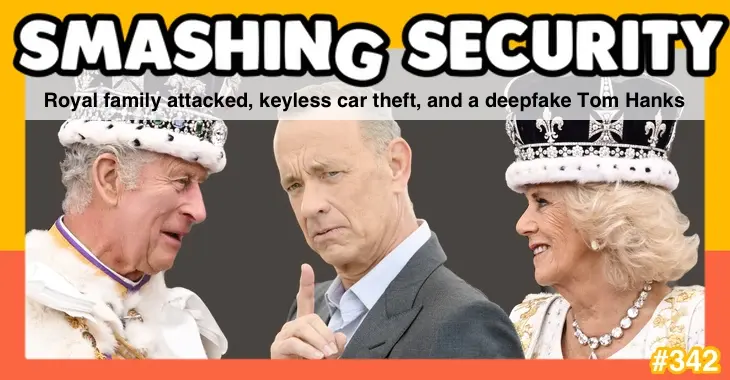
Is a deepfake Tom Hanks better than the real thing? Who has been attacking the British Royal Family’s website, and why? And how can you protect your vehicle from the spate of keyless car thefts?
All this and much much more is discussed in the latest edition of the “Smashing Security” podcast by cybersecurity veterans Graham Cluley and Carole Theriault, joined this week by Maria Varmazis.
Plus don’t miss our featured interview with Devo CISO Kayla Williams.
Warning: This podcast may contain nuts, adult themes, and rude language.
Show full transcript ▼
 This transcript was generated automatically, probably contains mistakes, and has not been manually verified.
Hello, hello, and welcome to Smashing Security episode 342. My name's Graham Cluley.
Hi.
Now coming up in today's show, Graham, what do you got?
Kayla Williams. And we're going to talk about all things SOC with security analytics platform ransomware form, Defo.
All this and much more coming up on this episode of Smashing Security.
And what makes it bad is the uncanny valley. It's a grotesque horror is the reality about The Polar Express, because it's going to give kids nightmares if they watch.
In fact, as an adult, it's going to give you the creeps because you're watching this dead-eyed animated train conductor with the voice of Thom Hanks.
And he also said, you know what? I want an extra 20% of the gross takings.
But no, he's not happy. He's not happy. He's a big grumpy. He's a grumpy man sitting on top of hundreds of millions of dollars.
I have the one, but anyway— I'm sure loads of people are.
There's a video out there promoting some kind of dental plan, he says. And they are using— Dental plan? They are using an AI version of me.
And he says, I've got nothing to do with it.
Anyway, so Thom Hanks, despite appearing in The Polar Express and ruining many children's Christmas and some adults as well.
I quite like Adam Buxton. I don't know why he invited Thom Hanks on, but anyway, he was on the Adam Buxton podcast and he said that AI could be used to extend the careers of actors.
Here's what Thom Hanks said. I can't do a Thom Hanks impression.
But performances can go on and on and on and on.' And I thought—
And I think, oh, come on, this is just too much.
And she says, at worst, they are a horrendous Frankensteinian monster. I think she could just say Frankenstein monster.
Cobbled together from the worst bits of everything this industry is. And I thought, hmm, interesting. The worst bits of the movie industry.
That would be things Flubber, I expect, from Robin Williams. And some of those—
I think The Telegraph reported that Bruce Willis had sold his face. Not Nicolas Cage and John Travolta swapped faces. Face Off.
But apparently they reported that Bruce Willis had sold his face to a deepfake company called Deep Cake, which is a great name.
But he has recently done an advert with Deep Cake, which uses a deepfake for him for a Russian telecoms company.
So he is doing a bit of acting, as it were, without actually having to do anything because they're just using the— James Earl Jones, the great James Earl Jones.
Did you see him in that episode of The Big Bang Theory? James Earl Jones. Anyway. No.
And the current Screen Actors Guild strike, that is in part, not entirely, but in part about the dangers of new technologies AI, digital recreation, leaving them out of pocket.
And I have sympathy for that.
I have sympathy for that because all of us potentially, if there were, for instance, 342 hours worth of me just prattling away into a microphone, or maybe you, Carole, as well.
I mean, really, if Bruce Willis's face— yeah, I mean, yeah, right? It's just a basic thing.
If you say it's okay for you to do it for this one instance, then fine, but if you do it without the other person's permission, you're just stealing someone's essence.
I mean, you're putting words in their mouth, literally you're making their fake mouth say the fake words. Who wants that? Nobody. I mean, that's just creepy.
So there will be technology companies who are now claiming that they've got the solution. I've seen companies saying what we need to do is proactively tag real genuine content.
I can't see how this is going to— Simply detecting it after the fact isn't gonna be strong enough because deepfakes are gonna get more and more convincing and so forth.
But I'm just thinking, I'm gonna flip the coin 'cause I completely understand why the actors don't want this and I wouldn't want it either.
I'm thinking of a situation where there's this podcast I listen to sometimes called Doodsie where it's two comedians.
I'm not gonna bother naming them 'cause either you know, you don't, that use AI and they're very explicit about the fact that they are using AI to write these crazy episodes that they are sort of reacting to.
And they actually had AI Thom Hanks, video and audio of AI Thom Hanks saying this crazy pitch for a fake movie like Ghost Train or something really ridiculous.
And it's hilarious because it's obviously a fake version of Thom Hanks. They're very upfront about the fact, hey, this is fake, this is not real, this is AI.
And for that, it's really funny.
So yeah, it is a consent thing in the end, but I'm just thinking of that random podcast where I'm making sure everyone knows that it's fake, but it is an AI version of him.
So I don't know, does that make it okay?
So I'll sort of walk you through my thought process on this. So what do you both think of when you hear the phrase "What is car hacking?"
Something a little bit dangerous.
Oh, when I was hearing the phrase "car hacking," I was thinking it was something basically Wi-Fi-enabled cars, or Graham, sort of along the lines of what you were saying.
But I saw something on X, formerly known as Twitter, and it showed a video of a car being stolen from someone's driveway, and it took just moments, and I was sort of "what the heck is going on here?" So I wanted to read up about it.
So it basically— that one form of car hacking that's really on the rise has been over the past few years, it involves keyless entry systems. So those little key fobs.
And Carole, you sort of mentioned this. So since you don't have a newer car, I don't know if you know how these work.
You just walk up to your car, press a little button, and the car unlocks just by being in proximity to your car with the key.
Well, attackers figured out that's a kind of nifty little attack surface, and maybe we can use it to our advantage to steal a car.
Because essentially, the car and those little keyless entry system key fobs are always talking to each other — even when you're not pressing a button, they're still sort of engaging with each other.
Oh my goodness, the device to communicate with the outside world, because this is a genuine, really serious problem. So I always put my car keys in one of those.
It's becoming very popular, very popular way to steal cars. And apparently in the UK it's especially popular, so I was noticing that when I was doing the research on this.
Less is known in the US. Essentially the car manufacturers know it's a thing, but I don't think anyone's tracking it aside from AAA.
But essentially, if you keep your car keys on a hook near your front door, or maybe on a hook near your garage, or on a table near a door or an external wall, that can sort of be a way for a car thief to sort of hijack the signal.
It's an easy way for them to hijack the signal because the key is so close to where they are standing.
So let me walk you through how the attack actually works — it's kind of fun to look at, not so fun to be the receiving end of it, though.
And the criminal stands outside your front door where they think your key is — in many cases it's a good bet — and they nab the signal from the car key fob that's continuously talking to the car.
And then they've got a second friend who's standing near the car holding a portable device, and then that second friend can then receive the signal from the first guy, unlock the car, and then use that device to start the ignition and drive the car away.
All you know when you wake up next morning is your keys are exactly where you left them. You had definitely locked your car, but your car's just gone.
And it is very common, at least here in the UK it is. And people are typically stealing cars to order or high-value cars. So she had quite an expensive car, which is what they stole.
And it is as though someone has walked up to a car with the keys in their pocket because it's relaying the signal from the key, which is still inside your house when it happens.
And that's why I keep my key in one of these little special boxes to prevent people from working.
And if your car won't open until you open the box, then you know that the box works.
Oh my goodness. Teaching people how to actually steal cars with this relay attack method.
And if you want to buy the kit online for basically the frame antenna, it's 80 pounds, $100, right? So not expensive.
And the range that these antennas can usually pick up the key fobs from is 5 to 20 meters. So it's actually, that's more than I would have thought.
So I was thinking, man, even if your key's not by the front door, it's 60 feet. Your keys can be pretty far into your house and they could potentially find the signal.
And the UK car security company Tracker said 92% of cars that recovered last year were taken without using the keys.
So I'm not saying it's all with this attack, but this is the problem with this country because very few villages have driveways, right?
In the States, at least a lot of people live in the, you know, have a bit of front lawn to give them some distance.
Why, when I walk up to my car, if I've got my keys in my pocket, why does my car start to unlock? And expect me just to press a button?
Why isn't it that I have to press a button on the actual key for it to send the signal to communicate with the car to unlock it?
Because I, for security reasons, would like to turn that off in my car so that I don't have keyless entry.
Apparently, several trade groups have written to the car manufacturers, and they've responded, the manufacturers, saying we're aware of the issue, and haven't really promised any action necessarily.
Although, as far as I know, Ford has said that its newer models are going to have the option to put the car into sleep mode.
So essentially to toggle this off, but it sounds like it's not always off. I don't really understand what the sleep mode necessarily, how sustained that is, but it is an option.
But a lot of the other ones are kind of well, the convenience of being able to unlock your car easily without having to rustle your things out of your bag is worth it for our customers.
So when I was trying to figure out what I should do about this, 'cause my cars are very close to the front of my house, I live in a small house. Small driveway, 20 meters.
Some people were saying put it in a Mylar bag, which I don't think Mylar is really the solution there, but maybe people are it's shiny, so that will do it.
A lot of preppers really love wrapping things in tin foil as their favorite Faraday cage, or lining a shoebox with tin foil completely.
I've heard that as a homemade Faraday cage in the prepper community. I've always thought that was funny, but that doesn't really work either.
Another suggestion was to put your car keys in the refrigerator.
My favorite is put it in a cookie tin, a little metal cookie tin, which historically was what grandmothers would put sewing supplies in.
So I'm just imagining kids looking at the cookie tin and going, "Oh, there's cookies!" And instead of it being sewing supplies.
So I think just buy yourself a little box and put it somewhere convenient. And just make it a habit of always putting your key in there.
But you can also just keep— if you have a larger property, I suppose you could keep your car keys away from a front door, especially if your front door is near your car.
I don't know if that'll actually help, but that is an option.
I'm what do prostates have to do with anything. This show's insane. No, it's just me.
And this is typically when an unauthorized third party or a baddie dings a website over and over and over and over again, you know, effectively flooding the server so it can't deliver actual content to actual visitors.
Do you guys remember February 2020 attack reported by Amazon services, AWS?
No, this one was known because at its peak, this attack saw incoming traffic at the rate of 2.3 terabits per second. Wow. Now, I have some unreliable visual from Quora.
So this poster claimed to have worked out what a terabyte in terms of Webster Dictionaries. Okay.
And assuming a dictionary is 5 centimeters thick, 100,000 of them would make the stack approximately 5 kilometers high and weigh 250 metric tons. Dictionaries, paper dictionaries.
And then these devices were all programmed to send requests to a single victim.
So all the big sites got affected: Airbnb, Netflix, PayPal, Visa, Amazon, New York Times, Reddit, GitHub, on and on and on.
And basically, these type of DDoS attacks at the heart is about rendering a website or service useless, which is the exact opposite of the attacks we see today, where someone's trying to sneak in and take loads of stuff away from you that you own, right?
But there are occasionally motivations for taking down a website, right?
What motivations come to mind if I told you that earlier this week, the Royal Family in the UK, their website was taken down?
And why would anyone want to do that to ready King Charles and plucky Camilla?
Killnet reportedly heads up the Killnet group, a group that seems has pretty close ties to Russian political agendas. Okay, yep.
So according to the Five Eyes intelligence network— that's, you know, agencies in Canada, Australia, New Zealand, US, UK— they warned last year that Killnet was one of several hacker groups that had pledged to support Russia and threatened to attack anyone who attacked Russia or supported Ukraine.
These are the guys that attacked the Eurovision Song Contest last year. Do you remember that? Because they were in an attempt to stop Ukraine winning.
See, King Charles, in what some are calling a wholly unprecedented move, dished some strong words speaking out against Russia's invasion of Ukraine during his landmark speech in the French Senate last Thursday morning, mere days before the royal family's website was targeted.
King Charles also reported saying Ukraine must win its war and invoked the unity of Britain and de Gaulle's Free French movement in the Second World War as an example of the need to stand together against unprovoked aggressions on our continent.
Oh, I was, what are you doing? Because I guess I'm used to the Queen's cool head. His mom had a cool head. You're the only true Brit here, Graham.
I mean, you wouldn't— you would expect the head of state to probably have that point of view regarding the war in Ukraine. I'd be more surprised if he went the other way.
It's not he went on and on about it. But he did enough to upset this Killnet group.
The upshot is the site was taken down for 90 minutes, displaying an error message on Sunday morning to those desperate to find out what people were up to on royal.uk, which would be the first place I would go on a Sunday morning.
If your SIEM is causing an endless cycle of noisy alerts, manually writing generic detection rules, and limited data ingestion and retention, your SOC might need an upgrade.
Well, Hunters is a SaaS platform purpose-built for your security operations team.
With Hunters, you can ingest and normalize as much data as you have at a predictable cost without having to compromise on visibility and retention.
Automatically cross-correlate data logs from your entire security and IT stack to connect and track events throughout your organization without switching screens.
And leverage out-of-the-box SOCs and always up-to-date detections that cover 80% of security use cases.
Solaris Group, a leading German fintech, they implemented Hunter's SOC platform to eliminate the burden of redundant detection engineering and manual event correlation, allowing SOC analysts to focus on higher-value tasks.
Visit hunters.security to learn how your SOC can move beyond SIEM. That's hunters.security, and thanks to Hunters for supporting the show.
DEVO is hosting the 3rd annual SOC Analyst Appreciation Day.
This year's program includes presentations and discussions from some of the InfoSec community's most prolific thought leaders, including the likes of YouTube creator Jon Hammond, CISO Olivia Rose, and unpopular opinion guy Joss Copeland.
This event will cover everything from real-life use cases to SOC automation, managing your mental well-being, and more. You won't want to miss it.
Join DEVO and other cybersecurity industry professionals on October 18th, 2023 for sessions and panels focused on destressing, SOC career development, and more.
Visit smashingsecurity.com/devo to register. That's smashingsecurity.com/devo. If you work in security or IT and your company has Okta, this message is for you.
For the past few years, the majority of data breaches and hacks you read about have something in common: It's employees.
Hackers absolutely love exploiting vulnerable employee devices and credentials. But imagine a world where only secure devices can access your cloud apps.
Here, credentials are useless to hackers, and you can manage every OS—even Linux—from a single dashboard.
Best of all, you can get employees to fix their own device security issues without creating more work for IT. The good news is you don't have to imagine this world.
You can just start using Kolide.
Kolide is a device trust solution for companies with Okta, and it makes sure that if a device is not trusted or secure, it can't log into your cloud apps.
Visit kolide.com/smashing to watch a demo and see how it works. That's k-o-l-i-d-e.com/smashing.
Could be a funny story, a book that they've read, a TV show, a movie, a record, a podcast, a website, or an app, whatever they like.
It doesn't have to be security related necessarily. Better not be. Well, I've got a question for both of you. What's the best Christmas movie of all time? Die Hard.
I don't know if you've— have either of you ever seen it?
You know, those sort of rom-coms which are sweet. Well, in this particular one, they both have an anonymous romantic pen pal.
And what they don't know is the wonderful person who they're chatting to is the other person.
So they're actually secretly— Now, it is a great movie and a wonderful thing, and it has only ever been tarnished by one thing, which is my nitpick of the week.
Because I was recently required to watch a Thom Hanks movie.
In fact, Meg Ryan's shop in You've Got Mail is called The Shop Around the Corner.
Can I tell all of you, go and watch The Shop Around the Corner from the 1940s, which is wonderful and doesn't have Thom Hanks in it, because it is a great, great thing.
So my pick of the week is The Shop Around the Corner, which is a wonderful movie. My nitpick is this constant remaking of perfectly good movies and producing inferior versions.
I've done my drama. For my pick of the week is something very geeky nerdy because I am in the throes of Halloween season.
Oh yeah, my kid wants to be the Light Dragon from Tears of the Kingdom. I was like, you want to be what for Halloween?
So I have been learning how to incorporate LEDs into costuming for this costume that I'm making.
And this website I came across to buy the LEDs is called evandesigns.com, and it is very old school in a way that I love, and that it's a little niche part of the internet for hobbyists, and it's full of a lot of good hobbyist information, exactly what you need.
How do I build this thing? Or how, if I'm trying to, I don't even know what I don't know. Can you please walk me through it? A top to bottom guide. Oh, wow.
And it's very competently done. And it's meant for people who do hobby trains, train sets, but he's got a bunch of stuff for people who do costuming.
And for someone who has a very basic understanding of circuitry, but very basic. But even I was reading through this.
I'm like, I can definitely handle making, you know, a string of LEDs, something like this, thanks to his help.
So I'm just giving a shout out to that, evandesigns.com, because I really appreciate their help.
So all your LED needs are at Evan Designs, but they also have a lot of resources on how to actually make the stuff work in the way you want it to, which is nice to see that people are still sharing that information.
And it's not video, it's written. God bless it. I can just read it. Beautiful.
That's kind of true. It's your Sherlock Holmes kind of thing. And it's rare that you get a good one. So often they can just be a bit predictable.
And maybe it's great for new readers to the genre. But if you've been around the detective block a lot, it's hard to be surprised.
So my pick of the week is a book I'm enjoying called The Eight Detectives by Alex Pavesi, P-A-V-E-S-I. And I'll quote The Guardian here because they say it so well.
So it is a set of seven Golden Age style mysteries where an abundance of brutal slayings in genteel surroundings are rendered in a heightened pastiche of the form.
So, in my terms, rollicking fun read. And it's surprising how the attacks transpire. There's this one scene where a victim is killed with a detachable tine from a fork. Right? Crazy.
So, all kinds of cute things.
And even better, all of these short stories, these 7 short stories, are nestled within a greater narrative where you have this fictitious author, Grant McAllister, and he's discussing his own set of detective rules for how you write a detective story with an editor.
And this leads to the 8th murder mystery, which I'm getting to this evening. If it sounds like your thing, it's great. I'm enjoying it a lot. Eight Detectives, a novel by Alex Pavesi.
And that is my pick of the week.
Today on Smashing Security, I am chatting about all things SOC with security analytics platform Devo's very own CISO, or I should give the whole title, Chief Information Security Officer, Kayla Williams.
Very warm welcome to you, Kayla. Thanks for coming on the show.
But more than that, the Devo team are the people behind the SOC Analyst Appreciation Day. But we're going to get to that in a second.
First, Kayla, I would love if you could tell us a little bit about you, your background, and maybe how you ended up at Devo as their CISO.
I wouldn't say bumpy, I'll say curvy, because I am not a traditional technology technologically sound CISO. I am what I like to call a GRC CISO because that is my background.
As we all know, the laws and regulations and the privacy, technical privacy landscape, everything is changing so rapidly.
And really, GRC or governance, risk, and compliance is the foothold of a security program because they're able to easily pivot.
So my background, I graduated with a bachelor's degree in accounting. Went on—
Try being one.
So I did that for a couple years because my track in my mind was I was going to get my CPA, Certified Public Accountant, certification, and then move on to being a CFO eventually.
And since I didn't like it, I decided to move out of that field into the wildly different field of internal auditing. And I worked at a financial services company for 8 years.
And in that time, I was an internal auditor for 3 years and then moved into security because they were looking for folks who understood process.
And that's something that auditors do very well. You give credit where credit's due.
Yes, I was able to come in and understand process and the risks associated with if a process goes wrong.
And I was in that company for 5 years, moving into various roles doing security consultancy, security program management.
The team acquired the enterprise risk management team and it became a CISO or information security and risk officer organization.
So then I moved into an enterprise risk management role for North America. And after that, I was like, well, there's really nowhere else for me to go here.
So I moved over into a director of GRC role at LogMeIn, which is now GoTo. So GoToMeeting, GoToConnect. They used to have LastPass, that company there. And I did that for 3 years.
And it was great. There was 20— at the time, there were 23 SaaS products in the portfolio.
And that gave me SaaS experience because all the teams are doing something different, right? The CI/CD pipeline was different. The processes were different. The output was different.
I ended up at Devo because our chief operating officer at LogMeIn came over to Devo as the CEO, and I ended up following him here.
I don't think I've heard anything similar, and I can see how those building blocks would help you be such a great asset because you understand risk, you understand process, and you understand security.
I wondered if you could help me understand the role of a security operations analyst because we use this term SOC, right? SOC analysts.
And just for some of our listeners, I know most of them totally know what this is, but there's gonna be some of them that are gonna really appreciate an explanation from you—what's in their day-to-day, what are they responsible for?
However, you know, the day-to-day is really logging in and checking for any potential incidents or events—anomalies, if you will—that you're not expecting to see.
And then investigating that, each company has their own risk that they're willing to take. You have to take risk just to have a company going, right?
So every company's going to be a little bit different, but logging into your SIEM, which I hope it's Devo, and seeing what's happening, what's been triaged or not triaged yet, and then doing your investigation.
Unfortunately, there is a lot of monotony there, especially for the level 1 SOC analysts who come in typically—the ones that are moving into the field for the first time that are in school or have just graduated and want to get their hands dirty with security.
You're gonna be going through a lot of your alerts, looking to see for any potential indicators of compromise or IOCs, and kicking off your own—I would call it a mini investigation on your own—before you escalate it up your chain of command to say, okay, I've now identified something.
And I think that is exciting when you identify something. It's not always great when you identify something, but for the company, I mean, but for the individual, that's exciting.
It's like, hey, I'm noticing something that's—this is an anomaly. This pattern isn't following patterns. There's maybe some user behavior that isn't expected.
Or one of my favorites that I hear a lot about is the impossible traveler—Kayla logged into Boston, she lives in Boston, that makes sense.
But all of a sudden, 20 minutes later, she's logging in from Alaska.
And that's really where I feel the SOC analyst is underappreciated, which will come into the day that DEVO has to celebrate them.
But this team, the SOC team, is really your first line of defense. They're your eyes on glass.
They are seeing things that it's coming in and out of your environment with precision and accuracy. And are mistakes made? Sure, but mistakes are made in every role.
Things do get by, but they're really the unsung heroes of your corporate defenses and having those folks understand the business, understand what's normal, what's not normal, expected, unexpected, however you want to phrase it, really arms them with the knowledge to reduce your risk profile.
They are essentially preventing financial loss, reputational risk, regulatory risk, obviously information security risk as well.
The branding piece and the reputational risk is something that's often discounted. And that's where people say, oh, security is a cost center. Absolutely not.
In my opinion, maybe I'm the only one that feels that way, but no, security is not a cost center. They're saving your brand. They're saving your customers, saving face, if you will.
And yes, we are a very expensive team to have, but balance that with your brand that you're protecting, whether it's a multi-million, billion-dollar brand, it's well worth the cost to keep that going.
There's always alerts, there's flooding of alerts, the monotony of having to go through them and make sure that they're, you know, if they're false positive, marking them as that, opening an investigation, writing rule sets to make sure that, you know, if you're seeing patterns that are all false positives, making sure that those are marked as such and removed from your product.
Processes, and it's just constant bombardment of noise.
Please do, even if you are not in the SOC and you were just thinking about coming into security.
It is a fantastic way to learn about the field because I think something that's often overlooked is people are, yeah, I want to get into security, there's a lot of jobs.
You have to be mentally tough to be in this field. I think we all deserve credit for that. The event is our third year, as you mentioned.
From year one to year two, we nearly doubled the number of people that attended. So this year we're hoping to have another record-breaking event. It is all online, but it is all day.
So you can come in, you can, you know, obviously being in a SOC, you probably have to have eyes on screen. You can listen to it in the background.
You will hear my voice, unfortunately or fortunately, I don't know.
But I do have an event that I'm co-hosting, the full event all day, but moderating a panel for There's a Seat for Everyone in Cyber that will touch upon what you and I just discussed a few moments ago around complementary skill sets and being able to transfer people in from other fields because that non-traditional background that I have has really opened up my eyes to how many other people could be in this field but maybe lack a cybersecurity degree or engineering background.
And it's certainly a way to address some of the shortages that we're seeing across the board.
And it also gives people out there that maybe are feeling stuck in a rut, maybe you're in accountancy and you're thinking this isn't for me, and you might find that cybersecurity desperately needs your risk assessing and your number crunching, right?
We need all those skills.
And I actually spoke at Blue Team Con in Chicago about a month ago on the non-traditional paths into security, and I did a segment on those complementary skill sets where I put them up on the screen and was drawing arrows between, you know, being an accountant and what kind of skill set is.
So having the attention to detail, being able to quickly analyze two sets of data and having the wherewithal to see those discrepancies that might be there, those patterns that have changed.
And my favorite story is that I talked about it at the event.
A friend of mine hired a former bus driver as an incident response manager because this individual was used to having to write reports, being very detailed, and also de-escalating situations.
Another session that is extremely important to me is the mental health session that Peter will be running from CyberMinds.
I had the pleasure of meeting Peter at RSA and at Black Hat. He came over from Australia, did his US launch back at RSA, and CyberMinds is amazing.
They have a program that is for cybersecurity professionals like all of us, and they come in and they teach you how to be better.
Deal with stress because we have more stress than some people that were on the front lines during the pandemic in our day-to-day.
And 77% of the survey respondents that DEVO did with Wakefield Research have said that their stress levels at work directly affect their ability to keep customer data safe.
They're making mistakes, they're not seeing things, they are so stressed out because they're so afraid they're going to make a mistake, that anxiety.
And as someone who has anxiety, and I talk about it openly, I do take anxiety medication. It is certainly a session that I highly encourage folks to attend.
That's with CyberMindZ, one word with a Z at the end. And then of course, John Hammond has SOC Hacks. So John is on my television screen, on my YouTube every time I turn it on.
My husband's like, who is this guy?
So yes, absolutely, October 18th, 2023, and this is the SOC Analyst Appreciation Day brought to you by DEVO and hosted by our very own Kayla Williams.
You can have it on the background and get some appreciation, much deserved and much needed SOC Analyst Appreciation Day.
Now, if you guys want to register, this is where you go: smashingsecurity.com/devo. That's D-E-V-O. So smashingsecurity.com/devo.
And is there anything else you'd like to add, Kayla, before we wrap up?
We talk about space, all things space, space industry, commercial space, all the good stuff, and a little bit of space cybersecurity too.
So you find it wherever fine podcasts are purveyed, or at space.n2k.com. And I'm also @mvarmazis on Twitter and @Varmazis on mastodon.social, M-A-S-T-O-D-O-N dot social. Super duper.
And don't forget to ensure you never miss another episode, follow Smashing Security in your favorite podcast apps such as Apple Podcasts, Spotify, and Overcast.
For episode show notes, sponsorship info, guest lists, and the entire back catalog of more than 341 episodes, check out smashingsecurity.com.
And I thought, oh, this is actually all right. So maybe it's only when I recognise Thom Hanks that I've got a problem. Forrest Gump? Never watched it. It's got Thom Hanks in it. Yeah.
Hosts:
Graham Cluley:
 @grahamcluley.com
 @
@
 / grahamcluley
Carole Theriault:

Guest:
Maria Varmazis:
Episode links:
- The disturbing uncanny valley of Robert Zemeckis film ‘Polar Express’ – Far Out magazine.
- Tom Hanks warns of deepfake video promoting dental plan – Instagram.
- Fuming Tom Hanks says he had nothing to do with that AI dental ad clone of him – The Register.
- Tom Hanks warns dental plan ad image is AI fake – BBC News.
- Robin Williams’ Daughter Zelda Criticizes Use of AI to Re-create His Voice: “I Find It Personally Disturbing” – Hollywood Reporter.
- Bruce Willis denies selling rights to his face – BBC News.
- Deepfake Bruce Willis in Russian telecoms advert – YouTube.
- Could you get “carhacked”? The growing risk of keyless vehicle thefts and how to protect yourself – CBS News.
- Keyless car theft: What is a relay attack, how can you prevent it, and will your car insurance cover it? – Leasing.com.
- Testing Phone-Sized Faraday Bags – Matt Blaze.
- Famous DDoS attacks – Cloudflare.
- The sinister Russian hackers who’ve claimed responsibility for crashing Buckingham Palace website – Daily Mail.
- King Charles rebukes Russia’s ‘horrifying’ invasion of Ukraine in unprecedented speech – Express.
- Visually, how much paper would a GB and a TB of data fill in terms of physical size? – Quora.
- “The shop around the corner” – Wikipedia.
- Evan Designs.
- “Eight Detectives” by Alex Pavesi – Penguin Books.
- Review of “Eight Detectives” – The Guardian.
- Smashing Security merchandise (t-shirts, mugs, stickers and stuff)
Sponsored by:
- Hunters – A SOC platform, built to empower your security team to reduce risk, complexity and costs.
- Kolide – Kolide ensures that if your device isn’t secure it can’t access your cloud apps. It’s Device Trust for Okta. Watch the demo today!
- Devo – Register now to join Devo and other cybersecurity industry professionals on October 18 for sessions and panels focused on de-stressing, SOC career development, and more!
Support the show:
You can help the podcast by telling your friends and colleagues about “Smashing Security”, and leaving us a review on Apple Podcasts or Podchaser.
Become a supporter via Patreon or Apple Podcasts for ad-free episodes and our early-release feed!
Follow us:
Follow the show on Bluesky at @smashingsecurity.com, or on Mastodon, on the Smashing Security subreddit, or visit our website for more episodes.
Thanks:
Theme tune: “Vinyl Memories” by Mikael Manvelyan.
Assorted sound effects: AudioBlocks.