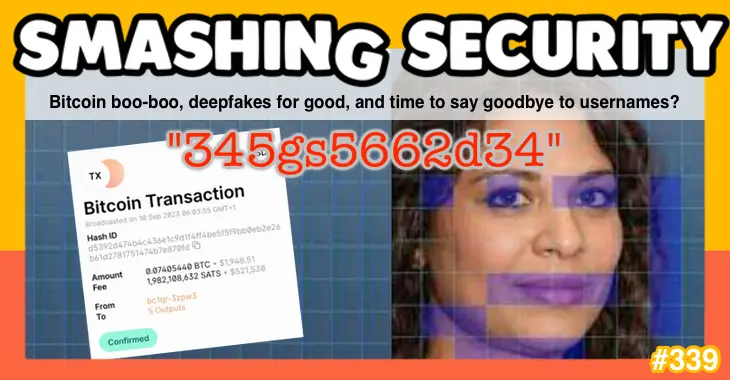
Deepfakes are being used for good (perhaps), common usernames could pose a security threat, and someone has paid a $500,000 fee… just to send $1,865.
Oh, and our guest mentions Mr Blobby (to the horror of the show’s hosts…)
All this and much much more is discussed in the latest edition of the “Smashing Security” podcast by cybersecurity veterans Graham Cluley and Carole Theriault, joined this week by The Cyberwire’s Dave Bittner.
Warning: This podcast may contain nuts, adult themes, and rude language.
Show full transcript ▼
 This transcript was generated automatically, probably contains mistakes, and has not been manually verified.
Hello, hello, and welcome to Smashing Security, Episode 339. My name's Graham Cluley.
Now, coming up on today's show, Graham, what do you got?
I shoving it to the man and thinking that I have got a way ahead.
Anyway, you eventually get to Gatwick Airport. Now, all I want to do is just pick them up, right? They're there. So, I think, where do I go?
And I haven't been to Gatwick Airport in a car for a while. And so, I think, well, I can just go to the drop-off place and pick them up there.
I'll just tell them, come, arrive there. And I get there, and they're there, and they jump in the car, and off we drive. You think that's the end of it.
Two months later, I get the bill come through, which says that I have to pay £100.
Because I went into this particular zone where apparently you can't drive unless you've pre-booked in advance or you pay within 24 hours or something like that. I didn't see a sign.
And because I lease my car, the original bill went to my car agent and then they forwarded it on to me.
But that arrives at my desk more than 14 days after the time limit, which means I don't get the cheapo fee of just £30. I have to pay the full £100. Right? I was a bit annoyed.
So I go on the review sites, I found a shortlist of good washing machines. I found what I wanted. And then I tried to find the best price for it online.
Oh, hello, I found one with £50 less than other people are selling for. Great, I think I'll buy it from them. So I went through the process of buying it online.
And it turns out the price I'm paying isn't actually what I imagined it was going to be.
Because it turns out that what I'd quite like is for them to take away and recycle my old washing machine as well, right?
So while I'm going through the checkout process, oh, that's an extra 20 quid. Fair enough, I think. That's an extra service that they're offering.
And then they say, well, would you like the washing machine delivered to a particular room? Yes, I would. I'd like it delivered to the kitchen. No, I don't want it in the bedroom.
So yeah, that'll be an extra 20 quid.
What was wrong with the past washing machine? All these questions, none of their business. Right?
They said, "So, you know, you want your washing machine delivered?" "Well, yes, I want my washing machine delivered.
I'm not going to travel to the Outer Hebrides to pick it up." Oh, you didn't want to give them your address though? No, I gave them my address when I was booked and everything else.
Turned out I hadn't ticked the box for delivery. So that's an extra £30. Not for quick delivery, that's just for any kind of delivery.
And so I thought, I've now got it all sorted, right? I've got the new washing machine unpacked. It's been— the old one can be removed and recycled.
And yes, I've even dared to ask for it to actually be delivered to my place of residence.
But what I've forgotten to do is say to them, oh, would you also mind uninstalling the old washing machine and plumbing in the new one?
Because it's an integrated washing machine, right? Extra cost of that, £130. And so I've got the hump now, right?
And we've been going for 8 minutes so far.
And I actually ended up buying a much more expensive washing machine than I'd originally planned. But I felt vindicated that I'd got everything I wanted.
And what about when you get an air ticket for a budget airline, you find out there's additional booking fees, or if—
You didn't realize that if you wanted to use the lavatory, or you want oxygen on this plane at 30,000 feet, that's going to cost you extra as well.
So, all the time, or booking theater tickets, okay?
And you think, well, hang on, even though we're booking online, and surely this is more cost-effective for you than having a real person take my order over in person on the telephone.
I'm going to have to pay several pounds more per ticket to go and see some god-awful superhero movie.
So these weren't just designed to fill someone's pockets with lots of bitcoin, but rather to deter people from flooding the network with transactions and spam and also incentivize miners to validate transactions and add it to the next block of the blockchain.
So this is part of the process. You put a little bit of Bitcoin there along with it. So Bitcoin transactions require a small fee, which is paid to the miners that confirm them.
And if you are in a rush to get your Bitcoin transaction processed, you might pay a higher fee. So imagine you want it to be processed in 20 minutes rather than an hour and a half.
Instead, they will have a predetermined fee, and that's how they make their millions and millions, is scraping off the top and then using the rest to make payments.
And that brings me to today's story because someone has just paid a fee to transfer $1,865 worth of bitcoin. So $1,865 worth of bitcoin.
In other words, they spent 270 times more than the transaction value to pay the fee.
Well, on Twitter, a bitcoiner called Jameson Lopp, which I think is a really cool name, it sounds a bit like Mobius strip.
What we do know is it isn't a newbie, because this particular cryptocurrency wallet, although we don't know who they are, they've made over 120,000 other transactions in the past.
Nothing quite as bad as this. So it looks automated. It looks like this is something which is done as a process. So it doesn't seem like it's simple finger fumbling which has gone on.
But clearly someone has somewhere written some software which doesn't do a sanity check about the amount of the fee being paid being so much larger than the amount they want to transfer.
The mining pool that was used to process the transaction, they're called F2Pool, and they've said that they are giving the sender 3 days.
So until Wednesday, September 13th at 5:10 PM UTC. Unfortunately, just before this podcast is released. So my attempts to warn someone is going to fail.
I'm sorry if this is bad news that you're hearing this.
Now, before we dig in here, let me, I'll ask each of you this question. What do you suppose, and we're talking about usernames and passwords, right?
The way to log into a system from about as far back as certainly I remember, right? BBS days, right? Username and password, username and password. We still use it today.
What do you suppose the most common username is? You have to guess.
So this story centers around a gentleman named Jesse LeGroux, who is the chief information security officer at Madison College in Wisconsin, and he also helps out the folks at the SANS Institute with their Internet Storm Center.
He runs a honeypot. And over the past 16 months, he's collected over 3.7 million usernames via attacks that targeted his honeypot.
And the most popular is root, accounting for 48% of all the login attempts. Graham, why do you suppose root is so popular? Any guesses?
What do we suppose the most common password attempts were here?
So in other words, if you're using, oh, I don't know, let's just choose a random part of the world, Russia.
If you're using a Cyrillic keyboard, perhaps that's the equivalent of that. Yeah, I don't know, but for whatever reason, that is the thing.
Does it matter that we have an easy-to-guess username if our password is strong? That's my question for the two of you. Does it matter?
And if one's a giveaway, 50% of the time, it's kind of, you know, you're making it way easier.
Obviously change the password, but when you read the best practices, it says also change the administrator username. You know, why use the same administrator username?
It makes sense. And so on my website, for instance, I don't use the standard administrator username.
I mean, the first thing that happens when you power the device up is it says, choose your login name and your password and doesn't even have a default entered in the system at all.
That's, that would be an option.
And so perhaps that's part of the motivation here as well. You have something that you can use.
And so there is the potential for privacy breaches to occur because people can see that you're a member of one particular website or a forum and they can see where else you may have accounts.
And that can, you know, there is an attraction in being able to choose your own usernames to remain a little bit more private.
So on modern iPhones now, it will actually say you don't have to use your actual email address if you're worried about spam or whatever else.
You know, they will give you an email address which will then forward to your real email address.
So there is some more privacy there, which I don't know how many people use that, but it seems like it could be a good idea.
He's host of their daily podcast, also regular guest on the CyberWire podcast and personal friend of mine. Plug, plug, plug.
He also makes the point that nobody should be using FTP anymore.
But this article points out that Rapid7, back in 2018, they found that there were 21 million FTP servers still running out there.
And I think, you know, I think it's one of those things that if it ain't broke, don't fix it, and people don't often consider something that's been in use for a long time.
It's just sitting there humming away.
And I was curious if either of you had any familiarity with passkeys, if you've experimented with them, if you added them with any of the accounts that you have.
I guess I should back up and say, if you even know what they are.
They're the new development on the sort of password front, trying to make it a more seamless experience to log into sites without having to scrabble around.
I must admit, I've played with it. I haven't actually set any of them up yet, so I'm not trusting them yet.
And that's partly because some of the technology which I use isn't completely compatible yet with the Passkey experience.
And I'm worried about being maybe locked out from some of my devices, from some of my accounts.
Is a Passkey something like your iPhone might say to you, I'll save that for you, I'll create it, and then you can just go in and go out and your phone manages it for you?
Or is it something different?
So the combination of Face ID and you being in physical possession of your phone, the key exchange happens behind the scenes. You don't even see it, but it is quite secure.
This all comes through the FIDO Alliance. So it's good stuff. The big players have all jumped on board. I think it's probably being mostly led by Apple.
It's built into iOS now, but Google and Microsoft, they're on board also. I think what's going to have to happen is the password managers are going to have to adopt it.
And I know a couple of them have, but not all of them have yet. So I think once they get on board, boy, that'll be convenient to be able to do that.
Graham, just like you, I've been Passkey curious, but I have not jumped in with both feet. And I actually found it hard to wrap my head around some of the details.
So I sought out someone to talk to, and I actually interviewed a guy named Chris Sherwood. He's from a company called Crosstalk Solutions.
If people are interested, we'll have a link to that interview in the show notes.
And then also I included a link to the Wikipedia page and the page from the FIDO Alliance on passkeys.
So I'm hoping that passkeys catch on and they become the future here because it seems to me like jettisoning this whole username password dance could ultimately be a good thing for folks.
But like you, Graham, I've just, it's hard. It's hard to trust it so far.
I know it has all of this pedigree behind it, all these good organizations, but I'm still not quite there emotionally. And I don't know, and I should be, but I think I trust it.
LastPass, the password manager I support, appears to be making a big push in this area.
They're making a lot of noise about this, and they view this as their future, and I have confidence in them.
So the Googles, Microsofts, Microsoft Bing, DuckDuckGo to eliminate child abuse material from their search results and take steps to ensure generative AI products can't be used to generate deepfake versions of the material.
But equally crappy is sex exploitation of any person, you know, either to cyberbully or decimate someone's reputation or shame.
Or the conversation last year said that the majority of deepfakes on the internet were assaults on women, grabbing facial images without consent, inserting them into pornographic content.
A deepfake expert found that 96% of deepfakes found online were pornographic, and 100% of those were video images of women. It's crazy, right?
Plus, we have deepfakes designed to spread disinformation, misinformation, and to undermine. Apparently, this is called the liar's dividend. Did you know this term?
So the liar dividend, the liar's dividend, is the idea that when anything can be faked, people who are lying, so claiming that something true is actually false, have the power because they benefit from the undermining of our trust in all images in this case.
The message is ultimately you can't trust what you see, but you can trust me because I'm calling out the liars who took— who deepfaked the pictures.
So one of them, for example, would be healthcare.
So they're creating more expressive, realistic voices to replace the robotic-sounding prototypes we had during the '90s and noughties. And there's also cultural implications.
Graham, I think you went to an art show where there was some AI stuff.
I don't know if it was deepfake, but at the Dalí Museum in Florida, they have a deepfake Salvador Dalí welcoming visitors, telling them about himself and his art.
And the idea is that it gives visitors a sense of immediacy and closeness and personalization. You know, deepfake Dalí even offers you a chance to take a selfie with him.
And I think, well, that isn't Albert Einstein. How can they pretend that this is Albert Einstein in the bath telling me this? This is outrageous, I think.
And it's all been done with deepfake technology.
So there's research engineers Kate Glasgow and Wee Wei Jiang are using deepfakes to help people with aphantasia, the inability to create mental images in your mind.
And I'm super keen on that because I recently learned of my own aphantasia. I have zero visual mental ability, zero. And apparently it's 2 to 3% of the population.
But effectively, things I'd say, close your eyes and imagine either a color or a shape or a face that you know very well. And then you build a mental image of that, I guess.
And then you would then say, oh, it's super clear super vivid. I can see all the lines, the colors. I can see movement.
Some people can see actual, you know, have movies play, you know, play a scene. I just never understood that when they said picture this in your head, that people actually—
It'd be amazing to be able to close my eyes and see color and shapes and stuff. I just, it's nuts.
Anyway, but my big question for you two today is whether the following use of deepfake is for good, because they're definitely trying to advertise it as for good.
So synthetic avatars can be used in advertising and internal communications. So this limits the cost of producing and filming and translating videos, right? That's the idea.
And there are a smattering of companies that are popping up trying to sell this service. So basically trying to say, have a deepfake.
But because deepfakes have such a bad reputation in what they are on the internet, a lot of them are straplining their websites with deepfake for good on their homepage.
So Synthesia do this and DeepBrain AI do this.
So Axios recently published a story about a company which is granting access to its deepfake tech to the public.
So the idea is to provide a quicker, cheaper, easier alternative to recording everything from customized marketing to instructional videos.
And you go to the website, the company is called HeyGen, and it says, no camera, no crew, no problem. Create videos from text in minutes with AI-generated avatars and voices.
So the way it works is to create a personalized avatar, you would send HeyGen a 2-minute video of yourself speaking into a camera.
Your smartphone's fine, along with another video giving consent for the company to do its thing.
Then HeyGen returns a digital avatar that you can use to generate videos by typing the words you want to speak into a text box.
And there is a content filter apparently that blocks explicit or violent content.
So is it just me, or I don't know, I don't like the idea of an AI-generated something selling me or training me without me knowing that they are a generated AI?
So pay you for one day of work and then we'll use your body, your image in the background of all of our movies at our discretion.
We need to use technology to do clever things which aren't criminal and all the rest. At the same time, I remember when the wheel was invented and we stopped— Oh, do you?
People who used to make a living giving people piggybacks were suddenly out of business because now there were carts and wagons and things like that which could be pulled instead.
Yeah, it gives me a queasy feeling too, Carole.
So what if your deepfake account gets hacked by an unauthorized third party? I mean, of course, I know this will never happen to any of them.
And I put in the text box saying, "Dave Bittner is a boob. Let me tell you why." And I insert a few fat lies in there.
And then I fire that over to Dave, and it's your face, your gob, spouting out all this stuff that I put in the text box.
And, you know, Dave might find out it's a deepfake, but he'll also, I don't know if he'll trust you the same way again. I don't know if he would.
Technology is for everyone. Cybersecurity should be too.
So if you're concerned that your iPhone is listening to you, want to know how to defend yourself from WhatsApp scams, or keep track of the latest Atomic macOS stealers, visit smashingsecurity.com/moonlock.
At Moonlock, you'll find useful tips on how to stay safe and protect your loved ones in the technology-powered world. Moonlock by MacPaw, cybersecurity tech for humans.
So go visit smashingsecurity.com/moonlock right now, and thanks to them for supporting the show.
For the past few years, the majority of data breaches and hacks you read about have something in common. It's employees.
Hackers absolutely love exploiting vulnerable employee devices and credentials. But imagine a world where only secure devices can access your cloud apps.
Here, credentials are useless to hackers, and you can manage every OS, even Linux, from a single dashboard.
Best of all, you can get employees to fix their own device security issues without creating more work for IT. The good news is you don't have to imagine this world.
You can just start using Kolide.
Kolide is a device trust solution for companies with Okta, and it makes sure that if a device is not trusted or secure, it can't log into your cloud apps.
Visit kolide.com/smashing to watch a demo and see how it works. That's k-o-l-i-d-e.com/smashing.
Gigamon's latest survey of over 1,000 global leaders reveals the state of hybrid cloud security and the dangers that free-flowing encrypted traffic poses to organizations.
Find out more. Download the report today at gigamon.com/smashing. That's G-I-G-A-M-O-N.com/smashing. And thanks to Gigamon for supporting the show. And welcome back.
Can you join us for our favorite part of the show? The part of the show that we like to call Pick of the Week.
Could be a funny story, a book that they've read, a TV show, a movie, a record, a podcast, a website, or an app, whatever they wish.
It doesn't have to be security related necessarily.
Thank you to the listeners who sent me photographs of their induction hobs, claiming that they loved the touch controls on them and that they didn't need knobs.
I would like to make my pick of the week the Cookology induction hob with knobs. It's an induction hob with knobs. What's not to like? £179. A lot cheaper than the Smeg version.
There aren't many of them out there, but I'm very happy with it. And that is why it is my pick of the week.
And that's all happened?
I have a great appreciation for the comedy that comes from your side of the world, be it Monty Python, Fawlty Towers, even I've been known to enjoy The Benny Hill Show. Wow.
That's good. Wow.
Somehow, I don't know why, and I can only guess it's because of my appreciation for British humor, that YouTube decided that it was time for me to learn all about this thing that I did not know existed, and I wonder how my life was satisfactory without knowing it, and that is Mr.
Blobby.
And what I've gathered is part of the fun of Mr. Blobby is that he shows up when you least expect him on the TV shows where you would least expect him.
Is that an accurate description, Graham?
There were a lot of stunts involving celebrities where the celebrities didn't know, but this was before Mr.
Blobby became extremely well known, where this Blobby character would appear and chaos would ensue and the celebrity would be thinking, what's going on?
It's a candid camera kind of thing. But then Blobby, his fame became absolutely enormous.
Blobby, who came from a place called Crinkly Bottom, there was a theme park and maybe a couple of theme parks which involved Blobby-type antics.
Oh yeah, they're now derelict and overgrown. It was all a sort of financial disaster, but there's plenty for Dave to explore more if he's interested in Blobbyland.
So of course he did.
Apparently I— I use the word experience when it's an audiobook. I feel weird about saying read, but I've experienced 57 in the last 12 months. So it's not bad going. Yeah.
Everyone seemed to love it, and I in fact put off reading it because of the hype. You know, sometimes there's so much hype, you're just like, come on, come on.
So it was stupid of me because I've just now finally read it, and it's fabulous. Polished, funny, thought-provoking, beautifully knitted together.
So we've got a lead, which is a pioneering chemist named Elizabeth Zott, and her obvious talents mean that she should be at the top of her chem game, you know, getting huge research grants for all her cool explorations and discoveries.
She's this no-nonsense dedicated researcher, but she's a she, and this is the 1950s set in California.
And as we access her inner life and outer experiences for about a decade, the reader gains an amazing understanding in what was normal just a few generations ago for men and women and how far we've come since then.
And this isn't a men are shit and women are fab narrative. There are many characters with flaws, some unforgivably awful, on both sides of the sex divide.
But it's so, just so well done, and it's a real testament to copywriters becoming writers.
Because as a copywriter, you learn how to be tight, you learn how to get rid of the riffraff, you learn how to tell a story. And it really shows.
Lessons in Chemistry by Bonnie Garmus. It's my pick of the week.
And that just about wraps it up for this week. Dave, I'm sure lots of our listeners would love to follow you online and find out what you're up to.
What's the best way for folks to do that?
We are at @smashingsecurity, no G, Twitter doesn't allow us to have a G.
And you can also make sure that you never miss another episode by following Smashing Security in your favorite podcast apps, such as Overcast, Spotify, and Apple Podcasts.
And of course, to our wonderful Patreon community, it's thanks to them all that this show is free.
For episode show notes, sponsorship info, guest list, and the entire back catalog of more than 338 episodes, check out smashingsecurity.com.
I don't know why it tickles me so, but it does.
Hosts:
Graham Cluley:
 @grahamcluley.com
 @
@
 / grahamcluley
Carole Theriault:

Guest:
Dave Bittner:
Episode links:
- Tweet by Jameson Lopp.
- Bitcoin user’s costly error leads to record transaction fee of $510,000 – Cryptoslate.
- Root Admin User: When Do Common Usernames Pose a Threat? – GovInfoSecurity.
- Dave’s conversation with Crosstalk’s Chris Sherwood – Hacking Humans podcast.
- Passkey authentication – Wikipedia.
- Passkeys: Accelerating the Availability of Simpler, Stronger Passwordless Sign-Ins – FIDO Alliance.
- Test your mental image ability – Aphantasia.
- How to create your own personal deepfake – Axios.
- Deepfakes are being used for good – here’s how – Connecting Research – University of Reading.
- Six things you need to know about deepfakes – BBC Radio 4.
- Mitigating Aphantasia with Generative Reality – Medium.
- Ethical Deepfake Maker – Synthesia.
- HeyGen deepfakes – HeyGen.
- Deepfakes are being used for good – here’s how – The Conversation.
- Search engines required to stamp out AI-generated images of child abuse under Australia’s new code – The Guardian.
- Induction Hob with Rotary Controls – Cookology.
- Top 10 WTF Mr Blobby Moments – YouTube.
- Lessons in Chemistry by Bonnie Garmus review – the right comic formula – The Guardian.
- “Lessons in Chemistry” – Book by Bonnie Garmus.
- Smashing Security merchandise (t-shirts, mugs, stickers and stuff)
Sponsored by:
- Kolide – Kolide ensures that if your device isn’t secure it can’t access your cloud apps. It’s Device Trust for Okta. Watch the demo today!
- Moonlock — cybersecurity wing of MacPaw. Developers of the antimalware tech in CleanMyMac X — Moonlock Engine.
- Gigamon – Download the Gigamon Hybrid Cloud Security Survey to learn about the hidden dangers of encrypted traffic.
Support the show:
You can help the podcast by telling your friends and colleagues about “Smashing Security”, and leaving us a review on Apple Podcasts or Podchaser.
Become a supporter via Patreon or Apple Podcasts for ad-free episodes and our early-release feed!
Follow us:
Follow the show on Bluesky at @smashingsecurity.com, or on Mastodon, on the Smashing Security subreddit, or visit our website for more episodes.
Thanks:
Theme tune: “Vinyl Memories” by Mikael Manvelyan.
Assorted sound effects: AudioBlocks.