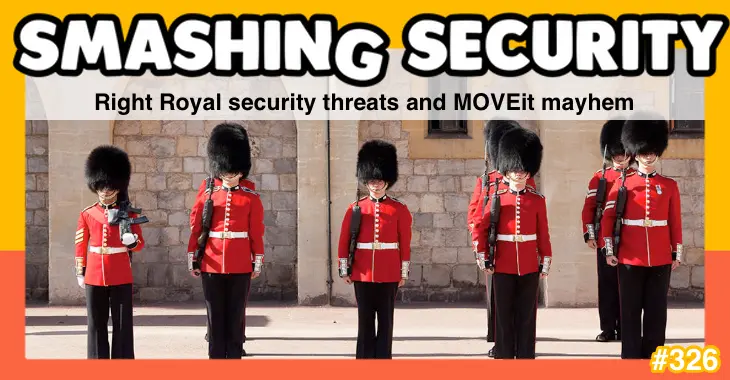
There are shocking revelations about a US Government data suck-up, historic security breaches at Windsor Castle, and the MOVEit hack causes consternation.
All this and much much more is discussed in the latest edition of the “Smashing Security” podcast by cybersecurity veterans Graham Cluley and Carole Theriault, joined this week by The Cyberwire’s Dave Bittner.
Warning: This podcast may contain nuts, adult themes, and rude language.

Show full transcript ▼
 This transcript was generated automatically, probably contains mistakes, and has not been manually verified.
Smashing Security, Episode 326: Ride Royal Security Threats and Move It Mayhem, with Carole Theriault and Graham Cluley. Hello, hello, and welcome to Smashing Security episode 326.
My name's Graham Cluley.
Now, coming up on today's show, Graham, what do you got?
Chums, chums, I realize, that's better, after some 325-odd episodes of Smashing Security, there are some areas of security that we haven't really touched upon enough.
Things, you know, there's some things where we've perhaps done a little bit too much. I'm thinking teledildonics.
And that is one of the things which I'd like to look at today is physical security.
You can secure your networks, you can secure your gateways, your laptops, but how well are we doing at securing our company's buildings from attack, from preventing people from actually coming through the front door before stealing something from our corporation?
So I thought that'd be interesting to talk about. Now, regular listeners will be aware that I'm a big fan of British institutions, the things which made Great Britain great.
Doctor Who, the hovercraft, the World Wide Web.
Gravity didn't exist before Isaac Newton invented it when the apple fell on his head. Didn't have that.
Alexander Boris de Pfeffel Johnson, if you remember him, former Prime Minister.
Dave, if you don't remember him, he's the one who looks like a mayonnaise-covered potato dipped in a bucket of straw.
He's been handing out gongs recently to a bunch of his closest disciples.
And it's been all a bit of a to-do about it all. But if you do become a knight, like the recently anointed Sir Michael Fabricant MP—
Or Dame Priti Patel, who will be— Anyway, they basically have been awarded these great honours, which means that they'll be able to get tables in restaurants for the rest of their life, because they of course have provided services to what you'd get if you threw Donald Trump, a hay bale, and a thesaurus into a washing machine.
What we call Boris Johnson. And if you get one of those awards, you will get an invitation to go and receive the award at Buckingham Palace or Windsor Castle.
And King Charles will pin on the medal or clonk you on the shoulder with his sword and tell you to arise. Or the gong, right?
And I'm talking about Windsor Castle specifically because there have just been declassified by the National Archive a number of papers about a number of things to do with Windsor Castle, including a document which looks at security scares which have happened there over the years.
And I thought, well, that would be quite interesting for us to look at because I believe there's a lot we can learn by looking at things from the past, things which have happened in the past.
You know, history repeats itself, lessons which we can learn from this.
They got their hands on this dossier let out by the National Archive, and it contains details of security incidents dating back to the late 1960s, which have until now been a closely guarded secret.
So more than 5 decades. These things have been kept hush-hush.
So, what they found was that in the 3 years running up to February 1970, there had been 27 crimes committed on the grounds of Windsor Castle. Security incidents, if you like.
Most of these were petty thefts. So it might have been, for instance, I don't know—
But you could— It's probably going to be quite high-quality— I remember flying on an airline once, and I was sort of bumped up into premium economy.
And they gave me these sort of metal salt and pepper shakers, and on the bottom of them it said, "Stolen from Virgin Airlines." Because obviously they were anticipating that everyone would say— Maybe the same thing happens at the palaces as well.
I don't know. So there's lots of petty theft going on.
But in January 1967, there was a small Chinese vase on public display in the Garter Throne Room, which suddenly, poof, went missing.
Maybe they'd bounded from side to side rather than touching the ground.
Or was it a clumsy maid who'd sort of broken it with her feather duster and just thought, "Oh crumbs, I'm gonna lose my job.
I'll just have to wipe them up into my pinny and get rid of the remains elsewhere." No one knows to this day. It's a mystery.
America has its Dealey Plaza, it has its Texas Book Depository, and the grassy knoll, we have the Chinese vase which just disappeared from the Garter Throne Room.
And then in March 1967, someone, which according to the declassified report, they call it a mental patient, that was the terminology at the time, was found wandering around in the courtyard, having followed an employee through what's called the advance gate.
So they tailgated. And so, you know, we talk about that now, people coming into your building.
Well, it was happening back in the '60s as well, people were doing that in order to get somewhere where they shouldn't be and potentially being a security threat.
And this problem of unauthorised people in the grounds of Windsor Castle, that actually continues to this day, not just in this declassified report, because in April last year, there was a Spanish woman who managed to get into the grounds of Windsor Castle's Royal Lodge where one of our favourite members of the royal family, Prince Andrew, lives.
Very popular, Prince Andrew.
They did say, "What's your name?" And she said, "Irene Windsor." I mean, it could have been Irene Saxe-Coburg-Gotha or whatever.
So she'd got there by taxi, and she said, "Oh, could you pay my taxi for me?" And obviously, that sort of behavior, they thought, well, only someone who's dating a member of the royal family or someone somehow associated with the royal family would have the cheek to ask the security guards to pay for her taxi.
And so they believed.
Go up the drive and you'll get to the lodge to have your dinner." And she walked around for about 40 minutes before anyone became suspicious and called the real police.
Now, it was claimed that she was allowed in so easily— there was a guy who runs a security— he was at a cybersecurity event, and he actually runs a company which provides protection for celebrities and VIPs.
And he said the reason why this happened is that Prince Andrew is such a pain in the ass.
And security would've been terrified of asking him, "Is anyone turning up?" Because he would've just bitten their head off.
So again, here's something you can learn at your own company about how to better protect yourself.
If someone just wanders in with all the bravado, whether they're a Spanish woman in their 40s claiming to date the CEO or not, that they have to have their proper ID and authenticate themselves before they gain access.
And finally, from this dossier, another story from the late 1960s. 24 members of the RAF in Windsor, and a woman who they were presumably trying to impress as well.
They decided it would be a real jape to break into Windsor Castle and steal one of the cannons.
Did they dig a tunnel, create a human pyramid, or build a giant horse made out of wood and leave it outside the front gate? What was their way of breaking into Windsor Castle?
So even if you've got enormous walls outside of your building or barriers protecting your network, human ingenuity sometimes might be able to get past.
This is article written by Del Cameron, and this is about a report that recently came out from the Office of the Director of National Intelligence, the ODNI, which reveals that the federal government is buying all kinds of data about our citizens.
So, no. I know, right? So this is a report that was generated back in January of 2022. It was classified. And Senator Ron Wyden, who's here in the US, is one of the folks who—
About people's location, about all sorts of personal information about ordinary citizens.
And the problem here is that in order for these agencies to get this information by traditional legal means, they would've had to have gotten a warrant.
I think it also calls into question, do we need some sort of federal privacy legislation here in the US?
Is your— do you feel as though your privacy is indeed protected in a way that, say, us Americans is not because you have GDPR?
Do you feel as though you're still being tracked by advertisers? Do you feel as though if people wanted to, they could buy this sort of location information about you?
Where do you stand on that?
Now it is outside of Europe.
But there have been some tech companies who've actually deliberately decided, oh my God, it's real pain having to deal with GDPR and it gives us these disadvantages.
Now Britain has come out of the European Union, we can siphon off that data and process it in a different way from the rest of Europe.
And that does worry me that some may well be doing that in order to take greater advantage of us.
So, do I feel, I don't know, I think, I mean, in some ways this story, who's binging? Who is that? Me.
And as soon as I turned it on, 4 messages from you just came in.
So the interesting thing for me about this story about the US, you know, authorities buying up all this data is, does this rather suggest that all those things Snowden complained about, about the US agencies being in bed with these big tech companies and siphoning off this data, maybe we don't have to worry about that anymore because it sounds like maybe the tech companies aren't providing it any longer and find it more difficult.
And so it's now come down to commerce. Maybe the tech companies have realized, oh, we've got a value on this.
We can actually sell this to the US authorities instead of them actually being plugged into our servers.
I don't know, you may not have this, Dave, but for us, every time you go to any website, you are presented with a form saying, do you consent to all our cookies?
Or do you want to go and review? And they're all implemented differently, which drives me nuts.
Why wouldn't there be a standardized way of saying, this is what you need to show people? Yes, no, decline, you know? So I find that very frustrating.
And I'm one of those idiots that go through every single time I go to a website, I go and reject what I can.
But it's better than what we had, which was nada.
And to me, it reflects that the pace at which government functions is much slower than tech. That's not news to anybody.
But should government organizations be allowed to do this end around to gather this information?
Now, on the other hand, in a way, we've all opted into this through EULAs, but— and I'll put that in air quotes because we haven't really— and that's where the regulatory regime can come in and sort of save us from ourselves.
If it were to say you can't gather this information, then the information wouldn't be there for the government to collect. To me, that's the solution here.
Are you going to get a placard written? Are you going to storm any buildings? What are you going to do about this?
Because we're always moaning about things, but are we going to change anything? Are we going to write to our congressman or something or whatever it is you do over there?
And according to its very own website, MOVEit, quote, is the leading secure managed file transfer software used by thousands of organizations around the world.
To provide complete visibility and control over file transfer activities.
It goes on to say it enables your organization to meet compliance standards, easily ensure the reliability of core business processes, and most importantly, secure the transfer of sensitive data between partners, customers, users, and systems.
Right. And plus, they have a ton of badges on their homepage.
But it's the leader, best usability, best relationship, best ROI, most implementable, top 50. So it sounds impressive.
You know, if you were going to look at them as a potential customer because somehow you didn't want to use HTTPS, you know, you would meet compliance requirements.
Governments, your businesses won't fall prey to nasty scammers, which is great because then you can share all your more sensitive information with others without a worry that it might get into the wrong hands.
And maybe this is why award-winning, quote unquote, payroll firm Zelis was so impressed by the product and the awards and the wording, decided to implement MOVEit as part of its business.
And this is where our hallelujah moment becomes an oh poopy moment, I think.
This is the threat intelligence people now part of Microsoft.
And they reported that they saw behaviors that seemed very in line with extortion attacks, like in other words, ransomware, but there didn't seem to be a demand for cash.
Or at least right away, but it did come a week later on the 6th of June, says Mandiant.
The Russian-linked threat actors, Clop, or Clap if you'd like to call them that, published a statement claiming responsibility for this activity and threatened to post stolen data if victims didn't pay the extortion fee or the ransomware.
Yeah, yeah. But what's unusual about this is that they didn't just go after Progress, the makers of MOVEit, right?
So when you have a ransomware, you often will hit the, you know, the people that you've attacked. You'll say, hey, give me money and I'll get your files back or whatever.
But they also went after MOVEit customers, customers like Zelis.
And Zelis too issued a statement because they said, we can confirm that a small number of our customers have been impacted by this global issue.
And we are actively working to support them.
And it says, you know, it makes very clear that all Zelis-owned software was unaffected and there's no associated incidents or compromises to any other part of our IT estate because they're in a bit of a panic, right?
It's only got— it's a percentage, but it's only probably got two digits in it, a very small number of digits in the percentage.
I can't remember her name. What was her name?
And then we realized we were talking about the supermarket, not the country. Oh, okay.
So other companies include Dyson, Range Rover, Transport for London, and, you know, of course, the pièce de résistance, Ofcom itself.
But it's way bigger than this because from my research, I believe all the companies I've listed were Zelis users, right? Using the payroll for the company.
So Zelis provides this payroll system, but what about all the other MOVEit customers?
So the US Cybersecurity and Infrastructure Security Agency issued an advisory on Wednesday regarding Clop's campaign to exploit the MOVEit service, warning the gang had historically compromised more than 3,000 US-based organizations and 8,000 global organizations.
So these guys are well known and seems fairly successful in terms of stealing cash from people.
But of course, so were their own customers. So customers like the ones we've just listed.
So you have all these pretty, in some cases, massive companies who they themselves don't use MOVEit software from Progress, having to deal with the fallout, informing customers, issuing statements, taking the heat from journalists and people like us who want all the details.
So it's a really interesting supply chain nightmare, isn't it?
So the British Airways, the Boots, the BBCs of this world who've been impacted by this, because of course the headline simply says data leak involving BBC, say, payroll data.
But the BBC, it's not like they ran any vulnerable software. They simply were using a supplier who themselves were using some third-party software which had the bug in it.
I just feel sorry for everybody. I feel sorry for everybody. Yeah, because ultimately it's Clop who are the big poo-poo heads, to use your terminology, for They're the plops.
So at least, you know, going in, this is who we use for this, this is who we use for that, so that you can have your due diligence done ahead of time.
I will also add that Progress Software, the folks who make MOVEit, they, we covered this yesterday on the influential CyberWire podcast, that they have disclosed a new, a second bug.
Yes, I think from what I'm reading, and of course, this is huge, there's loads of writing on this, but they seem to have gotten a lot of cyber experts to help them.
This is Progress, right? So to try and help them handle the situation.
Looking at the websites of Progress and Zealous and others, they seem to be having advisories right on the homepage, lots of information about the CVs that are available.
All that seems pretty good for me. And yes, there you go. Another niggle pops up. Another issue is spotted in the MoveIt software.
So companies had to issue another advisory, another patch. It's a bit of a nightmare, but I'll tell you the thing that bugs me the most, right?
So you've got this company that's affected and they're like, oh shit, wherever you are in the chain, you're affected.
And what the Clop people are saying is, look, pay us or we're going to actually post this information to give it to everybody. So it's out there.
So your private info is now no longer private. In terms of zealous, where it's payroll, you're an employee making what, $15,000, $20,000, $40,000 a year, you know, doing your job.
You know, if you're working at the airport, you're maybe working in baggage handling. You're maybe just saying hi. Oh, you want to move to first class? You're doing all that.
And what now? Your data is gone. And what's BA, if it were BA, what is their responsibility towards that? You know, how are individuals protected from it?
And as far as I'm concerned, they're not. Because we say don't pay, right? That's our advice as well. We say don't pay the ransom.
I think we've talked about this many times in the show, and I think lots of people say don't pay the ransoms because if you pay the ransoms, you're just encouraging the whole model.
I think it's very easy for people just to say you should never ever pay ransoms. It's like, oh, hang on, people could lose their livelihoods or people's debt.
I mean, you know, I think maybe this is just a bit— and if you've got cyber insurance as well, which is going to cover you, perhaps if you're lucky enough that insurance does cover you, then I'd like to see as a cyber insurance company that's going to say that in the small print today.
I've never had an insurance company pay me for anything, to be honest. I mean, you know, I've never succeeded.
So, you know, but if you were that one person who managed to get your insurance company to pay up, then maybe that would be great.
So the June 14th, and originally apparently it was supposed to be June 12th, but that was a national holiday in Russia. So, you know, yeah, exactly.
So step 1, if you have MOVEit software, continue to step 2, else leave. Email our team, unlock, and gives the address, right?
And our team will email you with dedicated chat URL over Tor. Secure. So we don't want to be — we don't want anyone listening to this. That's how we're going to be secure.
And if we don't hear from you until June 14th, we'll post your name on this page. So it keeps going on and on. You can look at it on the show notes.
This is going to be a big job for them to deal with.
And maybe they'll be hiring people on Fiverr and the like, maybe people who've been made redundant from companies who've previously had ransomware attacks and made them unemployed, maybe the ransomware gangs will actually begin to employ people to handle future ransomware.
I'm just mad today. I think it's the heat in this room, Carole.
Is it proper to assume that your third-party vendors are likely to be popped?
And I think when you're writing contracts with these people, you need to double-check their security and make sure that the same standards you have in place at your organization are also in place at their organization as well.
I think many providers now are being asked to make those sort of commitments.
And, you know, I've heard of Zelis before today — it's a well-known payroll company. And so loads of people will be using that and then suddenly just going, oh, shit.
But again, Zelis is a victim as well. It wasn't in their code, right?
And the funny thing is, is the Clop Kings should have been a thing of the past because in 2021, the hackers were arrested, the alleged Clop hackers were arrested in Ukraine in a joint operation between Ukraine, US, and South Korea.
And at the time, authorities claimed to have taken down the group, which they said was responsible for extorting $500 million from victims around the world.
But as Joe Tidy wrote in BBC, it has continued to be a persistent threat.
There was one, I can't remember who wrote it, but they were going, we encourage our customers to install the, you know, and I'm going, don't encourage — don't put that on the 15th paragraph going, we would like to encourage our customers.
Don't do that. Just say install the fucking thing.
So yeah, so MOVEit Cloud customers and MOVEit Transfer customers, I think Cloud had been patched, but you want to review your audit logs for signs of unexpected or unusual file downloads.
I would have loved that, you know, as they're saying, you know, here are all the companies that are affected.
Of course, they don't want to do that because they're getting everyone else in the shit, I guess. But you kind of want to know who is everyone. Give me the list of all the companies.
Well, Hunters is a security operations center, or SOC, platform built to empower your security team to reduce risk, complexity, and costs.
With Hunters, you can ingest and normalize as much data as you have at a predictable cost.
You can automatically cross-correlate data logs from your entire security and IT stack to connect and track events throughout your organization, and you can leverage out-of-the-box and always up-to-date detections that cover 80% of security use cases.
Using Hunters, a CISO at a leading online retailer tripled the amount of data ingested by her security team while cutting costs from a legacy SIEM provider by 75%.
Visit hunters.security to learn how your organization can move beyond SIEM with Hunters. That's hunters.security, and thanks to them for sponsoring the show.
Bitwarden's password manager securely stores credentials spanning across personal and business worlds.
And every Bitwarden account begins with the creation of a personal vault, which allows you to store all your personal credentials.
These are unique and secure passwords for every single account you access. And it's easy to set up. Easy to use. I honestly love Bitwarden.
I use it at home, use it at work, use it on the go.
Get started with a free trial of a Teams or Enterprise plan at bitwarden.com/smashing, or you can even try it for free across devices as an individual user.
Check it out at bitwarden.com/smashing. And thanks to Bitwarden for sponsoring the show.
Well, if a device isn't compliant, the user can't log into your cloud apps until they fix the problem. It's that simple.
Kolide patches one of the major holes in zero trust architecture, which is device compliance.
Without Kolide, IT struggles to solve basic problems like keeping everyone's OS and browser up to date.
Unsecured devices are logging into your company's apps because there's nothing there to stop them.
Kolide is the only device trust solution that enforces compliance as part of authentication, and it's built to work seamlessly with Okta.
The moment Kolide detects a problem, it alerts the user and gives them instructions on how to fix it. If they don't fix the problem within a set time, they are blocked.
Kolide means fewer support tickets, less frustration, and most importantly, 100% fleet compliance. Visit kolide.com/smashing to learn more or to book a demo.
That's k-o-l-i-d-e dot com slash smashing. And welcome back and you join us at our favorite part of the show, the part of the show that we like to call Pick of the Week.
Could be a funny story, a book that they read, a TV show, a movie, a record, a podcast, a website, or an app. Whatever they wish. It doesn't have to be security related necessarily.
Now, my pick of the week that week was a movie I'd been to see, which I thought was absolutely bloody brilliant, called Spider-Man: Into the Spider-Verse.
And what I can tell you is now, 4 years later, there's a sequel, and it's equally brilliant.
But Spider-Man: Into the Spider-Verse is a Spider-Man movie which is completely animated, and it is beautiful all the way through it.
You think, well, if I were to pause this movie, every single frame, you just think that is an absolute work of art. A whole variety of— have you never seen one of these? No.
So the first one's called Into the Spider-Verse. The one that's just come out is called Across the Spider-Verse.
And I'm not a Spider-Man fan, but I would imagine that if I were a Spider-Man fan, there must be so many in-jokes and so many little references which are just zooming past me.
But it doesn't matter, I still absolutely love it. And Carole, if you need any further endorsement, you can check out what Mark Kermode said about this movie as well.
Both in the storytelling, but just the style of the art is unlike anything you've seen before. And they swung for the fences, and they hit the ball out of the park.
It is just amazing what they've been able to do here.
And there is going to be a third part coming out next March. And— I can't remember if it's Mark Kermode or someone else, but I certainly sort of believe in this.
There are people who are saying this could be the greatest trilogy of movies there's ever been. What?
But if you don't want to go to the cinema, check out your streaming services and maybe you can see the original Spider-Man: Into the Spider-Verse.
First of all, because they both are amazing movies.
That's what I did over the weekend, and it is a film that deserves to be seen on as big a screen as you can see it on.
Yeah, it just washes over you, and it really is something to see.
Longtime Muppet fan from my early days watching Sesame Street, and then of course The Muppet Show and The Muppet Movies.
Well, the Muppets are back, and the Muppets are owned by Disney these days, and Disney has put out a 10-episode series called The Muppets Mayhem. And this is the story of Dr.
Teeth and the Electric Mayhem, which is one of the all-time great band names ever.
And the story is that long ago when the Electric Mayhem were formed, they were given a recording contract, but they never got around to making an album.
And now it's been 35, 40 years, and someone calls them on it and says, "We gave you several hundred thousand dollars a few decades ago, and we want our album." And so this is all about the Electric Mayhem coming together to try to make their album.
And it is really funny. It captures the spirit of the Muppets that I would say has been missing for a long time.
The original spirit of The Muppets, where it was funny but also heartfelt.
And you felt as though these characters were grounded in reality and that they genuinely care for each other. And this has all of that. It's well-written.
It feels authentic Muppet content. There are a ton of hilarious cameos, as Muppets tend to have. Again, it's 10 episodes. It's on Disney+. The Muppets Mayhem. Highly recommended.
And that is my pick of the week.
It was, I think it was Saturday at 7 or something. It played and—
So if you think the sound is, hey, that's not bad, Carole, I'm using the Rode NT-USB Mini. And Graham, I think you've got one of these as well, don't you? I didn't know that you did.
But after I bought it, I told you, you're, oh yeah, I got one myself.
So it can just slot into its base, but there's a little tiny magnet that holds it together. But when you want to put it in your bag, you can take it right off.
No unscrewing, none of that crap. Plus you can put it on a Rode arm or any other arm, right? It's simple. I mean, there's not much to talk about other than it's really small.
It's solid. It's cleverly designed. And I think it's just a beautiful piece of machinery. And if the sound's good, listeners. Yeah.
It does say it has a built-in one, but I have heard myself pop a little. So you do have to be a little bit careful or be an editing queen like me.
What's the best way for folks to do that?
And also don't forget to ensure that you never miss another episode. Follow Smashing Security in your favorite podcast apps such as Apple Podcasts, Spotify, and Overcast.
It's thanks to them all this show is free.
For episode show notes, sponsorship info, guest list, and the entire back catalog of more than 325 episodes, check out smashingsecurity.com.
Hosts:
Graham Cluley:
 @grahamcluley.com
 @
@
 / grahamcluley
Carole Theriault:

Guest:
Dave Bittner:
Episode links:
- Declassified files reveal ‘large number’ of security scares at Windsor Castle – Metro.
- Intruder at Windsor: Security 400 scared of unpleasant Andrew’ to turn away fantasist – Express.
- The US Is Openly Stockpiling Dirt on All Its Citizens – Wired.
- I don’t care about cookies browser plugin.
- MOVEit hack: Media watchdog Ofcom latest victim of mass hack – BBC News.
- BBC, BA and Boots issued with ultimatum by cyber gang Clop – BBC News.
- Ukrainian police arrest multiple Clop ransomware gang suspects – TechCrunch.
- BBC and British Airways affected by data breach at payroll company Zellis – The Record.
- BA, Boots and BBC staff details targeted in Russia-linked cyber-attack – The Guardian.
- Zero-Day Vulnerability in MOVEit Transfer Exploited for Data Theft – Mandiant.
- MOVEit Transfer and MOVEit Cloud Vulnerability – Progress.
- MOVEit announces second vulnerability; Minnesota schools agency breached with original bug – The Record.
- An Update on the Steps We are Taking to Protect MOVEit Customers – Ipswitch.
- Spider-Man: Across the Spider-Verse – IMDB.
- Spider-Man: Across the Spider-Verse trailer – YouTube.
- The Muppets Mayhem – Disney+.
- The Muppets Mayhem trailer – YouTube.
- NT-USB microphone – Rode.
- Smashing Security merchandise (t-shirts, mugs, stickers and stuff)
Sponsored by:
- Bitwarden – Password security you can trust. Bitwarden is an open source password manager trusted by millions of individuals, teams, and organizations worldwide for secure password storage and sharing.
- Kolide – Kolide ensures that if your device isn’t secure it can’t access your cloud apps. It’s Zero Trust for Okta. Watch a demo today!
- Hunters – A SOC platform, built to empower your security team to reduce risk, complexity and costs.
Support the show:
You can help the podcast by telling your friends and colleagues about “Smashing Security”, and leaving us a review on Apple Podcasts or Podchaser.
Become a supporter via Patreon or Apple Podcasts for ad-free episodes and our early-release feed!
Follow us:
Follow the show on Bluesky at @smashingsecurity.com, or on Mastodon, on the Smashing Security subreddit, or visit our website for more episodes.
Thanks:
Theme tune: “Vinyl Memories” by Mikael Manvelyan.
Assorted sound effects: AudioBlocks.