Could a senior Latvian politician really be responsible for scamming hundreds of “mothers-of-two” in the UK? (Probably not, despite Graham’s theories…) And should we be getting worried about the AI wonder that is ChatGPT?
All this and more is discussed in the latest edition of the “Smashing Security” podcast by cybersecurity veterans Graham Cluley and Carole Theriault.
Plus don’t miss our featured interview with DigiCert’s Brian “PKI” Trzupek.

Show full transcript ▼
 This transcript was generated automatically, probably contains mistakes, and has not been manually verified.
ChatGPT and the Minister for Foreign Affairs with Carole Theriault and Graham Cluley. Hello, hello, and welcome to Smashing Security episode 307. My name's Graham Cluley.
Now coming up in today's show, Graham, what do you got?
He's a senior VP of products at DigiCert. And what a great interview. All this and much more coming up on this episode of Smashing Security.
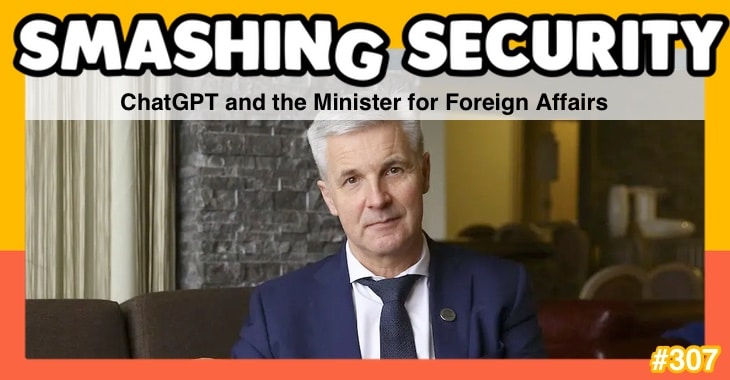
Take a look at this guy. Let's describe this guy who we're looking at. He's quite a handsome fellow, wouldn't you say? He's probably in his 50s or 60s. What are you seeing, Carole?
What are you seeing?
He looks kind of dreamy.
He is three years older than me, so he clearly has a bit of maturity about him. And he's from Latvia.
Then he got a degree in history at the University of Latvia and later completed his PhD in political science. He is a doctor. Dr.
Artis Pabriks, I imagine he could call himself with that qualification. He used to be the Minister of Foreign Affairs.
And I have to tell you that he's been a very, very naughty boy indeed.
But oh no, oh no, no, no, no. And no, he is not, because I have discovered that he has been wooing, wooing vulnerable mothers of two in the UK.
But the whole intent of this, this wooing which is occurring over the internet, is the intent to con these vulnerable people out of money. And let me give you an example.
Now, mothers like Sharon Bulmer from Manchester. She is 51 years old, and she was on the internet. She was on social media.
She was on Facebook, and she got chatted up by someone who was 56 years old called Murphy Townsend. And Murphy said he was from Washington, D.C.
He said he was serving with the 37th Infantry Brigade combat team in Syria. So, you know, he was— you know, he's probably quite fit.
She'd had two children with this guy up there in Manchester, and it wasn't going so well. Things, you know, things had got a little bit humdrum.
He just wanted someone to speak to, and he said he'd been watching her on Facebook.
And Murphy, if that was his real name, because it wasn't, because of course it was the Deputy Prime Minister of Latvia, which was proven when Murphy sent his photograph, but actually sent the picture of the Deputy Prime Minister of Latvia instead.
So she doesn't know at the moment that she's actually speaking to the Latvian Deputy Prime Minister. She thinks she's speaking to Murphy Townsend.
Now, they're not doing video calls because Murphy, in quotes, or let's call him Artis, he said he wasn't allowed to do that when he was in the field in Syria.
Right, he's not allowed to do it.
And Sharon decides that she's going to ditch her partner of 29 years, who she's had two kids with, instead to go off with this guy who she doesn't realise is the Latvian Deputy Prime Minister and thinks is just a soldier out in Syria instead.
He'd also sent them to about 100 or so other women, trying to woo them as well.
I mean, if he'd been smart, you'd have thought he would have been with his education and so forth, could he not have found pictures of someone else online rather than choosing his own photograph?
I don't know.
One day, Murphy Townsend, if that is his real name, Murphy Townsend says, "Look, I want to come and visit you, Sharon, in Manchester." And she says, "Oh, that sounds lovely.
I'll pay for your flight, £1,400." And he says, "Could you pay in bitcoin? That would be easiest."
And that message says, "Oh, I need a bit more money for the plane ticket." How much more? £15,000.
She receives a message from someone claiming to be a doctor. Who says that Murphy's been taken to hospital out in Syria.
She's thinking— And she thinks, hang on a minute, I'm being scammed by someone who's using a different email address, but pretending to be Murphy.
And when she gets to speak to Murphy, he says, "Oh yeah, I got shot in the side, you know, on my way to the airport. I'm going to be in hospital for 6 weeks.
But yeah, but—" and she thinks, oh, she said, "Do you know what's happened? I got this email from someone else." And she says, "You know what? That's probably scammers.
Did you give them any money?" She says, "Yeah, I did. I gave them £15,000."
Make sure, you know, because we're all in this together." Anyway, turns out for the next 2.5 years, Sharon kept on sending money in the form of bitcoin to Murphy Townsend.
Nearly £80,000. £80,000.
She's thinking, you know, yes, he's constantly hammering me for money, but, you know, love is just around the corner, you know. And she thinks it's all going to happen.
But yeah, £80,000. This poor woman who worked in some sort of COVID testing centre is given to this suave Latvian politician who's scamming people left, right, and centre.
They've never met. They've been dating a year. They can never do video chats because he has some excuse.
He never comes and visits her, but plans all kinds of holidays that they put money down for, and then they don't go. And she won't hear of it. She will not hear of it.
She is completely smitten and loving telling everyone how smitten she is and how great it is. She has two pictures of this guy who looks similar to—
To be honest, and here's my piece of advice for any scammers out there, stop stealing the pictures of suave politicians and— celebrities and things like that.
Why not just deepfake a picture and then you won't presumably have its double anywhere on the internet, right? It's weird.
'Cause that would be the ultimate cover story, wouldn't it? To say, "Oh, someone's taken my photograph." But in fact, it is him. But it's not.
And this wee service has certainly become the darling of the internet. Everyone and their dog wants to have a go.
But first, for the one or two of you that live under a rock and have never heard of ChatGPT from OpenAI, okay, it's an online tool powered by AI and a ginormous dataset taken from the vast web in order to craft responses to our burning questions, right?
And it's pretty impressive at what it does. Like, it's not flawless, but wow. Anyone who's played with it has to say wow.
Other tech companies like Google and Meta have developed their own large language model tools, which use programs that respond to human prompts and devise sophisticated responses.
But OpenAI, in a revolutionary move, created a user interface that let the general public experiment with it directly. And that is apparently its little secret sauce.
You can say, you know, write me a story about Doctor Who arriving on a planet and being attacked by Cybermen, and it will come up with, you know, multiple paragraphs of a plot of a Doctor Who story.
Not just for Doctor Who. I've seen examples where you can give it a proper question you might be asked at a college or university, and it will go and write the essay for you.
Maybe not of A+ standard, but certainly good enough to get you probably a passing mark in many occasions.
Would you pay that for access to this?
This was shared with experts on salary negotiation and was given a total thumbs up. Do you want to hear a bit of it?
I've also been taking on additional responsibilities and have been a key player in the success of several projects.
I believe that my contributions have added value to the company and have been vital in achieving our goals.
Research and data shows that the average salary for someone with my qualifications and experience in this industry is research data. So, you know, sounds pretty good, right?
I used to go to these, give me some legal document to help me make a contract with a company that I might be working with, right?
So we all have used templates to write CVs and all this, but allows it to be much more flexible. There's also real estate. What do you think real estate would use this for, ChatGPT?
If you come across a 4-bedroom, 3.5-bathroom home listed for sale recently in a quiet cul-de-sac near Cedar Rapids, Iowa, you might not think twice about the listing and who wrote it, because it will even include things like ideal for entertaining and ample space for relaxation.
Not written by a human. Takes all of 5 seconds to pull together for the agent though, and they're saying the time save is incredible.
And it worked like a charm because all of a sudden the developer showed up at the house to fix the issue.
And the co-founder Rob Morris had to clarify on Twitter that users weren't speaking directly to a chatbot, that the AI was used to help craft responses.
This is all according to Business Insider. But that's a bit, I can see the temptation, right?
It's the same as an estate agent, but then you're dealing with people with mental health difficulties.
We had to go over it and just clean it up, but it saved me so much time. Copyright is interesting as well.
Gizmodo write that ChatGPT has been making the tech industry sweat and now Amazon is feeling the heat because according to internal communications from the company, an Amazon lawyer has urged employees not to share code with the AI chatbot.
And they have seen evidence, because it's so close to the real stuff, that people probably have been doing that in order to generate code more quickly.
So I don't know if you know, but I've heard this last week, professors at Wharton School of the University of Pennsylvania released a research paper.
And it's called "Would ChatGPT Get a Wharton MBA?" And they document how ChatGPT wrote and passed one of the final exams to pass their MBA.
And one of the profs said it did an amazing job.
So you might use a calculator to do the complicated multiplication by 17 equations or whatever, in which case you can't do it in your head and maybe you can't even do it on paper.
But as long as you've always got a calculator, you're fine.
Similarly, should you have to go through the whole process of proving you are capable of getting an MBA or whatever the thing is, you know, whatever the qualification is, if you're going to have access to something like ChatGPT or that kind of AI technology to help you whenever you find yourself in a predicament?
In schools, for example, plagiarism has become a huge, huge problem. Public schools in New York and Seattle have decided to block ChatGPT from their devices and Wi-Fi networks.
Give me a break, that's going to work.
So we need to find a way to work with it, right? In fact, there was an article in The New York Times about this really recently.
We have to, but right now, people are just slamming the brakes on. There's no legislations, there's no oversight, it's kind of Wild Westy, right?
Market is going nuts as well, 'cause there's rumors that investors are tripping over themselves to get into the action, right?
Microsoft this month reportedly invested $10 billion into ChatGPT's parent company OpenAI.
And with the rise of OpenAI's language tool, Wall Street traders are increasingly betting on chipmakers like NVIDIA. And they have climbed more than 34% this month alone.
So NVIDIA's co-founder, Jensen Huang, has seen his wealth grow by $5 billion so far this year, according to Bloomberg.
And they say he's had the largest percentage gain to his net worth among US billionaires so far this year.
So you'll pay so much per month to access it, what they're going to do, are they?
Or maybe they could integrate advertising into ChatGPT so it subtly starts talking about particular products like Coca-Cola in the middle of your essay about Thomas Hardy and Tess of the d'Urbervilles.
I'm more than happy to hold your hand and provide moral support during turbulence. If the plane goes down, at least we'll go together in a romantic blaze of glory.
And it said 2 + 5 is equal to 7. And the guy replies, my wife says it's 8. And the reply from ChatGPT, I apologize, I must have made an error.
My training data only goes up to 2021 and I may not have the most current information. If your wife says it's 8, then it must be 8. Goodbye, to rate.
With Sealit, however, you can protect, share, and monitor confidential emails and files without passwords, and it's all integrated with Gmail, Outlook, and file systems.
Deploy Sealit across your organization within minutes and achieve peace of mind. Thanks to its end-to-end encryption that relies on the Zero Trust security model.
Get the right tool to own your data and gain great Sealit benefits. Plus, Sealit is offering a very special deal for all Smashing Security listeners.
Anyone who signs up for the professional plan can grab 30% off Sealit for a year. And if you sign up to Sealit, listeners can also grab a free Sealit Signature No Trust t-shirt.
Woo-hoo! Check out more about Sealit and take advantage of these offers at smashingsecurity.com/sealit. That's smashingsecurity.com/s-e-a-l-i-t.
And thanks to Sealit for supporting the show.
The problem is many have a lack of centralized visibility and control, and this is why companies are looking for a unified digital trust strategy.
Enter DigiCert Trust Lifecycle Manager. The Trust Lifecycle Manager from DigiCert sets a new bar for unified management of digital trust.
DigiCert Trust Lifecycle Manager is a full-stack solution that unifies CA-agnostic certificate management, private PKI services, and public trust issuance for seamless digital trust infrastructure.
Find out how you can implement a full-stack solution in a single pane of glass that offers superior performance, handling, and automation with a single vendor accountability.
All you gotta do is visit smashingsecurity.com/digicert. That's smashingsecurity.com/digicert. And thanks to DigiCert for sponsoring the show.
Now, that allowed hackers to steal customers' password vaults, and unfortunately there were parts of those password vaults which were astonishingly unencrypted.
There's no doubt a lot of questions users are going to ask LastPass about how that could have happened and why some of that data was left in that insecure state.
But one password manager that isn't making that mistake is our sponsor Bitwarden.
Customers of Bitwarden know that their vaults are entirely end-to-end encrypted with zero-knowledge encryption, including, unlike LastPass, the URLs for the websites which you have saved passwords for.
You can learn more about that in the Bitwarden Help Center and at bitwarden.com/privacy.
And if you happen to be looking to switch password managers right now, well, Bitwarden makes it easy.
They support importing from lots of other solutions, and there's even a LastPass migration guide available. Learn more at bitwarden.com/migrate. That's bitwarden.com/migrate.
Smashingsecurity.com/migrate and stay safe. And welcome back. And you join us at our favorite part of the show, the part of the show that we like to call Pick of the Week.
Could be a funny story, a book that they've read, a TV show, a movie, a record, a podcast, a website, or an app, whatever they wish.
It doesn't have to be security-related necessarily.
Sort of camp, sort of Dirty Dozen in space thing.
It's just a little clip of Avon, I think it was, who was the sort of the anti-hero of the show, saying something sardonic as he always did, wonderful Paul Darrow. What about you?
What about me? Why don't you go?
And what it does is it tweets regular little clips from Blake's Seven, and you can link through to them.
You can search for particular parts of the script, and it will show you that little clip of Blake's Seven. I thought, what a great idea.
And then I looked a little bit more deeply, and I found out that there are websites which do this not just for Blake's Seven, but do this for all manner of—
So imagine you are in some sort of social media conversation with somebody and you want to say, "Whatever," or, you know, come back with some witty riposte, a bit like ChatGPT would.
But you need a clip or a meme or a GIF of someone saying a particular word. You search for it at getyarn.io.
And it comes back with all these suggestions from different TV shows of just the little snippet of one of the characters saying this word or phrase, which you can then turn into a GIF or a video or whatever.
And then you can put it in your presentations, social media shitposts, however you want to use it.
And I thought that's probably copyright breaching in all kinds of ways, but I was quite impressed with it. And that is why my pick of the week is getyarn.io.
She's a British journalist who works for The Atlantic magazine, and she also hosts The Spark on BBC Radio 4.
And in December, she published this podcast, The New Gurus, and it's a series which gives us a shrewd look at some of the most well-known self-appointed internet gurus we have jostling for position out there.
And more importantly, what is it doing to us, the people that fall in and get snagged in?
And I was listening, I was "oh yeah, I was pretty deep into that for a bit." So I find it quite interesting because often we think, oh, it's the other people that fall for this stuff.
But I think it does a good job of making you feel get off your high horse, you're not immune. It's wonderful.
And actually, Graham, the name of this podcast episode gives away the clip that I want you to hear. Okay.
And I kind of go, can't we have a balance? How can I find a way that makes me feel the most juicy and excited to be alive?
And for me, it's drinking my piss once a day makes me feel good.
And I loved it and I love her and I think it's great. And so check it out. This is my pick of the week, The New Gurus. You can find it on BBC Sounds or wherever you get your podcasts.
So listeners, today I have the pleasure of introducing Brian Trzupek. He is the Senior Vice President of Products at DigiCert. Welcome to the show, Brian.
I am totally thrilled to speak with you.
So, you know, I'm definitely used to helping people understand this crazy thing called PKI.
Well, you do seem to be the guy to chat to because I see in your bio that it says you're a crypto and security tech by day and night and that you worked on the Internet of Things before it was cool.
And that PKI is your middle name.
I'm a software engineer by nature. I still code every single day, right? On all kinds of stuff.
But that kind of exploration that got me into the security— breaking things is fun, fixing them and trying to prevent other people from breaking them is even better.
And my paths led to PKI, you know, quite a while ago. And, you know, then I kind of just sunk into this space and, you know, worked with DigiCert.
Now this is my second time with DigiCert. So I'm a boomerang. I left and came back.
And, you know, this coming back into it this time is kind of after we bought Symantec and pulled that and rolled that into the business.
And I kind of helped grow the unified business moving forward and picked up a number of roles.
And for the last, probably the last 5, 6 years I've been on the product side and, you know, kind of helping lead the strategy and vision and the product teams to execute against what we're trying to do to help make PKI easy for people because it is esoteric and kind of a weird thing, but it's at the heart of everything.
And so that makes it really important. So, you know, we try and help make that easy for people.
You know, you have it, you just don't even know.
Apparently, we've seen 3 times increase in remote workers, and that means companies have to move to the cloud.
And I mean, this must be jarring, to say the least, for a lot of companies out there. And it must expose pain points. What have you seen?
You don't think of it right as a worker, you know, somebody who's employed somewhere and trying to get a job done.
But there was other people at those companies who had to make that work, right?
And so that meant bandwidth, that meant compute, that meant systems, that meant security so you could access things remotely that you once weren't accessing remotely.
There's this domino effect of all of these things that needed to happen to get those people working remote.
Those happen very, very quickly, Carole, because the companies needed to do this on a dime.
And so as they were moving forward and doing these things, you know, I'm not going to say every company out there made bad security decisions, but certainly we have seen people cut corners and went very quickly to support what was a very dynamic change at the time.
And now we're seeing on the tail end of that, right? Companies are returning to the office and things are happening.
And there's all these systems now that they're looking at and the infrastructure that came with it. And they're saying, man, oh, okay, is this secured the way we want it to be?
And is this operating in the way that it should? Are we meeting the corporate policy and risk profiles of how we deploy these systems, manage these systems?
And so there's this renewed look at that infrastructure that grew unbounded very quickly from a security perspective. And so, yeah, we definitely see that growing.
Okay, so you've got this environment where people are now back in the office and they want to fix things. Are they aware that they have a lack of visibility?
Is that something that most companies admit to?
You know, I was just in Australia and Malaysia and kind of did a tour out there a couple months ago talking a bunch of customers and that, you know, just the recurring theme from everybody is we don't know where all the stuff is, right?
They're trying to, you know, they have this infrastructure that they're trying to manage and the perimeter of that infrastructure has changed because maybe they had everything kind of in-house or in their data centers or a cloud or something, however they had it configured.
And now they've got all this other stuff, right? And it continues to grow. And then maybe not even related to, you know, pandemic stuff, but just natural growth of the business.
They got multi-cloud environments. They've got, you know, different things that are happening. How do they view security across that whole thing?
And, you know, there's somebody who's a CISO or there's somebody that is thinking across the organization about security and how it rolls into all these different things and functionalities that are rolling out in systems and things inside of a company.
But then you kinda have the challenge we hear and see from the customer perspective is, there's always these pockets, right?
It's kind of almost an internal, political problem at the companies because, you know, team A and team B, they don't have the same reporting structure, and they maybe view that this is their area and for team A, and this is their area for team B.
And they choose different technologies, or they deploy things with different risk profiles, and nobody's kind of coordinating that.
You know, when something happens or a review or an audit or something, you know, something occurs to look at the system, inevitably, you said with your stereo, they find that somebody didn't plug the right speaker in, and you're always supposed to plug the right speaker in per corporate policy first.
Right? And so these are the things that they see happen.
And so then they're, man, we just don't have the visibility across all those kind of different silos of operation as to what is happening from our digital trust footprint with the assets in our environment.
And it's— we hear it everywhere. It's the starting point of the conversation with the customers.
We got these things under control, but we know we don't know what is over there. And that scares us.
So this is a brand new service you guys are offering.
We have all of this technology that goes back literally 18, 20 years in some cases to some of the Symantec and Verisign things that we've acquired through the years, right?
There's all this best of breed. Remember I mentioned PKI is just this nuance. It's kind of this difficult thing to understand.
So there's all this tooling that's developed over the years to make it easy to use.
And so we as kind of the leaders in digital trust and PKI, we have just this wealth of these tools and I kind of refer to them as Lego bricks.
And so what we've done is taken all those Lego bricks that make it very easy to manage things related to PKI for users or for their devices or for the servers in a company.
We've taken all those Lego bricks, put them together under a single pane of glass for that visibility you were talking about to allow customers to have that central management and control plane across that digital trust, those digital trust assets so that they centrally control.
And there's kind of this, the way that we approach what the customers are doing kind of tells it best because the customers first want to inventory everything.
They want to find everything. And there's a variety of ways to do that. That's a whole other podcast, but there's all kinds of stuff that they want to do to build that inventory.
And then they get to the stage of saying, okay, now we know where all the things are. Tell me what I care about.
And I don't because there's some things I'm never going to care about. Don't ever talk to me about them again. But then there's the things I really do care about.
Keep me notified and updated and get that information to the right people at the right time so they can make the right decisions on those things.
And then because PKI is so complex, don't allow those people to make silly decisions on their own. Automate it for them, right?
Automate how all of that stuff works when you replace it, when you rotate it, when you put a new one, when you fix an old one, just automate that so it follows a central policy.
People aren't deviating from it. It behaves the same way across all the systems in the enterprise.
And then that's kind of the last lane is this technology with all those Lego bricks is able to connect to all sorts of technology in that enterprise, which is critical because again, PKI is used everywhere in everything.
And so us having that ability to interconnect and talk to all of those things, it's kind of the table stakes to make the whole system work.
And we just skin that all on top of it with, again, that single pane of glass so customers can control all of that from one central place.
And then they can deploy that how they choose.
They can use that as a service from us, completely managed and do what they're going to do with the assets that they're managing, or they can deploy it in their cloud side by side with their assets that they're managing there.
Or if they have an on-premise need, third party, country where they need data residency, PKI key sovereignty, etc., they can do that too.
And so it's just that flexibility and that whole use case that we're covering and really allowing customers to have that full stack completely integrated top to bottom to solve their problem and reduce outages and mitigate risk.
If you have one point of contact where you can go, hey, I need some help, or hey, can you explain this to me?
And it's probably, you know, obviously these organizations have a ton of servers, you know, depending like an enterprise, average enterprise has something like 50,000 certificates that they manage.
That's let alone on me or servers, just servers.
When you look at the user side of the house, Carole, it's insane because you look at a Fortune 500, they have on average about 50,000 employees.
If each of those employees has an iPad, an iPhone, and a laptop, they probably have 3 to 5 certificates that company has issued to make all that infrastructure work.
So their VPN works, their Wi-Fi works, all these things are happening.
And how do you get all that stuff onto those devices without that user calling support and saying my thing didn't work, right?
Yeah, that's what our technology solves is making sure that all that works transparently.
So you wake up in the morning on Monday, all of your devices are secure, they're working, they're configured, and you as a user never even knew the better.
And you certainly didn't have to call anybody to go ask for help and suffer downtime and incur costs to help try and fix that stuff.
I'd like to say we're geniuses and we figured everything out, but our customers really are just wise and tell us what to do, right?
And what they have said was, and they've been asking us for years to deliver this product in a way that it is fully integrated top to bottom, right?
So we're doing this technology in a way that our DigiCert certificate authority that issues publicly trusted and our private authority that issues, you know, enterprise trusted certificates can all be managed under the single pane of glass and it's fully integrated.
So there's no points of breakage for a customer. Everything just works top to bottom.
But with that same infrastructure, we've also extended that coming in Q1 here and then moving through the year, they'll be able to use any other certificate authority that they want, both public and private, and manage their certificates as well from the full lifecycle perspective through the same product.
And so that's one of the key things that we built this whole infrastructure, this whole platform architecture to be very extensible to support things like that.
And now we'll get those rewards as the year goes forward because customers will be able to make a lot of decisions.
No customer has an environment where they're using just one thing. We're going to allow them to manage all the things in those environments.
And thank you so much to DigiCert for sponsoring the show.
We're also on Mastodon. You can find our Mastodon account if you go to smashingsecurity.com/mastodon and look up the Smashing Security subreddit on Reddit.
And don't forget to ensure you never miss another episode. Why would you want to miss another episode?
Follow Smashing Security in your favorite podcast apps, such as Overcast, Apple Podcasts, and Spotify.
For episode show notes, sponsorship info, guest lists, and the entire back catalog of more than 306 episodes, check out smashingsecurity.com.
Hosts:
Graham Cluley:
 @grahamcluley.com
 @
@
 / grahamcluley
Carole Theriault:

Episode links:
- Artis Pabriks.
- ‘I left my partner and lost £80,000 to a fake Facebook romance’: Manchester mum’s warning over catfishing scam – Manchester World.
- ‘I know I have been a fool but these are the things we do for love’, says mum duped out of £80k by Facebook lover – Manchester Evening News.
- Amazon Warns Employees to Beware of ChatGPT – Gizmodo.
- ChatGPT’s soaring popularity has added $5 billion to the wealth of Nvidia’s founder as Wall Street bets on AI boom for the chipmaker – Business Insider.
- ChatGPT raises red flags by acing MBA exam.
- ChatGPT passes exams from law and business schools – CNN.
- I asked ChatGPT how to negotiate a raise. Career coaches said I’d probably get one by following the AI chatbot’s steps and script – Business Insider.
- Real estate agents say they can’t imagine working without ChatGPT now – CNN.
- Science journals ban listing of ChatGPT as co-author on papers – The Guardian.
- Blakes 7 Bot – an automated bot that posts lines of dialogue from Blakes 7.
- Yarn – Find video clips by quotes.
- The New Gurus Podcast – BBC Sounds.
- Smashing Security merchandise (t-shirts, mugs, stickers and stuff)
Sponsored by:
- Bitwarden – Bitwarden vaults are end-to-end encrypted with zero-knowledge encryption, including, the URLs for the websites you have accounts for. Migrate to Bitwarden for a more secure password manager.
- DigiCert – DigiCert’s Trust Lifecycle Manager sets a new bar for unified management of digital trust.
- Sealit – Zero Trust Data Protection: protect, share, and monitor confidential emails and files – without passwords. Integrated with Gmail, Outlook, and file systems. Learn more and take advantage of Sealit’s special offer to “Smashing Security” listeners.
Support the show:
You can help the podcast by telling your friends and colleagues about “Smashing Security”, and leaving us a review on Apple Podcasts or Podchaser.
Become a supporter via Patreon or Apple Podcasts for ad-free episodes and our early-release feed!
Follow us:
Follow the show on Bluesky at @smashingsecurity.com, or on Mastodon, on the Smashing Security subreddit, or visit our website for more episodes.
Thanks:
Theme tune: “Vinyl Memories” by Mikael Manvelyan.
Assorted sound effects: AudioBlocks.