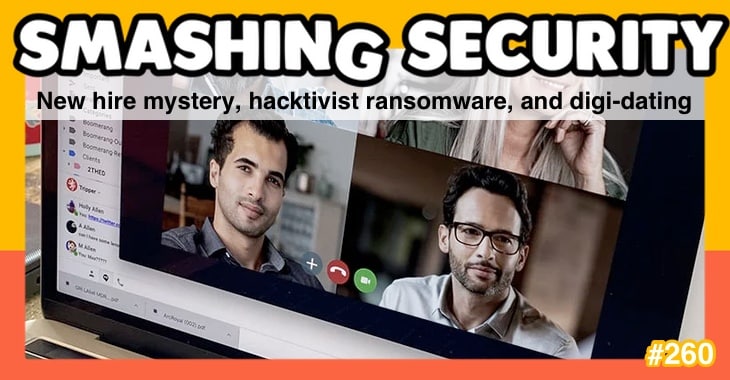
Who’s that new guy working at your company, and why don’t you recognise him from the interview? How are hacktivists raising the heat in Belarus? And should you be fully vaxxed for your online date?
All this and much more is discussed in the latest edition of the award-winning “Smashing Security” podcast by cybersecurity veterans Graham Cluley and Carole Theriault, joined this week by Maria Varmazis.
Show full transcript ▼
 This transcript was generated automatically, probably contains mistakes, and has not been manually verified.
Hello, hello, and welcome to Smashing Security, episode 260. My name's Graham Cluley. And I'm Carole Theriault. And Carole, we've got a special guest, our first of the year.
Oh, finally. Who might it be? My favorite.
When new hires are brought in, I should just vet them, make sure they're a good fit.
But eventually you get to the person you're going to be working alongside maybe for years and years. Right. So this chap called John, he gets interviewed.
Obviously, it's a remote interview because this is 2022. And he goes through a couple of rounds of interviews.
And the people before you, the ones who are doing the preliminary interviews, they decide he's the guy for the job.
He knows the subject inside out. He seems confident. His resume looks good. He checks out.
So, the company has effectively thrown out all the other candidates, and he comes through to the third and final panel, which includes you as a big cheese.
You ask him some tricky questions. He handles it with aplomb. Aplomb. Aplomb. Well, well, well used aplomb. And you think, yep, this guy's all right.
We're going to give him the thumbs up. Gets my seal of approval. And the company makes John an offer. So, all is good. John starts working remotely for the company.
All of those things going on.
He's got different hair. And now he's wearing glasses.
But in the interview, he'd mentioned that he was single and he was sitting in somewhere with loads of desks. Oh. Hmm. Bit odd, isn't it?
It's been very tricky to juggle the two families and two households. But, you know, I imagine some people manage it.
John also can't answer a number of questions that they previously discussed in the interview.
Things which he'd been able to handle, things which seemed pretty pivotal and important to the job that he's taken on. Doesn't seem to be able to handle them.
Well, you know, what do you do at this point? If you've got the suspicions.
Well, this was a question post on the Ask a Manager website where a wife wrote in saying that her husband who worked in IT at a mid-sized private company had exactly this happening in the office right now.
And he had his suspicions about a new colleague. And had become convinced that the person they'd hired was not the one who was now actually doing the job.
Because HR and legal, who are the bane of all of our lives, the ones who ruin all the fun in the office.
They might get unhappy saying that's mean, but it's not, right? No.
What if the person says, well, you know, you weren't justified in what you were saying, or you're picking on me, or you just didn't like my nasal voice, or, you know, I don't know.
So, the interesting thing is, according to this woman who wrote into the Ask a Manager website about her husband's predicament, someone else then, high up in the company, Holly, the boss of her husband, had suspicions as well.
And Holly called up the husband on mobile phone. She said, "I don't want there to be a record of this," and said she had suspicions.
But she didn't want to accuse him of anything in case they were way off. There were legal concerns.
Yes.
And he didn't seem to know who I was. And I introduced myself. And that's despite me being present on all of the interviews. And he was, well, who are you? What do you do?
You know, oh, you know, and it's— I heard a story, by the way, I heard a story, by the way, of someone who got hired for a job remotely or something.
They went into the office and it was a couple of months later and they were in the kitchen area. And this guy comes up to them and they kind of vaguely recognise them.
They're not sure who really they are because there's so many new people in the office. And he's sort of asked, you know, how you getting on? How you settling on?
And he goes, oh God, job's a bit boring to be honest. You know, it's a— And it turns out it was one of the guys who interviewed him. Oh Lord. So you do have to be— Rookie move.
You have to be quite careful. So Holly and this chap, they're trying to work out, you know, if he is an imposter, what might he be doing?
And should IT put some monitoring software remotely on his PC to watch his behaviour and activity? Oh no.
And he was using it, and he's accessing data. And that sort of— But they're a bit nervous of calling him out as a liar.
So the eventual consensus, lots of toing and froing, lots of, oh yeah, and the eventual consensus is that HR should have an online meeting with this guy to discuss the concerns.
And they said, what we'll do is we'll say it's about your performance and whether you've been overselling your abilities on your resume.
So it might be, as appears to have happened in this case, someone different actually takes the interview. Right. Yeah. And you just don't remember.
Maybe you're hiring so many people and it's a bit taking an exam test or taking a driving test for somebody else. Yeah.
But even that wouldn't work, would it, if someone was in front of you with a whiteboard writing down the answers as you asked them over the call?
If I had to hire somebody who actually was backed up by 4 different people, all of which had a part of the job covered, and they represented themselves as one entity to do the work for me, do I actually care?
The problem here was he wasn't doing the work very well. If he was a stellar performer, would they have given a shit?
But if he was, this guy could have just been a mole and just sat there and taken a whole bunch of confidential data and no one would've been the wiser.
Oh, take notes whoever wants to do this. Just note, don't do it.
Now I had a bit of a think about this and I thought, wouldn't it be a good scam, right?
Because of all this remote working, there's no reason why I couldn't take on more than one remote working job. I could have a full 5-day-a-week job, but in multiple places.
Maybe I could have 7 different jobs at the same time. I'm sure people are doing this right now.
And wait to get made redundant. And you're gonna cash in, aren't you?
Just work for 8 weeks a year and you've probably been paid enough for the entire year if you had enough companies like this. So right now I'm recording for the Cyberwire.
Maria, what story have you got for us this week?
And then, okay, when I say ransomware, what do you think of?
It's more about the money rather than the political stance.
So we've talked about hacktivism and ransomware. So what do you think would happen if you tried to put the two together? Hacktyware. Ransomism.
What if I told you the answer is, actually, in all seriousness, this has happened recently in the last week, and it's called Operation Scorching Heat, and it was political hacktivism that used ransomware.
Have you heard about this?
And this hacktivist ransomware attack was done by a group calling themselves the Belarusian Cyber Partisans. Belarus being a neighbor to Ukraine and Russia, kind of involved.
I don't want to get into too much of it. I think we all know that there's a— it's very complicated, right?
So the Belarusian Cyber Partisans are— please don't hack me, guys, if I get this wrong— aligned with the opposition.
And they put out a notice on Twitter, and I'll read to you exactly what they wrote on Twitter because I think it's really fascinating.
"As a command of the terrorist Lukashenko, who is the leader of Belarus, Belarusian Railway allows the occupying troops of Russia to enter our land.
We encrypted some of Belarusian Railway's servers, databases, and workstations to disrupt its operations.
Automation and security systems were not affected to avoid emergency situations, but we have encryption keys and we are ready to return Belarusian railroad systems to normal mode.
Our conditions are release of 50 political prisoners who are in most need of medical assistance and preventing the presence of Russian troops on the territory of Belarus." Crikey.
It's still not super clear to me if it's been 100% effective, but I'm just going to assume that it was, because there was a lot of chatter in the press that they— people were asking for proof that they actually did manage to hack into these systems.
And what was interesting to me, because I started reading about the story a few days ago when it broke, and it's been developing rapidly since then, and I'm sure by the time this podcast is out, there'll be more.
When the cyber partisans were asked for proof, they actually posted a thread on Twitter with screenshots sort of proving to the public that they actually had been able to access bank statements, file servers on the backend—
And one tweet said this: "Screenshots taken during a #ScorchingHeat cyberattack on the Belarus railroad reveal that employees frequently used pirated software.
Do you think it's connected to how they got hacked?" With a bunch of upside-down smileys afterwards.
And the screenshots showed VMware Workstation Keymaker directories and directories called crack, so lots of warez type stuff going on. Yeah. So what a shit show. Oh no. Yeah. Yeah.
So a lot of people in the press are saying that this is pretty much the first time we've ever seen political hacktivists using ransomware to achieve their goals, which sounds about right to me because I can't think of another situation where this has happened.
So in terms of who did this, who are the cyber partisans? They actually have a spokesperson, Yuliana Shemetovets. And she's not part of them, but she's their spokesperson, she says.
So she says that the opposition activists once worked in Belarus's well-respected computer science community. That was pretty much all we know.
And NATO is trying to stay away from this because, as you imagine, you don't really want to get involved.
According to a NATO intelligence officer they said, "I have no reason to doubt that they're an independent outfit, and they don't appear to have done anything more than a decent hacker might do." So was this a sophisticated hack?
I don't really know if we can say that, but it seems like a lot of these targets are sort of ripe for being hacked.
And there's some worry that this is going to escalate and start— there's going to be counterattacks and retaliation. So I guess put a pin in it, watch the space.
But if we start seeing Russia getting attacked by hacktivists...
They say, I mean, they say they're not, you know, they're not being supported by another nation, they say.
But you know, if somebody goes after, say, Russia, we know that Russia knows how to counterattack. So it would be a lot of escalation happening and that could get really nasty.
I mean, I'm not saying that's a right or wrong request, but millions of people though depend on the rail systems for supply chain, for work, for everything.
But how long does it take to fix computer systems? You may have a backup or you may be able to restore.
I mean, there have been railways which have been disrupted by ransomware attacks in the past and it may be disruption for a few days or whatever.
I think you should start small, maybe asking for the quality of the sausage rolls on the railway or something to be improved or something like that.
So it may emerge by the time this is put on the internet that they were actually able to shut things down, but right now it doesn't seem like they were.
It just seems like they have access and they have the ability to—
I imagine someone's taking notes. I am not doing that, please don't come after me.
No, I just thought it was such a fascinating story because it's the next evolution. It seems almost logical that we've gotten to this place.
And I'm going to be very interested to see where this goes.
I'm interested in the mega changes that have happened in the online dating world over the last few years because, you know, coronavirus changed stuff for everybody.
You couldn't meet in person very often or easily, and you couldn't go out and do stuff. And it basically threw a huge curveball on how people use the sites.
I mean, dating is kind of a social activity, and social distancing doesn't really align, right?
So are you surprised if I were to say to you that 91% of Americans say they believe there's no stigma attached with online dating?
You meet on Zoom or something and not in person. People are saying they wait a month virtual dating before they go for a real date.
Okay. So since last summer, Tinder offers users vaccinating or vaccing soon interactive stickers for profiles.
And even the UK government teamed up with, I think, Snapchat to provide in-app bonuses for vaccinated profiles. But do you have to be—
So if you want to go to a restaurant or go to the theater, you have to prove that you are fully vaxxed. Do you have that? Have you had that at all in Boston? Vaccine passports?
So, so it seems that if you advertise your vaccination status on these sites, you improve your chances of interacting with others.
But at the same time, advice from security pundits like us would say, hey, you know, be careful about giving full identification. Don't use your full name.
You know, don't say where you live. Don't say where you work. You know, use a real photo, but not, you know, a unique photo, not one that's tied to other profiles of you.
Because I know, I get we're being asked for medical information, you know, we're being encouraged by our governments to share this medical info in order to encourage people to be vaccinated.
I feel that's a fair statement to make, Professor, right?
But is it a slippery slope for it becoming the norm to request that people advertise this type of information, medical stuff?
We all, we all know this stuff. But what about asking stuff on someone, oh, you know, are you sane? We don't ask that of people. We don't expect them to put that in their profile.
So if in my profile description, it's really important for me to communicate my vax status, I can say, hey, by the way, I'm totally vaxxed.
But for them to have the option there, if it said, please enter your BMI, right? Some people would be, screw you, that's personal, private medical information.
There's the whole joke about how every man on those dating sites is a certain height, and then when you meet them in person, you're like, you definitely are not the height you said you were.
Same thing with the ladies often saying, I'm this weight, and then you meet them in person, you're like, you are definitely not that weight. So people lie. I agree, people lie.
If people are trying to move to more serious relationships with people, I worry that people are gonna be more open with their information because they're saying, "Hey, this is me, let's go," and might be wanting to share more and more information.
And I'm not so much worried about between two people, but there's a company in the back that we have seen many security vulnerabilities with insights on the dating world, right?
And they're collecting a ton of info here.
But you're saying, is it bad to be providing this information because that's just too much information in the hands of the companies, or is it both?
But by answering it, I'm also giving away medical information which I agree right now we're all sharing that information, but is that something that we want to creep into other bits of our medical information?
By the way, the whole idea of I'm not vaxxed, it just makes me think of Eastern Europeans saying that I am not vaxxed. Would you be interested in me? I am totally vaxxed for you.
Sorry, I'm being filthy.
So if you're in France right now, and you now have a vaccine passport, and you've been lying on your dating app saying, yeah, I'm totally vaxxed, man, to all the people, have fun going on dates, right?
Because you'd be like, oh, let's go down and see this restaurant. I'd love to go.
Yeah, I mean, I'm thinking at it from the situation I'm in, in the States, where Boston, which is the city I'm near, does have vaccine passports, but none of the surrounding areas do.
And also a lot of the places where we get vaccinated are actually through private companies. So that information is already in the hands of private companies.
I got vaccinated through a Walgreens, for example, my first two shots were through a hospital and then my third, my booster shot was done through Walgreens.
So that private company has that information already that I'm vaccinated and boosted and all that stuff.
So for me, I'm just like, a lot of the information is already in the hands of private companies in my case. So that horse is out of the barn. Yeah, I don't know.
It's an interesting question, though, Carole. I think it's— I'm glad you're asking it.
If you are, you would see that many people put that information on their profile photos, hey, I'm vaccinated. It becomes a way of people to self-select. I don't know. I mean, I—
Yeah, in an emergency situation, you're, "I know, let's all encourage everybody, let's do this." But I think we're maybe at a point where we have to just think about what the hell are dating apps doing with this kind of info.
Okay, so it's happening with vaccination, but I bet before the pandemic it was happening with, "do you like the poetry of Emily Dickinson?" Or, you know, "do you like whatever it is."
Age is already there. A lot of cases where somebody lives is already there. Yeah, I mean, if you have a visible disability, you can't hide that.
If you were born missing a limb, that's already— a photo will reveal that about you. You know, I don't know, it's an interesting question.
I mean, what does somebody do with knowledge that somebody's vaccinated?
Well, let 1Password and Brex simplify finances and online security so you can focus on doing what you do best.
Brex is the financial operating system that powers tens of thousands of businesses, and now that power is accessible through 1Password in the browser.
With this new integration, Brex customers can autofill their Brex corporate and vendor card information while checking out anywhere on the web, right from 1Password in the browser, making online payments simple, secure, and frictionless.
1Password's integration with Brex is available right now to 1Password Teams and business customers based in the United States.
To find out more about 1Password and Brex, check out smashingsecurity.com/brex. That's B-R-E-X, smashingsecurity.com/brex.
Uptycs zeroes in on blind spots that are preventing you from identifying and responding to existing threats and vulnerabilities in your ecosystem.
Plus, Uptycs normalizes telemetry across macOS, Linux, Windows, and containers, records system activity for historical investigation even when no alert has fired, and enables you to build complex custom detections.
In short, Uptycs provides observability across both cloud workloads and endpoints in a single centralized platform.
Visit smashingsecurity.com/uptycs, that's U-P-T-Y-C-S, to learn more about its cloud-native security analytics platform. And thanks to Uptycs for sponsoring the show.
Could be a funny story, a book that they've read, a TV show, a movie, a record, a podcast, a website, or an app. Whatever they wish. Doesn't have to be security related necessarily.
Better not be. Well, my Pick of the Week this week is not security related. It is something that's been around for some years.
But I remembered it this morning and I thought that was a bit of fun. And so I've been playing it today.
And if I were to tell you that at this very second, I am baking 75,143 cookies per second. What? Would you know what game I am playing?
You'll be able to buy little cursors which will click every 10 seconds onto the cookies.
After a while you'll be able to get grandmas who will do the cooking for you and factories and mines and kittens and even a portion of some how long spent doing this?
So I said, so I haven't been clicking throughout this recording, but I have recruited grandmothers and farms and all kinds of other things which are doing the clicking for me.
You see, so I have so far in the last 3 hours or so, I've— let's see how many cookies I've actually— so many I've baked so far, 182 million cookies.
And you open achievements. I'm sure some people will enjoy this because I enjoyed it.
I love bicycling, it's my absolute favorite sport, and I'm very slow.
I'm also very short, so I'm not great at it, but I love doing it, and I got myself an indoor bicycle, one of those trainers, not a Peloton.
I got a different one, so I have a little tiny living room, and I have my bike in there, so I can sort of watch TV as I'm biking.
And I've been looking for good things to watch while I'm on the bike because I'm in there a lot now.
And I've been going through my Netflix, and a show that I've been watching recently that I really have been enjoying is Getting Curious with Jonathan Van Ness.
Which is a video version of his very famous podcast.
So this is— there's some fascinating guests on there, some really interesting conversations, and it's been very bingeable and very watchable while you're exercising or whatever.
So what would be a typical show? Well, the first episode was about bugs, how cool are they, what do they do, and are they— how delicious can they be?
Like, have you ever eaten a bug?
He's not that hairy, but I think he's sort of— not compared to your husband, but I mean, I would imagine— but he's actually quite well groomed despite the amount of hair, so I wouldn't think he has a lot of bugs on him.
So the first episode was interesting also about people who eat bugs. I've eaten bugs knowingly, I've had crickets, they were delicious.
But there was another episode about the history of hair and hair grooming around the world. Oh, that's why he's such good hair groomer.
Well, he's a— he was a hairstylist for ages and ages, so, as you know, you try.
So I'm only about 3 or 4 episodes in, but every episode I've seen was really very interesting, and I'm looking forward to watching the rest of the season.
I have watched some episodes of Queer Eye, and although sometimes there's an emotional story in it, and some of them are quite charming, it can be a little bit too much, can't it?
Personally, I think. And he's possibly the best.
Oh my goodness, chicken fatte, not like fatty, but fatte, F-A-T-T-E. It's good, right?
So let me send you the link.
So basically, it's kind of rice chickpea, allspice, cinnamony, there's crisp breads, there's yogurt, and it kind of looks complicated when you see the recipe, but it's not.
It's so different and unusual, and you could totally do it veggie if you wanted. So anybody out there, we all have to eat, right?
And sometimes we get really bored with the stuff we cook. We all have what, 7, 10 dishes that we do on repeat.
I can also recommend all of Moro's cookbooks, which I own and cherish, and they're a delight to cook from. And in fact, I was thinking, oh, what would you have after this?
Maybe I should throw a dessert in, right? Moro's chocolate apricot tart, which, Graham, you've also had.
Just cook something a little different. It's February. It's a dark, dreary month for many of us. So do something delicious.
Maria, I'm sure lots of our listeners would love to know more about what you're doing and follow you online. Is there a way of doing that?
And don't forget, if you want to ensure you never miss another episode, follow Smashing Security in your favorite podcast app, such as Overcast, Apple Podcasts, and Google Podcasts.
For episode show notes, sponsor membership information, guest list, and the entire back catalog of more than 259-ish episodes, check out smashingsecurity.com.
Hosts:
Graham Cluley:
 @grahamcluley.com
 @
@
 / grahamcluley
Carole Theriault:

Guest:
Maria Varmazis:
Show notes:
- The new hire who showed up is not the same person we interviewed — Ask a Manager.
- How to Spot Fake Candidates in Video Interviews — Nick Shah on LinkedIn.
- How To Avoid The Fake Candidate Scam in the Tech Industry — Focus GTS.
- Tweet by Belarusian Cyber-Partisans.
- Tweet showing screenshots of hacked railroad.
- ‘We Can Hurt Them in Ways They Don’t Understand’: Ukraine on Russia Cyber-War — Vice.
- Pandemic fuels new trends in the online dating world — WXYZ Detroit.
- 'Swipe left for unvaxxed’: Vaccine status complicates the scene on dating apps — France 24.
- Tips for private and safe dating on Tinder — Kaspersky.
- Survey Says Bumble Users Are Burned Out on One Thing in Particular — Bumble.
- Cookie Clicker.
- Getting Curious with Jonathan Van Ness — Netflix.
- Chicken fattee with rice, crispbread and yoghurt recipe — Moro.
- Chocolate and Apricot Tart report — Happy Foodie.
- Smashing Security merchandise (t-shirts, mugs, stickers and stuff
- Support us on Patreon!
Secure online payments and grow your business with Brex and 1Password.
Brex and 1Password have partnered to make online payments secure and frictionless. 1Password customers can now use Brex virtual credit cards to check out online with just two clicks.
1Password’s integration with Brex is available right now to 1Password Teams and Business customers based in the United States.
Learn more at smashingsecurity.com/brex
Uptycs is a cloud-native security analytics platform built to protect the modern attack surface.
Uptycs zeros in on the blind spots that are preventing you from rapidly identifying and responding to existing threats and vulnerabilities in your ecosystem.
Uptycs normalizes telemetry from across macOS, Linux, Windows, and containers; records system activity for historical investigation even when no alert has fired; and enables you to build complex custom detections in addition to its industry-leading MITRE ATT&CK mapping.
Uptycs provides observability across both cloud workloads and endpoints in a single centralized platform.
Find out more and try it for free at uptycs.com
Follow the show:
Follow the show on Bluesky at @smashingsecurity.com, on the Smashing Security subreddit, or visit our website for more episodes.
Remember: Subscribe on Apple Podcasts, or your favourite podcast app, to catch all of the episodes as they go live. Thanks for listening!
Warning: This podcast may contain nuts, adult themes, and rude language.