“Demonically” possessed devices print out antiwork propaganda, advice on how to secure your store, and is Twitter’s new photo privacy policy practical?
All this and much more is discussed in the latest edition of the award-winning “Smashing Security” podcast by cybersecurity veterans Graham Cluley and Carole Theriault, joined this week by Dinah Davis.
Show full transcript ▼
 This transcript was generated automatically, probably contains mistakes, and has not been manually verified.
Hello, hello, and welcome to Smashing Security, Episode 255. My name is Graham Cluley.
I listen to your show all the time, and I kept thinking to myself, I would have so much fun with them on this show that I'm so glad you invited me to come.
I'm really excited about it.
Now, coming up on today's show, Graham, what do you got?
All this and much more coming up on this episode of Smashing Security.
This isn't news that you're going to want to hear, but ultimately it was my decision and I wanted you to hear from me. It's been a really, really challenging decision to make.
This is the second time in my career I'm doing this and I do not want to do this. The last time I did it, I cried. This time I hope to be stronger.
If you're on this call, you are part of the unlucky group being laid off. Your employment here is terminated effective immediately. I wish you all the best of luck.
Thank you for everything you've done for Better.
And the company said that the layoffs had been gut-wrenching, especially at this time of year. So pity them, you know, they must have had a terrible time.
So they have a shower and comb their hair and put some makeup on.
But it later emerged that the CEO had claimed that at least 250 of those people who'd been terminated were stealing from the company, because some people apparently were working 2 hours per day but actually claiming to have worked 8 or more hours per day.
And what he said to them was, "You're a bunch of dumb dolphins. Dumb dolphins get caught in nets and eaten by sharks. So stop it, stop it, stop it right now.
You're embarrassing me." Dumb dolphins?
Well, sometimes he would lie on the ground and bleat like a sheep by your desk if he thought you were wasting time.
So quite why he's employing dolphins, dumb or otherwise, to do the job is a bit of a mystery to me.
Wonder how much cash your coworkers were making?
And then you kind of think, "Oh, but do I ask them or not?" Because it's gonna feel bad if they're making more, but it's also gonna feel bad if they're making less than me.
And you're sort of in this quandary.
And did it in a meeting room that wasn't, shall we say, soundproof. And a particular employee was next door taking notes.
And then instead of just skipping, and not discussing that, just going full force and having a negotiation in front of you of how much you should get paid.
That actually happened to me once.
Now I've checked out this subreddit and it's rather interesting. It's clear a lot of people aren't terribly happy with their jobs at the moment or how they're being treated.
They'd like more money, more respect, just to be treated like human beings. In fact, there are 1.2 million members of this subreddit where they're posting jokes and memes and—
They're saying, you know, we need union representation. We need to be part of it. We need to fight for our rights of a decent wage.
Come on, rise up, battle against your bosses." And they're doing this, they're spreading these words, not by doing an airdrop, not by dropping things from a helicopter above people, but instead demonically possessing printers normally used to print out receipts at checkout.
So, demonically—
So if you were somebody who worked in a sort of customer service role where you took a payment for something and then said, would you like your receipt?
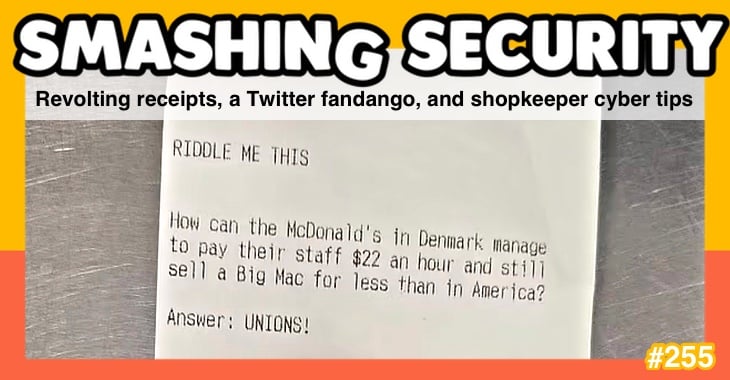
Your receipt machine would start spitting out. It would spit out messages like this.
It would say, riddle me this, how can McDonald's in Denmark manage to pay their staff $22 an hour and still sell a Big Mac for less than in America? Answer, unions.
Did you know it is rather simple task to organise a union?
And it's not just that message, there's oodles of other messages as well.
Life is short," they say. "Time is your most valuable asset. And so, you know, what are you doing to make sure that you have a decent life?
Stop working for slave wages," they're saying.
So people are getting these messages on the receipts in front of them, and they're thinking, "That's funny." And then they go on to Reddit and check it out and say, "What on earth is this that's just appeared?" Brilliant.
And so they're joining the subreddit. So the subreddit is growing in popularity.
And some people are saying, look, you know, I find this amusing, but what I really find funny is my boss who's unhappy that this thing keeps on getting printed out and that we're beginning to talk more about our wages and salary.
I think I've been reading too many cybersecurity books, but—
I know you're a bit older than me.
Oh, oh, just—
I was very— I was actually— I read that when I was doing the research and I went, really? That was the first thing? Couldn't we have done better than that?
And they did it on a Unix machine loaded with an X-Mosaic browser, and they used PGP, or Pretty Good Privacy, you see.
They seem to have— they did it in a secure way rather than just sort of, yep, emailing their credit card numbers through or something.
I didn't— I didn't go so far as to actually try and buy something because I was a little bit skeptical about it.
And the author of PGP, Phil Zimmerman, was this is an important step towards the creation of digital cash. And look at that now. Now we're here, right?
So this was up a trillion, almost a trillion from 2019, and the sales projected for 2021 are about $4.9 trillion. So this is crazy, right?
And, you know, if you have a cat, you need that stuff that they pee in, whatever it's called, the cat litter. And, you know, dog leashes, dog food, all the pets, hamster stuff.
Anyway, so, and I'm in this mall, you know, and everyone's scream buying stuff, and I couldn't get into it. I don't think I'm doing Christmas this year. I want to do it with love.
All right.
But what we don't hear a lot of is what can small businesses do? Because there's almost $5 trillion up for grabs, right? So small businesses want to get online.
They got to sell stuff. You know, they want to sell their soap or their handmade jewelry or maybe, Carole, one day you want to sell your paintings.
You need to sell that in a safe way, right?
So I thought I would talk a little bit about the things that small businesses could do to make sure that they stay safe during the holiday season.
At some point in their business lifecycle, and it costs them on average about $100,000 US, right? So that's a lot. And there's kind of two main ways small businesses get attacked.
The first is the account takeover.
So maybe the attacker will go to your customers, try and do some phishing attacks and take over their accounts and then make fraudulent purchases, right?
And the store is then left in the lurch having to pay for these purchases because, you know, the credit card company's refunded the other person back and they have to carry the cost, right?
And then the second is identity theft, right? So hackers hack into the company database, steal the usernames and passwords.
But both of these attacks lead to financial and reputational impacts for the small businesses.
Yeah, yeah, right? It's a basic step but not always used. Second, if you're a really small business, don't try and implement all of this yourself, right?
You don't want to hold credit card information. So you want to go and look for an e-commerce platform. But the thing is, there's a few different ones out there, right?
Like there's, there is a large market for this now. So things to look for when you're choosing an e-commerce platform. So do they use the address verification system or AVS?
So do they check the billing address against the address on file of the credit card company? Do they require the CVV or the card verification value? Are they PCI compliant?
What data do they store from your customers? What responsibility do they have if your client data is breached? Like, what do you get for this?
And Carole, you're going to like this one. You got to really make sure you read the T's and C's before signing up.
Only collect what you need for transactions and nothing else, especially credit card information. That's bad.
If you get caught with that, you know, it's a violation of PCI and there can be fines. But the biggest thing to remember here is hackers cannot steal what you don't have. Right?
So only get what you absolutely need. And then approximately 71% of merchant loss can be attributed to friendly fraud.
So to help you not be affected by this, you can ensure there's proper notation of charges on your customer credit card statement.
So the more information that's on the customer credit card statement, the better it can match up to what was actually sold.
And it'll help you as a business when the credit card comes in and says somebody's disputing a charge, right?
I mean, this is also how some of the other side of the fraudsters work, where they ship you something crappy and then you're like, I didn't get it, and they're like, yeah, you did, you got this tiny little piece of crap.
But for you as a business, this is the right way to go. And then of course, get a list of the chargeback codes.
Like anytime somebody is saying, no, this isn't what I wanted, or I'm trying to dispute this purchase, make sure you get the chargeback code so you can really see what the credit card company is saying.
One more really good one is consider setting limits, right?
So based on your orders and your revenue trends, set limits for the number of purchases or total dollar value that you will accept from one account in a single day.
So you don't get hit by somebody going crazy buying a whole bunch of your things and then you shipping them out and then it's like they refuse to say that that was theirs and then you're on the hook, right?
You would think this must be a bot who is ordering everything in every size imaginable to be delivered, and then they'll return anything that they decided they didn't like or didn't fit properly.
So companies actually do put some kind of limit, do they? That's encouraging to know.
So you guys, and many of our listeners, probably know that about a week ago Twitter announced new privacy rules.
It was going to allow the takedown of pictures of people that were posted without that person's permission. So for example, if I were to find a video or a picture of you, Mr.
Cluley, at one of my famous, you know, pre-Rona parties in the '00s where you dressed up as a naked sumo wrestler, basically a plastic onesie with a fan inside to inflate your size.
And I took a video of this secretly, and then I slapped that up on the Twitters, right?
That's slightly insulting, actually. Thank you.
Now, say you're chilling on Twitter as you do. And you see that someone posted a pic of you, Graham, taking a number 2 in a US bathroom stall. Remember?
So I'm off for a business meeting. So, okay, so he's having a business meeting and a camera shows up. We've talked about this.
And just to be clear, Twitter's rules already prohibited the posting of private information like addresses, phone numbers, and medical records.
People were sharing that and I decided I didn't want people to share it. Would I then be able to say to Twitter, "Ah, could you remove all of that off Twitter, please?
I don't want that spreading around."
You know, basically, if Twitter deems that the video or picture is of public interest and adds value to public discourse, they will allow it.
That was the other question I might have. Maybe you might get extra service there, right? Because they definitely know who you are.
So Twitter says the rule, this new rule, would help, quote, curb the misuse of media to harass, intimidate, and reveal the identities of private individuals "Which disproportionately impact women, activists, dissidents, and members of minority communities." Well, that's the thing, because there are people who post up pictures of minority groups or women and say vile things.
So it seems that activists are reporting that members of the far right are using this very policy to have accounts identifying them suspended.
I don't know if this is definition of irony. I know you guys are probably smarter than me. Dinah, you went to my alma mater. Graham, that's university.
As far as I'm reading, it includes researchers, journalists, activists.
The Washington Post says that these far-right activists were coaching followers on how to use the new Twitter rule to persuade the social media platform to remove photos of them posted by anti-extremism researchers and journalists.
So due to the new privacy policy at Twitter, things now unexpectedly work in our favor, a far-right sympathizer wrote to followers on Telegram. And this is last Wednesday.
He included a list of nearly 50 Twitter accounts and urged people to report them for suspension under the new rule.
Another far-right activist shared tips on how to find potentially reportable images using Twitter search queries such as images Fascist Exposed.
Washington Post interviewed Gwen Snyder. She's an anti-fascist researcher and organizer in Philadelphia. You mentioned Philadelphia earlier, Dinah.
And Snyder's Twitter account was suspended early Thursday after someone reported a 2019 tweet of hers.
So this means Twitter weren't clear that this goes from this day forward, right? This is from all time.
I think maybe if you're going to set a rule as to what is acceptable to post on Twitter, maybe you should be able to go back in time and say, actually, we've decided we're going to delete that old tweet because it's broken our rules.
Because one time I had my— I don't even know what I did, but my Instagram account all of a sudden wouldn't let me post for 30 days.
And I was like, I can't— there's no way to tell them.
I posted a whole bunch on one day, but it could just be that somebody didn't like the message I was sending and then said I was doing something nefarious when really I wasn't.
But there's no way to get it back. You just have to wait the 30 days out. It's horrible. You can't get a contact with anyone.
And you can put in some rules which on the— at first glance appear really good, but of course there are always ways to abuse them and to use them in other ways.
They just end up in this humongous mess. I think we should just probably shut down everything.
They think of the really positive outcome of what their technology can do and they don't, They choose often not to think about what bad could be done with it, or they're just being very idealistic and they don't even consider it.
What I want is I want to pay for a Twitter account so I don't have any ads, I don't have any messing around with my timeline, and I can use Twitter the way that I want to use it.
So I'd be very happy. If you're listening, whoever's in charge now.
100,000 businesses use 1Password to secure employees at scale by encrypting their passwords and sensitive information and helping them get more done faster.
That's why for a limited time only, new customers can get 25% off the first year of 1Password Business and find out how 1Password can boost productivity while protecting their most sensitive data.
But you better act fast. This deal is only good until December 16th, 2021. Find out more and claim your discount at 1password.com. And thanks to 1Password for supporting the show.
Uptycs zeroes in on blind spots that are preventing you from identifying and responding to existing threats and vulnerabilities in your ecosystem.
Plus, Uptycs normalizes telemetry across macOS, Linux, Windows, and containers, records system activity for historical investigation even when no alert has fired, and enables you to build complex custom detections.
In short, Uptycs provides observability across both cloud workloads and endpoints in a single centralized platform.
Visit smashingsecurity.com/uptycs, that's U-P-T-Y-C-S, to learn more about its cloud-native security analytics platform. And thanks to Uptycs for sponsoring the show.
Could be a funny story, a book that they've read, a TV show, a movie, a record, a podcast, a website, or an app. Whatever they wish. Doesn't have to be security related necessarily.
So I did a quick crossword from The Guardian. And I thought, this is a lot of fun. So I was doing this, and there was one where I was completely stumped.
And I thought, what's the answer to that? I just can't work out what would fit in.
And I found out that The Guardian had a little webpage, a very slick webpage where they put the answer, but you can type in your answers and you can press a button and it'll say, "Eh-eh," or it will even, if you want, reveal an answer to you as well.
And I thought, "This is terrific." And then I found out that they had an app as well where I could see not only today's crosswords, but thousands and thousands of other crosswords, cryptic ones, Quiptic, which are cryptic puzzles for beginners.
I would argue actually, Carole, that cryptic puzzles sometimes are easier than the quick puzzles, the quick crosswords.
Because with cryptic, you know if you've got it right and you don't always know that with the quick. Sudoku as well. Anyway, they've got loads of them.
There's an app, you can try it out for 14 days for free. You can carry on using it with one and just do one crossword a day for free forever if you want, or you can pay some money.
But if you pay some money, you can also, if you have an online chum, you can actually complete the crosswords together, which is a lovely thing to do.
Don't want any rude language. Dinah, what's your pick of the week?
And it's just my daughter and my husband and I, and we needed some laughs. And a friend of mine said, hey, check out this show Taskmaster.
Now you have to understand, I know this is huge in the UK, but nobody knows about it in North America. It's not a big named thing at all in North America.
So my husband says, okay, well, watch the first episode, see if you like it, and then we can watch it together. So I start watching it, and I start laughing hysterically.
And my daughter, my poor 12-year-old daughter at the time, comes down the stairs trying to fall asleep.
And she's "Mom, what are you laughing at?" And I'm "you got to see this." And it's the first episode ever where Tim Key is losing watermelon out of his face.
And we just died laughing.
So they get five or six comedians and they've got the taskmaster, which is Greg Davies and Alex Horne, who is his little helper.
And they do all of these random tasks and then they have a show where they then show each other what they did and Greg Davies rates them and gives them points very arbitrarily.
And so the best shows for me are the ones where they try to cheat and figure out a way to convince Greg Davies that they're not actually cheating. But we laughed hysterically.
Gave us a laugh every single time. And last year at Christmas, it was the first time we could not spend Christmas with my sister and her kids, and that was very difficult.
And so my daughter was super into this, and I kind of said to her, "Well, what if we did our own Taskmaster?" And she was "what?" And I was "yeah, let's do our own Taskmaster."
I was getting a little bit scared when on the list was shaving cream and sour cream.
I was "what are those for?" And so I thought she'd give us ten tasks and they would take a few minutes each. Oh no, this child really thought this through.
So first we, of course, we did the task where you have to bring something shiny. And then we did, you had to make slime. And she knows I hate slime. I hate it. It's so yucky and gross.
And she made us make it.
But the pièce de résistance was the third task in which she pairs us up into teams, and then she goes, "make me my favorite dessert." So she conned us into making her desserts.
If you're in North America or someplace else, you can watch seasons 1 through 11 on YouTube for free. But I don't know when or if they're going to release season 12.
And then quite hilariously, my office is now doing this.
And so I have just become another participant of Taskmaster for a secret little Christmas show we're doing for our team at Arctic Wolf. And I got roped in again. But it's great fun.
Every single show resulted in a laugh. Every single show.
I think my husband's actually an amalgamation of Alex and Greg Davies, and they have a love child, and that's my husband, literally.
So I'm literally going to read it. Okay. Quote, okay, so our build engineer has left for another company. The dude was literally living inside the terminal.
You know, the type of guy who loves Vim, creates diagrams in Dot, writes wiki posts in Markdown.
If something, anything requires more than 90 seconds of his time, he writes a script to automate that.
Sends a text message, "Late at work," okay, quote unquote, "Late at work," to his wife. Automatically picks reasons from an array of strings randomly.
The job fires if there are active SSH sessions on the server after 9:00 PM with his login. So he's written a script to tell his wife, "Oh, I'll be late." Number 2, kumarasshole.sh.
Scans the inbox for emails from Kumar. He was a database admin at a client's. Looks for keywords help, trouble, sorry, etc.
If keywords are found, the script SSHs into the client's server and rolls back the staging database to the latest backup, then sends a reply, no worries, mate, be careful next time.
Sends automated emails, quote, not feeling well slash gonna work from home, unquote, et cetera. Adds a random reason from another predefined array of strings.
Fires if there's no interactive sessions on the server at 8:45 AM. So if he's late, he just has a random, he just doesn't have to get up and tell anybody.
It just automatically happens.
We had no fricking idea the coffee machine was even on the network. Runs Linux and has a TCP socket up and running.
And sends something "sys brew." Turns out this thing starts brewing a mid-sized half-caf latte and waits another 24 seconds before pouring it into a cup.
The timing is exactly how long it takes to walk from the machine to the dude's desk.
So that is my pick of the week.
And don't forget to ensure you never miss another episode, follow Smashing Security in your favorite podcast app, such as Apple Podcasts, Spotify, and Google Podcasts.
For episode show notes, sponsorship information, guest lists, and the entire back catalog of more than 254-ish episodes, check out smashingsecurity.com.
And we've made it despite audio snafus. Technology saw us through. So I gotta say it, high five to Zoom.
Hosts:
Graham Cluley:
 @grahamcluley.com
 @
@
 / grahamcluley
Carole Theriault:

Guest:
Dinah Davis – @Dinah_Davis
Show notes:
- CEO of US mortgage company fires 900 employees on a Zoom call — YouTube.
- Better.com Zoom firing: Employees share what it was like — CNN.
- Antiwork subreddit — Reddit.
- Hackers Are Spamming Businesses’ Receipt Printers With ‘Antiwork’ Manifestos — Motherboard Vice.
- Hackers are spamming printers with 'antiwork' slogans — Metro.
- How To Get Back At Your Annoyingly Loud Neighbors — Dumpaday.
- Attention Shoppers: Internet Is Open — The New York Times.
- A Brief History of E-commerce — Michael Tefula.
- NetMarket.
- Global retail e-commerce market size 2014-2023 — Statista.
- Ecommerce Fraud Prevention: How To Protect Your Online Store — Big Commerce.
- How to Secure Your E-Commerce Website: 6 Basic Steps — PC Magazine.
- How to Secure Your eCommerce Website: 7 Tips — MailMunch.
- Twitter Will Take Down Pictures of People Posted Without Their Permission — The New York Times.
- Far-right activists using Twitter new rule against anti-extremist researchers — The Washington Post.
- Far-right target critics with Twitter's new media policy — BBC News.
- The Guardian Crosswords.
- Guardian Puzzles & Crosswords for iOS — iOS App Store.
- Guardian Puzzles & Crosswords for Android — Google Play store.
- Now that's what I call a Hacker — Jitbit.
- Taskmaster — YouTube.
- Smashing Security merchandise (t-shirts, mugs, stickers and stuff
- Support us on Patreon!
It’s that time again when we’re all thinking about plans for the upcoming year. Does your plan include making your team more productive and secure?
100,000 businesses use 1Password to secure employees at scale by encrypting their passwords and sensitive information and helping them get more done, faster.
That’s why, for a limited time only, new customers can get 25% off the first year of 1Password Business and find out how 1Password can boost productivity while protecting their most sensitive data.
Act fast! This deal is only good until December 16, 2021. Find out more and claim your discount at 1password.com
Uptycs is a cloud-native security analytics platform built to protect the modern attack surface.
Uptycs zeros in on the blind spots that are preventing you from rapidly identifying and responding to existing threats and vulnerabilities in your ecosystem.
Uptycs normalizes telemetry from across macOS, Linux, Windows, and containers; records system activity for historical investigation even when no alert has fired; and enables you to build complex custom detections in addition to its industry-leading MITRE ATT&CK mapping.
Uptycs provides observability across both cloud workloads and endpoints in a single centralized platform.
Find out more and try it for free at uptycs.com
Follow the show:
Follow the show on Bluesky at @smashingsecurity.com, on the Smashing Security subreddit, or visit our website for more episodes.
Remember: Subscribe on Apple Podcasts, or your favourite podcast app, to catch all of the episodes as they go live. Thanks for listening!
Warning: This podcast may contain nuts, adult themes, and rude language.