CAROLE THERIAULT
You're not willing to take a journey across town to shag, then—
GRAHAM CLULEY
Wow. It's an equation, isn't it? Right? You look at their picture and you think—
CAROLE THERIAULT
I'm gonna get 2 minutes of joy.
GRAHAM CLULEY
They're 5.2 miles away, whereas this one is 3.7 miles away. Are they significantly hotter to justify the extra distance? Seriously?
MARIA VARMAZIS
Well, remember, Carole, you may not have a lot of blood in your brain when you're thinking about this.
Unknown
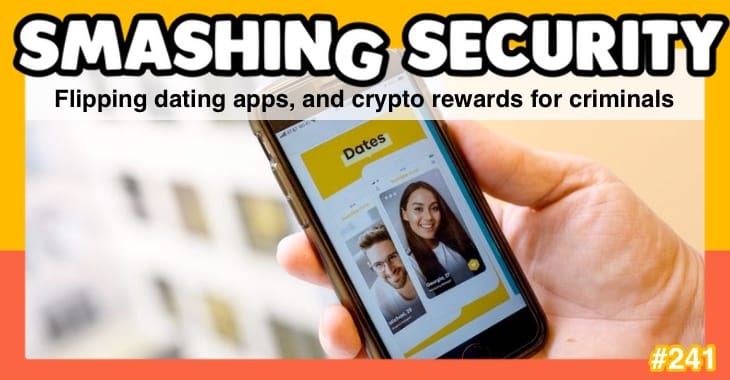
Smashing Security, episode 241, phishing, dating apps, and crypto rewards for criminals with Carole Theriault and Graham Cluley.
Hello, hello, and welcome to Smashing Security episode 241. My name's Graham Cluley.
CAROLE THERIAULT
241. And I'm Carole Theriault.
GRAHAM CLULEY
And this week, we're joined by an oldie but a goldie. It's Maria Varmazis.
MARIA VARMAZIS
Hi, Maria.
GRAHAM CLULEY
Actually, not as old as either of us, is she?
MARIA VARMAZIS
Getting older every day.
CAROLE THERIAULT
Maria, host of Sticky Pickles, and, oh, maybe you've heard of it, often guest host of Smashing Security. Maria, how the heck are you?
Haven't talked to you in, well, at least weeks and weeks.
MARIA VARMAZIS
I'm relaxed from a nice vacation and have no idea what's going on in the broader world, so here I am jumping back in.
GRAHAM CLULEY
You went on vacation? Where'd you go, down the end of your garden?
MARIA VARMAZIS
Yeah, no, I went about an hour north of myself to Maine. Yeah, which feels like a world away even though it's a very quick drive.
So it was very nice and enjoyed a whole week by the ocean. It was lovely.
GRAHAM CLULEY
Oh yeah, the world of security has not gone on vacation, has it?
CAROLE THERIAULT
It hasn't. But first, let's thank this week's sponsors, privacy.com and 1Password. It's their support that helps us give you this show for free.
Now coming up on today's show, Graham, what do you got?
GRAHAM CLULEY
I've got a very important question, which is this: what is the flipping point of dating apps?
CAROLE THERIAULT
To have sex, I think. Maria, what about you?
MARIA VARMAZIS
Oh, me the question or my story?
CAROLE THERIAULT
What's your story?
MARIA VARMAZIS
My story is along the lines of dating out. No, it's not. It's about biometric data and the Taliban.
CAROLE THERIAULT
And my story's about a wacky cryptocurrency snafu brought to us by a Patreon supporter who I'm gonna call the Chubster.
All this and much more coming up on this episode of Smashing Security. The Chubster!
CAROLE THERIAULT
I wasn't ready for that. I did a total spit take. There's coffee everywhere.
GRAHAM CLULEY
Oh God. Sorry. We had spilt tea last week.
CAROLE THERIAULT
This week.
GRAHAM CLULEY
Anyway, right.
CAROLE THERIAULT
I miss Freya so much.
GRAHAM CLULEY
Now, chums, chums.
CAROLE THERIAULT
You have to wait.
GRAHAM CLULEY
Are you alright there?
MARIA VARMAZIS
Okay, I'm gonna mute my—
CAROLE THERIAULT
Breathe.
MARIA VARMAZIS
Okay, I'm good.
GRAHAM CLULEY
Do you know what chubster means? You know, it's a euphemism.
CAROLE THERIAULT
I wanted to anonymize, pseudo-anonymize the person, but I wanted them to recognize that I knew who they were, that I knew what— yeah, so we all understand each other in a private sort of way.
MARIA VARMAZIS
I'm good, I'm great. This is really great.
CAROLE THERIAULT
Welcome back, Maria.
GRAHAM CLULEY
Dating, dating apps, that's what I want to talk about. Dating apps, we've talked about them before.
I think we may have even admitted, some of us, that we might have met our partners online.
GRAHAM CLULEY
Was it IRC or ICQ or something?
MARIA VARMAZIS
No, not ICQ. In my case, it was OKCupid. Yeah, that's where I met my husband.
CAROLE THERIAULT
Yeah, I didn't. I met mine the old-fashioned way.
GRAHAM CLULEY
You didn't go to Wookiees R Us or something like that?
CAROLE THERIAULT
Yes, exactly. I went to Planet Wookiee.
GRAHAM CLULEY
Well, you know, these dating apps, especially under lockdown, you know, that's the way you're going to meet the ladies or the gents or the small furry creatures from Alpha Centauri, whatever it is that you fancy, because you're probably not going down bars as much.
You're not going to— mind you, I've never been to— would I go to a bar ever, or a pub? But you know, you're not going to your chess club.
MARIA VARMAZIS
Coffee house.
GRAHAM CLULEY
Yes, whatever it is.
CAROLE THERIAULT
You know, Craig doesn't leave the house and do anything normal.
GRAHAM CLULEY
Oh, you're not— yeah, exactly, you're not doing that as much. Now, have you heard of a dating app called Bumble?
MARIA VARMAZIS
Yeah, I have. Yes.
GRAHAM CLULEY
It's an interesting name for a dating app, isn't it? Bumble. I mean, it's like— It's not Bum Ball.
We've sort of covered— You've covered both sides of the equation there, haven't you?
CAROLE THERIAULT
Bumble. Jeez.
MARIA VARMAZIS
I was thinking Bumblebee.
CAROLE THERIAULT
Exactly.
GRAHAM CLULEY
Oh, Bumblebee.
MARIA VARMAZIS
Bum Ball Bee.
GRAHAM CLULEY
So, one of the things that the Bumble dating app, and I imagine other dating apps do as well, is they tell you how far away you are from your potential date.
So you look someone up and it says, ooh, they're 13 miles away.
CAROLE THERIAULT
1 meter away!
MARIA VARMAZIS
They're outside your window! Watching you pee!
CAROLE THERIAULT
I find that so creepy. Creepy! Holy moly.
GRAHAM CLULEY
They're just looking at you through the ceiling tiles at the moment.
CAROLE THERIAULT
It's Ceiling Cat!
MARIA VARMAZIS
Ceiling Cat knows what you've been up to. Bringing that meme back.
GRAHAM CLULEY
So, yes, they tell you how far away somebody is.
Now, obviously it would not be a good thing if they said to you not only how far away they were, but that they were on the corner of, you know, Marcham Street and Jubilee Close.
If they said something like that, that would be a bit bad.
CAROLE THERIAULT
Oh, they just give you, they give you 2 minutes away or 2 miles away, something like that?
GRAHAM CLULEY
Yeah, exactly. They'll say 2 miles away or 3 miles away.
CAROLE THERIAULT
All right. In any direction. So you have to run in circles to find them.
GRAHAM CLULEY
Right, exactly. So all you can think is a circle.
Now, of course it is possible that you might be on some sort of, maybe you're on a pier or something which is a bit of a jetty going out into the sea, and then you think, well, they're probably not in a boat, and you might be able to work out roughly where they are.
But most of the time, that is not the case.
CAROLE THERIAULT
They're in an aeroplane!
GRAHAM CLULEY
But I think, yes, they're 3 miles away above you at the moment. Oh, they're going to look closer very quickly.
MARIA VARMAZIS
And now they're gone.
GRAHAM CLULEY
And now it's splat. So, I'm trying to be serious here, guys. So it's obviously a good thing that dating apps don't tell you precisely where somebody is, right?
Because that could be used for stalking. Or maybe, you know, somebody uses a dating app who's a business rival, or maybe you're a spy and you're trying to track somebody.
So you don't want your dating app giving out your precise location.
CAROLE THERIAULT
No. Well, I think by default it shouldn't do any of that.
GRAHAM CLULEY
But anyway, no, they shouldn't.
GRAHAM CLULEY
But maybe they're still leaking enough information.
CAROLE THERIAULT
What happened, Graham?
MARIA VARMAZIS
What did you do?
GRAHAM CLULEY
Not me. Not me. I'm not a user of Bumble. But a chap called Robert Heaton, who is a software engineer at Stripe, the payments company, he found a problem with Bumble.
And Bumble only tells you oh, they're 3 miles away, right? They're 4 miles away. And what you're able to do is you're able to use trilateration.
GRAHAM CLULEY
In order to find out their location. Now you're wondering what is trilateration?
CAROLE THERIAULT
No, I'm guessing it's 3 points, right?
GRAHAM CLULEY
Well, we all know about triangulation, don't we? Because you see that all the time on TV.
GRAHAM CLULEY
Trilateration is kind of similar.
So what he was able to find, and this was a problem as well with Tinder a while back, but they were able to fix it, is that if a dating app is too specific about the distance, if they say something oh, it's 3.56 miles away from you, then if you had a number of different dating profiles located in different places, then you'd all be able to look at that particular person, find the distance, and then go choo choo choo with your three lines and work out where they were, right?
MARIA VARMAZIS
Yeah, yeah, yeah.
GRAHAM CLULEY
So you don't want a precise distance. And so for that reason, dating apps hopefully normally round the distance instead. Okay. So if you use Bumble, it will round the distance.
So if it's, for instance, 3.3 miles or 3.32 miles, rather than being really precise like that, it will actually say 3 miles.
GRAHAM CLULEY
Okay. Instead. And that means that if you use trilateration, then you'll only be able to locate them within about a mile by mile square, which probably is vague enough.
CAROLE THERIAULT
Is this just for the lazy? I mean, literally, what's wrong with just the town or the city name? Are you thinking, oh, they're all the way across town, that's annoying, forget it?
They have to be—
MARIA VARMAZIS
Can't you just meet up?
GRAHAM CLULEY
I mean, yeah, I think the thing is this, right? There are some dating apps which offer romantic dates, and there are other dating apps which might be for hooking up.
MARIA VARMAZIS
Oh, right.
CAROLE THERIAULT
If you're all hot and horny, you're not willing to take a journey across town to shag, then—
GRAHAM CLULEY
It's an equation, isn't it? Right?
CAROLE THERIAULT
You look at their picture and you think, I'm going to get 2 minutes of joy.
GRAHAM CLULEY
They're 5.2 miles away, whereas this one is 3.7 miles away. Are they significantly hotter to justify the extra distance? Seriously?
MARIA VARMAZIS
Well, remember, Carole, you may not have a lot of blood in your brain when you're thinking about this at that moment.
So doing that kind of math in your head might not be successful.
GRAHAM CLULEY
So I think— And also there are dating apps. Is it Grindr and—
MARIA VARMAZIS
Grindr, actually, is how it's pronounced.
GRAHAM CLULEY
Grindr. Grindr. So you might want someone who's within 50 metres or something, mightn't you? I don't know. You might do, right?
CAROLE THERIAULT
You might turn around and be engaged. Exactly, exactly.
MARIA VARMAZIS
Be engaged.
GRAHAM CLULEY
So imagine you're trying to find out someone's real location, right? And the dating app is rounding the number.
What you can do, according to Robert Heaton, is you can use the API to slightly shift the location by 0.01 degrees of latitude or longitude on every occasion.
So you've got these 3 profiles, right, for your 3 lines. And what you do is you move them slightly further out or adjust one ever so slightly.
And at some point, the distance is going to flip from being 4 miles away to suddenly it's now 5 miles away, and you only just went a very small distance. Do you see what I mean?
MARIA VARMAZIS
Yes. Yeah, yes.
CAROLE THERIAULT
You're pinpointing the exact location by just sniffing around, waiting for everything.
GRAHAM CLULEY
Exactly, because that point where you go from 4 miles to 5 miles, that's probably 4.5 miles distance.
CAROLE THERIAULT
Tell you what, listeners, if you're in the dating sphere and someone admits to doing this to you, can you run away?
MARIA VARMAZIS
Oh yeah, that's a red flag if I've ever heard one.
CAROLE THERIAULT
What a humongous red flag, right?
MARIA VARMAZIS
I trilateralled you. No, wait, tri—
CAROLE THERIAULT
Trilateralized you.
MARIA VARMAZIS
Trilateralized you. And that's how much I'm attracted to you.
GRAHAM CLULEY
So Robert Heaton did this.
MARIA VARMAZIS
You're worth the trilateralization.
GRAHAM CLULEY
He did this with a few profiles, right?
Where he wrote a little routine and he was using the Bumble API to slightly change his location, and he was expecting it to change at the 3.5.
That would be the flipping point, right? That's why I'm talking about the flipping point of dating apps.
MARIA VARMAZIS
Yeah, what is the—
CAROLE THERIAULT
What is the point of this?
GRAHAM CLULEY
Well, he thought it would be at 3.5. He thought at 3.5 it would then turn to 4, but it didn't. What happened was it went all the way up to 3.99999 and then became 4.
So Bumble, it turned out, was actually rounding down. So whatever the number was, even if it was 3.9 miles, it would round down to 3, and at 4 it then became 4 until it was 5.
CAROLE THERIAULT
Well, of course it did, because they thought, oh my God, there's more fish in a 4-mile radius than there are in a 3-mile radius.
MARIA VARMAZIS
So let's make it sound like they're closer than they are.
GRAHAM CLULEY
Yeah, it's the marketing thing. That's interesting.
MARIA VARMAZIS
Oh yeah, that's the— math doesn't come into play when we talk about marketing. You start fudging stuff all left and right.
GRAHAM CLULEY
Right. Okay, cool.
And so he found that he was able to precisely locate individuals, not because he was looking for dates or something like that, but he thought this would be useful for snooping and surveillance.
He also found there was a separate bug he found where it was possible— normally, if you want to swipe yes on people and sort of say yes, there's a match, or someone who swiped yes on you, normally you have to pay a $1.99 fee to the app.
And he found that it was possible to bypass that as well.
MARIA VARMAZIS
Oh well, yeah.
GRAHAM CLULEY
So another kind of useful—
MARIA VARMAZIS
Sure, they fixed that one immediately. Yeah, that one, well, you can cheat us out of our money and yeah, we're gonna fix that.
CAROLE THERIAULT
So, but that's really scary though in terms of someone being a bit of a psycho and taking advantage of this. So did they fix it? Did he responsibly disclose it to Bumble first?
GRAHAM CLULEY
Yes, he did. He was good, man. He reported it to them via HackerOne, yeah, bug bounty initiative. Sophos. He's got $2,000 as a result.
The bug was fixed within 72 hours of reporting, which is a good happy ending, I think, which is what you want if you're dating, I suppose.
But I think it's an interesting thing because clearly they designed it with the thought that we don't want to be precise about location, but there was enough information in there if the API was abused to actually find out people's location really, really specifically.
MARIA VARMAZIS
Sometimes people don't think about how this stuff can be used maliciously, but don't put it past somebody who's got stalkery tendencies to put in the work, because they will.
GRAHAM CLULEY
And like I said, even if it's not romantic, it might be a business rival. It could be anything, you know. Someone wants to know if two people, for instance, are meeting.
This would be a way to do it if they were both Bumble users.
MARIA VARMAZIS
Business rival, that sounds like a meet cute for a rom-com.
That's like, we were business rivals and I was stalking her on Bumble, and then ends up we went on a date and we matched and now we're in love, or something.
GRAHAM CLULEY
I don't know, ever the romantic, Maria.
CAROLE THERIAULT
Except I'm a crazy stalker and that's terrible.
MARIA VARMAZIS
Please don't fall in love with me. Anyway, yes.
GRAHAM CLULEY
Maria, what's your story for us this week?
MARIA VARMAZIS
Well, mine is also a really upbeat and uplifting story. It's about the Taliban.
GRAHAM CLULEY
So are they on a dating app at all? Can you choose to date the Taliban?
MARIA VARMAZIS
I don't even want to touch that.
CAROLE THERIAULT
No, don't even laugh.
MARIA VARMAZIS
It's terrible. Yeah, what?
CAROLE THERIAULT
Yeah, yeah, just—
MARIA VARMAZIS
Yeah, no, no, no, no. This story is about— I have been reading all the headlines I can find about the U.S.
withdrawal from Afghanistan and the large amount of equipment that has been left behind and has now fallen into Taliban hands.
So there are a lot of competing stories, and there's a lot of, we left this much behind, no we didn't, yes we did, kind of how much did the U.S.
leave behind, how much is actually accessible to the Taliban? It's still really unclear right now.
There's the hypotheticals of $83 billion, and then there's people saying, no, that's not accurate, that's how much we paid that's not what it's worth, whatever.
We do know that there's quite a bit of tech that the Taliban now has its hands on that was used by US forces and US allies over the last 20 years.
And one piece of kit that has been getting a lot of headline news is the databases of biometric data that were gathered over the years by US forces and allies.
CAROLE THERIAULT
This is my worst nightmare.
MARIA VARMAZIS
Yeah, yeah. This, so I might be putting some of your fears to rest, but also giving you new ones. So here we go.
So the US military used biometric collection devices called— I'm gonna say they're called HIIDE machines, H-I-I-D-E machines— and they use them to scan the fingerprints and irises and facial geometries of not just allies but people that they were looking for.
So it's said that actually biometrics were used in identifying Osama bin Laden when they hunted him down about 10 years ago.
So biometrics were a big, big part of identifying allies, identifying potential bomb makers that were sort of hiding amongst the general public.
So the Taliban now has their hands on all these HIIDE machines. Those were left behind.
And at least in the U.S., the news is painting the picture that a whole bunch of Afghanistan— their data has been hoovered up biometrically, and all of that information is basically on these HIIDE machines.
So digging into this a little bit, I think I was misinformed drastically. It seems like vast swaths of this data is potentially in the Taliban's hands.
This biometric data is potentially something they can access.
However, it seems like the biometric data that was scanned by these HIIDE on these machines has been remotely stored, and very likely, or at least we're hoping, the Taliban can't access it.
GRAHAM CLULEY
Oh, so it's been stored maybe on a cloud server or something?
MARIA VARMAZIS
Correct. And maybe on US servers remotely. It's really unclear because we're getting a lot of settings.
CAROLE THERIAULT
They're good.
MARIA VARMAZIS
Yeah, yeah. So it's like, there might be data at rest on these devices, we don't know.
There might be data remotely stored they can't access unless they have enough training, we don't know.
I don't want to paint a rosy picture being like, it's fine, they don't know how to use these devices, because it's not good for them to have any of this stuff.
And the manuals for using these devices are readily available on the internet, and you can buy them on eBay.
Seems like right now a lot of the hope with the biometric data is that the database of information or whatever's at rest on the devices is gonna be too hard for them to sift through without really knowing what they're doing.
So maybe they won't be able to access it, or they'll see the data and they won't know what to do with it.
CAROLE THERIAULT
Or there's rootkits on all the devices or some kind of spyware. Ooh.
GRAHAM CLULEY
That suggests that the Americans would have had to have planned that in advance. I got the impression they had a lot of things on their plate.
MARIA VARMAZIS
Yeah, I feel like if they had the time to do that, they should have just not left the devices behind or just literally destroyed them.
The other thinking is that the Taliban might use these devices to make their own biometric database of allies or enemies, or these devices could— they could bring them to the Pakistan spy agency, which might know how to actually extract all this info.
So there's a lot of hypotheticals with the biometric data. When I had originally heard these stories, it sounded like it was a done deal. This information is out there.
Everybody is at crazy risk. And it is possible.
It sounds like there's a lot of hope in a security by obscurity that maybe they won't know what to do with all this stuff, which is a really, really shitty way to operate.
GRAHAM CLULEY
Maybe it's all protected by a really strong password. Maybe the Taliban have now got the US Army's Netflix password and they're being preoccupied watching that instead.
MARIA VARMAZIS
They won't notice us creating a new profile over here on the side. If we just say it's a kid's profile, maybe they won't notice.
GRAHAM CLULEY
Disney Plus. Fantastic. We'll do that. Yeah, we'll work our way through The Mandalorian.
MARIA VARMAZIS
I found this quote when I was researching the story that was great.
It's by Welton Chang, the chief technology officer for Human Rights First, and he's a former Army intelligence officer.
He said, I don't think anyone ever thought about data privacy or what to do in the event of the HIIDE system falling into the wrong hands.
Moving forward, the US military and diplomatic apparatus should think carefully about whether to deploy these systems again in situations as tenuous as Afghanistan.
GRAHAM CLULEY
Oh, do you think it might be a good idea to think about it?
MARIA VARMAZIS
He's totally right.
CAROLE THERIAULT
I mean, I think that is the most ridiculous thing I've ever heard. They didn't think— that people didn't think about that?
I can't imagine you'd have this powerful technology and go, look, we must consider what if this gets in the wrong hands. Give me a break. That didn't happen.
If it didn't, shame on you.
MARIA VARMAZIS
Yeah, and that— it is pretty incredible that nobody thought, like, what, what? Yeah, there is no policy about this at all.
So on the biometric data thing, I don't want to be like everything's fine, they don't know how to use it, don't worry about it. We just generally do not know.
So of course, it is possible that the iris and fingerprint scans and the facial scans are not as much in danger as we thought, but they could be. We don't know yet.
I think it's kind of a keep a pin on that. So that's actually not what I wanted to talk about primarily.
I also wanted to mention there's a big but to this story, and I don't mean a big butt, not a derrière, but a caveat, if you will.
Our friends at the MIT Technology Review did some digging on this story because they were also curious about what the heck is going on with it.
And they talked to some sources who are familiar with what's going on, and they had to anonymously protect their sources.
I'm guessing these are folks who either worked on this or helped set it up.
And they said that all this attention we've been paying to these biometric HIIDE systems is really misplaced because there's a lot of unknowns there, right?
What the Taliban has almost guaranteed access to is not getting as much press, and it's not as sexy as biometrics, but it turns out that the Taliban has access to a whole lot of PII for Afghan police and soldiers.
MARIA VARMAZIS
Yeah. So a US-funded but not controlled database called the Afghan Personnel and Pay System, or APPS, that's what's at risk.
So this database was set up starting in 2016 to make sure that we're paying national army and police in Afghanistan and not frauds who are posing as soldiers to get money.
According to the sources at MIT Tech Review who they spoke to, there was no data retention or deletion policy on this database, not even the contingency of, say, the Taliban coming in and taking over.
And the kicker is that unlike the HIIDE systems, which have all their data remotely stored, apparently the APPS data is held entirely on local Afghan government servers.
So it is basically guaranteed that the Taliban has this data right now, and there's no complex biometric data machinery needed to access this. It's literally just a database.
They just hit print on this.
So the data on the APPS includes about 40 different data points, which includes the basics you would expect, like the name, place of birth, date of birth for the soldier or the police officer.
CAROLE THERIAULT
Everything you need to get a passport, for example.
MARIA VARMAZIS
Right. It also includes things like their military specialization, their favorite fruit.
GRAHAM CLULEY
Yeah, favorite fruit.
CAROLE THERIAULT
Like kiwi.
MARIA VARMAZIS
Right. Favorite vegetable.
GRAHAM CLULEY
Favorite flavor ice cream. This sounds a bit like Smash Hits magazine when they'd have these teenage interviews of pop stars.
MARIA VARMAZIS
Those two are kind of funny, the fruit and vegetable. You're kind of like, what? But it goes on, and this is where it starts — I start sweating.
The names of two tribal elders who serve as guarantors of that person's service, who can basically vouch for them.
The names of the soldier or police officer's father, mother, uncle, and grandfathers, as well as a unique ID number that connects them to a biometric profile that is kept by the Afghan Ministry of the Interior.
So going beyond the initial fear that this data could be used to identify people who worked with the Americans, if the geeks at the Taliban know what they're doing — and who's to say that they don't — they may be able to one by one hunt down service members' families and people who just vouch for them and carry out wide-ranging reprisals on anyone they suspect is just a political opponent.
So the story about the HID devices and the biometric devices is not a red herring, but it's getting all the sexy press because we're talking biometrics, and that is terrifying.
You can't change that, obviously — can't change your fingerprint.
But these databases that are locally stored provide more than enough information to find people, and it also has that identifier tying them back to a biometric profile.
So if the Taliban figure out what they're doing with those HID devices, I don't even want to finish the sentence because that's terrifying.
So it needs to be said again, there was absolutely no data retention or protection policies in place for any of this.
I really hope anytime a government entity wants to start collecting data on people, that they'll listen to this podcast.
Whether it's PII or biometric data, I want them to ask themselves, what kind of data are we collecting and why? What are the benefits and drawbacks of collecting it?
And do we really need it at all? Why do we need favorite fruit and vegetable? I mean, what was the need of the father and the grandfather?
I mean, I'm sure they were justifying it somehow. But really, did that need to be recorded?
GRAHAM CLULEY
It is quite important though to know what someone's favorite vegetable — I mean, or rather their least favorite vegetable. It's like, oh, don't give him sprouts. Come on.
CAROLE THERIAULT
If I brought over okra fingers, for example. Right, right.
MARIA VARMAZIS
Yeah, not a happy story. But please, when you're thinking about data policy, it has real life implications, and this is one terrifying example.
CAROLE THERIAULT
And now you can hand the comedy baton to me.
MARIA VARMAZIS
Please, I hope you have a happier story than mine. Oh God.
GRAHAM CLULEY
Carole Theriault, I'm sure you do. I'm sure you're going to rescue us this week. What have you got?
CAROLE THERIAULT
Okay, okay, you guys shake your heads out a little bit because quick, quick, quick, quick, without Googling, I want you to give me your best guess at what you think the current bitcoin valuation is at the time of recording, which is Tuesday afternoon.
GRAHAM CLULEY
I don't know. $34,000.
MARIA VARMAZIS
John McAfee's penis. Didn't he eat it or something? Oh wait, no, he died.
GRAHAM CLULEY
Oh wait, what a way to go.
MARIA VARMAZIS
I, I — yeah, I don't know because I only trade in Monero. I'm just kidding, I'm just kidding, I'm just kidding. I actually have 5 cents. I have no idea.
CAROLE THERIAULT
$50,000 USD at the moment. $48,000. That's a lot of wonka. Now, what would you do if someone actually gave you $50,000 just now?
If I just handed you, you know, a bitcoin worth this money, what would you do?
GRAHAM CLULEY
I think I'd probably start — I'd halt the recording of this podcast and try and turn it into hard cash.
CAROLE THERIAULT
You turn it into hard cash pronto. Yeah, yeah, yeah.
MARIA VARMAZIS
Oh, definitely.
CAROLE THERIAULT
You wouldn't kind of go, oh, it's going to go up, it's going to go up.
GRAHAM CLULEY
I don't care if it's going to go up. You've just given me $50,000. That's brilliant. I'm very happy with that.
CAROLE THERIAULT
Okay, here's another interesting question.
Imagine you have this bitcoin, but you've done something bad, like prison-worthy bad, and you have to go to the clink for a number of years, right? What happens to your bitcoin?
GRAHAM CLULEY
Wouldn't it be seized by the authorities? Don't the authorities have piles of digital currency lying around wondering what to do with it.
CAROLE THERIAULT
From my understanding, and listeners correct us if I'm wrong here, but I think it has to be successfully argued that the monies or the crypto has been gained from illegal activities.
CAROLE THERIAULT
And then it's confiscated, perhaps to pay fees or restitution to victims, that kind of thing.
MARIA VARMAZIS
Yeah, I don't think the authorities can just grab your money just because you've been arrested. That would... It probably varies though.
CAROLE THERIAULT
All over.
MARIA VARMAZIS
Yeah. Yeah.
CAROLE THERIAULT
But sometimes this whole thing can go badly wrong. So we are heading to Sweden, land of detective noir series, ABBA, IKEA, and fika. Do you know what fika is?
MARIA VARMAZIS
I don't know what fika is.
CAROLE THERIAULT
It's a cool coffee break. It's when you sit down with a cup of coffee and a piece of cake and have a little moment. Fika.
GRAHAM CLULEY
Fika or flika.
CAROLE THERIAULT
Fika. F-I-K-A.
MARIA VARMAZIS
It sounds like you just did a little commercial for it. Just put some guitar music behind that. A little coffee and a cake, a little moment.
GRAHAM CLULEY
Loganberries, isn't that what they like as well?
MARIA VARMAZIS
Yeah, they're very delicious actually. No? Okay, just me.
GRAHAM CLULEY
Oh, I heard that's quite scary. Yeah, that movie.
CAROLE THERIAULT
Yeah. So, back to me, back to me. So back in 2019— okay, we're in Sweden here— back in 2019, 3 Swedish drug dealers were charged.
Okay, and the prosecutor Tove Kullberg argued that the 36 bitcoins seized by Swedish police should be confiscated because they were earned through online drug sales.
Ipso facto, illegal activity. Ipso facto, all of ours, right? And the courts agreed. Okay.
When Tove was communicating the value of this bitcoin in the Swedish courts, remember, this is back in 2019, maybe these are people that weren't particularly au fait with crypto and how it worked.
Prosecutor Tove Kullberg provided a valuation in Swedish krona.
CAROLE THERIAULT
And so she argued that these 36 bitcoin were equal to 1.3 million krona, or about $120,000.
MARIA VARMAZIS
Okay, okay. Yep, following you. Yep, yep, yep, yep.
CAROLE THERIAULT
So men go to prison in 2019, in May 2019, and it fell to Sweden's state enforcement authority to auction off these proceeds of the drug crime, including the bitcoin.
But due to bureaucracy, a pandemic, and a plethora of other headaches, this process of getting the assets, including the bitcoin, to auction took two whole years.
Now, what happened in that two-year period, do you think?
MARIA VARMAZIS
It's worth a lot more money now, right? Uh-huh. Right.
CAROLE THERIAULT
The value of the 36 bitcoin skyrocketed.
GRAHAM CLULEY
Well, that's good news, isn't it? The authorities— well, they've got spare money.
MARIA VARMAZIS
It sells nice holiday.
CAROLE THERIAULT
Yes, in 2019, a single bitcoin averaged $8,000, and today we know what it's worth, right? What is it worth?
GRAHAM CLULEY
$50,000? $48,000?
CAROLE THERIAULT
$48,000. Thank you very much.
MARIA VARMAZIS
Oh wait, my decimals are off. Sorry about that.
CAROLE THERIAULT
Now, where does this excess of $40,000 where does a bitcoin go?
MARIA VARMAZIS
My pockets?
GRAHAM CLULEY
No, I would think it would go to the police Christmas party, but that would be a pretty sexy Christmas party, let me tell you. Sweden, it's going to be a sexy party.
There's going to be birch twigs and saunas and fires.
CAROLE THERIAULT
Yeah, ice hotels. So the Swedish state has been forced to return the surplus in value to the convicted drug dealers because they hardcoded the value of the bitcoin into krona.
GRAHAM CLULEY
Oh, so they said it's worth about $120,000, right?
CAROLE THERIAULT
1.3 million krona.
GRAHAM CLULEY
And since then it's become a humongous amount? And so actually these criminals basically got—
CAROLE THERIAULT
They had to pay a little bit for their blunder for getting caught, right? They had to pay a little, but they come out with some pocket change.
CAROLE THERIAULT
Yeah, this is a bit costly error, obviously. One done in good faith, right? But God Almighty, would you feel a dumbass if you're the prosecutor?
You imagine all the people looking at you and you're walking around the halls of justice just going, oh yeah, there's that numpty.
So do you think it's a bobo error, or do you think this is probably actually not written correctly in legal documents now across everywhere?
MARIA VARMAZIS
Yeah, I would just think of current market value at whatever. Yeah, why would they hard go with the— I mean, markets fluctuate. That feels like a rookie error to me.
CAROLE THERIAULT
Yeah, I agree.
GRAHAM CLULEY
But what would have happened if the price of bitcoin had crashed?
MARIA VARMAZIS
Tough shit.
GRAHAM CLULEY
Would they then have gone to the criminals and said, I'm so terribly sorry, but you actually owe us a bit more cash? You actually got to give us more because it turns out—
MARIA VARMAZIS
Yeah, yeah, I would say yeah. If it's if you owe the government a certain amount of money, they're going to get their money.
So you pay up in terms of cash, however you need to get it, or bitcoin if the value is over blank. You know, make up that money however it's owed. Tough shit. I don't know.
CAROLE THERIAULT
The prosecutor, Tove Kohlberg, apparently said on national radio— and I quite this, I really the feel of this— she goes, it is unfortunate in many ways.
It has led to consequences I was not able to foresee at the time.
CAROLE THERIAULT
Yeah. But she says others should learn from this. It's unfortunate that it has ended up this way.
The lesson to be learned is to keep the value in bitcoin, that the proceeds of a crime are 36 bitcoin regardless of the value of bitcoin at the time. So expensive lesson.
But interestingly, so you guys were talking about how much money seizures make for people.
So I was just looking in fiscal year 2019, the FBI said they had about $700,000 worth of crypto seizures. In 2020, it was up to $137 million.
CAROLE THERIAULT
And so far in 2021, $1.2 billion. So this is going to be a focus area for the authorities for obvious reasons.
CAROLE THERIAULT
Anyway, the word to the wise, check the fine print.
MARIA VARMAZIS
As I always say, hire Carole to read your terms and conditions. Because she will.
CAROLE THERIAULT
It's going to cost you a lot. I hate doing it.
MARIA VARMAZIS
One bitcoin.
CAROLE THERIAULT
But I do.
GRAHAM CLULEY
This episode is brought to you by the folks at Privacy.com.
Privacy lets you buy things online using virtual cards instead of having to use your real ones, protecting your identity and bank information on the internet.
What a fantastic idea that is, and a great way of keeping your details out of the hands of the bad guys.
Right now, new customers will automatically get $5 to spend on their first purchase. All you've got to do is go to privacy.com/smashing to sign up now.
And thanks to privacy.com for supporting the show. Cybercrime is at an all-time high and it's not slowing down, so why should you?
This August, you are invited to Security Summer School, a brand new webinar series hosted by the 1Password team.
Learn from security experts at top organizations, hear about sizzling security trends, and get quick tips for building a culture of security at home and at work.
You can get exclusive perks like 1Password swag for attending events, the chance to network with top security leaders, and much, much more.
Find out more and enroll now at www.smashingsecurity.com. Www.onepasswordsummerschool.com. That's www.onepasswordsummerschool, all one word,.com.
And welcome back, and you join us for our favourite part of the show, the part of the show that we like to call Pick of the Week.
CAROLE THERIAULT
Pick of the Week.
MARIA VARMAZIS
Pick of the Week.
GRAHAM CLULEY
Pick of the Week is the part of the show where everyone chooses something they like.
Could be a funny story, a book that they've read, a TV show, a movie, a record, a podcast, a website, or app, whatever they wish. It doesn't have to be security related necessarily.
CAROLE THERIAULT
Better not be.
GRAHAM CLULEY
Well, my pick of the week this week is not security related.
CAROLE THERIAULT
Excellent.
GRAHAM CLULEY
My pick of the week this week is musical.
CAROLE THERIAULT
Oh, mine is too.
CAROLE THERIAULT
Interesting. Okay.
MARIA VARMAZIS
Interesting.
GRAHAM CLULEY
Well, it's musical related. Not musical as in, you know, show tunes, but it is a documentary on Netflix all about Miles Davis.
GRAHAM CLULEY
It's called Miles Davis: This Birth of the Cool.
CAROLE THERIAULT
That is so weird. I was just talking this week about Miles Davis to somebody. Yeah, because I was listening to it. I was doing some painting and it was pretty awesome. Yeah.
GRAHAM CLULEY
Interesting. Anyway, it's a great documentary all about the origins of Miles Davis, where he came from, how he revolutionised jazz with his trumpet.
CAROLE THERIAULT
Do you like him?
GRAHAM CLULEY
Well, I— okay, here's the thing. First of all, interesting question. Do I like him or do I like his music? I think Miles Davis is a rather difficult character to like.
He wasn't necessarily a terribly nice chap.
CAROLE THERIAULT
Okay, so this show goes into that, I'm guessing, the private—
MARIA VARMAZIS
Art versus artist. Yes.
CAROLE THERIAULT
I know absolutely nothing about that, actually. I know his music fairly, medium well.
CAROLE THERIAULT
Because my dad was a fan, so I kind of got exposed really young.
GRAHAM CLULEY
So some of his music is much more accessible than others. So if you were to, for instance, he had an album called A Kind of Blue, which is very famous, came out in the late 1950s.
It's an amazing piece of work, very accessible, I would think, to most people.
GRAHAM CLULEY
It's beautiful and all the rest of it.
GRAHAM CLULEY
But by the time you get to the late '60s and early '70s, there is a, what is considered a groundbreaking LP, which he did in around about 1971 called Bitch's Brew.
GRAHAM CLULEY
And which I have heard, and I was thinking, what on earth is this?
CAROLE THERIAULT
Maybe your ear is not refined enough to appreciate it.
GRAHAM CLULEY
Oh, here's the thing, Carole. The reason why I was listening to Bitches Brew is that I was invited to a concert to see a group perform the Bitches Brew LP in its entirety.
So I thought I'd better listen to it in advance. So I've got to think.
And then I started listening to it, thinking, oh my God, how am I going to tell— But when I saw it live, the magic of live performances, if you remember those, yeah, I actually thought this is pretty cool and I actually enjoyed it seeing people perform it.
I really enjoyed listening to it on Spotify.
CAROLE THERIAULT
Do you know what though?
I would put it to you, Graham, that you could now listen to it on Spotify or wherever and you might find it much more exhilarating because I've seen quite a few jazz acts in my time.
GRAHAM CLULEY
I think you're probably right. I think I probably could.
CAROLE THERIAULT
What a whole new cool world to explore. I'm so pleased for you.
GRAHAM CLULEY
Indeed. And I will be wearing my turtleneck from now on.
GRAHAM CLULEY
Go check out Miles Davis: Birth of the Cool on Netflix. Great documentary, really interesting. And you can understand why people rave quite so much about Miles Davis.
And that is my pick of the week.
CAROLE THERIAULT
Well, Miles Davis's music.
MARIA VARMAZIS
Yes, yes, yes, yes.
CAROLE THERIAULT
And I just made that point. I just want to underline it. Yeah.
GRAHAM CLULEY
Maria, what's your pick of the week?
MARIA VARMAZIS
My pick of the week is a show that is returning for its third season, right now actually.
I think it's coming out in the next few days, so when this episode airs, it'll be the premiere.
The show is called What We Do in the Shadows, and I did not think I was gonna enjoy the show because it uses my least favorite recent innovation of comedy, which is that fake documentary thing that The Office made very popular.
I can't stand that whole thing. I just can't. I think it's just— at least to me, it seems overdone now, so I just can't do it.
CAROLE THERIAULT
Yeah, yeah.
MARIA VARMAZIS
No, I love the original UK Office. That was really funny. But I just can't do— but Jermaine Clement, yes, and Taika Waititi— I think I pronounced his last name correctly. Yeah.
So this show is about three vampires living on Staten Island now, and it's actually— the show is— It's not so much about them as it is about their sort of assistant/familiar, who's the best part of the show.
And I don't want to give too much away, but the thing that I about this show is there's a very clear story that they're following.
And it's not just we're following them and they have hijinks and it's super funny. There's a very clear story arc that's happening and it's very, very smart.
So yeah, you see all these mythical creatures, werewolves and witches and vampires, as they're sort of just living in modern society and dealing with their dry cleaning and all that kind of stuff, but also dealing with weird occult stuff from the past.
CAROLE THERIAULT
And it came from a movie, didn't it? Yeah, it was a movie first, which we— I saw on my husband's 40th birthday. I remember it very clearly.
MARIA VARMAZIS
The pilot was successful, now they've made a TV show out of it. So season three is starting this week. I have no idea how you watch it outside of the US.
I don't know, I'm sure there's a way, but in the US it's on FX and I watch it on Hulu. So, really, really funny show.
I enjoy it a great deal, so I'm looking forward to season three starting.
CAROLE THERIAULT
Fantastic pick of the week.
GRAHAM CLULEY
Well, Jermaine Clement, he's hilarious. He's from Flight of the Conchords.
CAROLE THERIAULT
Yes, yes.
GRAHAM CLULEY
And that other chap, they're both from Flight of the Conchords.
MARIA VARMAZIS
They're like the dream team. So yeah, they, basically almost everything they do, I find myself really enjoying it. So yeah, this show's great.
And they're in it too, like they sometimes make little cameos. Oh my gosh, why am I blanking out?
Matt Berry is one of the stars, so obviously the show's hilarious because he's in it. So I don't know, he's great.
GRAHAM CLULEY
Terrific. Great pick of the week. Carole, what's your pick of the week?
CAROLE THERIAULT
Okay, I invite you guys to go to a website.
CAROLE THERIAULT
That website is called radio.garden.
MARIA VARMAZIS
Radio garden, okay.
CAROLE THERIAULT
Radio.garden. Listeners, you can go too, as long as you're not operating any machinery.
GRAHAM CLULEY
Radio Garden. Radio dot garden. Yeah, I know what it is, Carole, because we've had it as a Pick of the Week before. Yeah, episode 215 earlier this year. It was my Pick of the Week.
Oh no, this is the second week that someone has come on this show with a Pick of the Week which has already occurred, but this is the first time I think that a co-host has actually had the audacity to bring a Pick of the Week.
CAROLE THERIAULT
Do you really think it was audacious of me, or do you think that I just didn't go double check?
GRAHAM CLULEY
I just think you can't have been paying attention on that previous episode and thought, that's a great Pick of the Week, Graham.
I'm — and would remember that I brought it to the show before, and now you've brought it. What are you going to do about this, Carole? Are you going to fix this problem?
CAROLE THERIAULT
I was going to carry on talking about my Pick of the Week.
That's okay, because maybe someone missed it, and maybe I'm just reinforcing your excellent Pick of the Week, which, if you'd let me finish, I would have said Graham mentioned this in an earlier show, and you know what?
He was right. I'm right now listening to stations in Bryn Mawr, right?
GRAHAM CLULEY
Explain what it is. It's worldwide radio. Well, they should do episode 215. Zoe Kleinman knows, she was on that show.
MARIA VARMAZIS
Wow, you remember the guests and everything.
CAROLE THERIAULT
No, he's looked — he searched for it, of course.
GRAHAM CLULEY
Oh yeah, because we have a page on our website, Maria, where we list all of our picks of the week. Yeah.
CAROLE THERIAULT
Thanks to our wonderful listeners. But we've been doing this show a long time.
So listen, Radio Garden, international radio, but it's done very cutely because you have a little globe that you can spin around and then you can get to, you know, I was worried it had already been mentioned, but I thought, fuck it, I'm going for it anyway.
You can actually click. So if you go to the site, for example, why don't you go look close to your hometown, Maria?
CAROLE THERIAULT
Yeah, and you may find one close by, and then you can kind of play it and listen to what music is being streamed 24/7 from that station.
So that's the one rule, they have to stream at all times.
MARIA VARMAZIS
Yes, so my hometown has one. Yeah, yes, Radio Uganda.
GRAHAM CLULEY
Is that your hometown?
MARIA VARMAZIS
Yes, we have one of the largest Ugandan diaspora populations in the world. Oh, here are they. Yep, so I'm not —
GRAHAM CLULEY
Well, I never —
MARIA VARMAZIS
Yep, so we've — Radio —
CAROLE THERIAULT
I've been enjoying music in France a lot recently. That's where I've been hanging out. But anyway, Graham, I just wanted to say I supported your earlier pick of the week.
I didn't know about it at the time, but I've had time to look at it and I think it's excellent.
And I think, well done you for coming with such a great pick of the week way back when. That's radio.garden people.
GRAHAM CLULEY
Tune in next week for a repeat of this week's episode.
GRAHAM CLULEY
Well, no, no, you know, it's just, you know, yeah.
CAROLE THERIAULT
I think it was a good save. I think you should give me the save.
GRAHAM CLULEY
Oh no, you've kind of saved it.
CAROLE THERIAULT
Thank you. You're welcome.
GRAHAM CLULEY
Let the listeners decide.
CAROLE THERIAULT
They will decide. They understand.
GRAHAM CLULEY
Yeah. I'm sure they understand what's happened. Whether they're impressed or not is a whole different matter.
And on that rather unsatisfactory denouement to the episode, we have just about wrapped it up.
CAROLE THERIAULT
Listeners, shame me publicly. That would be so fun. Yeah, that'd be really fun. I'd love that so much.
MARIA VARMAZIS
It counts as engagement. We need it. It's good.
CAROLE THERIAULT
Shut up, Maria.
GRAHAM CLULEY
Maria, and I know people will have heard this bit before, but I'm sure lots of our listeners would love to follow you online. What's the best way for folks to do that?
MARIA VARMAZIS
Go to stickypickles.com.
CAROLE THERIAULT
We'll be back soon.
MARIA VARMAZIS
Yeah, we'll be back soon. So we'll probably be recording this week.
So, yeah, yeah, seriously, I don't use Twitter for much anymore, and Sticky Pickles is where I'm spending the rest of my time. So follow me there.
GRAHAM CLULEY
You can follow us on Twitter at Smashing Security, no G. Twitter allows to have a G. And we also have a Smashing Security subreddit.
And please don't forget to ensure that you never miss another episode. Follow Smashing Security in your favorite podcast app, such as Apple Podcasts, Spotify, and Google Podcasts.
CAROLE THERIAULT
Thanks to this week's episode sponsors, privacy.com and 1Password, and to our wonderful Patreon community. It's thanks to them all that this show is free.
For episode show notes, sponsorship information, guest list, and the entire back catalog of more than 240 episodes, check out smashingsecurity.com.
GRAHAM CLULEY
Where there's also a list of all of our past picks of the week.
CAROLE THERIAULT
Yes, we're talking about that.
GRAHAM CLULEY
And until next time.
GRAHAM CLULEY
Cheerio! Bye-bye!
CAROLE THERIAULT
Don't hate me, listeners. Bye-bye! Thanks for the public scolding there, Dad. Mommy and Daddy are fighting. I don't like it.
Didn't I have your back earlier today in a non-public fashion? Did I not?
GRAHAM CLULEY
Yeah, you do. You're all right.
CAROLE THERIAULT
Exactly. So, just saying.
MARIA VARMAZIS
Don't fight, you two.
CAROLE THERIAULT
This makes me sad. I'm not bothered. I kind of, honestly, I had a nagging suspicion it had come on the pick the week before because I'd remembered the globe somehow, the visual.
I wouldn't remember the name, but I remembered looking at the visual. And then I'd already, yeah. So then I just thought, you know what? He'll remind me, I'm sure.
And you did within 10 seconds. So, well done, you, Chris. No clue.
GRAHAM CLULEY
Yeah, I was right on.
CAROLE THERIAULT
You were lightning. Yeah, you still got it, guy. You still got it.
MARIA VARMAZIS
I'm amazed that you remember. I'm amazed that you remember.
GRAHAM CLULEY
Of course it was yours, so of course it was my pick of the week. Yeah, yeah.
MARIA VARMAZIS
But after so many episodes, doesn't it all become a—
GRAHAM CLULEY
You know the blood, sweat, and tears that are created trying to think of a pick of the week each week? You remember your past picks of the week.
We don't remember what we say about cybersecurity, but we remember the picks of the week.
MARIA VARMAZIS
Yeah, I don't remember my past ones, honestly. I'm amazed that you do.
CAROLE THERIAULT
Yeah, I'm amazed as well. And pleased, Graham. It was a test.
MARIA VARMAZIS
Oh, you passed.



 This transcript was generated automatically, probably contains mistakes, and has not been manually verified.
 @grahamcluley.com
 @
@
 / grahamcluley