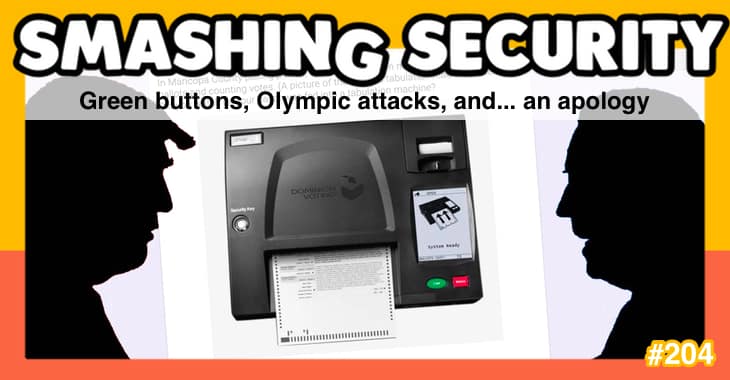
There’s been a cybersecurity goof in the wake of the presidential elections, the US fingers the hackers responsible for disrupting the Winter Olympics in South Korea, and we take a long hard look at long hard legal mumbojumbo…
All this and much much more is discussed in the latest edition of the “Smashing Security” podcast by cybersecurity veterans Graham Cluley and Carole Theriault, joined this week by Jack Rhysider from Darknet Diaries.
Plus don’t miss our featured interview with Mimecast’s Danielle Papadakis.
Show full transcript ▼
 This transcript was generated automatically, probably contains mistakes, and has not been manually verified.
This week's shout-out goes to Dimitir, Brendan Cawhey, Glenn Wilson, Harry, Bravo Whiskey, Wesley van de Kamp, Anders Hansen, Ray Redacted, Graham's Delicious Cucumbers, and Dave.
Thank you all for your support. It means the world, and it helps us create this show week in, week out. And we love you.
If you want to join these amazing Patreon supporters, visit smashingsecurity.com/patreon, and you'll get all sorts of goodies like stickers and episode bonuses and even a letter from Graham and I.
Now let's get this show on the road.
Or should we just roll it ourselves and just put our flag to the wind and say, oh, we've never done this before, but let's give it a try.
It's not like the whole world might start attacking it.
My name is Graham Cluley, and I'm Carole Theriault, and this week we are joined by a returning guest. It is a star of, well, a superstar podcast.
It's Jack Rhysider from Darknet Diaries. Hello, Jack.
I was in a totally different league than you and here I am with you. It's so weird.
You don't have to be into computer security to enjoy it. It's, well, how would you describe it, Jack?
How did they figure it out? What was the forensics involved? And then I'll cover that from beginning to end. So while you're covering the latest news, I'm covering the oldest news.
Now, coming up on today's show, Graham tells us about an election vote wrinkle. Jack heads to the courts where 6 Russian operatives might face some cyber heat.
And I will, well, apologize. Plus, we have a featured interview with Danielle Papadakis. She's a project manager at Mimecast.
Now she'll tell us about some sneaky trusted brand hijacking scams and how they can be avoided. All this and much more coming up on this episode of Smashing Security.
And of course, it's created quite a kerfuffle about the vote and whether all the votes were legitimate or not.
And as I'm sure everybody around the world has been following with rapt interest or incredible tedium.
The Republican Party, of course, Donald Trump's party, have been claiming that there may have been some shenanigans going on with the voting.
You're taking over the reins.' That has not happened yet.
But yes, he, at the time of recording, has not said that, 'Yeah, okay, well done, Joe.' Even though all the press has. Well, most of the press have, yes, yes, virtually all of it.
And there's been this focus on particular parts of the United States.
And one of the counties which, if you were like me, I stayed up very late here in the UK, which was crazy because I knew we weren't going to get a result that evening, but I stayed up late watching the TV news networks just mocked me when I said I might stay up late.
And one of the places where they've done that is a place called Maricopa County in Arizona, one of these counties which was taking quite a while to come up with the figures.
According to the lawsuit, what was happening was some voters who submitted their completed ballot, because as we've discussed in our previous episode with James Thompson, in America, it's very common to use voting machines.
And so you fill out a little— is this right, Jack? I presume you voted.
If you fill out a form, you sort of cross and tick boxes and it gets spat into a machine and that reads who you voted for.
Because of course, you're not just voting for one thing, you're voting for umpteen different things, right?
And one of the first things it will do is it will try to work out whether you've made any mistakes on the ballot, 'cause you might have filled in too many holes or you may have written something incorrectly.
Like, can you see how people might make a mistake in using them, or do you have to be off your face to—
Like, you know, okay, this bubble is for this candidate, but in the past, there's been some weird stuff where the lines didn't line up and the bubbles didn't line up and it looked like you were voting for one candidate, but it was for the other.
This year I haven't seen that yet.
So according to the lawsuit, what happened on this particular occasion, they say, is that some voters were warned by the voting machine of a facial irregularity.
Now, when I heard the term facial irregularity, I thought, is there a webcam built into these voting machines?
Are they looking at the actual voters and saying, you're too damn ugly to vote? Is there something, you know, have you got a squashed nose or a cauliflower ear?
So you get a warning, uh-uh, there's a problem with your voting ballot.
But they reckon that what was happening was an error message was being displayed, and they claim this happened frequently when there was an ostensible overvote.
Now, an overvote isn't like an overbite. An overvote is where you voted for too many things, where maybe you filled in too many bubbles, or it looks like that.
So you may have filled in too many.
And the lawsuit claims that when this happened to people, the people who were working in the polling station would press a green button, and the green button was marked with the word cast, and that would make the error message go away.
But what it would also mean was that that ballot was automatically disqualified from being adjudicated or reviewed later. Do you see what I mean?
So there would be some sort of confusion as to who you voted for on the ballot, and pressing the green button, as people claim they were told to do, actually said, just go ahead anyway.
And so their vote wouldn't get counted.
Now, the odd thing about this lawsuit from my point of view is presumably this affects people regardless of who you are voting for as president.
I would hope not, at least, right?
So there's lots of rumors going around, people are talking, and we've even now seen Bill Barr and others sort of saying, right, we're going to properly investigate this because we believe there may have been some naughtiness going on.
So there's a lot of people sending me tips.
They want anecdotal evidence from voters that they were pressured into pressing the green button, which may have misconstrued their vote.
And so they have created a website called DontTouchTheGreenButton.com.
Now, as soon as I heard they'd created this website, Don't Touch the Green Button, of course I wanted to go and visit the website, right?
So I tried to visit the website and I got this error message. I got this Amazon Cloud error message. Not a user-friendly message, I have to say.
It just looked like a complete screw-up. And I thought, what have they done with this website? Until I worked out, ah, hang on, I'm trying to access it from the UK.
What if I pretend to be an American? So what I did was I put my spurs on and my big cowboy hat and I jumped on my horse and okay, I just put in a VPN and logged in from America.
Now, what they're asking is, they're saying, did you vote in Maricopa County? And if you did, what happened? Did people ask you to press the button?
Was there a problem with your vote?
Now, they don't want just anybody going to that site, clearly, but they also don't want anyone submitting evidence if they weren't actually eligible to vote in Maricopa County.
So what they do, quite sensibly, is they make you jump through a number of hoops to prove that you are legitimate, because you don't want — turns out, Jack, there are some troublemakers on the internet who will take an opportunity like this maybe to tell fibs.
So if you just had an open website which asked for evidence of voter fraud, for instance, you'd either have jokers going there or you'll have people trying to say something happened which didn't, right?
Or are you saying that people were— it's a bona fide website and people were—
And if you're worried about entering any of that, right at the top of the page it says, this site is for voters in Maricopa County to submit sworn declarations about their in-person voting.
And it says, any information you give us may be used in litigation. And it says, don't worry, the Republican Party and Donald J. Trump for President, Inc.
will not disclose any personally Identifying Information Inc. Yes, he has— well, there's obviously a campaign company, right? So which has been set up called Donald.
He does like to have his name on things. So Donald J. Trump for President Inc. So he says, you know, we're not going to disclose any information other than what's required by law.
But it asks you all these questions, some really odd questions. Like one of the questions is, did you intentionally vote for too many candidates? For any office.
For example, did you vote for both Trump and Biden, which would be too many presidential candidates? Can you imagine if they were sharing the job?
You know, have one at one end of the desk and the other at the other end. It would be— wouldn't be that good.
And when I first heard about this website, I thought, oh, people would be putting in fake information or people might be launching a denial of service attack.
Can you think of anything else bad which might happen with a website this?
But what could possibly go wrong? Well, I'll tell you what went wrong, because there is a Reddit thread which comments that this hastily set up website has some flaws.
So for instance, it had a name field, right? One of the very first things it asks you is, what is your name?
But if you start typing in your name, it reveals a list of previous people who have entered their names on the website.
So, so if your name is Dave, for instance, and you hit the D button, you'll also see all the Dereks and all the Donalds.
Which can be exploited by anyone worldwide.
So they started with Arnold Aardvark, and they started with the A's, and they started cycling through.
And by the time they got to the first 5,000 entries, they thought, okay, we've done enough, we've proven our point. That it's possible to extract names and addresses from this.
But that wasn't the only problem with this website. This website also was vulnerable to SQL injection vulnerabilities.
So people could not just pull names and addresses, but also dates of birth and the last 4 digits of your Social Security number.
Or should we just roll it ourselves and just put our flag to the wind and say, oh, we've never done this before, but let's give it a try?
Like, you know, it's not like the whole world might start attacking it.
I mean, it's quite possible because it wouldn't be hard to spot that something's amiss, is it, when you start entering your name and other people's names begin to appear?
There was that Dutch researcher, it's fascinating, that Dutch researcher who claims that Donald's Twitter password a while back was 'You're fired.' And then just a week or two ago—
And then there was a follow-up tweet.
So good for them, I thought. Oh, bless him. Okay, onwards, onwards. Jack, what's your story for us this week?
Yes, this was an attack on Ukraine that was ransomware, which took down a lot of the national infrastructure of Ukraine.
You know, schools, libraries, federal buildings were hit with ransomware. The ATMs weren't spitting out money, grocery stores weren't able to process transactions. It was a big deal.
Now it spread outside of Ukraine and it hit Merck and Maersk. So Maersk is the biggest shipping company in the world.
So that global shipping just ceased for the day, or actually a couple weeks, right? Everything was just wiped in their whole inventory and database. Everything was just not working.
But Merck is a major pharmaceutical company in the US and they make drugs. So they were hit.
So when the US got hit, then the US Department of Justice started researching this, right? So that was 2017.
At the end of 2017 were the Winter Olympics in South Korea, and at the opening ceremony of the Winter Olympics, the infrastructure of the Olympics was hacked and everything taken down.
AD servers, the Wi-Fi, that little phone app for where do you go when you're here at the Olympics? Here's your digital pass to get into all the venues, right? It's all gone.
Nothing was working during the opening ceremony. Something hit them. Well, as it turns out, the DOJ announced three weeks ago they know who did it.
And I think this is a big deal because the Winter Olympics, whoever hacked them... this is a peaceful event. Whoever's doing it should get a firm slap on the wrist.
Hey, you don't hack the Olympics, dude. If this is a government entity—
So North Korea could definitely say, we want to show you how much we hate you, we want to make you embarrassed, and hack you, right? So there's that.
But there was one country that was banned from the Olympics that year.
And the reason why they were banned was because when they had the Winter Olympics before that in Sochi, they were doping, or actually, they were faking the doping results, all right?
So they had drug testing, and then somebody was on the inside and said, okay, cut that.
So a couple years later, after the Rio Olympics, the news came out that these drug tests were faked and we don't know if they were actually clean or not.
So Russia was not allowed to come to the Winter Olympics in 2017. So this could be a culprit as well. So that's exactly what the DOJ said.
They said the Russians were the ones behind both NotPetya and the Winter Olympics, and they went so far as to give pictures of the 6 men who did this, as well as their names and I think even rank in the GRU, which is their intelligence unit in Russia.
And yeah, I think this is a big deal because if a government entity hacks the Olympics and doesn't get a slap on the wrist, like, look, we know you did it, you got to stop this, then what is that going to do for the next Olympics, right?
If there's no repercussion whatsoever. And so I think this is a big deal for the DOJ to say, hey, we caught you.
Now, of course, they didn't actually catch these hackers because they're in Russia, but for them to say, look, we know you did it, stop it, I think is going to be quite a deterrent.
So this was sort of mid to late October that this announcement was made, which of course was only a few weeks before the election.
Do you think there was maybe some ulterior motive of doing it then, perhaps to tell Russia hands off, don't mess around too much during the election as well?
And that was one of the questions was, why is this 3 years after the fact that you're now finding out who did this and coming out with this news?
And they said, you know, we didn't have a full picture before and now we do.
And now that we can firmly point our finger and have enough evidence, you know, and what this indictment means is if they could bring these people to court, they have enough evidence that they think they can find them guilty.
And so, you know, they say now we have enough evidence to do this. So they're just saying they didn't have enough evidence before that and there wasn't any extra story behind it.
And I imagine in these cases, to pull all that evidence together can't be simple, it can't be straightforward.
I'm sure people are covering their tracks if— were it the Russians, right?
And, you know, the thing is that the DOJ has access to extra information that an independent security researcher wouldn't.
So the whole security community thought this was Russia that hacked NotPetya and the Winter Olympics, but there was no firm finger-pointing from the US government.
And some of these pictures actually look like they could be webcam shots.
And it's really interesting they said that because how did they know that these hackers celebrated?
Is this going to increase that ban?
So I can't see why it wouldn't continue after there's proof.
So they have to be the ones who do the 1500 meters.
You know how I go on and on and on about terms and conditions and everyone should read them.
And, you know, people should take time to take in that information before making a smart tech purchase, you know? Yeah, exactly. Yawn, yawn, yawn. And you know what?
I'm actually sorry. I'm sorry.
My intentions were always in, I think, the right place to this point in time, but I was putting the onus on the user to make sure that a device does what it says it will do.
Like, imagine buying a sandwich, for example, at a corner store, right? And it comes with a leaflet of ingredients.
You'd probably think, well, I'm not allergic to anything, so who cares? It's ham and cheese, rock on.
But what if inside it said in tiny font, you know, 50,000 nanobots are included here and will be activated by stomach acid? You'd want to know, right? You'd want to know.
All I'm saying is people should have the right to expect that something reasonably does what it says it will do without having to read the terms.
And we all know why. And the problem that they have is that, of course, the vast majority of consumers don't read their Ts&Cs, right? Their terms and conditions.
So Think Money, this company, decided to see what the terms and conditions were for the 13 most popular UK apps currently available.
Then we have kind of worker apps. There's a group of Zoom and Google Meet, and then there's Slack, Messenger, Gmail, and Microsoft Teams.
And one that I forgot to put there, there's also Candy Crush.
So Facebook includes almost 9,000 words in its privacy and terms and conditions, takes an hour and 9 minutes to read, right?
And Slack is 9,800 words, which takes an approximate 1 hour 18 minutes to read.
If you have a Google account—
It takes an hour and a half to read. And number 2, last guess anyone? Go wild card.
Surely it's just a game, isn't it?
I don't think I should have to pay $1,000 for this game. And then their lawyer says, yeah, the T's and C's.
If you add up all these 13 apps, right, all their T&Cs and their privacy agreements, it adds up to 128,415 words, which is 3 times the size of a novel and/or 30,000 times more words than J.R.R.
Tolkien's The Hobbit. So put that in your pipe. Then the next thing that they looked at was which ones required the most permissions. Of this list. Do you want to have a crack?
One each.
Because the thought that, you know, what I was thinking when I was reading this is Facebook says, oh, you have to be at least 13 to be a member of our Facebook, you know, society.
And I'm thinking a typical 13-year-old shouldn't be thought that she could understand all the guts of these privacy agreements and service terms in order to say yes.
What can be done? What can be done? So I was doing a little digging and back in 2016, the EU issued a report called the Study on Consumers' Attitudes Towards Terms and Conditions.
That is my heroin, isn't it? It's my crack.
I couldn't believe this exists and I didn't— And they wanted to know whether following would help foster trust and make T&Cs more acceptable.
But the other cool thing about it was if you force someone to go through the terms and conditions, you know how some people force you to read them as opposed to just say, yes, I've read them without actually looking at them.
Yeah, my God, I've got some good ideas, haven't I? I hope someone's writing all these down.
He came on a few times, but one of his either pick of the weeks— I remember because I bookmarked it right away— was TL;DR Legal, right?
Which stands for Too Long Didn't Read Legal. Now I went and checked it today, and I love the concept of this site.
So basically you would put in a T's and C's that you wanted to know the information on it, and then it would shorten the information, basically it would just kind of say this is what it means in English.
And it does that by looking at how many trackers are on that website if this is encrypted or not. But then one of the things is, what are the privacy practices of this website?
And if you look at the webs— if you look at it, it'll take you to tosdr.org. So that's terms of service didn't read dot org, tosdr.org.
And if you go to tosdr, they will— I don't know who will, but someone will look at the terms of service of the website and then rate you get. This is a Class E.
So I'm looking at them here. Google gets a Class C, YouTube gets a Class D, Wikipedia gets Class B.
And what they're doing is they're saying this service will publish your content using a free license, or this service will read your private messages.
Pornhub says in their terms of service, you will sign away your moral rights. So they get a real bad rating.
So this TOSDR site actually will scrutinize. It'll give you a grade rating.
So that, I think, would be another thing that would be really helpful is, yeah, someone else read this for me and rate it for me. And then tell me the bullet points real quick.
And then that's what this site shows.
So I'm not saying you have to go read every single word in terms of conditions, just see what are we doing with your information and what are your privacies?
The ones I kind of focus on. But anyway, this site looks amazing. So that's tosdr.org. Thank you, Jack.
And whenever it gets to the point of okay, I've got to write a terms of service or something, what do I write? There's a blank page in front of me.
What's the first thing I should say here? And am I a lawyer? Do I know enough to say the right thing?
And it's always been very frustrating for me as a website creator to know what to write.
So I'm urging someone the EFF to create a boilerplate terms of service that I can say, the MIT license, right?
So this is a Creative Commons license or something like that where I say, okay, I'm adopting this license for my software. We do that all the time.
I want to adopt a standard terms of service and then follow it.
Say this, we swear we do not store information for more than 90 days that we don't need or something, you know, whatever.
If there is a boilerplate terms of service that I can say, now I have adopted this standard that the EFF has created or something like that, I think that would go a long way with a lot of people who are just trying to wing it out there.
There's one called termsfeed.com, which claims it will generate terms and conditions for your site. I guess you answer several questions.
I don't know how good it is, so I think there are some maybe out there. I think what a lot of people do though is they actually cut and paste, don't they?
Which is a bit of a daft idea from a site they like and shove it on their site. If you're going to do that, make sure you check what you're doing.
Probably an alarm alerts you to the danger, emergency operators get you connected so you get help, and firefighters snap into action to put out the flames.
When it comes to Kroll Responder, it's the alarm, the operator, and the fire department all rolled into one.
You see, Kroll Responder merges hunting, detection, containment, and remediation to deliver best-in-class endpoint security.
Kroll responds to over 2,000 cyber incidents every year and is uniquely positioned to bring that capability and expertise 24/7 with Responder.
Learn more about Kroll Responder at smashingsecurity.com/kroll.
Now everyone knows about LastPass's password manager for end users, but it's also a great solution for businesses.
In fact, tens of thousands of companies rely upon LastPass to protect themselves.
LastPass Enterprise simplifies password management for companies of all sizes and helps you secure your workforce. So whatever the size of your business, go and check it out.
Go and visit lastpass.com/smashing to find out more. And thanks to LastPass for supporting the show.
Today's show is also sponsored by Mimecast, the number one cloud email security solution for Microsoft 365.
Safeguard your organization with Mimecast's end-to-end phishing, impersonation, and brand exploitation protection service.
It's a layer of email security defense that picks up where Microsoft security leaves off.
Mimecast's innovative service blocks brand attacks before they can launch, stops live cyberattacks in their tracks, and gives you visibility into anyone using your domains without your authorization.
Start today by downloading a free copy of the State of Email Security report at smashingsecurity.com/mimecasthub. And welcome back.
Can you join us at our favorite part of the show, the part of the show that we call Pick of the Week? Pick of the Week.
It could be a funny story, a book that they've read, a TV show, a movie, a record, a podcast, a website, or an app, whatever they wish.
It doesn't have to be security-related necessarily. Better not be. Well, my pick of the week this week is not security-related.
It is a TV program, but a TV program which isn't on the television anymore. And I wasn't able to find on any streaming service, but I had an urge.
I remembered a documentary which I'd seen a while ago. Now, America, you've got Ozzy Osbourne and you've got the Osbournes, haven't you? You've got the Kardashians.
Well, we here in the UK, we have an idiosyncratic husband and wife team called the Armstrongs, John and Anne Armstrong.
And they were the subject of a BBC documentary about 10 years ago because they run a company called Ufit, which is Coventry's third biggest double glazing company.
Oh, that was ages ago.
But it's just, it is like watching The Office, but I don't think it's scripted and I don't think it's being acted.
I think it's real, but it's very hard to tell for sure because you're watching it, you're hiding behind your fingers, just going, no, no, no, no, no, no, this is so bad.
This is so horrendous. Anyone who's ever worked in a company will recognize some of the horrors here.
Basically, Ufit, Coventry's third biggest double glazing company, have fallen on hard times. Things aren't going well, and they're trying to boost the company's fortune.
And they do a number of things.
They hire a Zimbabwean motivational guru called Basil Meany, which, you know, we've seen people close to those that we've elected do something similar.
And then the Armstrongs have the idea of, let's go to France to sell our windows to French people because they make windows and conservatories. But they don't speak French at all.
They don't let that get in their way. Instead, they use the internet to translate their sales pitch.
They've got their sales pitch printed out and they go into this, they go all the way down to Montpellier where they've got their first meeting with a Frenchman.
And they are trying to sell him their conservatories or conservatoires as they call them, which apparently means music academies in France.
And so you're watching this just going, no, no. Anyway, it's wonderful. And an oldie but a goodie, I'd say. It's an oldie but a goodie.
So I've linked to the episodes in the show notes if you want to enjoy it, but I really found it most entertaining. So that is The Armstrongs. Jack, what is your pick of the week?
And so then you go to the dentist, they check to see how far they can jab a stick down in between your gums and your teeth. And I was 10 millimeters down that they were able to jab.
So it was really bad. So the dentist said, you got to come every 4 months to get treatment for the rest of your life. You've got this problem.
But I was determined to fix it, so I got a Waterpik. But the Waterpik was— have you seen these things where it shoots water out of a little hose and you clean your teeth with it?
But the Waterpik was hard to use because it had a little bucket that you had to put the water in, and when you lean over—
It sprays all over the bathroom floor. It's a big problem. So I've always hated those things.
So what I found was one that attaches to your shower head and then a little hose comes down.
It can go everywhere. So I got that, and I used that every day when I took a shower. And 6 months later, I had no perio when I went to the dentist. It was all gone.
And the dentist couldn't believe it. They're like, I think we made a mistake on your last checkup. I said, no, I don't think so. I think you were probably right.
I just took it seriously. But the other thing is, even if you don't have no perio, when you go to the dentist, sometimes your gums bleed because they're poking at it and stuff.
They're like, oh man, I hate it when they guilt me on all this stuff. And so what this can do is within 2 weeks of just using it every day, just 2 weeks, that's not very long.
When you go to the dentist, your gums won't bleed.
I don't care what you use, but the one I use is called Oral-Breeze, and it just connects right into your shower head. And I use it every single time.
So even though this is supposed to clean this stuff between your teeth, I still think that you need to floss on top of this. But yeah, you still need to brush as well.
So this is way more— because my dentist keeps saying, use these. I'm like, I don't like them.
So it's two journalists obsessed with the past kind of reconsider a person or event that, in their opinion, may have been miscast in public imagination, you know, maybe due to unfair media representation, for example, or some shenanigans that came clear afterwards.
Simpson case, and Nicole Smith. And currently I'm listening to a 5-part Princess Di series. I don't know anything about Princess Di. I never really followed it when it all happened.
I've learned tons. Okay, can I ask if I'm going to say 3 things I learned?
I want to know if you know them, Graham, because you pay much more attention to— Prince Charles never told Camilla that he wanted to be her tampon.
Prince Charles, upon breaking his arm during a polo match, as you do, right, wanted to do the press conference pretending he had actually lost his arm completely in the accident, only to reveal, haha, no, it's here, it's simply broken.
And he was like, no, no, no, I know best, I know these things.
And so she got the staff to hide it, and when they arrived at the press conference, they had to do this big like, oh, we didn't— we don't know where it is.
It was here, we swear it was here. So they had to do it normally.
And the other one is that Di would get in trouble if she dared to leave the family country home, Balmoral, without permission from the Queen.
If she wanted to just trot off to the shops or something and not make dinner.
I listened till 3:30 yesterday, so literally I was addicted. I listened to parts 2, 3, and 4 in a row, and they're all an hour, an hour and a half long, right?
Anyway, I think you'd like it. Check it out, podcast You're Wrong About, wherever you get your podcasts.
She is going to talk to us about how cybercriminals are scamming customers. Danielle, thank you so much for coming on the show.
And so it has evolved. We used to think of phishing and scamming mostly by email, and that's very, very true. But nowadays, we see it in text messages that have some type of link.
We see fake Google ads, social media advertisements.
And it's really an incredible type of technique in order to try and lure the customer onto some type of mimicked or cloned website. Okay, so let me make sure I understand.
So what you're saying is scammers are actually targeting businesses, not the end user directly, by trying to pretend to be the brand, and then they're luring those customers towards them so the scammers doesn't realize— they think they're on a bona fide site and in fact they're on a scammer site.
Is that right? Actually, what the scammers have been doing is they've noticed that it's so hard to try and penetrate inside an organization and target a specific company.
So what they're actually doing is targeting the end users themselves by impersonating to that brand.
So you were correct on the fact that yes, they are targeting the end users, not the actual business, but they're trying to impersonate into the business itself.
Yeah, and I guess the big problem with that is reputation from the brand. I mean, they're not victimless here, right? Because your brand gets affected by this? Definitely.
This can cause huge brand damage, a loss of trust, and at the end of the day, there's so many alternatives, right?
There are different organizations offering the same services as you. So what makes you different and stand out? You really need to keep that customer's trust.
Do you have an example of this in action, one that you might have seen? Oh, plenty of times.
You could easily receive an email from a well-known payment portal, for example, or some type of brand, and they can tell you, your password is expiring and there's an urgent need for you to change.
And what they like to do is kind of pressure the end user. "Deactivate it.
You need to do this fast." And the email can look very realistic with the logo, the writings, the colors, the font, everything.
And unfortunately, that is where social engineering really comes into play. Yeah. So, it's really hard to spot.
Have you seen some examples where even with all your knowledge, you would not have spotted it without any technology? Definitely.
I mean, I'm into this field, so I'm always on the look, right? I'm always looking at the domain name, looking to see if there's a certificate.
But sometimes these attacks are so sophisticated that it can just pass by. And, at the end of the day, we have a tendency just to go ahead and click on things.
And so we really have to be careful. So there are some really sophisticated attacks out there.
And I guess what they're doing, and when we were talking earlier about reputation, they're basically piggybacking on that brand's foot in the door, right?
For example, if I always buy, I don't know, Nike shoes, for example, I might be much more willing to open up a promotion from a seeming Nike email or SMS or however they're getting in touch with me.
Exactly. Are these hard attacks to kind of pull together?
Is this something that you'd have to be super, super talented and really devy to do, or is it easy and you might have younger people involved? SPEAKER_03.
So it's not as hard as it looks, but what's happening now these days is hackers are not only understanding cybersecurity and its weaknesses, but they're also understanding the market and what makes consumers tick.
So they're experts at social engineering and they know how to encourage even a tech-savvy person to go ahead and open a malicious email and just click on a suspicious link.
So these attackers can get very sophisticated. They can be little kids, for example. They could be smart.
It's really not that hard to go ahead and impersonate a brand, and it costs them much less money to do that. And still the value that they can get is very big.
And it seems to me that hackers are taking advantage of that and kind of, for example, the example you gave earlier where it's oh, get in touch with us, change your password, someone might have hacked your account.
So they're taking advantage of this, we are being responsible and security conscious and you should be too, so here's the link you should follow.
And in fact, they're just hacking you. SPEAKER_03. Definitely. So they're looking at trends, they're seeing how they can social engineer their way in, use your name.
It's very interesting as well. You can even purchase a fake social media advertisement and you can slice and dice and choose the exact targeted audience of your choosing.
So if I'm looking, for example, for men between the age of 35 to 45 who live in the UK and like electronics, I'm going to find that exact targeted audience to go ahead and click on my ad.
And a lot of people think that these ads are regulated when they're really not. So very interesting.
We have a lot of topics right now that almost on a global basis we're paying attention to.
So you have the coronavirus, for example, we have countries having elections, we have Brexit, we have all these big topics.
Is that something that these guys are using to try and get us as well? SPEAKER_03. Definitely. I mean, first of all, customers can be victimized at any time by a fake website, right?
Just tricking them to hand over sensitive data, you know, usernames, passwords, etc.
However, there are specific targets and topics that they can actually use in order to make everything look more realistic.
So if that's Election Day, if that's Mother's Day, Memorial Day, they really know how to take everything together and make things look very realistic.
And they click on the link and boom. Yeah, exactly. Do you find in a lot of these cases during this trend that they are trying to get people to click before they think, so to speak?
I've seen a lot of scams where they're trying to make people almost panic. So that may be actually what you were saying earlier about your password being hacked. Of course.
SPEAKER_03. They're always using words like urgent, you need to do this, it's really important.
And then people get scared and they have a tendency just to go ahead, click on things without thinking about it. And that's just on a regular day-to-day basis.
But let's take for example Black Friday. Customers are excited to grab a bargain, right?
And there's an urgency on both sides because the retailers, they need to get as many people as possible into their website while the end user themselves, they don't want to miss out on a great bargain, for example.
You've got hackers pretending to be that technology store, but they're actually using the actual brand's advertising to get people there. It's really clever. So this isn't fun.
If this happened to anybody, this would not be fun. So tell me what companies can do.
I mean, presumably the company really doesn't like this happening because it's hurting their brand and it's hurting their customer base. SPEAKER_03. Very true.
So a lot of companies, obviously they need to first secure their inbound perimeter and make sure that no one penetrates, no one takes data, but the question at hand is, do companies have the right monitoring tools to see everything that's happening outside of their perimeter?
Because if someone's going to purchase a domain that's similar to your brand, but it isn't your brand, they can obviously break that trust and cause a lot of brand damage.
So the first thing that's very important is for organizations to have some type of 24-hour, 7-day-a-week scanning so that they have full visibility of all of these domains that are similar to their brand and that could potentially impersonate their brand just to see exactly what's going on behind the scenes.
So that's the first thing that I would recommend, a monitoring tool.
The best solutions, of course, use AI because at the end of the day, these hackers are getting more and more sophisticated.
At the beginning, it could be a website with 123 at the end, but nowadays they're buying fake certificates to make the website look secured and legitimate.
They're using non-Latin characters in the domain name to make it look almost invisible to the human eye.
So they're being very sophisticated, and you really need to put the right monitoring tools in place.
You need to deploy some type of end-to-end solution. So let's say you do have a monitoring tool in place, but how do you actually take down that threat, right? It's still up there.
So you need some type of end-to-end solution that's not only going to monitor things for you, but the moment they find or we find anything suspicious, phishing, we have the capability to go ahead and take it down for that organization.
Instead of having two complex, different solutions that need to try to work together, it's better to have just one complete solution that's going to take the entire problem off the company's hands.
They have a lot of things to deal with, as I'm sure you know. And so they need some type of solution that's an end-to-end managed service.
You've got an expert right there that can help you. SPEAKER_03. Exactly. At the end of the day, they don't have time to work on these problems.
There are so many different cybersecurity problems. So let just an organization take that off your hands.
And so you have a reliable person that's only looking at this specific problem, which at the end of the day is a huge problem for many organizations that have some type of digital presence online.
Now, what about the end user?
So how can an end user better protect themselves against these types of brand attacks? SPEAKER_03. Well, I recommend that daily users take caution.
Of course, the first thing that I would recommend is always to check the URL on the website that you're on.
You know, if you're supposed to be on a specific website, look at the URL, make sure that it's some type of combination that you expect it to be. And that's the same for email.
You just receive an email make sure that you're actually looking at the email itself and not the name that's actually posted on there.
So that's a definitely important recommendation. Don't trust HTTPS alone. So a lot of hackers, they actually buy fake certificates.
You do have an option to click near the padlock symbol and you can see what type of certificate it's issued from.
So there are trustworthy certificate owners and there are also ones that are not. And lastly, be safe on mobile. Okay, it's really easy to get confused on mobile.
The URLs look different. The font looks different. It's a different browser. So I would personally recommend doing most of your things on computer where it's a big screen.
You can see everything if you're doing bank transactions. Those are the big recommendations that I could provide.
But it's important to remember that our customers, the end users themselves, they're not security experts.
And it should be the company's responsibility to provide them some type of protection.
It's always important to be alert, but at the end of the day, the responsibility lies with the company.
Because, for example, I might be targeted because I happen to be, as you said earlier, a 35 to 40 or 45-year-old man in Britain, right, into tech.
But I may never have bought from a particular technology store whose brand is actually being abused, right? So I could, they may not even have a relationship with me at all.
But you're right, for the known customers, they definitely should take responsibility for that and try and help them. Danielle, this has been fascinating.
Thank you so much for your insight in all this. SPEAKER_03. Sure, I'm happy to help.
You can learn more about this and other Mimecast research and insights by visiting smashingsecurity.com/mimecasthub. Oh gee, I forgot to ask who she thought was funnier.
What's the best way for folks to do that.
But yeah, just search Darknet Diaries on any search engine and you'll find me. But I am active on Twitter @JackRhysider.
Don't forget, if you want to be sure never to miss another episode, subscribe in your favorite podcast app such as Apple Podcasts, Google Podcasts, Spotify, or Pocket Casts.
And of course, high five to this week's Smashing Security sponsors, Kroll, Mimecast, and LastPass. Their support helps us big time give you the show for free.
Check out smashingsecurity.com for past episodes, sponsorship details, and information on how to get in touch with us.
Hosts:
Graham Cluley:
 @grahamcluley.com
 @
@
 / grahamcluley
Carole Theriault:

Guest:
Jack Rhysider – @JackRhysider
Show notes:
- Legal complaint on behalf of Donald J Trump for President Inc and Republican National Committee — PDF.
- Don't touch the green button!
- Reddit thread about Donttouchthegreenbutton.com
- Richey Ward's Twitter thread showing how over 163k records were exposed in the Don't Touch The Green Button database — Twitter.
- Trump lawsuit site to report 'rejected votes' leaked voter data — Bleeping Computer.
- Hilarious news report of the Four Seasons Total Landscaping debacle — Tweet by Ros Atkins of the BBC.
- “Yourefired” was Donald Trump’s Twitter password, claim hackers — Graham Cluley.
- Donald Trump’s Twitter password is “maga2020!”, and there’s no 2FA, claims hacker — Graham Cluley.
- Six Russian GRU Officers Charged in Connection with Worldwide Deployment of Destructive Malware and Other Disruptive Actions in Cyberspace — Department of Justice.
- What does your phone know about you? — Think Money.
- Popular app T&Cs 'longer than Harry Potter' — BBC News.
- Study on consumers' attitudes towards Terms and Conditions (T&Cs) — European Commission (PDF).
- Terms of Service; Didn't Read
- TLDRLegal — Software Licenses Explained in Plain English.
- TermsFeed — Generator of Privacy Policy, Terms & Conditions, Disclaimer, EULA.
- Simply Docs — Legal, Business & Property Documents & Templates.
- The Armstrongs Episode 1 Part 1 — YouTube.
- Oral Breeze — Jack’s pick for the best dental irrigator for water flossing.
- You're Wrong About — Apple Podcasts.
- Smashing Security merchandise (t-shirts, mugs, stickers and stuff)
- Support us on Patreon!
LastPass Enterprise makes password security effortless for your organization.
LastPass Enterprise simplifies password management for companies of every size, with the right tools to secure your business with centralized control of employee passwords and apps.
But, LastPass isn’t just for enterprises, it’s an equally great solution for business teams, families and single users.
Go to lastpass.com/smashing to see why LastPass is the trusted enterprise password manager of over 33 thousand businesses.
Mimecast’s State of Email Security 2020 report helps you understand the most pervasive threats and how they attack organizations at their email perimeters, from inside the organization (through compromised accounts, vulnerable insiders, social engineering), or beyond the organization’s perimeters (the domains they own and their brands via impersonation).
Grab your copy at smashingsecurity.com/mimecasthub
Rapidly detecting a threat is meaningless without the ability to respond with confidence. Kroll responds to over 2,000 cyber incidents every year and is uniquely positioned to bring that capability and expertise 24×7 with Responder. Kroll Responder merges hunting, detection, containment and remediation to deliver best-in-class endpoint security.
See how Kroll Responder works at smashingsecurity.com/kroll
Follow the show:
Follow the show on Bluesky at @smashingsecurity.com, on the Smashing Security subreddit, or visit our website for more episodes.
Remember: Subscribe on Apple Podcasts, Spotify, or your favourite podcast app, to catch all of the episodes as they go live. Thanks for listening!
Warning: This podcast may contain nuts, adult themes, and rude language.