Police are hoping to stop kids becoming cybercriminals by bombarding them with Google Ads, phishers rub their hands in glee at the NHS track and trace service, and just how does a nano-layer of quantum holographic catalyzer technology make a USB stick cost hundreds of pounds?
All this and much much more is discussed in the latest edition of the “Smashing Security” podcast by cybersecurity veterans Graham Cluley and Carole Theriault, joined this week by Mark Stockley.
Show full transcript ▼
 This transcript was generated automatically, probably contains mistakes, and has not been manually verified.
Smashing Security, Episode 181: Anti-Cybercrime Ads, Tricky Tracing, and a 5G BioShield with Carole Theriault and Graham Cluley.
Hello, hello, and welcome to Smashing Security episode 181. My name's Graham Cluley.
On today's show, Graham looks into how to stop kids from turning to a life of crime. Mark is looking into all the ways bad guys might hinder the UK's track and trace efforts.
And I try to find out just what life-affirming frequencies and holographic nanolayer catalyzers are. All this and much more coming up on this episode of Smashing Security.
Suddenly they're playing Call of Duty, they're wearing baggy trousers, they've got baseball caps on sideways, they're smelling of Lord knows what, and who knows what they're up to in their bedroom.
You don't go younger than that, you don't go older than that, definitely not any women. Teenage boys apparently are the problem.
Specifically, the cops are hoping to make a dent in the number of teenage males who are launching DDoS attacks and installing remote access trojans and various shenanigans like that.
I remember playing Pac-Man and Super Mario, and in those days it wouldn't lead you into a life of crime as police say it does now.
The worst that would happen is, you know, maybe if you played, I don't know, Mario, you might get into plumbing.
And they get bots and little bits of software and things like that to augment their powers inside the game or give them a better ability to shoot you or whatever.
Eventually, this culminates in gamers trying to take down other gamers by other means, such as denial of service attacks, such as swats, where they call up the cops and— You know, they say—
Now, according to research, most of these kids don't really consider what they are doing to be wrong because all the other kids and their mates are doing it as well.
And they certainly don't believe that they're going to get into any trouble.
So how do police convince teenagers that they shouldn't launch these kind of attacks, which might eventually lead them down this path of, you know, more serious cybercrime?
Having been a 13-year-old boy, albeit a very long time ago, I can confirm that, you know, not the most together and, you know, intelligent group. Certainly not when I was one.
I remember being at school and all the boys in school, we were on a very rickety table, right, with rickety legs.
And so the custom was that you would come in each day and you'd give the leg of the table a bit of a kick, right? Because it was quite entertaining to see how far it would go.
And you'd think, wonder when—
You know, there's something sort of game-like about, okay, you're doing something on a computer, you're trying to overpower someone else on a computer in a game, and then you find a way that you can actually take over their computer for real, or you can stop them being able to use their computer for real.
I don't think it's a very big jump. I think there's a lot of similarities there, so I can kind of see how that happens.
If they think that you've been up to no good or downloaded something you shouldn't have, like a piece of malware, or if you've been to a DDoS stressor site or a booter site, they may well come around, hopefully with your parents present as well, to really put the fear of whatever into you.
And they'll have a little word in your ear and say, look, we know what you've been doing.
Brian Krebs, security blogger, noted that the NCA, the National Crime Agency, has been busy buying Google ads, Google ads targeting teenage males in the UK who are looking for certain search terms to do with DDoS attacks.
So things like booters and stressors.
And what they're doing in these adverts is they're pointing people to articles that they have placed in online gaming magazines explaining that such things are illegal.
So up pops one of them instead and sort of says to you, oh, you know, you'd be a very naughty boy.
They're not going to—
Because surely that's really irritating seeing ads in a search engine. I don't use search engines and see ads because I run a little ad blocker.
So I was first of all surprised that certainly if these people are slightly technical anyway, if they're into computers, you would expect that.
So I'm surprised from that point of view that these ads are actually being seen. But apparently and amazingly, this approach may actually work.
The University of Cambridge Cybercrime Center, they say that a similar campaign which ran in 2017 over 6 months from the NCA caused a reduction in the growth in demand for DDoS attack services.
I think they're a bit shady about it, but I think what the Cambridge Cybercrime Centre do is they have some dodgy sites which look like DDoS booting websites and they are measuring traffic to those sites and how many people try and sign up for them in an attempt to measure how big the problem's becoming.
And they have released reports over the years of this growth in interest in these kind of sites.
And have YouTube as their best friend. So—
So, yes, you go around using the web, and as you go around using the web and looking for search terms, Google builds this enormous profile of you so that it can do demographic marketing, including the ability to classify you as a 13-year-old child.
And then as that 13-year-old child uses Google, they do a Google search and Google goes, ah, we know all about you.
You're 13, and those people over there have bought some adverts which they only want to target 13-year-old males, and here's one that's going to stop you from doing DDoS attacks on people because you're going to read this article.
But if they don't click on that one, they might click on another one which takes them to a fake stressor site, which is essentially a phishing site to count how many 13-year-old boys are doing DDoS.
Yes, these are the tactics we're using in 2020.
They're also displaying ads which have been bought by criminals who are running booter and stressing sites.
But history has shown that they're not very good about vetting these things, especially when it comes to booter sites and DDoS attack sites and stressor sites.
And it tends to rely upon the public to report these before they get taken down or for the press to make a great big stink about it. So Google's doing great out of all this, right?
They're displaying ads from these guys, ads from those guys, ads from the researchers as well.
But of course, a lot of the cybercrime websites and some of the things which are deeply, deeply disturbing are also protecting themselves using Cloudflare as well.
And Cloudflare tends to turn a bit of a blind eye to these things, doesn't it?
I want to know how many people read it and changed their lives. That's what interests me.
I reckon people are so used to only clicking the first link in Google, that what's happened here is they've just essentially bought the first link.
So, I mean, it's an ad, it's not the first link, but it's the first thing you see.
And because they've just got the number, they've spent a load of money, so they've crowded out that number 1 slot. And loads of people are just hitting that and nothing else.
So they never go further.
Just trying to cheer everybody up with some good news.
And the address is— so Graham, drum roll please.
And the reason I'm asking is because I am actually a little bit worried about scammers targeting the UK's freshly minted track and trace systems.
And I think I have good reason to be worried.
So since the start of the coronavirus, there has been an enormous surge in scams and malware piggybacking off the back of all the disruption and the uncertainty and the fear that has come with this.
So we're all easy targets right now on this front.
And there's a load of— You know, some people are doing it in a hurry and there are vulnerabilities that come with that.
I did a quick review of the stats from Sophos Labs before I came on just to give you a flavor of what's happening.
So since the start of the outbreak, we have seen coronavirus-themed sextortion scams. So those scams that say, we've got video of you enjoying yourself at adult websites.
And if you know anything about malware, TrickBot is probably in your top 3 things you don't want to get on your computer.
There have been scams offering to sell you PPE, and thousands and thousands and thousands of domains and SSL certificates with the words COVID, corona, or coronavirus in them.
He registered the domain name ph-gov.uk when he saw the official test and trace website, and he was amazed that someone in a position of power hadn't already registered that domain.
So he's demonstrated just how easy it would be to create a phishing website.
So registering a misspelling allows you to be very clever, but you probably don't even need to get close.
And I think the evidence of phishing scams even now is that you can host a phishing scam on somebody else's website with a totally incongruous domain. People will still click on it.
There are 25,000 contact tracers now, and anyone in England with coronavirus symptoms can now get a test, basically.
And if your test is positive, then you'll get contacted by text, email, or phone and asked to log into the NHS Test and Trace website that you don't know the URL for.
So you should expect an email if you have a test, you should expect an email with a link to a website that you don't know, telling you there is a matter of utmost importance that you need to deal with.
And if that script sounds familiar to you, then that just means, me, you've seen lots of phishing scams.
When you go to that website, you can expect to be asked for the following PII.
You'll be asked for your name, date of birth, and postcode, who you live with, the places you visited recently, and the names and contact details of people you've been in close contact with in the 48 hours before your symptoms started.
Now I did a little back-of-the-envelope calculation. So this is the first part of the system.
If you sent an email to any random UK adult, that gives you roughly 1 in 70 chance of hitting someone who's had a coronavirus test in the last week.
Because of course the other thing which these tracers will be doing is they'll be contacting other people saying, we think you may have come into contact with someone who had the symptoms or who has tested positive.
So part one is if you have a test, there's an opportunity where you're going to be contacted, but part two could target anyone.
So Graham, let's say that you're feeling under the weather and you go and get a test.
And unless you've spoken to Graham, you don't know that that's going to happen.
Graham gets the disease, we've seen each other, I want him to call me up and go, "Hey dude, sorry," right? I don't want him to give my personal information to a third party.
There is no way he wouldn't call. But hey, maybe he didn't see me. Maybe he saw some lady down at the supermarket, right? He happened to bump into who has no idea what her name?
So for the benefit of your listeners, could you just tell us all what that number is?
Obviously, unfortunately, they may not be the only people calling you from that number, because as you correctly said, Carole, spoofing of phone numbers is actually a matter of routine for scammers.
And even if it weren't, you aren't going to remember that number. None of us are going to remember that number, so it probably doesn't matter anyway.
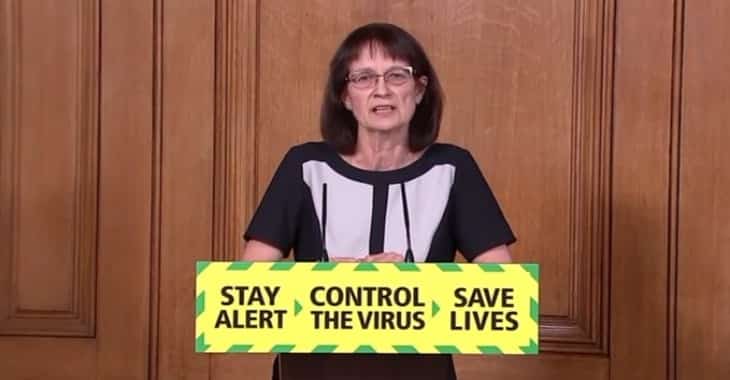
Jenny Harries OBE, who is the Deputy Chief Medical Officer for England, reassured us that it will be very evident when somebody rings you that these are professional individuals.
She had no idea how to handle it, and I kind of feel bad for her because she is being ripped to shreds about it. And she's a medical officer.
'If you don't know the answer to that, you should say, you know what, I don't know the answer, but there's some real boffins—' I do agree.
—at NCSE who can maybe answer that question. So I mean, she's not wrong.
But I think what we're all getting at is that there are two fairly sizable assumptions at work there.
And the first one is that people will know what the contact tracers are supposed to sound like.
It only matters if they sound professional if you know what they're supposed to sound like.
If you get called out of the blue by someone who isn't a contact tracer, you aren't going to know what they're supposed to sound like.
So that's now in the public domain. So thank you so much, Daily Mail. So that'll make it even more likely to fool people. Now, I have a scenario for you, Mark.
It's quick, but I was thinking about this morning. Right? So let's use the Graham Cluley scenario here, right? I don't have the virus.
Graham and I are going for the same job, say at a company X. Don't want Graham to get the job.
So I report on the form that I've had been tested, it's positive, and these are the people I've been around. So he gets a legitimate call. Oh, right.
From a trace worker who's doing her job or his job, and you're told, I'm sorry, you can't go out 'cause you saw ask someone and they go, and you go, who? Well, who?
I can't tell you that. Where?
Yeah, I'm just making— it's not just scammers and phishers, but also if you wanted to get your own back against someone, if you had a rival on the podcast, something like that.
Yeah, this would be an opportunity, an avenue for doing it.
The only thing I came up with when I was thinking about this is recording the call. So, and telling them that you want to record it. So saying, you know, thank you for calling me.
Before you say anything, I just like to make sure I've got this all on record so I can share it with my close ones. So I'm going to be recording this call. And it's going to do that.
I trace— well, me.
You wouldn't trust a national one? But whatever, they do. And last month, the local paper reported their findings.
The gist is they've agreed to oppose the rollout of 5G until further information is made available on the safety or otherwise of the technology.
And many respected media houses have said that the following statement is in this recommended measures report of which there's a link, but I can't access it.
But if anyone wants to, it's on page 31. And apparently it's listed that 5G BioShield. We use this device and find it helpful. 5G BioShield. Sorry? Yeah, 5G BioShield.
Use this device and find it helpful as a recommended measures report.
5GBioShield.com. And look at who clears you through to the website as you go through, Graham.
And we are here, and there's a big picture of a lion and a USB stick and a young woman in some sort of, whoa, she's in a version of the Eden Project.
She's got some sort of a magical bubble around her protecting her.
The 5G BioShield USB key with the nano layer is a quantum holographic catalyzer technology for the balance and harmonization of the harmful effects of imbalanced electric radiation.
The active key operating diameter shields and harmonizes a complete family home. So there's an FAQ. And you go to the FAQ hoping for a bit more information. What is it?
Why am I paying 300 quid for a USB? How big is the USB?
D claims to be a medical doctor and says they put one USB device under my pillow expecting nothing to happen. But later Dr. D reported feeling a strange tingling feeling.
I suspect the USB device has in some way normalized my energy to be as it should and not negative or harmful.
So all this is going on, and then who do we see swagger in but Pentest Partners? This is a company that performs security assessment.
They saw this 5G BioShield recommendation from the Glastonbury City Council, how God knows, and decide to take a look at it.
So they ordered one, and it comes in a little velvet bag. Nice. And inside you have— it's very special— a USB stick.
But the USB stick has this kind of shiny circly bit about the size of a dime or a 5p coin. And it has this intricate design on it.
The pentest people said it looked a bit like George and the Dragon from the reverse of a medal.
They found it to be basically a generic USB without any additional anything that should cost an estimated few quid. But it has a pretty sticker.
And they write, whether or not the sticker provides £300 worth of quantum holographic catalyzer technology will leave you to decide.
So in Companies House, there are two directors of BioShield Distribution.
Both of them appear to have been involved previously in a business called Immortalis, which sold dietary supplements called Clotho Formula. So already a bit dodgy.
And one of them told the BBC that her company was the sole global distributor of the 5G BioShield, but did not manufacture or own the product.
So the UK operation hasn't gotten their hands on it, they're just a distributor, they're saying.
But when Rory Cellan-Jones from the BBC asked her if selling a £5 product for much more than £300 was unreasonable, she said, quote, in regard to the cost analysis your research has produced, I believe that the lack of in-depth information will not drive you to the exact computation of our expenses and product costs, including the cost of the IP, intellectual property rights, and so on.
This is Stephen Knight of the London Trading Standards, and his team is working with the City of London Police Action Fraud Squad to crack down on this, you know, this scammy, scammy scam.
But I decided to go check out Trustpilot, right?
And on Trustpilot, it's quite fun at the moment because people are kind of ripping through it, you know, basically being very snide about the whole thing being a complete pile of garbage.
But I went back to the first Trustpilot review of it to find out when that would have been, when it all go to market. And the first one there is 29th of March.
And the guy says, total scam, reported to Action Fraud, contains a USB solid disk component worth a dollar from China. They have even created many fake review websites.
So he's, you know, the only thing which protects you from high frequency radiation is a Faraday cage. Don't be scammed. So that's the first message in the Trustpilots, right?
And yet, are people buying this?
If anyone out there wants to spend premium dollar for a, you know, $5 USB with a shiny sticker, this is the place to go.
Immersive Labs gives security professionals practical and gamified content to keep pace with the latest threats.
Sign up to get instant access to more than 24 hours of free labs and a new lab to try out each week.
Latest being their red and blue team labs on the SaltStack vulnerabilities, which were in the news last week. Go check it out at immersive labs.com/smashingsecurity.
LastPass by LogMeIn is a password manager both for consumers and the enterprise.
In a company, you get extras like central admin oversight, controlled shared access, automated user management, and everything is protected with multifactor authentication.
Learn more at lastpass.com/smashing. Oh, and if you're a home user, LastPass is available for free, so check it out, lastpass.com/smashing.
Deep Instinct strives to prevent all known and unknown threats using deep learning, making detection and response automated, fast, and effective for any threat that cannot be prevented.
Check out a report by the Ponemon Institute which studied the cost savings of adopting an efficient prevention model.
Go grab it at smashingsecurity.com/prevention, deepinstinct.com. And thanks to Deep Instinct for sponsoring the podcast.
Could be a funny story, a book that they've read, a TV show, a movie, a record, a podcast, a website, or an app. Whatever they wish. Doesn't have to be security-related necessarily.
Better not be. Well, my pick of the week is not security-related. I wonder if either of you, Mark and Carole, have noticed anything different about me today.
And it means I am bouncing around like Zebedee from the Magic Roundabout. I'm going over here. Let me go over here. Here I am. I'm going back over here now.
And I thought, I'm going to have to change my chair and I need to have a little bit more motion rather than being sat at my desk.
I do have a standing desk, but sometimes I want to sit, but I still need to be moving a bit more.
This thing, it's a bit sitting on an exercise ball, but of course, if I was sat on an exercise ball, the exercise ball would go to the other end of the room and I'd fall down on my butt and I'd hurt myself.
Not so with the Swopper chair, which looks a bit a toadstool and it moves in all kinds of directions and is on a great big spring. And that's it. That is my pick of the week.
This will tell you exactly where I'm at at the moment.
So obviously we're just coming out of lockdown at the moment, but it turns out that I've been in lockdown for years, and this is where my head has been. So it's a fantastic book.
I've been listening to this as an audiobook.
Because I don't know who the guy doing the audiobook is, but he is amazing. He's got the most fantastic dramatic voice.
The guy who wrote the book decided to try and answer the question: what knowledge would you need in order to reboot society?
Because lots and lots of us walking around now, you don't know what it takes to do the things that you use. Nobody could build an iPhone from scratch.
Nobody knows enough to build an iPhone. Nobody knows enough to build a laptop.
And interestingly, he references a paper that was written in the '50s where somebody tried to trace all of the elements that go into making a pencil.
Just a pencil, bit of wood with a bit of graphite down the middle.
And that no one person on the planet knows enough of the process to simply make a pencil, never mind all the things that we have invented since.
And so it's this kind of unraveling of, from basic principles, these are the things you need to know, this is the science you need to know.
If you know this, then you can learn this.
And as long as I can get to your house by foot, which I probably could, wouldn't be that, you know, I'd be there in a few hours.
It's also a bit of a history book on how did we acquire that knowledge in the first place, right? Because some of what you need to do is to trace the steps of the past.
But it turns out that some of the things that we learned in the past we didn't need to learn in the order that we did. And there are big gaps, for example.
So we had all the technology we needed to invent photography several hundred years before we invented it.
Knowing how technology could unravel and comparing it to how it did unravel is fascinating in itself. So it's full of useful stuff.
It makes you want to go and do things, makes you want to go and build fires and learn metallurgy and do some amateur— it's got me doing— we're homeschooling at the moment, and I've been— we're doing batteries with the kids.
We've been turning limes and potatoes into batteries.
So if there's kids, tell them go away, of being tied up in his underwear and stroked with a broom. So, okay, let's— we're just going to stop there.
And he was willing to pay $5,000 Australian dollars if it was really good, quote unquote.
But meanwhile, our man, our— what do we call him? Client. Yes. Moved house. And forgot to tell the hired people.
He probably did it when he was drunk or something, forgot he even ordered it.
That's why I'm— it's my pick of the week because I was just— So there's a new guy living there and he's in bed fully equipped with his sleep apnea mask, and he wakes up and he sees a light on in the kitchen.
He thinks, oh, that's my buddy. He comes in 6 o'clock in the morning to make coffee sometimes. And then he hears a weird noise. It sounds like someone's name.
So he kind of gets up, you know, from his bed, puts his light on, starts taking off his mask, and there's two guys with machetes standing over his bed. And he freaks out.
And after a bit of talking, it turns out that perhaps he isn't the client. He wouldn't know the safe word.
I'm just like, where's the broom? How did they get from broom to machetes? No idea. But it is a staggeringly shocking entrance to make. I suppose machetes are like a broom.
They then drove to the correct address where the client noticed that one of the men had a great big knife in his trousers, and he asked him to leave the weapons in the car.
The client then cooks them breakfast, and that's how the police find them. Machetes in the car, sitting around the table eating breakfast with the initial client.
The judge ruled that evidence did not suggest the men's actions were intentional and said no problem. The machetes were either a prop or something to be used in a fantasy.
It was unscripted. There was no discretion as to how it should be carried out. So there you go.
And don't forget, if you want to be sure never to miss another episode, subscribe in your favorite podcast app such as Apple Podcasts, Spotify, or Pocket Casts.
Also, big thank you to this week's Smashing Security sponsors: Deep Instinct, Immersive Labs, and LastPass. Their support helps us give you this show for free.
Check out smashingsecurity.com for past episodes, sponsorship details, and information on how to get in touch with us.
Hosts:
Graham Cluley:
 @grahamcluley.com
 @
@
 / grahamcluley
Carole Theriault:

Guest:
Mark Stockley:
Show notes:
- Cheating in online games — Wikipedia.
- UK Ad Campaign Seeks to Deter Cybercrime — Brian Krebs.
- DDoS attacks are illegal — National Crime Agency (NCA).
- Google doesn’t seem to believe booters are illegal — Light Blue Touchpaper.
- Google ad policies.
- NHS Test and Trace — Yes, the legitimate website.
- Phishing danger is just a hyphen away — The AntiSocial Engineer.
- Apparently Coronavirus-tracing scammers won't sound professional… (Yeah, right!) — Graham Cluley.
- This is how you can verify you are actually being contacted by the government’s Test and Trace service — Full Fact.
- Glastonbury calls for 5G inquiry — Glastonbury Town Council.
- Trading Standards squad targets anti-5G USB stick — BBC News.
- Reverse Engineering a 5g 'Bioshield' — Pen Test Partners.
- Glastonbury 5G report 'hijacked by conspiracy theorists' — BBC News.
- Tweet by the BBC's Rory Cellan-Jones.
- 5GBioShield.
- Swopper chair — Stuhl.
- The Swopper by Aeris — YouTube.
- The Knowledge: How to Rebuild our World from Scratch — Book by Lewis Dartnell.
- Men hired for sexual fantasy break into wrong house — BBC News.
- Smashing Security merchandise (t-shirts, mugs, stickers and stuff)
- Support us on Patreon!
Deep Instinct strives to prevent all known and unknown threats using deep learning, making detection and response automated, fast and effective for any threat that cannot be prevented.
Check out a report by the Ponemon Institute, which studied the cost savings of adopting an efficient prevention model. Go grab it at smashingsecurity.com/deepinstinct
LastPass Enterprise makes password security effortless for your organization.
LastPass Enterprise simplifies password management for companies of every size, with the right tools to secure your business with centralized control of employee passwords and apps.
But, LastPass isn’t just for enterprises, it’s an equally great solution for business teams, families and single users.
Go to lastpass.com/smashing to see why LastPass is the trusted enterprise password manager of over 33 thousand businesses.
Immersive Labs gives security professionals practical and gamified content to keep pace with the latest threats.
Listeners can signup at immersivelabs.com/smashing to get instant access to more than 24 hours of free labs AND a new lab to try out each week.
Follow the show:
Follow the show on Bluesky at @smashingsecurity.com, on the Smashing Security subreddit, or visit our website for more episodes.
Remember: Subscribe on Apple Podcasts, Spotify, or your favourite podcast app, to catch all of the episodes as they go live. Thanks for listening!
Warning: This podcast may contain nuts, adult themes, and rude language.