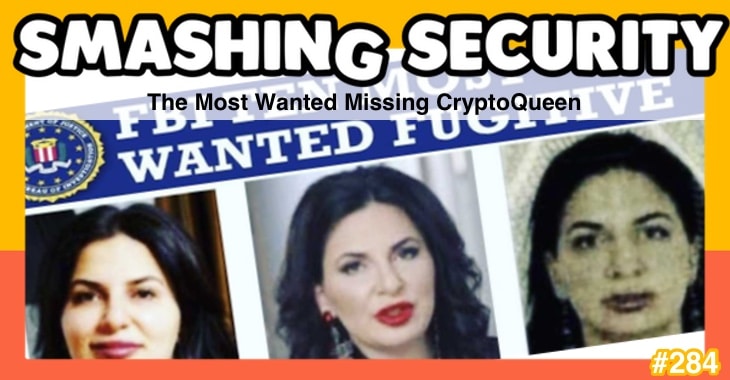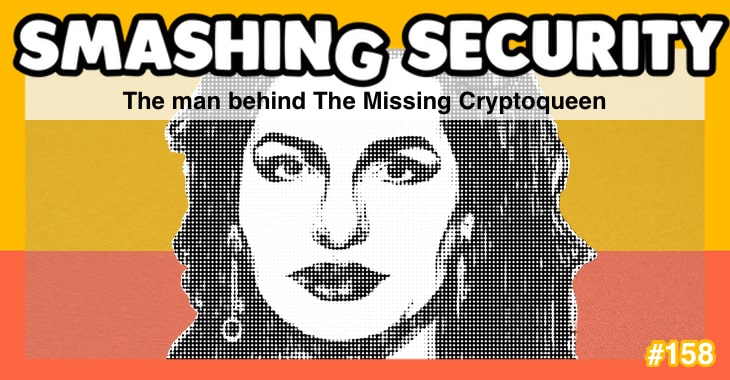
We’re joined by special guest Jamie Bartlett, of the chart-topping “The Missing Cryptoqueen” podcast, in this bumper episode where we discuss his investigation into the OneCoin cryptocurrency scam, the Russian cybercriminals behind Evil Corp, and the mysterious leaks about the NHS that have turned oh-so-political…
All this and much much more can be found in the latest edition of the “Smashing Security” podcast, hosted by cybersecurity veterans Graham Cluley and Carole Theriault.
Show full transcript ▼
 This transcript was generated automatically, probably contains mistakes, and has not been manually verified.
You can go onto LinkedIn and you'll see everyone exaggerating their achievements, using, you know, speak— getting invited to a— I'm not saying you two.
Hello, hello, and welcome to Smashing Security episode 158. My name's Graham Cluley.
That's my mark of success.
To avoid detection.
Now, Graham is looking at the loot that a few cybercriminals walk around with, just in case you thought crime didn't pay.
Jamie's going to give us some great insight into the missing crypto queen and making it and all the background information.
And I'm going to get a little political on this show, just a smattering of digital snafu. All this and loads more coming up on this episode of Smashing Security.
And the kind of people who would are the two Russian nationals who've just had charges filed against them by the US authorities, because they're alleged to have run a global cybercrime organisation called Evil Corp.
Robot, he attempts to destroy the largest conglomerate in the world called E-Corp, which he has renamed to Evil Corp.
But this particular— this Russian Evil Corp run by these two guys is said to be responsible for some of the worst computer hacking and bank fraud schemes of the past decade, said to have stolen $100 million through spamming out email attachments, which then helped them break into bank accounts and steal large amounts of cash.
Should we just fast forward to Jamie's segment of the show and talk about the Crypto Queen?
I mean, that's pretty strong stuff, isn't it?
But no, they're saying these guys are the most significant cybercrime threat who are out there.
They've got quite a large infrastructure, as we will hear, and the US authorities have just placed a $5 million bounty on the head of their leader, a guy who goes by the code name of Aqua.
His real name is Maxim Yakubets.
And according to law enforcement, he has employed scores of people to run his operation from the basements of smoky Moscow cafes.
Why are you thinking of applying for the job, Carole?
He's got another one which is covered in pictures of skulls and knuckle dusters. He's got scores of people working for him from smoky Moscow cafes.
He's defrauded and stolen money from bank accounts of members of the public and businesses using the Dridex malware.
The money launderers, the network of money launderers, because once the money's stolen, the money is moved into accounts and ultimately comes back to Evil Corp.
Over 40 years in prison those guys have been sentenced to. And—
In fact, if you click on some of the links in the show notes, we've got, for instance, a link to a YouTube video of them burning rubber in their sports cars, doing donuts in the main streets of Moscow, holding up traffic.
This guy Yakubets, it looks like something from the Eurovision Song Contest. There are lasers everywhere and chandeliers and fancy lighting.
You know, it's— these guys are living very ostentatiously.
But the thing is about this is, looking at this story makes me think immediately, with all of these cybercrime cases, when you see how much money you can make and you get to be able to have Eurovision weddings and donut-themed cars in car parks, you think to yourself, well, why would you work for the local authority on cybersecurity?
Well, Yakubets also had a sideline because he was also giving direct assistance, according to the US authorities, to the Russian government's malicious cyber efforts.
And of course, this is probably what's been protecting him from having his collar felt because they thought, well, you know what you're doing, you could be rather handy because we've got a little bit of hacking we'd like to do ourselves.
But certainly what's happening is that the US has said, there's $5 million if you help us catch these guys.
It's going to be more difficult for these guys to operate internationally.
They're clearly going to have to probably stay in Russia rather than go on holidays to the Algarve, or they once toddled off to Dubai, for instance, on a bit of a beano.
They're not going to be able to do that so easily.
So in some ways their wings have been clipped, but I think it's going to be hard for the Americans to actually get their hands on them and extradite them, isn't it?
But I'm not hearing any of that, right? How are they getting us with email phishing attacks?
I think we've actually spoken about it in a past episode of Smashing Security.
They've been evolving it in different ways in order to fool people, in order to get past the antivirus defenses that many people have in place.
You can also, of course, have two-factor authentication in place for things like your bank accounts, keep an eye open for suspicious transactions.
And these are two youngsters, I mean, I say youngsters, they're early 30s at best, but they have been bragging rather a lot over the years on social media, posting up pictures of their high-speed car chases.
They've also posted up videos of them sort of falling off hoverboards, or at one point they appear to be cavorting with baby lion cubs on their oriental carpets.
And as long as you leave us alone, we'll leave you alone. And it's felt like for quite a few years that in Russia, it's been the same.
You carry on with your cyber attacks on these other countries we don't much like, we will leave you alone, we'll leave you to it. But don't turn against us.
If you do, then you're going to be in trouble. And it's a perfect situation, isn't it, for the Kremlin? Because they have this distance from them.
And I wonder whether— I mean, the US probably knows they're never going to extradite them, they're never going to arrest them, but it's all about a power play.
You're just publicizing the fact that there are these malicious actors in Russia that are being allowed to operate openly and freely.
Because I think that's really becoming one of the diplomatic tools that people are leaning on each other, accusing each other of various types of corporate espionage and stuff.
So it's probably just an announcement to just lean on Russia a bit more.
You know, we're just going to target Russian businesses, and whether our government says, okay, you know, we're going to look the other way. And I have no idea. Be interesting.
And I think this is encouraging to see the US authorities really taking a hard line finally against Russian hacking.
But a lot of them I'm sure did, but give a little vignette on basically the whole story.
And she says to the world, "You've all heard about bitcoin. Maybe you think you've missed the boat on bitcoin, but don't worry, I've got a new one. I've got the next bitcoin.
It's going to be bigger, it's going to be better, it's safer, it's simpler. The bitcoin people are too technical anyway, they're arrogant.
This is going to be bitcoin for the masses that you can really use in the local shops, and it's called OneCoin. I've invented it, and would you like to invest?
And if you invest now, just like with bitcoin, you're getting in at the very beginning, price is going to shoot up and you can make a fortune."
But yeah, you're right, 2014, I think that was when Ethereum first arrived.
So there were these new coins arriving and there was this sort of a sense that bitcoin was just the start and there were others coming and hers was one of them.
And so she says all this and very, very quickly this spread so fast. So by March 2017, over €4 billion has been poured into this cryptocurrency.
And Ruja was saying within a couple of years they'll be worth $100 each and who knows what beyond that.
People were amassing these coins, 175 countries, I estimate around a million or so people invested. And then in October 2017, she disappears. She has not been seen since.
She vanishes off the face of the earth and then of course the podcast is trying to find her but also to uncover the fact that this is a colossal pyramid scam and trying to work out how she's managed to pull it off.
The promise was that this was going to happen. There was promise, oh, it's a blockchain, it's all been recorded properly.
But all people really got was a website where the current price of the OneCoin was increasing all the time, so they thought their investment was increasing?
So the idea was you buy your coins, you get your coins into your account, you open an account on the OneCoin website, and then when you send the money, you get the coins into your account.
So you can open it up, look and see, oh, I've now got 100 OneCoin, I've got 1,000 OneCoin. And the price kept updating, and the price kept going up and up and up and up every month.
The promise was very soon you will be able to exchange your coins back for real money again at the price on the website. But there was no blockchain behind any of this.
It was just a number on a screen. There was nothing behind it. It was probably an SQL database in an office in Sofia and someone was just changing the price.
So everyone thought they were sitting on, some people thought they had millions of dollars worth of OneCoin. And they had nothing at all.
And to be honest, this is called a crypto scam and everyone called it a crypto scam.
And we called it, you know, the missing crypto queen, because she called herself the crypto queen, but really it's actually just an old-fashioned pyramid scam.
But you're using a fake cryptocurrency as the product. I mean, was your mom ever an Avon lady or a Tupperware? Because my mom used to sell Avon products. Do you remember that stuff?
You get your friends around. Avon is makeup.
Where there seems to be so much pressure to recruit more people to go underneath you rather than actually, you know, the product selling because it's a good product.
There's nothing illegal about it. And yes, it's a controversial way of selling because of the pressure that you're under to sell to your friends and family, but it's not illegal.
And so Avon and Amway, they're legal companies, but if you've got no product, but you're selling in this kind of, you sell to your friends and then they sell to their friends and you build a pyramid beneath you, and the bigger the pyramid gets, the more profit you make, because you get these commissions all the time, then that becomes an illegal pyramid scheme.
Scam, and that's really what OneCoin was.
It was an old-fashioned pyramid scam, but using all the hype of cryptocurrencies and especially bitcoin to make people think they were buying something that was not only useful bit of makeup or Tupperware, but a cryptocurrency that's going to keep going up in value.
I mean, what could be more perfect? You don't have to have your garage full of Tupperware.
Do you think, because you've talked to so many of them, did you feel it made reasonable sense when you heard their reasons to believe, or did you think they drank the crypto Kool-Aid and were just in love with her?
And those stories— I invested $5 in bitcoin in 2010 and now I'm a millionaire.
They weren't targeting the blockchain experts. They were targeting ordinary people who maybe had read an article in the newspaper about these bitcoin millionaires and thought, ooh.
How was it possible, do you think, that magazines like The Economist and others of, with such a huge repute would not have done due diligence to actually find out if she actually was worth all that?
She did have a PhD. I remember you doing the research on that. Was it really that much of a smokescreen? Or did people fail in doing any digging, do you think?
And she'd take little clips little bits of media coverage she'd had and packaged them all up, taking advantage maybe of some people's laziness to present such a believable image that she was the next Steve Jobs.
I mean, she appeared on what looked like the cover of Forbes magazine.
Go online and there's a picture of her on Forbes magazine, front cover, like this amazing— Zuckerberg's on there and Jobs is on there and Buffett and all that, and then there she is and you think, wow.
Now, actually, what that was was a paid advertisement in a local Forbes Bulgarian franchise.
I met people in Uganda that had invested their life savings into this because they saw her on what they thought was the front cover of Forbes magazine.
Now the question, I suppose, then is, well, why does a local Bulgarian franchise of Forbes magazine— why do they do adverts that look identical to the front cover? But that's it.
I don't know. I can't answer that. But then The Economist— yes, she spoke at an Economist event in Bulgaria.
I basically probably did an image search on her and then saw all the covers.
And I think everyone's thinking everyone else is checking. But from The Economist perspective, what they would probably say is, look, this was a legal company.
It was operating in Bulgaria. She won the Bulgarian Businesswoman of the Year Award in 2014. I mean, who organized that? I don't know. How legitimate was that? I don't know.
But you look at that and you think, okay, that seems fine to me, then we'll have her as a speaker.
And so what she did was every time someone didn't quite do the due diligence they might have done or relied on someone else's research, she'd build that into her profile, and that would mean the next people who should check would say, oh, The Economist checked, so that's fine.
So when Thom Jones sang at her birthday party in 2016— Yes, he probably— his advisor— Cryptocurrency— No, no, no, that's Neil Diamond. That's Neil Diamond, yes.
You don't have to wash your hair.
In a way, we could say that all of us do that.
You can go onto LinkedIn and you'll see everyone exaggerating their achievements, using, you know, speak, getting invited to a— I'm not saying you two.
Or maybe you get invited to come on a podcast or go on the TV and every— the producers are busy and stressed and then you clip that up and then you show that to everyone and then they get you on next time because you've been on this program and you build up like that.
Are you a fraud, Jamie?
There's a woman who you spoke to who was a fervent believer in OneCoin and you actually play a recording of someone who was a skeptic arguing with her for ages.
And she's now turned around and she's now formed this support group for people who've lost money. But it's—
Ruja can have done wrong, and for you to question her means that you're, you know, we have to close you off, we can't speak to you because you're just spreading lies, just like the BBC are spreading lies about OneCoin.
And the, one of the most insightful interviews I did for this was someone who didn't know much about OneCoin at all but had specialized in religious, new religious movements and cults.
And she had so— she was a professor from the London School of Economics and so insightful about describing some of the behaviors of supporters of OneCoin.
So I said to her, surely when Dr. Ruja vanishes in 2017, the believers, the people that really bought into OneCoin, would start to question, is this all she said it was?
And Eileen Barker said, you don't understand, she has your money.
Once you've invested your money and once you believe this is going to change the world, you can find a reason for this. She's disappeared.
And people would rather— would rather— you put your reputation into this, you put your money into this, you put years of your life into this sometimes, and you would rather find a reason why she's disappeared.
That's because she's gone into hiding because the banks are going to take her down and the governments are scared of her, but she'll be back soon.
It's easier psychologically for you to do that. And I thought, yeah, it was right. It started to sound a bit more like a religious movement really than an investment opportunity.
But you know what? This is one of the awkward things about OneCoin. Sometimes when you listen to the legitimate crypto enthusiasts, they also have the same kind of fervor.
You know, bitcoin, you can't criticize bitcoin. This is the greatest thing ever.
And so there are similarities in OneCoin to lots of different movements as well, you know, different behaviors that we all have. That's what I enjoyed about it as a story.
I thought it said something about society as a whole.
I don't think I was ever as scared as they might have been doing this.
But probably the scariest bit was going into the— anyone who's not listened to this podcast won't— will think this is ridiculous, but going into the beauty pageant. Yes.
I know that will sound a bit of a tangent.
We'd heard that there's possible involvement of, you know, dark shadowy forces, organized crime groups, who knows really who's behind OneCoin.
And then we bowled up to an event, the first cryptocurrency beauty pageant organized by OneCoin, basically talked our way in and then sat there in the corner with a really big microphone with everyone sort of staring at us thinking, what on earth have we got ourselves into here?
But we just felt like we had to— you know, we had to go.
But we— it was one of those moments where you think it's a great idea on paper and you're like, yeah, yeah, brilliant, let's do it, amazing.
And then you get there and think, oh God, what are we doing here? Yeah, but now we gotta stand up and walk out without anyone noticing. Yeah, it was weird. Yeah, it was very weird.
Was it exhausting though?
And some podcasts, because you obviously got your podcasts, and then which are sort of, they go over several years. Yeah, well, you're on 100 and episode 50, 158, is it? Yeah, wow.
So, but then you've got the ones that are just 8 episodes on one story, which is obviously this one, and they're quite different even though they're both called podcasts, aren't they, and what they're about and how they are structured and everything.
But some of the people that make those podcasts, they make all of them and then they release them week by week, but they're already made, they're all finished, they're all done, legal and checked, and— but they're just slowly releasing them for the tension.
But we were making each one as we were going.
Yeah, well, that's what we knew would happen because we realized just how big this story was, and we thought when we release episode 1 and 2, people are going to come back at us.
OneCoin's going to come back at us, investors are going to come up with stories. Maybe listeners will have spotted Dr. Ruja and will phone us up. So we thought we can't make them all.
We made some of them, obviously, but we couldn't make them all.
We left a lot of gaps, and each episode, we were changing them sometimes right up to literally a couple of hours before they were published.
After you kind of put out your last episode, did you have a bit of paradise syndrome? You know, where you're kind of like, what do I do with myself now?
You'd look forward to the moment it was over, and then the minute it was over, you don't know what to do with yourself.
But I mean, me and Georgia, who's the producer, who's in it quite a lot—
And but we would be, we'd be up at 6 AM on the phone to each other, and then midnight in bed, be phoning each other. What's good? Yeah, what's the date?
And then suddenly, Graham, it's not just us. So it really was.
But I mean, the thing is, for those who've listened, they'll know that maybe there are bits of the story that haven't quite fully finished.
And so, yes, it's— ah, we're gonna be another one. Let's just say we're still talking basically every day. But you're talking seriously, right?
Yeah, we're talking every day, all the time. I mean, the thing about it is though, and those people that have followed this story will understand this.
It gets very weirdly addictive. You know, you become obsessed with this woman, and every weekend you're just, you know, what's the latest? Has there been a thing?
And look at these videos.
And I've been getting a lot of people telling me they've seen her all over. So you know what I did? I personally do keep an eye open. You know why?
Because I was told by someone that she's so brazen about what she does that she would have found out where I go and where I work, and she'd probably drive by me just to see what I look like.
Just so I can— because it's quite interesting that Georgia was approached by someone, one of her friend's friends, who was in a pub going on about it, saying, oh, I found this amazing new cryptocurrency 'You know, this is amazing, I'm gonna make loads of money.' She started looking into it and thought, 'This is weird.' Phoned me up because she knew I'd covered these stories in the past and said, 'Have you ever heard of OneCoin?' And the thing is, I said no.
She said, 'Oh, that's funny because it's a cryptocurrency where there's been billions of dollars invested.' And I said, 'No, that's impossible I'd know about it,' because I wrote a book about the darknet in 2014 and I really covered cryptocurrencies and bitcoin.
And I'd never heard of it.
And it was so weird because the whole of the crypto world, it kind of passed them by because they looked at it and just thought, this is a Ponzi scheme, this is a pyramid scam, this has nothing to do with us.
So they ignored it. And the mainstream press looked at it and thought, oh, this is a cryptocurrency story, that's for them, those crypto specialists, to look at.
And it kind of was just missed by everyone. And then they get on the cover of Bulgarian Forbes, and we all, oh yeah, yeah, it's almost like an echo chamber thing.
And the truth is, OneCoin still going, right? Are there still people out there who still believe in it?
In fact, a handful of them posted a picture the other day from the OneCoin head office in Sofia. They're still going. They're still denying they're a scam.
People are still investing all the time in this because not everyone listens to the BBC's podcast. So how are they gonna— and if they do— what fools!
So you can't— it's so difficult to change people's minds.
And what's really annoying is that not only is their money tied in, but people have made a lot of cash because they're selling a kind of education plan and they're getting money back.
People at the top of the pyramid were making loads of money.
We interviewed one guy who was making over a million dollars a month selling OneCoin because he's— so you get a 10% commission on every package you sell to people, and you'd sell a package for €5,000, you know, €5,000 worth of OneCoin, and you get 10%.
And then if they sell and then their friends sell and then your pyramid gets bigger, then you get— it gets very— the only thing more complicated than cryptocurrencies and blockchains is multi-level marketing compensation schemes.
Honestly, it's you get a matching boat, you have the strong leg and a weak leg, and you get sales volume per week, and then your weak leg is deducted from your strong leg, and what's left over you're paid out a percentage of that, and 40% in real money, 60% in OneCoin, that kind of thing.
So people at the top who are near the top of the pyramid, they were making lots of money, but then of course most pyramid schemes nearly everyone loses out.
It's only those who got in early.
The Shrink Next Door, Graham? And it was about this guy who had basically fooled his patient into basically taking over his life.
But literally, the whole idea is 20 years, people just snowed. People can believe anything, can't they?
I mean, we've only really sort of dipped our toe into it. I think we'd strongly recommend listeners to our show go and check out The Missing Crypto Queen.
You will not be disappointed. And I really hope there are more developments in the story.
I've seen some in the news, but I'm sure there are probably a few more episodes of The Missing Crypto Queen to come.
I'm not suggesting it'll be a— of course you're going to do other exciting and interesting things, but it feels something which is going to be there, a bit like background radiation, all the time until this woman is imprisoned.
And you know, the weird thing is, if she's caught and extradited and goes to prison, there'll be a certain— I would never say sadness, because this is what she needs.
And for this thing to really finally stop, her being sentenced would help. But there'll be a small bit of me that will miss the search for her when that happens.
Well, that's true. That's true.
And he admitted two weeks ago or three weeks ago in a US court, he pleaded guilty to multiple counts of fraud in connection with OneCoin as part of a plea agreement.
And I thought this, finally, this is the moment that OneCoin dies. But it's still going.
I don't know if you know this, but in a few days' time, on the day that this podcast is made available to the world, it is election day in the US.
I mean, there are a lot of people out there who want a better UK but are stumped as to how to get it.
And the thing is, this UK election has been racing ahead at a clip that makes people Ben Johnson's 100-meter time look positively slow.
I mean, I think that'd be fair, wouldn't it?
It's a weird position to find yourself actually hoping for a hung parliament. Rather than anyone to win.
World politics are a bit scary these days thanks to things flipping fake news and the fact that so many a content provider out there says they're not responsible for what is pushed out on their sites.
But sometimes on these sites, there are some juicy truths that get through as well, right?
So just because there's a lot of fake crappy stuff out there doesn't mean there's not a few gems once in a while.
So if I forget anything, you just jump in and interrupt me. We've got crackpot media buffoon Boris Johnson, our current prime minister. Yes, he's up for his post.
And we have testy faux leather elbow patch Jeremy Corbyn. I'm sure they're faux leather, and that's basically the two main players, would you agree?
Listeners that don't really understand, it's a loved system, but for the last decade, the system has been smacked with austerity and it has less money for services, staff, and equipment, and it's hobbling along right now.
During the recent debate between these two party candidates, Corbyn and BoJo, they were discussing the NHS, and during this debate, Corbyn reveals a heavily redacted 451-page document, his aha moment.
And he says that the document proves that US negotiations were hoping to secure "full access" to Britain's health sector as part of a bilateral trade deal. Right? This is a big deal.
And Corbyn said that Labour had obtained official documents which showed that this would be the case, that the US is demanding that the NHS will be on the table in talks in a post-Brexit trade deal.
So lots of people are thinking, this must be fake news, this must be fake, what's going on, this is a bit weird. But it turned out that perhaps it wasn't fake news.
Johnson replied to this, puffed up his chest as only he knows how. Ruffled his hair and said, this is an absolute invention, this is completely untrue, puff, puff, puff.
"Under no circumstances whatever will this government or any Conservative government put the NHS on the table in a trade negotiation.
The NHS will never be for sale." Okay, so you're thinking, okay, bravo. This must be a storm in the teacup, but what's this document?
Right, and Labour is staying totally stum about where they got it from. Johnson, of course, is demanding to know the source of the leak.
It's a bit similar to the whole Trump stance on the whistleblower, right, with the Ukraine-Zelensky case.
But whilst all this is going on, they didn't get a lot of time to play that game because Reddit came forward last Friday confirming that an unredacted document was uploaded as part of a campaign that has been reported as originating from Russia.
It's being branded in a lot of this media that I saw today, and there's the ones you'll see in the show notes, as a Russian disinformation campaign.
And while Johnson has denied Labour's accusation that the NHS will be carved up, it does seem that the document is actually genuine.
They said its investigation had found a pattern of coordination between the now banned accounts on its site and a Russian campaign uncovered by Facebook earlier this year.
And they said, "This group provides us with an important attribution for the recent posting of the leaked UK documents," the ones we're talking about, "as well as insights into how adversaries are adapting their tactics." As a result of the investigation, we're banning 61 accounts under our policies against vote manipulation and misuse of the platform.
So basically, Reddit, the social network, suspects that Russian operatives were behind the leak of sensitive trade data, likely with the intention of impacting the UK's general election campaign.
You can't trust any piece of information because you're always trying to second-guess, well, why has that information come out? And is what has been reported actually true?
Or is there some sort of undercurrent of mischief-making which is going on.
Imagine what other amazing things are on there for them to learn about. I mean, there's all sorts of stuff on there.
If they just spend 5 minutes scrolling through Reddit, they'll find things that blow their minds.
But there's a lot of ways you can get leaked. There's a lot of ways you can find doxing. There's a lot of weak points in society.
You know, political parties have terrible security and they send all sorts of very sensitive material amongst themselves, as we saw in the US election with the famous Clinton emails.
There's a lot of weak points in a democracy that aren't well defended. Or in any bureaucracy.
And so, as a journalist, I know that nothing works quite so well as adding the word leaked to something, even if it's not leaked.
But if you say leaked, it sounds really exclusive, even though it's been on Reddit for weeks. Add the word leaked to it, and suddenly it's an exclusive.
Everyone starts talking about it. And if you're the Russians, very easy probably to get hold of a document that was a trade envoy's discussion.
I'm sure there's all sorts of people that had that and didn't have amazing security. And you're right, I don't think the purpose is necessarily to get one side elected or another.
It's just to make everyone confused and angry, disagreeing, bitter, nothing can be trusted, because that weakens the resolve of countries that you might consider to be your enemies.
And it's very, very cheap. It's so cheap to do this. I mean, it could have been one person did this in a day.
And they must have just been the cat that got the cream.
You know, and fair play to them, they did reject it before they went on national television with it, so we didn't have any micro cameras going in and trying to find out some secret information.
But the whole idea here is, see, they're basically saying— so Corbyn's saying, look, you're trying to sell off the NHS in some way post-Brexit.
Johnson's saying, no, no, no, no, no, no, and you know, I have this document to prove it. And they're saying, pish, pash, push, who gave you this document?
And he's now gone a bit quiet now. So there's no contesting saying this is absolutely fake from the Conservative Party that I could find.
But what is a little bit interesting is that last July, there was news items or murmurings that Amazon were partnering with the NHS to stream the health service advice via Alexa, right?
Which all this information is already available online, but using voice. So what do you mean, NHS Direct?
So I would be able to say that to Alexa instead, say, I've stubbed my toe, or I've got a pain in my groin, what should I do?
So basically, all relatable copyrightable content and data and other materials is going to be shared with Amazon.
Now, not patient data, okay, I have brackets here, at this time, right? But no patient data is currently being shared.
And, you know, they've made a lot of statements on the NHS website about the great security measures they have in place to stop that sort of thing.
So there's a little ray of sunshine there, I'm sure everything will be fine. But the thing that's kind of shocking is that they didn't get any payback.
So this is basically being offered to Amazon for free, right?
So the UK is considered a world leader in compartmentalizing and basically organizing all this huge wealth of health information.
And it's now been shared with one of the richest, well, the richest man in the world's company.
But a recent Freedom of Information request revealed, right, and this was published by the Sunday Times, that the contract between Amazon and NHS was much, much bigger than we all originally thought.
And they're not just going to be giving power to Alexa to be able to help people, but they're also sharing with Amazon information on symptoms causes, definitions, conditions, basically this huge, huge, huge copyrightable database of health information.
Which is that the NHS obviously needs lots of processing power and probably wants to make use of big data and, you know, rightly or wrongly, thinks that that would help people live fuller and healthier lives.
We're struggling with an ageing population, and there will be great benefits to patients from sharing all this data, won't there? That's sure.
Well, what big technology companies could they partner with who aren't American?
You know, it's not there's a UK company who can decide to do all this data mangling for you, is there? All the powerhouses are over there.
So all the big tech— we've got decades, I would hope people's entire lives have been datafied on the NHS. Amazing stuff.
And when we start processing that, amazing findings and things to learn and preventative things we can take on board.
So you've got to think that all the big technology companies are going to be desperate to get their hands on this data, which worries me a great deal.
I think that if the UK is going to develop a really healthy and competitive tech sector, it's going to be in health data, it's going to be in health apps, it's going to be in the next sort of wave of diagnosis tools and stuff.
And we have to invest in UK-based companies to be able to do that, rather than just outsourcing it to the big players who've already got all the processing power.
And I think it needs to be approached very cautiously. And right now, both sides are denying that there's any privatization going on, but I think you're probably right.
There's no other way to maintain it without the rich funds of the private sector.
We should do all this stuff 'cause of the benefits, but it's gonna have to be so carefully regulated that you're gonna want it to be with a company that's, I mean, maybe it's a public-private partnership company.
Maybe it's a company that the government owns some proportion of the shares in, or, but a company based here at the very least would be forced to follow very strict UK-based regulations.
And so you'd just be able to control a bit better how that data was used.
Don't you love a win-win situation? Imagine if you could have both enterprise-wide password management with single sign-on. What is single sign-on? Well, Graham, let me dazzle you.
Single Sign-On is designed to connect employees to high-priority apps, all without needing the user to log in at every single hurdle.
Now, by combining these two services, our friends at LastPass may have just revolutionized security at the enterprise level. Learn more at lastpass.com/smashing.
You don't need to say the forward slash.
Could be a funny story, a book that they've read, a TV show, a movie, a record, a podcast, a website, or an app. Whatever they wish. Doesn't have to be security-related necessarily.
Better not be. Well, my Pick of the Week this week is not really security-related, although it Huzzah!
It is a problem sometimes you might encounter at a security conference, because I don't know if any of you have encountered the issue of smelly armpits and bad body odor.
Well, I have to say, just recently I was saying to my lovely wife, I was saying, you know, 'Look, you know, I've noticed that I seem to be a bit stinky,' I thought.
And I'd go away and I'd wash my armpits and I'd come back and I'd say, 'I'm still stinking. What on earth is going on?' And so for some reason it wasn't working.
And I thought, 'This is a bit funny.' And I saw a tweet written by a rather— well, you may know him actually, Rik Ferguson, who works— He's a long-haired, heavy metal kind of chap who works as a cybersecurity expert at Trend.
He's a dude. And he was recommending, he said that his life had been transformed by a different method of cleaning his armpits. And it's called NUUD. N-U-U-D.
And here's the wonder, here's the wonderful thing, is that you don't have to do anything again for 4 or 5 or maybe 5 days or so. You don't have to do anything anymore.
You can shower.
And all I can tell you is it really works. And according to Mrs. Cluley, at least she says I don't stink at all anymore.
We're not getting a commission. Maybe we should. Maybe they should have a multi-level marketing. Maybe I'm now part of his pyramid. Who knows? Oh dear.
Jamie, what's your pick of the week?
He's standing trial at the moment in Staten Island because he shot and killed a top gangster called Francesco Carli.
Now the thing is, it seems that this young man, he's only 25, is Anthony Carmello.
It seems that he was really obsessed with these weird online far-right conspiracy theories like QAnon. Have you heard of that one?
They're very interesting things, and it's, I suppose, sort of related to OneCoin in a way, like you create these information bubbles and nothing can break through.
But the interesting thing about this is that his lawyer is basically claiming that because he believed in these conspiracy theories, he's kind of pleading insanity.
And the question that the New York Times asks is, and it says that this will become a big issue in the future, is at what point does belief in a far-right conspiracy theory make you legally insane.
That is what the court will be considering. Isn't that weird? I mean, but it's kind of— So weird. Yeah.
Or you could claim as a defense against terrible, heinous crimes, claims that I was temporarily insane because I believed in this weird conspiracy theory that drove me to these acts.
It's based on a belief though rather than I think any kind of psychiatric testing or whatever. Oh my goodness.
But as in to have believed so much in this obviously ludicrous theories to the extent that you would then go and kill someone because you thought they were part of the anti-Trump deep state renders you insane.
I mean, I don't quite know what I think about this.
So if I believe in Nessie or something, or the Abominable Snowman, whether there's been some government— there's been some government cover-up which is preventing Nessie having her day in the sun, and so I'm going to take down Anne Widdecombe or something.
Oh, I don't know. You know, it's just— it's, it's a bit— but the whole world— what I've learned from this podcast is the whole world is insane.
You know, I think the great thing that we've all been assuming since the Second World War is that everyone is— democracy and all of our systems are based on the assumption that everyone is roughly rational and sensible, and that's not actually true.
And we're finally beginning to realize it, and things are falling apart.
Carole, what's your pick of the week?
My pick of the week would be a bit more family-oriented. Just to make up, you know, address the balance. So I found this podcast, which I started listening to, right?
And it's called The Radio Adventures of Dr. Floyd. It's been going since 2004, which is kind of cool, just in itself. And it's a family-friendly twist on old-time radio.
It features adventures and exploits from the world's most brilliant scientist, Dr. Floyd. Dr. Floyd thwarts the plans of his evil arch nemesis, Dr. Steve. Everyone hates Steve.
But what's cool about it is during all this you learn about people and events that shape history and the earth and all kinds of cool stuff like that.
So there's lots of tidbits of actual useful information.
So what I was hoping is that Graham and Jamie, you soon, makes sense in a second, and all our listeners could maybe get one of their kids to check out an episode, just a random episode, because I really like this, but I don't think I'm the target audience.
I want the under 10s, under 12s to let me know if they think it's boring or amazing. Take a listen to one episode. The episodes are short, you know, they're not very long.
And send me some reviews, thumbs up, thumbs down. I just think this kind of thing, we need more of this. So I'd like to know what you guys think. That's my pick of the week.
I know I'm stretching it, but you know, I've done 157 pick of the weeks. Basically, I'm done. I'm tapped.
Jamie, I know lots of our listeners would love to follow you online and find out more about the missing crypto queen. What's the best way for folks to do that?
Yeah, I mean, that's the best place to go. I mean, I'm on Twitter as well, @JamieJBartlett. I'm still basically there. I'm posting updates.
So any new bits of the story that come along, any interesting new rumors I hear, I share them there as well.
So, Jeremy Corbyn, if you're listening, make sure to check out the Smashing Security subreddit. And listeners, you are the wind beneath our wings.
Its support helps us give you this show for free. Check out smashingsecurity.com for past episodes, sponsorship details, info and how to get in touch with us.
Hosts:
Graham Cluley:
 @grahamcluley.com
 @
@
 / grahamcluley
Carole Theriault:

Guest:
Jamie Bartlett – @JamieJBartlett
Show notes:
- Russian hacking group "Evil Corp" accused of targeting American businesses — CBS News, YouTube.
- Evil Corp donuts — YouTube.
- International law enforcement operation exposes the world’s most harmful cyber crime group — National Crime Agency.
- Treasury Sanctions Evil Corp, the Russia-Based Cybercriminal Group Behind Dridex Malware — U.S. Department of the Treasury.
- UK Government Releases Photos of Russian Hackers, Whose Lives Look Awesome — Motherboard.
- Hackers with high-placed daddies ‘Evil Corp’ member designated by U.S. Treasury is son of former Russian mayor — Meduza.
- The Missing Cryptoqueen — BBC Sounds.
- Jeremy Corbyn reveals dossier 'proving NHS up for sale' — The Guardian.
- Reddit links UK-US trade talk leak to Russian influence campaign — TechCrunch.
- Corbyn v Johnson: BBC election debate round-up — YouTube.
- Stammer Time! — Cassetteboy on Twitter.
- The Inside Story of Labour's 'NHS For Sale' Leak — Motherboard.
- More proof NHS is up for sale as Amazon exploits NHS for free — TruePublica.
- Tweet by Rik Ferguson about his fragrant armpits — Twitter.
- nuud.
- Accused of Killing a Gambino Mob Boss, He’s Presenting a Novel Defense — The New York Times.
- Graham and Carole appear on the BeerConOne Stream — Twitch. Graham & Carole show up at about 1 hour 48 minutes into the show.
- The Beer Farmers raise funds for the Electronic Frontier Foundation and Mental Health Hackersy The Beer Farmers : BeerConOne. — GoFundMe.
- The Radio Adventures Of Dr. Floyd.
- Smashing Security merchandise (t-shirts, mugs, stickers and stuff)
- Support us on Patreon!
LastPass Enterprise makes password security effortless for your organization.
LastPass Enterprise simplifies password management for companies of every size, with the right tools to secure your business with centralized control of employee passwords and apps.
But, LastPass isn’t just for enterprises, it’s an equally great solution for business teams, families and single users.
Go to lastpass.com/smashing to see why LastPass is the trusted enterprise password manager of over 33 thousand businesses.
Follow the show:
Follow the show on Bluesky at @smashingsecurity.com, on the Smashing Security subreddit, or visit our website for more episodes.
Remember: Subscribe on Apple Podcasts, Spotify, or your favourite podcast app, to catch all of the episodes as they go live. Thanks for listening!
Warning: This podcast may contain nuts, adult themes, and rude language.