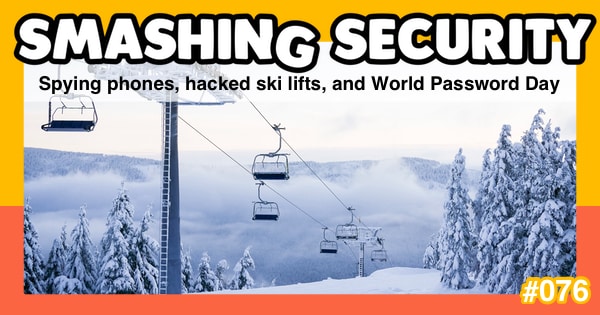
Cheap Android smartphones sold on Amazon have been sending customers’ full text messages to a Chinese server, ski lifts are found to be the latest devices left open to abuse by hackers, and we remind you why password managers are a good idea on World Password Day.
Oh, and our guest serenades us with a hit from the 1980s!
All this and more is discussed in the latest edition of the “Smashing Security” podcast by cybersecurity veterans Graham Cluley and Carole Theriault, joined this week by broadcaster and journalist David McClelland.
Show full transcript ▼
 This transcript was generated automatically, probably contains mistakes, and has not been manually verified.
And what they do, their business is they say, look, we've got the technology to wirelessly update software installed on mobile and IoT devices.
And they have a number of big-name clients, not just Blue, but ZTE and the impossible-to-pronounce— and I'm going to look at you now, David— Huawei.
Smashing Security, Episode 76: Spying Phones, Hacked Ski Lifts, and World Password Day with Carole Theriault and Graham Cluley.
Hello, hello, and welcome to Smashing Security episode 76. My name is Graham Cluley.
I'm Carole Theriault, and we're joined today by returning guest, it's the globetrotting TV star, broadcaster, and journalist David McClelland. Hello, David.
And talking of shows, David, you may have heard, if you've been following our Twitter, and our gracious listeners may have heard as well, that we are going to take our show on the road next month.
Now, that in itself is petrifying, podcasting in front of people, but what's even worse is that Carole and I will be in the same room as we do it. And we've—
If you happen to be interested in coming to see us and the rest of the Secure Tour, if you go to smashingsecurity.com/live, you can check out—
People are the key to minimizing cybersecurity risk postures, and MetaCompliance makes this easier.
Listeners, you can get a 10% discount off the high-quality cybersecurity e-learning catalog from MetaCompliance by quoting the code SMASHING.
Visit metacompliance.com and quote the code SMASHING.
If you unlocked them, just give them to me. It'd be fine. It won't be a problem.
No problem at all. Well, the thing is, have you or any of our lovely listeners bought themselves a cheap Android phone on Amazon or at the Best Buy store?
Because if they have, it may have been secretly sending all of your text messages and more to a server in Shanghai.
Several Android smartphones sold through major retailers like Best Buy and Amazon have had firmware pre-installed on them which transmits sensitive information to third-party servers in China without the owner's knowledge or consent.
And the ones which are of interest to us today are made by a Florida-based company called BLU, B-L-U, all in caps.
And if you go looking for cheap Android phones on Amazon, chances are you're going to find some BLU phones.
You know, they're American budget Android handsets, but they've got pretty good specs. They look quite good and they're available at a really reasonable price.
And most of the tech titles that got their hands on it said, yeah, it's a pretty good budget phone. And it comes from the States.
You know, it's a United States brand rather than a no-name Far Eastern brand.
They go up to around about £250, I think, for the new ones.
Now, so Blue, an American company, but they don't want to do everything, so they contract out some of the dull, tedious, boring stuff like security updates, supply chain issues, things like that.
They gave that to a company called Shanghai Adups Technology Co., Ltd. And that may surprise you. Shanghai Adups Technology Co., Ltd. is actually a Chinese firm.
And what they do, their business is they say, look, we've got the technology to wirelessly update software installed on mobile and IoT devices.
And they have a number of big-name clients, not just Blue, but ZTE and the impossible-to-pronounce— and I'm going to look at you now, David— Huawei.
You may be thinking, well, how much data were they really taking? Well, let me tell you exactly how much.
Now, that would be bad enough, and let's face it, that is pretty appalling because your private messages are simply not private and your location is not private anymore.
It's been shared with this other company you've never even heard of.
Furthermore, this AdUps software, which was pre-installed on the phones, contained its own security flaws, which could be exploited by hackers.
So bad enough that you're getting ripped off, but which is horrendous.
But in addition to that, to make it even more painful, that ripping off software was actually exposing you to other risks.
You know, I think if we read between the lines, it's probably advertising. It's going to be about making money in some fashion.
I mean, it's a lot of information.
Here is something which I would argue is even more invasive in some ways, taking much more of your information.
This is a level of data theft, basically, which goes far beyond what that Facebook application was taking from users.
There was a piece of malware which Michael Horowitz, I think, discovered that was sending data to Omniture, and that was all about marketing and so on.
And that was a big stink when that got trawled out as well. And again, consumers have no idea that this is happening.
It's so wrong that I may well have agreed to some terms and conditions, but nowhere in there does it say that it's going to be sending the content of my text messages or my emails or the data about the files that I've got stored in My Documents.
It seems to be more rife than we imagine.
This sort of crapware which is pre-installed on your— it's like you have to pay more money to get a computer which doesn't have all this junk which is pre-installed by the manufacturer.
That's one of the ways they're trying to claw some income out of you because they've sold it to you for so cheap.
Does anyone in any of the forums have a drinking game that whenever you mention passwords or malware or something, it's, you know, have a sip of your beer or something else.
Maybe we should have the same for GDPR.
And Blue said to its customers, oh look, Adups has updated its software, don't worry about it. They've stopped all of that. A year later, it was found that they were still doing it.
And just now, FTC have said that Blue continued to allow Adups to operate its rather shady activities without properly watching what was going on.
They could turn it back on again. So maybe Blue didn't know about it. I don't know. It's a little bit vague as to how much Blue were compliant with all of this. Yeah.
They have been told that they cannot misrepresent what has happened in the past. And further than that, what the heck does that mean?
I think that means that they may have told some porky pies about it in the past as to why exactly.
And for the next 20 years, every 2 years, they will be subject to third-party assessments of their security program. And they've been told they have to be anyway.
So it's pretty, you know, although they haven't been financially fined for this, it's pretty rough treatment, I think, for one.
Be wary of anything that's super cheap, because if it is really cheap and doesn't make you watch ads, for instance, then you have to wonder how else the company is making money.
It has to be worth paying a little bit more to have some confidence that you've got a safe device. And you are right, Carole. More expensive doesn't necessarily mean better.
And it's a piece of what some would call controversial advice from UK bank Santander.
And so he got in touch with the bank on Twitter.
And the bank turned around and said that it would never recommend using third-party password managers. It is no longer possible to use these for security reasons.
Well, as you can imagine, the internet kind of blew up at that statement, but I just wanted to raise some of the concerns because I know we've talked about password managers on here.
I've talked to them elsewhere as well, and there are a number of common concerns that people, maybe from outside the industry, and looking at the Twitter conversation with Santander and a few security professionals, yeah, some people even within the security industry, some concerns that people have around password managers.
So while I think of them as generally being a good thing, I know you guys do as well.
I think given that it's World Password Day, it might be as well just to address some of those concerns and maybe do a bit of myth-busting if you like.
So this is a bit of a Splinter episode topic, I'm just noting.
So how about the criticism or the concern that password managers— surely having all of your eggs in one basket is a bad thing?
They say, yeah, but what if that gets hacked? I love it when people say that, because that says to me you are thinking about security the right way. Well done for being cynical.
Well done for thinking something really bad could happen, because that's what's going to protect you in future. And yes, potentially—
But it's still got to be better and more secure for you to use a password manager than using your puny human brain to remember passwords because you'll just end up using the same password everywhere.
Would you recommend that they try and get their head around the whole concept of apps running within browsers that allow you to cross-platform it from your computer to your phone, or do you just say pen and paper?
There's people who I've managed to overcome their concerns and they're, "Oh, I don't know what to do." You know, we've shown them it's not that tricky.
However, I have had a number of failures and in those cases I have tended to say, "Write it down in a book and put the book somewhere safe." I don't love that as a solution.
Because there's the risk, of course, that you might have a fire, or you may lose the book, or get stolen.
You may lose your password manager vault as well if all of that's in one place and it's well secured. You know, that's equally open to a fire as well, I guess.
Now, some of us are very lucky and we have 5 websites we go to, and to you I say, I wish I had your life, often.
But I am not one of those people, and I need to use a password manager in order to have nice, long, complex passwords that I don't need to keep track of. That's it.
It makes my life easier. I don't know if it's safer, though. 'Cause I do think they're a bit of a, you know, no, I do think they're safer. I do think they're safer.
I do think they're safer.
We've done a Splinter episode all about passwords, so I don't want to cover too much of the same ground, but maybe the most important thing to stress to people is it's not so much about having a hard-to-crack password.
The most important thing is to have a unique password. So have a different password for different sites.
The bad guys will grab your password in one place and the first thing they will do is try and use that password to unlock your Gmail account.
You can even hopefully on your password vault have additional levels of authentication to make sure someone can't get into that.
But they, I think they do live that lifestyle that you crave in terms of having 5 different usernames and passwords.
My dad has a Chromebook, which goodness me has cut down on my PC support calls so much. And you know, everything he accesses is through a web browser.
Everything he accesses is basically two websites, which even he can just about remember those. And my mum on her iPad, that's all she uses, pretty straightforward.
My wife, she doesn't listen to everything that I do, so that's fine. I can kind of naysay her.
She seems to think it's far easier just to reset the password every time you forget what it is, which is practically every time. I've heard people do that.
She is one of those people.
I'd never even thought of it myself, so I thought when someone mentioned, I was like, kind of interesting idea.
It's an additional step, you know, with the password manager that I use, it can be built into the browser or as a standalone app or something, but it's just not in her muscle memory, and I think that's her main objection to it.
So I'm going to keep on chipping away at that little block, and I'll report back and let you know if I have success.
So maybe today's the day to just give it a dip your toe in and see how you get on.
He wasn't used to being involved in the middle of a Twitter storm like this, and I think that he actually handled it very well.
The guy, he actually spoke with the guys from Santander who did say, well, you know what, in the face of this and in the face of so much vitriol online from all of the great and good of the security world and the National Cybersecurity Center who chipped in as well, they said, we're going to go and review our policies.
We're going to have a chat to our developers and we will get back to you and let you know what we think. So, you know, it's not as though Santander have shut us down.
They've been quite open about it and said, well, thank you for bringing this to our attention.
I think more and more websites are learning that they shouldn't do things which stop password managers from working effectively.
And one of those things is, of course, the ability to paste your password into the login form, because if you don't do that, then admittedly, yeah, a password manager can be a bit of a pain there.
To end this episode of Smashing Security with. What have you got for us?
So, Dave, I want to know if you're a big wuss like Graham when it comes to winter athletics.
I've got quite a high center of gravity, which means I fall over, and it makes a lot of noise, and it may crack the ice when I fall over. And the same with skiing as well.
It's a long way to fall. I've never been skiing on actual snow, just those really bristly, dry ski slopes. And I hate those.
Does it turn out that out of the two of us, out of hunky David McClelland and myself, who's got a very low centre of gravity, I am actually the more experienced winter athlete.
They're the only ones that seem to engage with me. I must be part dog or something.
Because there you are standing at the bottom of this slippery, slidey, icy mountain thing, and you've got to get to the top of it in the glorious sunshine.
You're wrapped up like this and you're biking away and all the rest of it, getting heat stroke or whatever.
And you've got planks stuck on your feet and you have to sort of waddle up to the top or catch a chairlift just for the purpose of coming all the way back down again.
It started speeding backwards at terrifying speeds with loads of skiers on the ski lift. So it's kind of hurtling them off. There's, I've got a short clip here.
You can take a look, but it's bloody harrowing.
Are we watching people die in here, Carole?
Now, a completely different story, all about chairlifts and security happens to come out on the same day, which is really kind of strange because apparently they're not related at all.
In fact, the researchers didn't even know about the Gudauri chairlift incident.
Let me welcome to the story two infosecurity dudes named Tim Philip Schäfer and Sebastian Neef, both from internetwache.org.
And that's just, you know, a cute ethos. I love all that.
So anyway, as one of their projects, Tim and Sebastian decided to do some internet-wide scanning, hunting down insecure human-machine interfaces. This is known as HMIs.
Now, an HMI is kind of the centralized control unit for manufacturing lines. I mean, we use them also. It's all the devices that we use, like a phone, right? It has an HMI to it.
But if we look at the ones that are in manufacturing lines, this is things that let us do event logging or video feeds or event triggering.
And it basically allows the person in charge to access the system at a moment's notice and make any changes, right?
Now, first, there was no login screen for viewing or making changes to the ski lift.
Second, and I'm quoting Bleeping Computer here, the wonderful Bleeping Computer, settings for controlling the ski lift speed, the distance between the cable cars, and cable tension were all exposed in the open along with logs and other data.
The ski lift was taken off pretty darn quickly, and Innsbruck officials are taking, quote, extreme care to roll out a secure system before summer season, unquote.
I suppose it's not slopes. It would be more the roads or the paths, the fields.
It's just, this is the one that they found.
But these guys are kind of like, do chairlift operators even consider that their thingamajig is connected to the internet?
So there's like three kinds of due diligence that everyone has to do. It's like, did the people who you bought the gizmo from build it safely, right?
You've got to somehow make sure of that. And then did you set the dingus up correctly? Did you make any mistakes? Did you leave it open? And you do checks, right?
Have you looked at it in the last few years to make sure you've updated it and it's running correctly?
And those are kind of the three things I think you got to do, even if it's a chairlift or even... think about gyms, think of everything's internet.
Not thinking about the potential harmful consequences.
You might take over a ski lift when Prince Charles and Camilla were going off on one of their jaunts, or Prince Andrew.
I wonder if you could take over the ski lift. I wonder, hey, how about ransomware for ski lifts? How about you get people stuck halfway?
So if you have something that's connected to the internet, which basically means anything that you can control that's not actually actively connected to it, it's probably using the internet, make sure it is locked down.
Boom.
People are the key to minimizing your cybersecurity risk posture.
You can save 10% as a Smashing Security listener off the high-quality cybersecurity e-learning catalog by going to metacompliance.com and quoting the code SMASHINGSECURITY.
That's metacompliance.com. And don't forget the code Smashing Security. On with the show. And welcome back.
It's our favorite time of the show, the part of the show that we like to call Pick of the Week.
Could be a funny story, a book that they've read, a TV show, a movie, a record, an app, a website, a podcast, whatever they like. Doesn't have to be security-related necessarily.
The BBC has compiled over 16,000 sound effects since they started doing such things in the 1920s, and they've made them available for free.
And also the interface means that you can't go and download all, you know, 16,000 all at once. So the interface isn't fantastic, but I love this. I think it's fantastic.
And it is hilarious, some of the sounds which some BBC technician obviously went out in the 1930s and recorded.
And opening night was earlier this week.
But it's got some really memorable songs in there like One Night in Bangkok and I Know Him So Well and Anthem.
And the original cast had some brilliant names in it like Elaine Paige and Barbara Dickson and Dennis Quilley.
This time around it's got Michael Ball and Alexandra Burke and Tim Howar.
Now the first preview last week actually took a bit of a turn for the worse when the lead Tim Howar who's also in Mike and the Mechanics, I should add, had to leave, had to make a move very quickly during the interval to go and make the birth of his baby boy.
But he's been back in again this week. So it's playing at the Coliseum this week and until the 2nd of June. And I've got tickets to go and see it next Friday.
And these are names that I don't really know. I'm sorry, Graham, you're gonna scowl at me now, but it's loosely based upon the stories of Bobby Fischer and Anatoly Karpov as well.
So it's kind of a product of its time in the '80s, but there then some would say maybe it's eerily relevant right now as well.
And that was exactly what happened with Chess.
So I'm talking about the World Community Grid. Do you hear of this, Graham? World Community Grid? I'm sure David has.
What a beautiful little segment.
So it's kind of a teeny bit like legit crypto mining where the WCG makes approved use of your idle processing power to number crunch for specific projects like learning more about cancer or influenza or Ebola or trying to eradicate these diseases.
They've also done some deep dives into sustainable water, clean energy, human genome and proteomes and research like that. So really amazing stuff. And the best bit is the website.
Go take a look at this website. It's the most beautiful, simple— I miss websites like this so much, and I really urge people to go back to this.
There's no bright colors. It's just nice and clear and perfect.
So the stats showing how it's used and how people help, and they talk about how much more they have left on current projects that they're running.
Maybe on your ISP bill, and you need to look into that, but it's trying to use a tiny bit of that processing power to—
They're basically saying, we don't want anything from you, we don't want to collect any data, all we want is to basically mine these numbers and collect that.
And you had an agent very much like this installed on your machine, and it would have a really cool screensaver. I think that was the reason why many people had it on there.
And I remember I had an IBM ThinkPad that I ran it on, and every time my machine went idle, SETI would kick in and it would start to take off.
The fans would spin up to full whack, and I knew that it was— yes, I'm finding ET. Fantastic. And I kind of feel a bit guilty for going back to work again.
But it strikes me very, very similar to that.
And you can pick up mugs and t-shirts and stickers and things like that at smashingsecurity.com/store.
And don't forget, if you're interested in seeing us live next month in the UK, go to smashingsecurity.com/live. And you can see the dates.
We really appreciate it, and it actually helps new listeners discover the show as well.
So go to www.smashingsecurity.com if you want to check out some of our past episodes and the details of how to get in touch with us. Until next time, cheerio. Bye-bye.
I practiced so much as well, and I've wrote it phonetically.
Now these two started looking at the HMI of a sky lift at Patrick-Kofelbahn, a mountain resort based near Innsbruck, Austria.
Hosts:
Graham Cluley:
 @grahamcluley.com
 @
@
 / grahamcluley
Carole Theriault:

Guest:
David McClelland – @davidmcclelland
Show notes:
- See Smashing Security LIVE!
- Mobile Phone Maker BLU Reaches Settlement with FTC over Deceptive Privacy and Data Security Claims
- Phone maker settles charges it let partner collect customers’ text messages
- Backdoor in some Android phones caught secretly sending data to China
- UK bank advises against password managers – Twitter
- Santander Locks Horns with Security Pros, NCSC Over Password Managers
- Passwords – a Smashing Security splinter episode
- Terrifying Ski Lift Malfunction Caught On Camera – YouTube
- Ski Lift in Austria Left Control Panel Open on the Internet
- Control of Tyrolean cable car open in the network accessible
- BBC Sound Effects
- Chess – English National Opera
- Murray Head – One Night In Bangkok "From CHESS" – YouTube
- Elaine Paige, Barbara Dickson – I Know Him So Well "From CHESS" – YouTube
- World Community Grid – Research Overview
- Smashing Security merchandise (t-shirts, mugs, stickers and stuff)
- Support us on Patreon!
People are the key to minimizing your Cyber Security risk posture. MetaCompliance makes this easier by providing a single platform for Phishing, Cybersecurity training, Policy, Privacy and Incident management. Listeners can get a 10% discount off the high-quality CyberSecurity eLearning catalog by quoting the code SMASHING. Visit www.metacompliance.com now.
Follow the show:
Follow the show on Bluesky at @smashingsecurity.com, or visit our website for more episodes.
Remember: Subscribe on Apple Podcasts or your favourite podcast app, to catch all of the episodes as they go live. Thanks for listening!