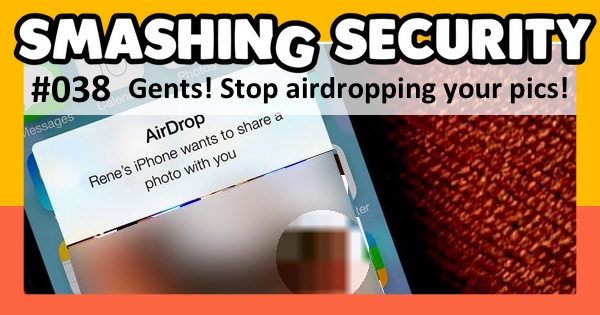
WannaCry hero Marcus Hutchins (aka MalwareTech) pleads not guilty to malware charges, the Scottish parliament is hit by a brute force attack, IoT smart locks aren’t so smart, and.. ahem.. someone is sending intimate pics via AirDrop to unsuspecting commuters.
All this and more is discussed in the latest edition of the “Smashing Security” podcast by cybersecurity veterans Graham Cluley and Carole Theriault, joined this week by technology journalist Geoff White.
Show full transcript ▼
 This transcript was generated automatically, probably contains mistakes, and has not been manually verified.
They're the real-time threat intelligence company whose patented machine learning technology continuously analyzes technical, open, and dark web sources to give organizations unmatched insight into emerging threats.
You should sign up for their free daily threat intelligence updates at recordedfuture.com/intel. And thanks to Recorded Future for supporting the show.
Smashing Security Episode 38: Gents, stop AirDropping your pics! With Carole Theriault and Graham Cluley.
Hello, hello, and welcome to Episode 38 of Smashing Security for the 17th of August 2017. My name is Graham Cluley, and I'm joined as always by my gorgeous co-host, Ms.
Carole Theriault. Hello, Carole.
Normally you'll see him popping up on Channel 4 News or the BBC talking about technology, sort of cybercrime stuff. But Geoff, hello, welcome to the show.
You are off to the Edinburgh Festival. You're doing a show called "The Secret Life of Your Mobile Phone." Tell us about yourself, what you do, and tell us about this show.
It sounds interesting.
So myself and a colleague of mine called Glenn Wilkinson, who's an ethical hacker or a penetration tester, to give it the more humorous name, are off up with our show to Edinburgh Festival.
So as you say, normally I cover cybersecurity full-time. I tend to do the more investigative stuff, the longer-term stuff.
The problem we had after a while was this whole thing of personal data.
The problem is it isn't personal data when these mega hacks happen and millions of records go missing, or when you expose some creepy vulnerability, people look and go, well, yeah, but that's not me, is it?
It's not my phone, it's not my data. So I realized that to really make data personal, you have to make it that person's data.
And the only way to do that is in a theater venue, with an audience face-to-face. So we cooked up this thing called The Secret Life of Your Mobile Phone.
We effectively take an audience of people, we hack their phones with their permission, I should point out.
We give them a significant warning at the beginning about what's going to happen. And then what we do is we track live and in real time where all of the data from their phones goes.
So we show them which countries it goes to, which companies get it, where they are in the world. We talk them through what a cookie looks like.
We show them what cookies they're throwing out.
And we also show them how the signals given out by their phones, mostly by Wi-Fi, can be used to kind of profile them and track them and target them.
And we also explain, by the way, we explain net neutrality using Mr. Potato Head. That's a high point.
We try to keep the whole thing offline because, you know, it's our show and we want to try and stop people copying it, but because we have a Luddite mentality about copyright.
But B, also the whole thing works when you're actually in the room.
So putting it available online, we'd be back to the same problem of people thinking, "Oh yeah, I saw your show, but it doesn't affect me." Everybody who's seen the show so far, no one can walk out of that venue and not think it applies to them because it does apply.
We have shown it applying to your phone. So it needs to be up close and personal.
They could set up an evil twin hotspot, say, in a cafe or an airport. People just mindlessly connect to it, and they'd be able to see everything which you're seeing in this show.
I mean, it's a very real threat, isn't it?
I mean, you know, as Glenn Wilkinson, the guy I do the show with, says, you know, this hack, what's called the karma attack, where you impersonate a Wi-Fi hotspot, you know, it's 10 years old, but it's still working for us.
And what's really scary is what you said there is people connect to a Wi-Fi hotspot.
Well, actually, no, you switch your phone's Wi-Fi on and it's automatically going to try and connect without you necessarily knowing.
So we just get the audience to switch their Wi-Fi on and that's it. They start connecting to the internet through our kit.
It's bewildering that this still works after this amount of time.
Go and check out Geoff if you are up in Edinburgh, and we'll put a link in the show notes where you can find out some more about Geoff and his show.
What we're really here for is to talk about what's been going on in the wonderful world of computer security in the last week. We're all going to choose a topic and—
If you remember, he was the WannaCry accidental hero, the man who single-handedly crushed the WannaCry ransomware, which was ravaging National Health Service here in the UK by finding a kill switch for it.
And of course, he hailed very much as a hero by everybody for what he did, which was fantastic. But—
And he's now appeared in court in Milwaukee.
He's pleaded not guilty in connection, not with WannaCry, but in connection with another piece of malware, a banking Trojan called Kronos.
And there's a suggestion that he, well, the allegation is that he may have written code which ultimately ended up inside the Kronos malware.
And it was just very confusing in that there seemed to be contradictory messages about whether he was claiming he'd actually designed this piece of malware.
If so, whether he'd given it to anybody else.
I couldn't quite work out what the defense was going to be, and the defense seemed, from the quotes I read anyway, seemed to be a little all over the place.
I'd imagine though, if it comes to court, you know, who knows whether it will or indeed when, they'll have nailed that down.
But the weird thing is I don't think on your own computer designing a piece of software like this is necessarily a crime.
If I'm just designing it, it's the point at which you give it to somebody else, sell it to somebody else.
And I think that'll be, if this does, I say, you know, it does come to court, that'll be an interesting crux to this, I think.
I'm of the opinion as well, though I've been working in antivirus for 25-odd years, I do believe on your own computer, if you want to write malware, you go ahead and write malware.
Because I agree with Geoff, it's hard to know what's going on right now.
You can follow him on Twitter as well, where no doubt he'll be tweeting away.
And so that's been one of the big stories of the week, but that wasn't actually what I wanted to talk about.
What I actually want to talk about was there've been some more brute force attacks against politicians' email accounts in the United Kingdom.
In this case, what's happened this week is Scottish Parliament has been attacked.
Staffers at Holyrood and members of the Scottish Parliament have been discovering that people have been trying to crack into their email accounts using this brute force technique, which isn't a sophisticated technique.
I mean, you can find automated tools freely available on the internet, which let you submit thousands and thousands of password attempts in seconds.
You know, it's like starting with Arnold Aardvark and working your way up. And we saw a similar attack a few weeks ago.
I think it was back in June against Westminster, against politicians in London.
Wouldn't the government be using software to kind of go, "Hmm, a lot of traffic coming in from here."
But what's happened is some users have been locked out of their accounts.
And that actually suggests to me that maybe some of the preventative measures which they put in place to prevent a brute force attack from succeeding actually worked.
They detected that something unusual was going on, which would be, for instance, 1,000 attempts to log into an account and getting the password wrong 1,000 times.
You know, that sort of account lockout is a good idea. And that's a typical countermeasure which can be used against a brute force attack.
The problem with account lockout, of course, is that it locks out legitimate users as well.
But if you lock out someone after 30 attempts or 100 attempts, or if you slow down the attacks so people can only try a few passwords every hour or progressively make that delay between entering a new password, even a few seconds can make a dramatic difference to slow down a brute force attack.
You know, how many of these brute force attacks go on all the time? And is it just that it was Westminster and Scottish Parliament's turn, or was it a directed, targeted attack?
And if it's the latter, who on earth would do that? I mean, as soon as you get rumbled, you're locked out.
You know, it's exactly the opposite of what people who are interested in getting into an organization want to do, which is to be stealthy, get in, stay in, and stay undercover as long as possible.
There are attempts made, for instance, you know, you get the LinkedIn breach database, the database of passwords which came out of LinkedIn years ago and other big hacks.
And you might try those passwords against particular people's credentials. But a brute force attack sounds a little bit dumber.
Although ultimately, you know, brute force attacks, given enough time, will work. It's just whether your site or your web service is going to allow a brute force attack to continue.
If you want to steal one thing, you'll divert everyone's attention to the hippopotamus in the lift or whatever it is that you've created as a huge distraction.
But there are things you can do to prevent brute force attacks. And obviously put in more checks, heighten the security.
If you determine that unusual levels of attempted logins are happening, you could have a CAPTCHA in place, although CAPTCHAs can be irritating.
So you might want to use Google's reCAPTCHA or even their invisible one. You can demand stronger passwords from your users in the first place. You can have two-step verification.
Troy Hunt, who runs the Have I Been Pwned website— we should try and get him on the show sometime because we keep on plugging his sites— he's just opened a new product called Pwned Passwords.
You can actually download 300 million passwords that they know have already been breached.
When people create an account, you can run it past that database and you can say, actually, don't choose that password because we know that one's been breached in the past, and it might be a dumb password.
And that maybe will encourage people to use stronger passwords. Passwords, I don't know, but it seems like a neat kind of idea.
And there's also some great advice if you want to read more about brute force attacks over on the OWASP Foundation, the Open Web Application Security Project Foundation website.
I'll put a link in the show notes where you can read more about that. But yeah, politicians there, I wonder what they might have in their email which would be of interest.
I was slightly huffy that they put out the line that "only" in inverted commas, 90 accounts compromised.
You know, imagine the ICO has been informed, but do users, do constituents get informed if data's been breached?
I mean, on the one hand, national security might say, oh no, don't tell anybody. On the other hand, it's like, well, this is people's data.
So I don't know what's going to happen with that.
The internet is things, you know, it's always been the fiber optic cable switches, routers, you know, to say the Internet of Things is glibly assuming that it used to run on kind of hot air and bacon.
So the Internet of Things obviously is now a headline. And my favorite story from this week of the Internet of Things gone wrong is the digital locks, the remote access locks.
There's a company called LockState, who are a US company. As the name suggests, they make digital locks. These are connected to the internet.
And as such, which is probably quite a good feature, these locks can update themselves over the internet. Unfortunately, it seems that—
And so, but now you're going to tell us—
Unfortunately, the update applied to one set of locks, a newer version, but got applied to the older set of locks and, in sort of techies' parlance, bricked the locks.
The locks just stopped working. This wouldn't have been so bad. It's hundreds of locks, so it's not the thousands and thousands, but it is a significant number of locks.
And what makes it slightly more worrying is LockState are— describe themselves as a global partner for Airbnb.
So this caused problems obviously for Airbnb customers who are trying to get into properties. Now there's a few depressing things about this story.
Number one is the fixes that were offered by this company were, well, one of them was take the back off the lock, send it to us. We'll update it. We'll send it back to you.
That could take about a week.
I mean, it's in the tweets and replies, you know, there's a lot of people saying, oh God, I'm locked out. What can you do?
And in fairness, LockState were contacting me on Twitter and reaching out fine. But on the front page, of LockState's Twitter account.
And last time I checked their website, there's barely a mention of this. And I just feel, you know, it's not like nobody knows this has happened.
I understand you kind of don't want to make a huge fuss about it, but the fact that on the front page of your website you don't have a thing saying, look, we're on it, here's the deal, I find that a depressing response in this day and age.
And there should always be a single line of something just saying, yeah, we screwed up, but look, here's what we're doing about it.
If you can kind of own up quickly and solve it as fast as possible, I think we all like it better.
There is a key that can activate the lock. And I just imagined myself getting my brand new lock state lock and fitting the door and thinking, "Oh, there's a spare key. That's great.
It's a really good idea. Where shall I store that? I'll store that in my flat." Yeah, underneath the welcome mat.
Because if you have to carry the key around just in case the lock goes wrong, what was the point of having the digital lock in the first place?
Yeah, this is the Higgins family. Father John lost the key to the imported car when he bent down to tie his son's laces one day.
Well, immediately I'm, you know, how would you— is he standing above some furnace or something?
What's— how do you— the key goes missing under strange circumstances, but it's the only key that will work on this car because they haven't got a spare because it's an imported, I think a secondhand version.
So friendly neighborhood hacker, because he put out a, you know, a Facebook alert for this lost key. Has anybody found it? We're locked out of our car.
It's months, I think, they were locked out of the car, just pushing it around a wheelbarrow. And eventually this hacker says, well, I can probably help you out.
They wheel it to a garage where the hacker unpacks the electronic systems behind the car, finds the chip apparently on which the key code is stored, and recodes the chip with the new key, and they get into their vehicle.
So happy ending, although you then think hang on, how many hackers can do that?
Oh no, we can't get in that either. You've got all these bricked devices left. What you actually need is a real brick.
We should all carry a brick around so we can smash a small window in order to get into our properties or into our cars.
This is largely thanks to the popularity of wireless headphones and wearables, not to mention all the IoT devices Geoff was just talking about, or even retail apps, those things that track you around stores, you know, that offer you click and collect or in-store navigation functionality.
But I'm thinking that not many people are actually managing the Bluetooth restrictions as well as maybe they should.
So we want to just look into how they can do that on iPhone particularly. And I want to talk about AirDrop in a second.
So this was inspired by a story in the New York Post earlier this week. This is involving 28-year-old Britta Carlson, who was on a New York train heading to a concert.
And her phone makes this weird sound, right? The one that she's not familiar with. And so she looks at the phone, there's a message displayed and it says iPhone 1.
'Would like to share a note with you.' She hits accept and was horrified with what she saw.
And now AirDrop is this neat little feature in Apple which makes use of Bluetooth to create a kind of peer-to-peer Wi-Fi network between devices.
So each device creates a firewall around itself, and the connection and the files that are sent are encrypted.
So this is great if you want to share pictures and files with friends and family and colleagues, maybe even YouGram, right?
Not so great if the settings are allowing anonymous strangers to send you pictures of their genitals.
And it turns out that Apple's AirDrop doesn't keep a log of these transactions.
So I have seen reports of people saying, oh, anyway, people are saying we can find out who sent these. I can't. I don't see how that can happen if Apple couldn't do it.
That's right. And was asking you to upload images to it. I mean, if Apple worked with that company, presumably maybe there'd be some correlation which could be drawn.
If, you know, I'd probably laugh out loud, but then I'd panic that I insulted the perv when I realized that he was just around, right? Peacocking at me and waiting for my reaction.
And I thought that had been for exactly that reason, that bluetoothing became this thing where you'd try and, if you heard a shriek at the other end of the train carriage, you knew you'd hit the right spot or whatever with your offensive message or rude message or whatever.
But I can't believe that they've brought that vulnerability back.
There are things that you can do and I would recommend, I know, you know, I'd recommend you talk to everyone around, check your kids' phones and your family's phones to make sure the settings like this.
So number one, let's talk Bluetooth, right? So Bluetooth, you can basically toggle between on and off. And that basically means I'm discoverable or I'm not discoverable.
Now Graham and I, before the show, had a little bit of a barney about Bluetooth because I'm a person who likes to have it turned off because I don't need every supermarket I go into to, if I have my Bluetooth turned on, to know what aisle I'm going down to try and gamify it better so that I buy things I shouldn't buy, right?
I don't need to know that I go down aisle 3 all the time. So I find that a bit disturbing. But Graham, you seem to be fine.
And certainly with AirDrop, which is the iOS technology which has been used to spread these rude pictures, I do use AirDrop.
I have a use for AirDrop inside my office, but what I only do is I only allow people who are contacts to send me an AirDrop message.
And if you do, you can see whether your AirDrop is turned on or off, or if it's allowing it for contacts or for everyone.
And if you've got everyone there, tsk, tsk, tsk, turn that off and choose contacts only.
Although contacts is also an interesting choice because I have a lot of people in my phone whose penises I don't want to look at. Maybe I should have a penis contact list.
What's interesting is there's an entire edifice behind the drive behind Bluetooth, because what's interesting is everybody switched their Bluetooth off because it used up batteries and it's annoying.
We now have Bluetooth Low Energy.
And what's interesting is because Bluetooth is such a short-range thing, and because, as you say, they can tell which aisle, not just which aisle in the supermarket, they can tell which vegetable you're in front of.
Now, what's interesting is the drive among advertisers are super, super excited about this, and marketers, because they can do really localized advertising, coupons for that brand of tampon or that vegetable, whatever.
But in order to do that, people have to have their Bluetooth switched on.
Now, at the moment, they can do, if they want, they can do push notification if they change the systems, which means you have no option.
Your phone comes up with a, "Hey, Geoff, you're in front of the potatoes, buy some." I feel the industry is holding back from that because they don't want to creep people out.
But as you start to get Bluetooth headphones, as you start to get Bluetooth enabled by default, these advertising methods are going to start coming through.
I really think we're going to see a boom in this.
And the reason Graham, for example, needs Bluetooth on all the time is 'cause he uses it in his car. So he pairs it with his car 'cause he's got a fancier car than I have.
So there's a lot of technology out there making it very easy for people to have it on all the time. And I think there is a cost.
The other cool idea here is that you can actually, so when your Bluetooth is turned on, you are effectively discoverable. And it might be a good idea to change your phone's name.
And you can do that in Settings, General, and About.
So using a code name or initials or something that doesn't infer, well, in this case, as we're talking about dick pics, infer gender or age might be a good thing.
If you had John Smith written there, maybe you'd be less likely to get that.
And what we do in the show is we show where people, you know, we can find people's work Wi-Fi networks, who know where they work. We can locate their home Wi-Fi.
We can also then tell what their name is. So you get a—
So I think it actually might be in the setup section. So it's a good idea for everyone, just check your phone's name, you got Settings, General, and About on the iPhone.
Just see what's written there and maybe change that to make it a little less all about you.
And then it would get, of course, what is it, your mother's maiden name and the street where you used to live, which obviously would be useful information for thieves as well.
But the advice you are giving people, Carole, is if you're going to have AirDrop on, make it contacts only. Of course, this—
In this particular case, this victim on the New York underground system, she had enabled it so everyone could contact her. I think she was using it like that for her office.
Wouldn't it be great if Apple gave you an option of saying, turn it on for everybody but only for half an hour, and then switch back to contacts?
Because you will forget to change it back.
I don't think via AirDrop it is a trend. From my research this morning, I don't think it's been happening very often. I saw one case in 2015.
There was a few in 2016, but I haven't really seen any others. So I think that is a bit of hyperbole.
However, there is a problem with— and there's many reports of women on dating apps receiving unwanted pics of male junk.
So that led to this interesting and related conundrum for me. So we all know that flashing in public is illegal in most places that I frequent anyway.
In the US, for example, indecent exposure— basically, I think that you have to purposely display your genitals in public causing others to be alarmed or offended.
And in the UK you can get a 2-year prison sentence if you're convicted under the Sexual Offense Act.
However, seems to be quite gray as to whether sending someone a dick pic, for instance, is considered indecent exposure. So it's this digital problem of cyberflashing.
You're actually targeting it to a specific person, albeit a stranger you don't know. But there's indecent communications legislation.
So if you send someone a picture through the post of your junk—
How do we apply our old laws to this new world that we're living in? Yeah, very deep.
They peruse the internet in its darkest corners and they work out what are the new emerging threats and vulnerabilities from the world of hacking and cybersecurity.
And then they bundle it all up. They wrap it up in a beautiful ribbon and send it to you in a free email.
And thanks to Recorded Future for supporting the show. Welcome back to the show. And it's our favourite bit of the show. This is what we like to call Pick of the Week.
And my pick of the week this week, I'm a bit of a chess fan. I'm not very good at playing chess, but I love chess. And right now there is an incredible tournament going on.
It has been going on for a few months. It'll be going on for a little bit longer. It's going on around the world, but right at this specific moment, the Grand Chess Tour is in St.
Louis in America where they are having a rapid and blitz chess tournament. I know I can hear the excitement right now.
No, no, no, it's not boring because normally a chess game will last about 4 or 5 hours, which I accept maybe not everyone will enjoy watching, right?
It's so exciting. Anyway, there are some amazing players. Leon Aronian, crazy player. He's been doing some fantastic games.
Hikaru Nakamura, and the return after 12 years, the incredible Garry Kasparov is back from retirement playing chess. And it's terrific to watch.
You can watch this live streaming on the internet. Oh no, it's not mate because he could go to d6 anyway. Knight c6 is King d6.
I'll put a link in the show notes as well, so you can— and there's live commentary on the games as well.
You know, my mum, for example, I went home to visit and she said, "Oh, should we watch DVD?" And I sort of felt like being invited on the Antiques Roadshow.
And so they've got— so this is basically, you know, Amazon like, nope, streaming is the way forward. DVDs no more.
And obviously that does throw up the question of what they do with all of the old DVDs. LoveFilm's catalogue covers apparently more than 80,000 titles.
Amazon has told the BBC that they will donate the DVDs to charity partners. And I just have this image of a guy going to Oxfam with bin bags. Here you go.
Do they actually manage to sell any of that stuff?
Not everyone can afford a Wi-Fi connection, you know, a strong one for streaming. So I don't know. I think it could be really good if they do that.
So this is a really interesting thing, you know, if we're streaming all the films now, they can change the films they did with Star Wars, this big controversy about that.
So I'm slightly worried by the fact that if the studio says, actually, we're going to recut this film, put out a new version, if I had the DVD, they couldn't take that back.
Whereas now, I know this might sound paranoid, but I do just, you know, I own the stuff. It's control, it's power.
Now, Sam Harris is no small-time fish. He's written a number of books. He's considered quite a genius in many, many circles.
But I had never listened to his podcast and someone recommended it to me.
So I took a listen as I was on my way to Cambridge last weekend, and after only three episodes, I am delighted and feel much brainier, which, you know, it's hard for me because I'm, you know, I'm up there on the scale.
So as I was talking about cyber flashing earlier, I would recommend checking out the episode called Living with Violence, a conversation with Gavin de Becker.
Now, de Becker is a three-time presidential appointee. He did pioneering work changing how U.S. governments evaluated threats to the highest officials.
He looks after lots of people in Hollywood. He's the business.
In fact, years ago when I was on my way to university, my dad actually sat me down and made me watch a PBS episode with him explaining how women could protect themselves better on the streets, on their own.
We were talking last week about a global thermonuclear war. So the cotton here is good. It'll protect you. You can find it at smashingsecurity.com/store.
And I think the sticker, the t-shirt combined with a whole bunch of Love Film DVDs, you could create a shelter out of them, I think, if there is a nuclear winter.
Really appreciate it.
You can go to our website, smashingsecurity.com, or drop us a line at , or even leave us a little review on somewhere like iTunes.
That'd be nice, wouldn't it, Carole?
It's the—
Hosts:
Graham Cluley:
 @grahamcluley.com
 @
@
 / grahamcluley
Carole Theriault:

Guest:
Geoff White – @geoffwhite247
Show notes:
- "The Secret Life of Your Mobile Phone" — Geoff White’s show at the Edinburgh Festival Fringe
- MalwareTech is back online, as he pleads not guilty to Kronos malware charges — Graham Cluley.
- Scottish parliament hit by cyber-attack similar to Westminster assault — The Guardian.
- Hackers try to break into Scottish parliament email accounts weeks after Westminster attack — Graham Cluley.
- Blocking Brute Force Attacks — Advice from OWASP.
- Hundreds of 'smart' locks bricked by flubbed remote update — Graham Cluley.
- Friendly neighborhood hacker helps family regain access to locked car — Graham Cluley.
- AirDropping penis pics is the latest horrifying subway trend — New York Post.
- Is there a way to view AirDrop transfer history? — Apple Support community.
- What Is AirDrop? How Does It Work? — Lifewire.
- Exposing yourself is illegal – so why should the law tolerate cyber-flashing on online dating apps? — The Independent.
- Saint Louis Rapid & Blitz — Grand Chess Tour.
- Amazon's LoveFilm postal rentals is shutting down — Radio Times.
- "Waking up with Sam Harris"
- Smashing Security podcast on Facebook
- Smashing Security merchandise (t-shirts, mugs, stickers and stuff)
Follow the show:
Follow the show on Bluesky at @smashingsecurity.com, or visit our website for more episodes.
Remember: Subscribe on iTunes or your favourite podcast app, to catch all of the episodes as they go live. Thanks for listening!