

Microsoft says the outbreak of WannaCry ransomware on 12 May reveals why governments shouldn’t stockpile software vulnerabilities.
Microsoft’s president and chief legal officer Brad Smith thinks governments’ hoarding of flaws is a “problem.”
These bugs might be valuable to the CIA and NSA, government agencies which can and do exploit flaws to advance the national security interests of the United States government.
But bad guys invariably find and leak these security holes, which places ordinary users at risk of attackers using exploit code to target unpatched systems.
As Smith explains in a blog post:
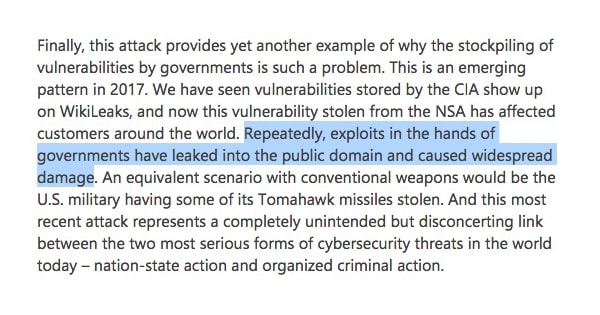
“Repeatedly, exploits in the hands of governments have leaked into the public domain and caused widespread damage. An equivalent scenario with conventional weapons would be the U.S. military having some of its Tomahawk missiles stolen. And this most recent attack represents a completely unintended but disconcerting link between the two most serious forms of cybersecurity threats in the world today – nation-state action and organized criminal action.”
Obviously, Smith is referring to the events of 12 May.
On that day, an updated version of WannaCry ransomware infected the United Kingdom’s National Health Service (NHS), the telecommunications provider Telefonica, and other high-profile within a matter of hours. As of today, it had spread to over 150 countries and reached more than 200,000 victims in an attack that exploited CVE-2017-0143, a Windows-based remote code execution (RCE) vulnerability.

The Redmond-based tech giant patched the bug on the latest Windows versions in March 2017. But there was no fix initially for Windows XP, an operating system which many customers continue to use notwithstanding its end-of-life status.
Microsoft therefore took the highly unusual step to release an update for Windows XP users and urge them to update their software (if possible) as soon as possible.
Microsoft also had something to say to governments that make attacks like the WannaCrypt outbreak possible. Smith delivers the message perfectly:
“The governments of the world should treat this attack as a wake-up call. They need to take a different approach and adhere in cyberspace to the same rules applied to weapons in the physical world. We need governments to consider the damage to civilians that comes from hoarding these vulnerabilities and the use of these exploits. This is one reason we called in February for a new ‘Digital Geneva Convention‘ to govern these issues, including a new requirement for governments to report vulnerabilities to vendors, rather than stockpile, sell, or exploit them.”
WannaCry helps illustrate the importance of governments cooperating with the private sector and the security industry to protect users. But as we all know, public agencies have lots of interests besides defending ordinary people, and some of those goals don’t benefit from transparency.
Let’s just hope the memory of this outbreak leads to some governments to work towards patching rather than stockpiling vulnerabilities. The world doesn’t need another WannaCry attack months or years from now to remind us all of what could happen otherwise.
For more discussion on the issue, make sure to listen to this episode of the “Smashing Security” podcast.
Show full transcript ▼
 This transcript was generated automatically, probably contains mistakes, and has not been manually verified.
Recorded Future arms threat analysts, security operators, and incident responders to rapidly connect the dots and reveal unknown threats.
Their patented technology automatically collects and analyzes threat intelligence from technical, open, and darkweb sources. Why?
To provide invaluable context for faster human analysis and real-time integration with your existing security systems.
Sign up to their Cyber Daily newsletter and get the latest insights from Recorded Future at recordedfuture.com/intel.
Hello, hello everybody, and welcome to another episode of Smashing Security, number 21 for the 18th of May, 2017. And I'm joined as always by my buddy Carole.
Pob isn't just here to say hi to Jason Isaacs from the Harry Potter movies. He's also here because we brought him in to talk about the big story of the last week.
Actually, did anything happen in the last week? Has anyone noticed?
Everyone on Twitter was saying, "I wonder what Smashing Security is going to speak about this week." Yes, we are going to talk about WannaCry, but we're going to do it a little bit later in the show, if that's all right with you.
In fact, I was talking to the BBC about this particular issue and then WannaCry happened. So I think they never actually published their story about this.
It's about HP laptops and a bunch of Swiss security researchers discovered that the audio driver being shipped on a number of HP laptops didn't just drive your audio and do all sort of audio sort of things.
It also secretly logged every key press which you made.
So I mean, the first thing that HP did when this was found out was like, "We're not getting any of these key presses," which obviously could have included password details and credit card information.
All, you know, basically everything you type, right? All of your, all of the sexy messages which you may send in the office.
Now, the reason why these keystrokes were being kept was actually because the programmers who were writing the audio driver were using it as a debugging method.
They wanted to capture whether things like function keys were being pressed in order to mute the microphone or unmute it and all that kind of jazz.
You need to be confident that your software, you know, you want it tested.
You want it tested and you want to know it's the software which you expected to ship, which you're actually shipping.
So, you know, it's bad enough there are thousands of Trojan horses being released all the time that spy on people's keyboards without also having legitimate software silently collecting it.
And even if it was unlikely that remote hackers might be able to grab hold of this information, imagine being at home, maybe you've got a jealous partner or you have a business rival.
If they gained access to your laptop, they'd be able to find everything, wouldn't they? On that, in that file, everything which you'd been typing. Pretty bad stuff.
I've done some work before with the Digital Stalking Trust who are, you know, trying to share information and spread advice about how to avoid being spied on and stalked online.
So, you know, I think this is a real fear. Now, of course, this big stink got kicked up over this, right? Oh, how can they do this? And HP, you know, they did the right thing.
They issued an update.
What they did was they changed the registry key, the setting, to turn it off. Which means, in theory, I mean, obviously that—
You know, they just wanted to get something out really quickly, and maybe this was the way to do it.
You can kind of understand why somebody leaves debugging code in software, but there should be a QA and they shouldn't have done it.
I would expect now Trojans just to be turning that registry key back on and seeing what's in there.
So it may have got buried in the press.
You must be— it's nice that it's maybe not made it on all the top of the front pages.
Make sure that you're running the very latest version of the audio drivers so that they're not secretly logging any key presses. Maybe look for that file, mictray.log.
So it's mic as in microphone.
Just to make sure that it's not there and indeed that you haven't been backing it up somewhere because there may be copies of it elsewhere because you do back up your computers, don't you, and your data.
And you were probably still in kindergarten, Carole, but I'm sure Graham remembers the Morris worm.
Everything is ransomware. Yeah, no longer are people writing worms and viruses for fun to impress their mates. They're doing it for financial gain.
And so the bad part about WannaCry is it was ransomware, and as people have said it will make you want to cry.
It was a network worm and it exploited a known vulnerability in SMB, Windows network sharing software.
And the particular vulnerability was publicized by the Shadow Brokers NSA hack, and it's been patched for about 10 weeks now. But there were actually two vulnerabilities used.
So there was a vulnerability called EternalBlue, and that allowed people to write a file to a remote SMB share.
And there was another vulnerability called DoublePulsar that allowed you to execute files from a remote SMB share.
And they created basically these exploits, having found the vulnerabilities in Microsoft's code, in order to spy and snoop on people, didn't they?
But the other half of their job, and part which arguably they failed to do on this particular occasion, is also to protect and secure the United States and other organizations against these sort of threats.
But yes, and I think we'll talk about that more in a minute, Graham.
So this exploit, this worm used these two exploits and most people first heard about it when Telefónica alerted on this, telling its employees to shut down their computers amid a massive ransomware strike.
So it seems that lots of NHS trusts— and for non-UK-based listeners, the NHS isn't one homogenous organization.
It's lots of federated hospitals that come under the umbrella of the NHS.
And the NHS got hit quite badly to the effect that A&E waiting times went up, hospitals stopped surgery. They stopped MRI scans because their computers didn't work.
Reports are that businesses and organizations in over 150 countries got hacked.
And this all came to an end early in the UK evening, about 6 or 7 o'clock, when somebody registered a domain that was in the code.
So a young computer researcher was looking at the code and he saw a domain that was looked up by the virus or worm, and he registered that domain so he could track how many computers had been infected.
So the action which was taken by that guy, MalwareTechBlog he is on Twitter, if you want to give him a thumbs up and what he did, had this really positive effect because it prevented the malware from spreading any further.
It effectively was a kill switch on the malware.
I wasn't for a minute suggesting, I'm just saying I had a problem with the word kill switch that the media used because I think it gave people a false sense of security.
And clearly it hit the UK's National Health Service, but also hit very hard in Russia and elsewhere around the world.
Maybe what would be interesting for us to discuss is whose fault is this?
Because it seems there's a lot of blame and a lot of finger-pointing which is going on right now as to who should be taking some flak.
And I don't know if the NSA told them about it, but they certainly patched those in all the supported systems quite quickly and said it was a critical update.
And that was about two months before this actually exploded.
And also let's not forget, okay, Microsoft did have a bug in their software, naughty, naughty, but what programmer can put his hand up and say he's never written a program with a bug in it?
Yes or she? So, I mean, Paul, you're a programmer. Have you ever written a buggy program?
You know, there are bugs found in Android all the time, aren't there? Which is sometimes quite serious as well.
Yeah, as we kind of touched on earlier, this bug was made public by the Shadow Brokers who stole it from the NSA. Is it the NSA's fault for writing this bug?
Well, the NSA's job, and just like GCHQ's job, is signal intelligence, and it's to try to steal secrets from foreign governments and enemies of the state.
So the NSA were doing their job by creating this, and it looks like, given the timing of the Microsoft patch, the NSA did tip Microsoft off about it when they knew that the Shadow Brokers were going to release this exploit.
We better tell Microsoft. There's another reason why maybe we can apportion some blame to the NSA. If we go— I love this.
We're going through our little blame list here, which is the NSA got hacked and the NSA are meant to be all about security. And here they go again.
Having a very embarrassing data breach. And I seem to recall they had another quite a big data breach, didn't they, a few years ago involving that contractor, Eddie Snowden?
Shadow Brokers claim to be an independent hacking team.
We would say, well, you get hacked by the KGB. Again, that's what the KGB is designed to do, to hack people like the NSA.
I am convinced loads of them are running legacy systems that are not running the latest and greatest. I wouldn't be surprised if there's even XP machines still running.
And, you know, how—
The issue with the NHS, like universities, is they don't often have one overarching IT system.
So the radiology department might have a slightly different system to the ICU or the ER or different parts.
And no disrespect to the IT guys in the NHS, they're not getting paid an awful lot of money, and they're getting run ragged keeping up to date with all the other things they have to do, allowing the doctors to use their iPads and whatever else they have on their plate.
So it's very difficult.
And so they don't have any more recent updates to the software and, you know, they can't get a Windows 10 machine to drive that piece of medical hardware.
And it would cost an absolute fortune, much more than replacing a computer to replicate this. And I think they're making that decision all the time.
It's like, well, we can spend this extraordinary amount of money and secure ourselves against some of these threats, or we can—
So for those who don't live in Britain or aren't aware, you know, the UK's National Health Service is pitifully underfunded.
You know, no one's saying they're not very responsible here. But if we had to go to, you know—
And we're not just talking a flimsy lock and a flimsy key.
I think triggering the ransomware immediately was probably silly of the author because the best pathogens want to keep their hosts alive.
In biological terms, it's no good killing patient zero, which this nearly did. There were several coding errors.
Reports are coming in now that the bitcoin code may not have worked properly.
And so this may be why it appears that so few payments have actually been made.
I think the last time I looked it was something like about $70,000, which, yeah, sure, it's great for a week's work, isn't it?
But for the scale of this attack, you would've expected them to have made more than that.
So back off.
Actually, speaking of movies, did you hear, did you guys read about the Texan who is suing his date for texting during a 3D screening of The Guardians of the Galaxy Vol. 2?
Anyway, apparently texting is one of his biggest pet peeves.
So he's asked this girl who's basically texting— she says she's texting because her friend's having some crisis, so she's just telling, you know, giving a few replies.
And he says, can you stop texting? When she doesn't, he tells her to go outside. So she does and does what any girl would do and doesn't come back.
He then— he's reportedly contacted her little sister chasing up the payment, and then he goes and sues her. So as I said, douche, right? She probably have a tattoo in his forehead.
Anyway, that's just—
You might have heard that the latest blockbuster— we don't know exactly which one, but people are thinking it's probably Pirates of the Caribbean— has been stolen from Disney.
Now, Chief Bob Iger says that the hackers have stolen it and they are demanding ransom for it. So this is not the first time we've seen this in Hollywood, has it?
Wasn't there— it was a few weeks ago, wasn't it? It was Orange Is the New Black. Yes, that was taken from Netflix.
So it's a similar situation here where they're saying if they don't pay up— and they haven't declared the sum that they're being asked, but they're asking for a large sum, a huge sum according to the Disney chief, in bitcoin— and otherwise they're threatening to release the first 5 minutes, and then they're going to release 20-minute chunks of the film until the financial demands are met.
Now, what's interesting—
Now the thing is, this movie is supposed to be released on the 26th of May, so that's— is that next week? That's next week. So they don't have very long to get their money in.
And the thing is, how is this happening repeatedly? So how is it that hackers are getting their hands on these final cuts?
I am sure these cuts are being watched with— by people's lives, how much money they cost. You know, there's a lot of— this is huge money.
So how do you think this may have got out?
And, you know, you're putting your trust in their computer security as well.
So even if you, as the boss of Disney, are thinking, "Oh yeah, our computer security is really locked down and everything," those partners of yours may not be as careful.
There's both the danger, the sort of insider threat danger of someone leaking the movies, and maybe they're getting more on top of that these days because there's been so much piracy in the past.
But there's also the computer security, isn't there, of external hackers. And it does seem that some of the hacking gangs have been particularly interested in doing this recently.
I guess because—
Everyone wants to talk about the Hollywood celebs, and it gives them a chance actually probably to put an ad up for the movie so they can get, you know, the newscaster, they know that the articles can get, or rather the publications can get a bit more attention.
Do you guys? I mean, what percentage of people that go to the theater might do that?
And maybe it's not just the people who are working on this, it's people who have to review it. It might have gone to the directors, or just to have final say.
And all I could think of was Mission: Impossible and this message must be destroyed after 5 seconds.
So they really need a way to play the movie and wipe it completely so you can't maybe copying it in these kind of scenarios.
And so they're sharing files inside a sort of encapsulated bubble or whatever, which gives them the ability to, you know, zap a file permanently, you know, and prevent people from copying it in unauthorized fashions.
But yeah, that's a really good suggestion, actually. The other thing is I don't think they're losing a lot of money.
And the other thing is they're getting a lot of publicity about the film, because I can't imagine that, you know, if I didn't know anything about the films, which actually I don't, right, I might go, oh, it's a popular film because someone's stolen it and is now holding it for ransom.
So I think there's some kind of weird sense that it actually makes the film more important and more people will actually go see it to see what the fuss is about.
It's called Smashing Security, and you can find it on iTunes. You can leave a review if you like as well.
But if you like the podcast, please subscribe, and that means you will automatically get it every time we release a new episode, which is normally every Thursday.
You'll find our email contact form and you can find a link to our Twitter as well.




I think this whole story is BS. Microsoft is the one responsible because they want to get rid of the old (Windows XP) and force the new crappy windows 10 spyware on everyone.
Governments should not hold back vulnerability knowledge: the information may become known by a breach, or by an accidental or intentional leak. It may, as a result, become known to criminals who likely will use it for criminal purposes, or sell it on to others who will. On the other hand, governments can use vulnerabilities in ways that many would consider more beneficial than harmful.
Criminals should not hold back vulnerability knowledge: they are likely to use the information for criminal purposes or sell it on to others who will. We can pretty much guess how well that will work out.
Private (non-criminal) organizations should not hold back vulnerability knowledge: the likely purpose of doing so is to sell it on to governments or other private organizations, some of which might use the information for criminal purposes or sell it on further to others who will.
Both governments and private organizations may obtain information about vulnerabilities by their own research, by stealing it from other governments or private researchers, purchasing it from private organizations, or taking advantage information leaked either intentionally or by accident.
In the aggregate, private research into vulnerabilities, including by developers and vendors such as Microsoft, probably exceeds similar government and government sponsored research by an order of magnitude or more. Government activity, including by the NSA and CIA is reasonably a matter for some concern, but focusing on these two agencies, or even all similar government agencies is a serious misdirection.
Those who fell victim to this particular exploitation generally were
– users of products for which Microsoft discontinued support two or more years past;
– users of unauthorized Microsoft products that do not qualify for updates;
– users who had not applied patches for very high severity vulnerabilities that had been available for about eight weeks.
The extremely rapid spread, in addition, seems likely to have been facilitated by overly permissive firewall configurations that exposed an outdated and deprecated version of the SMB protocol on the public Internet.
The NSA may be in for some blame, but there is more than enough for others, the first of which is Microsoft, which developed the vulnerable software and apparently overlooked the vulnerability for 15 years or more.