


Twitter is in chaos.
The company has kicked out thousands of its engineers (as well as thousands of the contractors responsible for battling misinformation and harmful content.)
Meanwhile Twitter’s CISO and head of Trust & Safety both quit, both the chief privacy and compliance officers suddenly departed, alongside other top executives inside the company.
And what’s Twitter’s new owner doing?
Elon Musk is scaring off advertisers with his bizarre behaviour, as decisions he made allowed pranksters to impersonate big brands and post tweets that did untold damage to business’s reputation and erased billions of dollars from their market cap.
We talked about some of the problems at Twitter a couple of weeks ago, on the “Smashing Security” podcast. Little did we know that things were going to go from bad to worse.

Show full transcript ▼
 This transcript was generated automatically, probably contains mistakes, and has not been manually verified.
Hello, hello, and welcome to Smashing Security, Episode 296. My name's Graham Cluley.
Coming up on today's show, Graham, what do you got?
But there's been a number of incidents since he bought Twitter for a— I was about to say a gastronomical amount of money, but that would be—
Did you see he's also been forcing his developers to print out their code? Some of them have even been—
Now, there's nothing a programmer likes more.
Having someone else look at the code and go, "Eh, no, I think you could have done that a little bit more optimally, couldn't you?" Well, whoa, whoa, whoa.
And him determining the quality of your work.
Now, having told people to print it out, they then sent around an edict telling people, shred that, don't print it out, shred it, shred it.
Because this story makes absolutely no sense at all from the point of view of reviewing code, okay? I've written code, I've reviewed code.
He's gonna do a meme. He's just gonna be sat there smoking a bifter out of people's code rolled up. I guarantee it.
I want to be able to say to people, you have to pay $20 per month to have a tick to verify your account. I want it to be live within a week and a half.
And if you don't do it on time, you're all fired. So that's what he's told his engineers apparently is to do this.
There is no way on earth that product will not get shipped.
They will spend the next 6 months fixing all the problems in the product that they shipped, but they will ship it on time. Not a doubt in my mind.
I don't know if you saw that CNBC interview with two data engineers as they came out of the— Mark, you saw that, did you? Maybe you can describe that to Carole for us.
They were just trolling people with amusing names, yes.
Maybe a little bit concerned about the new boss, may not think he's such a great guy. And there is a concern apparently that some disgruntled staff might go slightly rogue. Rogue?
Yes, rogue.
And they could cause problems if they think Elon is— if they wanted to sabotage it, if they imagine they're going to lose their jobs within the next couple of days, they might decide, well, I'm just going to— Do you remember when back in 2017, there was a Twitter employee who suspended Donald Trump's account?
Yes. I think he suspended it for a grand total of 11 minutes.
And they thought, well, as I'm going, why don't I do the world a favor? And so they deleted his account for 12 minutes.
Now, it's possible if someone doesn't like Elon Musk, they might go rogue on Twitter now and may do something mischievous.
And this is why Twitter says at the moment it has locked down a number of its staff from doing things on Twitter.
Just little things on Twitter, like maybe handling all the offensive posts and hate speech. So that they can't suspend accounts and deal—
And so there is a worry that this might— because there are some very high-profile people with verified accounts on Twitter who have posted misinformation.
For instance, there is an account called @elonmusk, and this chap Elon Musk posted a link to a conspiracy theory the other day, claiming that— I don't know if you heard— Paul Pelosi, the husband of Nancy Pelosi, his home got— someone broke into his home with a hammer, saying, "Where's Nancy?
Where's Nancy?" And they attacked Paul Pelosi with this hammer. He's now in hospital getting some cranial surgery or something.
He claimed that this in fact was a gay prostitute who was having a relationship with Paul Pelosi.
And people are saying, "Well, are you going to do this to Elon Musk?" And of course, Yoel Roth doesn't want to lose his job.
Meanwhile, this conspiracy theory and much more stuff— apparently there's been this huge surge in offensive slurs, derogatory terms, really nasty stuff happening on Twitter since Elon took over because people are testing the system.
So there's been this, in Twitter's own words, there's been this ton of tweets which have come out.
Posting all of these messages, 50,000 tweets they said, were just using one particular word, which we don't like, on Twitter, which has happened since. So, everything's great.
Trying to work out what is the moderation procedure for moderating the guy that pays their monthly checks.
Elon Musk took a screenshot of that New York Times story and said, "This is not true. I haven't linked to the New York Times."
So, you know, you do have an option, Graham, and all of you other people out there have an option. Get off Twitter. Don't get off on Twitter, but get off it.
And Digg, which had been this company worth hundreds of millions of dollars, suddenly was worth nothing.
I just don't like this anymore.
So, when I was growing up, it seemed like there were lots of documentaries on TV or things on the TV news about humans trying to understand animals.
And the way that we did it, it always seemed to be the same. So, whether it was chimps or dolphins, we were always trying to teach them English or sign language.
So, I remember vaguely, somebody tried to teach a gorilla, you know, there was a big deck of buttons it could press, and it could say, "I want a banana," and it could press the banana button.
And I think there was another one for dolphins that was obviously, it was in the water.
And this struck me as very odd, 'cause the conceit was that we are terribly clever.
Humans, terribly clever, very different from all the other animals, far cleverer from those stupid animals.
And, you know, somehow we use their inability to learn English and sign language or whatever test we set them as proof of our own brilliance.
Well, anyway, as it turns out, there was a whole bunch of other people that had the same thought and they had a far more productive reaction than I did.
And what they learned and told us is that they're saying an enormous amount. To each other. So, I'm gonna give you some examples.
And elephants have got words for honeybees and humans, and they can communicate the difference between threatening humans and non-threatening humans, which is very useful.
You probably know that honeybees communicate all kinds of information about suitable nesting sites and flowers and nectar and things like that using interpretive dance.
And microscopic coral larvae which have got no central nervous system and no apparent ability to hear, will swim towards the sound of a healthy coral reef singing.
So what they do is one of them sees a predator and they will communicate how dangerous the predator is. And then the other birds around it will repeat that.
And you get this ripple warning that goes out through the community of birds.
And this signal travels at about 100 miles an hour, which means that far away, birds can get minutes of advanced warning about a predator.
"—and await my fate." Anyway, this system of early warning is so useful that it isn't just the birds that listen to it.
There are other animals that will listen in to the birds as well. And they have learned to interpret what those warnings mean.
And as I've mentioned before on this podcast, I think even trees have a form of information exchange.
And the trees in a forest will use the underground network of fungal mycelium as a sort of arboreal internet.
However, it's one thing to witness this communication between two animals or two species. It's quite another to work out exactly what they're trying to say to each other.
And that is where I have finally discovered that rarest of gems, a worthwhile application for artificial intelligence.
And I learned about this from Vox, which has just published an interview with Dr.
Karen Batka, who's written a book called The Sounds of Life: How Digital Technology Is Bringing Us Closer to the Worlds of Animals and Plants. Hang on, hang on.
Vox writes, automated listening posts have been set up in ecosystems around the planet, from rainforests to the depths of the ocean, and all of this recording creates a great deal of data which can't be sorted manually.
Enter AI, which of course can sift through mountains of data and find patterns and even perhaps make dictionaries from different animal species' words.
And one day she conjectures that all of this sifting and sorting of animal communication could lead to a sort of Google Translate for animal languages and act as an intermediary between us and other animal species.
So we might be able to use AI to create two-way communications between us and the animal kingdom.
These birds that are kept in cages without their mothers and then released into the wild with absolutely no information so that rich people can go hunt them easily.
I wonder what they're saying to the people.
Bakker tells Vox about rudimentary communications with honeybees, dolphins, and elephants.
And all of that sounds rather wonderful to me until you realize that humans are involved, and of course, no sooner does she say that we have started to communicate with these things than she offers a great big warning that we might screw it all up and turn it into a weapon and crash an ecosystem.
So I'll give you an example. This is the example that she gave to Vox. She says, "I'll give you an example.
A research team in Germany encoded honeybee signals into a robot that they then sent into a hive."
The next stage in this research is to implant these robots into honeybee hives so that the hives accept these robots as members of their community from birth.
And then we would have an unprecedented degree of control over the hive. We'll have essentially domesticated that hive in a way that we've never done before.
And this creates possibilities of exploitative use of animals. And there's a long history of the military use of animals. So that's one path I think raises a lot of alarm bells.
When you said that there's a danger of us exploiting animals through this technology, I thought maybe we'd give them phone calls saying, "Have you been missold PPI or had a recent car accident?"
And the person who is responsible for this program says, basically, you can't teach dolphins to kill people. And him saying that implies that they've tried, doesn't it?
Turns out they won't do that. Anyway, I think that there is another equally world-altering possibility here, and you kind of hinted at it with the pheasants.
So one of the projects that Bacher is talking about, I think, is CETI, which is spelled C-E-T-I, which is obviously supposed to make you think of SETI, which is S—
Which is using machine learning and what it calls gentle robotics, because it's 2022. And if you don't say your robots are gentle—
And I remember hearing about this a couple of years ago. And when I first heard that, I thought the idea of finding out what whales have got to say to each other sounded fantastic.
And then I realised that we are probably quite a hot topic among the whales, particularly the sperm whales. And we might not actually want to hear what they've got to say.
And then boats with engines turned up. And suddenly they couldn't. And then boats with sonar turned up, and then they all got headaches and died.
Anyway, it's also worth bearing in mind that sperm whales can live for 70 years.
And that means that there are probably sperm whales who are still alive now who were alive during the age of industrial whaling.
So you've said you want to know what the pheasants have got to say. What other animals are you dying to hear from?
So now the metaverse we all pretend to understand is a VR-based world independent of our physical one, where people can socialise, engage in unlimited variety of virtual experiences, so they say, all supported by its own digital economy as well.
And listeners might remember that a year ago when Facebook rebranded to Meta, it soon opened access to its virtual reality social media platform, Horizon Worlds, which is still today its biggest platform in this area.
And there were teething problems. Do you remember we spoke about in one of our episodes where people were sounding the alarm of digital sexual harassment on the platform?
And then people egging them on.
What's the point? Right? What? Of the metaverse. What's the point of the metaverse? Yes.
They're coming, they're coming.
I mean, of course, it's maybe fun to play around, but it's not TikTok.
And at first, you might think that workers are clamoring for this virtual environment where they can interact. But that's not what I'm seeing or hearing.
But you see, at Meta Connect, Zucks announced that Meta is working with tech business leader Microsoft to make available virtual sessions of business software such as Office and Teams.
And these will be incorporated into the Horizon Workroom virtual office platform, which kind of has been widely ridiculed for its low-quality graphics and floating legless avatars.
So does this partnership with Meta and Microsoft make sense to you guys? What do you see there? It's genius.
Great for all the other tech companies, I imagine. Very good.
And what it's done is, because everybody uses Windows and it does all this bundled licensing, it has foisted all sorts of software that people absolutely hate into businesses very successfully over a long period of time.
Yes. So, Internet Information Server, absolutely terrible, terrible web server full of security holes when it came out. Very widely used. Microsoft Teams. Nobody likes Microsoft Teams.
It's way more widely used than Zoom because it just gets bundled in. Microsoft SharePoint, possibly the worst piece of software ever invented anywhere by anyone.
It's all through the corporate world because you just get it free once you've paid the sky-high license fees for everything you want, you just get it.
And that's what, that's what'll happen with this.
And Meta needs to gain some credibility in the enterprise market if it's going to sell its work theory, so why not partner with Microsoft, who has a history of building trusted business software?
Shit software. Well, yes, but successful.
Yes, we'd love to have the workers in headsets. They're not going to go for this, are they?
And this might not be something that consumers want to use, to Mark's point, but rather that workers are forced to use.
Like, because you may not like Microsoft products, but you're forced to use it in your own business environment and it somehow trickles down into your home.
It's a bit like wearing Google Glasses and going to a sensible company, which just gets on with work.
Would it not be because then they can actually record every single behavior you've ever done in your life?
And this approach, if we push everyone into the metaverse, it does have a bit of a whiff of the Orwellian, doesn't it? But not everyone is surprised, right?
For example, there's journalist Janice Rose, who in The Intercept in 2016, after watching Mark Zuckerberg's first-stage flirtation with the VR headset, said, "This could only mean one thing."
You don't think it's just because Mark Zuckerberg is so socially awkward that he has been promoting the metaverse so much?
Because he knows that people find him really, really weird.
So if he makes everybody else just as weird by putting them into the metaverse, he begins to look a little bit more normal.
So, for example, you may have to use this at work, but you'll turn on a lot of safety features. And then others might kind of say, "Hey, you should turn those off.
You know, it's not seen as cool. You don't seem as part of the team, and it could have negative impacts" on marginalized workers.
So behavior nudging based on a gazillion datasets with Zuck as our unesteemed leader at the helm, pulling all the levers like the Wizard of Oz master. But I'm being cynical.
Well, it was sort of taking off and then sputtering and then sort of gently landing in the swamp at the end of the runway.
The people who were talking about it at this tech conference were talking about the fact that you could see which billboards people were looking at online and where their eyes were, where their virtual eyes were looking and how long they lingered on something.
Web analytics can tell where your cursor is and where that's hovering, but it can't track your eyes. It can't tell you where your attention is. It can only approximate that.
Whereas the virtual, so this has been an overt selling point for these sorts of virtual environments. But the thing is, that's a reason why the people who make it want it to happen.
And what I don't see with the metaverse, I see lots and lots of things with the metaverse that the people who make it want to happen.
And I haven't seen anything at all that looks like a thing that solves a problem users are genuinely...
He has a quote: "Frankly, there's no one who's investing more in privacy and data security. Nobody is more focused on this problem than Meta."
I tell you that the most convincing explanation that I have seen so far for what all this metaverse stuff is really about is the idea of the billionaire's curse, which is that, you know, you make all the money in the world, you've got more money than God, and then one day you wake up and you realize that you're going to die just like everybody else.
And when you get into that sort of fraction of a trillionaire kind of rarefied air, suddenly they get gripped by the need to go and populate other planets, Bitcoin, do things like that.
And I think that the metaverse, this is not my original thought, I have glommed onto someone else's, but I think the metaverse is Zuck's retirement plan.
So when he dies, he's going to upload his consciousness to a fully immersive, fully realistic reality.
And the only way he can get there and fund that is if he comes up with something that businesses will buy that looks like a bunch of legless waxworks now.
Every second, the internet gets more chaotic, more cyber threats.
Securing entire ecosystems, clouds, apps, APIs, and users that grows more complex, causing friction that slows innovation and hampers agility.
With Akamai, cybersecurity can become an engine for innovation and growth.
Whether you want to achieve unmatched security with Akamai's suite of app and API protection or embrace a zero-trust architecture, Akamai can help.
With insights from the world's most distributed compute platform, Akamai delivers unique security research on the latest attacks and trends on everything from ransomware as a service, gangs like Conti, DDoS attacks, phishing attacks, to help you protect your business.
Where else can you take advantage of insights from 7 trillion DNS queries per day? Learn more about Akamai and their security research. Visit their website, akamai.com/smashing.
That's A-K-A-M-A-I dot com slash smashing.
Bitwarden's password manager securely stores credentials spanning across personal and business worlds.
And every Bitwarden account begins with the creation of a personal vault, which allows you to store all your personal credentials.
These are unique and secure passwords for every single account you access. And it's easy to set up, it's easy to use. I honestly love Bitwarden.
I use it at home, use it at work, use it on the go.
Get started with a free trial of a Teams or Enterprise plan at bitwarden.com/smashing, or you can even try it for free across devices as an individual user.
Check it out at bitwarden.com/smashing. And thanks to Bitwarden for sponsoring the show.
You need visibility into your fleet of devices in order to meet security goals and reduce service desk tickets.
But how do you get that visibility when different parts of your company run on Mac, Windows and Linux? Well, you get Kolide.
Kolide is an endpoint security solution that gives IT teams a single dashboard for all devices regardless of operating system.
Kolide gives you real-time access to your fleet's data and can do things that traditional MDMs can't.
And instead of installing intrusive agents or locking down devices, Kolide takes a user-focused approach that communicates security recommendations to your workers directly on Slack.
You can answer every question you have about your fleet without intruding on your workforce. Visit kolide.com/smashing to find out how.
If you follow that link, they'll hook you up with a goodie bag just for activating a free trial. That's k-o-l-i-d-e dot com slash smashing.
And thanks to Kolide for supporting the show. And welcome back. Can you join us for our favorite part of the show? The part of the show that we like to call Pick of the Week.
Could be a funny story, a book that they've read, a TV show, a movie, a record, a podcast, a website, or an app. Whatever they wish. Doesn't have to be security related necessarily.
Better not be. Well, my Pick of the Week this week, is it security related? I'll tell you. Anyway, right. I've been, you know, going around on the internet for a little while.
And in the last few weeks, I've been a little bit irritated because I go to a website and suddenly in the top right-hand corner pops up a message saying, oh, sign into Google, or, you know, you can register for this site with your Google account.
Why don't you do it? It's like, what? Bugger off. Bugger off. This pop-up appears all the time in the top right-hand corner. Why is it doing this all the time?
And all these websites are suddenly saying to me, oh, you can log in with that. You can log in with Google. I don't want it to, right? I've gotta—
All the passwords are different. I don't want to sign in with my social login malarkey. And it's always every website I'm going to, slip off.
And so I'm going to tell everyone how to turn off the Sign in with Google prompt. I found it on the web, how to do it. I've done it myself and now I'm very, very happy.
So I'll put a link in the show notes, but I will tell you all because I'm sure you're all just as upset as I am about this. Outraged.
Go to myaccount.google.com, navigate to security, click on Signing in with Google.
And you will find a toggle, a toggle next to Google account sign-in prompts, which they have helpfully turned on without asking you, and just turn it off.
So Julia Davis is a columnist for The Daily Beast, and she has created what she calls the Russian Media Monitor. And this has become must-watch morning entertainment for me.
So when I get up in the morning, I go and have my cornflakes, I get my phone out, and I go and see what Julia Davis has tweeted in the night.
Because what she's doing is she is watching Russian state TV so that the rest of us don't have to. And it is fascinating, absolutely fascinating.
So obviously Russia has invaded Ukraine and is committing all kinds of horrific genocidal war crimes.
It's clearly a very, very serious thing, and I don't wish to make light of that, but I do think that gallows humor is inevitable in a situation like this.
And I also think it's worthwhile keeping an eye on your adversary. And Russian state TV is something to behold.
It's like they've looked at Fox News and they've gone, ah, it's a little bit namby-namby, it's a little bit wishy-washy. And it's where they test out talking points.
And you can see, you can chart the course of the conflict in the way that they're talking on these TV.
There's a panel show where they have a ring of very, very unhealthy looking gentlemen generally all trying to out argue each other for which bits of Ukraine they should nuke and whether or not they should invade Brussels and whether or not they should invade Washington.
And it's quite fascinating to watch and it can actually be quite useful as well. So you remember not very long ago they announced this partial mobilization.
Well, just prior to that, the tone on this TV program suddenly changed and they went from bombast and talking about the fact that they were winning, even though they had been in retreat for several months, they suddenly started talking about how good their enemy was and how sophisticated the weapons their enemy had got.
And it just overnight, it suddenly changed. And the reaction of the people following this account was, ah, a mobilization is coming because they're trying to change public opinion.
And it was only a few days in advance, but that happens quite a lot.
But the really interesting thing about this is which bits of American media they like. And they really like Tucker Carlson. Don't we all? Don't we all, he's a great guy.
They often play clips from his show.
And just today, the clip that was tweeted today, they were talking about how Trump had given them 4 years to prepare for the invasion of Ukraine in the way that he changed the way that the US dealt with Russia.
So effectively it was able to recover from previous regimes of sanctions and it had 4 years to ready itself. And that was quite interesting too.
And it claims that if they lose, Russians will be on display in Western zoos alongside the animals. So, there's some pretty crazy stuff going on out there.
But what's interesting there is that they are now talking about it being a war, and not a special— because they weren't allowed to say war for a very long time. That's right.
And they've reframed the whole thing. If you watched it, you would never believe that they invaded Ukraine. It's all framed as a war with the West. And it's a war with NATO.
And now it's all about what would happen if they lose. It's not about— or winning means getting an inch of territory. If we've got an inch of territory, then we've won.
And on Saturday, we went to the opera at the— I'm gonna try and say this— the Wiener Staatsoper. It's one of the leading opera houses in the world.
And I know absolutely nothing about opera world, but I can say my mind was pretty blown in more ways than one.
I tell you that I went to see La Traviata, a 19th century melodrama in 3 acts by Verdi. This big, fancy opera house, what do you imagine?
Let me just read this. This is the best way to explain it.
So Violetta is not only a prostitute in this show, she's also an influencer with millions of followers on Instagram and Twitter.
She has her own perfume line and is a huge celebrity. So this is Robert Cousin's stage, an enormous revolving cube corner with three sides adjacent sides of a cube.
So it's hard to explain, but imagine a cube on stage that spins and revolves.
So during the prelude, these screens show us Violetta's social media feed, her Instagram selfies, comments from her followers, but also emails from doctors advising therapy for her cancer.
So they replaced consumption with cancer as the illness that kills her, right? In Act 2, okay, this is where my jaw dropped.
In Act 2, the party at Flora's is a mix between a fancy dress ball and an orgy, with explicit images and neon lights in the background, and the chorus wearing the weirdest costumes, many with BDSM overtones.
So, Dr. Grenville has a dildo strapped on his forehead. Sideways, but not in the front, thank God.
Alfredo came out as Donald Duck, and there was this other character with a dildo strapped to the bottom of his back.
So, it was super surreal for me to watch all this craziness on stage.
And then, you know, you just look around and you see people in ball gowns and all the glitz and the gold of this huge opulent opera house.
We like your vibe." You'd been taken there by someone because it was his birthday. It sounds like he knew about this in advance.
And they're rushing into a room, and they've got this guy. And I'm like, hey, look, look, look, look. And other people are noticing.
We're all kind of— and then, these 3 cops come out and they clear out 2 rows in the bottom and they go up to this guy who'd refused to move and they said, "Please move, Mr.
Epstein." And he refused. Did he have flip-flops? He was sitting there. He's quite a big man, right?
But his arms crossed and sitting with his arm, you know, his legs are straight and just kind of sitting there.
And so then more cops came over and they tried to pick him up and he refused to move.
And then more cops came and the guy slithered down to the ground and lied like a board on the floor. And then it took 8 cops to lift this guy as he was shouting out of the room.
Meanwhile, on my floor, the women were, stop filming, stop filming, everyone stop filming. So it was very exciting. Anyway, go to the opera. It's not what you think.
I was, hey, did you hear what happened?
And he said there was a match with Austria versus Poland and that this guy kicked off at the match and, you know, did a bit of busting up and then went off to the opera and they found him at the opera.
There's lots of history on the opera house as well.
What's the best, or the metaverse? What's the best way for folks to do that?
We'll have to wait and see. That'll keep us. And we also have a Smashing Security subreddit.
And don't forget, if you never want to miss another episode, follow Smashing Security in your favorite podcast app. You can do that on Apple Podcasts, Spotify, and Google Podcasts.
For episode show notes, sponsorship information, guest list, and the entire back catalog of more than 295 episodes, check out smashingsecurity.com.
The latest screw-up at Twitter? An ill-considered initiative by Musk to rid Twitter of “bloatware” seemingly accidentally locked some users out of the site for a while, as SMS-based two-factor authentication was accidentally disabled.
It sounds like someone was ordered to rip some code out of Twitter, and they simply didn’t understand the complexity of Twitter’s system – the gazillions of dependencies and consequences that just making one change can have on other parts of the site.
The only people likely to understand those links and dependencies between Twitter’s systems, and raise a warning of possible consequences, are most likely people that Twitter has already fired. If they even were still employed by the company, chances are that Twitter’s new boss wouldn’t listen to them.
So, what does this mean for you if you’re a Twitter user? Well, I’m a Twitter user… and I find it worrying.
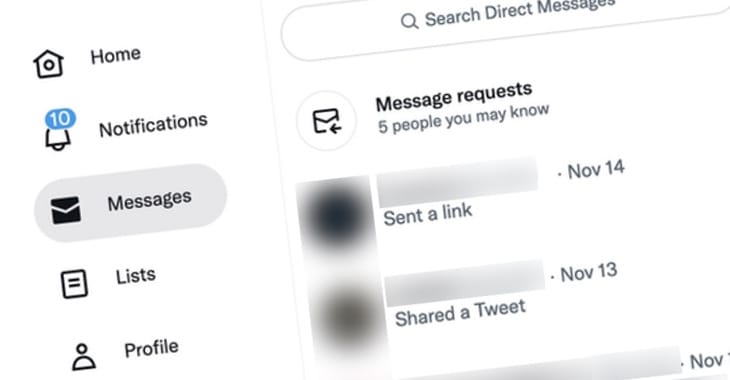
Because although most of what I do on Twitter is public, I have also had plenty private direct message (DM) conversations in the almost 15 years I’ve been a user on the site.
I can’t remember everything I’ve said in those conversations, or what people may have said back to me.
If Twitter is careless enough to break how 2FA works for some of its users a few days ago, what mistake might they make next? If Twitter’s security experts have either been fired, have quit, or – presumably – are wondering where they should go next, then just how safe is my data on Twitter?
It may be a remote possibility that Twitter will have a monumental security screw-up or suffer a hack that it simply doesn’t have the expertise to protect against, but it is a possibility. And it’s a possibility that seems more probable today than before Elon Musk bought the company.
There’s not anything I can do to make a chaotic Twitter safer. But I can reduce the potential risk to me, by deleting my DMs.
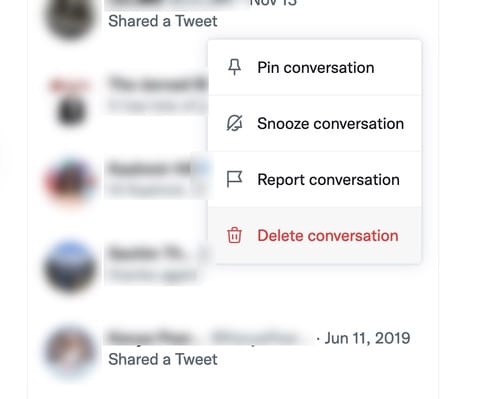
I don’t need all those old DM conversations, they can be erased. They should be erased.
It’s a laborious process (Twitter doesn’t give you an automated way of doing it), but I’d rather delete them one-by-one than one day find that they are in the hands of a hacker or a disgruntled Twitter employee who goes rogue.
PS. You know what’s really galling? Erasing your Twitter DMs doesn’t actually stop Twitter from keeping a copy of your private messages unbeknownst to you, even if you one day completely close your account.
Some final thoughts:
- Encourage your Twitter buddies to delete their DMs too, so “both sides” of the conversation are wiped.
- Even if Twitter doesn’t delete them behind-the-scenes, if *your* account is breached the messages shouldn’t be readily accessible by a hacker.
- If Twitter keeps your private messages even after you have requested they are deleted, is that potentially a (costly) GDPR violation?
- If you want to keep a permanent record of your DMs (and your other Twitter activity) consider downloading your Twitter archive.




You can't download your Twitter archive right now if you have 2fa. That security check is required before it will initiate the download.
Oh dear. When I log into my Messages (via a browser) I just see and option to Write a message or 'New Message' but none of my old DMs.
Same using the Android app; all I see is 'Welcome to your inbox and a button to 'Write a message'
Game, set, and match for me, Twitter. I'm out. I deactivated my account (which might or might not delete my account, who knows) in support of Twitter employees who got sacked, are sacked, and will be sacked by someone who firmly believes he must have an opinion about everything, has a questionable ethical compass and is just a bully.
Typical fascist.
Musk is as dangerous as Trump he along with Tesla can just go away.