


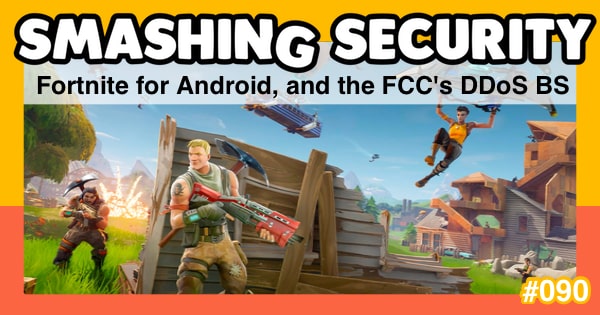
The Verge has confirmed reports that Android users wanting to play the hit game “Fortnite” won’t be able to get it from the official Google Play store:
“Epic Games announced today that it will not distribute its massively popular game Fortnite on Android through Google’s Play Store marketplace. Instead, the company plans to directly distribute the software to players through the official Fortnite website, where Android users can download a Fortnite Installer program to install the game on compatible devices.”
I can understand Epic Games feeling mightily miffed that Google tries to take a 30% cut from any sales in its online store, but encouraging Android users to download apps from non-official sources is not a good idea.
Fortnite is already available for the Sony PlayStation 4, Xbox One, Nintendo Switch, iPads and iPhones from their respective official online stores.
But Android offers users an easy route for getting apps from stores that have perhaps not been so careful in vetting their wares.
If you dig into your Android’s settings, you’ll find an option to install programs from “unknown sources”.
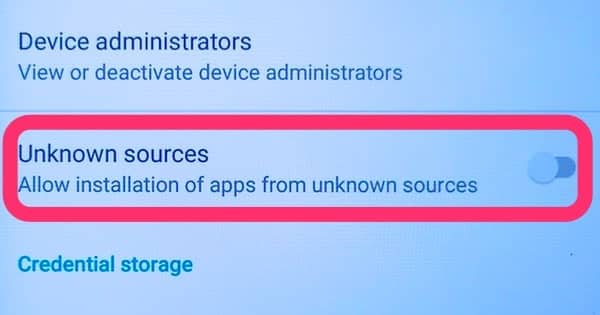
If you enable that option, Google is good enough to display a loud warning message:
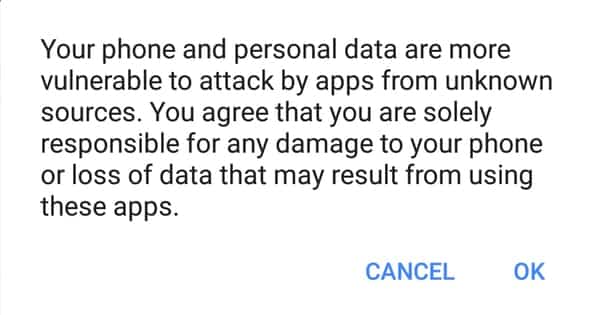
“Your phone and personal data are more vulnerable to attack by apps from unknown sources. You agree that you are solely responsible for any damage to your phone or loss of data that may result from using these apps.”
Interestingly, Epic Games founder Tim Sweeney tweets that things will work slightly differently if you’re one of the (small percentage) of Android users that is running the latest version of the operating system:
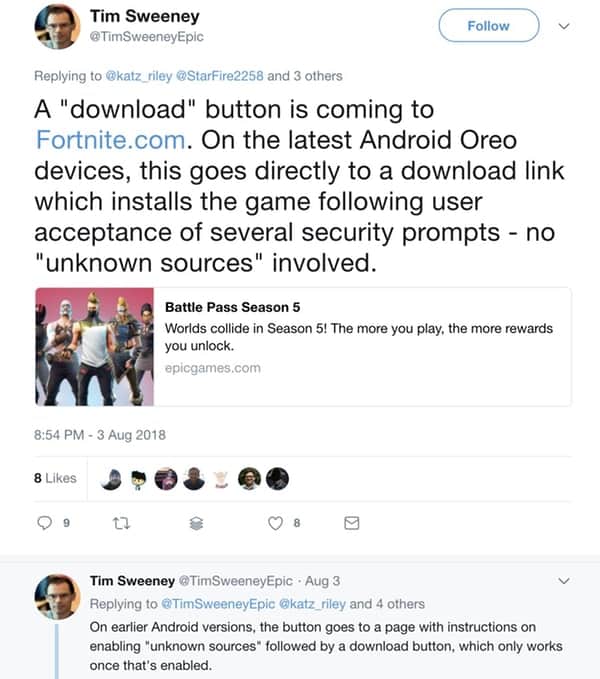
“A “download” button is coming to Fortnite.com . On the latest Android Oreo devices, this goes directly to a download link which installs the game following user acceptance of several security prompts – no “unknown sources” involved.”
“On earlier Android versions, the button goes to a page with instructions on enabling “unknown sources” followed by a download button, which only works once that’s enabled.”
I don’t know if this workaround for Android Oreo users is supposed to reassure me or not. The truth is that anything that makes it easier to install apps from unapproved sources actually makes me feel more uneasy.
Google’s policing of the official Android marketplace has often fallen short, but there is no doubt that installing apps from unofficial sources exposes your Android device to greater risks.
I’m not trying to suggest that I think it’s likely Epic Games will goof up and distribute a malicious version of their hit game.
But I do worry that some users might be so desperate to play Fortnite that they might forget to disable the “unknown sources” after installation, or that this will encourage more users to take a more laissez-faire attitude as to whether it’s wise to install apps regardless of their source in future.
And there will, inevitably, be online criminals who will try to trick Android users into thinking they are downloading the real Android edition of Fortnite, but instead installing malware.
Listen to more discussion about this topic in this episode of the “Smashing Security” podcast:

Show full transcript ▼
 This transcript was generated automatically, probably contains mistakes, and has not been manually verified.
Smashing Security, Episode 90: Fortnite for Android and the FCC's DDoS BS with Carole Theriault and Graham Cluley. Hello, hello, and welcome to Smashing Security, Episode 90.
My name is Graham Cluley.
Imagine running a company, hiring new staff, and worrying that one of them might bring their bad password habits into the office. Horrendous nightmare.
That's one of the reasons why businesses small and large need a password management solution like LastPass Enterprise.
LastPass brings a vast array of features for enterprise users, including company-wide policies, reporting, user groups and roles, and new support for Microsoft Active Directory.
As an administrator, you can create highly secure passwords for your new starters right from the onset. Means no snafus.
Listeners can check it out for themselves by visiting lastpass.com/smashingsecurity. No more password snafus, no more boo-boos, just LastPass.
So guys, I think it's well established that there are various stages during the life of a man? Or a woman? You begin off fairly simply, don't you?
You begin off with wooden toys or Lego, something like that. And then maybe you get into Minecraft. Then when you're a teenager, you might get into some of those shoot-'em-up games.
And eventually you become a crazy old white guy.
What I'm talking about today are the people who are teenagers who are attracted to a video game, and I wonder if either of you have heard it or indeed played it, called Fortnite.
It's for the Switch. You can get it for your PlayStation, your Xbox, iPads, iPhones, and now Epic Games have said that they are going to distribute this for Android as well.
Apple and Google are making a nice chunk of change and becoming trillion-dollar companies by having some of this cash.
You can play it for free, but if you want in-game purchases, if you want to download patches and extra bits and bobs, then you have to give money for it.
It's like the crack of games. So even if we're not in the official Android store, people are going to happily come to us and we'll get an extra 30%.
So when you disable this security setting on Android, it pops up a message and it says, your phone and personal data are now more vulnerable to attack by apps from unknown sources.
You agree that you are solely responsible for any damage to your phone or loss of data that may result from using these apps.
So they're really trying to discourage you from sideloading apps onto your phone from unknown sources.
It's going to cost less than 30% cut of the sales to hire someone to manage that whole onboarding process of getting them to change the config option and then putting it back on afterwards once they've installed the app.
You are going to leap headlong into that game. You're not going to be thinking that much about re-enabling that security setting, are you? Because you want to get on with it.
So yeah, there's no doubt that there will be attempts to trick people into downloading illegitimate versions of Fortnite.
Now I can kind of understand Epic Games' point of view because what frankly are Google adding?
They're adding the ability to reach a huge audience, but they're probably thinking we've got that anyway, because it's Fortnite.
I think it's an— I mean, also it may force others to think maybe we'll think that way and it'll maybe force Google to go, look, maybe our tax is a bit high, right?
Because 30%, I don't know.
I think that this sets a bad precedent. I can understand their reasons for doing it, but I do worry that this will create a more laissez-faire attitude.
As to whether it's wise to install apps regardless of their sourcing future. And you have to remember as well, what about updates?
If you're getting an app from the official app store, then the whole updating system—
You're going to have to be making them some other way. So there's all kinds of manner of chance of this going wrong.
And I would bet my bottom dollar that although Google hasn't been perfect in policing its app store and malicious software has got in there in the past, they will be better at security than Epic.
And what a target Epic Games are now going to be for someone to try and infect one of their updates.
Tim Sweeney, the founder of Fortnite company, has been saying, look, if you're running the latest version of Android called Oreo, then the interface will be slightly different.
It will have a couple of security questions, but you won't have to manually disable this particular feature. Now the thing is, Oreo came out a year ago. It came out in August 2017.
How many Android devices as a percentage do you think are actually using it?
If you compare that to Apple with iOS, iOS so much more quickly gets out onto all of those devices, and Android has always had this terrible experience, particularly for the non-Google manufactured devices, of distributing updates.
So Oreo has been around for a year. Oh, around about 1 in 10 Android devices are actually running it.
There is actually a brand new version of Android come out this week, Android version 9, also known as Android Pie, which has a number of new security features, but you're only likely to get that for now if you're running one of Google's own Pixel devices.
Yeah. There is a problem with Android security updates.
It has got better, but it's by no means as good as Apple, and once again, I'm very uncomfortable with this whole idea of disabling any security functionality on Android just in order to play a game.
I have maximized the wafting in order to keep everything cool.
It creates secure web connections in public places like hotels and coffee shops and those kinds of things.
If you go to the website, it says it uses bank-grade encryption technology as well as includes an ad tracker blocker where it can prevent advertisers from tracking users' activity and serving up targeted ads.
So really good stuff. You want to have something that, especially if you're going on a public Wi-Fi.
But there's a problem because if you look into SafeWiFi itself and start poking around the website, you can't find any current privacy policy for the service.
If you go into the terms and conditions, there is a privacy and security section.
Instead of a unique privacy policy, it basically just includes a link to McAfee's privacy notice and has a link then to McAfee's website.
So for instance, it says that McAfee can collect things like contact information, payment data, and account login credentials, which may include social network details.
And then it goes on saying that we may also collect other information like what products you purchase, demographic information, photographs, these kinds of things.
Of course, tracking what products you buy and demographic information, they could probably do threat analysis.
But the funniest thing that I saw and how they use that information is this little section that says, in order to keep these products free, we may use information collected through them basically to allow McAfee and others to show you ads that are targeted to your interests.
But hang on, it says on the website that the VPN includes an ad tracker blocker.
But you go to McAfee's privacy policy notice, and it says McAfee does just that, what it's not supposed to do.
Basically, a Verizon spokesperson came out to Motherboard and said, "We are working with McAfee to post our specific privacy policy to address SafeWiFi," and said that the service won't collect any personal information, which is fine, but we're talking about Verizon, and we all know what Verizon has done in the past with zombie cookies and all those kinds of things.
So can you really trust them at this point that they're going to follow through and act on good faith?
I mean, honestly, I wouldn't go with SafeWiFi right now until you can click on that privacy and security section and see a specific privacy policy and make sure that there's not anything remotely suspicious about logging or collecting data.
We should be able to trust them. And Verizon is working with McAfee.
We don't really have Verizon over here as far as I know, but clearly it's got a bad reputation over in North America for various things.
It might be that this has been done with the best intentions and that they just haven't crossed all the T's and dotted all the I's and got their privacy policy together.
Maybe they're not actually going to do all the things which this privacy policy allows them to do.
So they can't just lean on McAfee and say, oh, it's all you guys.
If I were them, I'd be showing up, it's like, this is what we're doing, this is what we're not doing, and you really, to appeal to the customer's ease of mind.
Photographs and videos, biometric data such as fingerprints or voice prints.
I think people, you know, you almost want to say maybe go check your other McAfee product privacy agreements that you may have signed.
Yeah, since last spring, many have accused the FCC of faking a cyberattack as the reason its commenting system went offline.
And this whole commenting snafu all stems from the net neutrality bill. So just a quick refresher. Net neutrality was the Title II order turned into law under Obama.
And the whole idea is to give equal footing to all internet services.
So this means that ISPs can't throttle your speeds or deny you access to certain services and apps if they weren't gonna do it for everybody else.
Almost everyone except the ISPs thought this was a good idea. They were all pro-net neutrality.
Oh, there you go. Hey. As head honcho of the FCC. And one of Ajit Pai's first focuses was to kill the net neutrality bill. Get it repealed. Right.
Now, despite a significant backlash, I'm sure you guys remember, from internet giants like Apple and Google and Reddit and millions of individual users voicing concern, the FCC pulled it off and net neutrality was officially repealed in June of this year.
Yeah. Now, as you can imagine, not many are happy about this, or rather, there's a lot of people that are unhappy about this.
They're pointing the finger at the FCC for having failed to act in good faith throughout this process. Now, this is where we come back to the whole commenting system DDoS BS.
See what I did there? DDoS BS. We can maybe use that in the title. Yeah. So in May 2017, the FCC system was overwhelmed with comments.
And this happened immediately after comedian John Oliver, host of HBO's Last Week Tonight, made an appropriately huge stink about net neutrality and then asked his millions of viewers to flood the agency with comments supporting net neutrality.
And only this past Monday of this week, the FCC has finally admitted that they were full of hooey. Now, this is where it gets annoying.
The chairman, Ajit Pai, was quick to blame the former chief information officer, not by name, but I think it's safe to say it was David Bray.
I mean, when push comes to shove and the proverbial hits the fan, the boss blames you publicly. So nice. Yeah.
Now, the problem is that he had more than a year to come clean and admit this was a system failure and not an attack. So why the delay? Why was that happening?
Well, could it be perhaps that the reason they were faking the cyber attack was because they wanted to avoid a huge media scandal about the lack of resiliency in their systems.
After all, the FCC had just spent $3 million overhauling the whole system.
And they had done this after the first time John Oliver incited his viewers to leave pro-net neutrality comments on the FCC website. This happened two years earlier in 2015.
And out of embarrassment, they said, "Ah, DDoS attack, you know, bad guys attacking our website." All right, okay. Huh.
And between those two instances, the FCC spent $3 million overhauling the lagging, archaic system presumably to improve resiliency, which it clearly failed to do.
And as you say, I think they were embarrassed that it screwed up its overhaul and then it fell over at the hands of John Oliver, a comedian.
So maybe better to say it'd been DDoSed than to fess up. Anyway, this is not even the only problem with the commenting system.
There was also the problem of people finding out that their identities were being falsely used. Remember this?
An estimated 2 million pro-appeal commenters found to be fake, including those of two senators.
So Senator Geoff Merkley, Democrat of Oregon, and Pat Toomey, Republican of Pennsylvania, were among the victims.
I think this is, what this is showing is that basically the FCC cannot tell the difference and cannot identify a real comment from a fake comment or one from a bot.
Now, one of the things they're planning to do is add a CAPTCHA system to try and stop bots from being able to post comments, but that doesn't stop an individual pretending or forging someone else's identity in order to leave a comment.
I think we need to underline that even though he's in charge of the entire organization, I don't think we should think the buck stops with him.
And an enterprise-grade password management solution, the one from LastPass for instance, will have support for Microsoft Active Directory and funky functions to make it even easier to secure your business.
Could be a funny story, a book that they've read, a TV show, a movie, a record, podcast, a website, or an app. Whatever they love.
Streaming rather than watching live TV.
And the World Wide Web, which of course, as we've discussed, is a part of the internet.
And anyway, there's a problem with Netflix and Amazon Prime, that is that there's too much content. Thousands of movies and TV shows for you to check out.
How are you going to decide what to watch?
You know, it's a nightmare drilling into these things, and the sites themselves aren't always the best at bubbling up the most interesting films or TV shows.
Well, let me introduce to you my pick of the week, which is—
It's called The Primal Urges Extreme Fantasy by Gloria Screams.
And that is why I would suggest that you check out a website called agoodmovietowatch.com. Okay, I'm going to go look. Go check it out.
Because what goodmovietowatch.com allows you to do is you can choose your genre. You can tell it which part of the world you're in. So which Netflix, for instance, you watch.
And you can say, oh, tell me about the interesting documentaries. Tell me about this. And you will find, most likely, some TV shows or movies that you weren't previously aware of.
Very cool. Excellent. And my pick of the week is not The Triceratops Who Loved Me.
If you haven't tried it, definitely go out.
I just played it again this weekend where a few of my friends, we went for a bike ride, got milkshakes, you know, real bonding stuff to bring us together to get into the zone of getting this kitchen functioning.
But as soon as we turn on the game, we're all yelling at each other and laughing. All the counters are on fire. You know, it's just—
A whole lot more recipes. I think there's cake in there. So it's oh, I love— there's cake. And definitely play it with some friends.
But I'd recommend that you have a cup of tea on standby for afterward. You'll need it to decompress.
Now, if you go to my link that I've provided, you can see that the comparisons began in 2013 with an image of Xi Jinping walking with President Obama, and it was posted alongside a picture of Pooh walking next to Tigger.
Do you see how their body language between the pictures are identical?
And again, the body languages and even the facial expressions are identical.
But in the roast, he also mentioned the president's sensitivity to being compared to the Pooh Bear.
Now, it's just worth reading the article because it's very cute how similar they look. But I just don't get why anyone wouldn't want to be compared to Pooh. I think it's an honor.
Yes, because he's the most— well, other than Piglet, is the most adorable thing in the world, isn't he? Why wouldn't you want to be?
Thank you for that pick of the week, and thank you, David, as well for joining us on the show today.
If people want to find out more about you, how should they follow you on the interwebs?
And if you want to get some t-shirts or some mugs or some stickers, you go to the Smashing Security store at smashingsecurity.com/store.
And you can leave a review on Apple Podcasts if you like the show. It really does help new listeners discover us. Until next time, thanks very much for listening. Cheerio. Bye-bye.



I can't wait for all the malware authors out there to figure out this 'download link' workaround, maybe even squeeze it into a drive-by…
Thanks, mobile gaming. This is why we can't have nice things.