


It’s been a bad week for Facebook and its two billion-plus users.
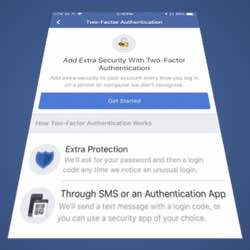
Firstly it was discovered by computer scientists at Northeastern University that Facebook was allowing advertisers to target advertising at individuals by exploiting phone numbers only given by the users for the purposes of two-factor authentication (2FA).
In short, even if you had set your Facebook privacy controls to their most restrictive settings – advertisers could still target you because you had (quite sensibly) enabled two-factor authentication to protect your account from hackers.
Similarly, according to the research, it seems there are pitfalls if users provide their phone number to receive alerts about unrecognised logins on their Facebook account:
“Facebook allows users to add email addresses or phone numbers to receive alerts about logins from unrecognized devices. We added a phone number and an email address to an author’s account to receive login alerts, and found that both the email address and phone number became targetable after 17 days.”
It’s one thing to use information that users choose to include in their Facebook profile for targeted advertising. It’s quite another to take advantage of information that was only shared with the site to boost security.
Remember, unrecognised login alerts and 2FA are features that users should be actively encouraged to enable, to better protect their Facebook accounts. When Facebook is revealed to be helping advertisers exploit such private, personal information, it only encourages users not to enable these protections in the first place.
And that’s not all… The researchers confirmed that Facebook was using “shadow contact information”, collected from other Facebook users’ address books, and associating them with your account. Facebook hides the fact that it has connected, for instance, alternative email addresses and phone numbers to your profile but uses it to assist targeted advertising.
As Kashmir Hill of Gizmodo explains:
…if User A, whom we’ll call Anna, shares her contacts with Facebook, including a previously unknown phone number for User B, whom we’ll call Ben, advertisers will be able to target Ben with an ad using that phone number, which I call “shadow contact information,” about a month later.
All of this amounts to what the EFF describes as “deceptive and invasive” practices by Facebook, which ignore “reasonable security and privacy expectations”.
Such behaviour by Facebook inevitably erodes users’ trust in the service.
And then the world found out about the security breach.
On Friday 28th September, Facebook went public with details of a “security issue” that it had discovered earlier in the week.
Approximately 50 million accounts were left exposed to attackers who were able to exploit a vulnerability in the site’s “View As” feature (actually a combination of three bugs). This security hole allowed hackers to steal users’ access tokens:
“Our investigation is still in its early stages. But it’s clear that attackers exploited a vulnerability in Facebook’s code that impacted “View As” a feature that lets people see what their own profile looks like to someone else. This allowed them to steal Facebook access tokens which they could then use to take over people’s accounts. Access tokens are the equivalent of digital keys that keep people logged in to Facebook so they don’t need to re-enter their password every time they use the app.”
The bad news is that these Facebook access tokens could not only be used to access Facebook accounts, but also other third-party apps that use Facebook for login.
According to Facebook, the vulnerability in its code was introduced in July 2017, and on September 16th 2018 it saw a massive spike in traffic on its servers as hackers exploited the flaw and harvested access tokens for other users’ accounts. It took until September 25th for Facebook to determine that there had been a security breach.
Facebook says it has temporarily disabled its “View As” feature until it has completed a “thorough security review”.
You can learn more about both of these issues in this edition of the “Smashing Security” podcast:
Show full transcript ▼
 This transcript was generated automatically, probably contains mistakes, and has not been manually verified.
Now, Carole, are we even going to do an episode next week? Because you're off somewhere, aren't you?
LastPass Enterprise simplifies password management for companies of all sizes, giving you the right tools to centrally control employee passwords.
Or indeed law enforcement or any hacker who broke into your account. So what I would recommend is use a piece of software like Boxcryptor.
It's what I run on my computer, and any file before it gets uploaded to those cloud services gets encrypted with my own keys, which I control.
So the cloud service itself can't see the contents of the files which I'm putting on the cloud drive. It's all encrypted.
I want to take you both on a summer holiday to the heart of Britain, the jewel of the Midlands, the beautiful resort known as Birmingham.
Now, the Conservative Party conference doesn't always go without a hitch. For instance, last year Prime Minister Theresa May, she was giving her keynote speech.
That's basically the form you get when you've lost your job.
He wanted to make sure that everything went very smoothly.
He was planning to boast at his opening address about the evidence that the party had turned itself around and that they were really getting with the beat.
And they had a new conference app, he was planning to say, which would let delegates provide feedback during cabinet ministers' speeches.
She's somewhere else in the house.
You could access and change anyone's information simply by entering their email address. No password required. Okay, access anyone's account.
It's a matter of public knowledge how you get hold of your MP via email.
In fact, a total of 11,000 people are in attendance at this conference, and many of them were presumably on this app.
You have the journalists, you have companies, because there'll be an exhibition there, people who are touting.
You will find it hard to believe, but there are pranksters and mischief makers out there who, when they get hold of a minister's private mobile phone number, they might call them up.
But yeah, I think the clue is in his surname, Johnson.
And this is where it begins to get a little bit dodgy because, for instance, Guardian columnist Dawn Foster, who was one of the first to notice the flaw, she raised the alarm.
And you can post comments as them. They've essentially made every journalist, politician, and attendee's mobile number public. Fantastic, she said sarcastically. Rather embarrassing.
Their mobile phone number, well, that'd be pretty useful, wouldn't it? So I think all Conservative MPs, their mobile phone numbers have to now be considered public knowledge.
Everyone who was listed in the app needs a new mobile phone number pronto.
And journalists as well who were in the app, they need new mobile phone numbers as well because of this security breach.
And you know, there are people out there who want to hack into journalists' phones, aren't there?
But you know, the damage has been done.
And he's saying, you know, basically they're all a load of rubbish, aren't they?
And one of my followers on Twitter said, hey, Graham, I've just installed the conference app and it's asking for my location on Android.
You know, why on earth would it be doing this? And I thought, well, maybe it's to track speakers.
You know, if I went off to the loo or something and I should have been on stage, maybe they'd be able to find me that way.
But yeah, generally I think it's probably unnecessary, right? But Matthew Hughes on the Next Web, he says, conference apps, they're as close as you get to disposable software.
They're like Pampers diapers, used once, then discarded. And as a result, they seldom have the polish you might expect from a commercial piece of code.
And I would imagine if this company made an app for this particular conference, they may make apps for other conferences, just reuse them.
So there may be many other conferences, maybe from other political parties, which have similar vulnerabilities.
Some Graham dude is not going to end up speaking because he's in the bathroom. So we need to change the lineup and we need people to know that. And paper doesn't update itself yet.
So I was— some sort of breach happened on a day where there was a lot of news happening politically in the States, and it was Facebook.
And I don't know, it kind of went under the radar for me, which was, I'm sure, completely on purpose.
So for those that aren't familiar, Facebook announced this past week that someone, some external actor, some malfeasant exploited a vulnerability that impacted the View As feature on Facebook.
Which is the little button that you hit on your profile that lets you see how your profile appears to somebody else, usually the general public.
You know, if I was my crazy stalker, would he be able to view me? No, he can't. Fantastic. Okay. Let's, you know, it's a good thing.
And you're able to grab it if you're a bad guy and actually pretend to be that person for real.
So let's talk for half a sec, maybe a little longer than that, and we're done, the weird cascade of flaws in Facebook that actually allowed this to happen.
I thought it was fascinating, because it wasn't just one thing. It's actually three.
So problem number one, in one version of View As, when you're specifically wishing somebody happy birthday, so it has to be the target's birthday, the video uploader still appears, which it should not.
So that's problem number one.
And then three, with a change in the video uploader that Facebook made last year, the video uploader incorrectly generates an access token with more permissions than it should.
So you can see a video uploader when you shouldn't be able to.
Facebook's actually given us some information on how this all went down, but they're being a little cagey because they're not entirely sure they've got it locked down yet.
So when you combine all these problems, basically the attacker could grab that access token that allows them to log in as somebody else. That's really the crux of it.
Does not mean all 50 million were breached, it means that those people were affected by this issue.
So 50 million users were forced out of Facebook and they had to basically re-login again.
And on top of that, Facebook said there was another 40 million users that were potentially problematically affected.
So that's total 90 million users who had to reset their access token by logging out.
And it was only last week that they noticed a few days before they decided to bury the news amongst all the political stuff.
LastPass, that Facebook single sign-on thing.
This whole hack means that potentially if the attacker had your token, they could have also logged into any other services that you were logged into before Facebook figured this all out.
Or in my case, if Spotify is now in conjunction with Ancestry and is making a playlist based on my DNA, that person now has my DNA info. So it's great. I don't know.
We've said that before, and now we're, "Well, we've got more proof." They've actually had an issue now about this, and maybe we should reconsider using that everywhere, because Facebook really wants to be your internet everywhere identity and—
And this isn't just Facebook. This is also Twitter, Google, and so on.
This story comes to us thanks to months and months of investigation work by a group of 4 academics and Gizmodo's Kashmir Hill.
So there's all kinds of notes in the show notes for you.
This all starts with a few researchers deciding to figure out how phone numbers and email addresses get sucked into the advertising ecosystem vortex.
Because there's some addresses that you kind of put out there for that. I don't know if you guys do that.
You may have a kind of junk account or junk mail address that you may use for certain purchases. For phone numbers? Well, for certain purchases, right?
Not phone numbers, but for email addresses.
And that's what these guys are trying to get into. That's what's bugging them. How are they getting access to this information?
So let's go back and just think about how online advertising works, right?
So Facebook, and I'm sure everyone has a version of this somewhere, says that they use the information it has about you, including information on your interests and your actions and your connections, to select and personalize ads, right?
And that's not a surprise. And what do you guys assume that includes in terms of information they'd have access to?
Yeah, your interests, groups that you've liked, or, you know, your interests and things you've liked on Facebook, I would imagine.
But anything else?
You know, your 2FA stuff, your multifactor authentication, the phone number they're supposed to call in case you get locked out of the app.
This took months and months of digging and researching to be able to prove this, and they've put a paper together to explain how they did it.
But they hoover up, snuffle up all that security contact information. And then basically hand it over to Facebook, vetted, whatever that means, advertisers.
So it's not like the advertisers get a database of all of this information. It's just that they are able to advertise and target based upon it. So Facebook does the match-up.
That should be walled off. It should, in my mind anyway. But I guess Facebook says, well, what's the point?
You're putting that data in my app, so I'm gonna do whatever the hell I want with it.
Whatever you're thinking I'm using it for, I'm gonna do for my own purposes because I'm Facebook. Fuck you.
But if you have used the version which requires the mobile phone number, then what the advertiser does is they upload loads of phone numbers, which they've collected through some means or another of people they want to advertise in front of.
And Facebook matches it to the mobile phone number which you have associated with your account by enabling two-factor authentication.
So they're calling it PII-based targeting, and it allows an advertiser to uniquely identify an individual. And I don't even know how this sits with GDPR. It just seems crazy to me.
They're like, well, we have it, so we're putting it in the big phone number pile. Right.
Of all the things that Facebook has done, this one I cannot believe is making me go, this is probably the one that makes me most uncomfortable.
It's so it's not satisfied with the contact information that you volunteer as part of your profile, but it also wants the details you provide to get extra privacy and security at their recommendation.
Right? They say to you, please do this so that your account can be more secure. And it pisses me off. Sorry to use big language, boys and girls.
But I do feel a bit like Facebook are acting a little bit like scammers, right? Because they're not being totally upfront about what they're taking from users.
They're not being explicit about it in their terms and conditions that they're taking that information.
This is a step to— sorry, do I need the klaxon again? The sarcasm?
But I think this is just underhanded because they're not alone. Omni-unscrupulous.
So they are literally, you know, effectively selling this security PII information to third-party advertisers. And by doing that, they're pitting privacy against security. Yeah.
And that is the issue, right? It's a bad precedent.
We advise people all the time to take advantage of these security features like two-factor 2FA to help users keep better control of their accounts.
Yeah, that's never what that information is for. So the EFF is freaking out about this, and I don't blame them.
They are worried that people are going to stop using things, security features like 2FA, to authorize accounts because they've heard about this big story.
And of course, from a security point of view, that's a big step backwards if we stopped using 2FA, because that's what helps you keep control of your account.
So, but should you have to do that as a trade-off for privacy?
But your data is encrypted before it reaches the cloud, works with lots of cloud services, and it's cloud security made in Germany. And that's cool, isn't it?
Imagine running a company, hiring new staff, and worrying that one of them might bring their bad password habits into the office. Horrendous nightmare!
That's one of the reasons why businesses small and large need a password management solution like LastPass Enterprise.
LastPass brings a vast array of features for enterprise users, including company-wide policies, reporting, supporting user groups and roles, and new support for Microsoft Active Directory.
As an administrator, you can create highly secure passwords for your new starters right from the onset. Means no snafus.
Listeners can check it out for themselves by visiting lastpass.com/smashing. No more password snafus, no more boo-boos, just LastPass. And welcome back.
And you join us at our favourite time of the show, the part of the show that we like to call Pick of the Week. Pick of the Week.
It could be a funny story, a book that they've read, a TV show, a movie, a record, a podcast, a website, or an app. Whatever they like.
I don't believe, Maria, you will be able to see it in the United States unless you do some craftiness with a VPN and pretend to be based in the UK and go on to iPlayer.
Tut tut if you do. What are you talking about? I'm talking about a TV show called The One Show. Oh, you're recommending The One Show? Just wait and see.
Unfortunately, even though it's been on for about 10 years, BBC One's programme controllers don't seem to have noticed. That it's complete and utter shite.
It's filled with gaff, it's painfully terrible, but it's there on our main TV channel. Pot kettle. Oi, watch it.
And so, because no one else appears to have done anything to put it out of its misery, there is a new podcast called The One Show Show. And what they do is every week—
So for instance, the most recent one was Rowan Atkinson talking about his new movie with his sidekick as serious guests on the show.
Anyway, so this podcast, The One Show Show, features John Holmes, not that one, and guests forensically analyzing each week of the show and ripping it to shreds.
But you will probably, even if you don't like The One Show, enjoy The One Show show, because it's quite— You too, if you can laugh at them, even if you don't know them.
It's quite funny.
Bless, bless, bless, bless Mark Zuckerberg. Oh, he's so good, isn't he? I love his hair. I love his hoodie. No, we're not doing that sort of show. We're saying it as it is, right?
I watched one with Bruce Willis once, a very, very awkward interview on The One Show. Maybe I'll dig it out and put it in the show notes.
They have a Twitter account, and the name of this internet experiment artistic-y thing is called The Man Who Has It All. So the Twitter account is Man Who Has It All.
That's what it is.
Working dad, pro tip, empower yourself by starting a gratitude journal. Log every occasion your wife helps you with the housework or the kids.
Or one of my favorites, I don't mind being called a postwoman because I know it covers both women and men. 'Anything else would sound silly,' says Ben 33, male postwoman.
It appears the worm has turned and womankind is rebelling through the form of this Twitter account.
It revolves around Lenovo and their attempt to boldly go where no laptop has gone before. Say hello to the Star Trek Dream PC. Oh my God, I have it!
Please click on the provided YouTube link, friends.
It actually is a laptop modeled after the 23rd century Federation Starship USS Enterprise.
Because there's also a replica of a Cardassian desktop computer that just came out, and it doesn't do anything. It doesn't actually work as a computer, but it costs $2,500.
Just for a replica.
Just for a replica of— it's just a screen that lights up that doesn't do anything, and it looks like the thing he had in his ready room, but it doesn't work as a computer.
So at least this works as a computer, and it's cheaper.
Oh, very interesting.
I slid it in there, it all went perfectly. Thank you, Maria.
Maria, if people want to follow you online to share Star Trek gossip, how should they do that?
And it's a good idea to follow us there because we often will tweet out discount codes, which you can save money at our online store and grab a mug, a t-shirt, a sticker at smashingsecurity.com/store.
And you, your episode might get in with a chance to be on the 100th episode.
High profile victims of the “View As” security breach are reported to include Mark Zuckerberg, as well as Facebook’s chief operating officer, Sheryl Sandberg, and its European vice- president, Nicola Mendelsohn.
What a week. It’s enough to make you reconsider your relationship with Facebook, isn’t it?
I quit Facebook earlier this year. If you’re finding it hard to imagine doing the same, why not listen to this “Smashing Security” podcast we put together describing the process of quitting Facebook:
Show full transcript ▼
This transcript was generated automatically, probably contains mistakes, and has not been manually verified.
My name is Graham Cluley.
We are going to discuss whether you should quit Facebook.
LastPass Enterprise simplifies password management for companies of every size with the right tools to secure your business with centralised control of employee passwords and applications.
But LastPass isn't just for enterprises. It's an equally great solution for business teams, families, and single users.
Go to smashingsecurity.com/lastpass to see why LastPass is the trusted enterprise password manager of over 33,000 businesses. Right, Facebook. Get me off it, kids.
Does it say anything in your feed that I've disappeared, or have I just kind of gone away?
You just disappeared into the mist.
If you remember, Graham, we did a lot of Facebook security training very early on in Facebook's birth and its growth.
And still my data could be compromised simply because I was friends with people that may not have been as privacy aware as me. Actually, it probably wouldn't have mattered.
Someone somewhere downloaded some game that hoovered up all my data.
You don't know what events are going on, you forget somebody's birthday, nobody wants to email you anymore, nobody answers the phone anymore.
Whereas for a lot of us who want to quit Facebook, it's like, well, we will literally have no way to keep in touch with people.
And they'll see a little, oh look, they said they like the picture of my child or whatever it was, or the holiday I'm on. That's nice. And you continue to feel connected.
What I don't like is that people, of course, give this curated image of themselves on social networks, you know, where they're, "Oh, aren't I fantastic?
Look at me, I'm doing my warrior pose at the yoga." That's like the max of your familiarity with yoga. I'm doing my sun salutation.
Because you could use Facebook to log into other apps, right?
I'm a Spotify user, and it's one of the many apps where you can create your account just by saying, just create your account with Facebook. You just click this button.
It's super easy. And I did that. And there's no way for me to easily disassociate my account without literally deleting my old account and creating a new one.
And then I'll lose my playlists and my albums. I have to recreate all that stuff I've done.
I don't have to generate passwords. Facebook's going to handle it.
And this site which I'm signing up for, I don't have to worry about them looking after my password because they're using the whole Facebook process instead.
So I think this is a really valuable thing for people to remember if they are considering quitting Facebook is what the impact will be on any other apps and websites which might be—
The way you can convince yourself that you've shared too much information on Facebook is to download a copy of your Facebook data, right?
There is a link, and we will put it in the show notes, which you can go to on Facebook. And regardless of whether you plan to quit or not, download your data.
It will download all the photos that you've posted and all the messages and all kinds of other stuff as well. You will be horrified.
And at that point, you begin to think, crikey, I volunteered so much information, information which I would never have given to a phishing site, information I would never have given to some scammer or fraudster ringing up on the phone.
I have willingly given to Mark Zuckerberg and his cronies, and what on earth are they planning to do?
I'm a little weird in how I use Facebook.
And I'm going to start off with the simplest thing you can do, which is not a complete cutoff, but it is called turning off the Facebook platform.
That is the thing which basically Facebook uses to integrate you with third-party apps and websites.
It's the thing which powers the like buttons which appear on third-party sites, which can of course track you around the internet, which isn't terribly nice either.
And this is the thing which was exploited by Cambridge Analytica's app, or the app which gave them the data, which allowed, for instance, your friends to give your information to other people as well.
So this is— if you're not ready to leave Facebook for whatever reason, you might want to consider turning off the Facebook platform.
So we're going to include a link where you can do that.
It's deep within the settings, and what it will mean is that all posts by apps and games and things like that will be removed from your timeline.
You won't be able to log into apps or games and websites using Facebook. Oh, wow, I live.
Oh, diddums. Oh dear, you've lost all that. But that is the most private I think you can really make Facebook without deleting the account altogether.
So there you are, disable Facebook platform.
Yippee, right? When you change your mind. So at the moment, you won't find Carole on Facebook. Carole could log back in if she wanted to, but right now, no one can see your profile.
No one can search for you.
And as soon as you log in, if you're using a password manager, it obviously just fills in the login page as you get there.
And bish bash bosh, you gotta do the whole deactivation again. So you can't get a friend to look to see if you've been removed.
Okay, so you don't clean up everything which you posted around the place. Your friends may even still see your name in their friends list, but it won't go any further beyond that.
But also keep in mind that if you deactivate your Facebook account, your Messenger account, which is like their IM system, that will remain active.
So disabling Facebook Messenger is a whole separate thing.
Now, I don't know if that's 100% true, but I know of some people who said they've sort of either deactivated or deleted their account, maybe just deactivated.
Have you heard about the Firefox extension that puts Facebook in its own little container tab?
They won't know that you're logged into Facebook as well.
Now I don't use—I use Firefox regularly, but one of the things that I've done is I've updated my ad blocker with specific code and rules which block any like buttons from working on pages when I visit them, because I don't want Facebook knowing which pages that I'm going to and gathering data about my movements around the internet if I do accidentally leave myself logged into Facebook.
And that's something else which you can do with a blocker as well. But this is all kind of really nitty-gritty advice.
I think maybe the push for this podcast is how are you going to stop giving any data to Zuckerberg?
So right after this sponsor break, we're going to talk about how you can actually delete your Facebook account entirely.
It's equally a great solution for business teams, families, and single users. Learn more at smashingsecurity.com/lastpass. LastPass.
Pretty hidden away, to be honest. You have to go hunting for it if you do want to do it.
And you will get this big fat warning says if you don't think you're going to use Facebook again and would really like your account deleted. We can take care of this for you.
Bear in mind, you will not be able to reactivate your account. So really, they want you to deactivate rather than delete your account.
I really wish I could.
Does nothing for a few days because it's given you a chance to change your mind.
Because that evening you're thinking, I wonder if anyone's posted any funny cat memes.
Your request is cancelled, yippee, and your account is back. And Facebook says it can take up to 90 days, up to 3 months to delete data they may have stored in their backup systems.
But it says during that time, your information isn't available on Facebook publicly.
If you've been communicating, if you've been sending messages to friends and things, they're still going to have those messages in their inboxes.
And the thing is, whatever privacy steps you take, even if shutting down platform and things like that, if you continue to have a Facebook account, you're still sharing information with Facebook.
And you have to ask yourself, do you trust this organization with your information?
You'll probably go on to some other social network instead.
Right. And so I started creating the community. Now I closed down my blog page. I told them I'm not going to update it anymore and it's going to be deleted.
Carole, what we haven't discussed is what should we do about the Smashing Security Facebook group?
Handwritten letter.
Right now, the one thing that is stopping me from deleting my personal account is that it is the administrator for our Smashing Security Facebook group.
I am gonna hold up a little flame for all our Facebook fans.
I'm sure we're not the only reason they're on Facebook, but why should we make it— I'm pretty damn sure that's not the case.
Why should we add to the difficulty of quitting the addiction?
We're going to check that we don't have any websites or third-party apps which are associated with our Facebook login.
And if they are, we'll recreate accounts on those sites without using Facebook logins. Okay. Or we just ditch the apps because what are they thinking?
And we'll zap the Smashing Security Facebook group. Sorry guys. Thank you for all the support. Go and join us on Twitter.
That helped me a lot.
I'm sure they've listened to the podcast and know, well, I'm going to give them time just to deal with it.
We'll be back next week with a regular episode, pick of the week and all the other goodies and a different guest.
But if you want to follow us in the meantime, you can join us on Twitter @SmashingSecurity. Security, no G, Twitter wouldn't let us have a G.
You can grab t-shirts and stickers and mugs and things like that at smashingsecurity.com/store.
And you can go to smashingsecurity.com for past episodes and for details on how to get in touch with us. Thanks for tuning in. Thank you, Maria, as well for joining us.
If you like the show, rate it on Apple Podcasts. It really does help new listeners discover us, which we like. Until next time, cheerio, bye.
If it helps, just consider your Facebook departure as “temporary” while you complete a “thorough security review.” You may find you don’t miss it at all.

"According to Facebook, the vulnerability in its code was introduced in July 2017, and on September 16th it saw a massive spike in traffic on its servers as hackers exploited the flaw"
Is this a typo, or did they keep it quiet for more than a year?
No, the feature was introduced July 2017, we don't know just when hackers discovered the bug in the feature, but assume it was recently. Perhaps within days of the spike in traffic.
I'm going to kill my account now, even though I hardly use it, my total data they claim to have on me was only 467kb, which is not much, and I downloaded to review it too. It's nothing compared to what's been revealed now, that they collected without our knowledge. Trust is gone.
I read it that they discovered it in September 2018, but the vulnerability had existed since a code change in July 2017.
So they didn't keep it quiet but have been able to establish how long the issue existed for,
That's correct John.
Facebook introduced the flaw in July 2017.
There was a lot of traffic exploiting the flaw on September 16 2018.
Facebook investigated the traffic spike, and determined that someone had been exploiting the flaw, on 25 September 2018.
On Friday 28 September 2018 – coincidentally (?) while the whole world's media were distracted by the ongoing circus around the Brett Kavanaugh hearings – Facebook went public.
There's nothing to suggest that Facebook knew about the problem before September 2018.
Personally, I would consider Facebook to be a public platform, no matter what security restrictions you enforce on your FB accounts. Someone somewhere is going to read your details eventually. This is probably true of any data you enter onto the web. Ultimately, it will be hacked open and plundered by black-hatters. The web has made the world and all of its transactions transparent. Personally, I don't mind because it's stupid trying to keep secrets nowadays. The web and the ubiquity of surveillance technology mean you're always being watched, investigated and anticipated. The watchers have not changed my life or actions therein. The watchers have no lives of their own!
Mr. Jacobs: You're welcome to believe that "it’s stupid trying to keep secrets nowadays", but your sanguine attitude will change quickly if you become a victim of identity theft.
I can tell you from personal experience that the watchers will change your "life or actions therein" significantly, and you won't like it.
I expect that you'll suddenly acquire a vastly different perspective about what you're now calling "stupid".
The thing that continues to bother me with Facebook and Messenger is that, although I've disabled targeted advertising, I still get adverts targeted to my country and age. Out of the last two adverts, one said I may be seeing it because I'd recently been near their business, which I had but I don't share my location with Facebook, Messenger, WhatsApp or Instagram; the other was MuleSoft and it suggested I was similar to their customers, which I probably am. None of that seems like non-targeted advertising to me.
Facebook aren't alone — Twitter also shows me ads based country and age when I've opted out of targeted ads.
The problem is going to be when they start changing your pages, wait and see its coming. My take no ones opions nor lives are that important it's all self adulation