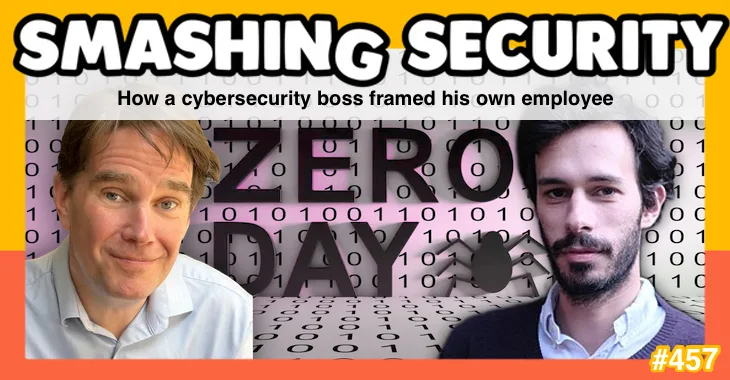
When a top cybersecurity firm discovered it had a leak, you would expect the FBI to be called. Instead, the person put in charge of the investigation was the actual leaker… who promptly sent an innocent colleague into a career-ending ambush.
In this episode, we unravel the jaw-dropping tale of a defence contractor caught selling zero-day exploits to a Russia-linked broker.
Plus: are nation states quietly poisoning AI models to bend reality itself? We explore how “foreign information manipulation interference” could target not just social media users, but the large language models we increasingly trust for answers — and what that might mean for truth, trust, and the future of online influence.
All this, and much more, in episode 457 of the “Smashing Security” podcast with cybersecurity veteran and keynote speaker Graham Cluley, and special guest Carl Miller.

Show full transcript ▼
 This transcript was generated automatically, probably contains mistakes, and has not been manually verified.
Hello, hello, and welcome to Smashing Security, Episode 457. My name's Graham Cluley, and I'm Carl Miller. Carl, welcome to the show, first time on Smashing Security.
Fantastic to have you here.
Must have just fallen out somehow or another.
Now, Carl, for anyone who hasn't encountered you before, and more shame on them if that's the case, who are you and why might they have heard of you?
So I am a co-founder of an information integrity group of technologists, a lab I suppose you'd call it, called ChasmTech.
I mean, it was a really popular podcast and it was about a fascinating topic, which we have touched upon in the past sometimes here on Smashing Security.
Do you want to share a little bit more about what that was about?
So it was a long investigation that me and colleagues did.
Essentially working with a hacker called Chris, who managed to gain access to the site, broke in, and found a way of intercepting all the orders being placed.
And really, the whole series of Kill List thereafter is about what we have to do with all of that.
It turns into this kind of global freewheeling, sometimes quite hair-raising, and often extremely surprising sort of investigation, which ends up us kind of working with the FBI and working with law enforcement agencies around the world.
And I think we're up to about 28 or 29 convictions now, and just shy of 200 years of convicted time. You know, pretty serious criminality happening in the marketplace.
You know, Chris the hacker found essentially that by cycling through the numbers at the top of the Onion address, he could bring up other people's orders.
And so through that, essentially extract all the messages running through the site. And that was as good as handing it over to law enforcement.
It wasn't, I strongly suspect, an actual law enforcement honeypot.
But it was so insecure that it essentially allowed us to sit undetected in the middle of the site for years, essentially triaging them and gathering them, and then ultimately working with law enforcement to try and identify the people that were not just taking out, but also paying money to have someone killed.
It's just that you are being scammed, a bit like you could be scammed by the offer of a free Apple Watch or something else, or handing over your phishing details.
Equally, you could be scammed thinking you are buying an assassination. In fact, you're just putting cryptocurrency into the pocket of a common scammer.
Yeah, the people running the site and the people running these sites in general, I don't think have any interest in actually delivering any of assassinations they're being paid to do.
There have been a small number of documented assassinations that have originated from the darknet.
They actually happen somewhat more chaotically or randomly, actually, in the margins of active, serious drug sites. So these sites, no.
They probably wouldn't have heard of it or know what think tanks do, but they're essentially these little boisterous, noisy universities that try and do really specific research that tries to inform policymaking.
And I've always been really drawn to this kind of envelope of technologically driven change in society and how government and policy and law and actually lots of institutions across society have to continue to adjust to that.
So one of the big things that I have been fascinated by and I'm now working with Demos trying to do something about is digital democracy or essentially redesigning democratic processes fit for digital age and fit to be able to leverage and use emerging technology.
So we've got this project called Waves. It's currently on the streets of Camden.
It's going to go to South Staffordshire really soon, within about a month or so, to basically create new ways of people participating in political decision-making.
I mean, I've just been reading in recent days some of the debacle regarding the Department of War over in the United States and their dealings with Anthropic and OpenAI and how AI could be used by the military and some of the goings-on over there.
Do you have any opinions on that?
I mean, if there's any lessons that we can take from the battlefront in Ukraine, it's that every military has such a strong impetus now in pushing automations forwards as quickly as possible.
I mean, I think there's two things that are really important.
One is that we do that in a way in here in the UK and across our ally network that means that it's consistent and consonant with our own liberal democratic system of rights, but also that we do it actually in a way which is more innovative and faster than our adversary.
I mean, liberal democracies cannot cede the technological playing field of warfighting to Russia or to China. I think that is really clear, Graham.
And you know, we would wish it to be otherwise, but that's not the world that we are living in.
So we actually need to become, as democracies, more innovative, not less, when it comes to how to fight wars.
We just have to do that in multiple fronts, not just how to fight wars, but how to fight wars which are rights-respecting and casualty-minimizing.
We'll be hearing about them later on in the podcast. This week on Smashing Security. We're not going to be talking about how AI can now link your anonymous posts to your real name.
You'll hear no discussion of how a hacked Iranian prayer app sent surrender messages to worshippers amid Israeli and US missile strikes.
And we won't even mention how streamers are worried that Amazon has just made wishlists a doxing risk. So Carl, what are you going to be talking about this week?
Now it's coming from a field known as FIMI, which I promise is the only clunky government acronym I'm going to throw at anyone today.
Smashing security. Well, we've got time now to chat about one of the sponsors of this week's show, Action1. And lucky old me, I've got someone here to help me do the ad.
Say hello to everybody, Joe.
Now then, if you are a systems administrator managing endpoints every day, you've probably postponed patching at least once, not because you forgot, but because you didn't feel gambling with uptime.
All you have to do is visit smashingsecurity.com/action1 and get started today. And thanks to Action1, for supporting the show. And also, thank you, Joe, for helping me with the ad.
We've got contractors who copy the customer database onto USB sticks, often labeled definitely not the customer database.
But this week, I'm going to be talking about something rather different. At the center of this story is a defense contractor called Trenchant.
And Trenchant is interesting because it specializes in cybersecurity stuff, in particular exploiting zero-day vulnerabilities, the vulnerabilities that haven't yet been patched, that help governments and intelligence agencies and potentially, of course, cybercriminal gangs gain unauthorized access to systems.
These are the kind of tools that governments will pay millions of dollars for.
And, well, rumors were spreading around that a Western defense contractor might have suffered a massive leak that was exposing these zero-day exploits.
They were thinking, is there a defense contractor who's got a bit of a leaky bottom and the vulnerabilities are falling out of them, and rather than being held securely, are falling into the hands of maybe nation states you wouldn't want them to fall into, or cybercriminal hackers, malicious hackers, and the like.
So people were whispering about this, but they couldn't narrow down the details.
They were effectively hunting for a bit of a ghost, a mysterious individual that they knew only as John Taylor. I mean, it's a fairly ordinary name, isn't it? John Taylor?
And this John Taylor was the name on the contracts which were being done with this operation called Operation Zero, a Russian outfit that rather politely claims to sell its exploits and zero-day vulnerabilities only to non-NATO countries.
So they've worked out their niche. They say, we're not going to sell to NATO countries. That is not our market.
So we shouldn't have been looking for a real John Taylor. It turns out it was someone who in reality, his colleagues knew as Doogie. And Doogie was this cyber espionage kingpin.
It sounds like someone who'd be at home revising for his GCSE biology, but in fact, Doogie— oh, 'cause that's all I can think of is Doogie Howser.
But anyway, Doogie Howser was a big deal. This Doogie, however, was a different Doogie.
He had access to these vulnerabilities, these powerful exploits, which could maybe crack into Android and iPhones, cause all kinds of nuisance. Now, here's the thing.
When the defense contractor Trenchant discovered that it had a leak, they didn't call the FBI immediately. They put one of their guys in charge of an investigation.
They put a guy called Peter Williams, who headed up the US offices of Trenchant. He was known to his colleagues as— Carl, you're the investigative journalist.
What do you suspect his nickname was?
So the head of Trenchant USA, known by his mates as Doogie, was selling exploits on the side to the wrong sort of people. Operation Zero, the Russian exploit broker.
And when Trenchant discovered that it had a leak, they didn't call the FBI. They put Peter Williams, the guy actually doing the leaking, in charge of the internal investigation.
And of course, this guy, Peter Williams, he decides to save his own skin. So what he did was he handpicked a scapegoat on his team.
He spotted that he had a talented iOS developer amongst his staff, and we're going to give them the nickname Jay Gibson.
That's the pseudonym which has been given to this person in reports. Don't know what his real name is.
In February last year, the Trenchant team, including this Jay Gibson guy, this innocent iOS developer, was sent to London for what Trenchant called a team-building exercise.
In reality, it was an ambush because while the team was in London, Peter Williams, also known as Doogie, right? You're following this?
Peter Williams, also known as Doogie, also sometimes known as John Taylor, appears on a video link from the States and with a straight face accused Gibson of being the leaker.
So this iOS developer was fired on the spot while he was in London, his devices were seized, he was left stranded in a foreign country, branded a traitor, presumably left to make his own way home.
And to twist the knife, shortly after he was fired, his personal iPhone received a message from the guys at Apple.
And it gave him a notification that he had been targeted with some pretty serious state-sponsored spyware.
You know how sometimes journalists and dissidents and people who generally aren't very popular with their government can receive messages saying, "You may well have been targeted by some serious spyware"?
That's the message he got.
Now, I don't know who tried to infect his iPhone with spyware or why, but it does make you think, doesn't it, since he had been working for a company which dealt with exploits, that he was someone who has been framed as the possible leaker of the exploits by the person who was actually doing it.
I mean, maybe, right, if they really do believe that someone is leaking something, which the main guy in charge didn't believe because he knew who the real leaker was, maybe it was to get him away from his other devices.
Maybe it was to get him away from his home network, or maybe it was to give them time to tip off the FBI, perhaps if they wanted to do that, so he could be caught upon his return to America.
It certainly puts you in a more fragile position, doesn't it, being elsewhere?
If a company was firing me, which isn't beyond the realms of possibility, to be perfectly honest, if they were employing me, maybe it makes sense to send me elsewhere in the world to make it more difficult for me to log in remotely and maybe cause damage inside the organization.
Maybe they've got some kind of IP block when people connect to say, well, are you logging in from your usual IP address or are you suddenly logging in from London rather than Delaware or wherever it was you were?
I don't know.
I'm just speculating here, and I don't want to give anyone any ideas as to how they should fire me because I'm not the kind of chap who would do damage even if it was grossly unfair that you fired me.
Let's stress that right now. You equally, Carl, obviously work for plenty of different people. You're not going to get up to any shenanigans, are you, if you're fired?
While the real culprit is sitting in the boss's chair, watching your life collapse through a webcam on Microsoft Teams.
They've uncovered that it was really him leaking these exploits to this Russia-linked exploit factory.
Prosecutors estimate that his actions caused about $35 million worth of losses for Trencent.
I wonder how much additionally they may have caused in terms of damages to other organizations who may have been hacked, whether it be by ransomware attackers or industrial espionage or spies, you know, all kinds of possibilities here.
Because here's the thing, we still don't know precisely which zero days he sold to these Russian exploit brokers or where they then got sold on to.
We know that they target Android and iOS, and we know that Operation Zero didn't keep them to themselves. They were selling to buyers across the Middle East and Asia.
And we also know that some of these vulnerabilities had previously been used by hackers in South Korea, as well as also being sold to the Russians.
So likely it's ended up in the hands of everybody from foreign spies to ransomware czars.
The most unsettling thing I think about all of this isn't so much the technology, it's how ordinary it's become. These trusted insiders, it's about greed. It's very human, this.
He even had a support contract with this Russian exploit broker as well, said, "Well, I'll help you if some of these vulnerabilities don't work properly." This was all contracted down, and boring aliases like John Taylor can disguise all kinds of dramatic activities going on outside.
So it's often not a Bond-style villain stroking a white cat. It can be a senior executive with a crypto wallet and a nickname that makes him sound like a kids' TV presenter.
But it's real people's lives which get turned upside down or put in danger because their accounts are being hacked by cybercriminals or dodgy regimes are breaking in and doing damage instead.
It's another extraordinary story.
Because, you know, it sounds like Doogie is in it for the money.
But then for him to really be targeting sanctioned entities, you know, non-NATO countries, there's a whiff of the geopolitics in there as well, isn't it?
It's not simply to the highest bidder. It's also to, kind of countries or actors that are lined up to confront the West.
And it's often like that, isn't it, Graham, where you're not quite sure what is motivating anyone in these sorts of places, but where politics and money and geopolitical confrontation often are all swept up in ways which are quite hard to untangle?
So he was making plenty of cash out of doing this because, I mean, some of these exploits, you can sell for well over $1 million. So there is a lot of money to be made.
I mean, everyone wants to crack into the latest iPhones and steal information, ideally with a zero-click exploit.
But yeah, there may also have been something more geopolitical going on, or maybe there was some political motivation as well, or simply they just didn't give a damn and they just wanted an awful lot of cash.
I mean, and since time immemorial, the idea that a traitor or a turned spy turning up to the office in a Ferrari, you know, is often one of the ways in which they get caught.
You can make our networks more sophisticated, but so often, you know, human greed and human error will finally catch people.
So, you know how setting up a network for a new office location involves about 17 different headaches?
You know, dealing with ISPs, designing floor plans, racking hardware, configuring everything.
So Meter is a network as a service company, but a proper end-to-end one. You give them a physical address and a floor plan. They sort out the ISP. They design and deploy the network.
They turn up on site. They rack the hardware, which is their own hardware, by the way, not just reselling someone else's kit, and they get everything running.
You keep visibility and control via their dashboard without having to do any of the tedious groundwork.
Sounds cool.
It is this strange new kind of conflict which has opened up within information spaces.
But its recent origin is recognition that militaries made in the mid-noughties where they reconceptualized information as being not just a tool of war, but in fact, a theater of war.
Now, the specific story is towards the end of last year.
It was in The Guardian, and it basically reports on this whole network of strange websites that counter-disinformation, counter-phoney researchers had found.
They were hundreds of websites aggregating millions and millions and millions of individual news articles, all of which were basically about Russia or pro-Russian in some way.
Lots were drawn from Russian state media and what was odd and what researchers were scratching their heads about was despite the eye-watering size of this huge pile of mainstream reporting.
You know, it was on everything.
There were stories about Ukraine and domestic stories about Russia, and there were things to do with Russian pop stars and there's quite a lot of culture and traditional values.
It was not selective and it was certainly not filtered.
But despite this huge aggregation of all this reportage across all these websites, it didn't seem, and it was a network, they called it the Pravda Network.
It didn't seem this network was making any effort to make itself seen. There wasn't any real attempt to make it more visible, you know, to link it to target audiences.
So there was one thing that we knew and one thing that we didn't know initially.
What we did know, what researchers were concluding, was that this is part of information warfare, this is part of FIMI.
Since the '00s, and certainly I think supercharged by the invasion of Ukraine, we have seen in information spaces states become much, much more active and muscular, threading and weaving together the tradecraft of cyber-offensive activity with the tradecraft of shadowy influence.
Partly it's technical, partly it's cyber, partly it's to do with understandings about how influence works, how humans think, psychology and sociology.
We've seen all these things weaving together to mean that states will now, certainly autocrats will now, systematically try and manipulate information spaces to have an effect, to change what we see, what we think, who we are, our sense of belonging and how we fit into society, loads of things.
It was recognizably a FIMI campaign.
This is about subtly trying to bend reality over time in people's minds by slowly seeding this misinformation into AI because people will now go to AI for so much.
Their search engine effectively has now become the AI, hasn't it? That's how people find out things these days.
And I think that's a starting point realization, and that's why I wanted to foreground this story for you, which is that as soon as I saw this, I began to think it is absolutely inevitable that manipulating LLMs is going to become a whole new and perhaps the dominating new battlefront in information warfare.
They're going to be the lens through which we see society. And not only that, LLMs are going to be some of the most precious and treasured relationships that many people have.
This isn't just ChatGPT and Anthropic. We're talking about hundreds of therapy bots, boyfriend and girlfriend bots, pen pals, creative writing partners.
People are going to create very deep, meaningful relationships with AI. And all of that is an attack surface.
And I think that was the first in what is going to be an accumulating and intensifying conflict where the overall aims of information warfare to have influence begin to intersect with the technical realities of how do you manipulate LLMs in order to change their responses for people in short-term ways, long-term ways, tactically, strategically, fact-based, non-fact-based, changing how people feel emotionally.
How they view the world as well as what they see. All of that is now up for grabs.
And what you began to do, Graham, is exactly what I began to do, which is begin to ruminate on how this might happen.
And the Pravda network probably wasn't that successful, but what it was probably doing was seeding the internet with vast amounts of text that it was hoping was going to get swept up in the training cycles.
So for AI to begin to create new semantic patterns on the basis of all of it that will become more pro-Russian over time.
But what would be fascinating is if instead of individuals being targeted with this misinformation, if it's the AI being targeted and us humans go to the AI for advice and we get our opinions and we get our news and all the rest of it via this AI lens, we as individuals are going to be producing content as well, which has been poisoned somewhat if the AI has been poisoned.
So we'll be legitimate people who are spreading misinformation, perhaps unknowingly, because it's been fed to them by an AI which has been misinformed as well. Is that right?
It is conceivable that states developing sophisticated, scaled ways of covertly being able to manipulate and exert influence over LLM responses might be able to exact long-term, deep cultural changes on a target population.
This is as serious a threat, not just to an election or an event or a particular moment, but to long-term senses of our culture and our ways of doing things as I think you can have in the information space.
If I was a Russian information warfare officer, I would be doing nothing else. This is what I would be trying to develop and build ways of doing.
And that means that LLMs, they're not stepping into this kind of neutral, you know, 1993, Google's just indexing the web. This is all so great. Hahaha, how fun environment.
They're stepping into basically a battlefield. And I don't think anyone has realized that yet.
And the battle over information integrity and then over our culture, society, integrity, polarization, basically everything.
Part of that will now be a battle over securing these LLMs.
And if there's one thing we've learned, Graham, from social media, which is what I've spent the last 10 years of my life or so, you know, researching trying to understand, this is not a battle that we can leave simply to the technology providers and platform providers to fight and win and be honest about by themselves.
And I don't think Ofcom has acted fast enough when it's come to obviously and clearly illegal content. So no, I think regulators are already far behind.
Politicians, I think, are now, via the bruising experience of trying to get social media companies to take responsibility and the bruising experience of seeing the last 10 years of warfare conflagrate across information spaces, I think are now more aware.
So I'm not utterly defeatist, but no, of course there's a constituency that's going to be part of the solution that we haven't mentioned, and that is of course technologists.
So we're going to have to build defensive barricades that can detect attempts to manipulate, can disrupt them.
I think the future is essentially going to be different largely automated systems trying to find vulnerabilities to interdict and to manipulate LLMs, and similarly, other systems trying to spot those attempts and trying to defang them.
That's the thing.
In fact, I spoke to The Economist who wrote an article that was in fact actually digging exactly into whether they were a Russian information operation.
So the thing that really worries me is that there is a whole private sector industry called generative engine optimization, or GEO, that is basically now springing up.
If you go to Web Summit, you go to any of these big startup global conferences as I do, you will now see a little section of one of the huge echoing exhibition halls basically crammed with GEO companies.
They're taking VC, you know, they're beginning to grow and they're basically billing themselves as an honest and direct extension of the search engine optimization world.
So what they're doing is they're building what they argue is just a new way of doing SEO in the age of LLMs.
Yeah, when that conjoins with Russia, or China, or Iran, that is when we have a problem. Because you can SEO all you want if you are a brand.
SEO, I think, has always been the weird, dirty secret of marketing, and no one's ever wanted to talk about it.
But the reality is that loads of companies all over the world basically engage in quite serious scaled online manipulation in order to get visibility.
But that is going to, I think, when bundled into an LLM, present us with a whole new batch of really quite serious problems, especially when it's being done for geopolitics or with more nefarious aims in mind.
One of the things I do is I do a lot of keynote speaking, and I was on this bootcamp thing for speakers.
One of their things they said to me was, well, are you optimizing yourself for LLMs?
Are you writing content so the LLM will scoop it up and say, oh, Graham Cluley is a wonderful keynote speaker and very reasonably priced, you should go and hire him, you know, in particular industry sectors.
And I thought, this is SEO 15, 20 years later. And now this will be the accepted wisdom as to what is truth because people trust these things so much.
And as you said, people's relationship with the ChatGPTs and the Claudes of this world are very personal sometimes.
You know, this is their friend they're speaking to or their advisor.
They're very clever. And I think the huge companies will build some kind of reasonable defensive response. Will it be enough? I don't know.
But I'm far more worried about the kind of character AIs, spicy AIs of the world, right?
There are hundreds and hundreds of foundational models that have now been built, many of them being open sourced.
And there are thousands of companies that are taking these models, tweaking them, working on their own, you know, many of which see their route to success to be about creating a product which creates a much deeper, more emotional, more intense relationship between the AI and the human user.
You know, you ask any sociologist how influence really works, and it's through your social ties. That is what really changes us. It's not randomly seeing something on the internet.
It's who you are surrounded by and what they're like.
We are so formed by social ties, Graham, that someone that you don't even know, that your friends know quit smoking, you're more likely to quit smoking.
But that's how powerful this is.
And it's also inevitable that our social network in the years ahead, for some people, and I know this sounds odd to some people listening to this, but people's social networks will include non-human AI models.
We can see this. This is already the case.
There are already people that are marrying their AI, and there's tons of people that are developing some kind of, to them, really meaningful relationship with AI.
That is the attack surface I'm most worried of. If I was Russia, that is what I would target.
And these do not have the hundreds of millions of capitalization that an OpenAI has to defend themselves.
They actually have no real interest in looking for this as a problem because once it becomes a problem, then you have to do something about it and that will cost money.
Why are we still trying to do everything with spreadsheets, for goodness sake?
Vanta takes all that painful manual security work, like chasing all the evidence, filling out questionnaires, updating the same spreadsheet for the thousandth time, and it automates it.
That's right.
And yes, it uses AI, but in the useful way. Flagging risks, streamlining evidence collection, and fitting neatly into the tools you already use.
All of this so you can move faster through the night.
And welcome back, and you join us at our favourite part of the show, the part of the show that we call Pick of the Week. Pick of the Week.
Pick of the Week is the part of the show where everyone chooses something, could be a funny story, a book that they've read, a TV show, a movie, a record, a podcast, a website, or an app, whatever they wish.
It doesn't have to be security related necessarily. Well, my Pick of the Week this week is not security related.
There I was the other night with my lovely wife and we somehow got chatting about movies that had scared us as kids. And I played my top trump card. No, not that scary.
My top card, which was The Incredible Shrinking Man. From 1957. Now, Carl, I'm not suggesting you watched it at the time. Neither did I. I wasn't around then.
Have you ever heard of a movie called The Incredible Shrinking Man?
And a few months later, he realized that his clothes are no longer fitting. They're getting a bit baggy and he's losing weight. And the doctors are baffled and they're doing tests.
And he starts shrinking and shrinking and shrinking. And before you know it, he's a teenage boy and then he's just a little 9-year-old.
Well, as he gets smaller, his life is collapsing around him. He loses his job. His marriage is under strain. Eventually, he's living in a doll's house.
And is terrorised by the family cat. Very frightening.
And the rest of the film is really the story of how he tries to battle his way out of the cellar. There's a great big house spider.
The effects, by the way, in this movie, for 1957, for black and white 1957 movie, are tremendous. Everyday objects are towering over him. Thread becomes climbing rope.
There are drips of water threatening to drown him. I mean, this is 70 years old, this movie, and it really scared the wits out of me when I was a kid.
And so I wondered, is it still going to work? So I sat my wife down and said, look, we're going to find this.
I tried to find it online and I eventually found it on the Internet Web Archive. So I'll put a link in the show notes if you want to watch it. I think it pretty much stands up.
I think it's still a good movie. The ending though wasn't really the best to my mind. I'm not going to spoil it for you. After all, it is a 70-year-old movie.
Some of you may not have got around to watching it yet, but I would recommend The Incredible Shrinking Man if you're in the mood for classic sci-fi.
It's tense, it's inventive, extraordinary effects for the time. So give The Incredible Shrinking Man a watch as it is my pick of the week. Link in the show notes.
Carl, what's your pick of the week?
It's a brilliant book and it would be a shame not to take up the opportunity to mention it to everyone. So it's The Immortalists by Alex Kratosky.
She's a brilliant technology reporter and writer and in fact, podcaster and broadcaster.
And she's just written a new book basically looking at the contemporary human attempts to try and defeat the ravages of time and that mortality itself.
And of course, it's not just generally that people are doing this, but in fact, one particular community that you might be able to guess, it's the technologists of Silicon Valley.
And so they've reconceived of the body as an engineering problem and cellular decay as an information theory problem.
And it follows different tribes, different groups that are attempting to do this, which involve grifters and strangely anti-science, almost anti-vaxxer groups.
And certainly people that are preying on other people's vulnerabilities, but then also individuals that are genuinely now beginning to demonstrate that they are slowing down the process of aging according to a series of objectively measured biomarkers.
There's one individual in the book that Alex thinks might actually have genuinely stopped ageing.
I think for almost everyone, we think that death and ageing is an inevitability, and to resist that is a heresy.
And to know that there is a group of people out there, the transhumanists and the long-termists who fundamentally reject that, that would see working on the problem of ageing to be right up there with Mars colonisation and the other preoccupations of the Valley, I think is, to me, completely fascinating.
I've never really seen bio-science and bio-engineering to go hand in hand with the PayPal mafia and crypto, but they do. And it was totally engrossing to me.
And Alex is a brilliant writer. So, that's my pick of the week, Graham, The Immortalists.
And it does feel like he would rather like to be immortal.
I mean, if there's an image that I might leave people with, let it be this.
One of the lab experiments that really kick off is where they literally stitch an old mouse to a young mouse.
And in doing so, and this is apparently a thing that you can do in biological experimentation, the blood systems fuse together.
And as they fuse together, of course, you've got young blood being pumped into the older mouse.
And you can see the degeneration of the organs begin to slow down, as in the actual organs in the older mouse get younger. And that's what really spurs plasmapheresis forward.
So there we go. Two mice sutured together to form one mouse. Good evening, everyone.
I'm sure lots of our listeners would love to find out what you're up to, follow you online and all the rest of that. What's the best way for them to do it?
And if anyone wants to talk about LLM manipulation, they think it's happening, they've got an idea of how it might happen, it's happened to them, they want to confront it, let me know, because I want to really do something about that over the next year.
And don't forget to ensure you never miss another episode. Follow Smashing Security in your favorite podcast apps such as Apple Podcasts, Spotify, and Pocket Casts.
For episode show notes, sponsorship info, guest lists, and the entire back catalog of 457 or so episodes, check out smashingsecurity.com. Until next time, cheerio, bye-bye.
Bye everyone. Well, you've been listening to Smashing Security with me, Graham Cluley.
Thanks so much to our guest Carl Miller for joining us this week and to this episode sponsors Action One Vanta and Mita.
And of course, to the chums who signed up for Smashing Security Plus over on Patreon.
As members of Smashing Security Plus, they not only get episodes of the pod earlier than the great unwashed public, and they get ad-free episodes as well, but they also get the chance to be pulled out of the hat to be thanked here at the tail end of the show.
So let's pick some of them out of that metaphorical hat right now to thank them. Let's see who we've got.
Mark Luxton, Justin Dale, Ted Wilkinson, Sharon, Just Nate Please, Sean Dyer, Travis West, SMY, Rich, economical in both his syllables and probably spreadsheets, Dmitry, John Morris, Urs Schönholzer, sorry, Urs.
Matt Cotten, who has a soft name but hard encryption. If you'd like to join Smashing Security Plus, just head over to smashingsecurity.com/plus for all of the details.
And you can become a member of our merry little band for as little as $5 a month. Of course, not everyone can stretch to that. That's absolutely fine.
There's no pressure to become a patron. And equally, there's no pressure to go and buy t-shirts and mugs and other stuff over on the Smashing Security merch store.
The truth is you can support the show in plenty of ways that don't cost a penny.
You can like, you can subscribe, you can leave a 5-star review, but most importantly of all, go and tell your friends about the show. Spread the word. Go on, why not?
Tell other people to go and listen to Smashing Security. It would warm the little cockles of my heart. Until next time, cheerio, bye-bye.
Host:
Graham Cluley:
 @grahamcluley.com
 @
@
 / grahamcluley
Guest:
Carl Miller:
/ carl-miller-889484172/
Episode links:
- Large-Scale Online Deanonymization with LLMs – Simon Lermen.
- Hacked Prayer App Sends ‘Surrender’ Messages to Iranians Amid Israeli and US Strikes – Wired.
- “Stay safe out there gamers”: Streamers say Amazon just made Wishlists a doxxing risk – Daily Dot.
- Apple alerts exploit developer that his iPhone was targeted with government spyware – TechCrunch.
- Former General Manager for U.S. Defense Contractor Sentenced to 87 Months for Selling Stolen Trade Secrets to Russian Broker – US Department of Justice.
- Treasury Sanctions Exploit Broker Network for Theft and Sale of U.S. Government Cyber Tools – US Department of Treasury.
- Inside the story of the US defense contractor who leaked hacking tools to Russia – TechCrunch.
- The Incredible Shrinking Man – Internet Archive.
- “The Immortalists” by Aleks Kortoski – Penguin Books.
- Smashing Security merchandise (t-shirts, mugs, stickers and stuff)
Sponsored by:
- Action1 – Keep your systems safe (and your sanity intact) with the patch management platform that just works. The best part? Your first 200 endpoints are free, forever, with no functional limits.
- Meter – Network infrastructure for the enterprise. Get a free personalised demo.
- Vanta – Expand the scope of your security program with market-leading compliance automation… while saving time and money. Smashing Security listeners get $1000 off!
Support the show:
You can help the podcast by telling your friends and colleagues about “Smashing Security”, and leaving us a review on Apple Podcasts or Podchaser.
Join Smashing Security PLUS for ad-free episodes and our early-release feed!
Follow us:
Follow the show on Bluesky, or join us on the Smashing Security subreddit, or visit our website for more episodes.
Thanks:
Theme tune: “Vinyl Memories” by Mikael Manvelyan.
Assorted sound effects: AudioBlocks.